2677
Accident Detection And Prevention Using Iot &
Python Opencv
Praharsha Sarma, Utkarsh Kumar, C.N.S.Vinoth Kumar,M.Vasim Babu
Abstract: Recent statistics shows that more people lose their life in an accident due to not getting the proper medical attention required. This is the project mentioned above using the Internet of Things and Computer Vision. The Ultrasonic sensors are placed on the vehicle to detect any obstacle. The Vibration sensor which is attached to the axle of the vehicle is used for determining any unusual movement along with the accelerometer is stored and a message through the GSM module is sent via the help of Arduino Uno. The location is retrieved via the GPS module (Longitude & Latitude) and the message is sent via the GPRS module. After the accident is detected, all the safety procedures are carried out like opening of doors, unlocking of seating belts, hazard indicator turned on all this for fast exit from the vehicle. This system is developed for preventing and detecting accident of vehicles. This monitors the value of sensors continuously and reacts when the constraints are satisfied. The software part of this proj ect is made which is expected to run according to the proposed system. Code for this module is made, and the hardware parts are collected. One of the main principles of it depends on the thresholds that are predefined in the program which is embedded in the Arduino coding platform. The proposed plan is on integrating a sensor that detects eye movements that can detect whether the driver is attentive while driving or not and to check whether the driver is drowsy with the help of an eye blinking sensor.
Index Terms: Accelerometer, Arduino Uno, Ultrasonic sensor, Vibration sensor, GPS & GPRS modules, Open CV.
————————————————————
1.
INTRODUCTION
There has been an increase in demand for motor vehicles in the past years and the recent statistics show that nearly1.25 Million people die in road accidents which averaged to around 3,287 deaths a day. All this leads to the conclusion that the rate of deaths is higher in terms of road accidents and very little has been done over the years. Several initiatives were taken up by the government but in vain. In the last few years, several projects have been launched, all having one goal – improving life on motor roads, increasing safety. At times people lose their life just because they do not get the immediate attention required to them by the medical professionals in time. In this project, the objective is to significantly lessen the amount of time taken by the emergency services to reach accident sites by alerting them as soon as an incident occurs. A message will be sent to the nearest emergency center with the location of the accident and then they will be able to send out an ambulance closest to the site. This may help save thousands of lives. The message which contains the location in terms of Longitude and Latitude is sent. When the sensors detect a possibility or even when the accident has occurred, the message is then automatically sent to alert the nearest emergency services and a registered family member. The location of the accident site is in real-time with the help of the GPS module and the message is sent with the help of the GPRS module.
The desire to help and save people from unwanted incidents is the main push to drive this project towards a social welfare. It just takes seconds for disasters to happen and this project here might just help people stay safe and make it to the other end. It takes a bit of knowledge on how to connect all the modules which can make a great impact on small things.
II STATE OF THE ART (LITERATURE SURVEY)
A. Automatic Vehicle Accident Detection and Rescue System
In this paper, it is realized that the rate of deaths related to vehicle accidents is very high. So, they have proposed a system where it detects accidents in less time and then sends the message to the nearest emergency services. In this, the accident is detected with the help of the Micro Electro Mechanical System (MEMS) sensor and Vibration sensor. The MEMS sensor even helps to determine by what angle the car has rolled over. The message is then sent through with the help of the GSMModule which collects the geographical location of the accident site. The system even consists of a kill switch that can help to cancel the sending of the message where it has been triggered by mistake.
B. Automatic Vehicle Accident Detection and Rescue System
The paper proposes a system to reduce the number of lives lost in road accidents. An impact sensor is fitted to the vehicle. Also, an ultrasonic sensor is placed on the front of the vehicle that determines the distance of the car to the object. If any abnormalities/ accident occurs, the signal is then sent to the microcontroller. There is a central unit that sends the location in terms of Longitude and Latitude which is retrieved from the GPS module. Nearest emergency departments are notified and also the nearest ambulance. The message, again, is sent with the help of a GSM moduleThe main purpose of this system is to reduce the amount of time taken by the emergency services to reach the accident site in time and save lives.
_______________________
Praharsha Sarma Bandaru Computer Science and
Engineering
SRM Institute of Science and Technology
Utkarsh kumar Computer Science and Engineering SRM Institute of Science and Technology
C.N.S Vinoth Kumar Computer Science and Engineering SRM Institute of Science and Technology
M.Vasim Babu Electronics and Communication Engineering KKR & KSR Institute of Technology and Sciences
C. A Survey on Accident Detection, Tracking and Recovery of Vehicles
The contributions of this paper are developing a system that results in a lower amount of deaths due to accidents. It also has implemented a navigation system for the emergency services to use the closest and fastest route possible to reach the accident site. A piezoelectric sensor is used to detect changes in pressure, temperature, acceleration by converting them into electrical charge. The signals from this sensor are sent to the RF module that helps to encode the signals in a compatible form. A Renesas microcontroller is used as the brain which connects the whole system. The Renesas microcontroller is a 16- and 8-bit CPU core for embeddedmicrocontrollers. It has 20-bit 1M Byte address space. The location is recorded from the GPS module and then by the help of the GPRS module, the message is then sent to the nearest emergency agency and registered family members.
D. Accident Detection and Alert System
A solution is achieved in this paper, by introducing an automatic alert system. The main objective is to reduce the number of deaths occurring due to road accidents. This is achieved by sending a message to the nearest medical centers and registered mobile numbers with the help of the GSM module. The vibration sensor used here will be activated when it feels some anomaly in the readings and the message is then transferred to the registered number. The GPS module used in the system will help provide the geographical location of the accident site.
E. Intelligent Vehicle Accident Detection and Ambulance Rescue System
2679
2.
PROPOSED WORK
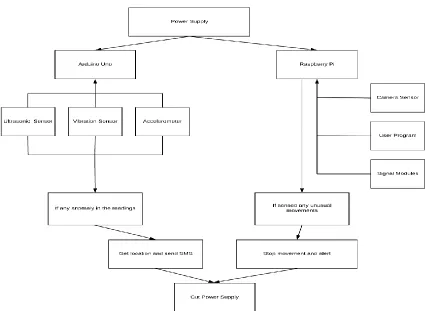
The module consists of different types of sensors, microcontroller, module for communication. All the main components are as shown as in figure 1.
A. Processing Unit
Arduino Uno is one of the microcontrollers used in the system. It is a type of microcontroller chip
which incorporates multiple ports, slots, input (power, signal). Consists of several Digital and Analog pins along with Ground and VCC pins.
Raspberry Pi is a series of single board computers. It supports Python and Scratch as the two main computing language. This module will be used in the computer vision part of the system.
B. Sensors
Ultrasonic Sensors are a type of measuring sensor that measures the distance of the object to the sensor. It consists of 4 pins namely; VCC, Trig, Echo, GND.
Vibration Sensor deals with the vibration of the module which in turn depicts the movement of the vehicle by means of the wave it generates. It consists of 3 pins: DO, VCC, GND.
Accelerometers are used in cars as the industry method way of detecting car crashes and deploying airbags almost instantaneously. It detects abnormal reading and does the needful like deploying airbags, slowing down the vehicle.
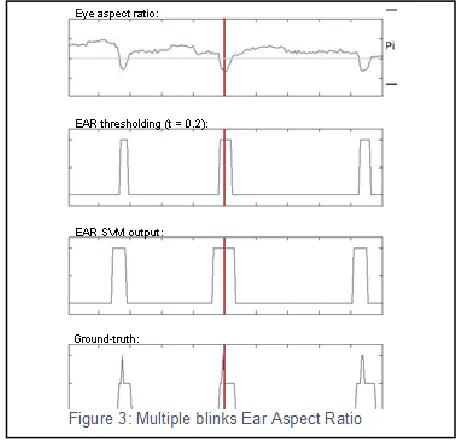
Eye Blinking Sensor is from the computer vision part of the system. It helps in detecting the eye movements
Figure 2: Eye Blink Sensor
B-Blink,N-Not Blink,Z-Zero level
of the driver and ensuring that the driver is attentive at all times.
C. Communication modules
GPS module gathers information regarding the location of the accident in either NMEA format or in terms of Latitude & Longitude.
GPRS module collects all the data like location and then sends it via SMS to the registered mobile user and Emergency centers.
3.
IMPLEMENTATION
A. Accident Prevention
In this, Raspberry Pi is the main microcontroller to be used. It is connected to an eye blinking sensor and gathers data in real-time. It helps in detecting driver’s drowsiness or whether they are distracted by let’s say their mobile phones. It then takes into account everything and if the threshold is not within acceptable parameters it alerts the driver by ringing loud beeps and displaying an alert message. If no activity is detected by the driver even after repeated alarms, then the vehicle comes to a complete stop. The image processing technique is used here by toolkits such as OpenCV (figure 2).
B. Accident Detection
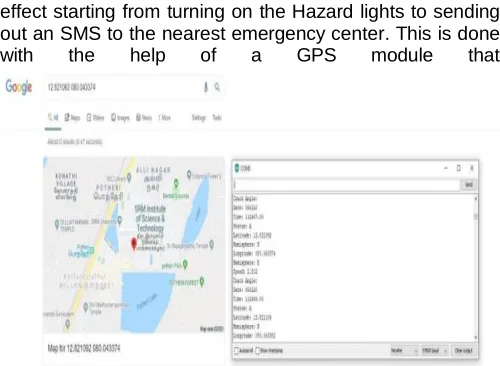
This section is taken care of by the Arduino. All the sensors are connected to it feeding it all the data (figure 3). Vibration sensors detect any unusual peak in the values and simultaneously the Accelerometer and the Ultrasonic sensor detect the change in speed and the distance of an object from the vehicle respectively. If all the sensors report abnormal values, the emergency procedures start to take into
Figure 3: IoT Interface with all the sensors connected
effect starting from turning on the Hazard lights to sending out an SMS to the nearest emergency center. This is done
with the help of a GPS module that
gathers the Longitude and Latitude and then the GPRS module kicks in by communicating the message to a family member and the nearest hospital.
V.CONCLUSION
Even though no vehicles are safe from any danger, a fraction of these can be avoided if the needful is done. There have been several excellent works of research on the subject of accident prevention and detection like tracking of vehicles or alerting the driver with the help of LED indicators and alarms, Alcohol detection and taking necessary actions if the alcohol level is high. Tracking the eye to make sure the driver is attentive. An extensive literature survey review about these papers will allow us to take a look at the current and upcoming technologies when it comes to saving lives of thousands of people by road accidents, helping us along the way to create a system that best performs effectively for customers at a large scale.
VI. REFERENCES
[1] Mr. Binod Kumar, Mr. Pintu Kumar, MR. Suman
Kumar, Mr. Suraj
R. Dhande, Prof. Suhas D. Kakde; ―Automatic Vehicle Accident Detection and Rescue System‖, vol 4, issue IV, April 2016.
[2] Sayeda Mudabbira urf Arifa Quadri and Shruti Jalapur, ―Automatic Vehicle Accident Detection and Rescue System‖, vol 6, issue VI, June 2019.
[3] Pranali More, Ulhas Patil, Prof. Avinash Ingole, ―A
Survey on Accident Detection, Tracking and Recovery of Vehicles‖, vol 4, issue X, October 2017.
[4] T. Kalyani, S. Monika, B. Naresh and Mahendra Vucha, ―Accident Detection and Alert System‖, vol 8, issue 4S2, March 2019.
[5] Nayan Kumar, Navya V. R., Ganashree N., Pranav K. U. and Ajay N., ―Intelligent Vehicle Accident Detection and Ambulance Rescue System‖, vol 5, issue III, March 2019.
[6] K. Saranya, P. Kowsalya, G. Nandhini and K. Pooja, ―Automatic Vehicle Accident Detection System‖, vol 5, issue III, March 2018.
[7] Fizzah Bhatti, Munam Ali Shah, Carsten Maple and Saif Ul Islam, ―A Novel Internet of Things-Enabled Accident Detection and Reporting System for Smart City Environments‖, pmid 31058879, May 2019.
[8] Amrutha Madhusan, Lavanya Vishwanathan,
Vaishnavi Ravindran, Dr. Shanta Rangaswamy, ―A Survey on Road Accident Detection and Reporting‖, vol 7, issue 4, April 2016.
[9] Venkata Krishna, Nagaendra Kumar et al, ―Automated
Accident Detection and Rescue System‖, inspec 17598754, February 2018.
2681 ―AccidentDetection and Prevention System to reduce
TrafficHazards using IR Sensors‖,inspec 18796516, July 2019.
[12] N. Shankar, B. Indurani, ―Smart Vehicle Monitoring with
Accident Detection and Prevention System‖, vol 8, issue 2S2, December 2018.
[13] Prof. Chethana Gosal, Akshay Chadaga, Anush Balraj T. M., ‖Intelligent Automatic Vehicle Accident Detection and Prevention System‖, vol 7, issue 7, July 2017.
[14] Mr. C. Balakrishnan, V. S. Rubika, M. Merlin, R. Priyanka, ―A
Proposed System for Vehicle Monitoring, Accident Detection and Prevention using IoT‖, vol 7, issue III, Mrch 2019.
[15] Priyanka Berade, Kranti Patil, Pradnya Tawate, Prof. Ghewari, ―Intelligent Accident Identification and Prevention System using GPS and GSM Modem‖, vol 5, issue 2, February 2018.
[16] Vijaykumar P., Ganesan V., Sharmila A., Madhu G., R. Rajashree, Xiao-Zhi Gao, ―IoT based Accident Management System‖, vol 7, issue 6, March 2019.
[17] Dr. J. L. Mazher Iqbal, S. Heena Kousar, ―Automatic Vehicle
Accident Detection and Reporting with BlackBox, vol 10, December 2015.
[18] Shankar Pawar, Ajay Barkade, Samruddhi Kulkarni, Er. Chandan Prasad, ―Review of Accident Reporting and Prevention System, vol 5, issue 3, March 2017.
[19] Nicky Kattukkaran, Mithundas Haridas, Arun George, ―Intelligent Accident Detection and Alert System for Emergency Medical Assistance‖, January 2017.
[20] Tereza Soukupova, Jan Cech, ―Real Time Eye Blink
Detection using Facial Landmarks‖, February 2016.