R E S E A R C H
Open Access
What is the effect of perioperative
intravenous iron therapy in patients
undergoing non-elective surgery? A
systematic review with meta-analysis and
trial sequential analysis
Akshay Shah
1*, Antony J. R. Palmer
2, Sheila A. Fisher
4, Shah M. Rahman
3, Susan Brunskill
4, Carolyn Doree
4,
Jack Reid
5, Anita Sugavanam
5and Simon J. Stanworth
1,3,4Abstract
Background:Guidelines to treat anaemia with intravenous (IV) iron have focused on elective surgical patients with little attention paid to those undergoing non-elective/emergency surgery. Whilst these patients may experience poor outcomes because of their presenting illness, observational data suggests that untreated anaemia may also be a contributing factor to poor outcomes. We conducted a systematic review to investigate the safety and efficacy of IV iron in patients undergoing non-elective surgery.
Methods:We followed a pre-defined review protocol and included randomised controlled trials (RCTs) in patients undergoing non-elective surgery who received IV iron. Primary outcomes were all-cause infection and mean difference in haemoglobin (Hb) at follow-up. Secondary outcomes included transfusion requirements, hospital length of stay (LOS), health-related quality of life (HRQoL), mortality and adverse events.
Results:Three RCTs (605 participants) were included in this systematic review of which two, in both hip fracture (HF) patients, provided data for meta-analysis. Both of these RCTs were at low risk of bias. We found no evidence of a difference in the risk of infection (RR 0.99, 95% CI 0.55 to 1.80,I2= 9%) or in the Hb concentration at‘short-term’ (≤7 days) follow-up (mean difference−0.32 g/L, 95% CI−3.28 to 2.64,I2= 37%). IV iron did not reduce the risk of requiring a blood transfusion (RR 0.90, 95% CI 0.73 to 1.11,p= 0.46,I2= 0%), and we observed no difference in mortality, LOS or adverse events. One RCT reported on HRQoL and found no difference between treatment arms. Conclusion:We found no conclusive evidence of an effect of IV iron on clinically important outcomes in patients undergoing non-elective surgery. Further adequately powered trials to evaluate its benefit in emergency surgical specialties with a high burden of anaemia are warranted.
Trial registration:This systematic review was registered on PROSPERO (CRD42018096288) Keywords:Anaemia, Iron, Surgery
* Correspondence:[email protected]
1Radcliffe Department of Medicine, John Radcliffe Hospital, University of
Oxford, Level 4 Academic Block, Oxford OX3 9DU, UK
Full list of author information is available at the end of the article
© The Author(s). 2018Open AccessThis article is distributed under the terms of the Creative Commons Attribution 4.0
International License (http://creativecommons.org/licenses/by/4.0/), which permits unrestricted use, distribution, and
Background
Perioperative anaemia is common in surgical patients and associated with adverse outcomes (Musallam et al. 2011; Baron et al. 2014). The principles of patient blood man-agement (PBM), which emphasise early diagnosis and treatment of anaemia, have been predominantly applied to patients undergoingelective surgery (‘Practice Guidelines for Perioperative Blood Management An Updated Report by the American Society of Anesthesiologists Task Force on Perioperative Blood Management*’ 2015; Kotze et al. 2015; Munoz et al.2018) with little attention paid to pa-tients undergoingnon-electiveor emergency surgery. Yet, patients undergoing non-elective surgery represent a sig-nificant burden for hospital surgical services, for example, approximately 30,000 patients undergo emergency lapar-otomy and 65,000 patients require hip fracture surgery in the UK each year with significant morbidity and mortality (Peacock et al.2018; Perry et al.2016).
Anaemia is likely to be common in patients undergo-ing non-elective surgery, as these patients are elderly with multiple comorbidities (Peden2011; Partridge et al. 2013). Given it is not possible to easily address anaemia preoperatively in these patients, management of anaemia after emergency surgery may translate into improved functional recovery and health-related quality of life (HRQoL). Observational data from the hip fracture population suggests that anaemia impedes functional re-covery and increases length of stay (LOS) and re-admission rates (Halm et al.2004; Foss et al.2008).
There is significant interest in understanding the opti-mal use of intravenous (IV) iron in patients undergoing elective surgery (Richards et al. 2015; Munoz et al. 2017), but again less attention has been devoted to the non-elective/emergency setting.
However, any benefits of IV iron on longer-term recov-ery and HRQoL have to be balanced against potential risks such as infection There remains an ongoing debate about the relationship between iron and infection risk as IV iron administration can increase levels of circulating free iron which can exacerbate pathogen growth and lead to organ dysfunction (Suffredini et al.2017; Parkkinen et al.2000). However, importantly, these issues of infection risk will be emphasised in patients undergoing emergency surgery where the background rate of infection can be as high as 40% (GlobalSurg2018).
We therefore conducted a systematic review to investi-gate the safety and efficacy of IV iron specifically in patients undergoing non-elective surgery. A better understanding of the existing evidence will help inform clinical practice and/ or the design of future clinical trials.
Methods
This systematic review was performed according to a pre-defined protocol registered on PROSPERO (CRD4
2018096288), and we followed the Preferred Reporting Items for Systematic Reviews and Meta-Analyses (PRISMA) (Moher et al.2009). Inclusion criteria were as follows:
(i) Randomised controlled trials (RCT)
(ii) Patients undergoingnon-electivesurgery, defined by the National Confidential Enquiry into Patient Outcome and Death (NCEPOD) as a decision to operate within days (expedited), hours (urgent) or minutes (immediate)
(iii) IV iron, given at any time in the perioperative period (i.e. pre-/intra-/postoperatively), versus comparator
Our search strategy is available in Additional file 1. Two review authors independently screened citations from the systematic search, extracted data, and assessed risk of bias using the Cochrane Collaboration tool (Higgins et al. 2011).
Predefined primary outcomes were as follows:
(i) All-cause infection
(ii) Mean difference in haemoglobin (Hb)
concentrations between treatment groups:‘ short-term’(≤7 days),‘medium-term’(8–21 days) and
‘long-term’(> 21 days)
Secondary outcomes were as follows:
(i) Transfusion requirements during study period (ii) Proportion of participants diagnosed with iron
deficiency perioperatively (iii) Hospital LOS
(iv) Changes in HRQoL
(v) Mortality:‘short-term’(≤30 days) and‘long-term’ (> 30 days)
(vi) In-hospital adverse events: anaphylaxis, medical and surgical complications as defined by study authors (e.g. stroke, myocardial infarction, pulmonary embolus, reoperation).
Meta-analysis was performed using a random effects model where enough data were available. For continuous measures, we used the mean difference (MD) with 95% confidence intervals (CI) between treatment arms at follow-up. Dichotomous outcomes were reported as relative risks (RR) with 95% CIs. Heterogeneity was assessed using the I2 statistic (Higgins et al. 2003). Where haematocrit was reported, values were approxi-mated to haemoglobin using a threefold conversion (Carneiro et al.2007).
statistical power to detect an effect of IV iron on RBC transfusion, which was a primary outcome for two of the included RCTs in hip fracture patients (Serrano-Trenas et al. 2011; Bernabeu-Wittel et al. 2016). We took into consideration the event rate in the control group (40%), a plausible/anticipated relative risk reduction of 20% from the intervention and the anticipated hetero-geneity variance (D2) of the meta-analysis (Wetterslev et al. 2017).
Statistical analyses were performed using Review Manager (RevMan, version 5.3) and TSA program version 0.9 beta (www.ctu.dk/tsa).
Results
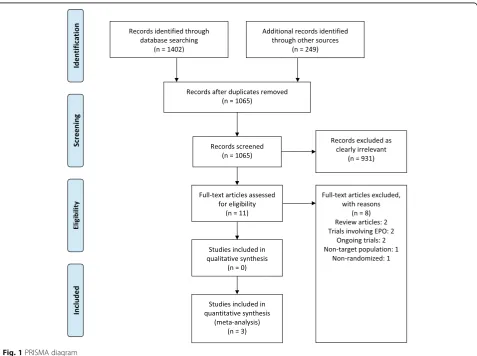
Our study selection process is outlined in the PRISMA dia-gram (Fig.1). Of 1065 reviewed studies, three RCTs met our inclusion criteria (Bernabeu-Wittel et al.2016; Mudge et al. 2012; Serrano-Trenas et al.2011) and included a total of 605 participants. Details of the included RCTs and interventions are shown in Table1. Two RCTs administered IV iron pre-operatively (Serrano-Trenas et al. 2011; Bernabeu-Wittel et al. 2016) and one administered IV iron postoperatively
(Mudge et al.2012). One trial involved three arms (IV iron + erythropoietin (EPO), IV iron and IV placebo), and we only included data from the IV iron and placebo arms for meta-analysis (Bernabeu-Wittel et al.2016).
Two trials were carried out in patients undergoing hip fracture (HF) surgery (Serrano-Trenas et al. 2011; Bernabeu-Wittel et al.2016) and one in patients under-going kidney transplantation (KT) (Mudge et al. 2012). This trial included a mixture of elective (live donor) and non-elective surgical (cadaveric transplant) pa-tients. We contacted the authors to obtain data relat-ing to cadaveric transplant patients but did not receive a response. Although 70% of participants in this study were undergoing cadaveric transplants, this was not felt to be a clear enough majority by the re-view team to be included in the meta-analysis. The study was included in risk of bias assessment but its outcome results are presented narratively.
The two RCTs in HF participants were generally at low risk of bias across all domains (Fig. 2). Details risk of bias assessments for each trial is provided in Additional file2.
Table 1 Characteristics of the included trials Study Serran o-Trenas et al. ( 2011 ) Mudge e t al. ( 2012 ) Bernabe u-Wittel et al. ( 2016 ) Patien t popu lation Age > 6 5 undergoing hip fra cture sur gery Adult s undergoing living-d onor or de ceased-donor kidne y transpl antation Age > 6 5 req uiring hip fracture sur gery with Hb levels betw een 90 and 12 0 g/L Count ry Sp ain Australia Spain No. of cen tres 1 1 13 No. of pat ients random ised 20 0 102 303 Interve ntion 60 0 mg of IV iron sucros e (Venofe r) in three dose s o f 2 0 0 mg at 48-h intervals -First dose alw ays administered before sur gery 500 mg of IV iron poly matose on the 4th post operative day 3 arm s • EPOFE — subcutan eous single dose of EPO 40,000 IU and 1000 mg of IV ferri c carboxy maltos e • FE — 1000 mg of IV ferri c carboxy maltos e and subcut aneou s place bo (sali ne) Comp arator Usu al car e 210 mg of or al slow rel ease ferrous sul fate daily unt il primary end point was reach ed Subcut aneous single dose pla cebo and IV pla cebo (saline) Primary outcom e(s) • Nu mber an d rate of pat ients transf used post operatively in each arm • Resolu tion of an aemia de fined as ha emogl obin conc entration more than or eq ual to 11 g/dL for both men an d wom en • Percent age of patie nts who rece ived an RB C trans fusion dur ing hospi talisati on and afte r 6 0 days from hospital disc harge Second ary outcom e(s) • Mean num be r of RB Cs per patie nt • Chan ges in haem atinic variables (admiss ion, 24 h an d 7 days po stoperatively) • Ho spital lengt h of stay • Inf ection • 30 -day mort ality • Si de-effect s • Gastrointes tinal symptom s • Infusion reactions • Acut e reject ion episodes • Infect ious episod es • Blood trans fusion • ESA administration • Numb er of RBC transf usion s per patie nt • Hb le vels 24 and 72 h afte r sur gery, at disc harge, an d afte r 60 day s • All-cause mort ality • Adverse event s •
HRQoL •Medical
Primary outcomes
All three trials reported on infection but none provided a diagnostic definition. Meta-analysis of the two RCTs involving HF patients (Serrano-Trenas et al. 2011; Bernabeu-Wittel et al. 2016) showed no evidence of a difference in the risk of infection in participants who re-ceived IV iron compared to those who did not (RR 0.99, 95% CI 0.55 to 1.80, p= 0.30, I2= 9%) (Fig. 3). The
authors of the RCT involving KT patients reported no difference in infection rates in patients who received IV iron compared to oral iron (10 vs. 12,p= 0.62) (Mudge et al.2012).
Meta-analysis of the two RCTs involving HF patients (Serrano-Trenas et al.2011; Bernabeu-Wittel et al.2016) showed no evidence of a difference in Hb concentration at ‘short-term’ follow-up (MD−0.32 g/L, 95% CI−3.28 to 2.64, p= 0.21, I2= 37%) (Fig. 3). We were unable to pool the results at our other pre-defined time-points due to variability of reporting in the included trials. One trial observed no difference in mean (± SD) Hb at 60 days post hospital discharge in patients who received IV iron compared to placebo (126.5 (± 15) g/L vs. 119 (± 11.3) g/ L, p> 0.05) (Bernabeu-Wittel et al. 2016). In RCT in-volving KT patients, the authors reported no‘statistically significant difference’ in the median times to resolution of anaemia comparing IV with oral iron (12 days vs. 21 days, hazard ratio 1.22; 95% CI 0.82 to 1.83, p= 0.32) (Mudge et al.2012).
Secondary outcomes
All three trials reported on the number of participants who required an RBC transfusion. Meta-analysis of two trials involving HF patients (Serrano-Trenas et al. 2011; Bernabeu-Wittel et al. 2016) showed no evidence of an effect of IV iron on the requirement for RBC transfusion (RR 0.90; 95% CI 0.73 to 1.11,p= 0.46,I2= 0%) (Fig.4). TSA showed that the required information size to detect or reject an effect of IV iron on requirement for RBC transfusion in patients undergoing HF surgery was 1131 patients, and only 403 were included in this review (Fig. 5). There was also no evidence of a difference in the mean number of RBCs transfused per patients (MD −0.07, 95% CI−0.31 to 0.17,p= 0.72,I2= 0). In the trial
a
b
Fig. 3Forest plots of the effect of intravenous iron on primary outcomes. Hb = haemoglobin, CI = confidence interval, M-H = Mantel-Haenszel,
IV = inverse-variance.aRequirement for RBC transfusion.bMean number of RBCs transfused.cShort-term mortality (≤30 days)
Fig. 2Risk of bias summary for all included trials.aInfection.b
Fig. 5Trial sequential analysis (TSA) of all trials of the effect of IV iron on the risk of requiring a blood transfusion. Control event proportion of 40%, diversity (D2) of 9%, alpha of 5%, power of 80% and relative risk decrease (RRR) of 20%. The accrued sample size (403) has not reached the required information size (1131)
a
b
c
Fig. 4Forest plots of the effect of intravenous iron on secondary outcomes. RBC = red blood cell, Hb = haemoglobin, CI = confidence interval,
involving KT patients, the authors reported no significant difference in the number of patients requiring an RBC transfusion between those who received IV iron compared to oral iron (5 vs. 9,p= 0.24) (Mudge et al.2012).
The two trials in the HF population reported on hospital LOS (Serrano-Trenas et al. 2011; Bernabeu-Wittel et al. 2016). Meta-analysis was not performed as one trial reported mean (± SD) and another median (interquartile range (IQR)). Both trials reported no difference in LOS in partici-pants receiving IV iron compared to placebo−7 (IQR, 5 to 10) vs. 8 (IQR, 6 to 10) days (p> 0.05) (14), 12.9 (± 6.9) vs. 13.5 (± 7.1) days (p> 0.05) (16). Only one trial, in patients undergoing HF surgery, measured HRQoL using the Short Form 36 version 2 and found no significant differences among patients receiving IV iron or placebo in physical and mental component scores at 60 days post-discharge (Bernabeu-Wittel et al. 2016). Meta-analysis showed no evidence of an effect of IV iron on‘short-term’mortality in patients undergoing HF surgery (RR 1.06; 95% CI 0.53 to 2.13, p= 0.88, I2= 0%) (Serrano-Trenas et al. 2011; Bernabeu-Wittel et al.2016) (Fig.4). One trial provided mor-tality data at 60 days after hospital discharge, and there no was no difference in the number of HF patients not surviving between the IV iron and placebo groups (12 vs. 10,p> 0.05) (Bernabeu-Wittel et al.2016). All three RCTs reported ad-verse events (Additional file3). There were no reported cases of anaphylaxis. Two trials reported gastrointestinal adverse effects with no significant differences between IV iron and placebo or oral iron groups (Serrano-Trenas et al. 2011; Mudge et al.2012). One trial reported on a range of medical complications between participants receiving IV iron compared to placebo and reported no significant differences (Serrano-Trenas et al.2011).
We were unable to perform any subgroup analyses due to the lack of available data.
Discussion
We found no evidence of an effect of IV iron on in-fection, haemoglobin or transfusion requirements in patients undergoing non-elective surgery. However, the available evidence included only three RCTs that met our inclusion criteria, all with small sample sizes, and the CIs for all outcomes were wide. These limits could encompass clinically important differences. The external generalisability of these RCTs is limited as only two surgical subspecialties were represented (hip fracture, kidney transplantation). Across the included RCTs, there was variability in the dosing and formula-tions of IV iron used, timing of outcome measure-ments and availability of data for our pre-specified outcomes.
Our findings are consistent with a recent systematic review assessing the efficacy of postoperative iron in patients undergoing elective surgery (Perelman et al.
2018). The authors identified a larger number of rele-vant studies but also found no evidence of an effect of iron on transfusion requirements or adverse events (including infection). They did however observe an improvement in Hb in participants who received IV iron but the clinical significance of this was uncertain. Our TSA findings suggest larger RCTs may be war-ranted to detect an effect of IV iron on transfusion requirements.
Strengths of our review include the strict methodo-logical process, which followed Cochrane Collaboration and PRISMA recommendations. Limitations of our re-view should be recognised, largely based on the primary trial evidence. Infection was not a pre-defined endpoint in any of the included RCTs, and there were no stan-dardised definitions of infection used. Although we did not observe any differences in mean Hb concentrations between treatment arms, the included RCTs did not specifically target participants diagnosed with iron deficiency.
Interestingly, sustained improvements in Hb up to 60 days after hospital discharge were seen in partici-pants who received EPO and IV iron in one trial (Bernabeu-Wittel et al. 2016), which could be ex-plained by the synergistic effects of exogenous EPO and IV iron. Postoperative inflammation can lead to upreg-ulation of hepcidin—which leads to iron‘trapping’, blunted erythroid response and decreased EPO production (Ganz 2013; Girelli et al.2016). Exogenous EPO provides a direct stimulus for erythroid production and reduces hepcidin levels. By reducing hepcidin with EPO and providing sup-plemental iron, it may be possible to reverse hepcidin-me-diated iron dysregulation and thereby provide iron for haemoglobin synthesis (Khorramian et al.2017). This war-rants further investigation especially as inflammation is likely to be present in this cohort of patients.
Conclusion
Additional files
Additional file 1:Search strategy. (DOCX 29 kb)
Additional file 2:Supplemental Digital Content 2: Details of risk of bias assessments. (DOCX 129 kb)
Additional file 3:Supplemental Digitial Content 3: Adverse events reported in the included RCTs. (DOCX 77 kb)
Abbreviations
CI:Confidence interval; EPO: Erythropoietin; Hb: Haemoglobin; HF: Hip fracture; HRQoL: Health-related quality of life; IV: Intravenous; KT: Kidney transplant; LOS: Length of stay; NCEPOD: National Confidential Enquiry in Patient Outcomes and Death; PBM: Patient blood management; PRISMA: Preferred Reporting Items for Systematic Reviews and Meta-Analyses; RCT: Randomised controlled trial; RR: Relative risk; TSA: Trial sequential analysis
Acknowledgements Not applicable
Funding
No external funding was required for this work.
Availability of data and materials
All data generated or analysed during this study are included in this published article and its supplementary information files.
Authors’contributions
AS (Shah), AS (Sugavanam) and SJS conceived the idea. CD performed the search. AS (Shah) and SMR carried out the study screening and selection. AS (Shah) and AJRP performed the data extraction, analysis and interpretation with support from SAF and SB. AS (Shah) drafted the manuscript, and all the authors have revised it critically and have approved the final version of the manuscript.
Ethics approval and consent to participate
Ethical approval was not sought as we extracted data from already published work.
Consent for publication Not applicable
Competing interests
This report is an independent research supported by the National Institute for Health Research (NIHR Doctoral Research Fellowship, Dr. Akshay Shah, DRF-2017-10-094). The views expressed in this publication are those of the authors and not necessarily those of the NHS, the National Institute for Health Research of the Department of Health. No other conflicts of interest are declared by the remaining authors.
Publisher’s Note
Springer Nature remains neutral with regard to jurisdictional claims in published maps and institutional affiliations.
Author details
1Radcliffe Department of Medicine, John Radcliffe Hospital, University of
Oxford, Level 4 Academic Block, Oxford OX3 9DU, UK.2Nuffield Department of Orthopaedics, Rheumatology, and Musculoskeletal Sciences, University of Oxford, Oxford, UK.3Frimley Health NHS Foundation Trust, Camberley, Surrey GU16 7UJ, UK.4Systematic Review Initiative, NHS Blood & Transplant, Oxford,
UK.5Brighton and Sussex University Hospitals NHS Trust, Brighton, UK.
Received: 14 September 2018 Accepted: 13 November 2018
References
Baron DM, Hochrieser H, Posch M, Metnitz B, Rhodes A, Moreno RP, Pearse RM, Metnitz P, Medicine European Surgical Outcomes Study group for Trials Groups of European Society of Intensive Care, and Anaesthesiology
European Society of. Preoperative anaemia is associated with poor clinical outcome in non-cardiac surgery patients. Br J Anaesth. 2014;113:416–23. Bernabeu-Wittel M, Romero M, Ollero-Baturone M, Aparicio R, Murcia-Zaragoza J,
Rincon-Gomez M, Monte-Secades R, Melero-Bascones M, Rosso CM, Ruiz-Cantero A, Pahfrac- Investigators. Ferric carboxymaltose with or without erythropoietin in anemic patients with hip fracture: a randomized clinical trial. Transfusion. 2016;56:2199–211.
Carneiro IA, Drakeley CJ, Owusu-Agyei S, Mmbando B, Chandramohan D. Haemoglobin and haematocrit: is the threefold conversion valid for assessing anaemia in malaria-endemic settings? Malar J. 2007;6:67.
Foss NB, Kristensen MT, Kehlet H. Anaemia impedes functional mobility after hip fracture surgery. Age Ageing. 2008;37:173–8.
Ganz T. Systemic iron homeostasis. Physiol Rev. 2013;93:1721–41.
Girelli D, Nemeth E, Swinkels DW. Hepcidin in the diagnosis of iron disorders. Blood. 2016;127:2809–13.
GlobalSurg, Collaborative. Surgical site infection after gastrointestinal surgery in high-income, middle-income, and low-income countries: a
prospective, international, multicentre cohort study. Lancet Infect Dis. 2018;18:516–25.
Halm EA, Wang JJ, Boockvar K, Penrod J, Silberzweig SB, Magaziner J, Koval KJ, Siu AL. The effect of perioperative anemia on clinical and functional outcomes in patients with hip fracture. J Orthop Trauma. 2004;18:369–74. Higgins JP, Altman DG, Gotzsche PC, Juni P, Moher D, Oxman AD, Savovic J,
Schulz KF, Weeks L, Sterne JA, Group Cochrane Bias Methods, and Group Cochrane Statistical Methods. The Cochrane Collaboration’s tool for assessing risk of bias in randomised trials. BMJ. 2011;343:d5928.
Higgins JP, Thompson SG, Deeks JJ, Altman DG. Measuring inconsistency in meta-analyses. BMJ. 2003;327:557–60.
Khorramian E, Fung E, Chua K, Gabayan V, Ganz T, Nemeth E, Kim A. In a mouse model of sepsis, hepcidin ablation ameliorates anemia more effectively than iron and erythropoietin treatment. Shock. 2017;48:490–7.
Kotze A, Harris A, Baker C, Iqbal T, Lavies N, Richards T, Ryan K, Taylor C, Thomas D. British Committee for Standards in Haematology Guidelines on the identification and management of pre-operative anaemia. Br J Haematol. 2015;171:322–31.
Moher D, Liberati A, Tetzlaff J, Altman DG, Prisma Group. Preferred reporting items for systematic reviews and meta-analyses: the PRISMA statement. J Clin Epidemiol. 2009;62:1006–12.
Mudge DW, Tan KS, Miles R, Johnson DW, Badve SV, Campbell SB, Isbel NM, van Eps CL, Hawley CM. A randomized controlled trial of intravenous or oral iron for posttransplant anemia in kidney transplantation. Transplantation. 2012;93: 822–6.
Munoz M, Acheson AG, Auerbach M, Besser M, Habler O, Kehlet H, Liumbruno GM, Lasocki S, Meybohm P, Rao Baikady R, Richards T, Shander A, So-Osman C, Spahn DR, Klein AA. International consensus statement on the peri-operative management of anaemia and iron deficiency. Anaesthesia. 2017;72: 233–47.
Munoz M, Acheson AG, Bisbe E, Butcher A, Gomez-Ramirez S, Khalafallah AA, Kehlet H, Kietaibl S, Liumbruno GM, Meybohm P, Rao Baikady R, Shander A, So-Osman C, Spahn DR, Klein AA. An international consensus statement on the management of postoperative anaemia after major surgical procedures. Anaesthesia. 2018;73(11):1418–31.
Musallam KM, Tamim HM, Richards T, Spahn DR, Rosendaal FR, Habbal A, Khreiss M, Dahdaleh FS, Khavandi K, Sfeir PM, Soweid A, Hoballah JJ, Taher AT, Jamali FR. Preoperative anaemia and postoperative outcomes in non-cardiac surgery: a retrospective cohort study. Lancet. 2011;378:1396–407.
Parkkinen J, von Bonsdorff L, Peltonen S, Gronhagen-Riska C, Rosenlof K. Catalytically active iron and bacterial growth in serum of haemodialysis patients after i.v. iron-saccharate administration. Nephrol Dial Transplant. 2000;15:1827–34.
Partridge J, Harari D, Gossage J, Dhesi J. Anaemia in the older surgical patient: a review of prevalence, causes, implications and management. J R Soc Med. 2013;106:269–77.
Peacock O, Bassett MG, Kuryba A, Walker K, Davies E, Anderson I, Vohra RS, Team National Emergency Laparotomy Audit Project. Thirty-day mortality in patients undergoing laparotomy for small bowel obstruction. Br J Surg. 2018; 105:1006–13.
Peden CJ. Emergency surgery in the elderly patient: a quality improvement approach. Anaesthesia. 2011;66:440–5.
outcomes following surgery: a systematic review and meta-analysis. Transfus Med Rev. 2018;32:89–101.
Perry DC, Metcalfe D, Griffin XL, Costa ML. Inequalities in use of total hip arthroplasty for hip fracture: population based study. BMJ. 2016;353:i2021. Richards T, Clevenger B, Keidan J, Collier T, Klein AA, Anker SD, Kelly JD.
PREVENTT: preoperative intravenous iron to treat anaemia in major surgery: study protocol for a randomised controlled trial. Trials. 2015;16:254. Serrano-Trenas JA, Ugalde PF, Cabello LM, Chofles LC, Lazaro PS, Benitez PC. Role
of perioperative intravenous iron therapy in elderly hip fracture patients: a single-center randomized controlled trial. Transfusion. 2011;51:97–104. Suffredini DA, Xu WY, Sun JF, Barea-Mendoza J, Solomon SB, Brashears SL,
Perlegas A, Kim-Shapiro DB, Klein HG, Natanson C, Cortes-Puch I. Parenteral irons versus transfused red blood cells for treatment of anemia during canine experimental bacterial pneumonia. Transfusion. 2017;57:2338–47. Wetterslev J, Jakobsen JC, Gluud C. Trial sequential analysis in systematic reviews