Open Access
Research
Evaluating indices of traditional ecological knowledge: a
methodological contribution
Victoria Reyes-García*
1, Vincent Vadez
2, Susan Tanner
3, Thomas McDade
3,
Tomás Huanca
2and William R Leonard
3Address: 1ICREA and ICTA, Universitat Autònoma de Barcelona, 08193 Bellaterra, Barcelona, Spain and Sustainable International Development Program, Brandeis University, Waltham, MA 02454, USA, 2Sustainable International Development Program, Heller School for Social Policy and Management, Brandeis University, Waltham, MA 02454, USA and 3Department of Anthropology, Northwestern University, Evanston, IL 60208, USA
Email: Victoria Reyes-García* - [email protected]; Vincent Vadez - [email protected]; Susan Tanner - [email protected]; Thomas McDade - [email protected]; Tomás Huanca - [email protected]; William R Leonard - [email protected] * Corresponding author
Abstract
Background: New quantitative methods to collect and analyze data have produced novel findings in ethnobiology. A common application of quantitative methods in ethnobiology is to assess the traditional ecological knowledge of individuals. Few studies have addressed reliability of indices of traditional ecological knowledge constructed with different quantitative methods.
Methods: We assessed the associations among eight indices of traditional ecological knowledge from data collected from 650 native Amazonians. We computed Spearman correlations, Chronbach's alpha, and principal components factor analysis for the eight indices.
Results: We found that indices derived from different raw data were weakly correlated (rho<0.5), whereas indices derived from the same raw data were highly correlated (rho>0.5; p < 0.001). We also found a relatively high internal consistency across data from the eight indices (Chronbach's alpha = 0.78). Last, results from a principal components factor analysis of the eight indices suggest that the eight indices were positively related, although the association was low when considering only the first factor.
Conclusion: A possible explanation for the relatively low correlation between indices derived from different raw data, but relatively high internal consistency of the eight indices is that the methods capture different aspects of an individual's traditional ecological knowledge. To develop a reliable measure of traditional ecological knowledge, researchers should collect raw data using a variety of methods and then generate an aggregated measure that contains data from the various components of traditional ecological knowledge. Failure to do this will hinder cross-cultural comparisons.
Background
Methodological contributions are essential in any branch
of science and many researchers have shown concern with a perceived lack of methodological advances in
contem-Published: 25 April 2006
Journal of Ethnobiology and Ethnomedicine2006, 2:21 doi:10.1186/1746-4269-2-21
Received: 15 February 2006 Accepted: 25 April 2006
This article is available from: http://www.ethnobiomed.com/content/2/1/21 © 2006Reyes-García et al; licensee BioMed Central Ltd.
porary ethnobiology [1]. Ethnobiology has often been criticized for focussing on list making and lacking meth-odological rigor. Before the mid-1950s, research in ethno-biology was primarily descriptive, but by the mid 1980s, researchers had already incorporated a variety of quantita-tive methods of data collection and data analysis. At present, quantitative methods in ethnobiology -shared with other biological, social, and linguistic sciences- are proliferating [2,3].
Although the use of quantitative methods is becoming common in ethnobiology, we still lack studies assessing the reliability of data collected with different methods. For example, researchers have applied quantitative meth-ods to assess the traditional ecological knowledge of indi-viduals and groups, but the methods used to collect and to transform the data vary across studies. Thus, to collect raw data on the traditional ecological knowledge of indi-viduals, researchers have used open-ended interviews [4], structured questionnaires [5], specimen identification [6], and direct observations of participant's behavior [7]. Once researchers collect the raw information, they also use dif-ferent methods to construct indices or summary measures of traditional ecological knowledge. Common methods to construct such indices include cultural consensus [8], matching of responses with ecological data [9], and diver-sity indices [10]. What we lack now are studies that assess the reliability of the different indices that presumably proxy for the same phenomena or the traditional ecologi-cal knowledge of a person.
Assessing the correspondence of data collected and trans-formed with different methods should contribute to eth-nobiological studies, and particularly to studies of traditional ecological knowledge, in two ways. First, assessing the correspondence of data collected and trans-formed with different methods will enhance cross-cul-tural comparisons. For example, quantitative studies about the determinants of the loss of traditional ecologi-cal knowledge show conflicting results across sites. Some studies suggest that socio-economic changes do not decrease traditional ecological knowledge [6], others sug-gest that only certain socioeconomic changes decrease tra-ditional ecological knowledge [11,12], and still others suggest that integration into the market economy through activities based on the natural environment could acceler-ate the acquisition of ecological knowledge [13]. Diver-gent conclusions might reflect the use of different methods because different methods might have captured dimensions of traditional ecological knowledge that do not necessarily overlap [14]. Cross-cultural comparisons about the acquisition, transmission, and loss of tradi-tional ecological knowledge will be enhanced when researchers use methods with acceptable reliability.
The second reason why assessing the correspondence of data collected and transformed with different methods might enhance ethnobiological research is that such stud-ies might help identify methods apt to measure various aspects of traditional ecological knowledge. Researchers have presented many definitions of traditional ecological knowledge. A universal, measurable definition is not likely because traditional ecological knowledge comprises many fields (i.e., plants, soils) and many dimensions (i.e., theory, practice, beliefs). Specific methods appropriate to capture information in one field or dimension might not be appropriate for another field or dimension. For exam-ple, observing people's use of plants might shows us their ability to apply traditional knowledge, but it says little about the individual's theoretical knowledge of the same plants. By studying the correspondence of data collected and analyzed with different methods, we might be able to identify the kind of knowledge captured by each method.
The goal of this paper is to assess the correspondence between eight indices of traditional ecological knowledge. We used four different methods to collect raw data from 650 Tsimane' Amazonians in Bolivia, and from that data we constructed eight indices. The study forms part of a long-term research to measure the effect of markets on the quality of life of indigenous peoples [15].
The information used in this paper is unique in at least three ways. First, the data were collected by a multidisci-plinary team of anthropologists, biologists, and agrono-mists who lived in the study area during 18 consecutive months (May 2002-November 2003). This contrasts with studies of traditional ecological knowledge that have been done by authors from a single discipline or over short periods of time. Long periods of research and multidisci-plinary teams, should enhance the quality of the data col-lected. Second, the sample size (n = 650) was more than five times larger than the average sample size of the typical study measuring individual traditional ecological knowl-edge [16]. A larger sample size, though only from one cul-ture, should enhance the confidence we can attach to the results of the comparison of methods.
that focus on either theoretical knowledge or practical skills.
Methods
The peopleWe conducted research among the Tsimane', a native Amazonian population of about 8,000 people living in about 100 villages in the department of Beni, Bolivia. Recent publications [3,17-19] provide ethnographic information on the Tsimane', including descriptions of their traditional ecological knowledge [20-23]. The Tsi-mane' provide an apt case to study the measure of tradi-tional ecological knowledge of plants because they display a level of ethnobotanical knowledge comparable to other groups in the region [24,25], and because they share the knowledge [26].
Sample size
We collected information from all the adults (>16 years of age) from 13 villages along the Maniqui River. To select the 13 villages for the study, we used village distance from the town of San Borja, the regional commercial center (population ~19,000). We interviewed all people over the age of 16 because, at this age Tsimane' adolescents start forming their own households and enter adulthood. A total of 650 adults from 13 Tsimane' villages participated in the study, but only 375 (or 48% of the 650) provided information for all the methods of data collection. Although we obtained complete data only for about half
of the sample, the results are representative of the villages surveyed. We refer to the sample with raw data for all the methods as "permanent sample", to differentiate it form the "non-permanent sample", or people who did not pro-vided raw information for one or more methods. Because the goal of the article is to compare results across meth-ods, we mostly use data from the permanent sample for the analysis. We use the additional information provided by the non-permanent sample to test whether the results hold across samples. The permanent sample was almost evenly split between women (n = 201, or 53.6%) and men (n = 174). The average age of the person in the permanent sample was 35.4 years of age (sd = 15.1).
Methods to collect raw data
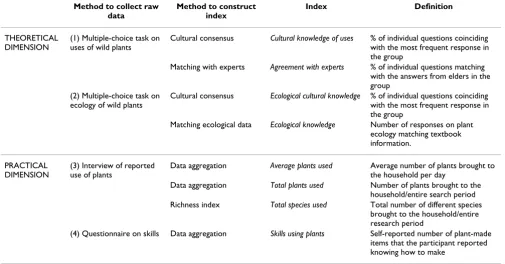
For each participant, we collected four sets of raw data. For three of the four sets of raw data, we collected information over three months, and for the last method we conducted weekly interviews on the uses of plants over a year (Octo-ber 2002-Octo(Octo-ber 2003). We have given detailed explana-tions of most of the methods presented here in previous publications [8,23,26,27], so here we summarize those methods. Table 1 contains a summary of the construction of the eight indices, indicating the method used to collect the raw data and the method used to transform the raw data.
Multiple-choice. We constructed two different multiple-choice tasks to measure knowledge of local plants. We Table 1: Definition of methods to collect raw data and construct indices
Method to collect raw data
Method to construct index
Index Definition
THEORETICAL DIMENSION
(1) Multiple-choice task on uses of wild plants
Cultural consensus Cultural knowledge of uses % of individual questions coinciding with the most frequent response in the group
Matching with experts Agreement with experts % of individual questions matching with the answers from elders in the group
(2) Multiple-choice task on ecology of wild plants
Cultural consensus Ecological cultural knowledge % of individual questions coinciding with the most frequent response in the group
Matching ecological data Ecological knowledge Number of responses on plant ecology matching textbook information.
PRACTICAL DIMENSION
(3) Interview of reported use of plants
Data aggregation Average plants used Average number of plants brought to the household per day
Data aggregation Total plants used Number of plants brought to the household/entire search period Richness index Total species used Total number of different species
brought to the household/entire research period
selected multiple-choice tasks to measure theoretical knowledge because multiple-choice tasks are the most common method used to measure traditional ecological knowledge [16]. Additionally, when working with indige-nous populations, multiple-choice tasks are more reliable than other types of structured questionnaires, such as paired comparisons and triads [27].
To construct the first task, we randomly selected 21 plants from a list of Tsimane' useful plants [8]. The task consisted of asking participants whether the 21 plants selected could be used for construction, firewood, food, medicine, or other ends. For each plant, participants could choose none, one, or more potential uses. We collected the infor-mation in the form of a matrix with the names of the plants on the X-axis, and the possible uses on the Y-axis. We coded affirmative answers as one and negative answers as zero.
The second multiple-choice task had to do with the ecol-ogy of plants. We asked about biological characteristics of ten plants randomly chosen from the list of the wild plants mentioned before, and presented the participants with three possible answers from which they could chose only one. For example, we asked: "Which is the color of the mahogany flower? a) red, b) green, or c) white". If par-ticipants were not sure about the answer we asked them to provide their best guess. Questions related to the habitat where the plant is found, phenotypic traits (e.g., color of the flower), and the ecology of the plants (i.e., flowering and ripping times).
Interviews about the uses of plants. To capture the practi-cal dimension of traditional ecologipracti-cal knowledge, we used interviews to measure daily uses of plants. Every week, on a day chosen at random, we visited all house-holds during a three-hour block falling from 7am until 7pm; we also chose the blocks of time at random. During those visits, we asked each adult present in the household to name all of the wild plants the person had brought to the household during the previous 24 hours. We only included adults present in the household at the time of the interview. Absent adults were coded as missing.
Questionnaire on skills. To collect information on partic-ipant's practical abilities we used a questionnaire on self-reported skills about crafting objects from wild plants. We asked participants whether they had ever made on their own 18 objects from a list of 15 different plants [12]. Three key informants helped to create the list of objects. The list included nine objects that are more commonly made by men and nine that are more commonly made by women. Each list also included six items that key inform-ants considered easy to make, six items they considered of
medium difficulty, and six items they considered difficult to make.
Indices of traditional ecological knowledge
We transformed data collected with the above methods to obtain eight indices of individual traditional ecological knowledge.
Cultural knowledge of uses
We analyzed data from the multiple-choice task on uses of plants with the cultural consensus method [28]. To calcu-late the index of cultural knowledge of plant uses, for each individual we computed the proportion of individual questions coinciding with the most frequent response in the group.
Agreement with experts
With data from the multiple-choice task on uses of plants we also generated an index measuring the degree of indi-vidual agreement with the experts of the group. To do so, we first generated an "answer key" to the multiple-choice task using answers from individuals over 55 years of age. We considered elders as experts because studies suggest that traditional ecological knowledge bears a positive association with age [4,29,30]. We then compared the participants' responses to the experts' answers.
Ecological cultural knowledge
We also used the cultural consensus method to analyze data on plant ecology from the multiple-choice task. We called the proportion of individual questions coinciding with the most frequent response of the group ecological cultural knowledge.
Ecological knowledge
We used data from the multiple-choice task on plant ecol-ogy to generate an index of ecological knowledge. For each participant, we added the number of times a response matched ecological data from the area. For example, Kil-leen [31] reports that the color of the mahogany flower is white, so we consider white the correct response to the question "What is the color of the mahogany flower?" Ecological information from the area was obtained from Hinojosa [32,33] and Killeen and colleagues [31].
Average plants used
Total plants used
We also used data from interviews on uses of plants to generate an index measuring the total number of plants used by a person over the research period [10]. To con-struct such an index, we added all the plants the person reported bringing into the household during the research period, independent of the number of interviews done to the person.
Total species used
This index captures the richness or diversity of species used by a person over the research period [14]. To con-struct the index, we counted the total number of different species brought home by a participant during the dura-tion of the study, independent of the number of inter-views in which the person participated.
Skills using plants
We used responses to the questionnaire on skills to con-struct another index of the practical dimension of tradi-tional ecological knowledge. To calculate the index, we summed the number of goods each person reported knowing how to make from the skill questionnaire.
Data analysis
We test for the normality of the sample using the skewness and kurtosis tests of normality. Since our data were not normally distributed, we used non-parametric statistics. We first compare results across the permanent and non-permanent samples using Mann-Whitney two-sample tests. We then computed the Spearman rank correlation coefficients (rho) between the eight different indices. To test the internal consistency of the eight indices, we com-puted the Chronbach's alpha and the principal compo-nents factors for the eight indices. The Chronbach's alpha computes the average inter-correlation between all the items in a scale. Since our indices had different units,
before computing the Chronbach's alpha we standardized all the indices (mean = 0 and standard deviation = 1).
Results
Table 2 shows the descriptive statistics for the eight indi-ces. Results from a Mann-Whitney test show that there was no statistically significant difference between three out of the four indices of theoretical traditional ecological knowledge between participants who provided answers for all the methods and participants who did not provided answers for one or more methods. We also found that the indices of practical traditional ecological knowledge and the index that measures agreement with experts were sig-nificantly higher for the permanent sample than for the non-permanent sample.
Table 3 shows the results of Spearman correlations among the eight indices. We found high and positive correlation coefficients between variables derived from the same raw data. For example, the correlation coefficient between the indices of cultural knowledge of uses and agreement with experts was 0.85 (p < 0.001) and the correlation coefficient between ecological cultural knowledge and ecological knowl-edge was 0.55 (p < 0.001).
We found low correlation coefficients between indices derived from raw data collected with different methods. For example, the index of ecological knowledge correlated in a significant and positive way with the indices of cultural knowledge of uses and agreement with experts, but the corre-lation coefficients were low (rho<0.35). The correcorre-lation of
ecological cultural knowledge with the indices from raw data from the first multiple-choice task was even lower (rho<0.15 for agreement with expert) or non existent (with
cultural knowledge of uses). We found similar results when comparing measures of practical skill. The three indices derived from interviews on daily uses of plants correlated in a statistically significant and positive way with one Table 2: Comparison of indices of traditional ecological knowledge between two samples (permanent and non-permanent).
Permanent Sample (n = 375) Non-permanent Sample Mann-Whitney two-sample Index Mean Std Median Variance Obs Mean Std Median Variance Prob>| z|
(1) Cultural knowledge of uses 0.58 0.20 0.56 0.04 155 0.55 0.19 0.57 0.03 0.23 (1) Agreement with experts 13.61 3.08 14 9.47 155 12.66 3.37 13.2 11.3 0.005 (2) Ecological cultural knowledge 0.55 0.18 0.57 0.03 110 0.55 0.18 0.56 0.03 0.96 (2) Ecological knowledge 5.48 1.49 6 2.21 110 5.53 1.64 5 2.69 0.95 (3) Average plants used 0.14 0.15 0.09 0.02 275 0.08 0.13 0 0.01 <0.0001 (3) Total plants used 2.58 3.66 1 13.4 275 0.90 1.75 0 3.05 <0.0001 (3) Total species used 0.87 1.06 1 1.13 275 0.49 0.81 0 0.65 <0.0001 (4) Skills using plants 8.11 3.02 8 9.1 160 7.47 3.47 8 12.06 0.03
another (rho>0.55; p < 0.001). The correlation coeffi-cients of those indices with the index of skills using plants
were below 0.25 (p < 0.001).
Last, we found that the indices of theoretical knowledge also correlated with the indices of practical skills, but all the correlation coefficients were low (rho<0.50). The index of theoretical knowledge that showed the lowest correlation coefficient with the indices of practical skills was ecological cultural knowledge (rho<0.15). The index of practical skills that showed the lowest correlation with the indices of theoretical knowledge was skills using plants
(rho<0.22).
To test the robustness of the associations, we ran the same correlations but using the total sample, i.e. including the permanent and the non-permanent samples (not shown). We found similar coefficients and levels of statistical sig-nificance for all the indices.
To test the internal consistency of the eight indices, we cal-culated the Chronbach's alpha of the different indices. We found that the Chronbach's alpha for the four indices of theoretical knowledge and practical skills were 0.69 and 0.72. We then computed the Chronback's alpha for the eight indices together and found that the eight items were positively related. The Chronbach's alpha of the eight indices was 0.78, higher than the Chronbach's alpha coef-ficients of indices of theoretical knowledge and indices of practical skills.
As a last test of reliability, we ran a principal components factor analysis of the eight indices (Table 4). As in previ-ous tests, we found that the eight indices were positively related, although the association was low when consider-ing only the first factor. The first factor of the principal component analysis had an eigenvalue of 3.38, and explained about 42% of the variation in our data. The first three factors explained 75% of variation in data.
We found that the two indices derived from the multiple-choice task in uses of plants and the three indices derived from interviews about the daily use of plants loaded strongly and positively on the first factor and negatively on the second factor. We also found that the two indices derived from the multiple-choice questions about ecology loaded weakly on the first factor, but positively and strongly on the second factor. Last, the index of skills using plants loaded weakly on three factors. In fact, the index of
skills using plants had the lowest factor loadings (0.27), meaning that 83% of the variance of the index remained unexplained by the first three components.
Discussion and conclusions
In this article we have tested the degree of correspondence among eight indices of traditional ecological knowledge from different methods. We found that indices derived from different raw data were weakly correlated, but we also found that all the indices reflected a single underlying construct, as shown by the results of Chronbach's alpha and a principal components factor analyses. Why did the indices show low partial correlation coefficients but a high degree of overall agreement?
We can think of two possible explanations for the low cor-relations found when comparing raw data collected with different methods. First, it is possible that some methods are more prone to bias and random measurement error than others. For example, some of the tasks may have been harder to understand than other tasks. Data col-lected with tasks harder to understand may contain more random measurement error than data collected with tasks that are easier to understand. Furthermore, each task might be subject to its own type of random measurement error. For example, data collected through weekly inter-views may be subject to informant's recall error; partici-pants might neglect to mention less significant plants brought to the household, thereby underestimating the number of plants used.
A second possible explanation for the low correlations found when comparing raw data collected with different methods is that the methods measured different aspects of traditional ecological knowledge. For example, previous research comparing theoretical knowledge and practical uses of plants suggests that the two types of knowledge do not correlate well [4,14,22,35]. This is a logical explana-tion for the generally low correlaexplana-tion coefficients that we found between indices that proxy for the theoretical and practical dimensions of traditional ecological knowledge. A similar explanation applies for the lack of correlation between the variables cultural knowledge of uses and ecolog-ical cultural knowledge. The low correlation between both variables cannot be attributed to random measurement error because data were collected and transformed using the same methods. However, the lack of correlation between the two variables could reflect differences in the domain of traditional ecological knowledge that they cap-ture. The first variable, cultural knowledge of uses, measures knowledge that is culturally specific, whereas the second variable, ecological cultural knowledge, measures the corre-spondence of local knowledge with scientifically vali-dated ecological knowledge.
Chron-bach's alpha for the eight indices we found that it was higher than the Chronbach's alpha for the indices of the-oretical knowledge and of practical skills separately. Because we found a relatively high association between the eight indices, we can assume that they reflect the same underlying phenomenon (i.e., traditional ecological knowledge), but because we are trying to measure a com-plex phenomenon, composed of many dimensions and domains, it is reasonable to think that comparisons of the different components do not show high correlations.
While a high value for Cronbach's alpha indicates good internal consistency of the indices used, it does not mean that the construct analyzed is uni-dimensional. Results from the principal component factor analysis help us to identify some of the different components or dimensions of traditional ecological knowledge. The principal compo-nent factor analysis suggests the presence of at least three components of traditional ecological knowledge. The first component refers to knowledge that is culturally con-structed. This component was captured by the five indices measuring uses of plants, or the indices that loaded strongly and positively on the first factor and loaded neg-atively on the second factor. The second component referred to ecological knowledge that could have been sci-entifically validated. This component was captured by the two indices measuring ecological knowledge, which loaded weakly on the first factor, and positively and strongly on the second factor. The third component reflected the participant's practical skills to use plants. The
third component was not well explained by our data, pos-sibly because we only constructed one index for practical skills.
As noted in the introduction, researchers have suggested that traditional ecological knowledge comprises many fields and many dimensions of knowledge. The results of our empirical work confirm the idea that specific methods appropriate to capture information in one field or dimen-sion of traditional ecological knowledge might not be appropriate to capture information in another field or dimension. For example, none of the indices of theoreti-cal traditional ecologitheoreti-cal knowledge is highly associated with any of the indices of practical skills. Therefore, meth-ods designed to capture theoretical knowledge will not capture accurately the ability to use that knowledge.
A last point requires discussion. When comparing the per-manent and non-perper-manent samples, we found that all the indices of practical knowledge from the permanent sample were significantly higher than the indices of prac-tical knowledge from the non-permanent sample, but that only one of the indices of theoretical knowledge, agree-ment with experts, was higher than the index from the non-permanent sample. The finding suggests that living out-side a community does not affect the individual theoreti-cal knowledge, but it does affect the individual's practitheoreti-cal abilities to use the knowledge. The finding has implica-tions for sample selection in future studies attempting to measure individual practical knowledge. The selection of Table 3: Spearman correlations among eight indices of traditional ecological knowledge (n = 375).
THEORETICAL DIMENSION PRACTICAL DIMENSION
(1) (2) (2) (3) (3) (3) (4)
Index Agreement with experts
Ecological cultural knowledge
Ecological knowledge
Average plants used
Total plants used
Total species used
Skills using plants
THEORETICAL (1)Cultural knowledge of uses
0.855*** 0.050 0.179*** 0.385*** 0.404*** 0.281*** 0.174***
(1)Agreement with experts
0.136*** 0.319*** 0.412*** 0.483*** 0.393*** 0.217***
(2)Ecological cultural knowledge
0.556*** 0.102** 0.139*** 0.097* 0.148***
(2)Ecological knowledge
0.146*** 0.212*** 0.241*** 0.140***
PRACTICAL (3)Average plants used
0.952*** 0.557*** 0.243***
(3) Total plants used 0.659*** 0.221***
(3) Total species used 0.104**
a sample that lives permanently in the village might raise the estimates of individual's practical knowledge.
We conclude with two suggestions to improve future research. First, we need further studies assessing the relia-bility of different methods. Researchers have used many quantitative methods to collect data and construct indices of traditional ecological knowledge, but they have not paid enough attention to the reliability of the various methods used. To develop a metric of individual tradi-tional ecological knowledge that can be used in cross-cul-tural research, we need to assess the reliability of methods of data collection. Second, we recommend the develop-ment of a comprehensive measure of traditional ecologi-cal knowledge. Traditional ecologiecologi-cal knowledge is a complex construct, so developing a comprehensive meas-ure of traditional ecological knowledge will require the use of a variety of methods to collect data on knowledge, skills, and beliefs of different fields of ecological knowl-edge.
Competing interests
The author(s) declare that they have no competing inter-ests.
Acknowledgements
Research was funded by the National Science Foundation (BCS-0134225 and BCS-0322380) and the Wenner-Gren Foundation for Anthropological Research (Gr-7250). We thank L. Apaza, E. Conde, J. Dávila, H. Rivas, Y. Lobo, P. Pache, E. Tayo, S. Cari, J. Cari, M. Roca, D. Pache, J. Pache, and V. Cuata for help collecting the information and for logistical support. We also thank R. Godoy, Craig Seyfried Jr. and two anonymous reviewers for com-ments to previous versions of this article and ICRISAT (India) for providing office facilities to Reyes-García.
References
1. Stepp JR: Advances in Ethnobiological Field Methods. Field Methods 2005, 17:211-218.
2. Phillips O, Gentry AH, Reynel C, Wilkin P, Galvez-Durand C: Quan-titative ethnobotany and Amazonian conservation. Con Bio 1994, 8:225-248.
3. Godoy R, Reyes-García V, Byron E, Leonard W, Vadez V: The Effect of Market Economies on the Well-Being of Indigenous
Peo-ples and on Their Use of Renewable Natural Resources. Annu Rev Anthropol 2005, 34:121-138.
4. Begossi A, Hanazaki N, Tamashiro J: Medicinal plants in the Atlantic Forest (Brazil): knowledge, use, and conservation.
Hum Ecol 2002, 30:281-299.
5. Ross N: Cognitive aspects of intergenerational change: Men-tal models, cultural change, and environmenMen-tal behavior among the Lacandon Maya of Southern Mexico. Hum Org 2002, 61:125-138.
6. Zarger R, Stepp JR: Persistence of botanical knowledge among Tzeltal Maya Children. Curr Anthropol 2004, 45:413-418. 7. Peroni N, Hanazaki N: Current and lost diversity of cultivated
varieties, especially cassava, under swidden cultivation sys-tems in the Brazilian Atlantic Forest. Agri Ecosys Environ 2002,
92:171-183.
8. Reyes-García V, Vadez V, Byron E, Apaza L, Leonard W, Perez E, Wilkie D: Market economy and the loss of ethnobotanical knowledge: Estimates from Tsimane' Amerindians, Bolivia.
Curr Anthropol 2005, 46:651-656.
9. Ghimere SK, McKey D, Aumeeruddy-Thomas Y: Heterogeneity in Ethnoecological Knowledge and Management of Medicinal Plants in the Himalayas of Nepal: Implications for Conserva-tion. Ecolo Socie 2004, 9:6.
10. Begossi A: Use of ecological methods in ethnobotany: Diver-sity indices. Econ Bot 1996, 50:280-289.
11. Godoy R, Brokaw N, Wilkie D, Colón D, Palermo A, Lye S, Wei S:
Of trade and cognition: Markets and the loss of folk knowl-edge among the Tawahka indians of the Honduran Rain For-est. J Anthropol Res 1998, 54:219-233.
12. Reyes-García V, Vadez V, Huanca T, Leonard W, McDade T: Reten-tion of ethnobotanical skills and economic development: Data from an Amazonian society in Bolivia. Hum Ecol 2006 in press.
13. Guest G: Market integration and the distribution of ecological knowledge within an ecuadorian fishing community. J Ecol Anthropol 2002, 6:38-49.
14. Ladio A, Lozada M: Patterns of use and knowledge of wild edi-ble plants in distinct ecological environments: a case study of a Mapuche community from northwestern Patagonia. Biodi-versity Conservation 2004, 13:1153-1173.
15. Tsimane' Amazonian Panel Study [http://people.brandeis.edu/ ~rgodoy/.]
16. Reyes-García V, Vadez V, Tanner S, Huanca T, Leonard W, McDade T: Measuring what people know about the environment. A review of quantitative studies. J Ethnobio 2006. submitted 17. Byron E: Market Integration and Health: The Impact of Markets on the
Nutritional Status, Morbidity, and Diet of the Tsimane' Amerindians of Low-land Bolivia Ph.D. thesis University of Florida; 2003.
18. Vadez V, Reyes-García V, Apaza L, Byron E, Huanca T, Leonard W, Perez E, Wilkie D: Does integration to the market threaten agricultural diversity? Panel and cross-sectional evidence from a horticultural-foraging society in the Bolivian Ama-zon. Hum Ecol 2004, 32:635-646.
19. Huanca T: Tsimane' Oral Tradition, Landscape, and Identity in Tropical For-est La Paz; 2005.
Table 4: Principal component factor analysis of eight indices of traditional ecological knowledge (n = 375)
Variable Factor loadings Uniqueness
1 2 3
Cultural knowledge of uses 0.73723 -0.18771 0.556 0.11
Agreement with experts 0.79549 -0.04522 0.50679 0.11
Ecological cultural knowledge 0.3361 0.82299 -0.11305 0.20
Ecological knowledge 0.45919 0.75426 -0.02407 0.22
Average plants used 0.77752 -0.2847 -0.33478 0.20
Total plants used 0.85005 -0.20598 -0.34651 0.11
Total species used 0.69175 -0.1106 -0.41778 0.33
Publish with BioMed Central and every scientist can read your work free of charge "BioMed Central will be the most significant development for disseminating the results of biomedical researc h in our lifetime."
Sir Paul Nurse, Cancer Research UK
Your research papers will be:
available free of charge to the entire biomedical community
peer reviewed and published immediately upon acceptance
cited in PubMed and archived on PubMed Central
yours — you keep the copyright
Submit your manuscript here: BioMedcentral
20. Huanca T: Tsimane' Indigenous Knowledge. Swidden Fallow Management and Conservation Ph. D. thesis. University of Florida; 1999.
21. Reyes-García V: Indigenous People, Ethnobotanical Knowledge, and Mar-ket Economy. A Case Study of the Tsimane' Amerindians, Bolivia Ph.D. the-sis. University of Florida; 2001.
22. Reyes-García V, Vadez V, Huanca T, Leonard W, Wilkie D: Knowl-edge and uses of wild plants: A comparative study in two Tsi-mane' villages in the Bolivian lowlands. Ethnobot Research Applications 2005, 3:201-207.
23. Reyes-García V, Huanca T, Vadez V, Leonard W, Wilkie D: Cultural, practical, and economic value of wild plants: A quantitative study in the Bolivian Amazon. Econ Bot 2006, 60:62-74. 24. DeWalt S, Bourdy G, Chavez de Michel L, Quenevo C:
Ethnobot-any of the Tacana: Quantitative inventories of two perma-nent plots of Northwestern Bolivia. Econ Bot 1999, 53:237-260. 25. Boom B: Ethnobotany of the Chacobo indians, Beni, Bolivia.
Advances in Economic Botany 1987, 4:1-68.
26. Reyes Garcia V, Godoy R, Vadez V, Apaza L, Byron E, Perez E, Leon-ard W, Wilkie D: Ethnobotanical Knowledge Shared Widely Among Tsimane ' Amerindians, Bolivia. Science 2003,
299:1707.
27. Reyes-García V, Byron E, Godoy R, Vadez V, Apaza L, Perez E, Leon-ard W, Wilkie D: Measuring culture as shared knowledge: Do data collection formats matters? Cultural knowledge of plant uses among the Tsimane' Amerindians of Bolivia. Field Methods 2004, 16:135-156.
28. Romney AK, Weller S, Batchelder W: Culture as consensus: A theory of culture and informant accuracy. Am Anthropol 1986,
88:313-338.
29. Caniago I, Siebert SF: Medicinal plant economy, knowledge and conservation in Kalimantan, Indonesia. Econ Bot 1998,
52:229-250.
30. Zent S: Acculturation and Ethnobotanical Knowledge Loss among the Piaroa of Venezuela: Demonstration of a Quanti-tative Method for the Empirical Study of Traditional Ecolog-ical Knowledge Change. In On Biocultural Diversity: Linking Language, Knowledge, and the Environment Edited by: Maffi L. Washing-ton D.C.: Smithsonian Institution Press; 2001:190-211.
31. Killeen T, Garcia E, Beck S: Guía de Árboles de Bolivia La Paz, Bolivia: Herbario Nacional de Bolivia y Missouri Botanical Gardens; 1993. 32. Hinojosa I: Aporte al Conocimiento de Plantas Útiles de la Estación
Biológ-ica del Beni B.A. thesis. Universidad Nacional Mayor de San Andres; 1989.
33. Hinojosa I: Plantas y etnobotánica del Beni. In La Paz, Bolivia, Reserva de la Biosfera: Estación Biológica del Beni ; 1996.
34. Phillips O, Gentry AH: The useful plants of Tambopata, Peru: II. Additional Hypotheses Testing in Quantitative Ethnobot-any. Econ Bot 1993, 47:33-43.