_____________________________________________________________________________________________________
International
18(4): 1-8, 2018; Article no.JGEESI.45596 ISSN: 2454-7352
Kinetics of Nitrate Removal from Bed Column
I. H. Nwankwo
1*, N. E. Nwaiwu
1and J. T. Nwabanne
21Department of Civil Engineering, Nnamdi Azikwe University, Awka, Nigeria. 2
Department of Chemical Engineering, Nnamdi Azikwe University, Awka, Nigeria.
Authors’ contributions
This work was carried out in collaboration between all authors. All authors read and approved the final manuscript.
Article Information
DOI: 10.9734/JGEESI/2018/45596
Editor(s):
(1) Dr. Wen-Cheng Liu, Department of Civil and Disaster Prevention Engineering, National United University, Taiwan and Taiwan Typhoon and Flood Research Institute, National United University, Taipei, Taiwan.
Reviewers:
(1) Ahmed Mohammed Abu-Dief Mohammed, Sohag University, Egypt. (2)Farid I. El-Dossoki, Port Said University, Egypt. (3)Mairton Gomes da Silva, Federal University of Recôncavo of Bahia (UFRB), Brazil. Complete Peer review History: http://www.sdiarticle3.com/review-history/45596
Received 21 October 2018 Accepted 25 December 2018 Published 17 January 2019
ABSTRACT
Abattoir wastewater contains nitrate concentration, which is toxic to the environment when discharged without treatment, adsorption is one of the effective methods for removal of nitrate in abattoir wastewater. The aim of this research work is to study the kinetics of nitrate removal in a packed bed column. The effluent from a waste water treatment plant was treated with crushed bone activated carbon (CBAC) in a packed bed and the adsorption performance of the packed bed for the removal of nitrate was investigated by varying various parameters such as pH, bed heights and particle size. The results indicate that the adsorption efficiency increased from 67.44% to 88.82% with increase in pH from 2 to 12, increased from 95.57% to 97.08% with increase in bed height from 10 to 30 cm and decreased from 95.58% to 90.54% with increase in particle size from 850 to 450 µm. The adsorption kinetics was analyzed using Thomas and Yoon-Nelson kinetic models. For bed heights of 10, 20 and 30 cm analyzed using Yoon-nelson model, adsorption time τ was 381.16, 428 and 464.34 min-1 respectively and Yoon-Nelson constant KYN was 0.0037, 0.0036 and 0.0035 min-1
respectively, indicating that as bed height increased, τ increased and KYN decreased. For Thomas
model where bed heights of 10, 20 and 30 cm were used maximum adsorption capacity q0 was
311.66, 174.84 and 126.57 mg/g respectively and Thomas constant KTH was 0.0037, 0.0036 and
Keywords: Packed bed column; nitrate removal; abattoir wastewater; adsorption.
1. INTRODUCTION
Treatment of abattoir wastewater before discharging to the environment is of prime importance, Abattoir wastewater is known to contain high percentage of nitrate which are not only toxic to human life but also to the water body, nitrate is a nitrogenous compound that are extremely soluble in water and can move easily through soil into the ground water [1,2]. When it is in excess in drinking water can cause reduction of oxygen capacity of blood, shortness of breath and blueness of skin. Concentration of nitrate above permissible limit is dangerous and poses a serious health threat to expectant women and can cause Methemoglobinemia (Blue baby Syndrome) in infants as well as a potential risk of stomach cancer in adults [3,1] and one of the main causes of eutrophication in receiving rivers. Nitrogen compounds are necessary for the proper functioning of the environment and living creatures, because nitrogen is an element of biogeny. However, the presence of nitrogen ions in excess in different forms results in the negative effects on the ecosystem, and consequently it can damage human health and even lead to death [4]. Adsorption is a widely used as an effective physical method of separation in order to eliminate or lower the concentration of wide range of dissolved pollutants, (organic and inorganic) in an effluent [5]. It can be used for removal of various pollutants from wastewater as it has many advantages over other methods like simplicity, effectiveness and flexibility in terms of adsorbent used and the contact equipment [6]. The high cost of activated carbon and its loss during the regeneration restricts its application. Thus, there is need to undertake studies to substitute the costlier commercial activated carbon with the unconventional, low cost and locally available agricultural waste adsorbent [7]. Treatment of wastewater by using adsorption derived from agricultural waste was carried out by Kulkarni and Goswami [8,7]. The performance of a fixed bed column can be described through the concept of breakthrough curve analysis, the time to reach the breakthrough point and the shape of the breakthrough curve are very important characteristics for determining the operation and the dynamic responses of an adsorption column. The substance performing the adsorption (solid, liquid, gas, amorphous) is the adsorbent, the adsorbate is a mixture of substances or solution on which the adsorbent is
used. Activated carbon is a big absorbent that can be used efficiently for removal of nitrate from abattoir wastewater. The aim of the research is to examine the adsorption and removal of nitrate from abattoir wastewater using crushed bone in a packed bed.
2. ADSORPTION KINETICS MODELS
2.1 Thomas Model
The Thomas kinetic model (Thomas, 1944) is one of the most general and widely used mathematical model in fixed–bed column studies [9]. The Thomas model is based on the assumption that the adsorption behavior follows Langmuir Kinetics and assumes that the rate driving forces obeys the second-order reversible reaction kinetics [10]. This column performance theory was developed to calculate the maximum solid phase concentration of the solute on an adsorbent and the adsorption rate constant for continuous adsorption process in column studies. The Thomas solution is one of the most general and widely used methods in column performance theory and it is based on the following assumption:
i. Langmuir kinetics of adsorption-desorption. ii. No axial dispersion which is derived with the assumption that the rate driving force obeys second-order reversible reaction kinetics.
iii. A constant separation factors.
iv. It is applicable to either favourable or unfavorable isotherms.
The main weakness of the Thomas model is that its derivation is based on second order reaction kinetics [11]. Adsorption is usually not limited by chemical reaction kinetics but is often controlled by interphase mass transfer [11].
2.2 Yoon-Nelson Model
adsorbent and the physical properties of the adsorption bed [12].
3. MATERIALS AND METHODS
3.1 Preparation, Carbonization and
Activation of Activated Carbon
The animal bone sample was collected from Kwata Abattoir located close to Udoka Housing estate Awka and was washed with deionized water to remove sand, dirt and flesh before being sundried. The sample was carbonized at Scientific Equipment Development Institute located at Enugu by charging into an automated muffle furnace and heated at temperature of 700°C for 2hours in the absence of air before transfer into a desiccator. The carbonized bone was activated at Chemical Engineering laboratory by crushing in a mortar, washed and was soaked with ortho phosphoric acid for 24 hours for purification and enhancement of surface area, then the acid was filtered off and crushed carbon washed several times with distilled water until pH 6-7 was achieved on the surface of the sample. The product was sundried and stored in an air tight polythene bag.
3.2 Packed Bed Study
The fixed bed column studies were carried out using a glass adsorption column of 30 mm internal diameter and length of 600 mm. Glass fiber nets were placed at the bottom of the column to prevent the adsorbent from leaching into and clogging the drainage while the nets were placed on top of the column to increase the distribution of the solution onto the adsorbent surface and maintain a constant flow rate. The activated carbon was ground and sieved into different particles size of 450 µm, 600 µm and 800 µm. and was packed in the column with a layer of glass wool at the bottom. Bed height of 10 cm, 20 cm and 30 cm was measured before the test in order to monitor the variation caused by the bed height. Distilled water was passed through the column in order to remove the impurities from the absorbent. The tank containing the effluent from the maturation pond was placed at a higher elevation so that the treated abattoir wastewater could be introduced into the column by gravitational flow. The first tank delivers the effluent from maturation pond to the second tank at a constant flow rate. The second tank is equipped with a pipe to help maintain a constant wastewater level in the tank
in order to avoid fluctuation of the flow rate of the wastewater being delivered to the column. The effluent samples were collected at specified intervals and analyzed for the nitrate concentration and the column studies were terminated when the column reached exhaustion.
3.2.1 Effect of pH on nitrate removal
The effect of pH for the adsorption of nitrate onto cow bone activated carbon (CBAC) was studied by varying the pH of 2, 4, 6, 8, 10 and 12 while maintaining a constant adsorption bed height of 30 cm and flow rate of 10 mL min-1.
3.2.2 Effect of activated carbon bed height on breakthrough curve for nitrate removal
The effect of bed height was carried out at different bed height of 10, 20 and 30 cm representing 12.23, 24.48 and 36.60 g respectively. This was to obtain the height required for optimal nitrate removal.
3.2.3 Effects of activated carbon particle size on nitrate removal
To examine the effect of particle size at different retention times, the initial solute concentration of nitrate, bed height of 30 cm and flow rate of 10 mL min-1 were kept constant, while the particle size range of CBAC was varied from 450, 600 to 850 µm.
3.2.4 Adsorption kinetics models
3.2.4.1 Thomas model
The linearized form of the Thomas model for an adsorption column is as follows [8].
−1 =
− ( ) (1)
= (2)
= (3)
−1 = − (4)
Where = Thomas rate constant
= the maximum adsorption capacity .
M = the total mass of the absorbent. V = the throughput volume ( ). Q = feed flow ( 1)
The values of K and can be calculated from the slope and the intercept of the linear graph between
1 −1 vs t at different inlet
concentration, flow rate and bed heights.
3.2.5 Yoon-Nelson model
The linearized model for a single component system is expressed as
− =
− (5)
τ = the time required for 50% adsorbate breakthrough (min) and
T = the breakthrough time (min)
4. RESULTS AND DISCUSSION
4.1 Packed Bed Study
4.1.1 Effect of pH on nitrate removal
The effect of pH on removal of nitrate by CBAC was found to be significant as shown in Fig. 1 It was observed that when the pH value was 2 during the 10 days HRT, the concentration of nitrate in an effluent was reduced from 8.14 to 2.65 mg/L-1 representing 67.44% removal efficiency. When the pH value was increased to 4, the nitrate was reduced to 2.35 mg/l
representing 71.13% removal efficiency, at pH value of 6, the nitrate removal was 1.83 mg/l representing 77.52% removal efficiency. When the value of pH was increased to 8 the nitrate was further reduced to 1.19 mg/l representing 85.38% removal efficiency. The highest nitrate reduction was recorded when the pH value was increased to 10, the nitrate concentration was reduced to 0.89 representing 89.07%. It was observed that when pH value was further increased to 12, there was no significant nitrate reduction. This is similar to the result obtained by [14] and can be attributed to the sorption rate which is lower in acidic ranges. At low pH, there is electrostatic repulsion resulting to lower rate of adsorption due to high positive charge density, with increased pH, electrostatic repulsion decreases due to reduction of positive charge density on the sorption sites of absorbent resulting in increase in rate of adsorption [15,16].
4.1.2 Effect of bed height on CBAC adsorption of nitrate
The effect of bed height on crush bone activated carbon adsorption of nitrate is presented in Fig. 2. The nitrate adsorption in the fixed bed column exhibited a positive relationship with the quantity of adsorbent in the column, showing that with increase in the bed height, the quantity of nitrate removed from abattoir wastewater effluent increased [17,18]. This can be attributed to the increase in the amount of adsorbent which provided more number of adsorption sites for the adsorption process to proceed. The increase in bed height increases the mass transfer zone. The mass transfer zone in a column moves from
the entrance of the bed and proceeds towards the exit. Hence for the same influent concentration and fixed bed system, an increase in bed height would create a longer distance for the mass transfer zone to reach the exit subsequently resulting in extended breakthrough time. For a higher bed height, the increase of adsorbent mass would provide a larger surface area leading to an increase in the volume of the treated solution. Adsorption column was saturated in less time for smaller column heights than for bigger heights. Smaller column heights correspond to less amount of adsorbent which means reduced capacity for the column to adsorb nitrate from wastewater the breakthrough and exhaustion time increased with increasing the bed height [19]. As the bed height increased abattoir wastewater from maturation pond had more time to contact with adsorbent. It was also observed that the maximum nitrate removal occurred at initial stage of the experiments, after some period of time, the nitrate removal decreased which might be due to non-availability of sorbent site for the sorption to occur.
4.1.3 Effects of particle size on CBAC adsorption of nitrate
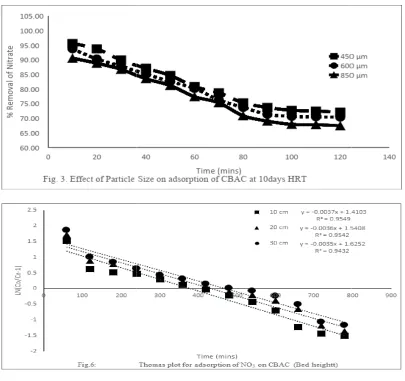
Column adsorption experiments were carried out for the removal of nitrate using three particle sizes 450, 600 and 850 µm. Fig. 3 show the plots of percentage removal of nitrate against time at different particle size. From the above findings, it was observed that nitrate removal efficiency
increased with decreased particle sizes. The removal efficiency increased with decreased particle size and this is probably due to the fact that, with the reduction in particle size, the surface areas of the adsorbents were increased [20]. Which provide greater number of sites for adsorption [14]. The increase in nitrate removal was mainly due to the utilization of available active sites provided by the larger surface area [21].
4.2 Column Adsorption Kinetic
4.2.1 Thomas kinetic model
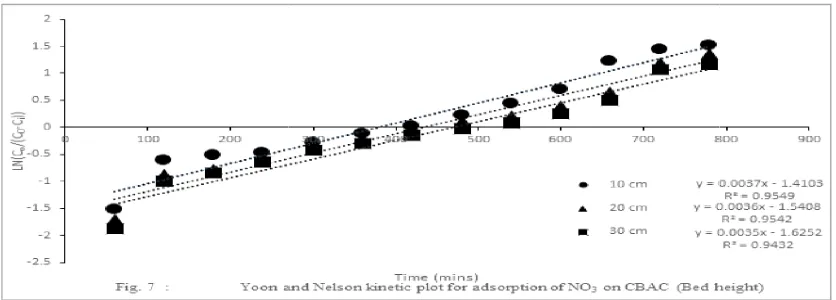
A linear plot of −1 against time (t) was
employed to determine the Thomas parameters, that’s the rate constant (KTH), adsorption capacity
(qe) and the correlation coefficient value (R2), in
which the various experimental conditions for column adsorption of NO3 onto CBAC was
conducted. The determined coefficient and relative constants were obtained using linear regression analysis and the results are listed in Table 1.
From Table 1, the Thomas rate constant KTH and
equilibrium sorption capacity qo values
decreased with increased in bed height. [22,23]
reported a similar finding for Thomas model applied to the removal of Acid blue 92
Table 1. Calculated column kinetics parameter
4.2.2 Yoon Nelson kinetics model
Yoon-Nelson model was applied to the experimental data with varying bed heights. A linear regression analysis was used to analyze each set of data. A linear plot of
against sampling time (t) was employed to determine the Yoon-Nelson model parameters.
A simple theoretical model developed by Yoon Nelson was applied to investigate the breakthrough behavior of NO3 on CBAC, the rate
column kinetics parameter for NO3 adsorption on CBAC
Yoon Nelson kinetics model
Nelson model was applied to the experimental data with varying bed heights. A linear regression analysis was used to analyze each set of data. A linear plot of
against sampling time (t) was employed to Nelson model parameters.
A simple theoretical model developed by Yoon-Nelson was applied to investigate the
on CBAC, the rate
constant and the time required for 50% adsorbate breakthrough could be predicted by the values of Yoon-Nelson constant K adsorption time τ. The values of K
listed in Table 2 and was obtained from the linearized Yoon-Nelson equation. It was observed that as the bed volume incr
values of τ increased while the value of K decreased [21,24-26]. This can be attributed to the fact that at higher bed height, the adsorbate molecules have more time to travel through the column.
on CBAC
constant and the time required for 50% adsorbate breakthrough could be predicted by Nelson constant KYN and
adsorption time τ. The values of KYN and τ are
listed in Table 2 and was obtained from the Nelson equation. It was observed that as the bed volume increased, the values of τ increased while the value of KYN
Table 2. Calculated column kinetics parameter
5. CONCLUSION
The following conclusion can be drawn from the present study. The effect of varying pH, bed heights and particle sizes were monitored. It was observed that the percentage removal efficiencies of nitrate were increased when the pH was increased from 2 to 10. The percentage removal efficiencies of nitrate also increased as bed height increased from 10, 20 and 30 cm and decreased as particle sizes increased from 450 µm, 600 µm and 850 µm. The adsorption kinetics analyzed using Thomas kinetic model indicates that as bed height increased from 10, 20 to 30 cm, maximum adsorption capacity
Thomas kinetics constant decreased. While for Yoon-Nelson kinetic model, the bed height increased from 10, 20 and 30 cm as adsorption time τ increased and Yoon-Nelson kinetics constant KYN decreased. The kinetic data
obtained is found to fit well with the Yoon kinetic model.
COMPETING INTERESTS
Authors have declared that no competing interests exist.
REFERENCES
1. Ubwa ST, Atoo GH, Offem JO, Abah J, Asemave K. An assessment of surface water pollution status around Gboko abattoir. African Journal of Pure and Applied Chemistry.2013;7(3):131
column kinetics parameter for NO3 adsorption on CBAC
The following conclusion can be drawn from the present study. The effect of varying pH, bed heights and particle sizes were monitored. It was observed that the percentage removal efficiencies of nitrate were increased when the . The percentage removal efficiencies of nitrate also increased as bed height increased from 10, 20 and 30 cm and decreased as particle sizes increased from 450 µm, 600 µm and 850 µm. The adsorption kinetics analyzed using Thomas kinetic model indicates hat as bed height increased from 10, 20 to 30 cm, maximum adsorption capacity and decreased. While Nelson kinetic model, the bed height increased from 10, 20 and 30 cm as adsorption elson kinetics decreased. The kinetic data obtained is found to fit well with the Yoon-Nelson
Authors have declared that no competing
Ubwa ST, Atoo GH, Offem JO, Abah J, assessment of surface water pollution status around Gboko abattoir. African Journal of Pure and Applied Chemistry.2013;7(3):131-13.
2. Jiban SM, Biswas MK, Anamika S, Suneel D, Akoikar AB. Slaughter house in uttar pradesh with hygienic environm studies research. 2016;4(1):9
3. Chukwu O, Adeoye PA, Chidiebere J. Abattoir waste generation, management and the environment. A case study of Minna, North central. Nigeria International Journal of Biosciences. 2011;1(6):100 109.
4. Andrze G, Iwona L. Adsorption of nitrate, nitrite and ammonium ions on carbon adsorbents. Adsorption Science and Technology. 2017;35(7-8):721
5. Mohammed-Khah A, Ansari R. Activated charcoal: Preparation, characteristics and application. A review article, International Journal of Chem Tech Research. 2009; 1(4):859-864.
6. Sunil JK. Modeling of adsorption columns for wastewater treatment: A review. International Journal of Innovation Research in Engineering, Multidisciplinary Physical Science. 2014;2(2):7
7. Ayub S, Khorasgani FC. Adsorption process of wastewater treatment by using coconut shell. Research Journal of Chemical Sciences. 2014;4(12)
8. Kulkarni SJ, Goswami AK. Adsorption studies for organic matter removal from wastewater by using bagasse flyash batch and column operations. International Journal of Science and Research. 2013; 2(11):180-183.
9. Chiavola A, D’Amato E, Baciocchi R. Ion exchange treatment of groundwater
on CBAC
Jiban SM, Biswas MK, Anamika S, Suneel D, Akoikar AB. Slaughter house in uttar pradesh with hygienic environmental studies research. 2016;4(1):9-18.
Chukwu O, Adeoye PA, Chidiebere J. Abattoir waste generation, management and the environment. A case study of Minna, North central. Nigeria International of Biosciences.
2011;1(6):100-Adsorption of nitrate, nitrite and ammonium ions on carbon adsorbents. Adsorption Science and
721-727. Khah A, Ansari R. Activated
, characteristics and application. A review article, International Tech Research. 2009;
Sunil JK. Modeling of adsorption columns for wastewater treatment: A review. International Journal of Innovation Research in Engineering, Multidisciplinary Physical Science. 2014;2(2):7-11.
ni FC. Adsorption process of wastewater treatment by using coconut shell. Research Journal of Chemical Sciences. 2014;4(12):1-8. Kulkarni SJ, Goswami AK. Adsorption studies for organic matter removal from wastewater by using bagasse flyash in batch and column operations. International Journal of Science and Research. 2013;
contaminated by arsenic in the presence of sulphate. Break through experiments and modeling. Water Air Soil Pollution. 2012; 223:2373–2386.
DOI: 1007/s11270-011-1031-2
10. Saad DM, Cukrowska E, Tutu H. Column
adsorption studies for the removal of U by phosphonated cross-linked poly
ethyleneimine: Modelling at Optimization. Applied Water Science. 2015;5:57-63. 11. El Qada EN, Abdelghany EA, Magdy YH.
Utilization of activated carbon for the removal of basic dyes in fixed bed micro column. International Journal of Energy and Environment. 2013;4(5):815-824. 12. Chowdhury Z, Zain S, Rashidi A, Rafique
R, Khalid K. Breakthrough curve analysis for column dynamics sorption of Mn(11) ions from wastewater by using Mongostana garcinia peel-based granular-activated carbon. Journal of Chemical; 2013.
DOI: 10.1155/2013/959761
13. Kavak D, Ozturk N. Adsorption of boron from aqueous solution by sepirolite 11 column studies 11. Illusirararasi Bor. Sempozyumu. 2004;23-25:495-500. 14. Rahman MA, Amin SMR, Alam AMS.
Removal of methylene blue from wastewater using activated carbon prepared from rice husk. Journal of Science. 2012;60(2):185-189.
15. Bhattacharya AK, Mandal SN, Das SK. Adsorption of ZN(II) from aqueous solution by using different adsorbents. Chemical Engineering Journal. 2016;123:43-51. 16. Abdel-Rahman LH, Abu-Dief AM, Sayeed
MAA, Zikry MM. Nano sized moringa oleifera an effective strategy for pb(11) ions removal from aqueous solution. Chemistry and Material Research. 2016; 8(4)8-22.
17. Hasfalina CBM, Christopher OA, Chin XJ. Coconut husk adsorbent for the removal of methylene blue dye from wastewater. Bio Resources. 2015;10(2):2859-2872.
18. Nwabanne JT, Igbokwe PK. Kinetic modelling of heavy metals adsorption on
fixed bed column. International Journal Environmental Res.
2012;6(4):945-952.
19. Patel H, Vashi RT. Characterization and column adsorption treatment for COD and color removal using activated neem leaf powder from textile wastewater. Journal of Urban and Environmental Engineering. 2015;9(1):45-53.
20. Phadtare MJ, Patil ST. Removal of heavy metal from industrial wastewater. International Journal of Advanced Engineering Research and Studies. 2015; E-1SSN 2249-8974.
21. Kulkarni SJ, Kaware JP. Groundnut shell adsorbent in packed bed for cadmium removal modeling for breakthrough curve SSRG. International Journal of Chemical Engineering Research. 2014;2(1):1-6. 22. Sivakumar P, Palanisamy PN. Packed bed
column studies for the removal of acid blue 92 and Basic Red 29 using non-conventional adsorbent. Indian Journal of Chemical Technology. 2009;16:301-307. 23. Chafi M, Akazdam S, Asrir C, Sebbahi GB,
Barka N, Essahli M. Continous fixed bed reactor application for decolourization of textile effluent by adsorption on NAOH treated eggshell. World academy of science engineering and technology. Inter-national Journal of Chemical, Molecular, Nuclear, Material and Metallurgical Engineering. 2015;9(10):1189-1195. 24. Han R, Wang Y, Zhao X, Wang Y, Xie F,
Cheng J, Tang M. Adsorption of methylene blue by a phoenix tree leaf powder in a fixed bed column. Experiments and prediction of breakthrough curve, Desalina-tion. 2009;245:284-297.
25. Ghribi A, Chlendi M. Modeling of fixed bed adsorption. Application to the adsorption of organic dye. Asian Journal of Textile. 2011;1:161-171.
26. Kulkarni SJ, Kaware JP. Packed bed adsorption column modelling for cadmium removal. International Journal of Thermal and Environmental Engineering. 2015;8(2): 75-8.
_________________________________________________________________________________ © 2018 Nwankwo et al.; This is an Open Access article distributed under the terms of the Creative Commons Attribution License (http://creativecommons.org/licenses/by/4.0), which permits unrestricted use, distribution, and reproduction in any medium, provided the original work is properly cited.
Peer-review history: