1-Chloro-1
H
-1,2,3-benzotriazole
Ming-Yong Yuan, Xia Zhao and Ling-Li Zheng*
Department of Pharmacy, The First Affiliated Hospital, Chengdu Medical College, Chengdu 610500, People’s Republic of China
Correspondence e-mail: [email protected] Received 14 October 2012; accepted 30 October 2012
Key indicators: single-crystal X-ray study;T= 293 K; mean(C–C) = 0.005 A˚;
Rfactor = 0.032;wRfactor = 0.068; data-to-parameter ratio = 9.9.
The title compound, C6H4ClN3, is essentially planar, with a maximum deviation of 0.007 (3) A˚ . In the crystal, a short contact of 2.818 (3) A˚ is observed between N and Cl atoms of adjacent molecules.
Related literature
For related structures of benzotriazole derivatives, see: Jebas et al.(2012); Guoet al.(2012); Selvarathyet al.(2012); Xu & Shen (2012). For applications of the title compound, see: Hunter et al. (2006) and references cited therein. For the biological activity of benzotriazole derivatives, see: Gaikwad et al.(2012); Dubeyet al.(2011).
Experimental
Crystal data
C6H4ClN3
Mr= 153.57 Orthorhombic,Fdd2
a= 22.8022 (11) A˚
b= 14.2637 (8) A˚
c= 8.2259 (4) A˚
Z= 16
MoKradiation
T= 293 K
0.420.340.32 mm
Data collection
Agilent Xcalibur Eos diffractometer Absorption correction: multi-scan
(CrysAlis PRO; Agilent, 2010)
Tmin= 0.979,Tmax= 1.000
1503 measured reflections 918 independent reflections 867 reflections withI> 2(I)
Rint= 0.017
Refinement
R[F2> 2(F2)] = 0.030
wR(F2) = 0.060
S= 1.06 918 reflections 91 parameters 1 restraint
H-atom parameters constrained max= 0.15 e A˚ 3
min= 0.16 e A˚ 3
Absolute structure: Flack (1983), 275 Friedel pairs
Flack parameter: 0.00 (8)
Data collection: CrysAlis PRO(Agilent, 2010); cell refinement:
CrysAlis PRO; data reduction: CrysAlis PRO; program(s) used to solve structure: SHELXS97(Sheldrick, 2008); program(s) used to refine structure:SHELXL97(Sheldrick, 2008); molecular graphics:
OLEX2(Dolomanovet al., 2009); software used to prepare material for publication:publCIF(Westrip, 2010).
This project was supported by Applied Basic Research Programs of Science & Technology Department of Sichuan Province (No. 2012JY0035) and the research fund of Chengdu Medical College, China (No. CYZ11–021).
Supplementary data and figures for this paper are available from the IUCr electronic archives (Reference: XU5634).
References
Agilent (2010).CrysAlis PRO. Agilent Technologies, Yarnton, England. Dolomanov, O. V., Bourhis, L. J., Gildea, R. J., Howard, J. A. K. & Puschmann,
H. (2009).J. Appl. Cryst.42, 339–341.
Dubey, A., Srivastava, S. K. & Srivastava, S. D. (2011).Bioorg. Med. Chem. Lett.21, 569–573.
Flack, H. D. (1983).Acta Cryst.A39, 876–881.
Gaikwad, N. D., Patil, S. V. & Bodade, V. D. (2012).Bioorg. Med. Chem. Lett.
22, 3449–3454.
Guo, T., Cao, G. & Xu, S. (2012).Acta Cryst.E68, o1409.
Hunter, R., Caira, M. & Stellenboom, N. (2006).J. Org. Chem.71, 8268–8271. Jebas, S. R., Selvarathy Grace, P., Ravindran Durai Nayagam, B. &
Schollmeyer, D. (2012).Acta Cryst.E68, o2239.
Selvarathy Grace, P., Jebas, S. R., Ravindran Durai Nayagam, B. & Schollmeyer, D. (2012).Acta Cryst.E68, o1132.
Sheldrick, G. M. (2008).Acta Cryst.A64, 112–122. Westrip, S. P. (2010).J. Appl. Cryst.43, 920–925. Xu, S. & Shen, Y. (2012).Acta Cryst.E68, o1066. Structure Reports
Online
supporting information
Acta Cryst. (2012). E68, o3432 [doi:10.1107/S1600536812044820]
1-Chloro-1
H
-1,2,3-benzotriazole
Ming-Yong Yuan, Xia Zhao and Ling-Li Zheng
S1. Comment
Benzotriazole derivates are an important class of heterocylic compounds with essential applications in the organic
synthesis and medicinal chemistry. In the synthetic chemistry, 1-chloro-1H-benzo[d][1,2,3]triazole is an important oxidation and chlorination reagent. Recently, 1-chloro-1H-benzo[d][1,2,3]triazole has been used in the synthesis of unsymmetrical disulfides (Hunter et al., 2006). Meanwhile, benzotriazole derivates derivates exhibit numerous essential bioactivitities, especially in antimicrobial (Gaikwad, et al., 2012) and antibubercular activities (Dubey et al. 2011). Most recently, several crystal structures of title compound derivates have been reported (Jebas et al., 2012; Guo et al., 2012; Selvarathy et al., 2012; Xu & Shen 2012), but crystal data of 1-chloro-1H-benzo[d][1,2,3]triazole has not been investigated. Herein, we report the synthesis and crystal structure of the title compound.
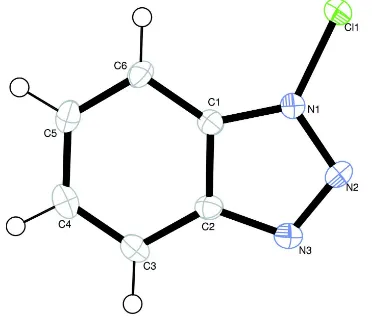
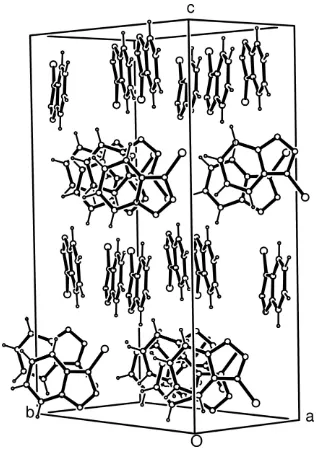
The molecular structure of 1-chloro-1H-benzo[d][1,2,3]triazole is shown in Fig. 1. The bond lengths and angles are within normal ranges. In the crystal, the short contact of 2.818 (3) Å between N and Cl atoms of adjacent molecules
occurs.
S2. Experimental
To a stirring solution of benzotriazole (10 g) in 50 ml of 50% acetic acid aqueous solution was added sodium
hypochlorite solution (30 ml) at room temperature dropwise. After dropping, the solution was diluted with water (100 ml)
to precipitate the product. The mixture was filtered, washed with water to afford 1-chloro-1H-benzo[d][1,2,3]triazole (8.5 g)as white solid. The single crystals of 1-chloro-1H-benzo[d][1,2,3]triazole were recrystallized from acetone at room temperature.
S3. Refinement
H atoms were included in idealized positions and refined using a riding-model approximation, with C—H = 0.93 Å and
Figure 1
Figure 2
Plane-to-plane stacking of alternate molecules parallel to the α axis.
1-Chloro-1H-1,2,3-benzotriazole
Crystal data
C6H4ClN3
Mr = 153.57
Orthorhombic, Fdd2
a = 22.8022 (11) Å
b = 14.2637 (8) Å
c = 8.2259 (4) Å
V = 2675.4 (2) Å3
Z = 16
F(000) = 1248
Dx = 1.525 Mg m−3
Mo Kα radiation, λ = 0.71073 Å Cell parameters from 738 reflections
θ = 3.0–28.5°
µ = 0.48 mm−1
Agilent Xcalibur Eos diffractometer
Radiation source: fine-focus sealed tube Graphite monochromator
Detector resolution: 16.0874 pixels mm-1
ω scans
Absorption correction: multi-scan (CrysAlis PRO; Agilent, 2010)
Tmin = 0.979, Tmax = 1.000
1503 measured reflections 918 independent reflections 867 reflections with I > 2σ(I)
Rint = 0.017
θmax = 25.2°, θmin = 3.0°
h = −15→27
k = −16→8
l = −9→9
Refinement
Refinement on F2
Least-squares matrix: full
R[F2 > 2σ(F2)] = 0.030
wR(F2) = 0.060
S = 1.06 918 reflections 91 parameters 1 restraint
Primary atom site location: structure-invariant direct methods
Secondary atom site location: difference Fourier map
Hydrogen site location: inferred from neighbouring sites
H-atom parameters constrained
w = 1/[σ2(F
o2) + (0.0242P)2]
where P = (Fo2 + 2Fc2)/3
(Δ/σ)max = 0.001
Δρmax = 0.15 e Å−3
Δρmin = −0.16 e Å−3
Absolute structure: Flack (1983), 275 Friedel pairs
Absolute structure parameter: 0.00 (8)
Special details
Geometry. All esds (except the esd in the dihedral angle between two l.s. planes) are estimated using the full covariance
matrix. The cell esds are taken into account individually in the estimation of esds in distances, angles and torsion angles; correlations between esds in cell parameters are only used when they are defined by crystal symmetry. An approximate (isotropic) treatment of cell esds is used for estimating esds involving l.s. planes.
Refinement. Refinement of F2 against ALL reflections. The weighted R-factor wR and goodness of fit S are based on F2,
conventional R-factors R are based on F, with F set to zero for negative F2. The threshold expression of F2 > 2sigma(F2) is
used only for calculating R-factors(gt) etc. and is not relevant to the choice of reflections for refinement. R-factors based on F2 are statistically about twice as large as those based on F, and R- factors based on ALL data will be even larger.
Fractional atomic coordinates and isotropic or equivalent isotropic displacement parameters (Å2)
x y z Uiso*/Ueq
Cl 0.31785 (3) 0.13250 (5) −0.13509 (9) 0.0508 (2) N1 0.37734 (9) 0.18891 (16) −0.0618 (3) 0.0436 (6) N2 0.43133 (10) 0.15132 (19) −0.0788 (3) 0.0544 (7) N3 0.46849 (10) 0.20933 (18) −0.0121 (4) 0.0537 (7) C1 0.37873 (11) 0.27246 (19) 0.0179 (3) 0.0369 (6) C2 0.43801 (11) 0.2849 (2) 0.0484 (3) 0.0402 (7) C3 0.45739 (14) 0.3651 (2) 0.1311 (4) 0.0538 (8)
H3 0.4969 0.3751 0.1531 0.065*
C4 0.41526 (15) 0.4282 (2) 0.1780 (4) 0.0577 (9)
H4 0.4265 0.4822 0.2330 0.069*
C5 0.35617 (14) 0.4133 (2) 0.1453 (4) 0.0550 (8)
H5 0.3292 0.4581 0.1796 0.066*
C6 0.33580 (13) 0.3357 (2) 0.0649 (4) 0.0459 (8)
Atomic displacement parameters (Å2)
U11 U22 U33 U12 U13 U23
Cl 0.0413 (4) 0.0522 (4) 0.0587 (4) −0.0073 (4) −0.0014 (4) −0.0109 (4) N1 0.0307 (12) 0.0452 (15) 0.0549 (15) −0.0005 (12) −0.0016 (12) −0.0116 (13) N2 0.0396 (15) 0.0519 (17) 0.072 (2) 0.0078 (12) 0.0062 (13) −0.0114 (15) N3 0.0327 (12) 0.0566 (16) 0.0719 (16) 0.0032 (14) −0.0019 (13) −0.0092 (13) C1 0.0367 (15) 0.0383 (16) 0.0358 (14) 0.0036 (14) −0.0016 (12) 0.0000 (13) C2 0.0368 (15) 0.0404 (16) 0.0434 (14) −0.0002 (13) −0.0010 (14) 0.0022 (13) C3 0.0494 (18) 0.057 (2) 0.0545 (19) −0.0129 (16) −0.010 (2) −0.0014 (17) C4 0.079 (2) 0.0376 (18) 0.0566 (19) −0.0060 (18) −0.002 (2) −0.0069 (15) C5 0.0570 (19) 0.0439 (19) 0.064 (2) 0.0099 (16) 0.0071 (18) −0.0067 (18) C6 0.0385 (15) 0.0440 (19) 0.0551 (18) 0.0071 (14) −0.0006 (14) −0.0004 (16)
Geometric parameters (Å, º)
Cl—N1 1.688 (2) C3—C4 1.371 (4)
N1—N2 1.350 (3) C3—H3 0.9300
N1—C1 1.360 (3) C4—C5 1.390 (4)
N2—N3 1.305 (3) C4—H4 0.9300
N3—C2 1.376 (4) C5—C6 1.371 (4)
C1—C2 1.386 (3) C5—H5 0.9300
C1—C6 1.386 (4) C6—H6 0.9300
C2—C3 1.403 (4)
N2—N1—C1 112.1 (2) C4—C3—H3 121.6
N2—N1—Cl 120.4 (2) C2—C3—H3 121.6
C1—N1—Cl 127.46 (18) C3—C4—C5 121.6 (3)
N3—N2—N1 107.3 (2) C3—C4—H4 119.2
N2—N3—C2 108.7 (2) C5—C4—H4 119.2
N1—C1—C2 102.8 (2) C6—C5—C4 123.0 (3)
N1—C1—C6 133.5 (3) C6—C5—H5 118.5
C2—C1—C6 123.7 (3) C4—C5—H5 118.5
N3—C2—C1 109.1 (3) C5—C6—C1 114.9 (3)
N3—C2—C3 131.0 (3) C5—C6—H6 122.5
C1—C2—C3 120.0 (3) C1—C6—H6 122.5