THE INFLUENCE OF RED WORMS (
E. FOETIDA
) ON COMPOST’S
FERTILIZING PROPERTIES
Czesława Rosik-Dulewska1, Tomasz Ciesielczuk2, Urszula Karwaczyńska2, Hanna Gabriel
1 Institute of Environmental Engineering of the Polish Academy of Sciences, Skłodowskiej-Curie Str. 34, 41-819 Zabrze, Poland, e-mail: [email protected]
2 Opole University, Department of Land Protection, Oleska Str. 22, 45-052 Opole, Poland, e-mail: tciesielczuk@ uni.opole.pl
INTRODUCTION
Vermicompost (earthworm compost) is the final product of organic matter after being bro -ken down by earthworms in a mesophilic com -posting process called vermicom-posting. The red worm Eisenia foetida is widely considered as the best species at converting organic mat -ter into compost, what is more, it feeds inten -sively and breeds most quickly. Composting is a biochemical process that uses microorganisms to aerobic organic matter decomposition. In the vermicompost method microorganisms begin the process, but it is the red worm that plays the largest role in converting organic matter subject -ed to preliminary decomposition processes (e.g. hydrolysis or fermentation). Composting by those organisms are the most effective between 15 and 25 °C, and with humidity between 60 and 70%. If the conditions are beyond the opti -mum scope, the effectiveness declines [Edwards 1995, Suthar 2009]. During the typical com -Volume 15, No. 2, April 2014, pp. 67–72
DOI: 10.12911/22998993.1094980 Research Article
ABSTRACT
Composting is becoming a more and more common way of biodegradable waste di
-sposal. Composts should be characterized by high content of nutrients and low amount of pollutants. Vermicompost is a compost produced by overpopulated culture of ear
-thworm Eisenia foetida (Savigny 1826). World scientific literature states that vermi
-compost has a high fertilizing value which often exceeds such value of conventional composts. The results showed that vermicompost has a much higher fertilizing value than the compost produced by the traditional pile method. However, prism vermicom
-post created with the participation of a less concentrated population of earthworms has an intermediate value as a fertilizer (nitrogen and heavy metals), it could be assessed as a lower value product due to the lower content of potassium and phosphorus than the material obtained without earthworms.
Keywords: vermicompost, earthworm compost, Eisenia foetida, fertilizing properties
Received: 2014.01.31 Accepted: 2014.03.10 Published: 2014.04.04
posting process a high temperature (55–65 oC) guarantees composted hygienic organic waste but also significantly eliminates earthworms’ ac -tiveness. Possible waste that can be utilized by vermicomposting is mainly kitchen waste, green waste, farm animals’ excrement, and selectively gathered municipal waste’s organic fraction and sewage residue.
The main aim and advantage of the vermi -compost method is a quick neutralization of or -ganic matter along with generation of or-ganic fertilizer which is a valuable source of organic coal for soil [Evanylo et al. 2008]. The two main advantages of vermicomposting are: creating a compost which is a valuable fertilizer and earth -worm biomass, which can be used as fish bait or substrate to production of protein flour.
The compost, highly contained with macro- and microelements, not only enriches soil but can also be used as a bed for flowers or perfect matter for soil and soil-less beds, and finally as a sorbent of oil derivatives and heavy metals in low polluted soils [Olszewska 2001, Rosik-Dulewska and Cie -sielczuk 2010, Wróbel and Nowak 2005]. Some researchers suggest to use vermicompost only as an additive to flower beds because of its salinity [Kostecka 1998]. However, its diluting reduces the salt to the levels that are harmless for plants. Other positive effects of vermicompost on plants include: increased sprouting, the limiting of fungi occurrence and limited stress while replanting [Edwards 1995, Olszewska 2001, Tripathi 2004].
LEGAL FRAMEWORK
Legal framework regulating waste manage -ment in Poland is the Act on waste of 21 April 2001 [Journal of Laws of the Republic of Po -land 2010 No. 28 pos. 145 with further changes]. Among others, it regulates time horizons and sets the time when biodegradable waste mass should be reduced from 50 to 35% respectively in 2013 and 2010 in comparison to the base year: 1995. It means that more and more professional com -posting plants are founded, as well as compost -ing in households is becom-ing a way to reduce the cost of mixed waste. The act from 10th July 2007 [Journal of Laws of the Republic of Poland No. 147 pos. 1033] on fertilizers and fertilizing regulates the conditions and the way of marketing fertilizers, additives encouraging plant growth and their usage in agriculture. The Act of Minis -try of Agriculture and Rural Development of 18th June 2008 (Journal of Laws of the Republic of Poland No. 119 pos. 765], in respect to putting into effect several acts considering fertilizers and fertilizing, sets minimal quality requirements and permissible heavy metals concentrations in fertil -izers. Using (mainly in reclamation process) low quality compost (not suitable for fertilizing) is al
-lowed by Act 10 from 22nd April 2011 [Journal of Laws of the Republic of Poland No. 86476].
EXPERIMENTAL MATERIAL AND STUDY
DESIGN
The studied area included composts gener -ated in individual households. Compost samples were taken from kitchen and garden waste (KO) made by a prism method and two types of vermi -compost: the first one was made of kitchen and garden waste (WK), and the second one from kitchen and garden waste (KM) that was cre -ated by vermicomposting using a condensed red worm E.foetida population. This sample was the
only one from the tested samples that originated from Upper Silesia; the following two samples (WK and KM) were created in a rural area near Opole. All tested composts were made in sheltered composting plants that allowed rainwater to seep into the compost mass, while in the case of WK vermicompost, seeping rainwater was completely eliminated. For the sake of the experiment the KM composting plant used 500 adult red worms (E. foetida). In the examined composts the humidity,
organic matter, nitrogen, phosphorus, acidity and the proper electric conduction (according to Polish Norms) were determined. Quantification of sodi -um, potassi-um, and calcium was determined by FES methods. Heavy metals were determined by an atomic absorption spectroscopy using the iCE-Thermo 3500after previous wet microwave min -eralization in aqua regia inMARS-X apparatus.
RESULTS AND DISCUSSION
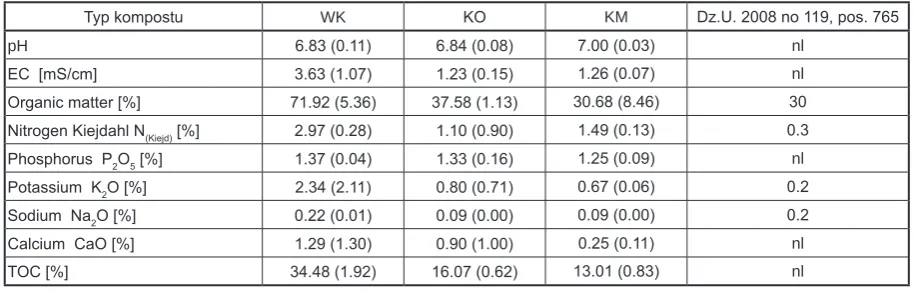
All tested samples are characterized by a neu -tral reaction and are nearly similar; nevertheless, in comparison to the scientific research data, the observed pH levels are slightly lower [Ciesiel-czuk et al. 2011].
The salinity of the tested composts (expressed with EC value) is low, only the WK samples are characterized by a slightly higher concentration of soluble salt which is 3.63 mS/cm, what is con -firmed by other authors [Pączka and Kostecka 2013]. It is the effect of limited or no access of rainwater and, consequently, the leaching soil from compost which is proven by a nearly two times higher content of sodium and potassium ions in comparison to KO and KM composts. The conductivity values of KO and KM com -posts are typical for com-posts made by a prism method and not sheltered against precipitation, especially since the composting took place dur -ing heavy rain. However, the compost produced from municipal solid waste reached even higher EC values, exceeding even 7–8 mS/cm [Harg -reaves et al. 2008, Saha et al. 2010]. A particular -ly important fertilizer’s parameter is the content of organic matter. The vermicompost (WK) was characterized by the highest content of organic matter, while in composts KO and HP (produced in composts plants which allowed access of rain water) the value of this parameter was approxi -mately two times lower. This may partly result from DOC losses resulting from the leaching by rainfall and a slightly different composition of the composted material.
WK compost is very rich in nitrogen, only vermicompost from municipal sewage sludge may contain more of it – up to 3.2% [Khwairak -pam and Bhargava 2009]. Lower content of this
element (0.8–1.5%) was observed in samples PS and KO made by the traditional prism method [Nagavallemma et al. 2004]. Despite significant nitrogen content (especially in samples WK) all tested composts were mature, characterized by the C / N ratio within 8.7–11.6.
The potassium content in the tested vermi -compost WK (2.3%) far exceeds the amount of this element in other vermicomposts [Fernández-Gómez, 2009]. This is probably the result of waste composition being composted (kitchen waste) and the lack of leaching this element by rainfall. Potassium content in the samples of KM and KO (Table 1) are typical for the composts produced by the prism method [Evanylo et al. 2008].
The highest phosphorus content was deter -mined in samples of WK compost, slightly less in the samples of composts KO and KM. These values are close but other organic fertilizers, such as manure is richer in this element [Bansal and Kapoor, 2000]. It is believed, however, that the enzymes in the digestive tract of earthworms (and remaining coprolites) convert phosphorus com -pounds to form what is available to plants – as a result, vermicomposts have a higher content of available phosphorus forms in comparison to the material formed without their participation [Suthar, 2009]. All the tested composts comply with the minimum nitrogen content (0.3%), po -tassium oxide and phosphorus oxide (0.2%) in organic fertilizer as defined in the Regulation of Ministry of Agriculture and Rural Development on the implementation of certain provisions of the Act on fertilizers and fertilization of 18 June 2008, including later amendments.
The highest calcium content was also de -termined in the compost WK (1.29%). This is,
Table 1. Characteristics of main investigated composts properties
Typ kompostu WK KO KM Dz.U. 2008 no 119, pos. 765
pH 6.83 (0.11) 6.84 (0.08) 7.00 (0.03) nl
EC [mS/cm] 3.63 (1.07) 1.23 (0.15) 1.26 (0.07) nl
Organic matter [%] 71.92 (5.36) 37.58 (1.13) 30.68 (8.46) 30
Nitrogen Kiejdahl N(Kiejd) [%] 2.97 (0.28) 1.10 (0.90) 1.49 (0.13) 0.3
Phosphorus P2O5 [%] 1.37 (0.04) 1.33 (0.16) 1.25 (0.09) nl
Potassium K2O [%] 2.34 (2.11) 0.80 (0.71) 0.67 (0.06) 0.2
Sodium Na2O [%] 0.22 (0.01) 0.09 (0.00) 0.09 (0.00) 0.2
Calcium CaO [%] 1.29 (1.30) 0.90 (1.00) 0.25 (0.11) nl
TOC [%] 34.48 (1.92) 16.07 (0.62) 13.01 (0.83) nl
n = 3 (SD value in brackets).
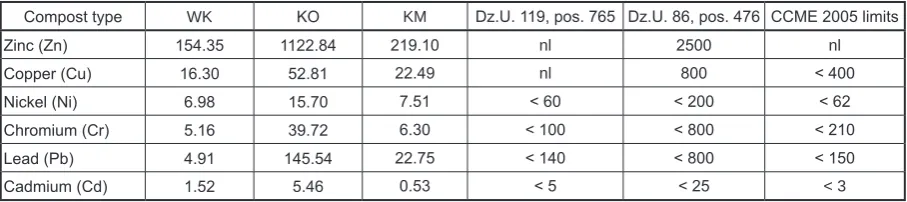
however, due to the addition of calcium carbon -ate to vermicompost, which was used to prevent pH lowering below the optimum value for earth -worms and bacteria (including endosymbiotic). The recorded calcium content values in composts KO (0.90%) and KM (0.25%) are lower than in comparison to composts produced by the prism method. An over normative heavy metal content in compost is one of the reasons disqualifying compost from applying it as a fertilizer. Compari -son of the results for the six heavy metals to the current standards is shown in Table 2. Segrega -tion of municipal solid waste „at source”, results in lowering the amount of heavy metals, even up to the level normally recorded in the soils [Rosik-Dulewska 2003, Smith 2009].
Among the tested samples, compost WK con -tains the lowest amounts of heavy metals, signifi -cantly below the maximum amounts allowed by the regulation of the Minister of Agriculture and Rural Development dated 18 June 2008 No 119 pos. 765. The content of chromium and zinc is the lowest of the compared data: two composts produced in households in Opole (GU) and Opole Voievodeship (KS), where chromium content was respectively (in mg / kg dm), 79.78 and 15.07, and zinc content 276.90 and 167.61 [Ciesielc -zuk and Kusza 2009]. It is expected that after the implementation of the act on fertilizers and fer -tilization, the major factor eliminating the use of compost as a fertilizer is going to be the zinc con -tent. In the studied vermicompost only cadmium content is increased, but does not exceed the le -gally permitted limits. The reason for such a low content of heavy metals in vermicomposts seems to be the ability of cumulating metals in earth -worms’ tissues which argues for the populariza -tion of this composting method [Edwards 1995].
This phenomenon is confirmed by the results obtained for composts KO and KM. The heavy metal content in compost KO is relatively high. Quantities of lead and cadmium content are high
-er than allowed by Polish as well as Canadian legislation, and thus compost KO can not be used as a fertilizer, but it is possible to use it for re -habilitation purposes [Journal of Laws of the Re -public of Poland No. 86 pos. 476]. The content of zinc and chromium are also the highest among the compared composts. Copper and nickel content is quite high, but does not exceed the permissible limits in Poland [Journal of Laws of the Republic of Poland No. 86 pos. 476 and Journal of Laws of the Republic of Poland from 2008 No 119 pos. 765]. The high content of heavy metals, especially cadmium and lead may appear due to the location where the composting process took place, which was in urban areas, near highly concentrated in -dustrial zones (Upper Silesia), and a large part of the mass was biodegradable garden waste.
Compost KM which was made by red worms E. foetida contains small amounts of heavy metals, considerably below the maximum permitted by the law. Cadmium content is low and comparable for compost produced from biodegradable waste se -lected at the source [Ciesielczuk and Kusza 2009]. Nickel and chromium contents are very low – only compost WK contains fewer of them. The quanti -ties of zinc and lead stays at an average level of the three compared to paper composts.
CONCLUSION
On the basis of the obtained results it was found that only two composts analyzed in this study (WK and KM) meet the requirements for organic fertilizers regarding the minimum content of nitrogen (0.3%), phosphorus and potassium in the oxide form (0.2%) and organic matter (30%) specified in the aforementioned regulation on the implementation of certain provisions of the act on fertilizers and fertilization. Vermicompost WK is a fertilizer particularly rich in nutrients, which is also confirmed by scientific data. This is due
Table 2. Heavy metals content in investigated composts and law concentrations limits (mg/kg d.w.)
Compost type WK KO KM Dz.U. 119, pos. 765 Dz.U. 86, pos. 476 CCME 2005 limits
Zinc (Zn) 154.35 1122.84 219.10 nl 2500 nl
Copper (Cu) 16.30 52.81 22.49 nl 800 < 400
Nickel (Ni) 6.98 15.70 7.51 < 60 < 200 < 62
Chromium (Cr) 5.16 39.72 6.30 < 100 < 800 < 210
Lead (Pb) 4.91 145.54 22.75 < 140 < 800 < 150
to the presence and activity of earthworms and, indirectly, their symbiotic bacteria. High salin -ity of vermicompost, which results not only from the composition of the composted waste, but also from a lack of salt leached by precipitation, which forces the use of this fertilizer in small doses, pre -cisely targeted not only to the type of soil but also to its salinity. Among the tested materials, com -post KO can not be classified as organic fertil -izer, due to noted excess amounts of heavy metals such as cadmium and lead, but still can be used in accordance with the provisions of the regula -tion on the recovery of R10 22.4.2011 [Journal of Laws of the Republic of Poland No. 86 pos. 476]. Compost KM, despite the participation of a con -densed earthworm population in the process of composting, is less rich in phosphorus, potassium and calcium. This may result from heavy rainfall and leaching of these elements from the compost. All in all, using E foetida earthworms favors rap -id production of high quality compost, which can successfully be used as organic fertilizer.
REFERENCES
1. Bansal S., Kapoor K.K., 2000. Vermicomposting of crop residues and cattle dung with Eisenia foeti-da. Bioresource Technology 73: 95-98.
2. Ciesielczuk T., Kusza G. 2009. Zawartość metali ciężkich w kompostach z odpadów jako czynnik ograniczający ich wykorzystanie do celów na
-wozowych. Ochrona Środowiska i Zasobów Natu
-ralnych, 41: 347-354.
3. Ciesielczuk T., Rosik-Dulewska Cz., Karwaczyńska U. 2011. Komposty z odpadów jako potenc
-jalne źródło substancji organicznej i biogenów w produkcji roślinnej. [In:] Kompostowanie i mechaniczno-biologiczne przetwarzanie odpadów (red.) G. Siemiątkowski: 108-116.
4. Edwards C.A. 1995. Historical overview of vermi
-composting. BioCycle, 36, 6: 56.
5. Evanylo G., Sherony C., Spargo J., Starner D., Brosius M., Haering K. 2008. Soil and water envi
-ronmental effects of fertilizer-, manure-, and com
-post-based fertility practices in an organic vegeta
-ble cropping system. Agriculture, Ecosystems and Environment 127: 50-58.
6. Fernández- Gómez M.J., Romero E., Nogales R. 2010. Feasibility of vermicomposting for vegeta
-ble greenhouse waste recycling. Bioresource Tech
-nology 101: 9654-9660.
7. van der Gaag D.J., van Noort F.R., Stapel-Cuijpers L.H.M., de Kreij C., Termorshuizen A.J., van Rijn E., Zmora-Nahum S., Chen Y. 2007. The use of
green waste compost in peat-based potting mixtures: Fertilization and suppressiveness against soilborne diseases. Scientia Horticulturae 114: 289-297.
8. Hargreaves J.C., Adl M.S., Warman P.R. 2008. A
review of the use of composted municipal solid waste in agriculture. Agriculture, Ecosystems and Environment 123: 1–14.
9. Khwairakpam M., Bhargava R. 2009. Vermitech
-nology for sewage sludge recycling. Journal of Hazardous Materials 161: 948–954.
10. Kostecka J., 1999. Kompostowanie z udziałem dżdżownic – nowe możliwości. [In:] Kom
-postowanie i użytkowanie kompostu, I Konferenc
-ja Naukowo-Techniczna, (eds) Siuta J., Wasiak G., Puławy – Warszawa: 125-131.
11. Kostecka J. 1998. Dalsze obserwacje nad produkcją wermikompostu z domowych odpadów organic
-znych. Zeszyty Naukowe Akademii Rolniczej w Krakowie. Sesja Naukowa, 58: 25-34.
12. Lakhdar A., Rabhi M., Ghnaya T., Montemurro F., Jedidi N., Abdelly Ch. 2009. Efectiveness of com
-post use in salt-affected soil. Jounal of Hazardous Materials, 171: 29-37.
13. Lopez M., Soliva M., Martínez-Farre F.X., Fernán
-dez M., Huerta-Pujol O. 2010. Evaluation of MSW organic fraction for composting: Separate collec
-tion or mechanical storting. Resources, Conserva
-tion and Recycling, 54: 222–228.
14. Montemurro F., Charfeddine M., Maiorana M., Convertini G. 2010. Compost Use in Agriculture: The Fate of Heavy Metals in Soil and Fodder Crop Plants. Compost Science & Utilizatíon 18, 1: 47-54. 15. Munroe G., Manual of on-farm vermicomposting
and vermiculture, strona internetowa http://www. agbio.ca/DOCs/Vermiculture_FarmersManual_ gm.pdf, dostęp online: 6.06.2009.
16. Nagavallemma K.P., Wani S.P., Lacroix S., Pad
-maja V.V., Vineela C, Babu Rao M., Sahrawat K.L. 2004. Vermicomposting: Recycling wastes into valuable organic fertilizer. International Crops Research Institute for the Semi-Arid Tropics, SAT eJournal, 1, 2, 2006.
17. Olszewska B. 2001. Szkolna hodowla dżdżownic. Rolnik Mazowiecki, 6: 7-8.
18. Pączka G., Kostecka J. 2013. The influence of vermicompost from kitchen waste on the yield-enhancing characteristics of peas pisum sativum l.
var. saccharatum ser. bajka variety. Journal of Eco
-logical Engineering, 14(2): 49-53.
19. Rosik-Dulewska Cz. 2003. Forms of some heavy metals in composts of municipal wastes as an index of their impact on the environment. [In:] Municipal solid waste composts, production and influence on the environment.
aromatic hydrocarbons from solution. [In] En
-vironmental Engineering III, L. Pawłowski, M. Dudzińska & A. Pawłowski (eds) Taylor&Francis Group London: 237-242.
21. Saha J.K., N. Panwar N., Singh M.V. 2010. An as
-sessment of municipal solid waste compost quality produced in different cities of India in the perspec
-tive of developing quality control indices. Waste Management 30: 192-201.
22. Songin W. 1994. Produkcja kompostu koproli
-towego w ogrodzie przydomowym i działkowym, Postępy Nauk Rolniczych, 1, 41: 145-151. 23. Smith S.R. 2009. A critical review of the bioavail
-ability and impacts of heavy metals in municipal solid waste composts compared to sewage sludge. Environment International 35: 142-156.
24. Suthar S. 2008. Bioconversion of post harvest crop residues and cattle shed manure into value-added products using earthworm Eudrilus eugeniae Kin
-berg. Ecol. Eng. 3, 2: 206-214.
25. Suthar S. 2009. Vermicomposting of vegetable-market solid waste using Eisenia fetida: Impact of
bulking material on earthworm growth and decom
-position rate. Ecological Engineering, 35: 914-920. 26. Tripathi G., Bhardwaj P. 2004. Decomposition of
kitchen waste amended with cow manure using an epigeic species (Eisenia fetida) and an anecic species (Lampito mauritii), Biores. Technol. 92: 215-218.