INTRODUCTION
In Indonesia, Ultisols are commonly found in Sumatra, Kalimantan, Sulawesi and Papua with an area of up to 45.8 million hectares or around 25% of the land area of Indonesia (Sudaryono, 2009). One of the problems of Ultisols utilization for agriculture is the low availability of phospho-rus (P) to support the optimal plant growth. The availability of P in Ultisols is around 3.4-19 ppm (Hilman et al., 2007). Therefore, phosphorus is one of the elements that limit the growth of plants in Ultisols (Shenoy and Kalagudi, 2005). The low availability of P is due to the strong binding of P by Al and Fe so that it is not available for plants (Thao et al., 2008). The P element plays a vital role in photosynthesis, respiration, physiological
and biochemical regulation of plants and acts as energy storage in the plant metabolism of through ADP transformation to ATP (Shen et al., 2011). If the plant is deficient in P, the RNA synthesis decreases so that the protein synthesis process is hindered and results in stunted plant growth, and inhibited fruit ripening (Mengel et al., 2001). A previous study conducted by Fahrunsyah et al. (2018) showed that the application of coal fly ash combined with oil palm empty fruit bunch com-post increased the availability of P in an Ultisol of East Kalimantan. The best combination of coal fly ash and oil palm empty fruit bunch compost was 80 t coal fly ash ha-1 and 20 t oil palm empty fruit bunch compost ha-1, which could increase the P available to soil by 542%. However, the effects of increasing the availability of P in the Ultisol on Accepted: 2019.04.15 Available online: 2019.05.20 Volume 20, Issue 6, July 2019, pages 36–43
https://doi.org/10.12911/22998993/108635
Utilization of Coal Fly Ash and Oil Palm Empty Fruit Bunch
Compost to Improve the Uptake of Soil Phosphorus
and Yield of Maize Grown on Ultisol
Fahrunsyah
1, Zaenal Kusuma
2, Budi Prasetya
2, Eko Handayanto
3*1 Department of Agroecotechnology, Faculty of Agriculture, Mulawarman University, Jl. Paser Belengkong, Samarinda, East Kalimantan, Indonesia
2 Department of Soil Science, Faculty of Agriculture, Brawijaya University, Jl. Veteran, Malang, East Java 65145, Indonesia
3 Research Centre for the Management of Degraded and Mining Lands, Brawijaya University, Jl. Veteran, Malang, East Java 65145, Indonesia
* Corresponding author’s e-mail: [email protected]
ABSTRACT
The study aimed at elucidating the utilization of coal fly ash and oil palm empty fruit bunch compost to improve
the soil phosphorus uptake and yield of maize grown on Ultisol. The investigation was carried out in a greenhouse.
The treatments tested were a combination of four coal fly ash doses (0, 20, 40, and 80 t ha-1) and three doses of
oil palm empty fruit bunch compost (0, 10, and 20 t ha-1). At 2, 4, 6 and 8 weeks after planting, plant height, leaf
number and stem diameter were observed. At the time of harvest (10 weeks after planting), fresh and dry weights of cobs, roots, stem, leaves, and seeds, as well as P uptake on the plant tissues, were observed. The results showed
that the application of coal fly ash and oil palm empty fruit bunch compost significantly increased the P uptake, growth and yield of maize. The combination of 80 t coal fly ash ha-1 with 20 t oil palm empty fruit bunch compost
ha-1 resulted in the highest P uptake, growth and yield of maize. Compared to the control treatment, the increase in
P uptake by maize, the fresh cob weight, the dry cob weight, the biomass dry weight, and the dry seed weight were 303.23%, 285.39%, 364.91%, 329.59% and 1,591.70%, respectively.
the improvement of P uptake, growth and yield of food crops have not been studied.
In Indonesia, coal fly ash, which is a coal-burning waste in Steam Power Plant and other industries that use coal as fuel, amounted to 4 million tons in 2012 (Hermawan et al., 2014). ASTM (1998) defined coal fly ash as a fine grain of coal combustion residues. The ash is a mix-ture of particles with very complex compositions (Kurniawan et al., 2010). Because of the high concentration of various elements in the coal fly ash, many studies have evaluated the usefulness of coal fly ash in soils that lack nutrients (Kishor et al., 2010; Singh et al., 2010). Coal fly ash can be used as a source of B, Ca, Cu, K, Mg, Mo, S and Zn (Singh et al., 2010). If coal fly ash is used to improve the acid soil fertility, it mainly in-creases the availability of micronutrients, copper, zinc and manganese to enhance the plant growth (Spark et al., 2008). Although the benefits of us -ing coal fly ash for agriculture are still debated because of the heavy metals content in the coal fly ash (Lee et al., 2006; Sharma and Kalra, 2006; Mahale et al., 2012; Ukwattage et al., 2013), several research results showed that the coal fly ash application in acid soils could increase the growth and yield of wheat and sorghum (Sharma and Kalra, 2006; Aggarwal et al., 2009; Mahale et al., 2012), maize (Sharma and Kalra, 2006), and tomato (Ismail et al., 2017). In sunflower plants, heavy metals (Cd, Cu and Zn) from coal fly ash did not have a significant effect on the dry weight of plants, but provided good growth in the stems, leaves and roots (Chaves et al., 2011).
Oil palm empty fruit bunch is a solid waste of oil palm processing which is commonly found in East Kalimantan. Mohammad et al. (2012) re-ported that most oil palm empty fruit bunch was returned to oil palm plantations, both in fresh form and as compost (Budianta et al., 2010). Studies have shown that oil palm empty fruit bunch can be used as an organic fertilizer to im-prove soil fertility (Udoetok, 2012). Application of oil palm empty fruit bunch compost could in-crease the yield of soybean by 50% (Budianta et al., 2010; Ermadani and Muzar, 2011). Ismail et al. (2017) reported that applying oil palm empty fruit bunch compost increased plant height, leaf area, dry matter accumulation, and suppressed the development of bacterial wilt disease on tomato, compared to using chicken manure. Bakar et al. (2015) reported that the application of oil palm empty fruit bunch biochar combined with organic
fertilization and intermittent irrigation has the po-tential to improve the rice yield on acid sulphate soil. The increase in crop yields is also related to the improvements in soil chemical properties, in-cluding the P available due to an application of oil palm empty fruit bunch compost (Ichriani et al., 2017). This study aimed at exploring the uti-lization of coal fly ash and oil palm empty fruit bunch compost to improve the soil phosphorus uptake and yield of maize grown on Ultisol of East Kalimantan.
MATERIALS AND METHODS
Each treatment combination of four coal fly ash (A) doses (0, 20, 40 and 80 t ha-1) and three doses of oil palm empty fruit bunch compost (K) (0, 10, and 20 t ha-1) was mixed with 15 kg of air-dried topsoil that passed through a 2 mm sieve, in a plastic pot having a diameter of 35 cm and a height of 25 cm. The mixtures of coal fly ash, oil palm empty fruit bunch compost, and soil in the pots were then incubated for 15 days. Dur-ing incubation, the soil moisture in each pot was maintained at 80% of the soil water holding ca-pacity. The twelve treatments were arranged in a completely randomized design with three repli-cates. After incubation (15 days), all pots received basal fertilizers consisting of 31 mg N kg-1 (150 kg Urea ha-1) and 20 mg K
2O kg-1 (75 kg KCl ha-1). The moisture content of each pot was adjusted to its approximate water holding capacity. Two pre-germinated seeds of maize (Bonanza F1 variety) were planted in each pot and thinned to one plant after one week. Water was supplied daily to each pot to keep the moisture content of the soil at the approximate water holding capacity. At 35 days after planting, the second application of N fertil -izer was made to all pots with a dose of 31 mg N kg-1 (150 kg Urea ha-1). At 2, 4, 6, and 8 weeks af-ter planting, observations were made on the plant height, number of leaves, and stem diameter of maize plants. At the time of harvest (10 weeks af-ter planting), fresh and dry weights of cobs, roots, stem, leaves, and seeds, as well as the P uptake on the plant tissues, were observed. The plant mate-rials were oven dried at 60oC for 48 hours. The
content of P in the roots, stems, leaves, and seeds was measured using the west ash method employ-ing HNO3 and HClO4 (Soil Research Institute of Indonesia, 2005). The uptake of P by plant tis-sue is the content of P (%) multiplied by the dry weight of plant tissue. The data obtained were subjected to analysis of variance followed by the Duncan Multiple Range Test (DMRT) at 5% level.
RESULTS AND DISCUSSION
P uptake by maize
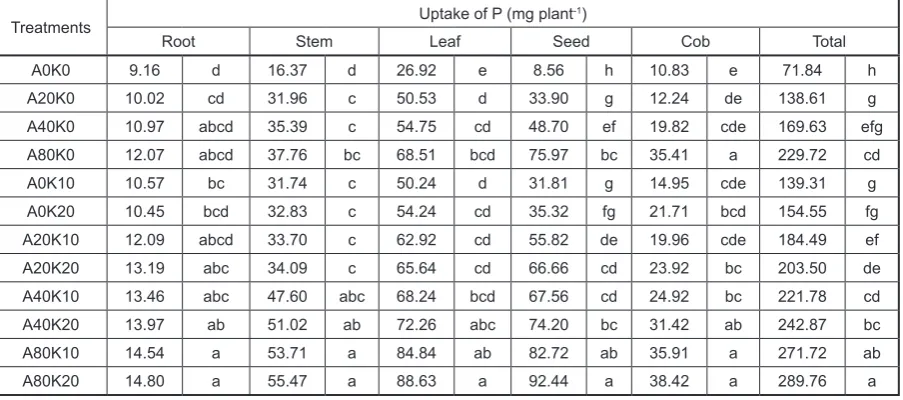
The application of coal fly ash and oil palm empty fruit bunch compost significantly increased the P uptake by maize (Table 1). The P uptake by maize increased along with the doses of coal fly ash applied. The lowest P uptake by maize (71.68 mg plant-1) was found in the control treatment. The low P uptake in the control treatment was probably due to the low available P content (3.76 ppm) of the soil used in this study. According to Minardi et al. (2017), the uptake of P by plants is largely determined by the concentration of P in the soil and the ability of plants to absorb the P in the soil. The highest P uptake by maize (289.76 mg plant-1) was obtained in the A80K20 treatment which was not significantly different from the A80K10 treatment, but it was significantly differ -ent from other treatm-ents. When compared with the P uptake by maize in the control treatment, the A80K20 treatment increased the P uptake by
Table 1. Effect of coal fly ash and oil palm empty fruit bunch compost on the P uptake by maize
Treatments Uptake of P (mg plant-1)
Root Stem Leaf Seed Cob Total
A0K0 9.16 d 16.37 d 26.92 e 8.56 h 10.83 e 71.84 h A20K0 10.02 cd 31.96 c 50.53 d 33.90 g 12.24 de 138.61 g A40K0 10.97 abcd 35.39 c 54.75 cd 48.70 ef 19.82 cde 169.63 efg A80K0 12.07 abcd 37.76 bc 68.51 bcd 75.97 bc 35.41 a 229.72 cd A0K10 10.57 bc 31.74 c 50.24 d 31.81 g 14.95 cde 139.31 g A0K20 10.45 bcd 32.83 c 54.24 cd 35.32 fg 21.71 bcd 154.55 fg A20K10 12.09 abcd 33.70 c 62.92 cd 55.82 de 19.96 cde 184.49 ef A20K20 13.19 abc 34.09 c 65.64 cd 66.66 cd 23.92 bc 203.50 de A40K10 13.46 abc 47.60 abc 68.24 bcd 67.56 cd 24.92 bc 221.78 cd A40K20 13.97 ab 51.02 ab 72.26 abc 74.20 bc 31.42 ab 242.87 bc A80K10 14.54 a 53.71 a 84.84 ab 82.72 ab 35.91 a 271.72 ab A80K20 14.80 a 55.47 a 88.63 a 92.44 a 38.42 a 289.76 a
303.23%. The data presented in Table 1 show that the application of coal fly ash without oil palm empty fruit bunch compost resulted in an increase of the P uptake in the A20K0, A40K0, and A80K0 treatments by 92.94%, 136.11%, and 219.68%, respectively, compared to the control. The ability of coal fly ash in enhancing the P uptake by maize was due to an increase in the availability of soil P, both from the original P of the soil (through an increase in pH) and the P derived from coal fly ash (Fahrunsyah et al., 2018).
As coal fly ash, the application of oil palm empty fruit bunch compost without coal fly ash also increased P uptake by maize, and the in-crease was in line with the increasing doses of oil palm empty fruit bunch compost. The P uptake was raised by 93.81% in the A0K10 treatment and 115.93% in the A20K0 treatment compared to the control treatment (Table 1). The ability of oil palm empty fruit bunch compost to increase the P uptake by maize seemed to be related to the decomposition process of oil palm empty fruit bunch compost in the soil. The decomposition of oil palm empty fruit bunch compost produces or-ganic acids such as humic acid, fulvic acid, lactic acid, acetic acid and oxalic acid which can bind metals such as Al, Fe and Mn, thus reducing the activity of the metal in absorbing P and increas-ing the P availability to soil (Haynes and Mokolo-bate, 2001; Ifansyah, 2013). Another mechanism for increasing the P availability is that oil palm empty fruit bunch compost had a high total P con-tent (3,700 ppm). Fahrunsyah et al. (2018) report-ed that application of oil palm empty fruit bunch compost with doses of 10 t ha-1 and 20 t ha-1 in-creased the soil P availability by 80.90% and 158.79%, respectively. Budianta et al. (2010) re-ported that the application of oil palm empty fruit bunch compost at a dose of 21 t ha-1 increased the P availability by 73.8% and increased the P up-take by soybean by 198%, compared to control. The ability of plants to take up P is determined by the availability of P in the soil; soil having high P availability has the potential to produce greater P uptake by plants (Balemi and Negisho, 2012). The application of 80 t coal fly ash ha-1 and 20 t oil palm empty fruit bunch compost ha-1 (A80K20 treatment) resulted in the P uptake by maize of 289.76 mg plant-1. Compared with the P uptake in the A80K0 treatment (80 t coal fly ash ha-1) and the A0K20 treatment (20 t oil palm empty fruit bunch compost ha-1), the A80K20 treatment increased the P uptake by 26.14% and 86.74%,
respectively. The results of a previous study re-ported by Fahrunsyah et al. (2018) showed that the combination of coal fly ash and oil palm emp -ty fruit bunch compost was able to increase the availability of soil P to a greater extent than coal fly ash or oil palm empty fruit bunch compost alone. Ashish (2017) reported that the combined application of coal fly ash and chemical fertilizer with either farmyard manure or compost helped in improving the measured growth parameters, as compared to coal fly ash alone and control.
Overall (12 treatments), the amounts of P taken up by roots, stems, seeds, and cobs were 6.31%, 19.89%, 32.25%, and 29.07%, respec-tively. This shows that most of the P taken up by plants was in leaves and seeds. However, when observed between treatments, there was a ten-dency for maize that most of the P uptake was observed in the seeds and the least P uptake was in the roots (Table 1). For example, the A80K20 treatment produced the highest P uptake (31.90%) in the seeds, and the least P uptake (5.11%) was observed in the root. If P was taken up slightly, for example in the control treatment, most of the P taken up (37.50%) was by the leaves, and the least (11.50%) was found in the seeds. This caused the control treatment produce smaller cobs and seeds than other treatments.
Growth of maize
Table 2. Effect of coal fly ash and oil palm empty fruit bunch compost on the height of maize plant
Treatments Plant height (cm)
2 WAP 4 WAP 6 WAP 8 WAP
A0KO 30.27 a 53.02 e 71.95 e 126.37 e
A20K0 35.43 a 86.68 d 118.67 cd 222.27 c
A40K0 32.30 a 89.33 cd 124.60 bc 233.45 bc
A80K0 33.87 a 96.47 abc 144.40 ab 252.48 ab
A0K10 36.78 a 88.85 cd 103.07 d 178.40 d
A0K20 33.53 a 93.55 bcd 125.53 bc 232.33 bc
A20K10 35.68 a 99.70 ab 146.83 a 242.38 abc
A20K20 37.27 a 104.82 a 160.67 a 245.15 ab
A40K10 34.60 a 104.82 a 163.43 a 259.02 a
A40K20 33.77 a 105.42 a 165.90 a 262.35 a
A80K10 36.92 a 105.00 a 164.40 a 261.23 a
A80K20 34.03 a 106.13 a 166.18 a 262.98 a
Remarks: A = coal fly ash; K = oil palm empty fruit bunch compost; 0, 10, 20. 40 and 80 = Doses of coal fly ash or oil palm empty fruit bunch compost. WAP = weeks after planting. Numbers followed by the same letter in the same column are not significantly different at α 5% DMRT.
Table 3. Effect of coal fly ash and oil palm empty fruit bunch compost on the stem diameter of maize plant
Treatments Stem diameter (mm)
2 WAP 4 WAP 6 WAP 8 WAP
A0KO 6.27 a 8.17 c 9.83 f 12.17 e
A20K0 7.30 a 11.33 b 15.33 de 21.83 cd
A40K0 6.37 a 11.67 b 16.00 bcd 23.00 bc
A80K0 7.17 a 12.67 ab 16.67 bcd 23.50 abc
A0K10 6.67 a 11.33 b 13.50 e 20.67 d
A0K20 6.60 a 11.83 b 15.33 de 23.17 abc
A20K10 6.87 a 13.17 ab 15.50 cde 24.33 ab
A20K20 7.77 a 14.67 a 16.67 bcd 24.50 ab
A40K10 7.20 a 14.50 a 17.50 abc 24.67 ab
A40K20 7.23 a 14.83 a 18.83 a 25.33 ab
A80K10 7.13 a 14.67 a 18.00 ab 25.33 ab
A80K20 7.17 a 14.83 a 19.00 a 25.67 c
Remarks: A = coal fly ash; K = oil palm empty fruit bunch compost; 0, 10, 20. 40 and 80 = Doses of coal fly ash or oil palm empty fruit bunch compost. WAP = weeks after planting. Numbers followed by the same letter in the same column are not significantly different at α 5% DMRT.
Table 4. Effect of coal fly ash and oil palm empty fruit bunch compost on the number of leaves of maize plant
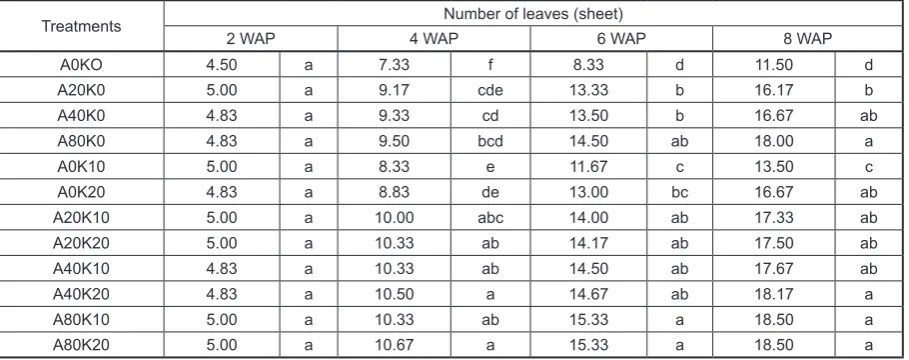
Treatments Number of leaves (sheet)
2 WAP 4 WAP 6 WAP 8 WAP
A0KO 4.50 a 7.33 f 8.33 d 11.50 d
A20K0 5.00 a 9.17 cde 13.33 b 16.17 b
A40K0 4.83 a 9.33 cd 13.50 b 16.67 ab
A80K0 4.83 a 9.50 bcd 14.50 ab 18.00 a
A0K10 5.00 a 8.33 e 11.67 c 13.50 c
A0K20 4.83 a 8.83 de 13.00 bc 16.67 ab
A20K10 5.00 a 10.00 abc 14.00 ab 17.33 ab
A20K20 5.00 a 10.33 ab 14.17 ab 17.50 ab
A40K10 4.83 a 10.33 ab 14.50 ab 17.67 ab
A40K20 4.83 a 10.50 a 14.67 ab 18.17 a
A80K10 5.00 a 10.33 ab 15.33 a 18.50 a
A80K20 5.00 a 10.67 a 15.33 a 18.50 a
that 40% of fly ash level was beneficial for plant growth. The response of plants to coal fly ash was also reported by other researchers, such as Bharti et al. (2000), on green grams, and Pathan et al. (2003), on Cynodon dactylon. Their findings indicate that the concentration of fly ash for im -proving plant growth varies from plant to plant. Muduli et al. (2014) reported the stimulating ef-fect of fly ash on various growth parameters like length, fresh and dry weight of roots and shoots, germination rate and chlorophyll content of legu-minous crops.
Yield components of maize
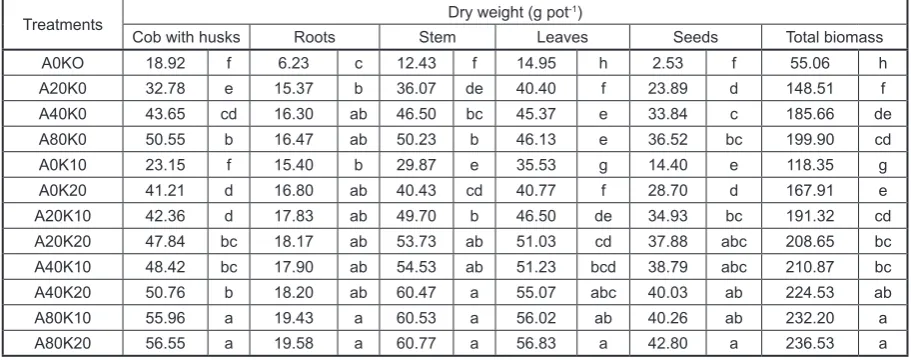
The application of coal fly ash and oil palm empty fruit bunch compost significantly affected the dry weight of plant biomass (cobs, root, stems, leaves, and seeds) (Table 5). The highest dry weight of plant biomass, obtained in the A80K20 treatment, increased by 329.59% compared to the control treatment. In addition, the dry weight of seeds in the A80K20 treatment was almost four times greater than that in the control treatment. The dry weight of seeds produced in the A80K20 treatment increased by 1,591.70% compared to the control treatment. However, the effect of the treatment on dry seed weight was not significant -ly different from the A20K20, A40K10, A40K20, and A80K10 treatments. The application of mate-rials generated from oil palm empty fruit bunch (biochar, compost, and phosphate solubilizing fungi) on Ultisol of Kalimantan significantly im -proved the growth and yield of maize, as well as
its the phosphorus uptake and uptake efficiency (Ichriani et al., 2018). Ekpo et al. (2014) revealed that oil palm empty fruit bunches amendments were able to ameliorate the effect of the crude oil pollution as well as enhance the germination and growth performance of the white mangrove (
La-guncularia racemosa) species.
CONCLUSION
The application of coal fly ash and oil palm empty fruit bunch compost on Ultisol of East Ka-limantan resulted in significantly higher P uptake and better growth and yield of maize plant than the application of coal fly ash or oil palm empty fruit bunch compost alone. The treatment of 80 t coal fly ash ha-1 combined with 20 t oil palm empty fruit bunch compost ha-1 resulted in an in-crease in the P uptake by 303.23%, dry weight of biomass by 329.59%, and dry weight of seeds by 1,591.70% compared to control. The combination of 80 t coal fly ash ha-1 with 20 t oil palm empty fruit bunch compost ha-1 produced the highest P uptake, plant growth and yield, but they were not significantly different from those produced by the combination of 80 t coal fly ash ha-1 with 20 t oil palm empty fruit bunch compost ha-1 treatment. Therefore, when it is associated with the efficien -cy of input use (coal fly ash and oil palm empty fruit bunch compost), it is recommended to use a combination of 80 t coal fly ash ha-1 with 20 t oil palm empty fruit bunch compost ha-1 in the cul-tivation of maize on Ultisol of East Kalimantan.
Table 5. Effect of coal fly ash and oil palm empty fruit bunch compost on dry weights of cob with husks, cob with
husks, roots, stems, leaves, and seeds of maize plant
Treatments Dry weight (g pot-1)
Cob with husks Roots Stem Leaves Seeds Total biomass A0KO 18.92 f 6.23 c 12.43 f 14.95 h 2.53 f 55.06 h A20K0 32.78 e 15.37 b 36.07 de 40.40 f 23.89 d 148.51 f A40K0 43.65 cd 16.30 ab 46.50 bc 45.37 e 33.84 c 185.66 de A80K0 50.55 b 16.47 ab 50.23 b 46.13 e 36.52 bc 199.90 cd A0K10 23.15 f 15.40 b 29.87 e 35.53 g 14.40 e 118.35 g A0K20 41.21 d 16.80 ab 40.43 cd 40.77 f 28.70 d 167.91 e A20K10 42.36 d 17.83 ab 49.70 b 46.50 de 34.93 bc 191.32 cd A20K20 47.84 bc 18.17 ab 53.73 ab 51.03 cd 37.88 abc 208.65 bc A40K10 48.42 bc 17.90 ab 54.53 ab 51.23 bcd 38.79 abc 210.87 bc A40K20 50.76 b 18.20 ab 60.47 a 55.07 abc 40.03 ab 224.53 ab A80K10 55.96 a 19.43 a 60.53 a 56.02 ab 40.26 ab 232.20 a A80K20 56.55 a 19.58 a 60.77 a 56.83 a 42.80 a 236.53 a
Acknowledgements
The authors wish to thank the Directorate of Research and Community Service, Ministry of Research, Technology and Higher Education of the Republic of Indonesia for funding this study. Thanks are also due to the Management and Staff of PT. Cahaya Fajar of East Kalimantan for pro-viding coal fly ash, and PT. Surya Inti Sawit Ka -huripan of Central Kalimantan for providing oil palm empty fruit bunch compost.
REFERENCES
1. Aggarwal, S., Singk, G.R., Yadav, B.R. 2009. Uti
-lization of fly ash for crop production: effect on the
growth of wheat and sorghum crops and soil prop-erties. Journal of Agricultural Physics, 9,20-23. 2. Ashish, T. 2017. Response of pea crop in fly ash
amended soil. Annals of Horticulture, 10(1), 25-30.
https://doi.org/10.5958/0976-4623.2017.00005.6
3. ASTM (American Society for Testing and Mate-rials). 1988. Annual Book of ASTM Standards.
Section 4: Construction. Vol.01.01: Cement, Lime,
Gypsum
4. Bakar, R.A., Razak, Z.A., Ahmad, S.H., Seh-Bar
-dan, B.J., Tsong, L.C., Meng, C.P. 2015. Influence of oil palm empty fruit bunch biochar on floodwa -ter pHand yieldcomponents of rice cultivated on
acid sulphate soilunder Rice Intensification Prac -tices. Plant Production Science, 18(4), 491-500,
https://doi.org/10.1626/pps.18.491.
5. Balemi, T., Negisho, K. 2012. Management of
soil phosphorus and plant adaptation mechanisms to phosphorus stress for sustainable crop
produc-tion: a review. Journal of Soil Science and Plant Nutrition, 12(3), 547-562, https://doi.org/10.4067/
S0718-95162012005000015.
6. Bharti, B., Matte, D.B., Badole, W.P., Deshmukh,
A. 2000. Effect of fly ash on yield, uptake of nutri -ents and quality of green gram grown on a Vertisol. Journal of Soils and Crops, 10, 122-124.
7. Budianta, D., Wiralaga, A.Y.A., Wahana, L. 2010.
Changes in some soil chemical properties of Ul-tisol applied by mulch from empty fruit bunches in an oil palm plantation. Journal of Tropical
Soils, 15 (2), 111-118, https://doi.org/10.5400/
jts.2010.15.2.111.
8. Chaves, L.H.G., Estrela, M.A., de Souza, R.S. 2011. Effect on plant growth and heavy metal ac
-cumulation by sunflower. Journal of Phytology,
3(12), 4-9.
9. Ekpo, F.E., Okey, E.N., Asuquo, M.E. (2014). Ef -fect of oil palm empty fruit bunches amendments in
crude oil polluted soil on germination and growth performance of white mangrove species ( Lagun-cularia racemosa). European Environmental
Sci-ences and Ecology Journal, 1(1): 19-28.
10. Ermadani, M., Muzar, A. 2011. Effect of oil palm mill effluent application on soybean yield and
changes in soil chemical properties of Ultisol. In-donesian Journal of Agronomy, 39(3), 160-167,
http://dx.doi.org/10.24831/jai.v39i3.14959 (in In -donesian).
11. Fahrunsyah, Kusuma, Z., Prasetya, B., Handayan-to, E. 2018. Improvement of some chemical prop-erties of an Ultisol of East Kalimantan through an
application of combined coal fly ash and oil palm
empty fruit bunch. Bioscience Research, 15(3),
1805-1814.
12. Haynes, R.J., Mokolobate, M.S. 2001. Ameliora
-tion of al toxicity and deficiency in acid soil by ad
-ditions of organic residues: A critical review of the phenomenon and the mechanisms involved. Nutri -ent Cycling in Agroecosystems, 59(1), 47-63. 13. Hermawan, A., Sabaruddin, M., Hayati, R., War
-sito. 2014. Conversion of P adsorption on an
Ul-tisol due to the mixture of fly ash of coal-chick
-en manure. Sains-Tanah: Journal of Soil Sci-ence and Agroclimatology, 11(1), 1-10, http://dx.doi. org/10.15608%2Fstjssa.v11i1.198 (in Indonesian).
14. Hilman, Y., Rahim, A.B., Musaand, M.H., Hashim,
A. 2007. Principal component analysis of factors determining phosphate rock dissolution on acid soils. Indonesian Journal of Agriculture Science, 8 (1), 10-16.
15. Ichriani, G.I., Syehfani, Nuraini, Y., Handayanto, E. 2017. Solubilization of inorganic phosphate by phosphate solubilizing fungi isolated from oil palm empty fruit bunches of Central Kalimantan.
Bio-science Research, 14(3), 705-712.
16. Ichriani, G.I., Syehfani, Nuraini, Y., Handay -anto, E. 2018. Formulation of biochar-compost and phosphate solubilizing fungi from oil palm empty fruit bunch to improve growth of maize in an Ultisol of Central Kalimantan. Journal of
Ecological Engineering, 19(6), 45-55,https://doi. org/10.12911/22998993/92891
17. Ifansyah, H. 2013. Soil pH and solubility of
alu-minium, iron, phosphorus in ultisols: The role of
humic acid. Journal of Tropical Soils, 18(3), 203-208, https://doi.org/10.5400/jts.2013.18.3.203.
18. Ismail, M.R., Saud H.M., Habib, S.H., Hossain, K., Maleque, M.A., Hakim, M.A. 2017. Efficacy
19. Kishor, P., Ghosh, A.K., Kumar, D. 2010. Use of
fly ash in agriculture: a way to improve soil fer
-tility. Journal of Agricultural Research, 4(1), 1-14, https://doi.org/10.3923/ajar.2010.1.14
20. Kurniawan, A.R., Adenan, D.D., Untung, S.R., Had
-ijah, N.R., Alimana, M. 2010. Report on Research
on Utilization of Coal Fly Ash of Steam Power
Plant on Pre Reclamation of Coal Mine. Centre for Research and Development of Minerals and Coal Technology, Research and Development Agency of Energy and Mineral Resources (in Indonesian).
21. Lee, H., Ha, H.S., Lee, C.H., Lee, Y.B., Kim, P.J. 2006. Fly ash effect on improving soil properties
and rice productivity in Korean paddy soils. Biore-source Technology, 97, 1490-1497.
22. Mahale, N.K., Patil, S.D., Sarodeand, D.B., Attarde, S.B. 2012. Effect of fly ash as an admixture in agri -culture and the study of heavy metal accumulation in wheat (Triticum aestivum), mung bean (Vigna ra-diata) and urad beans (Vigna mungo). Polish Journal of Environmental Study, 221(6), 1713-1719. 23. Mengel, K., Kirkby, E.A., Kosegarten, H., Appel,
T. 2001. Principles of Plant Nutrition. 5th Edition, Kluwer Academic Publisher. London
24. Minardi, S., Harieni, S., Anasrullah, A., Purwanto, H. 2017. Soil fertility status, nutrient uptake, and maize (Zea mays L.) yield following organic mat -ters and P fertilizer application on Andisols. IOP
Conference Series: Materials Science and Engi -neering 193 (2017), https://doi.org/ 10.1088/1757-899X/193/1/012054.
25. Mohammed, M.A.A., Salmiaton, A., Wan Azlina, W.A.K.G., Mohamad Amran, M.S. 2012.
Gas-ification of oil palm empty fruit bunches: a char -acterization and kinetic study. Bioresource Tech-nology, 110, 628-636, https://doi.org/10.1016/j.
biortech.2012.01.056.
26. Muduli, S.D., Chaturvedi, N., Mohapatra, P., Dhal, N.K., Nayak, B.D. 2014. Growth and physiologi -cal activities of selected leguminous crops grown
in carbonated fly ash amended soil. Greener Jour
-nal of Agricultural Sciences, 4 (3), 83-90, http:// dx.doi.org/10.15580/GJAS.2014.3.021114104
27. Panda, S.S., Mishra, L.P., Muduli, S.D., Nayak, B.D., Dhal, N.K. 2015. The effect of fly ash on
vegetative growth and photosynthetic pigment
con-centrations of rice and maize. Biologija, 61(2): 94-100, https://doi.org/10.6001/biologija.v61i2.3143.
28. Pathan, S.M, Aylmore, L.A.G., Colmer, T.D. 2003.
Soil properties and turf growth on a sandy soil
amended with fly ash. Plant and Soil, 256, 103-114.
29. Reddy, T.P., Umadevi, M., Rao, P.C. 2010. Effect of fly ash and farmyard manure on soil properties
and yield of rice grown on an Inceptisol. Agricul-tural Science Digest, 30(4), 281-285.
30. Sharma, S.K., Kalra, N.2006. Effect of fly ash in -corporation on soil properties and productivity of
crops: A review. Journal of Scientific and Indus
-trial Research, 65, 383-390.
31. Shen, J., Yuan, L., Zhang, J., Li, H., Bai, Z., Chen,
X., Zhang, W., Zhang, F. 2011. Phosphorus
dy-namics: from soil to plant. Plant Physiology, 156, 997–1005, https://doi.org/10.1104/pp.111.175232.
32. Shenoy, V.V., Kalagudi, G.M. 2005. Enhancing
plant phosphorus use efficiency for sustainable
cropping. Biotechnology Advances, 23, 501-513. 33. Singh, R., Singh, D.P., Kumar, N., Bhargav, S.K.,
Barman, S.C. 2010. Accumulation of translocation
of heavy metals in soil and plants from fly ash con -taminated area. Journal of Environmental Biology, 31, 421-430.
34. Soil Research Institute of Indonesia. 2005. Tech -nical Guidelines for Chemical Analyses of Soil, Plant, Water, and Fertilizer. Ministry of Agriculture
of the Republic of Indonesia (in Indonesian).
35. Spark, K.M., Swift, R.S. 2008. Use of alkaline fly ash based productsto amend soils: extractability of
selected elements and their uptakeby plants.
Aus-tralian Journal of Soil Research, 46(7), 585- 599.
36. Sudaryono. 2009. Soil fertility rate of Ultisol
at Sangatta coal field, East Kalimantan. Jurnal Teknologi Lingkungan-BPPT, 10(3), 337-346 (in
Indonesian).
37. Thao, H.T.B., George, T., Yamakawa, T., Widowati L.R. 2008. Effects of soil aggregate size on phos -phorus extractability and uptake by rice (Oryza sativa L.) and corn (Zea mays L.) in two Ultisols
from the Philippines. Soil Science and Plant Nutri
-tion, 54, 148-158,
https://doi.org/10.1111/j.1747-0765.2007.00220.x.
38. Udoetok, I.A. 2012. Characterization of ash made from oil palm empty fruit bunches. International Journal of Environmental Sciences, 3(1), 518-524,
https://doi.org/10.6088/ijes.2012030131033.
39. Ukwattage, N.L., Gamage, R.P., Bouazza, A. 2013. Theuse of coal combustion fly ash as a soil
amendment in agricultural lands (with comments on its potential to improve food security and