A TOP-DOWN AND BOTTOM-UP APPROACH TO IMPROVE REGIONAL INNOVATION
ECOSYSTEMS IN PORTUGAL
David Nunes Resendea; Marco Bravob
a University of Aveiro (UA) – Aveiro, Portugal b University of Texas (UT) – Austin, TX, United States
The objective of this article is to present a successful program that built a National Innovation Network based in the University Technology Transfer Offices (TTOs), incubators and science parks. The University Technology Enterprise Network (UTEN), which was launched in March 2007, includes 15 Portuguese Universities and select international partners in a 5-Year program funded by the Portuguese government. The main objective has been to accelerate the development of a sustainable, globally competitive, professional technology transfer and commercialization network within Portugal to increase Portugal’s international competitiveness in university– based science, and technology transfer and commercialization. We argue that all initiatives that took place in the project have gotten UTEN network present-ly run in the Open Innovation paradigm fostered mostly by the TTOs and their own networks and officers. Science and technology based entrepreneurship was increasingly seen as a key element of Portugal’s ability to grow and prosper (UTEN, 2012). Research universities had worked to foster a range of technology transfer and commercialization activities and offices, together with industrial liaison programs, mostly devoted to fostering entrepreneurial envi-ronments, launching technology based start-ups, and bringing ideas from the laboratory to the market. UTEN was created to synergize this growth and stimulate new competencies in inter-national technology transfer and commercialization to facilitate industry access to leading markets worldwide. In other words, UTEN is the living example of an Innovation network - an Open Innovation Network launched to contribute to build the necessary relationships be-tween all actors, giving them the necessary knowledge to play their roles. This working paper shows the actions taken to construct UTEN and improve the Portuguese Innovation Ecosys-tem. These actions follows the patterns observed in other studies – essentially those ones from Resende et al.,2013; McAdam et al.,2012; Philpott et al.,2011; Todorovic et al.,2011; Rogers, 2002; Rogers et al.,2001; Rogers et al.,2000 etGibson and Rogers, 1994.We have collected data that shows the success of the program based on the results of the first five years of the project.
Keywords: Technology Commercialization; University Industry Relationship; Technology Valorization; Technology Transfer; Innovation Ecosystems.
Abstract
ENVIRONMENT AND SCENARIO
The Portuguese Science and Technology Foundation (FCT) working with The University of Texas at Austin’s IC2 Institute has launched The University Technology Enterprise Network (UTEN) in March 2007 with the vision of building, within five years, a globally competitive and sustainable science and technology (S&T) transfer and commercialization network, managed by highly trained Portuguese professionals, in close international collaboration, achieving a co-creative environment through the empowered links of the network. In fulfilling this vision, UTEN is working to accelerate the international commercialization of Portuguese science
and technology through the development of skills and professional competence at home and the leveraging of UTEN partnerships to foster international technology-based entrepreneurship and business development throughout Portugal.
We will show, in the next sections, how UTEN have applied a well-planned set of procedures to build, within its first five years of implementation, a globally competitive and sustainable science and technology (S&T) transfer and commercialization network, ready to the co-creative OI Ecosystem. UTEN has focused in the TTOs (a bottom-up approach) to build and spread the Portuguese regional innovation ecosystem. Initial clear challenges involved strengthening existing Portuguese regional and national technology transfer (TT) academic-ABEPRO
science-business cooperative networks and abilities in order to achieve needed critical competencies of required expertise to successfully take the best Portuguese S&T and entrepreneurial capabilities to commercial applications and international markets.
This is a working paper based in collected data and will demonstrate the success of the UTEN program (the methodology to collect data consisted of documental analysis, surveys, and interviews).
This working paper is organized as follows: 1. Environment and Scenario; 2. Problem characterization; 3. Research Methodology; 4. Research Data and Discussion; 5. Final Notes and Conclusions; Acknowledges and References.
PROBLEM CHARACTERIZATION
The significant challenges Portugal currently faces center on 1) retaining the country’s educated talent by developing high value jobs and careers, by 2) commercializing Portuguese S&T in global markets to create these new jobs and regional wealth across Portugal (UTEN 2012). UTEN’s initial goal since inception has been the enhanced training and network building, on an international scale, of Portugal’s TT managers and staff, and technology entrepreneurs — an effort initiated under the leadership of the FCT, INPI – Instituto Nacional da Propriedade Industrial, and the IC² Institute at The University of Texas at Austin.
Capacity Building
UTEN’s network includes 14 Portuguese universities and select technology parks and research centres. It focuses on capacity building for the accelerated commercialization of Portuguese S&T.
Portugal stands unique in conceiving, launching, and continually assessing UTEN as an international program for capacity building focused on commercialization of academia S&T to business development and venture creation. These challenging tasks are the key to wealth and job creation— in emerging, developing, and developed economies— especially during the current global financial challenges. If it were easy to launch and build globally competitive national and international technology-based companies then all nations would be doing it. It is not easy. And while Portugal has selected examples of such successes, more needs to be done. The following pages demonstrate UTEN’s proposal to address these challenges and to produce significant results.
UTEN has been continually enhanced from 2007 through 2012, to provide much-needed training in technology transfer and commercialization, together with increased access to international networks, in order to increase capacity building that would:
• Strengthen Portuguese academic-industry linkages • Increase technology-based entrepreneurship • Accelerate firm growth nationally and globally.
Taking the Last Mile
In network systems that support many of today’s critical services – roads, energy grids, telecommunication infrastructures, etc. – there is a well-known difficulty referred to as “the last mile problem.” The (common) difficulty is bridging the gap from a local high-throughput distribution centre to every single consumer home, equipment or individual, so that the service delivery point can actually (physically) meet the consumers, satisfying their needs and thereby producing value. The challenge is to feed the network with valuable content while providing it with the required capillarity to bridge the gap and avoid connectivity problems.
UTEN was born as a concept or a vision of a cooperative network aggregating entities and individuals in Portugal concerned with technology transfer, with a single major goal: Improving and accelerating the transformation of science and knowledge into economically valuable innovative solutions as well as addressing societal problems in a global context. Such a network is being built, with UTEN support, on increasingly larger and more effective knowledge-producing nodes (laboratories, university research groups, tech-based companies) and on the new delivery links created through the technology transfer offices and professionals associated with those labs and universities – the boundary-spanners.
In the OI environment, a boundary-spanner links the desired actors of an innovative project. The links (inbound or outbound links) with partners, brokers or any kind of organization or company participating in a project needed to be managed.
Because these links have been initially created to interconnect the knowledge-producing nodes, they have trouble in effectively connecting with the knowledge-consuming nodes (the end-user companies and other licensees aiming at transforming and/or selling technology and technology-based products and services). This difficulty in effectively connecting to potential clients is the “last mile problem” of the technology transfer network.
With the application of all the capacity-building programs and activities over five years the “last mile problems” of UTEN Portugal have already shown relevant results as can be seen in the next sections.
into economically valuable innovative solutions as well as address their societal problems is adequate.
The questions driving this analysis are concerned with UTEN project and are:
• Granted, there is a huge collection of variables conditioning the TT relationships, can we confirm that all processes, procedures and structures in UTEN network improved and accelerated, with relevant results, the transformation of science and knowledge of UTEN partners into economically valuable innovative solutions?
• Is it possible to characterize processes, procedures, and structures in the network, and to identify their weight in the results?
• Is it possible to point out processes and critical procedures that are still weakly implemented? • If we find and improve weakly implemented
processes and mechanisms, what performance increases (both efficiency and effectiveness) can we expect to achieve from intervening and rectifying existing problems?
RESEARCH METHODOLOGY
The research approach of this study is action research. Action research uses a scientific approach to study important social or organizational issues together with those which experience these issues directly. It has always two goals: making the action happen and reflecting what happens in order to contribute to the theory. This process involves collaboration between researchers and members of the organizational system. Action researchers are not just observing change; they are actively working to make it happen (Coughlan et Coghlan 2002).
Tharenou et al.,(2007) argue that action research studies iteratively cycle through diagnosis and intervention until there is an understanding of the situation investigated. In this study, the action research is used to develop practice-based innovation processes in cooperation with the employees of case organizations.
The empirical research is based on various case studies. In fact, these case studies are all related to each other since the intention is to create a powerful network in the Portuguese innovation ecosystem. “Case study is a comprehensive inquiry, conduced in the field, into a single instance, event or setting” (Tharenou et al.,2007). Case studies allow concentrating on specific instances aiming to provide a multidimensional view of the situation (Remenyi
et al.,1998). Although the results of a case study are difficult to generalize to other cases, the generalizability
can be improved by using more than one case (Tharenou et al.,2007).
Action research always requires pre-understanding of the organization’s environment, conditions of the business as well as structure and dynamics of the operating systems (Coughlan et Coghlan, 2002). Therefore, a baseline data collection was gathered in the first research phase.
RESEARCH DATA AND DISCUSSION
According to Coughlan et Coghlan (2002), the general phases of an action research processes are: planning, taking action, evaluating the action and further planning. This section describes the evaluating phase (s) with UTEN Program where twenty offices were contacted, and responses were received from 18 TTOs as of late October 2012.
The next discussion is a transcription of selected parts of our empirical research from UTEN report (UTEN 2012), by James Jarret and Aurora Teixeira, Assistant Professor with Habilitation, Faculdade de Economia, Universidade do Porto; Associate researcher of CEF.UP, INESC Porto & OBEGEF.
Evaluation - UTEN Surveys of TTOs
In 2012 the third annual UTEN network survey of technology transfer offices was conducted to develop a more comprehensive view of technology transfer in Portugal from 2007 to 2011. The summary of key findings follows.
• The primary functions of TTO employees continue to be: grants and fund-raising (27%), intellectual property (18%), and entrepreneurship/spin-outs (14%) with smaller amounts of time devoted to coordination, licensing, and industrial liaison; • On average, approximately half of the revenues
received by TTOs are from grants, with another 20% from external fees and services; only one fourth of TTO revenues are provided by their institution; • Compared to last year, there was a substantial
increase (42%) in the number of invention disclosures reported by the TTOs;
• There are no clear trends with patent applications, while there has been an upward or stable trend over time for the three main types of patents granted. In the last two years, the impact of the economic crises in the use of patents seems clear;
• Total license income increased once again in 2011, by about 6% over the prior year;
• R&D agreements were 38% higher in 2011 than in 2010 and
• TTOs reported a large number of new companies established: 141 in 2011 compared to 95 in 2010.
EMPLOYEE DUTIES: The number of full-time technical/
professional employees ranges from 1 to 14 per office. Twelve of the 18 TTOs have five or fewer technical/ professional employees. The offices that responded have a total of 81 technical/professional employees. Across the different TTOs, on average employees allocate their time to several key functions.
SOURCES OF REVENUES:Grants and fund-raising are an
important task for TTOs. Only one TTO in 2011 received all of its revenue from its home university. TTOs are in fact quite dependent on grants to perform their functions as nearly half of their revenues, on average, come from grants. In 2011, ten of the TTOs secured at least half of their revenue from grants, with three TTOs above 70%. Two other TTOs were
entirely funded from external fees and services. Compared to the prior year, TTOs increasingly relied on external fees and services and grants, and received a smaller proportion from their home institution.
ROYALTIES: Seventeen TTOs provided information about
royalties, and 15 reported that royalties are split between their institutions and the inventors in varying proportions. In eight of the institutions, royalties are split 50%-50%. In another seven institutions, the inventors receive 55% or more, including two institutions that provide 80% to inventors. One university alters the allocation depending on the total amount of royalties received—for smaller amounts the inventor receives a higher percentage, while for larger amounts the university receives more and the organizational unit receives some proportion. Compared to last year, inventors now are receiving a larger share at a number of institutions.
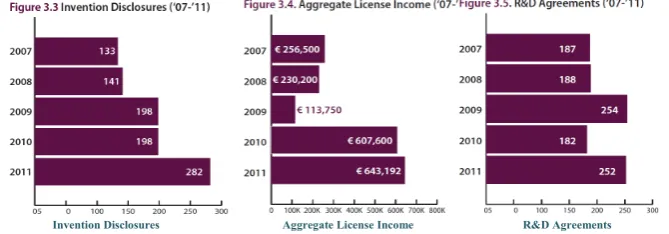
INVENTION DISCLOSURES: Compared to last year, there
was a substantial increase (42%) in the number of invention disclosures reported by the TTOs. As shown in Figure 1, invention disclosures in 2011 reached 282.
Invention Disclosures Aggregate License Income R&D Agreements
Figure 1 – Indicators – 2007 to 2011
PATENT APPLICATIONS (PRIORITY FILINGS): The trend
is less clear on patent applications as shown in Table 1. In one category (provisional), the trend is clearly upward, while in the other four categories there are no clear trends. In 2011, there was one application in Spain and another in India.
PATENT APPLICATIONS BY SUBJECT AREA: More than
half of the TTOs applied for some type of a biomedical (diagnostic, devices, pharmaceutical etc.) patent in 2011. Six of the TTOs applied for a patent related to computers
or communication equipment, while four applied in the area of nanotechnology/new materials, and two in low or zero carbon energy technologies. Other areas in which TTOs applied for patents were agricultural sciences, life sciences, mechanics & electromechanics, and the food industry.
PATENTS GRANTED: The trends have been upward or
stable over time for the three categories. In 2011, two TTOs reported receiving Canadian patents.
TTOs Patent Applications (Priority Filings)
Patents Granted: The trends has been upward or stable over time for the three categories
2007 2008 2009 2010 2011 2007 2008 2009 2010 2011
Provisional Filings 4 23 66 80 100
Portuguese 71 88 76 78 69 24 32 38 56 52
EPO 12 13 12 4 6 4 5 5 7 8
USPTO 11 17 5 11 7 5 3 5 4 2
PCT 29 30 74 43 17
LICENSES, OPTION AGREEMENTS, AND
ASSIGNMENTS: As in prior years, the large majority of the
licenses, agreements, and assignments have been executed with Portuguese partners as shown in Figure 1. The total in 2011 nearly matched the very strong number in 2010, and the trend over the past five years continues to be positive.
About an equal number of licenses and options were granted to start-up companies and firms with fewer than 250 employees. The remaining licenses and options, about 20%, were granted to companies with more than 250 employees.
LICENSE INCOME: The total amount of license income
increased once again in 2011, following the dramatic increase in 2010. Seven of the TTOs reported license income, with three TTOs reporting license income of at least €100,000 in 2011. Therefore the aggregate amount of nearly €650,000 is not due to a single transaction or single TTO. Three TTOs reported international license income.
COMMERCIALLY PROFITABLE PRODUCTS: Eleven
TTOs indicated that their institution’s licensed technology or knowledge had resulted in commercially profitable products or processes in the past three years.
RESEARCH AND DEVELOPMENT AGREEMENTS: TTOs
reported a dramatic increase in the number of executed agreements in 2011, up 38% from the prior year. The number in 2011 essentially matches the strong performance in 2009 and considerably surpasses the levels in 2007 and 2008 as shown in Figure 1.
INSTITUTIONAL RESEARCH RESOURCES: For the first
time in this series of surveys, TTOs were asked questions about their institution’s research resources. The total number of research personnel (researchers, technicians, and administrative support personnel) at 14 institutions in 2011 was 22,377. Six TTOs reported more than 1,000 researchers each. The aggregate research budgets at nine institutions were €112,908,866, with two institutions accounting for three-quarters of the total. Privately funded research at institutions varied considerably. One TTO said 35% of total research expenditures came from private companies, a second TTO said that figure was 24% at their institution, and a third TTO reported 19%. One TTO each reported 12%, 11%, 10%, and 9%, while three TTOs reported 5%. Other TTOs did not provide a response.
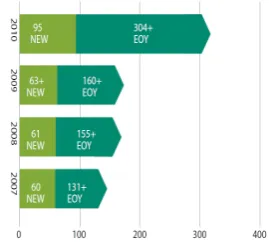
SPIN-OFF & START-UP COMPANIES: Data from the
TTOs show that a large number of new companies are being established. In 2011, TTOs reported 141 new companies were established, while nine companies from prior years ceased operations. The total number of new companies and the total number of active spin off and start-up companies until 2010 is shown in Figure 2.
Figure 2 – New Academic Spin Offs (ASOs) and total ASOSs at end of year.
Figure 3 - Beginning of the activity/sales/exports/ subsidiary of ASOs. (Teixeira, A. in UTEN 2012)
We argue that UTEN program has improved not only the OI ecosystem but, more deeply, the co-creation relationships. The indicator is the number of ASOs that started selling earlier in the last years (Figure 3). In this case, one could state that the ecosystem boot up the user driven innovation with some network actors.
Discussion
It was not until the middle 2000s though that, in Portugal, a definitive academic entrepreneurial wave entered effectively and explicitly into the agenda of both politicians and academics. In 2006 three major international cooperation programs (Carnegie Mellon | Portugal, MIT | Portugal and UT Austin | Portugal) have started with a central aim, among others, to promote the commercialization of scientific knowledge (Heitor et Bravo, 2010).
The TTOs have been established to assure professional commercialization of the knowledge generated within the universities. These developments have received extensive attention worldwide with researchers focusing initially to a larger extent on the direct implications of licensing and patenting (Rothaermel et al., 2007).
such trends, depicting TTOs and ASOs as key university related technology transfer mechanisms, might in large part be connected with the institutional changes observed
in Portugal in this period, associated with the creation of transnational programs, namely UTEN - The University Technology Enterprise Network (Gibson et Naquin, 2011).
As the TTOs and ASOs are linked to the universities in our study, we can continue our discussion with some more indicators of university patent applications. In Portugal, university national patent applications have continuously increased between 2006 and 2009, with growth rates above 20% per year, as seen in Table 2. In 2010, it is possible to observe a slight decrease, partly recovered in 2011. The effects of the financial restrictions, resulting from the economic crisis, are visible in the number of patents applied for, in these last years, namely after 2010.
In general, the main applicant universities increased the number of patent applications over the last six years. On an individual level, between 2006 and 2011, University of Beira Interior (UBI) and University of Trás-os-Montes and Alto Douro (UTAD) showed the most distinct growth. In 2006, these universities had the lowest number of patent applications. However, in 2011, UBI had the lead and the UTAD had the third highest number of patent applications. While Instituto Superior Técnico (IST) has significantly
decreased the number of patent applications in the last two years, it remains the university with the highest number of accumulated applications (194) in the period 2006-2011.
As shown in Table 3, except for the United States, the national and international (WIPO and EPO) patent applications have risen until 2009. In the last two years, the impact of the economic crises in the use of patents seems clear. There was a decline in the number of patent applications in all routes of protection. It was at national level that this effect was less visible, to a certain extent this can be explained by the fact that the protection in Portugal is the one which requires the lowest investment.
The number of patents applied for directly in the United States increased in 2007, but in the following years the level of applications has been more or less maintained. Moreover, it is interesting to observe that in 2010 there was even a rise in the applications in the United States contrary to the behavior in other routes/territories.
Table 2 - University National Patent Applications
Table 3 – National and international patent applications, 2006 - 2011
In 2011, EPO published 89 patents applications and WIPO published 185 applications, in several technology areas, belonging to Portuguese enterprises, higher education and R&D institutions, and independent inventors. The majority of these applications came from enterprises, followed by universities and then by individuals. The U.S. Patent and
Trademark Office (USPTO), in 2011, published 27 patents submitted by Portuguese entities; enterprises filed 23 of those patents, and while universities filed the remaining four.
of OI have brought new challenges and opportunities to international technology transfer and commercialization. UTEN have worked the last five years, with national and international partners to leverage existing professional technology transfer and commercialization know-how, to generate new knowledge for successful S&T co-creation and commercialization, and to promote Portuguese economic development in the global economy.
FINAL NOTES AND CONCLUSIONS
The UTEN program was launched in 2007 by the Portuguese Government and the IC2 Institute, The University of Texas
at Austin (UT Austin) to provide a commercialization outlet for Portuguese S&T resulting from in-country investments. Over the years, UTEN’s mission has been gradually evolving to build a professional, globally competitive and sustainable technology transfer and commercialization network in Portugal which is oriented toward international markets. As noted below, the outcomes from the UTEN program have been quite impressive:
• Networking of all major research institutions throughout the Portuguese mainland and associated islands;
• Development of a technology transfer office (TTO) infrastructure at all major nodes within the UTEN network;
• Delivery of more than 50 workshops hosting over than 1,500 participants providing broad training for in-country professionals and scientists;
• Intensive infrastructure investment in 12 TTO’s from leading universities, providing intensive assessment, development and process improvement;
• Deep training of more than 30 TTO professionals who have interned in the US receiving immersion training in best practices in commercialization of technologies;
• Disclosure of over than 150 new technologies in the form of inventions from Portuguese researchers, which is an almost 50% increase in disclosure rate compared to the pre-UTEN environment;
• Catalyzing a 1,900% increase in provisional patent filings and almost 20% increase in issued patents to Portuguese researchers;
• Supporting the launch of more than 100 new technology-based companies and their support with regards to international markets and business strategies;
• Driving a 132% increase in academic start-up
rate compared with pre-UTEN, where the young companies show more than 125% increase in revenue and 38% growth in hiring annually;
• In-person meetings with more than a dozen Fortune 500 companies and US subsidiaries for three companies and
• Development of five Portuguese companies in the US market through the UTEN “US Connect” pilot program resulting in business, services, and manufacturing deals.
These metrics demonstrate the success of the UTEN program and argue for its continued and critical role connecting the innovation of Portuguese entrepreneurs and the growth in scientific output with real economic impact – both in GDP and employment. The outcomes of the UTEN program and the pilot US Connect program in 2012 were highly impactful and indicative of the success that can be expected from a continued program in terms of: (1) capturing leading scientific accomplishments as inventions; (2) practicing effective technology transfer in support of out-licensing and spin-out activities; (3) developing human capital to support entrepreneurial activities; and (4) preparing Portuguese companies for international market expansion. This success provides the impetus to propose a more comprehensive strategy for the coming five-year period, from January 2013 to December 2017 with further improvement “taking the last mile” internationally.
REFERENCES
Coughlan P, Coghlan D (2002) Action research for operations management. International Journal of Operations & Production Management, 22 (2), 220-240
Gibson D, Rogers E (1994) R&D collaboration on trial: The Microelectronics and Computer Technology Corporation. Boston: Harvard Business School Press
Gibson D, Naquin H (2011) Investing in innovation to enable global competitiveness: The case of Portugal. Technological Forecasting and Social Change, Vol. 78, Issue 8, pp. 1299-1309
Heitor M, Bravo M (2010) Portugal at the crossroads of change, facing the shock of the new: People, knowledge and ideas fostering the social fabric to facilitate the concentration of knowledge integrated. Technological Forecasting and Social Change, Vol. 77, Issue 2, pp. 218-247
Remenyi D, Williams B, Money A, Swartz E (1998) Doing research in business and management: an introduction to process and method. London: Sage Publications, 309p
Resende D, Gibson D, Jarrett J (2013) BTP—Best Transfer Practices. A tool for qualitative analysis of tech-transfer offices: A cross cultural analysis, Technovation, Volume 33, Issue 1, January 2013, Pages 2-12
Rogers E, Yin J, Hoffmann J (2000) Assessing the effectiveness of technology transfer offices at U.S. research universities. Journal of the Association for University Technology Managers, 12, 42-80
Rogers E, Takegami S, Yin J (2001) Lessons learned about technology transfer. Technovation 21 (4), 253-261
Rogers E (2003) Diffusion of innovations. New York Free Press. 5th edition
Rothaermel F, Agung S, Jiang L (2007) University entrepreneurship: a taxonomy of the literature. Industrial and Corporate Change, Vol. 16 (4), pp. 691–791
Tharenou P, Donohue R, Cooper B (2007) Management research methods. Cambridge. Cambridge University Press, 338p
Todorovic ZW, McNaughton RB, Guild P (2011) ENTRE-U: An entrepreneurial orientation scale for universities. Technovation 31 (2-3) 128-137