A Novel Time Advancing Mechanism for
Agent-Oriented Supply Chain Simulation
Xu Xu, Jie Lin
School of Economics and Management, Laboratory of Intelligence Decision and Decision Support Tongji University, Shanghai, P. R. China
Email: [email protected], [email protected]
Abstract— Among the techniques supporting a multi-decision context, as a supply chain is, distribution simulation can undoubtedly play an important role in a co-operative environment. The distribution simulation for supply chain has its advantages to find and solve bottleneck of supply chain. Considering the design of distribution simulation platform for supply chain, the realization of time synchro-nization and time advance will be the key points. This paper proposes an advancing mechanism that integrates High Level Architecture with multi-agent distributed simulation to meet time management in supply chain simulation, i.e., a ’heterogeneous’ system is built during our research. We present some preliminary experimental results which illustrate the performance of our advancing mechanism on our platform established. Finally, the experimental results have demonstrated the novel time advancing mechanism can be successfully applied in supply chain contexts, and surely prove that it is feasible and scientific.
Index Terms— distributed simulation, supply chain, high level architecture, agent, time management
I. INTRODUCTION
Modern industrial enterprises operate in a rapidly changing world, stressed by even more global compe-tition, managing unforeseeable markets, supervising ge-ographically distributed production plants, striving for the provision of outstanding products and high quality customer service [1].
In the last years, globally companies, as well as Small and Medium Enterprises (SMEs), are realizing that the efficiency of their own business is heavily dependent on the collaboration and co-ordination with their suppliers as well as with their customers [2]. This external perspective is termed in literature under the concept of supply chain management (SCM), which is concerned with the strate-gic approach of dealing with trans-corporate logistics planning and operation on an integrated basis [3].
From the IT perspective, a new wave of solutions is arising with the main type to overcome all the physical, organizational and informational hurdles which can se-riously jeopardize any co-operation effort [4]. Advanced Planning and scheduling (APS) systems aim to step over
Xu Xu and Jie Lin are co-first authors.
The research is supported by the National High-Tech. R&D Program for CIMS, China (No.2007AA04Z151), Program for New Century Excellent Talents in University, China (No.NCET-06-0377), Shanghai Leading Academic Discipline Project (No.B310) and the National Natural Science Foundation, China (No.70531020).
the intra-company integration supplied by Enterprise Re-source Planning (ERP) systems by providing a common inter-organizational SCM platform, which supports the logistics chain along the whole product life-cycle, From its initial forecast data, to its planning and scheduling, and finally to its transportation and distribution to the end customer [5]. Despite the various solutions currently available on the market, the common feature of the APS products reside on the intensive usage of quantitative methods in order to provide users with the best solution at time.
Among these quantitative methods, simulation is un-doubtedly one of the most powerful technique to apply as a decision support tool, within a supply chain environ-ment.
In the industrial area, simulation has been mainly used for decades as an important support for production engi-neers in validating new lay-out choices and correct sizing of a production plant. Nowadays, simulation knowledge is considered one of the most important competition to acquire and develop with modern enterprises in different processes (marketing, manufacturing) [6]. In particular, supply chain is a typical environment where simulation can be considered a useful device.
The simulation of physical systems (e.g. supply chain) is an important tool for researchers that allows them to analyze the behavior or/and performance of the system considered and to verify new ideas. It is natural to model supply chain as a set of computing processes which then can be handled by distributed machines or processors. For the last two decades, distributed simulation has been an active research area. Distributed simulations not only reduce the computation time and permit to execute large programs which cannot be executed on a single machine, but they first of all reflect better the structure of the physical system to be simulated.
other agents whose environment of a given agent. Simulation has traditionally played an important role in agent research and a wide range of test-beds have been developed to support the design and analysis of agent architectures and systems. There has been considerable recent interest in agent-based platform which cooperate within an environment to perform some tasks, such as Swarm, Repast, Ascape. By far, there has no mature distributed simulation platform not only to satisfy the needs of supply chain, but also to solve the bottleneck of supply chain. The work suffers the following problem. The problem is how to integrate distributed simulation with multi-agent to build the platform. Such combination is an essential step in establishing an simulation platform, the behavior and environment in which they are all em-bedded. Taking all into consideration is how to establish an advancing mechanism to satisfy time synchronization and time advancing. These are our paper’s key points.
In summary, aim of this paper is to find and realize time advancing mechanism for agent-oriented supply chain Simulation.
The paper is organized as follows. First, background and related work are illustrated. Second, time manage-ment research is summarized. Third, time advancing mechanism is proposed in order to build agent-oriented supply chain simulation. Fourth, preliminary experimental results are presented and reported. Finally, conclusion and future work from the authors are provided.
II. BACKGROUND ANDRELATEDWORK
In this section, we briefly describe the relation between distributed simulation and SCM, traditional distributed simulation protocols, and multi-agent distributed simula-tion.
A. The Relation between Distributed Simulation and SCM Generally, simulation of supply chain can be carried out according to two structural paradigms: using only one simulation model, executed over a single computer (local simulation) or implementing more models, executed over more computers in a distributed fashion.
Distributed simulation: Distributed simulation is con-cerned with execution of simulations on geographically distributed computers interconnected via a network, local or wide [8]. The need of a distributed execution of a simulation across multiple computers derives from four main reasons [9], [10]: (1) produce execution simulation time, (2) reproduce a system geographic distribution, (3) integrate different simulation models that already exist and integrate different simulation tools and languages, and (4) increase tolerance to simulation failures.
SCM: SCM involves managing the flow of material and information through multiple stages of manufacturing, transportation and distribution with the objective of main-taining low inventories without compromising customer service level. The effective practice of SCM is critical to participating companies especially in today’s business
trend whereby companies are geographically distributed throughout the globe.
Traditionally, SCM involves only a single enterprise with multiple facilities and distribution centers. But in recent years, the scope of SCM has evolved to cross the enterprise boundaries, as vertical integration is no longer the emphasis of large corporations [11].
Commercial simulation tools for supply chain planning have been released in recent years, for example the Supply chain Analyzer by IBM and the integrated tools of simulation and optimization by i2. This illustrates the importance and applicability of simulation to supply chain planning. The main area of application of supply chain simulation has been on performing what-if analysis, by varying various aspects of the chain. Building a detailed model of the supply chain does not pose a problem when the chain involves only a single enterprise. In contrast, not many participating companies are willing to share detailed model information when the chain crosses the enterprise boundaries. This obstructs the use of simulation in supply chain planning.
Distributed simulation techniques as the enabling tech-nology to eliminate this obstacle. Distributed simulation technology allows each participating corporation to run their own simulation model at their own site. Detailed model (application codes and data) information is encap-sulated within the corporation itself and the participating corporations only need to define essential information flows from one model to another. i.e., some of the features of distributed simulation were recognized as important benefits for enabling sound simulation models in support of SCM. The distributed approach has been progressively considered the most viable. This is due to its undeniable advantages [12], [13]: (1) the possibility of developing complex models preserving proprietary information as-sociated with individual systems, (2) the correspondence between model and node, guaranteeing a real and updated representation of the single industrial units, and (3) a reduction of the simulation time, taking advantage of the additional computing power of the distributed processors. In the specific field of supply chain simulation, tra-ditionally carried out with the use of local models. To realize the model encapsulation, traditional distributed simulation protocols should be discussed.
B. Traditional Distributed Simulation Protocols
Distributed simulation has been largely used for many years in military applications, in which computers and executables have been joined together through tools such as distributed interactive simulation (DIS) protocol, aggre-gate level simulation protocol (ALSP), and the high level architecture (HLA). These architectures, all developed in the military field, are the basis of distributed simulation. Weaterly et al. [14] and Page and Smith [15] provide a complete description of them; they are briefly illustrated in the next paragraphs.
an IEEE standard in 1993 and its objective was to create synthetic, virtual representations of warfare environments through a systematic connecting of separate simulation subcomponents which reside in distributed and multiple locations. Generally, DIS simulations run in real-time with an elevated degree of detail. Communication in a DIS environment is based on the protocol date unit (PDU), a set of encoded bits that communicate entity state and other information identified as useful within the protocol (weapons fire events, etc.). A process known as ’dead reckoning’ (esteemed position) is used to reduce the number of entities introduced into the network during runtime, by allowing entity state extrapolation between updates.
The Aggregate Level Simulation Protocol: The Ag-gregate Level Simulation Protocol (ALSP) was targeted towards support for the inter-operation of aggregate-level, logical-time simulations. ALSP provides an ASCII-based message-passing protocol and software infrastructure that coordinates the advance of simulation time, enforces adherence to a common object model of the shared simulation state, and arbitrates contests over the right to modify that shared state.
The High Level Architecture: High Level Architecture (HLA) [9] is the most known distributed framework. It represents both a generalisation and extension of DIS and ALSP [9]. The HLA is defined by three components: (1) a common model definition and specification formalism, (2) a collection of services describing the HLA runtime environment, and (3) a set of rules governing compliance with the architecture. HLA is designed with a high degree of flexibility, permitting an arbitrary mixture of fidelity and resolution. The notion of federation is at the heart of HLA, that is, a collection of federates-simulators and other systems-that inter-operate using the protocols described by the architecture. In a typical federation execution, a federate joins the federation, indicates its operating parameters (information that federates provide to the federation and information that they expect to receive from that federation) and then participates in the evolution of the federation state until the federate departs the federation, or the simulation ends [16]. In 1996 the HLA was endorsed as the standard for all US DoD M&S. Today it still represents the most widely used architecture for distributed simulation. Many scientific papers analyse perspectives and the uses of HLA in different applications (navy, transportation, environment, videogames, etc.) [17], [18], included the industrial pro-duction field [19], [20].
In HLA, each individual model is a federate. A collec-tion of federates that form the whole simulacollec-tion system is a federation. To apply this to a supply chain simulation, the federate is thus the basic simulation model of each individual company. Each company defines only data that they are willing to share in the Simulation Object Model (SOM) using the object model template (OMT) of the HLA. The simulation time synchronization of federates is achieved automatically through the time management
Simulation Agent
Core Agent Network Environment Federation
Simulation Agent
Simulation Agent
Figure 1. Multi-agent distribution model.
services of HLA. Time management will be discussed in the next section.
C. Multi-Agent Distributed Simulation
Agent-based simulation offers advantages when inde-pendently developed components must inter-operate in a heterogeneous environment, e.g., the Internet, and agent-based simulation are increasingly being applied in a wide range of areas including business process modeling and military simulations. A multi-agent simulation is an simu-lation composed of multiple interacting intelligent agents. Multi-agent simulation can be used to solve problems which are difficult or impossible for an individual agent or monolithic simulation to solve.
What is required is a general, distributed simulation framework for multi-agent. Such a framework, capable of supporting a wide variety of agents and environment, would facilitate generalization by ensuring that different implementations are subject to identical assumptions. In addition, the use of distributed simulation techniques would allow exploiting the processing power to study larger and more complex multi-agent.
The aim of the study is to simulate a wide range of agent-based supply chain, from a single agent in a com-plex environment, e.g., an agent controlling a production process, to many agents in s simple environment, e.g., an environment consisting almost entirely of other agents such as transportation agent, buffer agent in network environment.
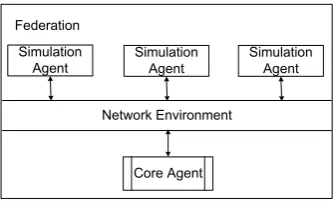
Figure 1 shows the simplified multi-agent distribution model. Supply chain simulation can be integrated through distributed simulation once each module is implemented.
III. TIMEMANAGEMENTRESEARCH
A. Time Models
Time models are inspired by research in the distributed simulation community, where they are used implicitly to assign logical time stamps to all events occurring in the simulation [21]. In software simulations, the logical time stamp of an event corresponds to the physical time the event was observed in the real world which is being simulated.
a multi-agent is related to logical time [22], and these logical durations of activities are used as a means to determine the relative execution order of all activities within a multi-agent platform. In this way a time model allows the developer to describe the required execution in a platform-independent way. The execution of an application on a particular execution platform must be controlled according to the defined time model.
B. Time Management Mechanism
By specifying time models, it is important to define execution requirements for a multi-agent platform. By relating multi-agent activities to logical time. Multi-agent simulation additionally need time management mecha-nisms to ensure that all activities are executed according to the time model specification. These mechanisms avoid that any event with a logical time in the future can have influence on things with a logical time in the past, even in the presence of arbitrary network delays or computer loads. In other words, time management preserves causal-ity dictated by logical time.
Distributed simulation communities have been inves-tigating the consistency of logical time in simulations for a long time. All events happening are ordered and hence causally related by means of the global notion of logical time [23]. Therefore various time management mechanisms have been developed to prevent causality errors:
Execution directed by clock.In this approach the logical time of the system is discredited in a number of intervals of equal size. The interval size is called time step. Global synchronization schemes force all entities to advance together in a lock-step mode, and hence the execution of the system proceeds synchronously. In the case of multi-agent simulation, a drawback is that synchronous execution forces all agents to act at the pace of the slowest one, which severely limits execution speed [24]. Moreover, since a central authority must control and keep track of the execution of all agents in the system, the cost of synchronous approaches increases rapidly as the number of agents grows.
Execution directed by events. In this case, events are generated by all entities [25], and each event has a precise logical time stamp which allows sorting them. During execution, the next event to be processed is the one with the smallest logical time stamp, ensuring causality and thereby skipping periods of inactivity. However in a distributed context, a system is modeled as a group of communicating entities, referred to as logical processes (or LPs).
Each LP contains its own logical clock (indicating its local logical time) and all LPs process events asyn-chronously and advance at different rates, which allow a significant speedup, but may cause causality errors. Hence, for asynchronous execution additional synchro-nization is needed to ensure that each LP processes messages in increasing logical time order:
Conservative synchronization. In conservative synchro-nization [26] each LP only processes events when it can guarantee that no causality errors (out of (logical) time order messages) will occur. This causes some LPs to block, possibly leading to deadlock. The performance of conservative synchronization techniques relies heavily on the concept of lookahead, but the autonomous behavior of agents could severely restrict the ability to predict events [27]. Moreover, to determine whether it is safe for an agent to process an event, information about all other agents must be taken into account, limiting the scalability of this approach.
Optimistic synchronization. In optimistic approaches, causality errors are allowed, but some roll-back mech-anism to recover from causality violations is defined (e.g. time warp [28]). While this approach is feasible for simulations, providing rollback for multi-agent simulation applications in general is not feasible at all. Moreover, the cost imposed by the roll-back mechanisms can easily outweigh the benefits [29] and increases rapidly as the number of agents grows.
C. Time Stamp Order
The features of time stamp order can be summarized: (1) a message will be held until run-time infrastructure (RTI) can guarantee that no message having a smaller time stamp will later be received, (2) no message will be delivered to a federate in its past, (3) it is useful for classi-cal discrete event simulations, and (4) conflict resolution (ordering of concurrent messages) is deterministic.
D. Lookahead
For Time Stamp Order using conservative synchro-nization, a federate promises the RTI that it will predict attribute updates and interactions at least L time units ahead of time, RTI can use this value to determine when it can safely allow a federate to advance its time, and a federate may retract a event.
Lookahead is often derived from: (1) physical limita-tions of federates, (2) tolerances to temporal inaccuracies, (3) Time step increment, (4) non-preemptive behaviour, and (5) pre-computed simulation activities.
The pre-requisite to using the time management ser-vices of HLA is that each federate must define a nonzero lookahead value. In HLA, lookahead is associated with a federate. It is a value which determines the next earliest time that the federate will send an external event. Before a federate executes each event, the simulation time of this event has to be checked against the time granted by the RTI earlier. If the simulation time is not greater than that previously granted, the event is then simulated. Otherwise, the federate needs to request for time advancement from the RTI.
Lower Bound on Time Stamp (LBTS). Earliest time the RTI expects it could possibly deliver a message to a particular federate, LBT S(F) =M in(Ti+Li) over all
Core Agent
Constrained Agent Control
Agent
Logical Time Synchronized Agent
Figure 2. The procedure of time advancing.
when LBTS(F) exceeds the time advance requested by F, the RTI can grant F its time advance.
IV. PROPOSEDTIMEADVANCINGMECHANISM
Taking into consideration all of the above, this paper adopts conservative synchronization to study the strategy of time management mechanism in agent-oriented supply chain simulation. The time management of federate can be classified into three types:
Time regulating or logical time aggressive. Federate participates in determining the logical time of other fed-erates (i.e., may send time stamp ordered messages).
Time constrained or logical time passive. Federate is constrained by the logical time of other federates (i.e., may receive time stamp ordered messages).
Logical time synchronized. Federate not only affects some federates, but also is controlled by other federates (i.e., may send and receive time stamp ordered messages).
A. Time management of Agent-Oriented Simulation Time management of federate is as discussed above, the time management of federate agent has the same classification. In other words, time regulating agent and logical time synchronized agent can send receive order (RO) message and time stamp order (TSO) message to time constrained agent and logical time synchronized agent, and they only send the RO message to regulating agent. Time constrained agent only sends RO message.
LBT Si of Federate agent can be defined as follows:
LBT Si= (M in(Tj+lookaheadj)·αi) +M·(1−αi)
(1) When the agent is time restrained agent,αi=1, the agent
only send the TSO messages; when the agent is non-time restrained agent,αi=0, M is infinite.
To the core agent, LBTS can be defined as follows:
LBT S =M in(LBT Si) (2)
B. Time Advancing Mechanism for Agent-Oriented Sim-ulation
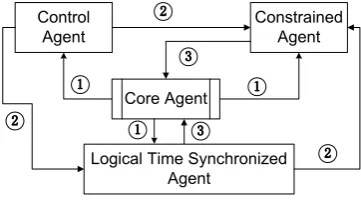
In this section, we first present a framework (see Figure 2) of time advancing, then explain the proposed time advancing mechanism according to the framework in detail.
B1
B3
B2
B4
B5
A1 B6
B7
B8
B9
B10-12
A2
A3
A4
A5
Ti
Figure 3. Experimental model.
The procedure can be summarized as follows1 : (1)
core agent receives the message of the completion of federate agents, then confirms federation LBTS, and sends federation time to the agents. After that, the simulation enters a new synchronization, (2) the second procedure of time advancing starts to discuss from different cases:
• Regulating agent and logical time synchronized
agent receive federation LBTS, then compares their LBTS to federate LBTS, if LBTS is larger than federation LBTS, reply the core agent through their LBTS, the synchronization is completed. Otherwise, the regulating agent and logical time synchronized agent send the messages to other agent, after the completion of all tasks, they send TSO messages to the related agent ( processing task included ).
• Time restrained agent (including the constrained and
logical time synchronized agent) receives federation LBTS, then compares his own LBTS, if LBTS is larger than federation LBTS, the core agent will re-ceive the reply of time restrained agent, the synchro-nization is completed, and the time restrained agent will wait for the next federation LBTS. Otherwise, the time restrained agent completes all the tasks, and check the last circle Lookahead of related regulating agent LBTS (logic time is less than federate LBTS) whether having new Lookahead or not, the time re-strained agent waits for the updating, after updating, the restrained agent gets his own LBTS (see equation (1)), then sends the messages to core agent. And (3) core agent receives all the reply of time constrained agent and logical time synchronized agent, then computes the new federation LBTS (see equation (2)), and sends the new LBTS to all agents. After that, the simulation enters a new circle.
V. EXPERIMENTALRESULTS
To evaluate the correctness and feasibleness of our proposed time advancing mechanism, we employ JADE in Eclipse platform to build a system to simulate the supply chain based on our novel time advancing mechanism. In order to illustrate the mechanism effectively, we establish an experimental model of supply chain (see Figure 3).
In Figure 3, there are five machining workshops (A1,
A2,A3,A4,A5), twelve warehouses or buffers (B1,B2,
B3,B4, B5,B6, B7, B8,B9, B10,B11, B12), and five
1We illustrate the advancing mechanism according to ordinal
Figure 4. Experimental model in simulation system. TABLE I.
PARTIAL SIMULATION RESULTS(OPERATION)
Operation
Lookahead State Logic Time · · · · · · · · ·
130 waiting 120
140 waiting 130
140 waiting 133
140 waiting 135
155 exchanging 140
· · · · · · · · ·
455 Producing 400
455 Producing 403
455 Producing 405
455 Producing 410
455 Producing 420
· · · · · · · · ·
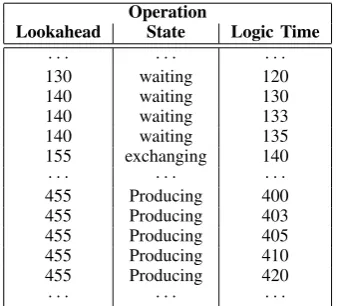
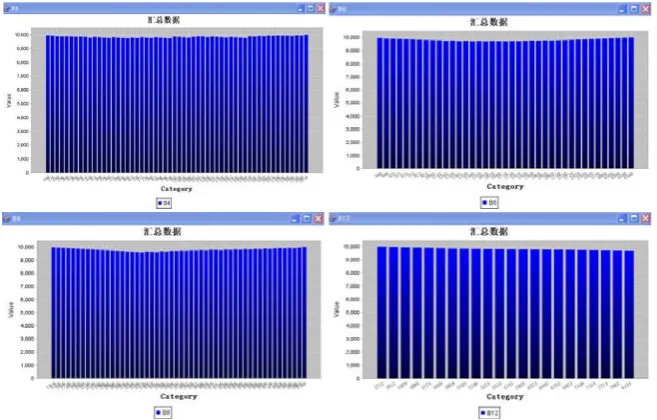
transportation trucks (T1, T2,T3, T4, T5). We first load this model into the simulation system (see Figure 4), then check the simulation results of this model (partial simulation results are shown in Table I, II and Figure 5, 62. Figure 5 and 6 show the bottleneck of this production process completely.
We can see that logic time advancing is complete consistency when the statuses of all nodes change, and satisfies the requirements of production process in supply chain. So the proposed time advancing mechanism is feasible and correct.
VI. CONCLUSION ANDFUTUREWORK
In this paper, we have introduced a novel time ad-vancing mechanism that integrates HLA with multi-agent distributed simulation to meet time management in supply chain simulation context. The experimental results show our approach is feasible and scientific.
The main novel points and merits of the proposed method are in threefold: First, the proposed time advanc-ing mechanism can apply in supply chain simulation,and help to solve the bottleneck of supply chain. Second, the proposed time advancing mechanism can apply in distribution simulation, and benefit for enabling sound 2Here, we set an example forB4,B6,B8,B12,A1andA3to show
the simulation results (the warehouses or buffers and machining work-shops above existing correlation in production process). The horizontal axis denotes logic time, and the vertical axis denotes the volume of material.
TABLE II.
PARTIAL SIMULATION RESULTS( BUFFER ANDTRANSPORTATION)
Buffer Transportation
Volume Logic Time Location Logic Time · · · · · · · · · · · ·
100000 120 B2 120
100000 130 B2 130
100000 133 B4 133
100000 135 B4 135
100000 140 B4 140
· · · · · · · · · · · ·
99810 400 B2 400
99810 403 B5 403
99660 405 B5 405
99660 410 B5 410
99660 420 B5 420
· · · · · · · · · · · ·
simulation models in support of SCM (across enterprises). Third, the proposed time advancing mechanism can ap-ply in agent-oriented simulation, and assist agent-based simulation in a heterogeneous environment.
Future work needs to consider the efficiency of our pro-posed time advancing mechanism. Furthermore additional work is necessary to verify our novel time advancing mechanism in more complicated system.
ACKNOWLEDGMENT
Authors thank Chenghong Gao for his assistance with this work, and the reviewers for their detailed comments.
REFERENCES
[1] S. Terzi and S. Cavalieri, “Simulation in the Supply Chain
Context: A Survery,”Computers in Industry, vol. 53, no. 1,
pp. 3–16, January 2004.
[2] R. Hieber, Supply Chain Management: A Collaborative
Performance Measurement Approach, Zurich, VDF, 2002. [3] H. C. W. Lau and W. B. Lee, “On a Responsive Supply
Chain Information System,”International Journal of
Phys-ical Distribution and Logistics Management, vol. 30, no. 7, pp. 598–610, July 2000.
[4] D. Schunk, “Using Simulation to Analyze Supply Chain,” inProceedings of the 32nd Winter Simulation Conference (WSC), pp. 1095–1100, December 2000.
[5] H. Stadtler and C. Kilger,Supply Chain Management and
Advanced Planning, Springer-Verlag, Berlin, 2000. [6] J. Kosturiak and M. Gregor, “Simulation in Production
System Life Cycle,”Computers in Industry, vol. 38, no. 7,
pp. 159–172, March 1999.
[7] M. Wooldridge and N. R. Jennings, “Intelligent Agents:
Theory and Practice,” Knowledge Engineering Review,
vol. 10, no. 2, pp. 115–152, June 1995.
[8] R. M. Fujimoto, “Parallel and Distributed Simulation,” in Proceedings of the 27th Winter Simulation Conference (WSC), pp. 118–125, December 1995.
[9] “High Level Architecture (HLA) Overview,” Defense Modeling and Simulation Office, 2002.
[10] “RTI Programmer’s Guide,” Defense Modeling and Simu-lation Office, 1999.
[11] G. Archibald, N. Karabakal and P. Karlsson, “Supply Chain vs. Supply Chain: Using Simulation to Compete
Beyond the Four Walls,” inProceedings of the 31st Winter
Figure 5. Partial simulation results:B4-B6 andB8-B12.
Figure 6. Partial simulation results:A1andA3.
[12] C. Chandra and N. Chilov, “Simulation Modeling for
In-formation Management in a Supply Chain,” inProceedings
of the 12th Annual Conference of the Production and Operations Management Society (POMS), March 2001. [13] C. Mclean and F. Riddick, “The IMS Mission Architecture
for Distributed Manufacturing Simulation,” inProceedings
of the 32nd Winter Simulation Conference (WSC), pp. 1539–1548, December 2000.
[14] R. M. Weatherly, A. L. Wilson, B. S. Canova, E. H. Page, A. A. Zabek and M. C. Fischer, “ Advanced Distributed Simulation through the Aggregate Level Simulation
Pro-tocol,” in Proceedings of the 29th Hawaii International
Conference on Systems Science (HICSS), pp. 407–415, January 1996.
[15] E. H. Page and R. Smith, “Introduction to Military Training Simulation: A Guide for Discrete Event Simulationists,” in Proceedings of the 30th Winter Simulation Conference (WSC), pp. 53–60, December 1998.
[16] R. Lannone, S. Miranda and S. Riemma, “Supply Chain Distributed Simulaiton: An efficient Architecture for
Multi-Model Synchronization,”Simulation Modeling
Prac-tice and Theory, vol. 15, no. 1, pp. 221–236, January 2007. [17] S. Strassburger,“ On the HLA-Based Coupling of
Simula-tion Tools, inProceedings of the 13th European Simulation
Multiconference (ESM),” pp. 45–51, June 1999.
[18] A. Borshchev, Y. Karpov and V. Kharitonov, “Distributed Simulation of Hybrid Systems with AnyLogic and HLA,” Future Generation Computer Systems, vol. 18, no. 6, pp. 829–839, May 2002.
[19] M. Schumann, E. Bluemel, T. Schulze, S. Strassburger and K. Ritter, “Using HLA for Factory Simulation,” in Proceedings of the 1998 Fall Simulation Interoperability
Workshop (SIW), September 1998.
[20] S. J. Turner, W. Cai, and B. P. Gan,“ Adapting a Supply
Chain Simulation for HLA,” inProceedings of 4th IEEE
International Workshop on Distributed Simulation and Real-Time Applications(DS-RT), pp. 71–78, August 2000. [21] R. Fujimoto, “Parallel Simulation: Parallel and Distributed
Simulation Systems,” in Proceedings of the 33rd Winter
Simulation Conference (WSC), pp. 147–157, December 2001.
[22] J. Misra, “Distributed Discrete-Event Simulation,” ACM
Computing Surveys ,” vol. 18, no. 1, pp. 39–65, March 1986.
[23] D. Weyens and T. Holvoet, “A Formal Model for Situated
Multi-Agent Systems,”Fundamenta Informaticae, vol. 63,
no. 2, pp. 125–158, May 2004.
[24] M. D’inverno, M. Luck and U. Ukmas, “Practical and Theoretical Innovation in Multi-agent Systems Research,” The Knowledge Engineering Review, vol. 17, no. 3, pp. 295–301, September 2002.
[25] J. Ferber and J. P. Muller, “Influences and Reaction: A
Model for Situated Multi-Agent Systems,” inProceedings
of the 2nd International Conference on Multiagent Systems (ICMAS), pp. 72–79, December 1996.
[26] A. Park, R. M. Fujimoto and K. S. Perumalla, “Conser-vative Synchronization of Large-Scaled Network
Simula-tions,” in Proceedings of the 18th Workshop on Parallel
and Distributed Simulation (PADS), pp. 153–161, May 2004.
[27] D. M. Nicol, “The Cost of Conservative Synchronization in
Parallel Discrete Event Simulations,”Journal of the ACM,
vol. 40, no. 2, pp. 304–333, April 1993.
“Optimistic Synchronization in HLA-Based Distribution
Simulation,”Simulation, vol. 81, no. 4, pp. 279–291, April
2005.
[29] S. Xu and L. F. Mcginnis, “Optimistic-Conservative
Syn-chronization in Distributed Factory Simulation,” in
Pro-ceedings of the 38th Winter Simulation Conference (WSC), pp. 1069–1074, December 2006.
Xu Xureceived the B.E. degree and the M.E. degree in Com-puter Science in 2005 and 2008, respectively. He is currently a Ph.D. student at the Department of Management Science and Engineering of Tongji University. He is also a Research Assistant in Laboratory of Intelligence Decision and Decision Support.
His current research interests are data mining applied to customer relationship management and supply chain context, modeling and simulation of manufacturing systems and supply chain, fuzzy systems and knowledge discovery.
He has been participating to several research projects. He has published about 20 papers on national and international journals and conference proceedings, such as International Journal of Applied Mathematics and FUZZ-IEEE. He is a reviewer for Quarterly Cornell Hotel and Restaurant Administration. He is a member of the IEEE and a member of the IAENG.
Jie Linis currently professor at the Department of Management Science and Engineering of Tongji University, and Director of Laboratory of Intelligence Decision and Decision Support. He received his Ph.D. degree in 1999.
His main fields of interest are decision support systems, mod-eling and simulation of manufacturing systems, application of multi-agent systems and soft-computing techniques (ant colony algorithm, group decision theory) for operations and supply chain management.