IDEF0 Methodology
Khatuna BARDAVELIDZE*Avtandil BARDAVELIDZE**
Abstract
The article considers aspects of using IDEF0 methodology of functional modeling for creation of functional model of educational space
which enables of high quality analysis of information-educational system and unification of analysis procedure. As an example there are
presented and analyzed the stages of functional modeling construction of information space of educational system common pedagogical complex with using BPwin program means of Case-technologies. On the basis of structural analysis of information-educational space is constructed the context and the decomposition diagrams, but the hierarchy of all working models is presented for the respective node tree diagram.
Keywords: functional modeling, IDEF0 methodology, context diagram, decomposition diagram, node tree diagram.
Introduction
Using functional modeling methodology for construction of the model’s information space in common educational systems allows making qualitative the analysis for
educa-tional systems and unifies the process. Funceduca-tional models
of educational processes in information environment ori-ented on determination of education quality allow deter-mining critical situations needing changes, exclusion, or retrieval of alternative solutions.
Theory and practice of development of educational systems for youth education traditionally base on special androgynous and psychological models of education of grown-ups. However, in conditions of steadily develop-ing information environment the instruments and preva-lent principles do not allow effective realization of educa-tion process without involving new informaeduca-tional models of education activity, new methods of its monitoring and standards of description of open educational processes (Gorbunova L.,2006)
Functioning and perfection of common information-educational systems in information space proposes the re-alization of different principles and methods of functional analysis.
Using of the methodology of functional modeling of information-educational systems will enable more quality
analysis as well as unification the analysis process. The
base of functional model IDEFO make structuralized de-scription of different functions and information communi-cations between the elements of educational system which
allows to:
• Present and describe full spectrum of the processes of educational institution;
• Provide accurate and laconic description of the mod
-eled objects;
• Optimize interaction and mutual understanding of
specialists occupied with the analysis and design of edu-cational processes.
As consistent with IDEFO methodology, functional model provides complete, accurate and adequate descrip-tion of informadescrip-tion-educadescrip-tional systems (Toiskin V.S., Krasilnikov V.V., Maliataki V.V., 2010)
Information Space Model of Common Pedagogical Complex
Information space of educational complex is a control sys-tem which consists of active controlled object, the latter having resources and environment. The system is active
and reflective and, in its part, has an adaptive model, pur -pose and decision making system.
Information space means the system with defined pur -pose and active free will, the behavior of which is based on information collected about itself and about environment, its analysis, prognoses of own and environment condition, decision making and realization.
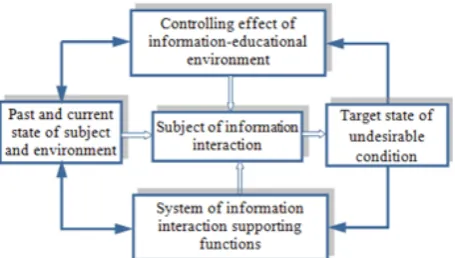
The structure of such a system generally may be repre-sented in the form of the scheme given in Fig.1.
Figure 1: Structure diagram of information-educational environment
Information interaction subject is described with adap-tive function of purpose, which allows determining goal at-tainment quality and possible undesirable condition. Sub-ject state besides control effect of information-educational environment depends on its previous state and environ-ment interaction. The purpose of creation of information-educational environment consists in elaboration of adap-tive system supporting informational interaction function in order to achieve the given goal with consideration of external factors effect at undesirable effect minimization.
The system of information interaction supporting function in general case should contain two subsystems: information and communication interaction supporting subsystems.
It is advisable to consider the structure of information-educational environment from systemic position which takes into account elemental, communicational, structural, functional and other aspects. For facilitation of formation and analysis of purpose and information-educational
en-vironment function at the first stage the priority should be
given to systemic-functional aspect of system study with consideration of formal methods and no formalized knowl-edge.
Under the given approach there arises the possibility of operational evaluation of designed environment, i.e. the evaluation of the quality of assigned purpose achievement. Therefore, it is advisable to use system functioning as the quality criterion under the possibility of the given logical complexity and practical realization.
It is proposed to use experimental methods for evalua-tion of funcevalua-tioning.
Information-educational environment function can be determined from space creation outer purpose which has resource for respective control of the space.
Respectively, the purpose of construction of informa-tion-educational space model is provision of professional-private education continuity and integrity of teachers.
The concept of education sphere generally may be for-mulated as follows: the teacher provides professional skills obtained by student, the readiness of the future teacher for learning and upbringing, within the frame of university
teaching to form the respective quality. The future teacher should have wide educational erudition, professional
re-flex, skill to make optimum decision in nonstandard situ -ations in case of limited information, have contemporary knowledge and skill of their practical realization.
In order to achieve the above mentioned purpose all necessary resources may be divided into internal and ex-ternal resources.
Internal resources consist of teaching and methodic,
personnel, financial, research and scientific,
material-technical and psychological resources. External resources
consist of university educational legislative base, financial
sources, work market in the country and region, university
work market and scientific researches in the country.
Thus, the aim will be on the basis of realized infor-mation interaction to determine the forms of pedagogical interaction which realizes anthropologic approaches:
• Subject-object interaction (educative-disciplinary model);
• Subject-subject interaction (privately-oriented mod
-el);
• Object-subject interaction (free, spontaneous interac -tion).
Construction of the Model Using BPwin Program
With methodology IDEF0 all the processes in educational system are called functions and a unique description in the form of functional model block will correspond to each function. The description of information communications and interactions between blocks on IDEFO diagram will be realized with ingoing and outgoing arrows. Ingoing ar-rows will indicate necessary conditions for realization of the function of educational system.
When developing functional model of information-educational environment a special graphical language IDEFO of program BPwinis is used which allows to repre-sent information model with a set of hierarchically ordered and logically related diagrams. This enables the developers to transfer information to each other accurately and op-eratively (Toiskin V.S., Krasilnikov V.V., Maliataki V.V., 2010)
The process of modeling of the system in BPwin be-gins from most abstract level of system description in the whole. This level consists of determination of modeling subject, purpose and viewpoint about the model. Under subject is meant the system itself. The position from which the system and the purpose of modeling are considered ef-fects substantially the determination of subject of the sys-tem.
Purpose of modeling. The following statements may
serve as the examples of purpose definition: “Describe the
sys-tem functions of residual knowledge of students with the purpose of expansion of their functional possibilities”.
Viewpoint. Model should be constructed with a com-mon viewpoint. Viewpoint may be presented as the view-point of a person who sees the system in the aspect neces-sary for modeling. For our example we consider, Viewpoint – supervisor.
IDEF0 model means the existence of a clearly formu-lated purpose, a single subject of modeling and one view-point.
Modeling of the system of general education on the basis of IDEFO begins from expression of modeling object in the form of one functional block with interface arcs. The context contains the description of modeling purpose, ar-eas and viewpoints (Fig.2).
Figure 2: Context diagram
Thus, in order to construct functional model using the synthesis method of alternative versions [2], the model may be presented in the following form in Fig 3.
Figure 3: A0-model
The components of the model are:
1. Informational resource of pedagogical complex; 2. Organization structure;
3. The means of informational interaction.
In this case, informational effect means are advised to be divided into two groups:
• Internal, in the scale of pedagogical complex; • External, between universities and in global scale.
When considering functional structure the following didactical possibilities of informational space will be taken into account:
• Storage and processing of transmitted and received information;
• Access to information sources of practically unlim
-ited quantity;
• Access to outer methodic and didactic materials which are widely realized in social network;
• Collective, individual and confidential communica
-tion;
• Dialog communication in real time scale and in de
-lay;
• Interactive interaction of information.
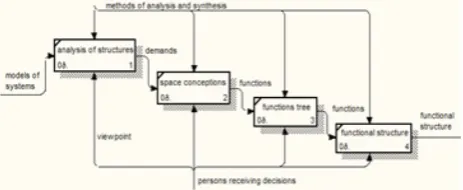
With consideration of the above presented the decom-position of information space functional structure may be done. In such a case the level of model detailing is deter-mined with the purposes of model construction and is stat-ed directly by the developer of the model. Decomposition of context work is given in Fig. 4.
Figure 4: Analysis of information space structure
Proceeding from the presented decomposition, when analyzing the existing approaches to information space construction, it is necessary to analyze realization ap-proaches and functions.
In the process of decomposition, the functional block A0 undergoes detailing on child diagram. As regards to child diagram and all blocks on it the decomposed block is a parent block. In correspondence to the standard of IDEF0 any block in the diagram of any hierarchy level may un-dergo decomposition (Maklakov S. V., 2007)
The developer together with the expert of object area does the description of each subsystem. Thus, the whole system is divided into subsystems to the required level of detailing and there is obtained a model approximating the system with the given level of accuracy.
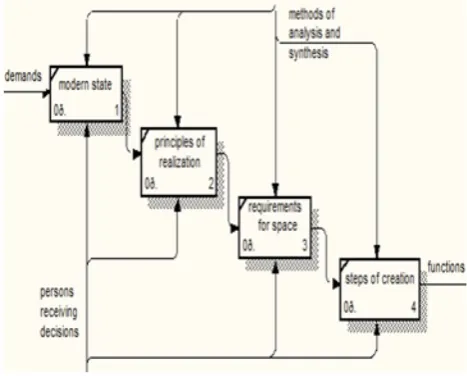
Decomposition of the concept of information space construction is presented in Fig.5. The analysis of the pre-sented decomposition shows that when determining the concept it is necessary to specify the principles, require-ments and information space construction stages.
Figure 5: Concept of information space
Decomposition of tree function is presented in Fig.6.
Figure 6: A3 tree function
Use of universal graphic languages of modeling IDE-FO provides logical integrity and completeness of descrip-tion necessary for achieving precise and consistent results.
Interactive abstraction of objects provides fixed visual
feedback communication in case of model construction. The addition to diagram IDEFO, BPwin supports the Node Tree Diagram which shows the hierarchy of all op-erations of the model on one diagram. For the considered example the Node Tree Diagram has the following form, Fig.7.
Conclusion
Thus, the set of the received diagrams and explaining ma-terials make functional model of educational process, the process of model creation being connected with knowledge acquisition as well as with its presenting. Topical knowl-edge obtained, for example, as a result of experts
question-ing or accumulation of information are fixed with the help
of graphic language IDEF0.
The decomposition analysis of information-educa-tional space shows, that when analyzing the existing ap-proaches to information space construction, it is necessary to analyze realization approaches and functions, but when determining the concept it is necessary to specify the prin-ciples, requirements and information space construction stages.
Due to additions and constraints of functional model the more accurate description of the structure of educa-tional data, objects, notions and terms, processes and pe-riods of discontinuation of decomposition of information-educational processes, separation of temporary relations between functions is done.
Functional models of educational processes in infor-mation environment oriented on determination of educa-tion quality allow determining most critical situaeduca-tions needing changes, removal, or retrieval of alternative solu-tions.
References
Gorbunova L. L. Steps of functional modeling for
educa-tional systems. Journal of ″Society. Circumstances. Progress (Terra Humana)″. Center of scientific pro
-duction technologies ″Asterion″,Sankt-Peterburg, 2006, №1, pp.51-56 (in Russian)
Toiskin V.S., Krasilnikov V.V., Maliataki V.V. ″Automa -tization of engineering processes on basis of CASE
technologies″. Tutorial, Stavrapol State Teachers'
Ttraining Institute, Stavrapol, 2010, p.131 (in Rus-sian)
Maklakov S. V. Creating information systems with ALL-Fusion Modeling Suite, 2rd ed., Moscow,