Journal of Information Literacy
ISSN 1750-5968
Volume 9 Issue 2
December 2015
Article
Bebbington, S. and Vellino, A. 2015. Can playing Minecraft improve teenagers’
information literacy? Journal of Information Literacy, 9(2), pp. 6-26
http://dx.doi.org/10.11645/9.2.2029
This work is licensed under a Creative Commons Attribution-ShareAlike 4.0 International License. Copyright for the article content resides with the authors, and copyright for the publication layout resides with the Chartered Institute of Library and Information Professionals, Information Literacy Group. These Copyright holders have agreed that this article should be available on Open Access and licensed under a Creative Commons Attribution ShareAlike licence.
"By ‘open access’ to this literature, we mean its free availability on the public internet, permitting any users to read, download, copy, distribute, print, search, or link to the full texts of these articles, crawl them for
indexing, pass them as data to software, or use them for any other lawful purpose, without financial, legal, or technical barriers other than those inseparable from gaining access to the internet itself. The only constraint on reproduction and distribution, and the only role for copyright in this domain, should be to give authors control over the integrity of their work and the right to be properly acknowledged and cited.”
Can playing Minecraft improve teenagers’ information
literacy?
Sandra Bebbington, information literacy instructor, Bishop's University.
Email: [email protected] Twitter: @sanbeb
André Vellino, associate professor, School of Information Studies,
University of Ottawa.
Email: [email protected] Twitter: @vellino
Abstract
Some research suggests that a significant number of Generation Z teenagers (those born in the late 1990s or early 2000s) display an insufficient level of information literacy (IL) to function effectively in an information-based society. Yet many of them are gamers who succeed at accomplishing game-related tasks that require a number of IL skills such as information seeking, the critical assessment of sources and relevance ranking of information. This paper describes the results of an interpretive case study of the information behaviours of teenage gamers that supports the hypothesis that the online game Minecraft supports the development of such IL skills. The online interactions of 510 participants of a public discussion forum on Minecraft and interviews from eight teenage Minecraft gamers, as well as the game itself, were analysed. This study suggest that some aspects of Minecraft’s design effectively induce players to seek out game-related information in affinity spaces (online informal learning spaces), select appropriate sources, evaluate the information shared by fellow gamers and decide which information best satisfies their needs.
Keywords
information literacy, gaming, Minecraft, teenagers, Canada
1. Introduction
While a number of Generation Z teenagers (usually defined as those born in the late 1990s or early 2000s) may have a good grasp of information technology, there is evidence that a significant number of them nevertheless exhibit an inadequate level of information literacy (IL). As several studies have shown (Barnes et. al 2007; Beheshti 2012; Salisbury and Karasmanis 2011), the abilities that contemporary teenagers have to determine what, and how much, information is needed to accomplish a task, to critically assess the quality of information sources and to identify relevant information are, as a general population, insufficient for them to function effectively in an information-centred society. As Large (cited in Beheshti, 2012) noted in his literature review on the IL of the previous generation of teenagers, young people in the internet age struggle with
information seeking; they have trouble “selecting appropriate search terms, move too quickly through the web pages while spending little time reading the materials, and have difficulty judging the relevance of the retrieved pages.” (p. 55). This observation is still true of a significant segment of Generation Z.
objectives of the game, may offer such an alternative. Minecraft is such a game, and, as we argue in this paper, it both requires and encourages the development of IL skills.
Minecraft is one of the most popular and successful video games ever built. It boasts over 100 million registered users worldwide, and, on any given day, between 2 and 3 million players login on
Minecraft servers. It is an “open world” game, one in which players are able to roam freely through virtual worlds of their own design and whose movements and behaviours are almost
unconstrained. Minecraft players can, either individually or collaboratively with other players, mine, gather and assemble various Lego-like virtual blocks in order to design their own structures such as buildings, cities and artefacts. What a player can build in Minecraft is limited only by the player’s knowledge and creativity; the end result of a game can be anything from a simple house to a complete recreation of Ancient Rome. In 2014, the Danish Geodata Agency (2013) made public its project which used Minecraft to recreate the entire country of Denmark to scale.
We chose Minecraft for this study for several reasons besides its enormous popularity. First, Minecraft’s sandbox design encourages players to seek information both from within the game itself and from a variety of external sources (for example from other players or online forums) and offers players many opportunities to exercise general-purpose IL skills. Secondly, a significant proportion of Minecraft users contribute actively to discussion forums, video demonstrations, tutorials, and blogs, providing an abundance of data on players’ information-seeking behaviour. The principal source of our text data came from the discussion threads found in
Minecraftforum.net, the official forum for Minecraft, which is also its largest, with over 2.5 million members and over 24 million posts. Finally, unlike some more recent variants like the survival horror game The Forest, Minecraft is a relatively non-violent game that is already being used in some school communities for subject-specific educational purposes (List and Bryant 2014).
This paper summarises the results of an interpretive, qualitative case study performed for a Masters in Information Studies (MIS) thesis (Bebbington 2014) that analysed the online
interactions from among 510 participants in 20 threads of a public discussion forum. The analysis of the discussion threads demonstrates both how IL skills are being practiced by gamers during game play and how these skills are manifested by participants in an associated affinity space (online informal learning spaces). These results were then corroborated by an analysis of interviews from eight teenage Minecraft gamers concerning their information-seeking and evaluation practices during gameplay and in discussion forums.
This paper is divided into five sections. The literature review surveys some of the pertinent related research on IL and video games; the following section offers an analysis of the design features of the Minecraft video game that pertain to IL. The fourth section provides an analysis of threads in the discussion forum that illustrate IL skills among players as well a summary of the results of interviews with teenage gamers. The last section draws some conclusions from this study and suggests possibilities for future investigation.
2. Literature Review
It could be argued that Generation Z is a demographic with much greater technological and informational challenges than those of previous generations. According to Lee et al. (2013), these challenges arise as a result of the ubiquitous access to the web and the emergence of big data, cloud computing and smartphones. The demands placed on teenagers by an increasingly global, information-centric online society therefore places a premium on their IL skills.
The question of what constitutes IL is itself the subject of much literature, some of which precedes the internet era. Yet the essence of some of those definitions still applies today. At its core, the concept of IL centres on how effectively and efficiently a person can locate, evaluate and
and have the ability to locate, evaluate and use effectively the needed information” (ALA 1989, p.19).
While there are more nuanced contemporary IL models (such as Nesset 2013), for the purposes of this paper we will use the following definition:
Information literacy is the ability to know when there is a need for information, to be able to identify, locate, evaluate, and then use that information effectively to make informed decisions.
This definition is a synthesis of several definitions drawn from IL standards published since 1989, and closely aligns with the one provided by the Chartered Institute of Library and Information Professionals (CILIP), which defines IL as “knowing when and why you need information, where to find it, and how to evaluate, use and communicate it in an ethical manner”. In the context of this study, we focused on the elements of need, discovery and evaluation. (CILIP 2013)
Our choice of definition aims to encompass information use contexts beyond the classroom. We agree with Martin’s (2012) assertion that IL should be looked upon as a collection of skills that demands critical thinking, collaboration and communication that apply to everyone, not just
students, librarians and academics. We also concur with Campbell (2008), who recommends that, whatever definition we choose for IL, it should be able to include new and evolving information environments.
One of the manifestations of teenagers’ engagement with information and technology is gaming. According to the Entertainment Software Association of Canada (ESAC) in 2012, 79% of Canadian teenagers (13-17) were gamers, with 46% playing every day, making it plausible to suggest that a large percentage of teenagers in Generation Z are gamers, at least to some degree (ESAC, 2012). The game genres played by teenagers span the range of action-adventure, first-person shooters and role-playing games. But game designers are also integrating an increasing variety of genres into one game. For example, a first-person shooter game may incorporate elements of a role-playing or puzzle-solving game. Hence, the range of skills that teens need to play these games effectively is increasingly diverse and complex.
Many studies have explored the educational value of serious games. A recent literature survey of empirical studies on serious games (Connolly et al. 2012) identified 129 papers that discussed the perceptual, cognitive, behavioural, affective and motivational aspects of games. While several of these aspects are foundational for IL as defined above, there are only a few studies that
specifically explore the IL elements of video games or how these skills are used in video game affinity spaces.
Nass et al. (2014) analysed a variety of games designed specifically for the purpose of teaching IL skills in an effort to discover or design a game to support library-related IL education. These included: Library Scene, an educational game that teaches students about basic library skills (e.g. the Dewey decimal system); the Scott Rice and Amy Harris Information Literacy Game, a digital hybrid of Monopoly and Trivial Pursuit; and Secret Agents in the Library which teaches students how to finding information in a library. The authors found that games designed specifically to enhance IL incorporate small puzzles or problem-solving elements. They also noted that the video game Legend of Zelda, which, like Minecraft, takes place in an “open world”, requires players to search for sources of information to solve puzzles and to evaluate the relevance of information in a manner that resembles typical information search and evaluation strategies used to write a
research paper.
gamers surveyed communicated with others online while playing and 72% stated that they played collaboratively with others in the same room. The gamers in the study stated that they preferred playing online because of the opportunities it afforded to meet new people, and also for
competition, escapism and collaborative play. Shaffer concluded that, by using online
communication tools, teenage gamers were making efforts to fulfil their social and learning needs; they were engaging with others, both new acquaintances and established friends, as well as learning new strategies for enhancing their game play.
Several studies have focused on the function of affinity spaces for learning and literacy. Gee (2007) defines an affinity space as an online informal learning space that allows users to create and share knowledge or seek information around a common theme or topic. They are community environments that gamers often rely on to obtain information about formal play strategies, or to solicit opinions and obtain feedback on something they have done or created. Lammers et al. (2012) showed that affinity spaces provide abundant opportunities to analyse informal learning activities, especially literacy.
Schrire (2006) maintains that affinity spaces provide occasions for collaborative learning exchanges that are conversational in nature. When collaborating and communicating, players develop social skills and shared meanings, leading to a community with shared values (Shaffer et al. 2005). It is these shared values and common interests that motivate participants to continue interacting with one another in affinity spaces (Silius et al. 2013). Participants who find the content in these spaces to be useful also tend to use the available resources and to inform others about them (Silius et al. 2013). Furthermore, the relationships that develop among participants in these environments can be the mainspring behind learning through collective information sharing, assessment, feedback, debate and consensus (Barnes et al. 2007). Therefore, affinity spaces provide ample opportunities for participants to practise their IL skills, particularly information seeking and knowledge creation (Steinkuehler 2008).
There are two aspects of affinity spaces that are indicative of the presence of IL skills: the use of a specialised language that is required when searching for information; and shared knowledge, which is essential for locating information (Gee, as cited in Martin, 2012). According to Martin (2012), interest-driven communities are a manifestation of a collective intelligence that provides a wealth of information to anyone seeking information about a given topic: “…a collective intelligence is held together by the dynamic and social process of acquiring knowledge, which allows for
continuous participation and the reaffirming of social ties” (Martin, 2012 p. 94).
This collective intelligence, she claims, fosters collective IL practices. In her analysis of a discussion forum centred on World of Warcraft, Martin found that IL is often a collaborative and collective activity, where communities of people primarily help each other with their information needs through information sharing and evaluation. In an earlier work, Martin (2011) found that, to be played well, Second Life and World of Warcraft require their players to be information literate. Without sufficient IL skills, a player may not be able to identify when information is needed, where to find it or how to determine what information would be most effective.
Affinity spaces are therefore an ideal setting in which to study IL because they are informal environments that are both natural and enclosed (Meyers 2013) and ideal for observing the
2.1 Research ethics
The research undertaken for this paper was approved by the University of Ottawa Ethics Board and conforms to the 2010 Tri-Council Policy Statement (Canadian Institutes of Health Research et al. 2010). All the interviews with children were performed with the consent of both the participant and his or her parent(s) and we made every effort to ensure complete anonymity and
confidentiality in these interviews.
The data collected from online discussion forums were publicly accessible and there was no need for us to register with these forums to access their content. The terms of service for
Minecraftforum.net explicitly state that it “does not guarantee any confidentiality with respect to any such submissions” (Curse Inc. 2011). While this forum does offer a premium (members-only) service enabling private conversations among subscribers, such discussions were not used for this research. The existence of such a private forum implies, even without a detailed reading of the terms of service, that the non-premium forums are public. Hence the expectation of privacy by users would be low. The authors of another study employing public message board discussions among video game players (Bourgonjon et. al 2015) also did not deem it necessary to obtain the informed consent from the players because no registration was required to consult the forums.
Furthermore, as is evidenced in our analysis, the intent of both the questioners and the
respondents in the forum discussions was to make their knowledge, views and opinions public. There is no reason to believe that our analysis of these discussions in the context of IL would affect the original authors, emotionally or otherwise, even though our use of these texts is different from the ones for which they were originally intended. None of our analysis passes judgement on the participants’ remarks and none of their remarks have any bearing on their ethical, religious or political views.
As we note below, many of the conversations in these public forums were most likely between teenagers, although the exact age of the participants was not available to us. It is unreasonable to expect that all these teens complied with the forum’s terms of service requirement that children younger than 18 years of age “may only access account-related features using a parent or guardian’s account so long as the parent or guardian consents and accepts full responsibility for the conduct of the child.” (Curse Inc. 2011). Nevertheless, we made sure that the information gathered from these forums was only about the Minecraft game, that it was not sensitive or controversial in nature, and that no real names were used. We have every reason to believe that our practices are consistent with the AoIR ethical decision-making and internet research guidelines (AoIR 2012).
3. Minecraft design features
Minecraft’s IL characteristics can be inferred both from a qualitative analysis of the game itself and an examination of the discussion threads in a Minecraft affinity space (discussion forum). Our qualitative analysis of the Minecraft game follows the framework set out by Consalvo and Dutton (2006), which was used both by Chess (2009) to analyse a variety of videos games geared to women and by Glas (2010) to analyse World of Warcraft.
As indicated in the introduction, Minecraft is a sandbox game that enables players, either
The game can be played in two main modes: survival and creative. In survival mode, players are challenged to collect tools used to gather, construct or cultivate resources while fighting hostile monsters. Staying alive also requires that players manage their health and hunger. In creative mode, players are not required to maintain their health or eat, nor are the monsters able to kill them. In creative mode, the player’s inventory is continuously full and, typically, his or her time is spent focused on creating.
Consalvo and Dutton’s toolkit for the qualitative analysis of games (Consalvo and Dutton, 2006) identifies four aspects of games, which, they claim, are the most revealing for understanding how they are played: the object inventory; the interface study; the interaction map; and the game play log. In this framework, an object inventory refers to the objects that can be found in a game and how players can interact with each of them. This, in turn, determines the strategies and skills required by gamers. The interface study includes an analysis of the design components that helps or informs players about the current state of their game and informs them about the consequences of their decisions. The interaction map describes how gamers can interact with non-object
elements of the game and reveals information about the ways in which gamers relate with other characters, whether they are controlled by other gamers or non-player characters. Finally, the game play log is an analysis of the game as a whole that explores emergent aspects of the game, such as the unintended interactions between characters and objects.
Our analysis of Minecraft usingthis framework reveals an object inventory list of more than 350 built-in objects that fall into eight main categories: materials, foods, tools, potions, information, weapons, armour, transport and decorations. Materials are the principal drivers of the game, regardless of the mode in which it is played, and are used primarily for building, farming and crafting. Foods are the second most important items since they are essential for survival in every mode except creative mode. Although the other items are not necessary for playing, they enhance the gaming experience by offering the player a considerable range of possibilities for creative expression.
The function of an object in Minecraft often depends on the function of other objects in ways that are not obvious and are specific to the design of Minecraft. For example, carrots, which cannot be farmed from seed, are found when zombies drop them, may be consumed to decrease hunger, used in combination with a stick to steer a pig, and altered into golden carrots for use in potions that heal horses and breed rabbits. Thus learning what functions objects perform in the game is a critical element of complex knowledge acquisition that requires some information seeking and evaluation in order to play the game effectively.
The items categorised as information in Minecraft, although few in number (only six), have
additional attributes that make them valuable, particularly when playing with others. For example, a virtual book and quill together, allow players to document their explorations, provide instructions and directions and record the information they have learned. Once complete, the book can be signed, saved and left in the virtual world for others to read and facilitates the sharing of
information in asynchronous gameplay. Similarly, a special kind of Minecraft block, called a sign, can contain written instructions or directions for other players and placed anywhere in the virtual world, thus giving players the opportunity to share their knowledge and develop reputations as resourceful, experienced and reliable players.
Given the large number of available objects, a player is unlikely to remember all of them, or, indeed all their functions and relationships to other objects. Moreover, relying only on one’s prior
even YouTube (in which a search for “Minecraft” produces about 59 million hits: approximately one-third of all of Google’s search results).
Selecting the relevant information from the significant quantity of available information requires the player to assess its reliability. For example, when a gamer decides that she needs information about how to make a tool, she must then assess which answer from among the ones she finds, provides her with details that that are sufficiently reliable for her to succeed at making it. This is a process that requires critical thinking skills that are enabled by the game itself: as players become better informed about the various elements found in the game, they can practice what they have learned by empirically testing the validity of this new information in gameplay.
4. Analysis method for discussion threads and interviews
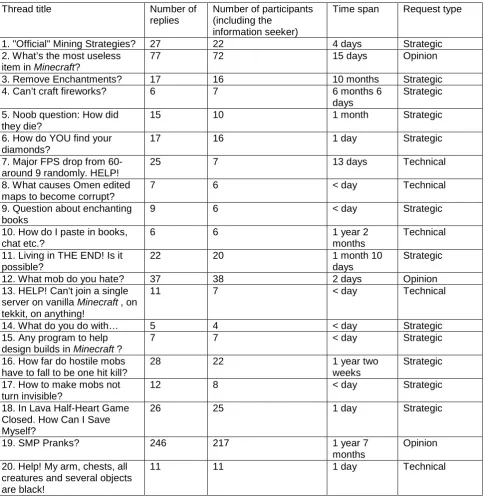
To identify the IL skills that Minecraft players manifest when using an affinity space, we collected 610 messages written by 510 participants across a total of 20 discussion threads, taken from minecraftforum.net, the official discussion forum for Minecraft and dated between August 2011 and June 2013. These discussion threads and some of their attributes are listed in Table 1.
While it was not possible to ascertain the precise age of the participants, circumstantial evidence such as the handle names, the writing style of the messages and an informal poll of Minecraft
Table 1: Summary of Minecraft discussion threads
Thread title Number of
replies
Number of participants (including the
information seeker)
Time span Request type
1. "Official" Mining Strategies? 27 22 4 days Strategic 2. What’s the most useless
item in Minecraft?
77 72 15 days Opinion
3. Remove Enchantments? 17 16 10 months Strategic
4. Can’t craft fireworks? 6 7 6 months 6
days
Strategic
5. Noob question: How did they die?
15 10 1 month Strategic
6. How do YOU find your diamonds?
17 16 1 day Strategic
7. Major FPS drop from 60-around 9 randomly. HELP!
25 7 13 days Technical
8. What causes Omen edited maps to become corrupt?
7 6 < day Technical
9. Question about enchanting books
9 6 < day Strategic
10. How do I paste in books, chat etc.?
6 6 1 year 2
months
Technical
11. Living in THE END! Is it possible?
22 20 1 month 10
days
Strategic
12. What mob do you hate? 37 38 2 days Opinion
13. HELP! Can't join a single server on vanilla Minecraft , on tekkit, on anything!
11 7 < day Technical
14. What do you do with… 5 4 < day Strategic
15. Any program to help design builds in Minecraft ?
7 7 < day Strategic
16. How far do hostile mobs have to fall to be one hit kill?
28 22 1 year two
weeks
Strategic
17. How to make mobs not turn invisible?
12 8 < day Strategic
18. In Lava Half-Heart Game Closed. How Can I Save Myself?
26 25 1 day Strategic
19. SMP Pranks? 246 217 1 year 7
months
Opinion
20. Help! My arm, chests, all creatures and several objects are black!
11 11 1 day Technical
Notwithstanding the possibility of bias in the use of a non-probability method, we used purposive sampling to select the discussion threads. We believed that the most effective way to find players who manifested IL skills was to select discussion threads whose very origin was an information request or request for help or feedback. In contrast, random sampling would have introduced a great deal of noise from players discussing software bugs, complaints about the Minecraft server and irrelevant discussions about how the game should evolve in the future.
However, the initial purposive sampling criterion yielded some threads which had few or no responses and it became immediately apparent that a second criterion for selecting threads needed to be introduced, namely that there be a minimum of three replies.
strategic information (n=12) (such as information directly related to Minecraft and/or how to play), or a request for the opinions of others (n=3). On average, each thread contained 30 replies and posts from an average of 25.5 participants.
After the initial phase of open coding, broader categories began to emerge. The coding process for these messages employed a grounded theory methodology that places the player at the centre of the process of meaning construction. The specific coding cycle for this study was similar to the one Bowers (2011) used to investigate the complex relationships that exist between former athletes’ sports identities and sports video games. It began with open coding where the units of the discussion thread were assigned codes (for example ‘Defining an information need’). Next, the categories were identified (using axial coding) according to the IL skill that was demonstrated in individual messages in the discussion thread. These codes were then assembled into three broad categories: information evaluation; information seeking; and information sharing. Finally, the messages were analysed in relation to the definition of IL provided above in order to identify the relationships and connections among the codes and categories.
As each new code was added to a message, we compared it with the previously coded messages to ensure that it was put into the most appropriate category. For example, the discussion thread sample “…So what DO YOU do with your TNT overflow?” (Thread 14) was initially coded as ‘Defining an information need’. In the second round of coding, this portion of the discussion thread was assigned an additional code of ‘Strategic (gameplay) information need’. This was done to further clarify the type of information being requested and, later, to investigate the impact that the type of information request had on the replies, as well as the subsequent IL behaviours exhibited in the forum. This technique allowed for a certain degree of flexibility in the fine-tuning of codes and categories. The principal author of this paper performed the first round of coding herself and completed the subsequent rounds with two additional coders.
4.1. Analysis of discussion threads
The time frames within which these discussions took place varied according to the conversation. The average duration of a discussion thread in the sample was 98.75 days, the shortest being half a day and the longest being 14 months. We found that opinion-based discussions generally continued for a considerably longer time period and contained many more replies than their technical and strategic counterparts. This is probably due to the limited number of possible solutions that exist for any given strategic or technical problem.
In four out of the twenty threads, the initial information seeker did not contribute to the discussion beyond the initial information request. Two of these started with an opinion-based information request and the other two started from a strategy-based information request. In the remaining 16 discussion threads, the original information seeker replied and conversed with the other discussion thread participants. From among these, the initial information seeker contributed an average 3.25 postings to the thread. More often than not, the initial information seeker was the dominant
contributor to the threads. This was particularly so for technical or strategic game play information requests, perhaps because they rely more on accuracy than opinions do, and are likely to have fewer direct implications for the information seeker’s gameplay. Ten of the twenty discussion threads had participants that contributed more than one message. The average number of postings per participant in these cases was 2.4.
We initially assigned a total of 1477 codes to the discussion threads messages. The axial coding process described above yielded a total of 34 codes, based on the kind of IL activity we identified within the threads. All of these 34 codes were then brought together into the three major
information literacy categories mentioned above: information evaluation; information seeking; and information sharing. From among the 610 messages comprising the 20 threads, 11 codes
4.1.1 Information seeking
The ability to recognise that one needs to find information is an essential component of our chosen definition of IL. The codes assigned to the category ‘Information seeking’ were concerned with the information-finding process embarked upon when attempting to satisfy an information need. A table of all the codes, frequencies and percentages for ‘Information seeking’can be found in Table 2.
Table 2: Summary of code frequencies for ‘Information seeking’
Codes Number of Applications Codes by Percentage
Providing context 52 29%
Defining an information need 30 17%
Providing further context 19 11%
Strategic information need 17 10%
Validating information need 14 8%
Drawing on prior knowledge 12 7%
Request for help 10 6%
Asking for more information 9 5%
Technical information need 9 5%
Opinion based information need 3 2%
Stating what information is not wanted 1 0.5%
The code ‘Providing context’ was applied in cases where the information seeker provided some context or subsequently included an explanation for why the information was needed or wanted in response to another participant’s reply. We identified 52 such cases. For example, the following information seeker was looking for ideas to “prank” his friends. When a reply occurred he refined his information request by providing the following additional context:
im the server owner so materials aren't a problem. i just wanna get a really pissed reaction or really confused reaction out of them. im running craftbukkit so getting plugins wouldn't be a big deal for me. i don't want to have to screw around with backups so everything i do has to be reversible. no fires or killing people where we can't get the items back. (Thread 19, SMP Pranks?, bigjeep, August, 7, 2011)
The code ‘Defining an information need’was applied when a participant made a request for information. We identified 30 such instances. In each of the 20 discussion threads, the code ‘Defining an information need’ was applied at least once because each thread began with the expression of an information need as established in the data collection criteria. In addition, another ten requests for information were made within the collected threads by either the original
information seeker or by another participant. For example, one of the discussion threads in the sample was initiated by the following request: “Is there a way to remove enchantments in 1.2.5?”
(Thread 3, Remove enchantments?, Andrewdale, June 18, 2013)
In some cases information seekers provided additional information or context when they were asked for it, or in response to a reply in the thread; 19 such instances were identified and each was coded ‘Providing further context/information’. The exchange below, taken from the thread “What causes Omen edited maps to become corrupt?”,is one such example:
wrong? (Thread 8, What causes Omen edited maps to become corrupt?, coradon, October 20, 2012)
Reply #2: “That has happened to me are you closing the server console with ctrl+c?”
(Thread 8, What causes Omen edited maps to become corrupt?, chariot, October 20, 2012)
Reply #5 (from initial information seeker): “No I've just been waiting for the server to save then I hit the X in the top right corner. Is there a preferred method to closing it that doesnit cause problems? (I'm an XP user Linux)” (Thread 8, What causes Omen edited maps to become corrupt?, coradon, October 20, 2012)
The code ‘Strategic information need’ was applied 17 times. In addition to initial requests for strategic help that began 12 discussion threads, five other requests for strategic help were identified within the threads. These five additional requests were related, or similar, to the initial request for information. For example, the initial request: “Is there a way to remove enchantments in
1.2.5?” (Thread 3, Remove enchantments?, Andrewdale, June 18, 2013)received the following
response: “i got a bunch of gold armor from skelly's with enchants and want to take the chants off
the gold and put it on my diamond armor, but doesn't look like you can…” (Thread 3, Remove
enchantments?, savagedogballs, June 18, 2013).
The code ‘Drawing on prior knowledge’was applied to cases in which the information seeker provided information such as recalling past experiences or indicating what she or he already knew about the information they were requesting. We identified twelve such instances in the sample. Six initiating requests for technical information were coded ‘Technical information need’ and three additional messages occurring inside the main threads were assigned this code, The code ‘Opinion based information need’ was also applied in three instances. An exemplary request taken from a discussion thread in the sample is the following message: “What do you think is the most useless thing in minecraft? Do not post about something you've never used.’ (Thread 2, What’s the most useless thing in minecraft?, Snipe7r, March 13, 2013)
Instances in which discussion participants responded with an acknowledgement that they either required the same information as the initial request or who expressed the belief that the request was valid or interesting, were coded as ‘Validating information need’. This code was applied in 14 cases. The code ‘Asking for more information’ was used when a participant requested more information from the information seeker and it was applied nine times.
We can see from the coding in this sample that information-seeking behaviour is a dynamic community-driven process, with information being exchanged and shared among multiple
participants. The information sought in these threads was largely about strategy: how to do various things within the game. The information seeker would make an initial request but the information sought became more refined as exchanges took place between interested participants.
Participants would provide additional context or more information as the information seeker refined and communicated his or her needs. Some participants validated the information seeker, stating that they were looking for the same or similar information. As participants help information seekers to refine their needs, they are inadvertently helping the information seekers to develop and improve their abilities to define an information need and articulate their knowledge.
4.1.2 Information sharing
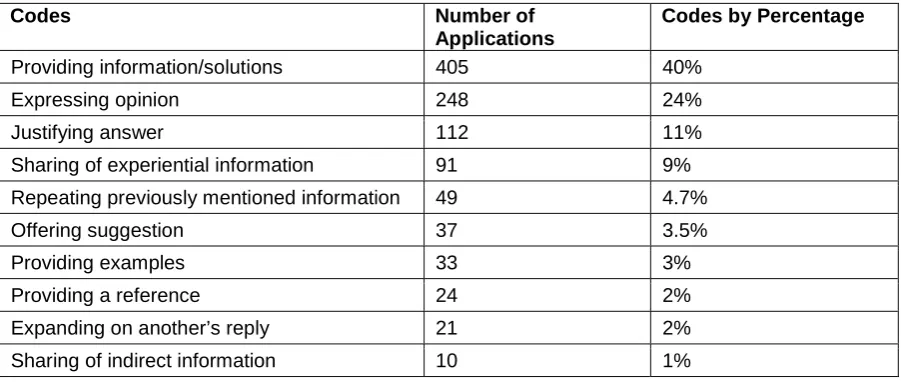
Table 3: Summary of code frequencies for ‘Information sharing’
Codes Number of
Applications
Codes by Percentage
Providing information/solutions 405 40%
Expressing opinion 248 24%
Justifying answer 112 11%
Sharing of experiential information 91 9%
Repeating previously mentioned information 49 4.7%
Offering suggestion 37 3.5%
Providing examples 33 3%
Providing a reference 24 2%
Expanding on another’s reply 21 2%
Sharing of indirect information 10 1%
There were 405 applications of the code ‘Providing information/solutions’. This code was assigned when information was being shared either in different ways for example as a reference or based on experience or when the information being shared was of different types (opinion, reference, or an example). Therefore, each code identified as ‘Providing information/solutions’ was refined to determine how and what was being shared. As a result, additional codes were applied. The length and complexity of the information shared varied considerably; some replies were short and
succinct while others were in-depth instructions or explanations. The following simple factual response to an inquiry is an example of a short query to which we applied the code ‘Providing information/solutions’: “23 blocks to severly damage mobs 24 to kill them” (Thread 16, How far do hostile mobs have to fall to be one hit kill?, CitrusZinus, December 5, 2012).
The large number of ‘Providing information/solutions’code applications is indicative of the participants’ willingness to share their knowledge and to help fellow gamers satisfy their information needs. This collaboration and exchange between participants and the information seeker is characteristic of the support that online communities can provide to fellow members with common interests and goals. This dialogue allows information seekers to use their critical thinking skills to assess the information shared by information providers, thus enabling them to further refine their information needs.
The code ‘Expressing opinion’, which indicates that replies or parts of replies offer a personal opinion, was the second most frequently applied code. However, it was sometimes difficult to distinguish between an opinion and an expression of factual information. Such cases needed to be interpreted in the context of the initial information request. For example, in one response to the information request “What mob do you hate?”, the information seeker received the reply: “No other mob as stealthy and dangerous as the creeper.” (Thread 12, What mob do you hate?, Danster5oo, February 24, 2013). While this reply may be interpreted as someone sharing a fact about a hostile mob, it was actually articulated in response to a question soliciting opinions. Therefore, it was interpreted as someone expressing his or her opinion.
Sharing opinions allows players to share their knowledge in a context in which they are permitted to demonstrate a bias and thus provides them with the opportunity to make critical judgments knowing that the information provided may not be fully factual. IL requires both an understanding of bias and the ability to recognise it in order to make appropriate.
provided access (primarily via a hyperlink) to the primary source. In some cases (n=5) the participant simply referred directly to the original source.
After having read some of the messages in a thread, some respondents elaborated on a previous respondents’ reply and those were coded as ‘Expanding on another’s reply’. A number of replies (n=49) were repetitions of previously mentioned solutions. It was not possible to determine whether these repetitious responses were indicative of the responders’ intention to corroborate or of a failure on the responder’s part to read previous replies in the discussion thread.
4.1.3 Information evaluation
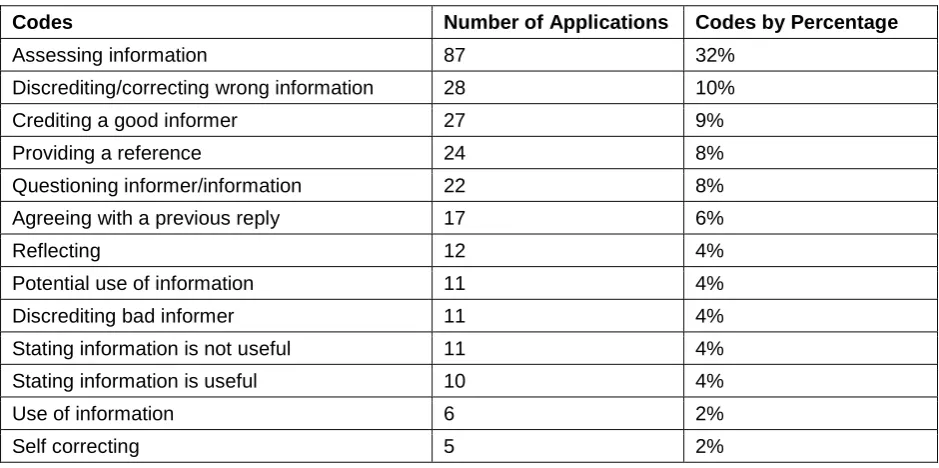
The category of ‘Information evaluation’ encompasses various activities that one might observe when information is being assessed for truth and relevance. Thirteen codes were assigned to this category and are listed in Table 4.
Table 4: Summary of code frequencies for ‘Information evaluation’
Codes Number of Applications Codes by Percentage
Assessing information 87 32%
Discrediting/correcting wrong information 28 10%
Crediting a good informer 27 9%
Providing a reference 24 8%
Questioning informer/information 22 8%
Agreeing with a previous reply 17 6%
Reflecting 12 4%
Potential use of information 11 4%
Discrediting bad informer 11 4%
Stating information is not useful 11 4%
Stating information is useful 10 4%
Use of information 6 2%
Self correcting 5 2%
Approximately one third of these messages were assigned the code ‘Assessing information’. This code was applied whenever there was an indication that a participant’s reply was based on previous information found in the discussion thread. Of the 87 instances in which that code was applied, 20 pertained to a message posted by the initial information seeker, with the remaining 67 referring to other respondents. The exchanges falling under the code ‘Assessing information’ were further refined to indicate how information was evaluated. The skill of information evaluation is an important component of information literacy since it requires elements of critical thinking and reflection on the part of the player and is essential for deciding whether information is useful or not.
The code ‘Discrediting/correcting wrong information’ was applied 28 times, accounting for 10% of the applied codes in this category. Any reply that made an attempt to discredit or correct previous information had this code applied. The exchange below, which took place among 3 participants in the “How to make mobs not turn invisible?”discussion thread, is a typical example:
Initial request: At a far enough distance mobs turn invisible. Is there a way to turn this off? (Thread 17, Weterman/user_837235, February 23, 2013)
Reply #1: They don't turn invisible they despawn (Thread 17, Crimsolite, February 23, 2013)
The code ‘Providing a reference’ exists in both the information seeking category and the
information evaluation category and it was applied whenever a message contained a reference to further information (such as a link to another resource). Our assumption was that if a participant chose to share a reference, they did so because they had assessed the relevance of this resource and decided that it was valuable and relevant to the original information request.
The code ‘Agreeing with another’s reply’ was applied when we found that a response indicating that the responder had agreed with a previous reply. Seventeen such cases were identified. For some replies (n=10) it was not obvious whether the message was, in fact, someone agreeing with a previous reply or someone simply adding a reply that coincidentally agreed with a previous post. If a reply to a post gave any indication that the responder had used information from a prior post or expressed that he/she was going to use the information, the assumption was that the responder, having made an initial assessment, felt that the information was adequate enough for further trial and validation. For these cases we applied the code ‘Potential use of information’. In cases where the information was actually used, we applied the code ‘Use of information’.
The number of applications of ‘Discrediting or correcting wrong information’ and ‘Evaluating information’ in the category information evaluation, indicates that a significant portion of the participants are critically assessing the information being shared in the discussion forum. Participants do not hesitate to discredit incorrect information, or reveal a bad informer. They display discriminating behaviour and, in so doing, allow for others to learn which information is valuable and which is not. This behaviour may make other participants wary of sharing incorrect information and encourage all gamers to validate their information before sharing it.
4.2 Teenager interviews
For the third phase of this study, we recruited a convenience sample of eight teenage Minecraft
players and conducted semi-structured interviews that focused on their information seeking and evaluation practices during game play and in affinity spaces. Interviewees were recruited via a flyer posted in the local public library and community centre. The participants were either 15 or 16 years old and the interviews were conducted in a glass-wall study room at a local library. Every interview was conducted, recorded and transcribed by the first author and each lasted approximately 30 minutes.
A narrative analysis of the interview transcripts, based on a process explained by Josselson (2011), revealed the unifying themes and patterning relationships. The narrative analysis used a categorical, interpretive approach to discourse analysis, which aims to extrapolate sections of the narrative that belong to a category obtained from coding and then compares these categories to other narratives. This strategy therefore has some degree of subjectivity and is consistent with a meaning-making approach to interpreting the transcripts. This type of approach has been used by Stock (2008) to examine IL development among college students. Similarly, Moline (2009)
interviewed teenage gamers using this technique to assess their perceptions of learning.
The analysis began with an initial overall reading of each interview transcript to examine how the narrative unfolds in each interview and to identify the general themes that emerged. Next, each interview was re-examined to discover the parts that contained more meaning and additional sub plots and to place them in context with the general themes. Thus we conducted several readings of each interview and made connections between themes and patterns that were extrapolated to game-events, information behaviours and emotional responses that occurred during game play. All extrapolations and notes were recorded by hand on the interview transcripts.
reported having wanted information about how to create a secret door. Not only did he recognise that he needed more information to succeed, he used his prior knowledge to help refine his need:
when I tried to make um like a secret door kind of thing in my house and that was like really complicated because you need like a bunch of different things but I only play on survival so well first of all getting it was difficult, but then um actually how the
mechanics work in Minecraft are pretty neat like you would need to have a lever 70 and then it would need to be attached to red stone and then you need to sort of make a trail around and then have it touch what you want moved. So I had no idea how to do that and one of the things is that you need to have it in one of the corners of the room so that the walls just pulls out.
Participant 104 refined his lack of information with his prior knowledge that the secret door had to be placed in a corner in order to work. He also recognised that he had to learn how to successfully build the mechanism so that the trigger, when touched, would open the secret door.
All eight interviewees were able to identify and locate information sources that helped them satisfy their Minecraft-related information needs. Five of eight interviewees mentioned relying on specific
Minecraft-focused information sources such as a Minecraft-specific YouTube channel, a Minecraft
discussion forum and a specific Minecraftmap creator’s discussion threads.
Although all interviewees were able to describe how they assessed information and how they decided whether it was what they needed, the process of evaluating information appeared to differ for each interviewee. For example, interviewee 108 reported looking up information in the Minecraft Wiki and subsequently verifying its accuracy on a discussion forum before using it. Interviewee 102, on the other hand, determined whether the information in a YouTube video would be useful by looking at the video’s star rating and reviews.
Three subthemes emerged from the interviews that influenced how the teenagers evaluated information: trial and error; humour; and trust. Five of the eight interviewees reported using a trial and error process once they had narrowed down the information that they believed best met their needs. In the words of interviewee 104, “Umm, I’ll normally look at the different answers and whichever seems most logical, I’ll pick that one and I’ll try it and if it doesn’t work then I go back and find something else that makes more sense until it works.”
For some interviewees, the criteria for selecting information sources extended beyond their usefulness to include how they were presented. Three of the eight interviewees reported that entertainment and humour influenced their assessment of information. Interviewee 107, for
example, mentioned that his preference for certain Minecraft-specific YouTube channels was, “Oh, just because the people that do it are funny.” Their preference for resources that are entertaining or humorous did not detract from their need to have accurate information, although humour was important enough among three of the interviewees that reliable and humorous information sources were regular “go-to” sources of information.
The notion of trust was a third theme that emerged from the information evaluation portion of the interviews. In Minecraft, false information can potentially end one’s life in the game; at the same time, some actions require accuracy (for example, a recipe to make bread), and others do not (such as building a house). When asked how they would know whether the information they found was true, three interviewees stated that they could not understand why someone from within the community would share false information or waste another gamer’s time. According to interviewee 106, “I trust the people playing and putting up this information would just be telling the truth instead of putting up some random thing and waste like 5 minutes of your time.”
Seven of the eight interviewees madespecific mention of using the information they found for their
Minecraft-related information needs. Interviewee 101, for instance, recounted how despite having come across information that was not completely accurate, he was still able to achieve his
5. Conclusion
Minecraft players who need information to satisfy the objectives they set for themselves in
gameplay often seek it in affinity spaces such as the Minecraft wiki and discussion forums or from other sources like YouTube. When information needs are self-imposed, as they normally are in sandbox games, the information seeker is highly motivated both to find the required information and to integrate the new information with existing information. Squire’s (2008) research suggests that the need to learn a new skill and to find information only occurs when a player has new goals and the desire to advance, in a just in time fashion, creating a stronger connection between what is being learned and the task at hand than if the information or skill was learned at a time when it was not needed. Minecraft provides opportunities for goals to be established by the player and for information to be searched for when it is needed.
Minecraft also permits multiple players to play simultaneously in the same virtual world, thereby enabling the task of collaborative information seeking, sharing, learning and game play. Game-specific tools also allow players to share information asynchronously, for example by leaving behind information on a sign or in a book. Communication and collaboration are often manifested in multiplayer online games, enabling players to work collaboratively to learn skills, assimilate information, find solutions to problems and ultimately achieve their game play goals (Squire 2006).
Minecraft’s game design encourages the acquisition of new knowledge, and the impact of applying that new knowledge becomes evident to the players as they use it to achieve their goals. In
particular, Minecraft’s design encourages its players to:
• Assess the information accessible to them during gameplay in order to make decisions • Recognise a need for information and identify information gaps
• Identify what sources will provide the information they need, within or outside the game • Locate and assess the needed information, either alone or collaboratively
• Apply the new information and assess the results
Minecraft also contains the elements necessary to motivate players to seek information by infusing them with the need to find information. From the vantage point of Dervin’s information-seeking theory (Dervin, 1998), Minecraft creates an ideal information-seeking environment for players to develop their IL by creating opportunities for players to seek information in order to close the knowledge gaps that naturally occur during game play.
5.1 Limitations of the study
This study has several limitations in both method and scope that must serve as caveats to the conclusions that we have drawn from it. The IL categories into which the discussion threads were classified and the codes that were applied to individual threads are not as clearly delineated as they would have been had the codes and categories pre-existed with analytical definitions. They were, instead, obtained from a bottom-up analysis and different researchers could have interpreted and labelled these threads differently, thus generating results that differ from ours.
The small number of interviewees and the sampling method for obtaining them does not provide any guarantee that they adequately represent the general population of teenage game players for
Minecraft. Furthermore, given the small size of the sample, it was impossible to account for variations in demographic features in the population of teenage players, such as family income or educational achievement. Out of the eight interviewees, only one was female, thus severely underrepresenting the gender distribution of teenage Minecraft players.
Our claim that the interviews corroborate the discussion board analysis would be better
layer of ethics approval, possibly crossing international boundaries. In addition, the narrative analysis of the interviews is interpretive and hence the results obtained from the interviews are somewhat dependent on the authors’ reading of the discussion thread texts.
Finally, we believe that most of the IL skills discussed in this paper do not depend strongly on specific characteristics of Minecraft itself but rather on the generic characteristics of open world sandbox games. However, to support this general claim, it would be necessary to replicate this study on a representative sample of such games that also have related affinity spaces. Thus, in addition to the limitations above, the scope of our conclusions properly applies only to Minecraft.
5.2 Future directions
Our analysis of discussion threads in an affinity space showed that participants in the discussion forum exhibited a number of IL skills including: recognising an information need; information seeking; using a variety of information resources; sharing information; and the evaluation and use of information. The participants were discerning in their choice of sources whether they were in an online affinity space or with fellow gamers in person. They often relied on more than one resource and the notions of trust, humour, and trial and error played a role in the evaluation of the
information that they obtained from those sources.
The question of whether these IL skills, once developed in Minecraft, are transferable to other contexts, such as scholarly information-seeking, requires further research. Martin (2012) suggests that the IL skills needed in both situations are one and the same. All information seekers are looking for the most appropriate resources in which to find the best information. Furthermore, since gaming and academic environments both involve affinity spaces and social media, teenagers who develop IL skills to succeed in one environment should be able to apply it in the other. One way to answer the question of whether IL skills obtained from gaming are transferable would be to
conduct a longitudinal study that assessed the IL competencies of a sample of teenagers both before and after a period of Minecraft play and affinity space engagements, and then compared it with a control group who had not been exposed to a similar gaming experience.
In the meantime, we believe our study indicates that Minecraft could be used to great benefit by educators not just to teach content-rich subjects such as geography (List and Bryant 2014) but also to enrich formal methods of IL education in the classroom with an enjoyable game that
simultaneously engages children’s attention, promotes creativity and refines their ability to seek relevant information, evaluate it and use it to make informed decisions. For example, teachers may want to use Minecraft for a research project that involves students researching information about a historical event or location (for example, a First Nations village) and having them then recreate the event or location in in the game.
Minecraft’s affinity spaces are informal learning environments in which teenagers can participate by creating and sharing information, ideas, opinions and feedback, and provide opportunities for the development of their own IL and improve that of others. Bringing together like-minded teenagers to participate and collaborate in communities of practice to fulfil some of their
informational and social needs, leads not only to the development of individual skills but also to the development of an awareness of their participation in the creation of an emergent collective
intelligence.
Acknowledgements
References
Adams, S. S. 2009. The case for video games in libraries. Library Review, 58(3), 196-202. Available at: http://dx.doi.org/10.1108/00242530910942045.
American Library Association (ALA). 1989. Presidential Committee on Information Literacy: Final report. Chicago. Available at: http://www.ala.org/acrl/publications/whitepapers/presidential
[Accessed: 10 November 2015].
AoIR 2012. Ethical decision-making and internet research: recommendations from the AoIR Ethics Working Committee (Version 2.0). Available at: http://aoir.org/reports/ethics2.pdf [Accessed: 10 November 2015].
Barnes, K., et al. 2007. Teaching and learning with the net generation. Innovate: Journal of Online Education, 3(4). Available at:
http://www.icyte.com/system/snapshots/fs1/8/c/3/e/8c3e2f2956b4f907c561a4397f6ca58a487fd984 /index.html [Accessed: 10 November 2015].
Bebbington, S. 2014. A case study on the use of the game Minecraft and its affinity spaces for information literacy developmentin teen gamers. MIS thesis. University of Ottawa. Available at:
https://www.ruor.uottawa.ca/bitstream/10393/31699/1/Bebbington_Sandra_2014_Thesis.pdf.
[Accessed: 10 November 2015].
Bourgonjon, J. et al. 2015. Players’ perspectives on the positive impact of video games: A
qualitative content analysis of online forum discussions. New Media & Society, pp. 1-18, Available at: http://dx.doi.org/10.1177/1461444815569723.
Beheshti, J. 2012. Teens, virtual environments and information literacy. Bulletin of the American Society for Information Science and Technology, 38(3), pp. 54-57. Available at:
http://dx.doi.org/10.1002/bult.2012.1720380313.
Bowers, M.T. 2011. Playing video games as a supplement to identity: Insights on former college athlete transitions. Journal of Issues in Intercollegiate Athletics, 4, pp. 289-308. Available at:
http://csri-jiia.org/documents/publications/research_articles/2011/
JIIA_2011_4_16_289_308_Playing_Video_Games.pdf [Accessed: 10 November 2015].
Campbell, S. 2008. Defining information literacy in the 21st century. In Lau, J. (ed.), Information literacy: International perspectives. IFLA, The Hague, pp. 17-26.
Canadian Institutes of Health Research, Natural Sciences and Engineering Research Council of Canada and Social Sciences and Humanities Research Council of Canada. 2010. Tri-Council Policy Statement: Ethical Conduct for Research Involving Humans. Available at:
http://www.pre.ethics.gc.ca/pdf/eng/tcps2-2010/TCPS_2_FINAL_Web.pdf [Accessed: 10
November 2015].
Chartered Institute of Library and Information Professionals (CILIP). 2013. Information literacy-definition. Available at: http://www.cilip.org.uk/cilip/advocacy-campaigns-awards/advocacy-campaigns/information-literacy/information-literacy [Accessed: 10 November 2015].
Consalvo, M. and Dutton, N. 2006. Game analysis: Developing a methodological toolkit for the qualitative study of games. Game Studies: The international journal of computer game research,
6(1). Available at: http://gamestudies.org/0601/articles/consalvo_dutton [Accessed: 10 November 2015].
Connolly, T. M. et al. 2012. A systematic literature review of empirical evidence on computer games and serious games. Computers and Education, 59(2), 661-686. Available at:
http://dx.doi.org/10.1016/j.compedu.2012.03.004.
Curse, Inc. 2011. Curse network terms of service. Available at:
http://www.curse.com/legacycontent/curse-network-terms-of-service. [Accessed: 10 November 2015].
Danish Geodata Agency. 2014. Denmark in Minecraft. Available at: http://eng.gst.dk/maps-topography/denmark-in-minecraft/ [Accessed: 10 November 2015].
Dervin, B. (1998). Sense-making theory and practice: An overview of user interests in knowledge seeking and use. Journal of Knowledge Management, 2(2), 36-46. Available at:
http://dx.doi.org/10.1108/13673279810249369.
Entertainment Software Association of Canada (ESAC) 2012. Essential facts 2012. Available at:
http://theesa.ca/wp-content/uploads/2015/08/Essential-Facts-2012-EN.pdf [Accessed: 10 November 2015].
Gee, J.P. 2007. What video games have to teach us about learning and literacy. 2nd ed. New York: Palgrave MacMillan.
Glas, M.A.J. (2010). Games of stake: control, agency and ownership in World of Warcraft. PhD Thesis. University of Amsterdam. Available at: http://dare.uva.nl/record/357610 [Accessed: 10 November 2015].
Josselson, R. 2011. Narrative research: constructing, deconstructing and reconstructing story. In Wertz, F.J. et al., Five ways of doing qualitative analysis:phenomenological psychology, grounded theory, discourse analysis, narrative research, and intuitive inquiry. New York: Guilford
Publications. pp. 224-242.
Lammers, J.C., Kurwood, J.S., and Magnifico, A.M. 2012. Toward an affinity space methodology: Considerations for literacy research. English Teaching: Practice and Critique, 11(2), pp. 44–58. Available at: http://edlinked.soe.waikato.ac.nz/research/files/etpc/files/2012v11n2art3.pdf
[Accessed: 10 November 2015].
Lee, A. et al. 2013. Conceptual relationships in information literacy and media literacy in knowledge societies. UNESCO. Available at: http://www.unesco.org/new/fileadmin
/MULTIMEDIA/HQ/CI/CI/pdf/wsis/WSIS_10_Event/WSIS_-_Series_of_research_papers_-_Conceptual_Relationship_between_Information_Literacy_and_Media_Literacy.pdf [Accessed: 10
November 2015].
Martin, C. 2011. An information literacy perspective on learning and new media. On the Horizon, 19(4), 268-275. Available at: http://dx.doi.org/10.1108/10748121111179394.
Martin, C. 2012. Information literacy in interest-driven learning communities: Navigating the sea of information of an online affinity space. PhD Thesis. University of Wisconsin. Available at:
http://depot.library.wisc.edu/repository/fedora/1711.dl:V7BSD4HX5ZZYV9C/datastreams/REF/cont ent [Accessed: 10 November 2015].
Meyers, E. M., Erickson, I., and Small, R. V. 2013. Digital literacy and informal learning environments: an introduction. Learning, media and technology, 38(4), 355-367.Available at:
http://dx.doi.org/10.1080/17439884.2013.783597.
Minecraft Wiki. 2015. Available at: http://minecraft.gamepedia.com/Minecraft_Wiki [Accessed: 10 November 2015].
Moline, T. C. 2009. Playing our way to cognitive self-efficacy: A qualitative study of adolescent video gamers and their perceptions of their ability to learn.PhD Thesis. University of Alberta.
Nass, M. et al. 2014. Serious games in information literacy: The creation and analysis of games to teach information literacy. Worchester Polytechnic Institute. Available at:
https://www.wpi.edu/Pubs/E-project/Available/E-project-031214-143058/unrestricted/IQP.pdf
[Accessed: 10 November 2015].
Nesset, V. 2013. Two representations of the research process: The preparing, searching, and using (PSU) and the beginning, acting and telling (BAT) models. Library and Information Science Research 35, 97–106. Available at: http://dx.doi.org/10.1016/j.lisr.2012.11.007.
Pew, L. 2012. What are the demographics of Minecraft players? Quora. Available at:
https://www.quora.com/What-are-the-demographics-of-Minecraft-players [Accessed: 10 November
2015].
Reinhard, C. and Dervin, B. 2011. Comparing situated sense-making processes in virtual worlds: application of Dervin’s sense-making methodology to media reception situations. Convergence: The International Journal of Research into New Media Technologies, 18(1), 27-48. Available at:
http://dx.doi.org/10.1177/1354856511419914.
Salisbury, F. and Karasmanis, S. 2011. Are they ready? Exploring student information literacy skills in the transition from secondary to tertiary education. Australian Academic and Research Libraries,
42(1), 43-58. Available at: http://dx.doi.org/10.1080/00048623.2011.10722203.
Silius, K. et al. 2013. Students’ motivations for social media enhanced studying and learning.
Knowledge Management and E-Learning: An International Journal, 2(1), 51-66.Available at:
http://www.kmel-journal.org/ojs/index.php/online-publication/article/view/55/39 [Accessed: 10 November 2015].
Schrire, S. 2006. Knowledge building in asynchronous discussion groups: Going beyond quantitative analysis. Computers and Education, 46, 49-70. Available at:
http://dx.doi.org/10.1016/j.compedu.2005.04.006.
Shaffer, J.R. 2012. Online and offline gaming social preferences of students. PhD Thesis. George Mason University. Available at:
http://digilib.gmu.edu/dspace/bitstream/handle/1920/7936/Shaffer_dissertation_2012.pdf?sequenc e=1&isAllowed=y [Accessed: 10 November 2015].
Squire, K.D. 2008. Video game-based learning: An emerging paradigm for instruction.
Performance Improvement Quarterly, 21(2), pp. 7-36. Available at:
http://dx.doi.org/10.1002/piq.20020.
Squire, K.D. 2006. From content to context: Video games as designed experiences. Educational Researcher,35(8), pp. 19-29. Available at: http://website.education.wisc.edu/kdsquire/tenure-files/18-ed%20researcher.pdf [Accessed: 30 November 2015].
Steinkuehler, C. 2008. Massively multiplayer online games as an educational technology: An outline for research. Educational Technology,48(1), pp. 10-21.
Stock, L.A.H. 2008. Exploring the development of information literacy concepts among community college students. PhD thesis. Iowa State University. Available at: http://lib.dr.iastate.edu/rtd/15882/