do pedagogical content knowledge de professores de ciências Físico-Químicas [Impact evaluation of master courses on teachers with a master degree: The development of pedagogical content knowledge on teachers of physics and chemistry]. Aveiro, Portugal, University of Aveiro. Unpublished master dissertation.
Cruz, E., Pombo, L., & Costa, N. (2008). Dez anos de estudos (1997-2007) sobre o impacto de Cursos de Mestrado nas práticas de Professores de ciências em Portugal [Ten years of study (1997-2007) about the impact of master courses on the practices of science teachers in Portugal]. Revista Brasileira de Pesquisa Em Educação Em Ciências, 8 (1), 1–22.
Government of the Repubic of Angola (2001). Lei 13/01 de Bases do Sistema de Educação [Law 13/01 about the educational system of Angola].
Gray, D. E. (2014). Doing research in the real world (3rd ed.). Greenwhich, UK: SAGE.
Guskey, T. R. (2002). Does it make a difference? Evaluating professional development. Redesigning Professional Development, 59 (6), 45–51.
King, F. (2013). Evaluating the impact of teacher professional development: An evidence-based framework. Professional Development in Education, 40 (1), 89–111. http://doi.org/10.1080/19415 257.2013.823099.
Kirkpatrick, D. (1959). Techniques for evaluating training programmes. Journal of American Society for Training & Development, 13 (11), 1–13.
Laureano, R. M. S. (2011). Testes de Hipóteses com o SPSS [Tests and hypothesis with SPSS]. Lisbon: Edições Sílabo.
Mauaie, C., Ito, L. S., & Arroio, A. (2014). Media literacy and health education: Empowering teachers in the Republic of Mozambique. Problems of Education in the 21st Century, 60, 114–124.
Ministry of Education of Angola (2008). Plano Mestre de Formação de Professores em Angola: Encargos Financeiros (2008-2015). Angola.
Ministry of Education of Angola (2014). Exame nacional 2015 da Educação para Todos: Relatório de Monitorização sobre Educação para todos. Luanda. Retrieved from http://unesdoc.unesco.org/ images/0023/002317/231722por.pdf.
Pombo, L., & Costa, N. (2009). The impact of biology/geology school teachers masters courses on the improvement of science education quality in Portugal. Research in Science & Technological Education, 27 (1), 31. http://doi.org/10.1080/02635140802658818.
Stake, R. E. (1967). The countenance of educational evaluation. Teachers College Record, 68 (7), 523– 540.
Thornhill, W. (1985). A study of the impact of masters’ courses on teachers professional practices and careers. University of Keele, United Kingdom. Unpublished master dissertation.
UNESCO (2016). Education 2030: Inchneon Declaration and Framework for Action towards inclusive and equitable quality education and lifelong learing for all. PARIS: UNESCO.
Women’s Comission for refugee women and children. (2003). Global Survey on Education in Emergencies. New York: Women’s Comission for refugee women and children.
Received: November 12, 2016 Accepted: December 15, 2016
Betina Silva Lopes PhD, Post Doctoral Researcher (fellowship), University Aveiro, Aveiro, Portugal. E-mail: [email protected]
Website: https://www.researchgate.net/profile/Betina_Lopes
Nilza Costa PhD, Full Professor and Senior Researcher, University of Coimbra, Portugal. E-mail: [email protected]
Website: https://www.ua.pt/de/person/10307625
Bernardo Filipe Matias Master, Head of Department of Research and Post-graduation at ISCED, Full Professor at ISCED, Lubango, Angola.
E-mail: [email protected]
TEACHERS' PERSPECTIVE ABOUT
FACTORS THAT PREVENT SUCCESS IN
TEACHING AND LEARNING PROCESS IN
HIGHER EDUCATION OF ENGINEERING IN
BRAZIL
Gláucia Nolasco de Almeida Mello
Pontifical Catholic University of Minas Gerais, Belo Horizonte, Brazil E-mail: [email protected]
Abstract
The last fifteen years, in Brazil, the number of engineering freshmen had a huge increased and, although the number of graduated also had increased over the same period, the percentage of engineering freshmen are by far higher than engineers graduated. In this context, there is a clear evidence of the high dropout rate in higher education courses of engineering in Brazil. Once most of developed researches about engineering courses dropout in Brazil are focused in the students and institutions point of view about factors that affect dropout rate, in this research it was investigated the professors perspective to answer the three questions: (1) What are the main factors which prevent success in teaching and learning process identified by professors of engineering during the classes? (2) How can professors to improve the teaching and learning process in higher education courses of engineering in Brazil? (3) How can Higher Education Institutions (HEI) support the professors? The research data were collected through team activities developed with 134 professors of higher education courses of engineering. This research reveals that the most important factors that affect negatively the teaching and learning process are related to inadequate high school preparation and behaviour of students. Main suggestions of professors for improving the teaching and learning process and also students' motivation are related to pedagogical aspects such as: use of Information and Communication Technologies (ICTs) as support of classes and implementation of professor and student support programs with significant participation of HEI. Key words: qualitative research, problems in engineering education, professor's perspective, higher education of engineering in Brazil.
Introduction
Besides the problems related to basic education, there are still socioeconomic problems, personal, family and incompatibility with the chosen course that actively contribute to the
increased lack of motivation and frustration feeling of students in the first stage of engineering
IN THE 21 CENTURY Volume 74, 2016
62 failing grades in math, chemistry and physics because of inadequate high school preparation. Capelas (2014) conducted a study on the social behavior of Production Engineering students aimed at understanding the reasons for high dropout rate. The author used a Social Network
Analysis Tool (SNAT) and concluded that students who had a superficial or no relation to their
peers are more likely to leaving their courses. Reis, Cunha & Spritzer (2012) and Pocock (2012)
affirm that dropout is a problem that originates impacts of social and financial nature. Related to financial nature, dropout represents a significant loss to the institutions in either government
subsidies or private fees. Despite being aware about the problem, most of Higher Education Institutions (HEI) in Brazil have not developed action plans to raise the student retention rate in higher education.
Engineering Education in Brazil
Nowadays, the Instituto Nacional de Estudos e Pesquisas Educacionais Anísio Teixeira - INEP [National Institute of Educational Studies and Researchs] (INEP, 2016) recognize more
than fifty engineering programs in Brazil. In addition, the last fifteen years, the number of
Higher Education Institutions (HEI) that offer engineering courses and the number of new engineering places at Brazilian institutions has increased considerably. For example, in 2001 the number HEI that offered face-to-face Civil Engineering course at public HEI was 53 and 73 at private HEI (INEP, 2016). In 2015 the numbers increased to 148 and 602 face-to-face Civil Engineering course at public and private HEI, respectively. Figure 1 shows enrolled, freshmen and graduated rates for face-to-face Civil Engineering course at public and private HEI from 2001 to 2015. In Brazil, civil engineering freshmen increased 1061.8% and graduated increased 514.3% over the same period, as shown in Figure 1. Overall, the ratio of civil engineering's freshmen is by far higher than civil engineering's graduated for each year (from 2001 to 2015).
Figure 1: Enrolled, freshmen and graduated rates for Civil Engineering courses in Brazil from 2001 to 2015.
IN THE 21 CENTURY Volume 74, 2016 63
Freitas, Costa & Costa (2016) found in their research that 44.9% of Civil Engineering freshmen at the State University of Paraiba leave the course. Dallabona & Alberti (2016) presented annual dropout rates average for some engineering courses in Brazil: Electrical Engineering (7.94%), Mechanical Engineering (6.86%) and Civil Engineering (7.86%). The
first semester dropout rate for engineering courses in Brazil is highest, 18.5% (Dallabona &
Alberti, 2016). In that context, the problem of student retention and completion continues being discussed inside HEI in Brazil (Carvalho, Kanayama & Dantas, 2016; Freitas, Costa & Costa, 2016; Dallabona & Alberti, 2016; Miranda & Masson, 2016). At Faculty of Technology in São Paulo it was created the week of integrating and strengthening the freshmen since 2014. That program consists of mathematics reinforcement, motivational speeches, presentation of labor market and academy, providing integration with the university. According the authors, dropout rates was reduced by 35% after program implementation (Carvalho, Kanayama & Dantas, 2016). Offered by the School of Engineering at Mackenzie University, Support Project for the Academic Performance Improvement – SPAPI was developed to minimize the causes of dropout
rates, especially in the early stages of the courses. The project includes students of the first steps
of Civil, Electrical, Materials, Mechanics and Production Engineering Courses. A diagnosis
about student knowledge of the essential contents of the first subject development is made.
After that, it has offered classes covering the most complex content. Since the implementation of the proposed model, there has been an increase from 10% to 15% in approval ratings in the participating disciplines of the program (Miranda & Masson, 2016).
Most of developed researches in Brazil are focused on the students' perceptions and, sometimes, in the institutions point of view. And there are just few proposed effective actions to
increase retention rates and minimize dropout in engineering education. However, to reflect on
the main causes of dropout in engineering courses, it is also important to know the challenges and problems faced by professors in the classroom. In this way, it is possible to support them proposing effective actions to increase students motivation and performance, consequently,
increase retention rates. Therefore, a qualitative study with fifteen groups of professors from
two HEIs in Belo Horizonte city in Brazil was held. It was proposed a workshop where was
presented to professor's teams a question for reflection: What are the main factors which prevent success in teaching and learning process identified by professors of engineering during the classes? In this scenario of intense discussions on the factors identified by professors of
higher education engineering, will be discussed in this article the responses exhibited by the teams. Professors' testimony suggesting actions to improve the classes with the main objective to motivate students and promote the engagement of them will be presented here as well.
In this way, the following questions were addressed to know the professors point of view about factors faced by them during the classes that could negatively affect the teaching and learning process. In addition, explore the possibilities for improvement of methodologies and techniques used by professors.
1. What are the main factors which prevent success in teaching and learning process
identified by professors of engineering during the classes?
2. How can professors to improve the teaching and learning process in higher education courses of engineering in Brazil?
3. How can HEI support the professors?
Methodology of Research
General Background of Research
IN THE 21 CENTURY Volume 74, 2016
64 engineering courses. A total of 134 professors participated in the workshops that lasted 4 hours. They were separated into 15 teams. This is a qualitative research whose the goal is to identify the main factors that can contribute to unsuccessful teaching and learning process in higher education of engineering in Brazil under the professors point of view.
Instrument and Procedures
After a brief presentation on how the work would be conducted, it was asked participants
to form teams according to the area of operation, i.e., specific professors' teams by area, such
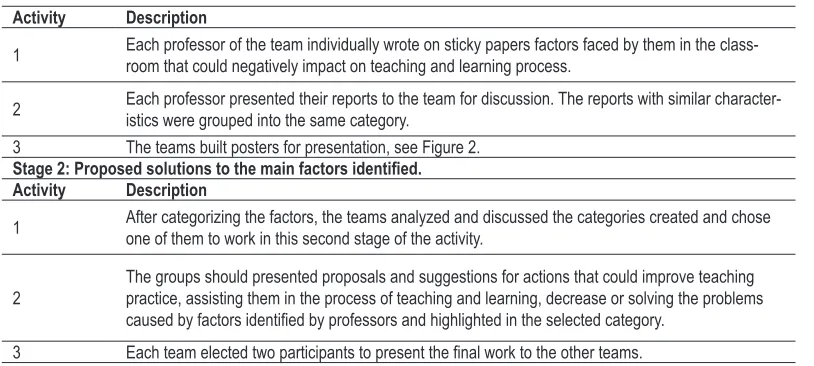
as mathematics, physics, chemistry, mechanical engineering, civil engineering, electrical engineering, production engineering. Table 1 shows the two stages description of activity
developed during the workshops. At first, each professor wrote on sticky papers the main
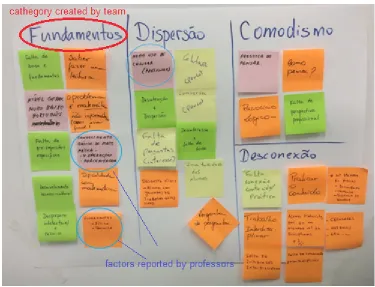
factors that can affect negatively the teaching and learning process faced by them during their classes in the last semesters. After that, the teams grouped all factors reported into categories. An example of the displayed jobs is shown in Figure 2. The poster shown in Figure 2 presents four categories, namely: basic foundations, dispersion, self-indulgence and disconnection. All other groups also created, freely, some categories where they could group the related factors.
The posters were fixed in the walls of the room and each team presented their work to the others.
Table 1. Description of workshop's activities.
Stage 1: Factors Identification
Question: 1. What are the main factors which prevent success the teaching and learning process identified by you during the classes?
Activity Description
1 Each professor of the team individually wrote on sticky papers factors faced by them in the class-room that could negatively impact on teaching and learning process.
2 Each professor presented their reports to the team for discussion. The reports with similar character-istics were grouped into the same category. 3 The teams built posters for presentation, see Figure 2.
Stage 2: Proposed solutions to the main factors identified. Activity Description
1 After categorizing the factors, the teams analyzed and discussed the categories created and chose one of them to work in this second stage of the activity.
2 The groups should presented proposals and suggestions for actions that could improve teaching practice, assisting them in the process of teaching and learning, decrease or solving the problems caused by factors identified by professors and highlighted in the selected category.
3 Each team elected two participants to present the final work to the other teams.
Data Analysis
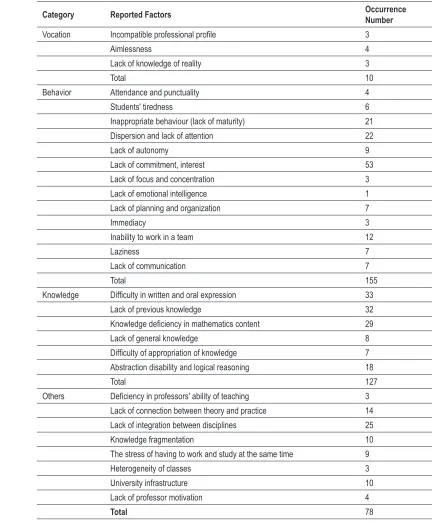
A qualitative data analysis was conducted in this research where it was analyzed 370 written reports and 43 comments of professors who composed the 15 working teams. Data were collected through teams' presentations, as shown in Figure 2, and professors' comments during discussions. After analyzing all written reports in stickers papers, the factors were organized by researcher into four categories: vocation, behavior, knowledge and others. In the others category were grouped factors reported about the infrastructure of classrooms and laboratories, professor self-assessment and content of disciplines. Table 2 shows the number of occurrences
IN THE 21 CENTURY Volume 74, 2016 65
Results of Research
Table 2 shows the number of occurrences of each reported factor and framed in one of the categories mentioned before. Factors related to behavior category represent 41.89% of total reports, knowledge and skills 34.33%, others 21.08% and vocation 2.70%. Ten most reported
factors were: lack of commitment, interest (14.32%), difficulty in written and oral expression (8.92%), lack of previous knowledge (8.65%), knowledge deficiency in mathematics content
(7.84%), lack of integration between disciplines (6.76%), dispersion and lack of attention (5.95%), inappropriate behavior (5.68%), abstraction disability and logical reasoning (4.86%), lack of connection between theory and practice (3.78%), and inability to work in a team (3.24%).
IN THE 21 CENTURY Volume 74, 2016
66 Table 2. Reported factors categorization.
Category Reported Factors Occurrence Number
Vocation Incompatible professional profile 3
Aimlessness 4
Lack of knowledge of reality 3
Total 10
Behavior Attendance and punctuality 4
Students' tiredness 6
Inappropriate behaviour (lack of maturity) 21
Dispersion and lack of attention 22
Lack of autonomy 9
Lack of commitment, interest 53
Lack of focus and concentration 3
Lack of emotional intelligence 1
Lack of planning and organization 7
Immediacy 3
Inability to work in a team 12
Laziness 7
Lack of communication 7
Total 155
Knowledge Difficulty in written and oral expression 33
Lack of previous knowledge 32
Knowledge deficiency in mathematics content 29
Lack of general knowledge 8
Difficulty of appropriation of knowledge 7 Abstraction disability and logical reasoning 18
Total 127
Others Deficiency in professors' ability of teaching 3
Lack of connection between theory and practice 14 Lack of integration between disciplines 25
Knowledge fragmentation 10
The stress of having to work and study at the same time 9
Heterogeneity of classes 3
University infrastructure 10
Lack of professor motivation 4
Total 78
In the second stage of activities (see Table 1), the groups had 30 minutes to discuss on a proposal for improving the classroom based on a created category by the team. It was suggested
that viable proposals were discussed, i.e., those did not demand considerable financial resources,
IN THE 21 CENTURY Volume 74, 2016 67
1. Use of technology and digital resources: (a) web environment implementation (blog, wiki, website) to become available content and extra materials (texts, videos, simulators) ensuring student access to the right information, from reliable sources and valid references; (b) web environment implementation (blog, wiki, website) by the students for posting work and research developed during the semester for the dissemination of the work and research results; (c) development of team practices involving research, cooperation and collaboration via web, at this moment, the students could perform activities using mobile technology available (tablets and smart phones).
2. Workshops, extra-class activities, video classes, software, simulators: (a) use of software and simulators to demonstrate the effects and behaviour of materials, math, chemistry and physics. For example, it was mentioned the University of Colorado website (Coloradoedu, 2016) that provides numerous simulations for science and mathematics; (b) video classes freely available on the web such as those provided by Khan Academy (Khanacademyorg, 2016) and Telecurso (Globocom, 2016) to revise the content considered as essential for the course; (c) uninterrupted tutoring program for students who did not had adequate preparation for math in high school.
3. Continuing education program for professors: (a) workshops and lectures to support professors who did not have pedagogical orientation or need help to improve classes with technological resources.
Discussion
Research question 1: What are the main factors which prevent success in teaching and learning process identified by professors of engineering during the classes?
Most of students drop out engineering courses during the first or second year motivated
by sense of failure (Reis, Cunha & Spritzer, 2012; Pocock, 2012; Carvalho, Kanayama & Dantas, 2016; Miranda & Masson, 2016; Meyer & Marx, 2014). Inadequate preparation during high school, especially in Mathematics and Portuguese subjects, including communication
and expression, leads to poor performance in engineering courses in the first two years. Some
professors team suggested intensive monitoring and tutoring programs for student follow-up in math. Use of computational resources as tools to support teaching practice was also well cited by the teams. They also suggested to create reading and text interpretation workshops to improve write communication abilities.
There was a huge discussion about how the students' behavior influences the teaching
and learning process. Some professors agree that behavior depends more on external factors of academia such as familiar education, cultural knowledge. However, they reported that the challenges in the behaviour category are closely connected to student motivation and engagement. Professors believe that once students being motivated, they will participate more actively in their learning process, engaging more and dispersing less.
In addition, the professors concluded that the huge majority of students are unaware of the engineer's tasks and the skills and competencies that are essential to this profession. They highlighted the need for integration between higher education courses and high schools. This connection can be developed through lectures and workshops offered in the high schools or universities to provide important information about engineering courses to high school students.
Research question 2: How can professors to improve the teaching and learning process in higher education courses of engineering in Brazil?
IN THE 21 CENTURY Volume 74, 2016
68 as an auxiliary resource in the teaching and learning process. In addition to the lectures, group activities, guided tours and practical classes in laboratories, other innovative methodologies based on computational resources such as chats, videos, animations, simulators, virtual labs and collaborative environments can be added to teaching practice. The use of the digital resources mentioned previously provide new possibilities for communication and transmission of knowledge and may favor interaction and collaboration (Mello, 2016).
Research question 3: How can HEI support the professors?
Introducing ICTs on teaching tasks are complex and require planning and discipline for both teacher and student. To the professors are reserved the task of carefully planning the activities that will be developed virtually or the contents that will be made available for online access considering: (a) organizational aspects that is the basis of the planning or pedagogical proposal; (b) methodological aspects that refer to activities, interaction and evaluation, and; (c)
technological aspects, that is, the definition of the environment or tool that will be used (Behar,
2009). To the students are reserved the responsibility and control of their learning. Students also need support to improve their knowledge in mathematics and oral and write communication; vocational advices and support to learn how to learn. Providing regular programs and activities for them it is essential to involve students and increase their motivation to remain in engineering courses.
HEI can provide support to both, professors and students. One of the institutions investigated created the professors' support centre whose main missions are: regularly offering lectures and workshops about teaching methodologies; to be available to answer professors and support students. Seven professors from different areas (pedagogy, psychology, philosophy and
engineering) make part of the center located in a specific room at university.
Conclusion
The main factors that can contribute negatively to the teaching and learning process in higher education of engineering in Brazil reported by professors in this research are closely related to students' motivation. However, professors are the important support for the success in teaching and learning process so, they should be also motivated. They know exactly how could collaborate to improve the teaching and learning process in higher education of engineering, i.e., improve their own classes employing innovative methodologies and technologies to increase student motivation. So, the traditional teaching model which is focused on content widely used
in HEIs in Brazil, although it has fulfilled its role and was responsible for the formation of our
ancestors, must be rethought and renewed. In this context, it is really important the participation of HEI on continued learning of their professors providing lectures, workshops, round table, seminars and other activities to discuss challenges faced by them and present effective actions to improve professors skills to teach.
In addition, the insertion of ICTs associated with appropriate methodologies can contribute a lot to teaching practice and student learning, promoting motivation and engagement and, consequently, improving student performance. These technologies present an opportunity for the innovation of courses or classes but the real change occurs when one understands the pedagogical issues and the educational project associated with the best use of the digital tools. For this to happen, it is imperative that all classes be carefully rethought and planned so that the correct choice of the most appropriate resources can be made.
IN THE 21 CENTURY Volume 74, 2016 69
References
Behar, P. A. (2008). Modelos pedagógicos para a educação a distância [Pedagogical models for distance education]. Porto Alegre: Artmed, 316 p.
Bennedsen, J. (2011). Active student care – lowering student dropout. In Proceedings of the 7th International CDIO Conference, Technical University of Denmark. Copenhagen, Denmark, 2011.
Retrieved 22 August, 2016, from http://www.cdio.org/files/document/file/61_paper.pdf.
Capelas, M. (2014). Análise de evasão de discentes em cursos de engenharia de produção (doctoral thesis) [Students dropout analysis in production engineering courses]. Sao Paulo: Paulista University, 119 p.
Carvalho, A. C. B. D. de; Kanayama, P. H., & Dantas, L. J. (2016). Semana de Acolhimento ao Calouro: Instrumento de Redução do Evasao e Melhoria do Ensino [Welcoming to the new students: Instrument dropout reduction]. Proceedings of XLIV Congresso Brasileiro de Educação em Engenharia - COBENGE, Natal, RN Brazil, 2016. [CD-ROM].
Coloradoedu (2016). PhET. Retrieved 8 October, 2016, from https://phet.colorado.edu/en/simulations/ category/new.
Dallabona, C. A., & Alberti, M. E. (2016). Evasão e Retenção em Cursos de Engenharia: Busca de Respostas a Partir de Indicadores Acadêmicos [Dropout and retention in engineering courses: Looking for answers through academic indicators]. In Proceedings ofXLIV Congresso Brasileiro de Educação em Engenharia - COBENGE, Natal, RN Brazil, 2016. [CD-ROM].
Education Ministry of Brazil - Instituto Nacional de Estudos e Pesquisas Educacionais (INEP) [National Institute of Educational Studies and Researchs]. (2016). Retrieved 10 October, 2016, from http:// portal.inep.gov.br/basica-censo-escolar-sinopse-sinopse.
Freitas, B. A. de; Costa, É. C. A. C. da, & Costa, C. P. da. (2016). Fatores da Evasão Discente no Curso de Engenharia Civil da Universidade Estadual da Paraíba [Factors of students dropout in civil engineering course of Paraíba state university]. In Proceedings ofXLIV Congresso Brasileiro de Educação em Engenharia - COBENGE, Natal, RN Brazil, 2016. [CD-ROM].
Khanacademyorg. (2016). Khan Academy. Retrieved 8 October, 2016, from https://www.khanacademy. org/.
Globocom. (2016). Telecurso - Educação. Retrieved 8 October, 2016, from http://educacao.globo.com/ telecurso/.
Mello, G. N. (2016). Recommendations for using Wiki in online group projects in engineering education.
Chinese Business Review, 15 (3), 132-142. doi:10.17265/1537-1506/2016.03.004.
Meyer, M., & Marx, S. (2014). Engineering dropouts: A qualitative examination of why undergraduates leave engineering. Journal of Engineering Education, 103 (4), 525-548. doi:10.1002/JEE.20054. Miranda, L. F., & Masson, T. J. (2016). Projeto de Apoio para Melhoria do Desempenho Acadêmico
– PAMDA [Support project for improving academic performance]. In Proceedings of XLIV Congresso Brasileiro de Educação em Engenharia - COBENGE, Natal, RN Brazil, 2016. [CD-ROM].
Pal, S. (2012). Mining educational data to reduce dropout rates of engineering students. International Journal of Information Engineering and Electronic Business, 4 (2), 1-7. doi:10.5815/ ijieeb.2012.02.01.
Paura, L., & Arhipova, I. (2016). Student dropout rate in engineering education study program. In
Proceedings of 15th International Scientific Conference Engineering for Rural Development, Jelgava, Latvia, 2016. Retrieved 10 September, 2016, from http://tf.llu.lv/conference/ proceedings2016/Papers/N118.pdf.
Pocock, J. (2012). Leaving rates and reasons for leaving in an Engineering faculty in South Africa: A case study. South African Journal of Science, 108 (3), doi:10.4102/sajs.v108i3/4.634.
IN THE 21 CENTURY Volume 74, 2016
70 Zimmermann, C. C., Bastos, L. C., Buttchevitz, A. W., Ribas, C. Y., Pintos, F. de M., Geraldi, M. S., &
Pedro, R. L. (2011). Análise Estatística dos Fenômenos de Reprovação e Evasão no Curso de Graduação em Engenharia Civil da Universidade Federal de Santa Catarina [Statistical analysis of dropout and failure in Civil Engineering School of Federal University of Santa Catarina]. In Proceedings of XXXIX Congresso Brasileiro de Educação em Engenharia - COBENGE, Blumenau, SC Brazil, 2011. Retrieved 20 August, 2016, from http://abenge.org.br/cobenges-anteriores/2011/artigos-2011/artigos-publicados.
Received: November 16, 2016 Accepted: December 22, 2016
Gláucia Nolasco de Almeida
Mello Dr., Adjunct Professor, Civil Engineering Department, Pontifical Catholic Uni-versity of Minas Gerais, Av. Dom José Gaspar, 500 Prédio 3-sl 102, Coração Eucarístico, Belo Horizonte MG, CEP 30535-901, Brazil.