https://doi.org/10.26637/MJM0604/0010
Two point fuzzy boundary value problem with
eigenvalue parameter contained in the boundary
condition
Tahir Ceylan
1* and Nihat Altını¸sık
2Abstract
In this article two point fuzzy boundary value problem is defined under the approach generalized Hukuhara differentiability (gH-differentiability). We research the solution method of the fuzzy boundary problem with the
basic solutionsΦb(x,λ)andχb(x,λ)which are defined by the special procuder. We give operator-theoretical
for-mulation, construct fundamental solutions and investigate some properties of the eigenvalues and corresponding eigenfunctions of the considered fuzzy problem. Then results of the proposed method are illustrated with a numerical example.
Keywords
gH-derivative, eigenvalue, fuzzy eigenfunction, fuzzy Hilbert Space.
AMS Subject Classification
03E72, 34A07, 65L05.
1Department of Mathematics, Faculty of Arts and Sciences, Sinop University, 57000, Sinop, Turkey.
2Department of Mathematics, Faculty of Arts and Sciences, Ondokuz Mayıs University, 55139, Kurupelit, Samsun, Turkey. *Corresponding author:1[email protected]; 2[email protected]
Article History: Received21August2018; Accepted26October2018 c2018 MJM.
Contents
1 Introduction. . . 766 2 Preliminaries. . . 767 3 Operator-Theoretic Formulation of the Problem. . 769 4 Solution Method of the Fuzzy Problem. . . 769 5 Conclusion. . . 772
References. . . 772
1. Introduction
In this paper we consider the two point fuzzy boundary value problem
L=−d 2
dt2
Lbu=λbu, t∈[a,b] (1.1)
which satisfy the conditions
b
a1ub(a) =ab2bu
0(a) (1.2)
b
b1ub(b) =λbb2ub0(b) (1.3)
wherea1b,a2b,bb1,bb2are nonnegative triangular fuzzy numbers,
λ>0 reel number,ba1+ba26=0,bb1+bb26=0 andub(t)fuzzy function.
goes [3]. So here we use gH-difference and gH-derivative to solve FDE under much less restrictive conditions [11].
The paper is organized as follows; section 2 introduces the basic concept of fuzzy function spaces, fuzzy Hilbert spaces and fuzzy gH- derivative. In section 3, we define operator formulation of the problem in the adequate fuzzy Hilbert spaces. In section 4, we give a numerical example. In section 5, the results are stated gained through the study of the paper.
2. Preliminaries
In this section, we give some concepts and results besides the essential notations which will be used throughout the paper.
Letubbe a fuzzy subset onR, i.e. a mappingub:R→[0,1] associating with each real numbertits grade of membership b
u(t).
In this paper, the concept of fuzzy real numbers (fuzzy intervals) is considered in the sense of Xiaoand Zhu which is defined below:
Definition 2.1. [2]. A fuzzy subsetbu onRis called a fuzzy
real number (fuzzy intervals), whoseα−cut set is denoted by
[ub]α, i.e.,[bu]α={t:ub(t)≥α}, if it satisfies two axioms:
(N1) There exists r∈Rsuch thatub(r) =1.
(N2) For all0<α≤1, there exist real numbers−∞<u−α ≤ u+α <+∞such that[ub]α is equal to the closed interval
[u−α,u+α].
The set of all fuzzy real numbers (fuzzy intervals) is de-noted byF(R).FK(R), the family of fuzzy sets ofRwhose
α−cuts are nonempty compact subsets ofR. Ifub∈F(R) andbu(t) =0 whenevert<0, thenbuis called a non-negative fuzzy real number andF+(R)denotes the set of all non-negative fuzzy real numbers. For allbu∈F+(
R)and each
α∈(0,1], real numberu−α is positive.
The fuzzy real numberbr∈F(R)defined by
b
r(t) =
1,t=r
0, t6=r,
it follows thatRcan be embedded inF(R), that is ifbr∈
(−∞,∞), thenbr∈F(R)satisfiesrb(t) =b0(t−r)andα−cut ofbris given by[br]α= [r,r],α∈(0,1].
Definition 2.2. [3] An arbitrary fuzzy number in the para-metric form is represented by an ordered pair of functions
(uα−,uα+),0≤α≤1, which satisfy the following requirements
(i) uα−is bounded non-decreasing left continuous function on(0,1]and right- continuous forα=0,
(ii) uα+is bounded non-increasing left continuous function on(0,1]and right- continuous forα=0,
(iii) uα−≤uα+,0≤α≤1.
Definition 2.3. [13] Let[aαbα],0<α≤1, be a given family
of non-empty intervals. Assume that
(a) [aα1,bα1]⊃[aα2,bα2]for all0<α 1≤α2,
(b)
lim
k→−∞a
αk,lim
k→∞b
αk
= [aα,bα]whenever{αk}is an
in-creasing sequence in(0,1]converging toα,
(c) −∞<aα≤bα<+∞, for allα∈(0,1].
Then the family[aα,bα]represents the
α−cut sets of a
fuzzy real numberub∈F(R).Conversely if[aα,bα],0<α≤
1, are theα−cut sets of a fuzzy numberbu∈F(R), then the conditions (a), (b) and (c) are satisfied.
Definition 2.4. [3] For u,bvb∈F(R), andλ ∈R, the sum b
u⊕bv and the productλu are defined by for allb α∈[0,1]
[ub⊕bv]α = [
b
u]α+ [
b
v]α={x+y:x∈[
b
u]α,y∈[
b
v]α},
[λbu]α = λ[ub]α={λx:x∈[ub]α}.
Defined:F(R)×F(R)→R+∪ {0}by the equation
d(u,bvb) = sup 0<α≤1
{max[|uα−−vα−|,|u+
α −v
+
α|]}
where[bu]α= [u− α,u
+
α],[bv]
α= [v− α,v
+
α].
LetT ⊂Rbe an interval. We denote by theF(C(T;Rn)) space of all continuous fuzzy functions onT. For bu, bv∈ F(C(T;Rn)), define a metric
D∗(u,bbv) =sup t∈T
d(ub(t),vb(t)).
From [3],F(C(T;Rn),D∗)is a complete metric space.
A fuzzy functionFb:T →F(R)is measurable if for all
α∈[0,1], the set valued mappingFα:T →FK(R)defined
byeFα(t) =
h b
F(t)iα is measurable.
Let L1(T;R) denote the space of Lebesque integrable functions. We denote byeS1Fthe set of all Lebesque integrable selections ofFα:T→FK(R), that is
S1F=
f ∈L1(T;R): f(t)∈Fα(t) a.e (2.1)
A fuzzy functionFb:T →F(R)is integrably bounded if there exists an integrable functionhsuch thatkxk ≤h(t) for allx∈F0(t). A measurable and integrably bounded fuzzy
functionsFα:T →FK(R)is said to be integrable overT if
there existsFb∈F(R)such that
Z
T
Fα(t)dt=
Z
T
f(t)dt: f∈S1F
,
for allα∈[0,1][7].
kfkLp
T=
( (R
T|f(t)| p
dt)1p, 1≤p<∞
infµ(T
0)=0supt∈T−T0|f(t)|, p=∞ )
,
whereµ(T)is the Lebesque measure onT andT0⊂T. Let Lp(T;R)be the Banach space of all measurable functions
f :T→RwithkfkLTp <∞. ByF(Lp(T;R)), 1≤p<∞, it
is denoted the space of all functionsub:T →F(R)such that the functiont→d(ub(t),b0)belong toLp(T;R+). Then
dp(bu,bv) = Z 1
0
(dH([ub]α,[
b
v]α))pd
α
1p
(2.2)
is ametric onF(Lp(T;R)), and for 1≤p<∞
d∞(u,bbv) =d(u,bbv) = sup
0≤α<1
dH([ub]α,[
b
v]α) (2.3)
is a metric onF(L∞(T;
R))[7]. So forp=2, letL2(T;
R)be the Banach space of all mea-surable functionsf:T→RwithkfkL2
T<∞. ByF L
2(T;
R), we denote the space of all square-integrable fuzzy functions
b
u:T →F(R)such that the functiont→d(bu(t),b0)belong toL2(T;R+). Then from(2.2)
d2(u,bvb) = Z 1
0
(dH([bu]α,[
b
v]α))2dα
12
is a metric onF L2(T;R), forp=2.
Definition 2.5. [9] Let X be a vector space overR. A
Felbin-fuzzy inner product on X is a mappingh., .i:X×X→F+( R)
such that for all vectors x,y,z∈X and all r∈R, have
(FIP1) hx+y,zi=hx,zi ⊕ hy,zi
(FIP2) hrx,yi=|r| hx,yi
(FIP3) hx,yi=hy,xi
(FIP4) x6=0⇒ hx,xi(t) =0, for all t<0 (FIP5) hx,xi=0if and only if x=0.
Remark 2.6. Condition (FIP4) in the above definition is equivalent to the condition for all(06=)x∈X hx,xiα−>0, for eachα∈(0,1]where[hx,xi]α=hx,xi−αhx,xi+αsee in [9].The vector space X equipped with a Felbin-fuzzy inner product is called a Felbin-fuzzy inner space. A Felbin-fuzzy inner product on X defines a fuzzy number
kxk=p2
hx,xi, for all x∈X. (2.4)
A fuzzy Hilbert space is a complete Felbin-fuzzy inner product space with the fuzzy norm defined by(2.4).
Example 2.7. Consider the lineer space L2([0,1];R)of all
square-integrable functions. Define
hf,gi(t) =sup
α∈(0,1]
t∈
Z 1
0
fα−g−αdx,
Z 1
0
fα+g+αdx
(2.5)
for f,g∈L2[0,1]such thatFb,Gb∈F L2([0,1];R)
. It can be showed thathf,giis Felbin-fuzzy inner product space on L2[0,1]andα-cut set ofhf,giis given bye
[hf,gi]α=hf,giα−,hf,giα+
= Z 1
0
fα−(x)g−α(x)dx,
Z 1
0
fα+(x)g+α(x)dx
(2.6)
for allα∈[0,1]. From theorem 6 of [8], it is clear thathf,gi is a fuzzy real number. So L2([0,1];R)is a fuzzy Hilbert
space.
Definition 2.8. [10]. Let bu,bv∈F(R). If there exist wb∈
F(R)such thatub=bv⊕w,b thenw is called the Hukuharab
difference ofu andb bv and it is denoted byub hbv. Ifub hvb
exists, itsα−cuts are
[ub Hbv]
α=
uα−−vα−,uα+−vα+
for allα∈[0,1].
Definition 2.9. The generalized Hukuhara difference of two fuzzy numbersu,bbv∈F(R)is defined as follows
[ub gHvb] =wb⇔
(i) ub=bv⊕wb or(ii) bv=ub⊕(−1)w.b
In terms ofα-cuts we have
[ub gHvb]
α =
min
uα−−vα−,uα+−v+
α ,
maxuα−−vα−,uα+−vα+
and if the H -difference exists, thenub hbv=bu gHv; theb
conditions for the existence ofwb=bu gHbv∈F(R)are
case (i)
wα−=uα−−vα−and wα+=uα+−v+
α,∀α∈[0,1]
with wα−increasing, wα+decreasing,wα−≤wα+
case (ii)
wα−=uα+−v+
α and w
+
α =u
−
α −v
−
α,∀α∈[0,1]
with wα−increasing, wα+decreasing,wα−≤wα+. It is easy to show that (i) and (ii) are both valid if and only if w is a crisp number [11].
Remark 2.10. Throughout the rest of this paper, we assume thatub gHbv∈F(R)andα-cut representation of fuzzy
val-ued function bf :(a,b)→F(R)is expressed by h
b
f(t)iα= [(fα−) (t),(fα+) (t)], t∈[a,b]for eachα∈[0,1].
Definition 2.11. [11] Let t0∈(a,b)and h be such that t0+
h∈(a,b), then the gH-derivative of a function bf :(a,b)→
F(R)at t0is defined as
b
fgH0 (t0) =lim h→0
f(t0+h) gH f(t0)
h . (2.7)
If bfgH0 (t0)∈F(R)satisfying(2.7)exists, we say that bf is
Definition 2.12. [11] Let bf :[a,b]→F(R)and t0∈(a,b)
with fα−(t)and fα+(t)both differentiable at t0. We say that
- bf is[(i)−gH]-differentiable at t0if
h b
fgH0 (t0)
iα
=h fα−0(t), fα+0(t)i (2.8)
- bf is[(ii)−gH]-differentiable at t0if
h b
fgH0 (t0)
iα
=h fα+0(t), fα−0(t)i (2.9)
for allα∈[0,1].
Definition 2.13. The second generalized Hukuhara derivative of a fuzzy function bf :[a,b]→F(R)at t0is defined as
b
fgH00 (t0) =lim
h→0
b
f0(t0+h) gHbf0(t0)
h .
ifbfgH00 (t0)∈F(R), we say thatbfgH0 (t)is generalized Hukuhara
derivative at t0.
Also we say that bfgH0 (t)is[(i)−gH]−differentiable at t0
if
b
fi00.gH(t0,α) =
(fα−)00(t0),(fα+)
00
(t0), if bf be[(i)−gH]
(fα+)00(t0),(fα−)
00
(t0)
,if bf be[(ii)−gH]
for allα∈[0,1],and that bfgH0 (t)is[(i)−gH]−differentiable
at t0if
b
fii00.gH(t0,α) =
(fα+)00(t0),(fα−)00(t0)
, if bf be[(i)−gH]
(fα−)00(t0),(fα+)
00
(t0), if bf be[(ii)−gH]
for allα∈[0,1][12].
3. Operator-Theoretic Formulation of the
Problem
Consider the(1.1)−(1.3)eigenvalue problem.
This is not the usual type of eigenvalue problem because the eigenvalue appears in the boundary conditions; so, we cannot putL=−d2
dt2 and consider problem as a special case ofLub=λubbecauseD, the domain ofL, depends uponλ. So we enlarge our definition ofL. To do this we formulate a theoretic approach to the problem.
From theorem 6 of [8], we define a fuzzy Hilbert space
b
H=L2([0,1];R)with a Felbin-fuzzy inner product
hf,gi = Z 1
0
fα−(t)g−α(t)dt+ (f1)−α(g1)−α,
Z 1
0
fα+(t)g+α(t)dt+ (f1)+α(g1)+α
where F ∈hFb iα
=
[fα−(t),fα+(t)]
(f1)−α,(f1)
+
α
⊂H and G∈
h b Gi α =
[g−α(t),g+α(t)]
(g1)−α,(g1)
+
α
⊂HandFb,Gb∈F+ L2([0,1];R)
such thatfα−(t),fα+(t),g−α(t),g+α(t)∈L2([0,1];R)and (f1)−α,(f1)
+
α,(g1)
−
α,(g1)
+
α ∈R.
Consider the space of two- component fuzzy vectorsFb∈ b
H,whose first component is a twice gH-differentiable fuzzy function bf(t)∈F+ L2([0,1];R)
and whose second com-ponent is a fuzzy real number bf1∈F+(R). Here Fb, bf(x) and bf1are pozitive fuzzy numbers and theirα−cut sets are
respectively[Fα−,Fα+],[fα−(t),fα+(t)]and
(f1)−α,(f1)
+
α
. In this fuzzy Hilbert space we construct the lineer operator
A:Hb→Hbwith domain
D(A) =
b
f(t) b f1 b
f(t),bf0(t)fuzzy absolutely continuous (see [6]) in [0,1];
b
a1bf(a) =a2b bf0(a), bf1=bb2bf0(b)
which acts by the ruleAFb=A
b
f(t) b
f1
=A bf(t)
b
b2bf0(b) !
=
−bf00(t) b
b1bf(b) !
withFb= b f b f1
∈D(A).
Thus the problem(1.1)−(1.3)can be written in the form
AFb=λFb
whereFb= b f b f1
∈D(A).Then the eigenvalues and the
eigenfunctions of the problem(1.1)−(1.3)are defined as the eigenvalues and the first components of the corresponding eigenelements of the operatorA, respectively.
4. Solution Method of the Fuzzy Problem
In this section we concern with fuzzy eigenvalues and eigenfunctions of two-Point fuzzy boundary value problems with eigenvalue parameter contained in the boundary condi-tion. To do this, at first we need to use fuzzy derivatives. So here we use gH-difference and gH-derivative to solve fuzzy problem [11].
Definition 4.1. Letbu:[a,b]⊂R→F(R)be a fuzzy function and[ub(t,λ)]α= [u−α(t,λ),u+α(t,λ)]be theα−cut represen-tation of the fuzzy functionub(t)for all t∈[a,b]andα∈[0,1]. If the fuzzy differential equation(1.1)has the nontrivial solu-tions such that u−α(t,λ)6=0, u+α(t,λ)6=0thenλis eigenvalue
of(1.1).
Consider the eigenvalues of the fuzzy boundary value problem(1.1)−(1.3). Using theα−cut sets and[i−gH ]-differentiability ofub,[ii−gH]-differentiability ofbu0; we get from(1.1)−(1.3)forλ =k2(k>0):
h
− u−α00(t),− u+α00(t)i=λu−α(t),u
+
α(t)
(a1)−α,(a1)
+
α u
−
α(a),u
+
α(a)
=
(a2)−α,(a2)
+
α
h
u−α0
(a), u+α0
(a)i (4.2)
(b1)−α,(b1)
+
α u
−
α(b),u
+
α(b)
= λ(b2)−α,(b2)+αh
u−α0(b), u+α0(b)i. (4.3)
Suppose that the two linearly independent solutions of
u00+λu=0 classic differential equation are u1(t,λ) and
u2(t,λ). Using these solutions the general solution of the
fuzzy differential equation(4.1)is
[bu(t,λ)]α=uα−(t,λ),u+α(t,λ)
where
u−α(t,λ) = C1(α,λ)u1(t,λ) +C2(α,λ)u2(t,λ) u+α(t,λ) = C3(α,λ)u1(t,λ) +C4(α,λ)u2(t,λ).
LethΦb(x,λ) iα
be a solution which is satisfying
u−α(a),u+α(a) = (a2)−α,(a2)
+
α
h
u−α0(a), u+α0(a)i =
(a1)−α,(a1)+α
(4.4)
initial conditions of fuzzy differential equations(4.1). This solution can be expressed as
Φ−α(t,λ) =C11(α,λ)u1(t,λ) +C12(α,λ)u2(t,λ)
Φ+α(t,λ) =C13(α,λ)u1(t,λ) +C14(α,λ)u2(t,λ).
(4.5)
and we write(4.4)in(4.5)such that
Φ−α(a,λ) =C11(α,λ)cos(ka) +C12(α,λ)sin(ka) = (a2)−α (Φ−α)0(a,λ) =C13(α,λ)cos(ka) +C14(α,λ)sin(ka) = (a1)−α.
From the determinant of the coefficients matrix of the above linear system, we getC11(α,λ)andC12(α,λ)such that
C11 = (a2)−αcos(ka)−(a1)−αsin(ka)
k , C12 = (a2)−αsin(ka) + (a1)
−
α
cos(ka)
k .
Substituting thisC11andC12coefficients the above equations
in(4.5), the general solution is obtained as
Φ−α(t,λ) =
(a2)−αcos(ka)−(a1)
−
α
sin(ka)
k
cos(kt)
+
(a2)−αsin(ka) + (a1)
−
α
cos(ka)
k
sin(kt).
(4.6)
Similarly we findΦ+α(t,λ)as
Φ+α(t,λ) =
(a2)+αcos(ka)−(a1)
+
α
sin(ka)
k
cos(kt)
+
(a2)+αsin(ka) + (a1)
+
α
cos(ka)
k
sin(kt).
(4.7)
Let[χb(x,λ)]
α
be a solution which is satisfying
u−α(b),u+α(b)
=
(b2)−α,(b2)+α
(4.8)
h
u−α0(b), u+α0(b)i = (b1)−α,(b1)
+
α
initial conditions of fuzzy differential equations(4.1). This solution can be expressed as
χα−(t,λ) =C21(α,λ)u1(t,λ) +C22(α,λ)u2(t,λ)
χα+(t,λ) =C23(α,λ)u1(t,λ) +C4(α,λ)u2(t,λ).
(4.9)
and we write(4.8)in(4.9)such that
χα−(a,λ) =C21(α,λ)cos(ka) +C22(α,λ)sin(ka) =k2(b2)−α
(χα−)0(a,λ) =C23(α,λ)cos(ka) +C24(α,λ)sin(ka) = (b1)−α
.
From the determinant of the coefficients matrix of the above linear system, we getC21(α,λ)andC22(α,λ)such that
C21 = =k2(b2)−αcos(kb)−(b1)
−
α
sin(kb)
k ,
C22 = k2(b2)−αsin(kb) + (b1)−αcos(kb)
k .
Substituting thisC21andC22coefficients the above equations in(4.9), the general solution is obtained as
χα−(t,λ) =
k2(b2)−αcos(kb)−(b1)−αsin(kb)
k
cos(kt)
+
k2(b2)−αsin(kb) + (b1)
−
α
cos(kb)
k
sin(kt).
(4.10)
χα+(t,λ) =
k2(b2)+αcos(kb)−(b1)
+
α
sin(kb)
k
cos(kt)
+
k2(b2)+αsin(kb) + (b1)+α cos(kb)
k
sin(kt).
(4.11)
Then from(4.6)−(4.7)and(4.10)−(4.11)we find
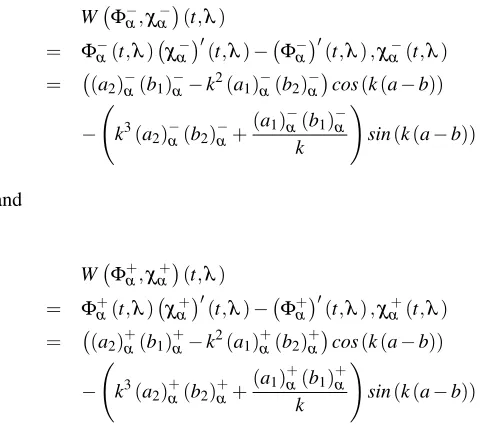
W(Φ−α,χα−) (t,λ)andW(Φ+α,χα+) (t,λ)Wronskian functions as
W Φ−α,χα−(t,λ)
= Φ−α(t,λ) χα−0(t,λ)− Φ−α0(t,λ),χα−(t,λ)
= (a2)−α(b1)
−
α−k
2(a 1)−α(b2)
−
α
cos(k(a−b))
− k3(a2)−α(b2)−α+(a1)
−
α(b1)
−
α
k
!
sin(k(a−b))
and
W Φ+α,χα+(t,λ)
= Φ+α(t,λ) χα+0(t,λ)− Φ+α0(t,λ),χα+(t,λ)
= (a2)+α(b1)
+
α−k
2(a 1)+α(b2)
+
α
cos(k(a−b))
− k3(a2)+α(b2)+α+(a1) +
α(b1)
+
α
k
!
sin(k(a−b))
Theorem 4.2. The Wronskian functions W(Φ−α,χα−) (t,λ) and W(Φ+α,χα+) (t,λ)are independent of variable t for t∈
[a,b], where functionsΦ−α,χα−,Φ+α,χα+are the solution of the fuzzy boundary value problem(1.1)−(1.3)and it is show that Wα−(λ) =W(Φ−α,χα−) (t,λ)and Wα+(λ) =W(Φα+,χα+) (t,λ) for eachα∈[0,1][4].
Theorem 4.3. The eigenvalues of the fuzzy boundary value problem(1.1)−(1.3)are coincided zeros of the functions Wα−(λ)and Wα+(λ)[4].
Example 4.4. Consider the two point fuzzy boundary problem
−bu00 = λub (4.12)
b
u(0) = 0 (4.13)
h b
1ibu(1) = λub0(1) (4.14)
where[1]α = [α,2−α]
,λ =k2(k>0)andbu(t)is[i−gH] -differentiable andub0(t)is[ii−gH]-differentiable fuzzy func-tions.
LethΦb(t,λ) iα
be the solution which is satisfying
u−α(0),u+α(0) =0
initial condition of fuzzy differential equations(4.12). Then we findhΦb(t,k)
iα
as
h b
Φ(t,λ)
iα
=sin(kx). (4.15)
Similarly let[χb(t,λ)]αbe the solution which is satisfying
u−α(1),u+α(1)
= λ
h
u−α0(1), u+α0(1)i = [α,2−α]
initial conditions of fuzzy differential equations(4.12). Then we find[bχ(t,λ)]α as
χα−(t,λ) =k
2cos(kt−k) +α
ksin(kt−k)
χα+(t,λ) =k2cos(kt−k) +(2−α)
k sin(kt−k).
(4.16)
From theorem 4.3, , eigenvalues of the fuzzy problem(4.12)
-(4.14)are zeros of the functions Wα−(λ)and Wα+(λ). So we get
Wα−(λ) = αsink−k3cosk (4.17) Wα+(λ) = (2−α)sink−k3cosk. (4.18)
For eachα∈[0,1]if the k values satisfying(4.17)and(4.18) equations compute with Matlab Program, then an infinite number of eigenvalues such thatλn= (kn)2are obtained. So we show first four k values of(4.17)with k1,nin table 1 such that
Table 1. For Wα−(λ)k1,nvalues corresponding toα α∈[0,1] k1,0 k1,1 k1,2 k1,3
α=0 4.7124 7.8540 10.9956 14.1372 α=0.2 4.7105 7.8536 10.9954 14.1371 α=0.5 4.7176 7.8529 10.9952 14.1370 α=0.8 4.7147 7.8523 10.9950 14.1369 α=1 4.7028 7.8519 10.9948 14.1368 and first four k values of(4.18)with k1,nin table 1 such that
Table 2. For Wα+(λ)k2,nvalues corresponding toα α∈[0,1] k2,0 k2,1 k2,2 k2,3
α=0 4.6930 7.8498 10.9941 14.1364 α=0.2 4.6950 7.8503 10.9942 14.1365 α=0.5 4.6979 7.8509 10.9944 14.1366 α=0.8 4.7008 7.8515 10.9947 14.1367 α=1 4.7028 7.8519 10.9948 14.1368 For each kn values and α ∈[0,1] graphic of Wα−(λ)and
Wα+(λ)functions are given figures 1.
So if we write k1,nand k2,nvalues in(4.15)and(4.16) equations, thenhΦnb (t,λ)
iα
and[χnb (t,λ)]αare
h b
Φn(t,λ)
iα
Figure 1.Wα−(λ),Wα+(λ)andW(λ)
(4.19)
and
[χbn(t,λ)]
α
= (χn)
−
α(t),(χn)
+
α(t)
=
(k1,n)2cos(k1,nt−k1,n) + α k1,n
sin(k1,nt−k1,n)
,
(k2,n)2cos(k2,nt−k2,n) +
(2−α) k2,n
sin(k2,nt−k2,n)
.
(4.20)
Then for all α ∈[0,1], (4.19) are eigenfunctions cor-responding to λ1,n= (k1,n)2 eigenvalues satisfying (4.17) equation and (4.20) are eigenfunctions corresponding to λ2,n= (k2,n)2eigenvalues satisfying(4.18)equation.
Consider that eigenvalues ofhΦnb (t,λ) iα
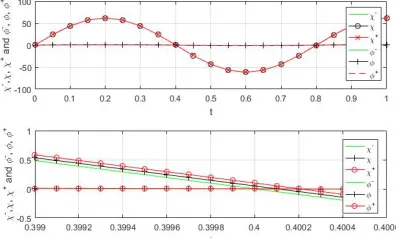
and[χnb (t,λ)]α eigenfunctions depend onα−cut. So if we changeα,then this eigenvalues change and eigenfunctions corresponding toλ change. In particular, we select k1,1=7.8540in table 1 and k2,1=7.8498in table 2 forα =0. If we substitute this values respectively in(4.19) and(4.20), we have the following figures forbχandΦbfunctions.
Figure 2.χbEigenfunctions and fuzzy interval ofbχ
Figure 3.ΦbEigenfunctions and fuzzy interval ofΦb
Figure 4.α−cut ofχbandΦb Eigenfunctions
AlsoχbandΦbfunctions are given same grafic with figure
4.
In figure 2χα−,χ,χ
+
α functions and in figure 3Φ
−
α,Φ,Φ
+
α
functions are seem to have the same graphic. But because of eigenvalues have very close to each other, this eigenfunctions are different. AlsohΦnb (t,λ)
iα
and[χnb (t,λ)]αeigenfunctions are fuzzy at certain intervals see figures.
5. Conclusion
Eigenvalues and eigenfunctions of the fuzzy boundary problem are introduced and examined by using generalized Hukuhara differentiability concept. In this problem, the eigen-value parameter is contained in the boundary condition atb. So we define lineer operator in fuzzy Hilbert space. To solve this problem, we use some initial value problems. Then we give a numerical example.
References
[1] Y. Chalco-Cano and H. Roman-Flores, Comparison
[2] I. Sadeqi, F. Moradlou and M. Salehi, On Approximate
cauchy equation in Felbin’s type fuzzy normed linear spaces,Iranian Journal of Fuzzy Systems, 10(2013), 51-63.
[3] P. Diamond and P. Kloeden, Metric Spaces of Fuzzy Sets:
Theory and Applications, World Scientific, Singapore, 180, 1994.
[4] H. G. Çitil and N. Altını¸sık, On the eigenvalues and the
eigenfunctions of the Sturm-Liouville fuzzy boundary value problem,J. Math. Comput. Sci., 7(2017), 786-805.
[5] A. Khastan and J. J. Nieto, A boundary value problem for
second order differential equations,Nonlinear Analysis, 72(2010), 43-54.
[6] L. T. Gomes and L. C. Barros, ,Annual Meeting of the
North American Fuzzy Information Processing Society (NAFIPS), 1, 2012.
[7] R. P. Agarwal, S. Arshad, D. O’Regan and V. Lupulescu,
Fuzzy fractional integral equations under compactness type condition,Fractional Calculus and Applied Analysis, 4(2012), 572-589.
[8] B. Daraby, Z. Solimani and A. Rahimi, A note on fuzzy
Hilbert spaces,Journal of Intelligent and Fuzzy Systems, 31(2016), 313-319.
[9] A. Hasankhani, A. Nazari and M. Saheli, Some properties
of fuzzy Hilbert spaces and norm of operators,Iranian Journal of Fuzzy Systems, 7(2010), 129-157.
[10] L. M. Puri and D. Ralescu, Differential and fuzzy
func-tions,J. Math. Anal. Appl., 91(1983), 552-558.
[11] B. Bede and L. Stefanini, Generalized
differentiabil-ity of fuzzy-valued functions,Fuzzy Sets and Systems, 230(2012), 119-141.
[12] A. Armand and Z. Gouyandeh, Solving two-point fuzzy
boundary problem using variational iteration method,
Communications on Advanced Computational Science with Applications, (2013), 1-10.
[13] O. Kaleva and S. Seikkala, On fuzzy metric spaces,Fuzzy
Sets and Systems, 12(1984), 215-229.
[14] O. Kaleva, Fuzzy differetial equations,Fuzzy Sets and
Systems, 24(1987), 301-317.
[15] T. Ceylan and N. Altını ¸Sık, Eigenvalue problem with
fuzzy coefficients of boundary conditions, , Scholars Journal of Physics, Math. and Stat., 5(2018), 187-193.
? ? ? ? ? ? ? ? ? ISSN(P):2319−3786 Malaya Journal of Matematik