INTRODUCTION
One of the main challenges which faced by the automobile manufacturers is to reduce the engine emissions without serious modifica -tions of engine systems in order to decrease the production cost and time. Many solutions were proposed by the researchers in the last decades to achieve green internal combustion engine. The use of gaseous fuel in compression igni-tion (CI) engine has received a great attenigni-tion by researchers [Rakopoulos et al., 2001; Rako-poulos et al., 2006; Stone et al., 1991]. Several papers considered the performance of diesel en-gine operating on dual fuel mode [Ishida et al., 2000; Singh et al., 2004; Abd Alla et al., 2002; Lee et al., 2003]. Methane, as a second fuel in conventional compression ignition engine dual fuel (methane/diesel), is a promising gaseous
fuel due to its clean combustion and low price compared with diesel fuel. In addition, many works reported that using methane/diesel mix-ture considerably improved the NOx-Soot trade off compared to neat diesel engine [Agarwal et al., 1998; Nwafor et al., 2000; Lee et al., 2003]. Moreover, methane has a high auto-ignition temperature, suitable for use in diesel engine with high compression ratio without the is-sue of knocking. The main drawbacks of using methane/diesel in dual fuel mode are the higher amounts of CO and HC emissions with lower engine efficiency compared to conventional die -sel engine particularly at partial engine load, as reported by researchers [Krishnan et al., 2002; Ling et al., 2005; Shenghua et al., 2003, Nwafor et al., 2000]. Carlucci et al. [2004] reported that using a CH4/diesel mixture in a compression en-gine at low load increases the HC and CO
emis-Published: 2018.09.01
Volume 19, Issue 5, September 2018, pages 52–58 https://doi.org/10.12911/22998993/91276
Air Pollution Reduction and Environment Protection Using
Methane Fuel for Turbocharged CI Engines
Osama Hasib Ghazal
11 Mechanical Engineering Department, Applied Science Private University, Al-Arab Street 21, Amman 11931
Shafa Badran, Jordan, e-mail: [email protected]
ABSTRACT
The internal combustion engine is considered as one of the main sources for air pollution due to hydrocarbon fuel combustion. The increased land transport usage requires improvement of the engine efficiency and combustion process technology to reduce the engine emissions. A turbocharged engine and the gaseous fuel replacement are the green tools proposed by researchers to enhance fuel saving and emissions reduction. In this paper, both methods were investigated. The methane is a preferred gaseous fuel due to its lower carbon to hydrogen ratio, resulting in lesser HC and CO emissions. In this paper, a turbocharged compression ignition engine with methane/diesel dual fuel is simulated using professional GT-power code to investigate the effect of methane percentage in mixture on the engine performance and emissions. A turbocharged 6 cylinders compression ignition engine has been built and investigated. During the simulation, the methane/diesel ratios were varied from pure diesel with zero percent meth-ane to 90% methmeth-ane concentration by mass with 10% increment every run. The results show that the engine brake
power and specific fuel consumption increased while the thermal efficiency decreased for lower CH4
concentra-tion. For higher CH4 percentage, the brake power and thermal efficiency increased while specific fuel consumption
decreased. Moreover, NO emission has 35% reduction compared to neat diesel fuel when 50% of methane was added to the mixture. Conversely, the CO and HC concentration increased when the methane ratio is less than 50% compared to neat diesel combustion. In general, the engine efficiency improved when methane was added to diesel fuel in compression ignition engine with turbocharger boost, resulting in lesser emissions and cleaner environment.
sion due to the lean methane/air mixture results in deficiency of combustion process. Koraki -anitis et al. [2011] observed that due do flame quenching caused by cylinder wall temperature, more methane is emitted to the atmosphere. Ansari et al. [2016] reported that the NG/diesel mixture extends the combustion duration and a decrease in the cylinder temperature results in lower NOx emission. The difference reactiv -ity between NG and diesel decreases the flame temperature and, consequently, the NO forma-tion [Nieman et al., 2012]. They confirmed that the multi-injection technique of DI diesel fuel increase the engine efficiency and decrease the emissions for different engine load. Zoldaket al. [2014] studied theoretically the effect of NG/ diesel dual mode on the engine performance and emissions. The concluded that the cylinder pres-sure and prespres-sure rate are increased compared to neat diesel fuel. Doosje et al. [2014] controlled the soot and NOx emissions to match the Euro standards for NG/diesel engine operating at dif-ferent load. Dahodwala et al. [2014] investigat-ed the RCCI technique on CNG/Diesel engine. They concluded that the lower engine emissions can be achieved by higher CNG replacement at low load. Peykani et al. [2015] studied the ef-fect of injection mode on the engine efficiency. They observed that the first and second start of injection timing and the amount of injected fuel have a major influence on the engine emissions. Another green technique to reduce the exhaust emissions and save fuel in a diesel engine is us-ing turbocharge system to recover the waste heat from the exhaust gases [Rongchao et al. 2014]. The turbocharged compression ignition engine operating with methane fuel has a higher thermal efficiency and lesser emissions due to lean com -bustion characteristic [Sunyoup et al., 2014].
In this study, the effect of methane addition to turbocharged diesel engine on the performance and emission has been investigated using profes-sional code GT-power. A six cylinder compression engine has been built and simulated. The meth-ane/diesel ratio varied from (10–90%) by mass. Additionally, neat diesel was also combusted to compare with the CH4/diesel mixture. The model has been validated using the available data from the literature and a good agreement was obtained. The engine output such as: brake power, thermal efficiency, fuel consumption, cylinder pressure and temperature, NO, HC and CO emissions were calculated and fully discussed.
SIMULATION MODEL
A six cylinder turbocharger with intercooler system for compression ignition engine has been built and simulated using professional code GT-power. The CH4/diesel ratio varied from (0–90%) by mass. The methane was injected to the intake port with various mass flow rates to mix with air and create homogeneous charge. Liquid die-sel fuel was injected directly to the combustion chamber with rail pressure = 2000 bar and the diesel fuel temperature equaled 330 K. The prop-erties of methane and diesel are included in the software and are presented in Table 1. During the simulation, the total fuel mass (methane and die-sel) was kept constant = 140 mg and the methane energy share was calculated using Eq. (1).
𝐶𝐶𝐶𝐶4 𝑒𝑒𝑒𝑒𝑒𝑒𝑒𝑒𝑒𝑒𝑒𝑒𝑠𝑠ℎ𝑎𝑎𝑒𝑒𝑒𝑒=𝑚𝑚̇ 𝑚𝑚̇𝐶𝐶𝐶𝐶4·𝐿𝐿𝐶𝐶𝐿𝐿𝐶𝐶𝐶𝐶4
𝐶𝐶𝐶𝐶4·𝐿𝐿𝐶𝐶𝐿𝐿𝐶𝐶𝐶𝐶4+𝑚𝑚̇𝑑𝑑𝑑𝑑𝑑𝑑𝑑𝑑𝑑𝑑𝑑𝑑·𝐿𝐿𝐶𝐶𝐿𝐿𝑑𝑑𝑑𝑑𝑑𝑑𝑑𝑑𝑑𝑑𝑑𝑑
𝑏𝑏.𝑡𝑡ℎ𝑒𝑒𝑒𝑒𝑚𝑚𝑎𝑎𝑒𝑒𝑒𝑒𝑒𝑒𝑒𝑒𝑒𝑒𝑒𝑒𝑒𝑒𝑒𝑒𝑒𝑒𝑒𝑒𝑒𝑒=𝑚𝑚̇ 𝑏𝑏𝑒𝑒𝑎𝑎𝑏𝑏𝑒𝑒𝑝𝑝𝑝𝑝𝑝𝑝𝑒𝑒𝑒𝑒
𝐶𝐶𝐶𝐶4·𝐿𝐿𝐶𝐶𝐿𝐿𝐶𝐶𝐶𝐶4+𝑚𝑚̇𝑑𝑑𝑑𝑑𝑑𝑑𝑑𝑑𝑑𝑑𝑑𝑑·𝐿𝐿𝐶𝐶𝐿𝐿𝑑𝑑𝑑𝑑𝑑𝑑𝑑𝑑𝑑𝑑𝑑𝑑
-tions are presented in Table 2 and 3. The model has been validated using available data from the litera-ture. The results from this model compared with references [Saito et al., 2001; Zhou et al., 2014; Yu et al., 1986; Gatts et al., 2012]. The theoretical and experimental data showed a good agreement.
RESULTS AND DICSUSSION
The author investigated analytically the performance and emission characteristics of a
turbocharged (DI) diesel engine operating on methane/diesel in dual fuel mode. The methane content varied from (10–90%) by mass. The neat diesel fuel was also calculated to compare with
the dual mode to find out the effect of methane
addition to diesel on the engine performance and emissions. Another technique used in the simu-lation to reduce emissions was by means of a turbocharger system. The engine ran at full load with constant lambda.
Combustion characteristics
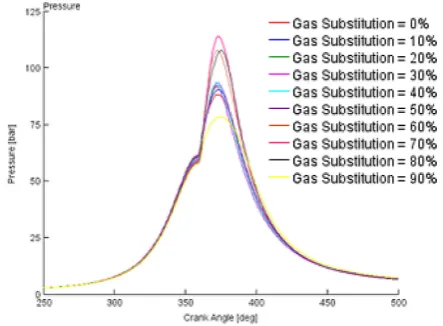
Figure 1 shows the cylinder pressure as a function of methane percentage under full engine
load. As shown in the figure, the cylinder pressure
increased along with the CH4 mass in the mixture. Moreover, the addition of 70% of CH4 by mass increased the cylinder pressure up to 30% com-pared to neat diesel fuel. In turn, the addition of more than 80% methane results in a decrease of the cylinder pressure compared to diesel fuel. In addition, the ignition delay increased along with the methane fraction in the mixture due to the
de-crease in the oxygen concentration which affected
the diesel combustion process [Saito et al., 2001]. The considerable increase of peak cylinder pres-sure caused by uncontrolled combustion of CH4/ diesel mixture compared with diesel fuel combus-tion was observed. This is due to high cylinder temperature resulting in multipoint methane com-bustion and consequently uncontrolled heat re-lease rate. Moreover, the ignition delay increased when the methane ratio increased in the mixture due to the extended of premixed combustion
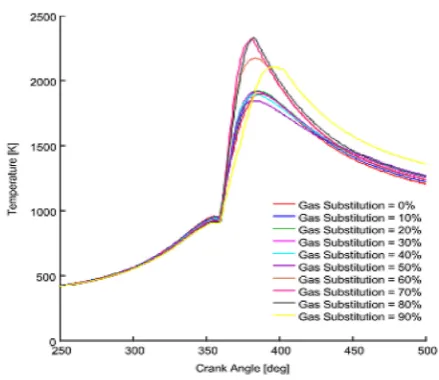
pe-riod [Zhou et al., 2014]. Figure 2 shows the maxi
-mum in-cylinder temperature versus gas substitu-Table 1. Fuel properties
Properties Units Methane Diesel
Carbon atoms per molecule – 1 13.5
Hydrogen atoms per
molecule – 4 23.6
Oxygen atoms per molecule – 0 0
Lower heating value MJ/kg 50 43
Critical temperature] K 190.4 569.4
Critical pressure bar 46 24.6
Absolute entropy at 298k J/kg-K 11618 3445.47
Laminar flame speed m/s 0.38 0.3
Auto ignition temperature k 813 530
Table 2. Engine geometry
Parameter Unit Value
Bore mm 120
Stroke mm 170
Conn. rod length mm 290
Piston pin offset mm 0
Displacement/cyl L 1.9
Total displacement L 11.4
Number of cylinders 6
Compression ratio 13.5
Bore/stroke 0.71
IVC, IVO °CA -122, 310
EVO, EVC °CA 105, 390
Table 3. Engine operation conditions
Parameter Unit Value
Initial pressure bar 1
Initial temperature K 298
Speed rpm 1800
Combustion start °CA -1.5
Injection start °CA -6
Vol. eff. ref. pressure bar 1.7
Vol. eff. ref. temperature K 315
tion. The results show that the increase of CH4 by 80% causes a 22% increase in cylinder tempera-ture compared to conventional diesel fuel.
The effect of methane addition on the heat re
-lease rate is presented in Figure 3. It is shown that the addition of methane between (60–70%) in-creases the heat release rate drastically compared to neat diesel fuel. Moreover, the heat release is retarded when CH4 is added to diesel. The results
agree with [Yu et al., 1986]. They performed that
the increase of hydrogen mass in hydrocarbon
fu-els results in increasing the laminar flame speed
and consequently, the cylinder pressure and heat release rate. For methane/diesel combustion, compared to neat diesel fuel, the heat release rate increased between (15–30%) depending on the methane concentration in the fuel mixture. In
ad-dition, the accumulation of heat by methane and diesel resulted in a remarkable increase in the heat release rate. Figure 4 shows the burn rate for
different methane/diesel mixtures. The burn rate
increased along with the methane ratio in the
mix-ture due to high flame speed of methane.
Engine performance
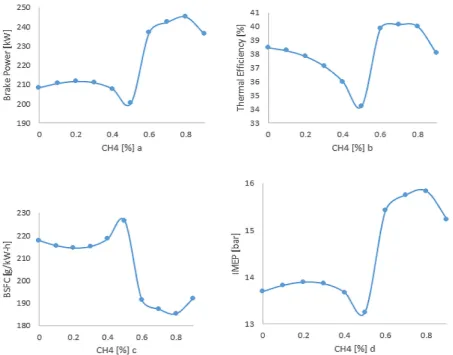
The major engine outputs are presented in Figure 5. The variation of engine brake power versus CH4 concentration is presented in Figure 5a. As shown, the increase of methane concen-tration raises the brake power approximately by 20%, compared to diesel baseline. Moreover, the addition of (40–50%) of CH4 decreases the
pow-er output. The effect of CH4 concentration on the
thermal efficiency is presented in Figure 5b. The brake thermal efficiency can be calculated using
Eq. (2).𝐶𝐶𝐶𝐶4 𝑒𝑒𝑒𝑒𝑒𝑒𝑒𝑒𝑒𝑒𝑒𝑒𝑠𝑠ℎ𝑎𝑎𝑒𝑒𝑒𝑒=𝑚𝑚̇𝐶𝐶𝐶𝐶4·𝐿𝐿𝐶𝐶𝐿𝐿𝑚𝑚̇𝐶𝐶𝐶𝐶4𝐶𝐶𝐶𝐶4+·𝑚𝑚̇𝐿𝐿𝐶𝐶𝐿𝐿𝑑𝑑𝑑𝑑𝑑𝑑𝑑𝑑𝑑𝑑𝑑𝑑𝐶𝐶𝐶𝐶4·𝐿𝐿𝐶𝐶𝐿𝐿𝑑𝑑𝑑𝑑𝑑𝑑𝑑𝑑𝑑𝑑𝑑𝑑
𝑏𝑏.𝑡𝑡ℎ𝑒𝑒𝑒𝑒𝑚𝑚𝑎𝑎𝑒𝑒𝑒𝑒𝑒𝑒𝑒𝑒𝑒𝑒𝑒𝑒𝑒𝑒𝑒𝑒𝑒𝑒𝑒𝑒𝑒𝑒=𝑚𝑚̇ 𝑏𝑏𝑒𝑒𝑎𝑎𝑏𝑏𝑒𝑒𝑝𝑝𝑝𝑝𝑝𝑝𝑒𝑒𝑒𝑒
𝐶𝐶𝐶𝐶4·𝐿𝐿𝐶𝐶𝐿𝐿𝐶𝐶𝐶𝐶4+𝑚𝑚̇𝑑𝑑𝑑𝑑𝑑𝑑𝑑𝑑𝑑𝑑𝑑𝑑·𝐿𝐿𝐶𝐶𝐿𝐿𝑑𝑑𝑑𝑑𝑑𝑑𝑑𝑑𝑑𝑑𝑑𝑑
(2) The engine efficiency decreases when the CH4 ratio is lesser than 50% compared to neat diesel, due to incomplete combustion [Gattes et al., 2012] as well as the high amount of input energy and low output power [Ghazal, 2013]. On the other hand, the efficiency increased when the methane ratio was higher than 60% due to raised indicated mean effective pressure (IMEP). The effect of methane addition on the fuel consumption and indicated mean effective pressure are illustrated in Figure 5c and Fig-Figure 2. In-cylinder temperature versus
methane concentration
Figure 3. Heat release rate versus
ure 5d. The fuel efficiency slightly decreased when CH4 added was less than 50% in the mix-ture at full engine load. On the other hand, the increase of methane percentage in the mixture of more than 60% decreases the fuel consump-tion up to 15% compared to neat diesel com-bustion. Additionally, the high methane con-centration results in an increase in the mean effective pressure. The same results have been obtained by [Ausquiza et al., 2011]. They re-ported that when the NG ratio increased, the fuel consumption increased as well, both at low load and at high load.
Engine emissions
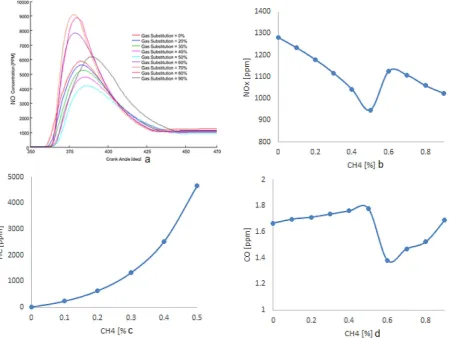
The exhaust emissions characteristics are presented in Figure 6. The NO emission de-crease drastically when gaseous fuel is added to the mixture. The 35% NO reduction can be achieved when 50% methane is added com-pared to neat diesel fuel as shown in Figure
6a and 6b. The NO concentration is presented in Figure 6a as a function of CH4 mass frac-tion. The results show a reduction in the NO emissions when methane fraction is increased in the mixture. However, the NO formation increased when methane was added to diesel due to high combustion temperature, but the NO oxidation rate also increased resulting in lower NO exhaust emissions. Conversely, the CO concentration increased slightly compared to neat diesel combustion when the engine was operating at full load and the methane ratio increased up to 50%. On the other hand, the CO concentration is lesser than base diesel line when the CH4 ratio increased up to 90% as pre-sented in Figure 6b. This is due to incomplete combustion of methane. The same results were demonstrated by [Gatts et al., 2012]. The HC production characteristic is illustrated in the Figure 6c. The increase of CH4 concentration up to 50% results in an increased HC amount in the exhaust gases.
CONCLUSIONS
In this study the effect of methane gaseous
fuel on the performance and emissions of turbo-charged compression ignition engine was inves-tigated. The engine ran with various CH4/diesel ratios under full load. The results show that the
brake power and thermal efficiency increased
while the fuel consumption decreased for high CH4 concentration in the mixture. Moreover, NO emission reduced by 35% compared to neat die-sel fuel when 50% of methane was added to the mixture. Conversely, the CO and HC concentra-tion increased when the methane ratio was less than 50% compared to neat diesel combustion. To conclude, the turbocharger and alternative fuel are promising green techniques to reduce the en-gine emissions and air pollution.
REFERENCES
1. Abd Alla GH, Soliman HA, Badr MF, Abd Rabbo MF. 2002. Effect of injection timing on the
perfor-mance of a dual fuel engine. Energ Convers Man-age, 43, 269–277.
2. Ansari E, Poorghasemi K, Irdmousa BK, Shah-bakhti M, Naber J. 2016. Efficiency and emissions mapping of a light duty diesel-natural gas engine operating in conventional diesel and RCCI modes. In: SAE international powertrain, fuel and lubri-cants conference, 2016-01-2309.
3. Carlucci AP, Ficarella A, Laforgia D. 2004. Experi-mental comparison of different strategies for natu-ral gas addition in a common rail diesel engine. In: Proceedings of FISITA 2004, Barcelona, Spain, May 23–27, Paper F2004V136.
4. Dahodwala M, Joshi S, Koehler E, Franke M. 2014. Investigation of diesel and CNG combustion in a dual fuel regime and as an enabler to achieve RCCI combustion. SAE technical paper 2014-01-1308, http://dx.doi.org/10.4271/2014-01-1308. 5. Doosje E, Willems F, Baert R. 2014. Experimental
demonstration of RCCI in heavy-duty engines using diesel and natural gas. SAE technical paper 2014-01-1318. http://dx.doi.org/10.4271/2014-01-1318. 6. Eg’ausquiza, J., Braga, S., and Braga, C. 2011.
Experimental Investigation of a Diesel Engine Op-erating on Natural Gas/Diesel Dual-Fuel Mode.
SAE Technical Paper 2011-36-0351. https://doi. org/10.4271/2011-36-0351.
7. Gatts T, Liu SY, Liew C, Ralston B, Bell C, Li HL. 2012. An experimental investigation of incomplete combustion of gaseous fuels of a heavy-duty diesel engine supplemented with hydrogen and natural gas. Int J Hydrogen Energy, 37, 7848-59.
8. Ghazal OH. 2013. Performance and combustion characteristic of CI engine fueled with hydro-gen enriched diesel. Int J Hydrohydro-gen Energy, 38, 15469-15476.
9. Ishida M, Amimoto N, Tagai T, Sakaguchi D. 2001. Effect of EGR and preheating on natural gas com-bustion assisted with gas-–oil in a diesel engine. Proceeding of the 5th International Symposium of COMODIA, Nagoya, 382–9.
10. J.H. Zhou, C.S. Cheung, C.W. Leung. 2014. Com-bustion, performance and emissions of a diesel engine with H2, CH4 and H2-CH4 addition. Interna-tional journal of hydrogen energy, 39, 4611-4621. 11. Karim GA. 2003. Combustion in gas fueled
com-pression ignition engines of the dual fuel type. J Eng Gas Turb Power, 125, 827–36.
12. Korakianitis T, Namasivayam AM, Crookes RJ. 2011. Natural-gas fueled spark-ignition (SI) and compression-ignition (CI) engine performance and emissions. Prog Eng Combust Sci, 37, 89-112. 13. Krishnan SR, Biruduganti M, Mo Y, Bell SR,
Midkiff KC. 2002. Performance and heat release analysis of a pilot-ignited natural gas engine. Int J Engine Research, 3, 171–84.
14. Krishnan S.R., Srinivasan K.K., Singh S., Bell S.R., Midkiff K.C., Gong W. 2002. Strategies for reduced NOx emissions in pilot-ignited natural gas engines. Proceedings of the ASME-WA-ICEF Meeting, New Orleans USA, September 8–11, 39, 361–367. 15. Lee CS, Lee KH, Kim DS. 2003. Experimental and
numerical study on the combustion characteristics of partially premixed charge compression ignition engine with dual fuel. Fuel, 82, 553–60.
16. Ling S, Longbao Z, Shenghua L, Hui Z. 2005. De-creasing hydrocarbon and carbon monoxide emis-sions of a natural-gas engine operating in the quasi-homogeneous charge compression ignition mode at low loads. P I Mech Eng D-J Aut, 219, 1125–31. 17. Nieman D, Dempsey A, Reitz RD. 2012.
Heavy-duty RCCI operation using natural gas and die-sel. SAE Int J Engines, 5, 270–85. http://dx.doi. org/10.4271/2012-01-0379.
18. Nwafor OMI. 2000. Effect of choice of pilot fuel on the performance of natural gas in diesel engines. Renew Energy, 21, 495–504.
19. Paykani A, Kakaee AH, Rahnama P, Reitz RD. 2012. Effects of diesel injection strategy on natural gas/diesel reactivity controlled compression
igni-tion combusigni-tion Energy.
20. Rakopoulos CD, Kyritsis DC. 2001. Comparative second-law analysis of internal combustion engine operation for methane, methanol and dodecane fu-els. Energy, 26, 705–22.
21. Rakopoulos CD, Kyritsis DC. 2006. Hydrogen enrichment effects on the second law analysis of natural and landfill gas combustion in engine cyl-inders. Hydrogen Energy, 31, 1384–93.
22. Rongchao Zhao, Weilin Zhuge, Yangjun Zhang, Yong Yin , Zhen Chen, Zhigang Li. 2014. Parametric study of power turbine for diesel engine waste heat recovery. Applied Thermal Engineering, 67, 308-319. 23. Saito H, Sakurai T, Sakonji T, Hirashima T, Kan-no K. 2001. Study on lean burn gas engine us-ing pilot oil as the ignition source. SAE Tech Pap 2001-01-0143.
24. Shenghua L, Longbao Z, Ziyan W, Jiang R. 2003. Combustion characteristics of compressed natural gas/diesel dual-fuel turbocharged compressed igni-tion engine. P Mech Eng D-J, 217, 833–8.
25. Singh S, Kong S-C, Reitz RD, Krishnan SR, Mid-kiff KC. 2004. Modeling and experiments of dual-fuel engine combustion and emissions. SAE Paper No.2004-01-0092.
26. Srinivasan KK, Krishnan SR, Midkiff KC. 2006. Improving low load combustion, stability and emissions in pilot-ignited natural gas engines. P I Mech Eng D-J Aut, 220, 229–39.
27. Stone CR, Ladommatos N. 1991. Design and evaluation of a fast-burn spark-ignition combus-tion system for gaseous fuels at high compression ratios. J Inst Energy, 64, 202–11.
28. Stone CR, Gould J, Ladommatos N. 1993, Analysis of bio-gas combustion in spark-ignition engines, by means of experimental data and a computer simulation. J Inst Energy, 66,180–7.
29. Sunyoup Lee, Changgi Kim, Young Choi, Gihun Lim, Cheolwoong Park. 2014, Emissions and fuel consumption characteristics of an HCNG-fueled heavy-duty engine at idle. International journal of hydrogen energy, 39, 8078-8086
30. Xu M, Cheng W, Li Z, Zhang H, An T, Meng Z. 2016. Pre-injection strategy for pilot diesel com-pression ignition natural gas engine. Appl Energy, 179, 1185–93.
31. Yu G, Law CK, Wu CK. 1986, Laminar flame speeds of hydrocarbon of air mixtures with hydro-gen addition. Combust Flame, 63, 339-47.
32. Zoldak P., Sobiesiak A., Bergin M., Wickman D. 2014. Computational study of reactivity con-trolled compression ignition (RCCI) combustion in a heavy-duty diesel engine using natural gas.
SAE technical paper 2014-01-1321. http://dx.doi.