INTRODUCTION
The post-production sewage generated in dye-ing, textile or paper factories often contains high concentrations of dyes. Due to the low susceptibil-ity of dyes for biodegradation, the decolorization of industrial wastewater with traditional, biologi-cal methods of wastewater treatment is usually ineffective [Robinson et al. 2001]. There is a high risk that the colored substances that have not been removed from sewage may enter the natural envi-ronment, causing its degradation. The perspective of the environment contaminated by dyes should encourage entrepreneurs to use effective technol-ogies for decolorizing the industrial wastewater.
Currently, the scientific community holds the opinion that sorption is the most economical and the most environmentally friendly method of wastewater decolorization. During the sorption, no toxic intermediates are formed, in contrast to
the oxidation methods (ozonation, oxidation with NaOCl) [Wijannarong et al. 2013]. Sorption also does not cause sediment formation or sewage sa-linity, like the precipitation methods do (coagula-tion and electrocoagula(coagula-tion) [Liang et al. 2014, Nandi and Patel 2013].
Decolorization of sewage by sorption does not require the use of complicated installations, as is the case with membrane methods. The sorp-tion costs and its effectiveness mainly depend on the type of sorbent. The most frequently used sorbents for the decolorization of wastewater are various types of activated carbons. Due to their high price, cheaper substitutes are currently be-ing sought. High hopes are associated with the use of waste materials from the agro-food in-dustry as commonly available alternatives to the commercial sorbents.
The coconut shells are easily available waste material from the food industry. Their popularity, Published: 2018.07.01 Volume 19, Issue 4, July 2018, pages 129–135
https://doi.org/10.12911/22998993/89672
The Use of Coconut Shells for the Removal of Dyes
from Aqueous Solutions
Tomasz Jóźwiak
1*, Urszula Filipkowska
1, Paula Bugajska
1, Tomasz Kalkowski
11 Department of Environmental Engineering, Faculty of Environmental Sciences, University of Warmia and
Mazury in Olsztyn, ul. Warszawska 117, 10–720 Olsztyn, Poland
* Corresponding author’s e-mail: [email protected]
ABSTRACT
The main purpose of the work was to check the possibility of using coconut shells for the removal of the dyes popular in the textile industry from aqueous solutions. The sorption abilities of an unconventional sorbent were tested against four anionic dyes: Reactive Black 5, Reactive Yellow 84, Acid Yellow 23, Acid Red 18 as well as two cationic dyes: Basic Violet 10 and Basic Red 46. The scope of research included investigation pertaining to the effect of pH on the effectiveness of sorption of dyes, conducted in order to determine the time of equilibrium of sorption and determine the maximum sorption capacity of coconut shells with respect to pigments. The most favorable pH of sorption for the anionic dyes and Basic Violet 10 was pH 3 and for Basic Red 46 – pH 6. The equi -librium time of sorption was the shortest in the case of acidic dyes (Acid Yellow 23/ Acid Red 18 – 45 min), while the longest in the case of alkaline dyes (Basic Red 46 – 90 min, Basic Violet 10 – 180 min). The sorption capacity of coconut shells in relation to anionic dyes was for Reactive Black 5 – 0.82 mg/g, Reactive Yellow 84 – 0.96 mg/g, Acid Yellow 23 – 0.53 mg/g and for Acid Red 18 – 0.66 mg/g. The tested sorbent showed much higher sorption capacity with respect to the cationic dyes, i.e. Basic Violet 10 (28.54 mg/g) and Basic Red 46 (68.52 mg/g).
which translates into a low price of raw material is the result of wide range of applications of co-conut. This paper explores the possibility of using coconut shells for the removal of dyes popular in the textile industry from aqueous solutions.
MATERIALS
Coconut shells
Coconuts from coconut palm (Cocos nu-cifera), originating from the Philippines, were purchased at a local hypermarket in Olsztyn (Po-land). Due to the monotypic nature of the Cocos genus, the coconuts available on the market al-ways have a similar composition, regardless of the country of origin. The shells of coconuts usu-ally contain 46% lignin, 14% cellulose and 32% hemicellulose [Cagnon et al. 2009].
Dyes
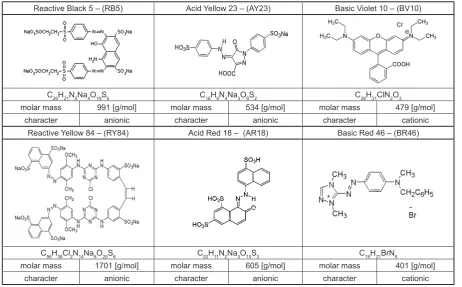
Six dyes popular in the textile industry, in-cluding 4 anionic and 2 cationic dyes were used in the research. Among the anionic dyes there were 2 reactive dyes (Reactive Black 5, Reactive Yellow 84) and 2 acid dyes (Acid Red 18, Acid Yellow 23). The tested cationic dyes were Basic
Violet 10 and Basic Red 46. The characteristics of the dyes used in this work are summarized in Table 1.
METHODOLOGY
The coconut shells were ground in a labora-tory grinder and sifted through the sieves with a mesh diameter of 5 mm and then 3 mm. A 3–5 mm diameter fraction was placed in 2M H2SO4. After 24 h, the shells were rinsed with distilled water, then placed in 2 M NaOH for 24 h. Next, the shells were drained and washed with distilled wa-ter (until pH ~ 7 was obtained in the leachate). The coconut shells (CS) were ready for study af-ter drying at 105°C.
The coconut shells (CS) were weighed in an amount of 1 g each and added to the series of conical flasks (250 mL). Then, dye solutions (10 mg/L – 100 mL) at pH 2–11 were added to the flasks. Then, the flasks were placed on a labora-tory shaker (150 r.p.m.) with vibration amplitude of 25 mm. After 60 min, the samples were taken from the flasks (10 mL) to determine the concen-tration of dye in the solution.
CS in an amount of 10 g each were weighed and added to the beakers (1000 mL). Afterwards, the dye solutions (10 mg/L – 500 mL) with the
Table 1. Characteristics of dyes used in this work
Reactive Black 5 – (RB5) Acid Yellow 23 – (AY23) Basic Violet 10 – (BV10)
C26H21N5Na4O19S6 C16H9N4Na3O9S2 C28H31ClN2O3
molar mass 991 [g/mol] molar mass 534 [g/mol] molar mass 479 [g/mol]
character anionic character anionic character cationic
Reactive Yellow 84 – (RY84) Acid Red 18 – (AR18) Basic Red 46 – (BR46)
C56H38Cl2N14Na6O20S6 C20H11N2Na3O10S3 C18H21BrN6
molar mass 1701 [g/mol] molar mass 605 [g/mol] molar mass 401 [g/mol]
optimum pH, determined in 4.1 were added to the beakers.
Then, the beakers were placed on a magnetic stirrer (150 rpm). During the sorption, samples (5 mL) were taken from the solutions at specified intervals to determine the dye concentration.
CS (1 g) were weighed and added to the conical flasks (250 mL). Next, dye solutions (100 mL) with optimal pH, determined in 4.1., with conc. 5–50 mg/L (anionic dyes) or 10–500 mg/L (cationic dyes) were added to the flasks and then the flasks were placed on a laboratory shaker (150 r.p.m.). After the sorption time determined in 4.2, the samples (10 mL) were taken from the flasks to determine the concentration of the dye remaining in the solution.
The amount of dye adsorbed on the sorbent was calculated from the equation 1:
Qs =(Co − Cs) ∙ Vm (1)
Three sorption isotherms were used to deter-mine the sorption capacity of CS: Langmuir (2), Langmuir 2 (Langmuir double isotherm) (3) and Freundlich (4).
Qs =qmax∙ Kc∙ C
1 + Kc∙ C (2)
Qs =1 + kb1∙ k1∙ C 1∙ C +
b2∙ k2∙ C 1 + k2∙ C
(3)
Qs = K ∙ Cn (4)
where: Qs – mass of the sorbed dye [mg/g]
Co – initial dye concentration [mg/L]
Cs – concentration of dye after sorption [mg/L]
V – volume of the solution [L]
m – mass of the sorbent [g.d.m.]
qmax – maximum sorption capacity in the Langmuir equation [mg/g]
Kc – constant in the Langmuir equation [L/mg]
C – concentration of dye remaining in so-lution [mg/L]
b1; b2 – maximum capacity of active sites (type I and II) [mg/g]
k1; k2 – constants in the Langmuir 2 equa-tion [L/mg]
K – constant of sorption equilibrium in Freundlich model
n – parameter of heterogeneity [-]
RESULTS AND DISCUSSION
The effect of pH on the effectiveness of dye sorption
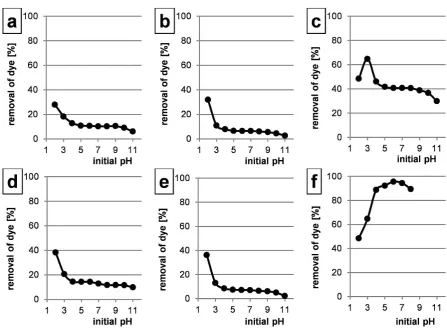
The sorption effectiveness of reactive dyes RB5 and RY84 on the tested sorbent was the highest at pH 2 and decreased with the increas-ing pH of the solution, obtainincreas-ing the lowest value at pH 11. The maximum decrease in the sorption efficiency of RB5 and RY84 was found in the pH range 2–4 (Fig. 1a,d).
The decrease of the sorption efficiency of reactive dyes, together with the increase in pH, has also been confirmed in the sorption studies of RB5 and RY84 on compost [Jóźwiak et al. 2013], chitosan sorbents [Filipkowska and Jóźwiak 201] wheat bran [Annadurai et al. 2002] and modified starches [Wang et al. 2010].
As in the case of reactive dyes, the sorption effectiveness of acid dyes on CS was decreased with the increasing pH of the solution. The effect of pH increase on the reduction of binding effi-ciency of AY23 and AR18 was most evident in the narrow pH range 2–3. (Fig. 1b,e). At pH 11, the sorption of AY23 and AR18 on CS practically did not occur. A very similar tendency was also observed in the studies on AY23 and AR18 sorp-tion on sawdust [Shokoohi et al. 2010].
The increased sorption efficiency of anionic dyes at low pH results from the change in sur-face charge of the sorbent. Probably, in the low pH, functional groups present in the CS structure (-OH) are protonated, owing to which the sorbent gains a positive charge. The sorbent, which has a positive charge, attracts the anionic electrostatic dyes, supporting their sorption. The interaction between the dye and the nut shell is the stronger the lower the pH of the solution (Fig. 1a,b,d,e).
The differences between the optimal pH of sorption of BV10 and BR46 may result from the presence of a carboxylic functional group in the BV10 structure. Generating a local negative charge, the -COOH group (-COO- + H+) caused that under certain conditions, at low pH, BV10 behaved like anionic dyes. Because BR46 does not have anionic functional groups, its sorption at low pH was ineffective.
Determination of the equilibrium time of sorption
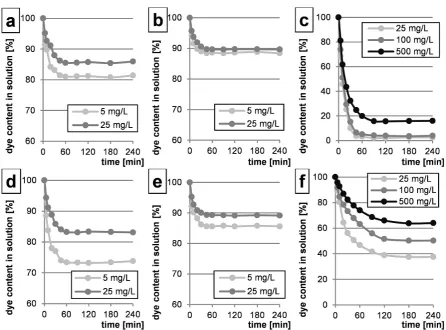
For reactive dyes RB5 and RY84, irrespective of the initial concentration of the dye, the equi-librium time of sorption was 60 min (Fig. 2 a, d). The highest intensity of sorption of dyes was not-ed in the first phase of the process.
Similar time of sorption of reactive dyes on biosorbents was obtained in the studies on sorbtion of RB5 on cotton seed shells (60 min) [Uçar et al. 2012] and rapeseed stems (60 min) [Hamzeh et al. 2012].
The equilibrium time of sorption of AR18 and AY23 acid dyes on the tested sorbent was
45 min (Fig. 2b, e). Similarly to the sorption of reactive dyes, the intensity of acid dye binding was highest in the first phase of sorption. The shorter time to obtain the sorption equilibrium of AR18 and AY23 with respect to RB5 and RY84 could result from the lower molar mass of acid dyes, compared to reactive dyes. Presum-ably, smaller sizes of acid dye molecules allowed them to penetrate into more difficultly available sorption centers located in the deeper layers of the sorbent in a shorter time.
The equilibrium time of sorption of cationic dyes on CS was longer than in the case of an-ionic dyes. For BR46, the sorption equilibrium was obtained after 90 min of sorption (Figure 2f). The same equilibrium time was also established in the research on Basic Red 46 sorption on pine needles [Deniz and Karaman 2011], as well as fir sawdust [Laasri et al. 2007].
Out of the tested dyes, the longest time of CS sorption, equaling 180 min, was obtained by BV10 (Figure 2c). The BV10 sorption equi-librium time, in comparison to BR46, may have resulted from its higher molar mass and the pres-ence of the -COO- group in the BV10 structure.
The sorption equilibrium time level of 180 min was also obtained in the studies on Basic Violet 10 sorption on coffee grounds [Shen and Gondal 2013], as well as the leaves of A. nilotica [Santhi et al. 2014].
Sorption capacity
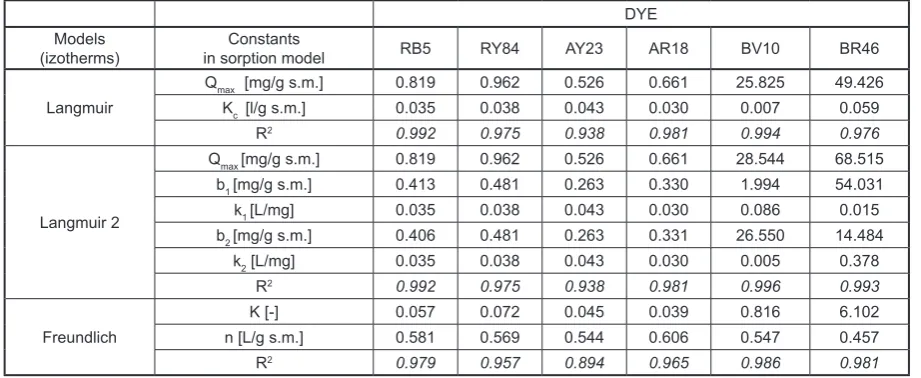
On the basis of the coefficient of determina-tion (R2), it was established that the Langmuir iso-therm and the Langmuir double isoiso-therm describe the sorption of CS dyes better than the Freundlich isotherm (Table 2).
In the case of sorption of anionic dyes on CS, the constants determined from the Langmuir and Langmuir 2 isotherm (Qmax, K/Kc, R2) obtain identical values. This may suggest the presence of only one type of sorption center for anionic dyes on CS. The discussed type of sorption center may be a small amount of the displaced hydroxyl groups of polysaccharides and lignins contained in the sorbent.
In turn, the sorption of cationic dyes on CS is better described by the Langmuir 2 isotherm. This
probably indicates the possibility of occurrence on the sorbent of at least two types of active sites relative to cationic dyes. Presumably, the sorp-tion centers may be the primary and secondary hydroxyl groups of cellulose, hemicellulose and lignin, contained in the CS structure.
The sorption capacity of CS in relation to re-active dyes RB5 and RY84 was 0.82 mg/g and 0.96 mg/g. In the case of acid dyes, the obtained sorption capacity was lower and for AY23 and AR18 it was 0.53 mg/g and 0.66 mg/g, respec-tively (Table 2). The values of Kc constants denot-ing the degree of dye affinity for the sorbent for all anionic dyes are similar.
CS sorbs the reactive dyes more efficiently than the acidic dyes, because RB5 and RY84 have reactive functional groups. The vinyl sul-fone group RB5 or the chlorotriazine group RY84 could support the sorption of dyes on CS by chemisorption.
The repeatedly tested sorbent showed a high-er sorption capacity with respect to cationic than anionic dyes. CS in the amount of 1 g was able to bind 28.54 g BV10 or 68.52 g BR46 (Table 2).
The sorption of cationic dyes on the tested sor-bent was promoted by its acidic nature, which was explained in section 4.1.
The k1 and k2 constants determined from the Langmuir 2 model indicate a higher affin-ity of BR46 for the sorbent compared to BV10. Lower sorption capacities of the tested sor-bent with respect to BV10 may result from the greater weight of the dye as well as the presence of a carboxyl group that generates a strong local negative charge.
CONCLUSIONS
The sorption effectiveness of dyes on CS de-pends on the type of dye. The effectiveness of sorption on the tested sorbent characterizing the cationic dyes is many times higher than that of anionic dyes.
The condition for obtaining satisfactory re-sults of dye sorption is the correction of the pH of the solution in which the sorption takes place. The sorption efficiency of anionic dyes is the highest in the pH range 2–3. Optimal pH of the sorption of cationic dyes should be determined individu-ally for each dye.
The Equilibrium time of dye sorption on CS depends on the type of dyes. The sorption equi-librium time for CS increases in the following series: acidic dyes <reactive dyes <cationic dyes (BR46 <BV10). The equilibrium time may be in-fluenced by: the nature of the dye, its molar mass and functional groups.
Probably, CS have only one type of active site relative to anionic dyes. Relative to cationic
dyes, CS presumably have at least two types of sorption centers.
Acknowledgements
This study was financed under Project No. 18.610.008–300 of the University of Warmia and Mazury in Olsztyn, Poland.
REFERENCES
1. Annadurai G., Juang R.S., Lee D.J. 2002. Use of cellulose-based wastes for adsorption of dyes from aqueous solutions. Journal of Hazardous Materials, 92, 263–274.
2. Cagnon B., Py X. Guillot A., Stoeckli F., Chambat G. 2009. Contributions of hemicellulose, cellulose and lignin to the mass and the porous properties of chars and steam activated carbons from various lignocellulosic precursors. Bioresource Technol -ogy, 100, 292–298.
3. Deniz F., Karaman S. 2011. Removal of Basic Red 46 dye from aqueous solution by pine tree leaves. Chemical Engineering Journal, 170, 67–74 . 4. Filipkowska U., Jóźwiak T. 2013. Application of
chemically-cross-linked chitosan for the removal of Reactive Black 5 and Reactive Yellow 84 dyes from aqueous solutions. Journal of Polymer Engi -neering, 33, 735–747.
5. Hamzeh Y., Ashori A., Azadeh E., Abdulkhani A. 2012. Removal of Acid Orange 7 and Remazol Black 5 reactive dyes from aqueous solutions us -ing a novel biosorbent. Materials Science and En -gineering: C, 32, 1394–1400.
6. Jóźwiak T., Filipkowska U., Rodziewicz J., Miel -carek A., Owczarkowska, D. 2013). Zastosowanie
Table 2. Constants designated from the isotherms: (Langmuir, Langmuir 2 and Freundlich)
DYE Models
(izotherms) in sorption modelConstants RB5 RY84 AY23 AR18 BV10 BR46
Langmuir
Qmax [mg/g s.m.] 0.819 0.962 0.526 0.661 25.825 49.426
Kc [l/g s.m.] 0.035 0.038 0.043 0.030 0.007 0.059
R2 0.992 0.975 0.938 0.981 0.994 0.976
Langmuir 2
Qmax [mg/g s.m.] 0.819 0.962 0.526 0.661 28.544 68.515
b1 [mg/g s.m.] 0.413 0.481 0.263 0.330 1.994 54.031
k1 [L/mg] 0.035 0.038 0.043 0.030 0.086 0.015
b2 [mg/g s.m.] 0.406 0.481 0.263 0.331 26.550 14.484
k2 [L/mg] 0.035 0.038 0.043 0.030 0.005 0.378
R2 0.992 0.975 0.938 0.981 0.996 0.993
Freundlich
K [-] 0.057 0.072 0.045 0.039 0.816 6.102
n [L/g s.m.] 0.581 0.569 0.544 0.606 0.547 0.457
kompostu jako taniego sorbentu do usuwania bar -wników z roztworów wodnych. Annual Set The Environment Protection, 15, 2398–2411.
7. Laasri L., Elamrani M.K., Cherkaoui O. 2007. Removal of two cationic dyes from a textile efflu -ent by filtration-adsorption on wood sawdust. En -vironmental Science and Pollution Research, 14, 237–240.
8. Liang C.Z., Sun S.P., Li F.Y., Ong Y.K., Chung T.S. 2014. Treatment of highly concentrated wastewater containing multiple synthetic dyes by a combined process of coagulation/flocculation and nanofiltra -tion. Journal of Membrane Science, 469, 306–315. 9. Nandi B.K., Patel S. 2013. Effects of operational
parameters on the removal of brilliant green dye from aqueous solutions by electrocoagulation. Ara-bian Journal of Chemistry, 10 (S2), 2961–2968. 10. Robinson T., McMullan G., Marchant R., Nigam
P. 2001. Remediation of dyes in textile effluent: a critical review on current treatment technologies with a proposed alternative. Bioresource Technol -ogy, 77, 247–255.
11. Santhi T., Prasad A.L., Manonmani S. 2014. A comparative study of microwave and chemically
treated Acacia nilotica leaf as an eco friendly ad-sorbent for the removal of rhodamine B dye from aqueous solution. Arabian Journal of Chemistry, 7, 494–503.
12. Shen K., Gondal M.A. 2013. Removal of hazard -ous Rhodamine dye from water by adsorption onto exhausted coffee ground. Journal of Saudi Chemi -cal Society, 21, 120–127
13. Shokoohi R., Vatanpoor V., Zarrabi M., Vatani A. 2010. Adsorption of Acid Red 18 (AR18) by Ac -tivated Carbon from Poplar Wood – A Kinetic and Equilibrium Study. E-Journal of Chemistry, 7, 65–72. 14. Uçar D., Armağan B. 2012. The removal of reac -tive black 5 from aqueous solutions by cotton seed shell. Water Environment Research, 84, 323–327. 15. Wang Z., Xiang B., Cheng R., Li Y. 2010. Behav
-iors and mechanism of acid dyes sorption onto diethylenetriamine-modified native and enzymatic hydrolysis starch. Journal of Hazardous Materials, 183, 224–232.