METHODOLOGY fOr iMpLEMEnTinG
LEarninG OuTcOMEs in a sTuDY
prOGraM as basis fOr fuTurE
rEcOGniTiOn Of priOr LEarninG
Agnese Rusakova, Andrejs Rauhvargers university of Latvia, riga, Latvia E-mail: [email protected], [email protected]
Abstract
One of the most important problems of the next decades in the context of lifelong learning is the inte-gration non- formal and informal learning achievements of individuals with formal learning so that non- formal and informal learning can be used for their formal promotion –gaining credits and/or whole
qualifications.
One of the means for integrating the achievements is through translating knowledge, skills and
compe-tencies obtained through alternate forms of learning into learning outcomes (further in text- LO). It is
necessary to implement LO approach in the formal system of education to prepare it for recognition of
prior learning.
The objective to be reached is understandable and so is the rationale to do so. However unclear is the way how to translate the theory into a working practice. In the following article the authors will address
this problem by proposing and examining a methodology for implementing LO in a program, discussing
the possibility to improve the quality of program through this action.
The LO approach reflects change from „teacher-centered” to „student-centered” learning. The first re -sults of surveying the lecturers involved in the analyzed program show that the LO are currently
imple-mented rather formally. It is necessary to do more explanatory work in order to benefit from the LO as quality instrument.
Key words: lifelong learning, learning outcomes, National Qualifications Framework, quality.
Introduction
interest in lifelong learning, in its modern sense, revived in the early 1990s, particularly in europe and the united states. a fresh round of studies and reports popularized the idea of lifelong learning, and it became part of national policy discussion, particularly as global compe-tition and economic restructuring toward knowledge-based industries became more prevalent. the focus on learning shifted from personal growth to human resource development
the aging of the society results in need for lifelong learning to stay competitive and mobile on labor market. it also becomes important to recognize the nonformal and informal
learning and integrate it into the formal qualification framework easily, because many laws require the candidate for work placement or employee to be able to prove having specific quali
of education in the 21st century Volume 26, 2010 125 getting the position. The significance of recognition of prior learning also increases due to the
increased geographic mobility of the labor force. even such reasons as previous involvement of individual in unregistered employment may provide knowledge, skills and competences that are hard if not impossible to prove.
recognizing what people know or can do – regardless of where they have acquired these knowledge, skills and competences – is indeed likely to be a strong incentive for them to resume learning formally as they will not have to start from scratch. this also cuts the tradi-tional costs (time, tuition fees, transportation costs, etc.) and opportunity costs (forgone earn-ings, etc.) of formal learning. cost is often an issue, particularly for the low-skilled who are also generally the lower-paid. one relatively simple and low-cost way of improving the overall
skills base of the workforce without having to create new qualifications is create new routes to access existing qualifications.
Problem of Research
Existing national qualifications systems need to be changed with respect to validating
learning forms such as non-formal and informal learning to become adapted to a fast-changing
knowledge economy. According to “Criteria and procedures for referencing national qualifica -tions levels to the eQf”the lo approach is fundamental to the eQf and the national framework
or qualifications system and its qualifications should be demonstrably based on LO. At the same
time strong links with the use of lo are a central element for the recognition of prior learning. the thorough implementation of lo is thus to be further advanced. implementation of lo may serve as quality instrument (adam, 2006; Jenkins and unwin, 2001) - providing more transpar-ency, time economy, clearly set responsibility and target orientation.
Research Focus
the objective to be reached is understandable and so is the rationale to do so. however unclear is the way how to translate the theory into a working practice. in the following article the authors will address this problem by proposing and examining a methodology for imple-menting lo in a bachelor program.
Methodology of Research
there are two main approaches to conduct the implementation of lo in a program. the top-down approach is useful, when the study program is already functioning, then the
course-level LO are adapted to the LO as specified for the major. The bottom-up approach can be ap -plied in cases when the program lo will be inferred from lo of existing courses or modules. at the point of introducing lo in the bachelor program “international economics and commercial diplomacy” at the faculty of economics and management, university of latvia, it was already a fully operational and accredited study program. this allowed for choosing the top-down approach which would also enable the study program director to better coordinate the implementation process and address the program in a holistic manner. for formulating the lo the authors decided to apply action verbs as suggested by bloom’s taxonomy (bloom, 1975).
remaining 27 lecturers as well.
Results of Research
after having taken conceptual decisions the authors proceeded by ensuring that the lo of the program are formulated correctly (see figure 1). the many of the intended outcomes
in accreditation documentation of the program were clearly formulated in a way to reflect the
teacher’s intentions:” to provide theoretical and practical knowledge in international econom-ics, commercial diplomacy, as well as in fields of political science, culture and legislation”. thus the lo of the program had to be reformulated in a student-centered way. the
accredita-tion documentaaccredita-tion of the program was prepared before the Naaccredita-tional Qualificaaccredita-tion Framework
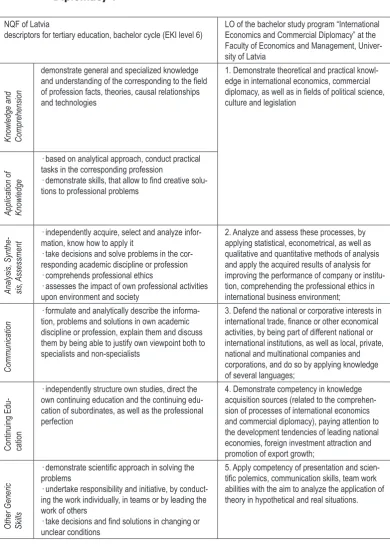
(nQf) was adopted to the eQf- the outcomes of the entire program had to be adjusted to the respective level descriptors of the nQf of latvia (see table 1).
Mapping the program’s LO to separate courses C onceptual decisions
Formulation of program’ s LO
Feedback from stakeholders
- NQF - curriculum
- detailed LO - methods & assessment
- responsibility - top- down/bottom- up
- taxonomy
of education in the 21st century Volume 26, 2010 127 Table 1. Cycle Descriptors of NQF of Latvia and the LO of the bachelor
study program “International Economics and Commercial Diplomacy”.
NQF of Latvia
descriptors for tertiary education, bachelor cycle (EKI level 6) LO of the bachelor study program “International Economics and Commercial Diplomacy” at the Faculty of Economics and Management, Univer-sity of Latvia
Knowledge and Comprehension
demonstrate general and specialized knowledge and understanding of the corresponding to the field of profession facts, theories, causal relationships and technologies
1. Demonstrate theoretical and practical knowl-edge in international economics, commercial diplomacy, as well as in fields of political science, culture and legislation
Application of Knowledge
· based on analytical approach, conduct practical tasks in the corresponding profession
· demonstrate skills, that allow to find creative solu-tions to professional problems
Analysis, Synthe
-sis,
Assessment
· independently acquire, select and analyze infor-mation, know how to apply it
· take decisions and solve problems in the cor-responding academic discipline or profession · comprehends professional ethics
· assesses the impact of own professional activities upon environment and society
2. Analyze and assess these processes, by applying statistical, econometrical, as well as qualitative and quantitative methods of analysis and apply the acquired results of analysis for improving the performance of company or institu-tion, comprehending the professional ethics in international business environment;
Communication
· formulate and analytically describe the informa-tion, problems and solutions in own academic discipline or profession, explain them and discuss them by being able to justify own viewpoint both to specialists and non-specialists
3. Defend the national or corporative interests in international trade, finance or other economical activities, by being part of different national or international institutions, as well as local, private, national and multinational companies and corporations, and do so by applying knowledge of several languages;
Continuing Edu
-cation
· independently structure own studies, direct the own continuing education and the continuing edu-cation of subordinates, as well as the professional perfection
4. Demonstrate competency in knowledge acquisition sources (related to the comprehen-sion of processes of international economics and commercial diplomacy), paying attention to the development tendencies of leading national economies, foreign investment attraction and promotion of export growth;
Other Generic Skills
· demonstrate scientific approach in solving the problems
· undertake responsibility and initiative, by conduct-ing the work individually, in teams or by leadconduct-ing the work of others
· take decisions and find solutions in changing or unclear conditions
5. Apply competency of presentation and scien-tific polemics, communication skills, team work abilities with the aim to analyze the application of theory in hypothetical and real situations.
curriculum. apparently the part “Analyze and assess these processes, by applying statistical, econometrical, as well as qualitative and quantitative methods of analysis... ” corresponds to the following courses - economic informatics i, statistics of economics and business, econo-metrics. the part “...and apply the acquired results of analysis for improving the performance
of company or institution...” correlates to the lo of the management theory, international
eco-nomics, Research Workshop. And, finally, the part “... comprehending the professional ethics in
international business environment” conforms to the intended lo of the courses - economics
and World Security, Comparative Analysis of World’s Regions etc.
If one assumes that these are the courses that will indeed address the specific program’s
lo, it will mean an unavoidable jeopardy of running into quality problems – the overlapping and redundancy of course content. this requires more discussion among the teaching staff in order to eliminate the possible repetition of the study material.
also the part of the lo no.3 “... and do so by applying knowledge of several languages” seems to be best allocated to the courses - business english, english for business and law,
Business Correspondence in English, French. However, this would be a too simplified and confined approach. Excluding other lecturers from addressing this LO, the overall quality of the
program may suffer or at least may reach unsatisfactory results.
such curriculum constituents as defense of bachelor thesis, defense of internship are presumed to take care of the more generic lo no. 5 nevertheless improvement of generic skills can become and often is part of all courses. the generic nature of this lo may lead to a too scattered perception of own responsibility in leading students to the achievement of this lo, as
the lecturer of the individual, specialized course (such as f.ex. World’s Religions) most prob -ably does not feel obliged to make sure that the students advance in achieving this lo. in most severe case this lo is not reached at all by the graduates of the program as all lecturers expect other lecturers to take care of it. to avoid such unwishful consequences it is necessary to further
interpret and define the responsibility of individual course lecturers in achieving this LO.
as a matter of fact the generic skills can also be further divided –f.ex. team work abili-ties (take on initiative, work with people from different backgrounds etc.). even in the case when the lecturers state that they take care of the generic skill “team work abilities”, by regu-larly assigning the students with team projects, it is necessary to check the extent and emphasis of lecturers’ approaches within this respect. thus it may happen, that all lecturers allow the stu-dents to form teams according to own preferences. in such a way the development of sub-skill
„work with people from different backgrounds” is impeded. per contra, if the group of lecturers,
that assign team projects during their lectures agree in advance, that one of them will always group the teams in a random way, the other will group the team by students sitting next to each other etc, the achievement of the sub-skill and correspondingly the umbrella-skill „team work abilities” will be achieved in a more qualitative way.
of education in the 21st century Volume 26, 2010 129 Table 2. Mapping detailed LO to the individual courses.
LO: the graduate is able. How to reach this LO, how to
assess it? Who will be responsible?
.. find solution to the problem by providing a
list of possible actions case studies Commercial Diplomacy
..select and concentrate the most important
information create a title and annotation to an article ?
..explain and justify own viewpoint in a written
form report, A4 dispatch, write critical review Economics and World’s Security
on the basis of such a map (developed in close collaboration with the director of the study program) the authors created the questionnaire.
The first results of interviewing the lecturers involved in the analyzed program show that the LO are currently implemented rather formally. Insufficient understanding of the term
lo and student centered learning has been detected. thus the annotations of individual courses of two lecturers were not formulated according to the main principles of lo – they contained formulations that were teacher centered. one lecturer stated that she is covering all lo’s of the
program within her course, which is also a sign that the approach is rather superficial – as it
can not be ensured that all aspects of the program are covered by one lecturer only. apart from discrepancy with the student centered learning philosophy, the lack of understanding creates a resistance to change among the teaching staff.
the survey showed that the majority of the questioned lecturers do not consider the teaching of generic skills as their full responsibility; this is especially observable with relation to presentation skills of the students.
Discussion
the chosen top-down approach was useful, since the study program was fully opera-tional and accredited. also the fact that many of the lo’s of the individual courses still have to be adjusted to student centered approach speaks in favor of the top-down approach as it is easier to change the learning outcomes of individual courses than the learning outcomes of the whole program as stated in the accreditation documentation.
While formulating the LO the authors followed the guidelines (Kennedy, 2007) outlined by Dr. Declan Kennedy, making sure that the LO are: Observable; Measurable; Student-cen -tered; 5-8 in total and that lo “are written at minimum acceptable or threshold (pass / fail) standard” (moon, 2005); and that they should serve as tool of transparency for the stakeholders – “ for those who pay the bills—taxpayers, parents, and students—to evaluate critically what they get for their money from public education” (frye, 1999). the lo have to relate to external
reference points (qualifications descriptors, levels, level descriptors) (Adam, 2004)
it was noticeable that the interviewed lecturers improved their attitude towards the con-cept, once it was explained that “learning outcomes” is not just another bureaucratic reformula-tion of existing term “study aims” but involves a new learning paradigm that can serve as qual-ity instrument. as result of the improved attitude the lecturers became more cooperative.
In order to fully benefit from learning outcomes as quality instrument it is necessary to
check not only the formal implementation, but also the quality dimension thereof. even though
five of the interviewed lecturers require the students to prepare a presentation in at least one of
the map of detailed lo to the individual courses can help to: identify the attained clus-ter of knowledge, skills and competences of the average graduate of the program based on the activities undertaken in sum by the team of lecturers; identify the cluster that currently is being attained at an unsatisfactory level; provoke discussion on the conformity of the lo of the pro-gram to the content provided.
to gain more complete picture of the current state of implementation of lo in the pro-gram it is necessary to interview the remaining 27 lecturers as well.
the further research would require checking the opinion of the stakeholders (such as graduates and employers) on the implementation of lo in the program. according to the results it will be most necessarily to adjust the program’s lo and restart the cycle, entering the process of an ongoing aspiration for quality. once formulated the lo can serve as basis for recognition of prior learning.
Conclusions
• currently the learning outcomes in the analyzed program are implemented rather formally;
• Due to still insufficient understanding of the concept „learning outcomes” among the
teaching staff it is necessary to do more explanatory work;
• formulation of learning outcomes does not only include choosing the taxonomy, but also making sure that other aspects are complied with – such as reasonable number of learning outcomes etc.
• the generic skills are often considered of second importance and are left out of the
field of responsibility of the lecturers’ team, as they strive to make sure that the stu
-dents know mainly the specific content of their courses;
• correctly implemented learning outcomes may serve as quality instrument;
• the map of detailed lo to the individual courses can serve as basis of discussion for implementing learning outcomes in a program.
References
Adam S., (2004). A consideration of the nature, role, application and implications for European educa-tion of employing learning outcomes at the local, naeduca-tional and internaeduca-tional levels. Report to the UK Bo -logna Seminar, Heriot-Watt University, Edinburgh, Scotland. Retrieved October 9, 2010, from pedagogy. ir: learning environment, performance & lifelong learning Web site: http://www.pedagogy.ir/images/pdf/ using-learning-outcomes-eu.pdf
adam, s., (2006). an introduction to learning outcomes , a consideration of the nature, function and posi-tion of learning outcomes in the creaposi-tion of the european higher educaposi-tion area. Bologna Handbook, BH 1 00 06 07 1, B 2.3-1, 1–24. Retrieved October 9, 2010, from Bologna Process, Ministry of Education, Youth and Sports, Czech Republic Web site: http://www.bologna.msmt.cz/files/Adam_IH_LP.pdf bloom, b.s. (1975). Taxonomy of educational objectives, handbook 1: cognitive domain. new york, usa: longman.
european commission. (2009). Criteria and procedures for referencing national qualifications levels to the EQF (eQf advisory Group, ares (2009)89092), retrieved october 9, 2010, from european commis-sion Web site: http://ec.europa.eu/education/lifelong-learning-policy/doc/eqf/criteria_en.pdf
of education in the 21st century Volume 26, 2010 131 Jenkins, a. & unwin, d. (2001). How to write learning outcomes. retrieved october 9, 2010, from National Center for Geographic Information and Analysis Web site: http://www.ncgia.ucsb.edu/educa-tion/curricula/giscc/units/format/outcomes.html
Kennedy, D. (2007). Writing and using learning outcomes: a practical guide. University College Cork. Cork, Ireland: Watermans Printing.
moon, J. (2005). The module and programme development handbook: a practical guide to linking levels,
outcomes and assessment criteria. London, UK: Routledge.
Adviced by Andris Kangro, University of Latvia, Latvia
Agnese Rusakova M.sc., Doctoral Student, Faculty of Education Psychology and Art, University of
Latvia, Raina Blvd. 19, Riga, LV-1586, Latvia. E-mail: [email protected]
Website: http://www.lu.lv
Andrejs Rauhvargers Dr.chem, Professor, Faculty of Education Psychology and Art, University of Latvia,