58
Current Challenges for Computer
supported sChool ChemiCal
experiments
Martin Bílek
university of hradec Králové, Czech republic e-mail: [email protected]
Jarmila Kmeťová matej Bel university, slovakia e-mail: [email protected]
Abstract
In the article we deal with the topic of Virtual Measuring Devices working in the computer supported measuring system in general chemistry education. We discuss the theoretical base for application of ex-periments in the chemistry education and its computer support. Attention is focussed to specific features of chemistry, alike to other natural sciences lay in observations of the course of chemical experiments and in forming conditions for their repetition and changes. Then, it is clear that the intellectual activities participate in every senso-motoric (or only sensory, and only motoric) activity. Dominant, or rather start-ing, activities in the theoretical procedure will be intellectual ones, while sensorimotor activities work in the empirical procedure.
When implementing the computer support into experimental activities, the adequate combination of measuring systems, simulations and “data-processing” programmes may result in a new environment for using experiments. The computer thus may make the inductive, deductive or combined procedures easier and evidently.
One of the challenges for school chemistry experiments is so-called “single-step mode” measurement method. Three types of this mode are discussed and examples provided: single-step mode on one experi-ment, single-step mode on comparison of samples and single-step mode on a set of experiments. Pre-sented examples of class chemical experiment were carried out in the Vernier system, very simple applied in computer labs with science orientation.
Key words:computer supported school chemical experiment; virtual measuring device, general chemis-try education, single-step mode of measuring.
Introduction
most approaches to curricula innovations in the general chemistry education consider
in-formation and communication technologies (ICT) to be a field which should penetrate through
curricula of all subjects. methodological aspects should not be omitted from the forefront of computer supported natural science instruction, i.e. the emphasis on empirical and theoretical methods of cognition. fast development of technologies makes easier the access and range of means for both computer supported real experiments and computer animations. “remote and virtual laboratories” and “remote measurements” are considered more and more often. digital technologies have become an organic part of chemistry instruction. chemistry, a natural
in the 21st century Volume 24, 2010 59
The question is whether virtual experiments are so powerful to replace real school laboratory
practice. in our opinion, the real chemical experiment should not be omitted from the school
practice, as well as mediated observations and work with models; adequate combinations are required (bílek et al., 2009).
The Theoretical Base for Computer Supported Experimental Activities in the Natural Science Instruction
Specific features of chemistry, alike to other natural sciences, lay in observations of the
course of chemical experiments (sensory sphere) and in forming conditions for their repetition and changes (motoric sphere). then, it is clear that the intellectual activities participate in every senso-motoric (or only sensory, and only motoric) activity. dominant, or rather starting,
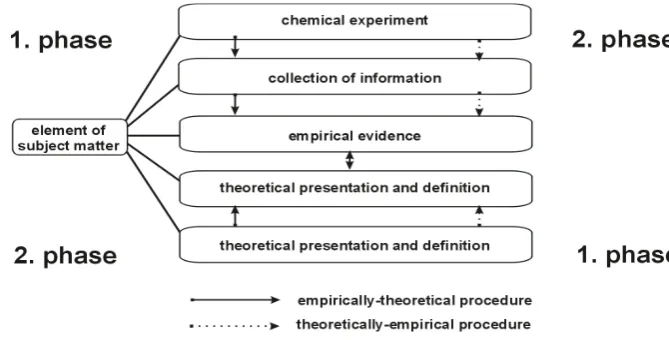
activi-ties in the theoretical procedure will be intellectual ones, while sensorimotor activiactivi-ties work in the empirical procedure. The simple analogy of both procedures according to Čtrnáctová (1982)
is displayed in figure 1.
as it can be seen, in both examples the procedure of running and evaluating the chemical
experiment is analogical. That is why pupils´ activities in running and evaluating the experi
-ment and in theoretical explanations of the given items of knowledge are similar. The differ
-ence appears mainly in teacher’s activities, i.e. in the way of managing the given phase of the educational process (Čtrnáctová, 1982).
Figure 1. Two-phase scheme of the theoretical and empirical procedure (Čtrnáctová, 1982, Bílek et al. 2009).
Within the so called cybernetic model of processing information (bílek et al., 2001)
from the methodological point of view the analysis and description of brain centres is crucial
– e.g. the sense centres are situated closely to performing centres (effectors) depending on
close co-operation. Human senses scan information from the neighbouring world in the form
of signals of various physical carriers. the sense organ is a convertor sensitive to a certain type of the physical carrier, and according to the quality and quantity of the stimulus it produces a
processible sequence of electric impulses for the central nerve system. From this point of view
the number of impulses is considerably higher than the six ones usually mentioned, e.g. Weber
(1984) speaks about 27 different senses. Each sense operates in a more or less bounded area
in the cerebral cortex of the great encephalon. centripetal nerve impulses from sense organs,
60 as mentioned above, the centres are situated closely to effectors. several examples of sensory
(SC) and motoric (MC) centres with short nerve connections forming nets follow:
• sc for auditory perception and mc for “listening movements”,
• SC for optical definition of space projection and MC for constructive activity,
• sc for optical attention and mc for focusing movements,
• sc for the position and movement and mc for turning the head and body,
• sc for the feeling of strength and mc for the sequence of motoric activities, etc.
(adapted according to Weber, 1984).
this layout “saves time” in running of nerve impulses and the “building material” (mo-toric centres for e.g. head motions, or eye motions for observing objects are developed).
effec-tors as target places of the centrifugal part of the nerve signalization participate in the whole
spectrum of various activities.
The presented facts relate to the importance of motivation towards learning, i.e. the proc -esses of selecting the individually important information and focusing on certain elements.
Weber mentions the process of scanning information via the sight:
• a directed head movement (broad point) and eyeballs (exact, specific point),
• setting the focal length of the lens according to the subject distance,
• setting the diaphragm to the optimal light intensity,
• coming closer to the subject to the optimal distance,
• backward actions towards reaching a certain position of the subject,
• using a measuring device, if the human discrimination ability is not sufficient, or if
such a sense (sensitive to the physical carrier representing the learning object) is not
available, the measuring device works as a convertor (e.g. in measuring electric val -ues),
• using a tool in relation to the backward action (or experiment), if the manual action
is not available,
• if the sight itself is not available, other senses may support it – e.g. sense of touch, temperature sensor etc.
Instead of the wide range of senses, the measuring devices play an important role in searching information on the learning object. Two basic functions must be clearly distin
-guished:
1) measuring devices rising the contrast of the scanned physical carrier itself in relation to the environment (e.g. the microscope or binocular) for observing the micro- or
macro-world),
2) measuring devices working as convertors from the physical carrier to the carrier of a
certain sense.
From this point of view, an experiment works as an intentional action against the nature of the learning object because of making its features more visible (Weber, 1984).
the sense evidence belongs to unique methods of so called innovative (discovery)
learn-ing, when the object does not provide any required information before. The attention and focus are the first intentionally directed filter of information entering the memory on the basis of
curiosity (interest) or forming (creating) associations. other factors are resourcefulness of the
learning content, which strengthens the interest, protection against stress factors, which may block the thinking (hormonal influence on the nerve synapse), considering the learning style of an individual or in the course of life (the range of motivation area is going narrow during the
course of life, it is not linear) etc.
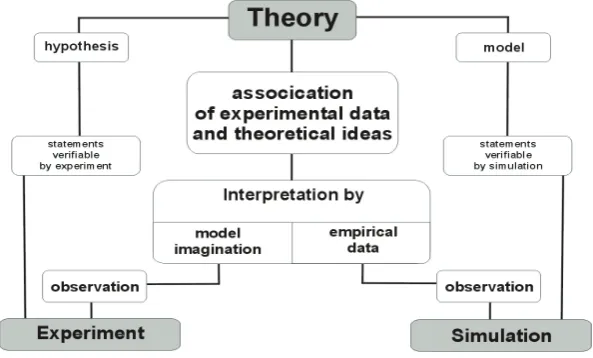
When implementing the computer support into experimental activities, the adequate combination of measuring systems, simulations and “data-processing” programmes may result
in a new environment for using experiments. The computer thus may make the inductive, de
in the 21st century Volume 24, 2010 61
in Figure 2. Thus measuring systems are widen into so called “integrated systems” which con
-tain most of the mentioned components defined as “learningspace“ or “micro-world“, and the component of the real environment cannot be omitted. This is the way how to understand the multimedia approach to natural science instruction, i.e. covering both the content and specific
methods.
Figure 2. Schema of the experiment – simulation relation
(adapted according to Wedekind, 1981, Bílek et al., 2009)
Virtual Measuring Devices in the General Chemical Education
Virtual measuring devices are considered to be all computer-run or computer-supported measurements of various values. mainly physical and physical-chemical values are meant in
chemistry. The virtual measuring devices can be structured into two basic groups:
1) the virtual devices, when the computer generates the environment to be measured on the screen and data are collected from the real environment with the help of real me
-ters or devices (sensors) and analogue-digital convertors which provide an adapted
signal for further processing,
2) the virtual devices when the computer generates not only the environment for meas -urements on the screen but also both mathematic and formal-logic models, and the appropriate signal, i.e. values of the measured item.
In previous papers we devoted to the second situation, i.e. virtual measuring devices, computer simulations of the work with them, e.g. (Bílek & Skalická, 2009 or Bílek, Rychtera & Skalická, 2010). In this paper we pay attention to several topical aspects of the first concept of
virtual measuring devices, i.e. the current state, and possibilities of using computer measuring systems (bílek, 2005).
Approaches to Using Virtual Measuring Devices on the Basis of Computed Systems
When using virtual measuring devices on the basis of direct connection of the
com-puter to the school chemical experiment via various peripherals, there have been classified various types of experiments with methodological aspects of their possible implementation in
62 frequency of its use in the chemistry instruction on all levels of the educational system. instead
of different classifications of the school chemical experiments, e.g. demonstrative and pupils´
ones, the main attention in using the computer as a measuring device is paid to so called
”ki-netic aspect”. It arises from the critical comments on running school experiments in such a way when pupils only determine the value of the measured item in the reaction system before and after the reaction. This way they can measure e.g. temperature by the laboratory thermometer,
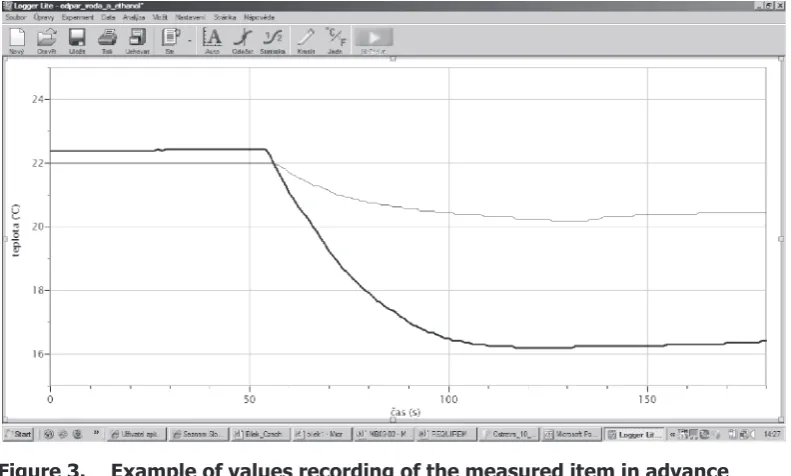
the ph value by the universal indicator paper, subjectively change the colour of the solution, create a sediment etc. Virtual, i.e. computer, measuring devices enable easy and operative intro-duction of the kinetic aspect to the running experiments, i.e. to determine and record changes in values during the chemical reaction. this approach brings other advantages. it enables to record
the values in short-time periods, e.g. shorter than 1 s (when using the laboratory thermometer
the period is approximately 30 s), or to run long-time measurements (e.g. to register ph changes in the process of spirits fermentation etc.), and consequently create a graphic record, store and evaluate the collected data.
Figure 3. Example of values recording of the measured item in advance selected time-intervals in the computer measurement system Vernier (2010).
Applications of the virtual measuring devices in chemical experiments usually work in three modes of experimental data registration:
• record of values of the measured item in advance selected time-intervals, or in the
intervals given by the combination of the quality of hardware realization of scanning data and the resolving power of the screen,
• registration of values of the measured item in advance selected intervals of another item (so called the single-step mode measurements),
• registration the measured value in relation to another item (automatic measurements,
two-channel ones at least).
the single-step mode measurements are often ignored. We consider applying this
in the 21st century Volume 24, 2010 63
The single-step mode measurements within one experiment
This application can be used in well-known semi-automatic titrations when the volume of the titrating agent influences the independent variable in the graphic representation (the ti -trating curve) – the selection of the added interval of the ti-trating volume and its registration, e.g. by clicking the “start“, pressing a key etc. numerous variations of traditional titrating
curves were debugged, e.g. HCl + NaOH, or interesting applications for their further interpreta
-tions, e.g. histidin-dihydro-chloride + NaOH (e.g. Bílek, 1995).
The single-step mode measurements within the set of analysed samples
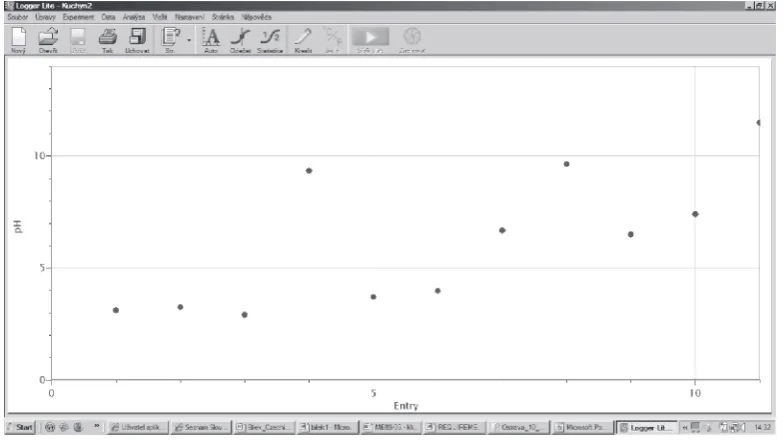
this approach can be applied in creating graphic records – diagrams. it enables to use various methods and organizational forms of instruction under school conditions (e.g. the
project method, group instruction etc. Figure 4 displays the final objectified pH scale created by pupils from the “kitchen matters”. They worked in teams and formed their subjective pH scale
of matters they considered by chemistry sour, and vice versa (e.g. bílek, 1999).
Figure 4. Measurements of pH of “Substances from the kitchen“ (Bílek, 1999) using the single-step mode in the computer measurement system Vernier (2010).
The single-step mode measurements within the set of experiments
this type of measurements can be used in the school application of the method of so
called isomolar series in determining the stoichiometry of chemical reactions, e.g. NaOH + HCl (Čipera and Bílek, 1997). Figure 5 presents running of the given set of experiments (various
64
Figure 5. Method of isomolar series for confirming stoichiometry in the chemical reaction NaOH-HCl (Čipera & Bílek, 1997) using the single-step mode in the computer measurement system Vernier (2010).
Conclusion
The single-step mode measurements, as briefly described above, bring new approaches to making school laboratory experimenting more efficient. Creating diagrams and graphs with pupils´ direct participation is an important contribution towards building natural science lit
-eracy. Difficulties with availability of expensive devices (automatic burette, titrating devices,
actuating devices etc.) are solved by using quite a simple device on the basis of computer
tech-nology. Frequently mentioned trends towards increasing simplicity, robustness and universality
of school computing measurement systems on one side and economic availability on the other
side are a great expectation in this field.
Acknowledgements
The paper is supported by the GAČR Project N. 406/09/0359.
References
bilek, m. et al. (2009). Interaction of Real and Virtual Environment in Early Science Education: Tradi-tion and Challenges. Hradec Králové: Gaudeamus, 145 p.
Bilek, M. & Skalicka, P. (2009). Real, Virtual Laboratories together in General Chemistry Education: starting points for research project. Problems of Education in the 21st Century, Vol. 16, pp. 30 - 39. Bilek, M., Rychtera, J. & Skalicka, P. (2010). Virtuální měřící přístroje ve všeobecném chemickém vzdělávání. Chemické rozhľady, Nr. 5/2010, pp. 35–42.
in the 21st century Volume 24, 2010 65
Bilek, M. (1997). Kroková měření s počítačem v chemických experimentech. In: Bilek, M. (ed.) Aktuální otázky výuky chemie. Gaudeamus, Hradec Králové, pp. 93–96.
bilek, m. et al. (1995). IP-Coach a chemický experiment. Liberec, Praha: CMA Foundation prostřednictvím pepeKo a mff uK, 105 p.
Bilek, M. (1999). Počítačem podporovaný chemický experiment i na základní škole. B-Ch-Z, ročník 8, číslo 3, květen 1999, s. 140–145.
bílek, m. et al. (2001). Psychogenetické aspekty didaktiky chemie. Hradec Králové: Gaudeamus, 135 p. Čipera, J. & Bilek, M. (1997). Komplexní použití počítačů ve výuce chemie (Určování koeficientů reaktantů). Technológia vzdelávania, Nr. 7/97, pp. 12–15.
Čtrnactova, H. (1982). Výběr a strukturace učiva chemie. Praha: SPN, 312 p.
Vernier. (2010). Vybavení pro výuku přírodovědných oborů. [online]. Dostupné na WWW: http://www. vernier.cz, [cit. 31. 7. 2010]
Weber, B. (1984). Kybernetik der Lernvorgänge (Dissertation). Hannover: Universität Hannover. Wedekind, J. (1981). Unterrichtsmedium Computersimulation. Weil der Stadt, p. 69.
Adviced by Vincentas Lamanauskas, University of Siauliai, Lithuania
Martin Bílek Professor, Ph.D., Section for Chemistry Didactics of Chemistry Department, Faculty of
Natural Sciences, University of Hradec Kralove, Rokitanskeho 62, CZ-50003 Hradec Kralove, Czech Republic.
E-mail: [email protected] Website: http://www.uhk.cz/
Jarmila Kmeťová Assoc. Professor, Ph.D., Department of Chemistry, Faculty of Natural Sciences, Matej Bel
University in Banská Bystrica, Tajovského 40, SK-97401 Banská Bystrica, Slovakia. E-mail: [email protected]