of support and facilities to their teachers so that they will not desist from using cooperative work. the study also recommends pre-service programs to extensively address cooperative work techniques when preparing science teachers. further research is required to tackle the situation of implementing cooperative work effectively, and to elucidate various problems and difficulties involved in using cooperative work effectively at the school level.
References
acar, b., tarhan, l. (2008). effects of cooperative learning on students’ understanding of metallic bonding. Research in Science Education, 38, 401-420.
acar, b., tarhan, l. (2006). effect of using cooperative learning startigies on students’ understanding of concepts in electrochemistry. International Journal of Science and Mathematics Education, 5, 349-373.
bilgin, i., Geban, o. (2006). the effect of cooperative learning approach based on conceptual change condition on students’ understanding of chemical equilibrium concepts. Journal of Science Education and Technology, 15(1), 31-46.
frankland, s. (2007). Teaching with Group Work, Peer and Self Assessment. in frankland, s., cho, p., James, n., miles, m., richetts, c. (eds.), Enhancing Teaching and Learning through Assessment: deriving an appropriate model. springer, p. 144-155.
Johnson, d., Johnson, r. (2003). Joining Together: Group theory and group skills (8th ed.). boston: allyn and bacon.
Johnson, d., Johnson, r., smith, K. (1998). active Learning: Cooperation in the College Classroom, edina, mn: interaction book company.
mercer, n., dawes, l., Wegerif, r., sams, c. (2004). reasoning as a scientist: ways of helping children to use language to learn science. British Educational Research Journal, 30, 359-377.
reznitskaya, a., anderson, r., Kuo, l. (2007). teaching and learning argumentation. The Elementary School Journal, 107, 449-472.
Advised by Naglis Švickus, SMC “Scientia Educologica”, Lithuania, Lithuania
received: October 10, 2011 accepted: November 01, 2011
Ali Huwaishel Al-Shuaili PhD, Associate Professor, Sultan Qaboos University, P. O. Box 32, PC 123, Muscat, Oman.
Phone: +968 99200399. E-mail: [email protected] Website: http://www.squ.edu.om/
SCIENCE CLASSROOM: PROCEDURES TO
VALIDATE THEM
María Alejandra Domínguez, María Silvia Stipcich National University of the Center of Buenos Aires Province, Tan�il, Ar�entina, Tan�il, Ar�entina
E-mail: m�omin�@exa.unicen.e�u.ar, [email protected]�u.ar
Abstract
This article derives from a doctoral thesis work. The aim of it was to characterize the processes of negotiation of meaning in Physics classes at High School in the Energy topic. The investigation adopts. The investigation adoptsThe investigation adopts ethnographic characteristics. In particular it is a multicases study. Each case was conformed by the set of all the classes in which the Energy topic was studied. The four cases studied are considered instruments The four cases studied are considered instrumentsThe four cases studied are considered instruments to analyze the processes of negotiation of meaning. The corpus is made up, mainly, by the audio of the communicative interchanges that occurs in the classes. Interviews with teachers were made and notes of field from the presence of the investigators in all the classes were registered. For the transcription and the analysis of the interchanges some elements of the Conversational Analysis were used. In this paper the construction of indicators is discussed to represent the communicative interaction between the professor, the students and the content. Also, the criteria are put to consideration that has allowed to determine negotiation degrees.
Key words: negotiation of meanings, energy, communicative exchanges, ethnography, conversational analysis.
Introduction
the results of or research on discourse in the classroom have been pointing at the need to study it in order to understand its peculiarities and how it is constructed, (locatelli and carvalho, 2005; candela, 2006; cubero et al., 2008; coll and sánchez, 2008; coll, onrubia and mauri, 2008; bellocchi �� ritchie, 2011); discursive patterns used (lemke, 1997; mortimerbellocchi �� ritchie, 2011); discursive patterns used (lemke, 1997; mortimer); discursive patterns used (lemke, 1997; mortimer and scott, 2002); how much influential teachers’ ideas about science are (campanario, 2004; sanmartí, 2005; islas, 2006; braaten �� Windschitl, 2011) and the need to study thebraaten �� Windschitl, 2011) and the need to study the, 2011) and the need to study the argumentative forms (Jiménez aleixandre, 1998; sardá �� sanmartí, 2000; Jiménez aleixandre�� sanmartí, 2000; Jiménez aleixandre sanmartí, 2000; Jiménez aleixandre �� díaz de bustamante, 2003; leit�o, 2007; díaz de bustamante, 2003; leit�o, 2007; von aufschnaiter, erduran, osborne, simon, 2007; bricker,bell, 2008; osborne �� paterson, 2011).).
Problem of Research
Research Focus
the hereby text presents the procedures followed to build results of an instrumental case study in a physics class at secondary school. this is a multicase study which has registered, among other issues, the teacher’s and students’ spoken language when teaching the concept of energy at a physics class. the theoretical approach, which frames the investigation, conceives the teaching and learning processes as placed in a communicational and socio cultural situation.
from a sociocultural approach, we assume that the construction performed by the subject is at once individual and social process. occur simultaneously. this means that the elaborate constructions can not be dissociated from the situations that occur, including interpersonal relationships. in this way the learning activities take on special significance, as well as the area in which they develop and the interaction between peers and the teacher.
the data corpus analysis has been carried out using ethnography and conversational analysis. instances of spoken language were characterized while meaning negotiation was being carried out. on characterization and description a set of indicators elaborated based on the integration of theoretical referents were used together with class monitoring. (domínguez y stipcich, 2009). the building of such indicators, same as the way of testing them, to characterize the negotiation processes are discussed on this work.
Methodology of Research
the research work is a multicase study, where the interest is focused on the communicative dynamics held in classrooms. it is an instrumental case study (stake, 2007) that uses ethnographicit is an instrumental case study (stake, 2007) that uses ethnographic tools such as observation, audio recording and recorded shares of in the fieldnotes the classes where the topic is energy.
also developed and implemented interviews with teachers in each case. the compiled the compiled information is intended to produce a descriptive work or document which shows a local knowledge of the interactions in class within the institution reality.
the audio recordings were literally transcribed, using a set of conventions appropriate to conversational analysis (tusón Valls, 2002) with some adjustments to meet these study objectives in the academic environment. in the frame of conversational analysis, conversation itself is understood as “a verbal-oral activity of interactive characteristics organized (or structured) in turns at talk” (cots et al., 1989, p. 59). during a conversation each interlocutor must pay attention not only to his own intentions but also to those of the other participants, and at the same time interprets each statement to make his own. tusón Valls (2002) expresses that interlocutors “negotiate” whether to keep going or to stop the topic being discussed, the goals and purposes of the exchange, and interpret the ongoing conversation. likewise, it must be decided what contextual aspects will be taken into account and which will not, on this work, the demarcation is based on the notes taken by the researcher during the drawing-up of the class map. using class mapsand notes is basic at the time of keeping a complete register. maps and field notes possible to identify the voices of participants and clarify the content of the statements in cases where the audio was unclear.
17
Data Reduction and Its Transformation
the first step in data reduction is the identification and separation of the units of analysis. the “cut downs” to the data corpus are considered in the following denominations:
Sessions: registers of each of the classes that constitute the corpus.
Episodes: set of talk exchanges that occur while solving a problem of a certain activity in class. the starting and ending are determined by the opening and closing of the activity resolution. into the episodes, extracts can be recognized where boundaries can be delimited by questions or comments from any of the interlocutors that temporarily change the development of the proposed activity.
episodes are defined by the kind of activity being developed. the following types of activities have been identified:
a) checking of activities; b) Group oral presentations;
c) handing-out of works and argumentation for marks given;
d) presentation, explanation and organization of the activity to be done and its conditions; e) communication and organization of test dates, works due dates, etc;
f) presentation and explanation performed by the teacher; g) Group work (students’).
for the study of the negotiation process indicators are constructed to represent the interaction between teachers, students, and content. each of them is accompanied by a relative each of them is accompanied by a relative weight. this weight takes into consideration the number of relations the indicator considers. for example, giving an opinion or explanation is considered an action of less complexity than
picking up the others’ thread of conversation and objecting these voices to propose reasons for that. in these last cases it is not only necessary to think about own ideas but also to take into consideration others’ voices, as for instance the one of a partner, a student, or a text.
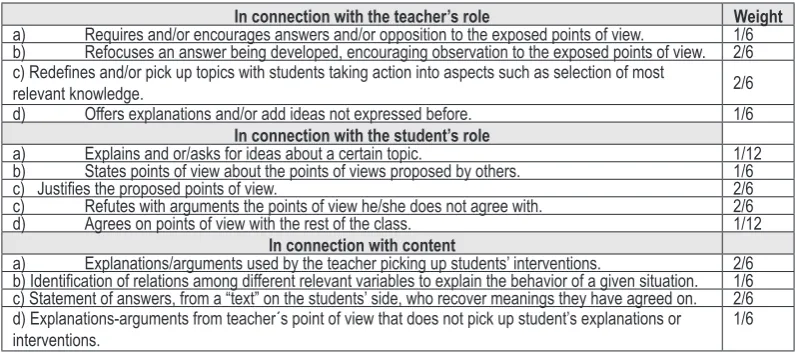
indicators of the negotiation process were built around three different distinctive categories: the teacher’s role; the student’s one and the content that both exchange. the aforementioned indicators (and their relative weight), resulting from the integration of the theoretical frames assumed at the investigation together with the evolution of registers of class observations, are listed below (table 1).
Table 1. Indicators for the negotiation of meanings.
In connection with the teacher’s role Weight a) Requires and/or encourages answers and/or opposition to the exposed points of view. 1/6 b) Refocuses an answer being developed, encouraging observation to the exposed points of view. 2/6 c) Redefines and/or pick up topics with students taking action into aspects such as selection of most
relevant knowledge. 2/6
d) Offers explanations and/or add ideas not expressed before. 1/6 In connection with the student’s role
a) Explains and or/asks for ideas about a certain topic. 1/12
b) States points of view about the points of views proposed by others. 1/6
c) Justifies the proposed points of view. 2/6
c) Refutes with arguments the points of view he/she does not agree with. 2/6
d) Agrees on points of view with the rest of the class. 1/12
In connection with content
a) Explanations/arguments used by the teacher picking up students’ interventions. 2/6 b) Identification of relations among different relevant variables to explain the behavior of a given situation. 1/6 c) Statement of answers, from a “text” on the students’ side, who recover meanings they have agreed on. 2/6 d) Explanations-arguments from teacher´s point of view that does not pick up student’s explanations or
having built and identified indicators for each of the episodes of registered classes, it is necessary to find ways to describe whether there was negotiation and if this was the case, how to determine to which “extent” this happened between one session and the other. With this aim, a prototype episode was selected (from all the episodes of the four studied cases). that is considered, from now onwards, the referent episode: this is about a set of oral exchanges among the teacher and the students whose roles highlight most of the indicators theoretically built. it is adopted as to what extent it is possible to expect if it is intended to negotiate meanings in terms of class situations where is talked about energy, with students between 15 and 16 years old.
for each distinctive category (teacher, student and content) an interval of presence was defined. this is built as follows:
• all the weighed frequencies of each indicator describing the categories are added.
• the total frequency obtained is multiplied by the maximum and minimum defined weight for that category. thus obtaining upper and lower limits of the interval of action.
• the place that takes the total added and weighed frequency in the interval previously built is identified.
• the interval of action is redefined in three segments considering the low, middle and high ponderations. being a prototype example, the frequency found is placed in the middle and upper stratum. this is not considered high as it is thought that every episode is capable of improvement and/or perfection.
• the redefinition of the action interval takes into consideration the percentile values for the extremes. this allows to regulate the action in three zones from 0% to a maximum of the prototype (which is not 100%) and thus characterizing the low, middle and high strata. • all the episodes in every class are pondered starting from the procedure as explained above
taking as a referent the prototype episode.
to define the negotiation of the whole class it is now necessary to combine ponderations of the three categories for each episode and then draw conclusions from all the episodes that formed the session. factors are to be analyzed in pairs. this is how the following tables, 2 and 3 are made, for the interaction teacher/student and which combines the result of the interaction with the respective content.
Table 2. Represent level of interaction.
Student/teacher interaction Teacher’s role
Low Medium High
Student’s role
Low Low Low Medium
Medium Low Medium Medium
High Medium High High
Level of negotiation for episodes Low Medium Content High
Interaction student teacher
Low Low Low Medium
Medium Low Medium High
High Medium High High
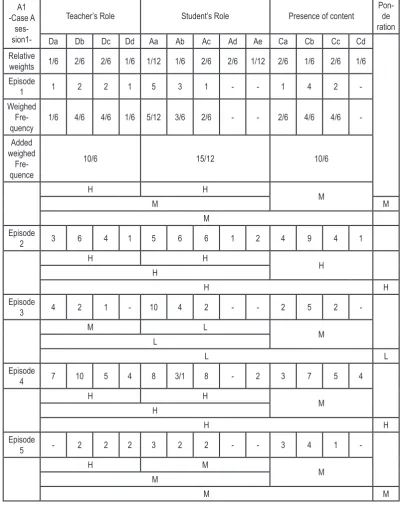
19 table 4 shows negotiation of meanings for the session of one of the cases that conforms the study. detailed in rows: the relative weights, the frequency, the weighed frequency, the added weighed frequency, (addition of all the preceding) and the descriptors low, medium, high as commented above.
Table 4. Negotiation of meanings for a case session.
A1 -Case A
ses-
sion1-Teacher’s Role Student’s Role Presence of content Pon-de
ration
Da Db Dc Dd Aa Ab Ac Ad Ae Ca Cb Cc Cd
Relative
weights 1/6 2/6 2/6 1/6 1/12 1/6 2/6 2/6 1/12 2/6 1/6 2/6 1/6
Episode
1 1 2 2 1 5 3 1 - - 1 4 2
-Weighed
Fre-quency 1/6 4/6 4/6 1/6 5/12 3/6 2/6 - - 2/6 4/6 4/6
-Added weighed
Fre-quence
10/6 15/12 10/6
H H
M
M M
M Episode
2 3 6 4 1 5 6 6 1 2 4 9 4 1
H H
H H
H H
Episode
3 4 2 1 - 10 4 2 - - 2 5 2
-M L
M L
L L
Episode
4 7 10 5 4 8 3/1 8 - 2 3 7 5 4
H H
M H
H H
Episode
5 - 2 2 2 3 2 2 - - 3 4 1
-H M
M M
Episode
6 9 11 5 1 5 14/2 5 3 3 5 3 7 3
H H
H H
H
Final Result per session: M- H- L- H-H-M
in the table above, results of other episodes for session 1 have been omitted due to the table length. the complete results are shown in table 5.
finally, having obtained the negotiation degree per episode, the one from the case is extracted starting from the identification of the percentage of the most dominant trend. this is what percentage of episodes (from the total making up the case) is listed as medium, what percentage as high and what percentage as low. the maximum percentage is the trend obtained for the case studied. this inference contents the assumption that the case is a set of episodes that keep the class structure. that is to say, the structure of the class is determined by the three categories already defined. the results for one of the case studies are presented in this paper. table 5 that follows shows the results of the ponderations of all sessions and the final ponderation for case a.
Table 5. Final result for the session of a case study.
Case A Sessions Ponderation per session Frequency of pon-derations Final Ponderations
First stage S 1 S 2 H-H-H-H-H-M-M-M-H-H-L-H-H-H-M-M
Total of episodes: 70 High:
42–(60%)Me-dium: 15 – (21.43%)Low:
12-(17.14%)
High Second stage S 3S 4S 5 L-L-M-M-M-M-H-H-H-
H-H-H-H-H-H-M-H-L-H-H-H-H-M-L-H
Third stage S 6 S 7 S 8 H-L-L-L-M ML-L-H-H
H-H-H-H-M-M-L-LH-Forth stage S 9S 10 S 11 HH-H-H-HH-H-H-H
Discussion
table 5 shows that for case a there is a tendency towards a high level in instances in which meaning is negotiated. �from the theoretical contributions, this means that subjects are. �from the theoretical contributions, this means that subjects are�from the theoretical contributions, this means that subjects are part of this case are able to state the views or replies to questions, and to justify using reasons.reasons. in addition, indicators gain value, to students as well as to the teacher, those who involve a more complex action as prediction to arguments that might be presented, others’ evaluations, others’ refutation with arguments of presented opinions, etc.
it is found in this case that the teacher not only provides explanations when convenient, but also reinforces agreed meanings, assesses them, retrieves voices, assesses students’ interventions and shows flexibility and capacity of reflection. these actions can be seen on students, who are also able to accept the rules of the game with this teacher and that subject area. most of the time students try to justify their points of view. regarding opposition to opinions, there is a remarkable difficulty when building an argument that goes beyond a simple opposition.
21 case must be studied in greater depth. the replication of the procedures in other cases would give account of this question.
Conclusions
characterizing instances in which meanings are negotiated implied a task where indicators for the different roles were identified, and were combined with the complexity of actions taken from the theoretical referents proposed. this led to a systematicity which translated into the construction of scales to make a comparison and decide levels of negotiation.
the participation in situations where different points of view are requested and/or offered or refutation is demanded promotes, as time goes by, negotiation and renegotiation of the constructed meanings.
the processes of negotiation of meanings are strongly conditioned by the ways of exchange used by the teacher. his role is a determinant factor to regulate the quality and quantity of turns at talk among students, and between them and the teacher. a competent teacher in promoting dialog situations, even of an individual with himself (generating contradictions) seems to be the “key to access” to start negotiation of meanings processes among students at secondary school.
the type of qualitative research is often criticized for not fully explain the reduction and transformation processes of the records to draw inferences. this article attempts to make a contribution to educational research with ethnographic characteristics.
the indicators that were developed have proven effective for analyzing communicative exchanges and decide the degree of negotiation of meaning in science classes.
the results obtained encourage us to plan new studies to replicate the criteria for sequencing and coherence for the integration of indicators in order to increase their validation.
Acknowledgments
this article was prepared with financial support from conicet and project funded 03/ c211 incentive program of the ministry of education and culture.
References
bellocchi, a., �� ritchie, s. (2011). investigating and theorizing discourse during analogy Writing in chemistry. Journal of Research in Science Teaching, Vol. 48, pp. 771-792.
braaten, m., �� Windschitl, m. (2011). Working toward a stronger conceptualization of scientific explanation for science education. Science Education, pp. 639-669.
bricker, l., �� bell, p. (2008). conceptualizations of argumentation from science studies and the learning sciences and their implications for the practices of science education. Science Education, In Wiley InterScience from www.interscience.wiley.com.
campanario, J. m. (2004). algunas posibilidades del artículo de investigación como recurso didáctico orientado a cuestionar ideas inadecuadas sobre la ciencia. Enseñanza de las Ciencias, 22 (3), pp. 365-378.
sinéctica 27, retrieved 10/08/2011, from: http://portal.iteso.mx/portal/page/portal/sinectica/historico/ numeros_anteriores06/027
coll, c., sanchez, e. (2008). el análisis de la interacción alumno-profesor: líneas de investigación presentation. the analysis of the pupil-teacher interaction: researching lines. Revista de Educación, 346.
coll, c., onrubia, J., mauri, t. (2008). ayudar a aprender en contextos educativos: el ejercicio de la influencia educativa y el análisis de la enseñanza [supporting learning in educational contexts: the exercise of educational influence and the analysis of teaching]. Revista de Educación, 346, pp. 33-70. cots, J., nussbaum, l., payrató, l., tuson, a. (1989). conversar. caplletra: revista de filología, Vol. 7, pp. 51-72, retrieved 3/09/2010, from http://descargas.cervantesvirtual.com/servlet/sirveobras/jlv/0249 4921981138941754491/200279_0010.pdf
cubero pérez, r., cubero pérez, m., santigosa, a. s., de la mata benítez, m. l., carmona, m. J. i., prados Gallardo, m. del m. (2008). la educación a través de su discurso. prácticas educativas y construcción discursiva del conocimiento en el aula. Revista de Educación, 346, pp. 71-104.
domínguez, m. a., stipcich, m. s. (2009).buscando indicadores de la negociación de significados en clases de física. Revista Electrónica de Enseñanza de las Ciencias, Vol. 8(2), pp. 539-551.
donaldson, m. (1979/2003). La mente de los niños. españa: morata.
islas, s. m. (2006). los debates en clases de física. en actas de: congreso: (nº 5) la lectura, la escritura y la comunicación oral en las instituciones de formación académica: universidad e institutos terciarios.
Jiménez aleixandre, m. p. (1998). diseño curricular: indagación y razonamiento con el lenguaje de las ciencias. Enseñanza de las Ciencias, 16 (2), pp. 203-216.
Jiménez aleixandre, m. p., díaz de bustamante, J. (2003). discurso de aula y argumentación en la clase de ciencias: cuestiones teóricas y metodológicas. Enseñanza de las Ciencias, Vol., 21(3).
leit�o, s. (2007). la dimensión epistémico de la argumentación. en seminario Diálogo como Paradigma para las Ciencias Humanas. retrieved 10/08/2011, from:retrieved 10/08/2011, from:: http://www.dialogicidad.cl/papers/leitao.doc. lemke, J. (1997). Aprender a hablar ciencia: lenguaje, aprendizaje y valores. barcelona: paidós. [publicación original en inglés en 1990].
locatelli, r., carvalho, a. m. (2005). como os alunos explicam os fen�menos físicos.como os alunos explicam os fen�menos físicos. Enseñanza de las Ciencias, Volumen extra Vii, barcelona.
mortimer, e., scott, p. (2002). atividade discursiva nas salas de aula de ciências: uma ferramenta sociocultural para analisar e planejar o ensino. Investigações em Ensino de Ciências, Vol. 7(3), pp. 283-306.
osborne, J. f., �� patterson, a. (2011).scientific argument and explanation: a necessary distinction? in Wiley online library (wileyonlinelibrary.com).
23
sardá J. a., sanmartí puig, n. (2000). enseñar a argumentar científicamente: un reto de las clases de ciencias. Enseñanza de las Ciencias, Vol. 18 (3), pp. 405-422.
stake, r. e. (2007). Investigación con estudios de caso. madrid: morata.
tusón Valls, a. (2002). el análisis de la conversación: entre la estructura y el sentido. Estudios de Sociolinguística, Vol. 3 (1), pp.133-153
von aufschnaiter, c., erduran, s., osborne, J., simon, s. (2008). arguing to learn and learning to argue: case studies of how students’argumentation relates to their scientific Knowledge. Journal of Research in Science Teaching, Vol. 45, 1, pp. 101-131.
Advised by Vincentas Lamanauskas, University of Siauliai, Lithuania
received: September 16, 2011 accepted: November 14, 2011
María Alejandra Domínguez Professor of Mathematics and Physics, �ational University of the Center of�ational University of the Center of Buenos Aires Province (U�CPBA), Argentina. (U�CPBA), Argentina.
Phone: +54 02293 439650 interno 107. E-mail: [email protected] Website: https://sites.google.com/site/ecientec/
María Silvia Stipcich PhD in Science Education, �ational University of the Center of Buenos Aires Province (U�CPBA), Argentina. (U�CPBA), Argentina..
Phone: +54 02293 439650 interno 107. E-mail: [email protected]