HESPERIA 75 (2006)
Pages 317-32$
ACHELO?S
PEPLOPHOROS
A Lost
Statuette
of a River
God
in Feminine
Dress
ABSTRACT
In this study the author analyzes the iconography of a unique Early Classi cal bronze statuette that represents the river god Achelo?s as a peplophoros.
Formerly in the National Archaeological Museum in Athens, the statuette is now lost. Using the myth of Herakles' peplos as a parallel, the author argues
that Achelo?s is represented wearing women's dress in order to counterbal ance his excessive masculinity. The combination of masculine and feminine
iconographie attributes serves to acknowledge the potentially destructive power of the river while also highlighting its life-giving beneficence.
In the current discussion of cross-dressing in Classical Greece, one in
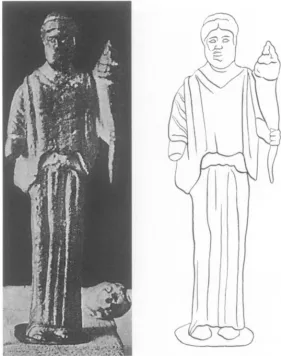
triguing image has been overlooked: a small bronze statuette representing the powerful river god Achelo?s wearing women's dress (Fig. I).1 This statuette, formerly in the National Archaeological Museum but now lost, was excavated in the early 20th century at Oichalia, near modern Kyme,
on Euboia.2 It depicts the god as a standing, bearded man wearing a chiton underneath a
peplos with kolpos and overfold. In his left hand he holds a cornucopia; the right hand is missing. The cornucopia, together with the findspot (see below), confirms the identification as Achelo?s. Identified by Brunilde S. Ridgway as a unique representation of a m?t peplophoros,3.
1. This paper was
presented in an earlier form at the 2004 Annual
Meeting of the American Philological
Association, as part of the Lambda Classical Caucus panel "Cross-Dressing
in Antiquity: Art and Text." I would
like to thank the
organizers of the panel, Laurel Fulkerson and H. Alan Shapiro, together with the other par ticipants, for their comments. Thanks are also due to the two anonymous Hesperia reviewers, whose critical
feedback was most valuable.
2. The statuette was discovered on
March 1,1909,
by K. Papaioannou, who
reported his findings in the local newspaper 'H% . The statuette is mentioned in
Papavasileiou 1910, p. 34; a
photograph appears in Papavasileiou
1912, p. 133, fig. 15 (reprinted in Gais 1978, p. 359, fig. 8; also Ostrowski 1991, fig. 18). Lippold (1950, p. 114,
n. 3) cites the object, without illustra tion. The statuette is included in the
monograph on Achelo?s by Isler (1970, pp. 60,112,165, no. 264) and in his
entry in LIMCl, 1981 (p. 18, no. 77,
s.v. Achelo?s). Weiss (1984, p. 166,
no. Al) notes that the location of the object, formerly in the National Archaeological Museum in Athens, was unknown at that time. In response
to my request to study the statuette in
2004, the Greek Ministry of Culture
confirmed that the statuette could not be located. No additional information or
photographs are obtainable from the Ministry.
3.
Ridgway 1984, p. 46. The statu ette is not included in the corpus of
Early Classical peplophoroi by T?lle Kastenbein (1980).
3i8
In
MIREILLE M. LEE
Figure 1. Achelo?s, bronze statuette
from Oichalia, Euboia. Second
quarter of the 5th century b.c.
Formerly National Archaeological
Museum, Athens (no inv. no.); current location unknown. Photo from Papavasileiou 1912, p. 133, fig. 15; drawing G. Fawkes
its transvestism has not previously been explained. Comparative analysis of cross-dressing in both ancient literature and modern dress practices demonstrates that the cross-dressing Achelo?s not only reflects Greek constructions of masculine and feminine gender, but also larger concerns about fertility, protection, and social boundaries.
Flowing from Epirus to the Ionian Sea, the Achelo?s River is the longest in Greece.4 In antiquity it comprised the often-contested boundary between Akarnania and Aitolia. Achelo?s was believed to be the source of all seas, rivers, and springs, and appears in classical literature as a synonym for water (e.g., Eur. Andr. 167; Eur. Bacch. 625; Ar. Lys. 381).5 The river
god Achelo?s, offspring of Okeanos and Tethys (Hes. Theog. 340), was worshipped together with his daughters, the nymphs, from a very early
period.6 Achelo?s is named in Homer (//. 21.194), but does not feature in extant narrative until the early lines of Sophocles' Trachiniae, when Deia neira describes her courtship by Achelo?s and how she came to be the wife of Herakles:
I suffered painful affliction on the matter of my wedding, if any Aitolian woman did. For I had as a wooer a river, I mean Achelous, who came in three shapes to ask my father for me, at some times manifest as a bull, at others as a darting, coiling serpent, and again
4. On the river and river god Ache lo?s, see Brewster 1997, pp. 9-14.
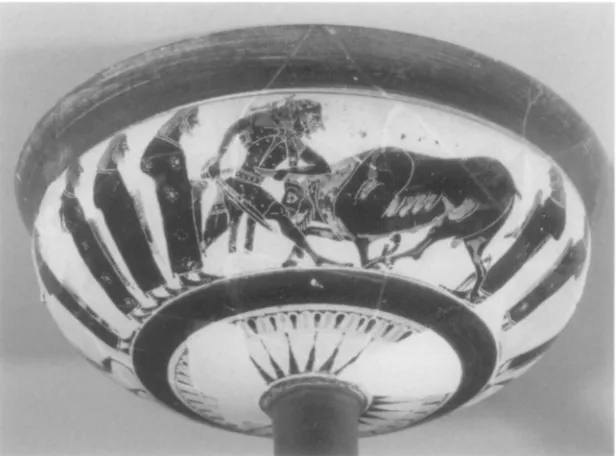
Figure 2. Herakles and Achelo?s, Attic black-figure kylix, attributed
to the Painter of Boston C.A., said
to be from Thebes. Ca. 560-550 b.c.
Henry Lillie Pierce Fund, 99.519.
Photo courtesy Museum of Fine Arts, Boston
ACHELOOS PEPLOPHOROS 319
^xVT
?
Or? />
at others with a man s trunk and a bulls head; and from his shaggy beard there poured streams of water from his springs. Expect
ing such a suitor as that I was always praying, poor creature, that I might die before ever coming near his bed. But at the last moment,
and to my relief, there came the famous son of Zeus and Alcmene, who contended him in battle and released me. I cannot tell of the manner of his struggle, for I know nothing of it; whoever was sitting
there not terrified by the sight, he could tell you.7
The chorus of women fromTrachis reiterate the struggle at lines 508-522, but do not explain how Achelo?s was
ultimately defeated. A more elaborate version of the myth is told by Ovid in Metamorphoses 9.1-100, in which Herakles defeats the river god by breaking off one of his horns. Magically
the horn fills with fruits and flowers, the cornucopia. But, as Ovid tells us: "Humbled though he was to lose that elegance, all else was sound, and he concealed his loss with willow leaves or reeds and rushes worn upon his head."8
The iconography of Achelo?s has been thoroughly examined by Hans Peter Isler, who traced the development of Achelo?s imagery from the
7th century b.c. through the Roman period.9 Early Greek images of the god are clearly derived from Near Eastern prototypes, in particular the man-headed bull (Fig. 2), which has Sumerian origins.10 The existence of other zoomorphic images of the god suggests that the bull iconography was not so firmly established, especially in earlier representations. Alter
natively, they may reflect Achelo?s s ability to change shape, as described in the early lines of the Trachiniae.11 In vase painting he is sometimes represented with the body of a centaur (Fig. 3), and once as a triton (Fig. 4).12 Most images of Achelo?s emphasize his genitals (e.g., Fig. 2), which signify both fecundity and his bestial aspect.13 Some depict him with the ears and snub nose typical of satyrs (e.g., Fig. 4), which likewise
7. Soph. Trach. 7-23, trans. H. Lloyd Jones, Cambridge, Mass., 1994.
8. Ov. Met 9.98-100, trans. A. D.
Melville, Oxford 1986.
9. Isler 1970; LIMC 1,1981, pp. 12
36, s.v. Achelo?s (H. P. Isler). See also Ostrowski 1991, pp. 16-20.
10. LIMC 1,1981, pp. 13-17,25
27, nos. 1-56,213-228,241-244,
s.v. Achelo?s (Isler). Conversely, a few images represent the god as a bull
headed man {LIMC 1,1981, p. 18, nos. 75, 76). On bull imagery generally
in the ancient Near East and the east ern Mediterranean, see Rice 1998.
11. The shape-changing aspect of Achelo?s parallels the constant fluctua
tion of moving water.
12. For other images of Achelo?s as a centaur, see LIMC 1,1981, pp. 27-28, nos. 246-259, s.v. Achelo?s (Isler).
13. For other opponents of Herakles represented with large genitalia, see
320 MIREILLE M. LEE
Figure 3. Herakles and Achelo?s,
Attic black-figure neck
amphora,
Achelo?s Painter. Early 5th cen
tury b.c. Libbey Endowment,
1952.65. Photo courtesy Toledo Museum of Art
emphasize his sexual nature.14 Other early representations include votive masks and pro tomes of a bearded man with the ears and horns of a bull.15 These images are also found on coins as well as gold pendants,16 which per
haps functioned as amulets for fertility and protection.17 From the middle of the 5th century onward, a parallel tradition develops in which the god
is represented as a nude, bearded, mature man with bulls horns.18 The statuette, dated by Isler to the second quarter of the 5th cen
tury b.c.,19 was found together with an inscribed boundary marker delin eating the limits of a local sanctuary of Achelo?s and the nymphs.20 The identification of the statuette as the river god is therefore secure despite the absence of Achelo?s's usual taurine features, save for the cornucopia, which
is a kind of symbolic transcription of the older bull imagery. In contrast to earlier representations of the god, which are either zoomorphic images or nude males, the figure is heavily dressed. What is especially curious is that he wears a distinctly feminine garment, the peplos, together with a long chiton, also worn by women in the Classical period.21
14. Schefold 1992, p. 159.
15. LIMCl, 1981, pp. 18-20, nos. 80-115, s.v. Achelo?s (Isler).
16.
E.g., ZJMC 1,1981, p. 19, nos. 90, 91, s.v. Achelo?s (Isler).
17. For the
magico-religious func tion of amulets, see
Kotansky 1991. 18. LIMCl, 1981, pp. 24-25, nos. 210?212, s.v. Achelo?s (Isler).
19.
Presumably on the basis of style. The statuette exhibits several of the
basic traits of the Severe Style outlined by Ridgway, including a "severe," almost
somber, facial expression, short hair style, and reserved gesture and pose. The peplos, rendered with broad, thick,
drapery folds, is itself a hallmark of the Early Classical period (Ridgway 1970,
pp. 8-11).
20. IGXn 9 135: Nvucpcov | AXe
taoioi) (3rd century b.c.); Papavasileiou 1910, p. 34. The inscription and statu ette
comprise the sole evidence for the
cult of Achelo?s on Euboia in the 5 th
century (see Larson 2001, p. 144). 21. The
hairstyle, though indistinct
in the extant photograph, may also reflect feminine styles of the
Early Classical period. The hair appears to be parted in the middle, with soft waves framing the face, possibly bound in a chignon at the base of the neck. A band encircling the head may be a braid, a frequent feature of male figures of this period (e.g., the Artemision bronze). The statuette, however, lacks the bangs
that usually accompany this
ACHELO?S PEPLOPHOROS 321
Figure 4. Herakles and Achelo?s,
Attic
red-figure stamnos, Oltos,
from Caere. Ca. 520 b.c. E 437.
Photo courtesy British Museum, London
How can we explain the unique appearance of the feminine peplos on a male figure for whom there is no preexisting tradition of drapery or dress? It is unlikely that the artist has misunderstood the significance of this gar ment. The Early Classical peplos functions iconographically as an indicator
of idealized feminine Hellenic identity, the enveloping garment reflecting
ideologies of protection and containment.22 But since the Achelo?s statuette is the only example known in Greek art of a male figure wearing a peplos, no pattern can be established that might indicate its significance.
Cross-dressing in antiquity is often identified as ritual behavior, es pecially for rituals of initiation.23 Unfortunately, little is known about the
specific cult activities associated with the worship of Achelo?s. Achelo?s was venerated together with the nymphs throughout Greece, especially in
caves containing freshwater springs.24 The primary function of these cults was to ensure the proper upbringing of children, especially male children.
Jennifer Larson has suggested that the Athenian koureion ritual, in which young men dedicated their hair to a local river, reflects the special function of rivers in the maturation rituals of young boys.25 Certainly cross-dressing also features in similar rituals of initiation (for example, the Hellenistic
ekdusia),26 but evidence for cross-dressing in an initiation ritual involving Achelo?s is lacking. Nevertheless, the notion that cross-dressing reflects
liminality is surely relevant to the shape-changing Achelo?s, a river in constant flux, marking the border between regions.
22. Lee 2005. The protective function of the
peplos is underscored by its role in the Panathenaia at Athens as a
protective garment for Athena Polias. See below, n. 32. The
scholarship on the ideological significance of women's dress generally has vasdy increased in
the past decade. See Darling 1998; Llewellyn-Jones 2002,2003; Cleland,
Harlow, and Llewellyn-Jones 2005. 23. On
cross-dressing in antiquity, see
especially Delcourt 1961, pp. 1-16; Frontisi-Ducroux and
Lissarrague 1990;
Leitao 1995; Cyrino 1998; Bremmer 1999; Miller 1999; Llewellyn-Jones 2005.
24. Larson 2001, pp. 98-100,226 231. The widespread veneration of
Achelo?s from the 5th century on may be the result of propaganda by the
oracle at Dodona (D'Alessio 2004, p. 32).
25. Larson 2001, p. 98. For the
Koureion, see Cole 1984; Golden 1990,
pp. 26-28.
322 MIREILLE M. LEE
As noted above, the Achelo?s statuette is the lone example of a male
peplophoros in Greek art. Male characters do wear peploi in Greek litera ture, however, and although we cannot assume that the literary peplos corresponds with the garment represented in sculpture,27 the comparison
is instructive. In early Greek epic and lyric, the peplos is worn exclusively
by women and goddesses. Starting in the Classical period (the date of the Achelo?s statuette), the tragedians manipulate the feminine connotations
of the peplos to convey the emasculation of male characters.28 In Aeschylus s Oresteia, Clytemnestra slays Agamemnon after ensnaring him in a peplos
(Ag. 1125-1128; Cho. 999-1000; Eum. 633-635). Similarly, in Euripides' Bacchae, Pentheus dresses in a peplos in order to spy on the Theban women, with horrible results (Bacch. 821-838,927-938). Hippolytos wears a peplos
in Euripides' play to indicate the impropriety of his exclusive worship of Artemis (Hipp. 606,1458). Herakles wears a
peplos in at least two plays, Sophocles' Trachiniae (600-613,674,756-776) and Euripides' play about his madness (HF 520, 626-627, 629-630). In each of these cases, the
adoption of a peplos by a male character symbolizes his feminization, and therefore his destruction.29 But these examples do not explain the Achelo?s statuette, which, despite the feminine dress (and perhaps the fruits and flowers in the cornucopia), exhibits no signs of emasculation.
Indeed, as Ovid notes, Achelo?s remained otherwise unharmed despite the humiliating removal of his horn. Given the literary tradition of male figures destroyed by peploi, how can Achelo?s retain his virility (even a beard!) despite his feminine dress?
Nicole Loraux has explained a similar instance of male cross-dressing in her essay "Herakles: The Super-Male and the Feminine."30 Despite his (in)famous hypermasculinity, Herakles wears a peplos with no adverse ef fects. The story is preserved in Diodoros's account of the life of the hero, which, although written during the 1st century b.c., may help explain the
constructions of gender at play in the Classical statuette of Achelo?s. Ac
cording to Diodoros, when Herakles retired from his life of exploits, "each one of the gods honored him with appropriate gifts; Athena with a peplos, Hephaistos with a war-club and a coat of mail, these two gods vying with one another in accordance with the arts they practiced, the one with an eye
to the enjoyment and delight afforded in times of peace, the other looking to his safety amid the perils of war."31
The peplos is associated with Athena on account of the sacred textile woven with scenes of the Gigantomachy, which was ritually woven by
selected women and girls and presented to the goddess at the Panathe naia. While the Panathenaic peplos represents the victory of the gods and the protection of the polis, the literary peplos, as discussed above, is
specifically gendered as feminine.32 In the Iliad (5.733-737, 8.384-388), Athena herself removes her peplos in order to participate in the fighting,
27. For the tenuous identification of the garment conventionally known as a peplos, see Lee 2003.
28. Lee 2004.
29. In this I disagree with Llewel
lyn-Jones (2005), who maintains that
the peplos is not a
gendered garment. I thank the author for sharing with me an advance draft of his chapter.
30. Loraux 1990.
31. Diod. Sic. 4.14.3, trans, adapted from C. H. Oldfather, Cambridge,
Mass., 1935.
32. See Barber 1992, with earlier references. For the
political significance of the Panathenaic peplos, see Scheid and Svenbro 1996, pp. 18-33; Fowler
ACHELO?S PEPLOPHOROS 323
exchanging this feminine garment for the war chiton of Zeus. Athena's transvestism underscores her own gender ambiguity, as does her choice of gift to Herakles.33 She is the goddess of weaving, but also of war; why should she select an article of clothing as her gift to Herakles, warrior par excellence?34
The answer, Loraux suggests, lies in Herakles' excessive masculinity.35 She proposes that "an excess of virility leaves Herakles' strength in constant danger of being exhausted, and so it is appropriate for him periodically
to return to a more reasonable level of male energy."36 Athena's gift of the
peplos is intended to restore the loss of equilibrium that is the result of his exploits.37 The peplos does not therefore feminize him, but, conversely, underscores the power of his masculinity.38 The same may be true for the
figure of Achelo?s, who is regularly depicted in excessively masculine terms?so excessive, in fact, that he is more typically represented as part beast.39 The representation of the river god wearing a peplos can therefore be interpreted as emphasizing the benevolent side of his character, which
is also suggested by the cornucopia, a symbol of fertility. In this way, the destructive capacities of the river are counterbalanced by its life-giving
aspects.40
As Marjorie Garber has shown, an important function of transvestism is as a means of reconciling contradictions, not only masculine and femi nine gender, but also other fundamental cultural categories such as race and class.41 She argues that transvestism often represents a displacement of other, apparently unrelated, "category crises." Margaret Miller has effec
tively adopted Garber's model to demonstrate that the transvestism of the so-called Anacreontic vases
dating to the late 6th century reflects broader Athenian anxieties about the breakdown of old, aristocratic institutions.42
33. On the
gender ambiguity of Athena, see most recently Deacy and
Villing 2001, pp. 15-16, with earlier
references.
34. Llewellyn-Jones's (2005, p. 60)
suggestion that the gift of the peplos reflects Athena's role as patron goddess of textile production (Athena Ergane)
is not inconsistent with Loraux's read ing of this passage (below).
35. Loraux (1990, pp. 35-36) cites
as evidence for Herakles' superabun dance of virility his extreme sexual behavior, coupled (perhaps ironically) with his misogyny.
36. Loraux 1990, p. 39. Cyrino
(1998) fruitfully expands upon Loraux's
interpretations, citing parallels in mod ern cinema and sports (e.g., basketball star Dennis Rodman).
37.
Though Diodoros does not indicate that Herakles actually wore the garment, the gendered connotations of the
gift would have been understood by an ancient audience. Herakles wears
women's
clothing in several episodes in Greek and Latin literature (see Cyrino
1998; Llewellyn-Jones 2005); however,
artistic representations of Herakles wearing feminine dress do not appear
until the Late Hellenistic period (see
Schauenburg 1960, esp. fig. 1; Kampen 1996, pp. 237-238, figs. 98,99).
38. For a similar
interpretation of the so-called Anacreontic vases (dis cussed below), see Frontisi-Ducroux and Lissarrague 1990.
39. Animal imagery is unusual for
Greek gods (see Padgett 2003). The bull iconography for Achelo?s, while
derived from Near Eastern sources, is likely to have been retained on account of its particular resonance for the Greeks, who associated excessive (espe
cially sexual) behavior with animals
(see Lissarrague 1990). On the Greek
notion of
hypermasculinity giving way to
bestiality, see duBois 1982, p. 31. 40.1 have likened the constructions of
gender in the Achelo?s statuette to
those
surrounding Herakles in the literary tradition. But is such a con nection
justified, given the fact that Herakles and Achelo?s are adversaries
in the contest over Deianeira? In a study of river-god iconography, Gais
(1978, pp. 367-370) demonstrated that,
while in early periods Herakles and Achelo?s are
conventionally repre sented as combatants, beginning in the 4th century b.c.
they are conflated iconographically as a means of empha sizing the theme of fertility.
41. Garber 1992, pp. 16-17. 42. Miller 1999. For earlier inter pretations of the costume, see Miller
1999, pp. 232-236; also Frontisi Ducroux and Lissarrague 1990. The
concern for the maintenance of proper boundaries is
similarly reflected in the Greek
practice of ritual transvestism, which is in all cases temporary, and
underscores the desired preservation of
324 MIREILLE M. LEE
The feminine dress of the Achelo?s figure likewise embodies multiple
categories of crisis: animal/human; destructive/beneficent; virile/feminine. The findspot of the statuette, marking the border of a sanctuary, further
suggests a concern with the categories of inside and outside, sacred and
profane.
The reconciliation of these categories made this votive statuette
especially efficacious for its dedicants, who, as devotees of Achelo?s and the nymphs, were presumably concerned with securing fertility. As Marie Delcourt has argued, the combination of masculine and feminine has
the special effect of bringing about increased fertility, "each sex receiving something of the powers of the other."43 Achelo?s peplophoros, with his feminine dress and the Freudian removal of his horn, is neither feminized nor emasculated; he is uniquely equipped to bring fertility and abundance
to his devotees. 43. Delcourt 1961, p. 16.
REFERENCES
Barber, E. J. W. 1992. "The Peplos of Athena," in Goddess and Polis: The Panathenaic Festival in Ancient Athens, ed. J. Neils, Hanover,
pp. 103-117.
Bremmer, J. N. 1999. "Transvestite Dionysos," in Rites of Passage in Ancient Greece: Literature, Religion, Society, ed. M. W. Padilla, Lewis burg, pp. 183-200.
Brewster, H. 1997. The River Gods of Greece: Myths and Mountain Waters
in the Hellenic World, London. Cleland, L., M. Harlow, and L. Llewel
lyn-Jones, eds. 2005. The Clothed Body in the Ancient World, London. Cole, S. G. 1984. "The Social Func
tion of Rituals of Maturation: The Koureion and the Arkteia," ZPE 55,
pp. 233-244.
Cyrino, M. S. 1998. "Heroes in D(u) ress: Transvestism and Power in the Myths of Herakles and Achilles," Arethusa 31, pp. 207-241.
D'Alessio, G. B. 2004. "Textual Fluc tuations and Cosmic Streams: Ocean and Acheloios,"///S 124,
pp. 16-37.
Darling, J. 1998. "Form and Ideology: Rethinking Greek Drapery," Hephaistos 16-18, pp. 47-69. Deacy, S., and A. Villing. 2001. "Athena
Past and Present: An Introduction," in Athena in the Classical World, ed. S. Deacy and A. Villing, Leiden, pp. 1-25.
Delcourt, M. 1961. Hermaphrodite: Myths and Rites of the Bisexual
Figure in Classical Antiquity,
trans. J. Nicholson, London. duBois, P. 1982. Centaurs and Amazons:
Women and the Pre-history of the Great Chain of Being, Ann Arbor. Fowler, R. L. 2000. "Greek Magic,
Greek Religion," in Oxford Readings
in Greek
Religion, ed. R. Buxton, Oxford, pp. 317-343.
Frontisi-Ducroux, F., and F. Lissar rague. 1990. "From Ambiguity to Ambivalence: A
Dionysiac Excur sion through the Anacreontic' Vases," in Halperin, Winkler, and
Zeitlin 1990, pp. 211-256.
Gais, R. M. 1978. "Some Problems of River-God
Iconography," AJA 82, pp. 355-370.
Garber, M. 1992. Vested Interests: Cross Dressing and Cultural Anxiety, New York.
Golden, M. 1990. Children and Child hood in Classical Athens, Baltimore. Halperin, D. M., J. J. Winkler, and F. I.
Zeitlin, eds. 1990. Before Sexuality: The Construction of Erotic
Experi ence in the Ancient Greek World, Princeton.
Isler, H. P. 1970. Achelo?s: Eine Mono graphie, Bern.
ACHELO?S PEPLOPHOROS 325
Kotansky, R. 1991. "Incantations and Prayers for Salvation on Inscribed Greek Amulets," in Magika Hiera: Ancient Greek
Magic and Religion, ed. C. A. Faraone and D. Obbink, New York, pp. 107-137.
Larson, J. 2001. Greek Nymphs: Myth,
Cult, Lore, Oxford.
Lee, M. M. 2003. "The Ancient Greek Peplos and the 'Dorian Question,"'
in Ancient Art and Its
Historiography, ed. A. A. Donohue and M. D. Fullerton, Cambridge, pp. 118?
147.
-. 2004. "Evil Wealth of Rai
ment: Deadly Peploi in Greek Tragedy," C]99, pp. 253-279.
-. 2005. "Constru(ct)ing Gender in the Feminine Greek Peplos," in Cleland, Harlow, and Llewellyn
Jones 2005, pp. 55-64.
Leitao, D. 1995. "The Perils of Leukip
pos: Initiatory Transvestism and
Male Gender Ideology in the
Ekdusia at Phaistos," ClAnt 14, pp. 130-163.
Lippold, G. 1950. Die griechische Plastik (Handbuch der Arch?ologie im
Rahmen des Handbuchs der Alter tumswissenschaft 3), Munich.
Lissarrague, F. 1990. "The Sexual Life of Satyrs," in Halperin, Winkler, and Zeitlin 1990, pp. 53-81. Llewellyn-Jones, L., ed. 2002. Women's
Dress in the Ancient Greek World, London.
-. 2003. Aphrodites Tortoise: The Veiled Woman of Ancient Greece,
Swansea.
-. 2005. "Herakles Re-dressed: Gender, Clothing, and the Con
struction of a Greek Hero," in Herakles and Hercules:
Exploring a Graeco-Roman Divinity, ed. L. Rawlings and H. Bowden,
Swansea, pp. 51-69.
Loraux, N. 1990. "Herakles: The Super-Male and the Feminine,"
in Halperin, Winkler, and Zeitlin
1990, pp. 21-52.
McNiven,T. 1995. "The Unheroic Penis: Otherness
Exposed," Source 15, pp. 10-16.
Miller, M. 1999. "Reexamining Trans vestism in Archaic and Classical Athens: The Zewadski Stamnos,"
AJA 103, pp. 223-253.
Ostrowski, J. A. 1991. Personifications of Rivers in Greek and Roman Art, Krakow.
Padgett, J. M. 2003. The Centaurs Smile: The Human Animal in
Early Greek Art, Princeton.
Papavasileiou, G. A. 1910. Ilepi x?v ?v Ev?oioc ?pxa?oov x?ccov, Athens.
-. 1912. "?vaaK(X9(xi Kai epei)
vai ?v Eu?oia," Prakt 1912,
pp. 119-140.'
Rice, M. 1998. The Power of the Bull,
London.
Ridgway, B. S. 1970. The Severe Style
in Greek
Sculpture, Princeton. -. 1984. "The Fashion of the
Elgin Kore," GettyMusJ12, pp. 29 58.
Schauenburg, K. 1960. "Herakles und
Omphale," RhM 103, pp. 57-76.
Schefold, K. 1992. Gods and Heroes in Late Archaic Greek Art, Cambridge. Scheid, J., and J. Svenbro. 1996. The
Craft of Zeus: Myths of Weaving and
Fabric, trans. C. Volk, Cambridge, Mass.
T?lle-Kastenbein, R. 1980. Fr?hklas
sische Peplosfiguren: Originale,
Mainz.
Weiss, C. 1984. Griechische Flussgott heiten in vorhellenistischer Zeit: Ikonographie und Bedeutung, W?rzburg.
Mireille M. Lee
Macalester College
classics department
l600 GRAND AVENUE
SAINT PAUL, MINNESOTA 55105-1899