Estimation of Radiation Shielding Properties for
Composites Material Based Unsaturated
Polyester Filled with Granite and Iron Particles
Najwa Jassim Jubier
University of Wasit , College of Science, Department of Physics, Kut, Iraq. Corresponding author, E-mail: [email protected]
Abstract—The purpose of this work is to measure the linear attenuation coefficient (µ), (µ) was calculated and studied for particulate rein- forced polymer- based composites. Unsaturated polyester resin (UPE) was used as matrix filled with (10wt. %) granite and then added different concentrations of Fe metal powders (5, 10,15and20) wt. % as reinforce- ments. The effect of the Fe addition on γ-ray attenuation coefficients of the composite material was evaluated. The results show, as the metallic particulates (Fe) content increased, the linear attenuation coefficients will increase too; it increased from 0.105Cm-1for UPE to 0.124Cm-1by
adding 10% granite alone (53µm) and then increased to 0.214Cm-1 when added of 20% Fe
with (53µm). It was found that the transmission decreases with increasing specimen thickness so the transmission factors decrease also. It was noticed that the mean free path λ, half value layer HVL, tenth value layer TVL decreases as the concentration of Fe increased, also it was found that the penetration depth X(mfp) for all prepared samples increased with the increase both thicknesses and concentration. Keywords--- composite materials; Gamma-rays; linear attenuation coefficient; penetration depth.
Keywords—composite materials; Gamma- rays ; linear attenuation coefficient ; penetration depth.
1. Introduction
With the increasing use of isotopes of gamma rays in industry, medicine, and agriculture, it has become necessary to study the attenuation coefficients in various materials to their importance technological and biological. There is always a need for the development of materials that can be used under harsh conditions
of exposure to nuclear radiation, which can serve as shielding materials [1], [2].
Shield was used in general to reduce the exposure to nuclear radiation and secondary interactions with material to mitigate their effects in human tissue for workers in the field of radiation and knew this kind of shields (shields biological), while using the other type of shields and knowledge of the (thermal shield) to protect reactors over heat limit as a result of absorbed nuclear Radiology [3]. So medical workers wearing coats usually shield of rubber called apron to protect them from radiation, shields polymer are used widely in hospitals, clinics and clinics where dentists use shield rubber coats to protect patients and staff from the direct and indirect radiation during diagnostic imaging[4].
Composite materials may give extra advantages provide in physical durability, chemical resistance and portability. However, the composite material will not exceed the gamma attenuation characteristics of an equivalent mass of the components that are used in its construction. This principle is often referred to as “mass in the path” [5].
There are some materials be effective more than others in shielding certain type of radiation, thus the type and quantity of shielding material needed for shielding will vary with the type and quantity of radioactive material which shielded [6].
The degree of attenuation of gamma radiation is dependent on the energy of the incident gamma radiation, the thickness of the shielding material, the atomic number and the density of the components in the shielding material [5].
Various studies were carried out about the calculation of gamma-ray attenuation coefficients through theoretical and experimental methods in the (2012) K.H.Mahdi et al. calculated and studied attenuation Coefficients for particulate Al, Fe, and Pb with different weight percentages (10,20,30,40,50)wt % reinforced unsaturated polyester resin by using the XCOM.1 program in the energy range of 0.1-20 MeV. . The results show the attenuation coefficients will increase as the concentration of particulate increased while it decreases when the gamma energy increase [7].
N. B. Al-Rawi (2014) investigated Linear attenuation coefficient for blend (%20PU) + (%80EP) and 70% lead/EP/PU composite as a function of the absorber thickness and energy, by using NaI(Tl) energy selective scintillation counter with 90Sr/90Y beta source having an energy range( 0.1-1.1) MeV it was shown from results obtained that the lead/EP/PU polymer composite material is good absorber of beta and bremsstrahlung ray. It can use as a shielding for beta sources [8] .Other researchers such as M.J. R. AL-Dhuhaibat(2015), M. AL fakhar et al.(2016) M. S. Amana[1,9,10] measured gamma rays linear attenuation coefficient for various absorber composites shields .
2. Theoretical concepts
Gamma rays are electromagnetic radiation either emitted from a nucleus or an annihilation reaction between matter and antimatter; it is one of the three types of natural radioactivity radiation, the other two types which are in the form of charged particles are alpha, and beta, gamma rays have identical properties to the
X-rays and different only in their source of the origin [11].
When a γ-ray passes through a medium, the energy transfers to the medium as a result of the interaction that occurs between the photons and matter .This interaction can be resulting in a large energy transfer or even complete absorption of the photon. However, the photon can be scattered rather than absorbed and retain most of the initial energy while the change occurs only in the direction [12].
There are five major types of interactions causing attenuation of a photon beam by matter: Compton effect, photoelectric effect, pair production, coherent scattering, and photo disintegration [13],Shielding of gamma radiation primarily involves the interaction of gamma radiation with matter via the first three main ways which are the most important .
The attenuation that results due to the interaction between penetrating radiation and matter is not a simple process. The linear attenuation coefficient (µ) is the probability of any type of interaction (PE, CE, PP) per unit path length and mainly depends on the composition of the attenuating material and the photon energy [14] , the total attenuation coefficient (μ) (expressed in cm– 1
) represents the sum of the attenuation due to different types of these interactions.
Study the attenuation of gamma rays (absorption and scattering) inside the material follows the Lambert- Beer law, by measuring the change of well-collimated beam ray intensity with the variation of material thickness, which is given by the following relationship [15].
𝐈 = 𝐈°𝐞−µ𝐱 (𝟏)
𝝁 =𝐥𝐧( 𝑰°
𝑰)
Where 𝐈° and 𝐈 represent counts detected without attenuation and with attenuation respectively through the material thickness x in (cm), with linear attenuation coefficient µ.
The linear attenuation coefficient μ was calculated by taking the natural logarithm of the ratio (I/I°) of the count rate ln (I/I°), Since the slope of the straight line of the form of relationship between the thickness x and the logarithm of the transmission ratio ln(I/I°) represents the value of the attenuation coefficient, that is, μ (cm-1) = Slope
The transmission factor, T (E, x), for the gamma source of energy E through thickness x [cm] of shielding material, it was determined by measuring the ratio between gamma-rays intensity I (E, x) of shielding material thickness x to the gamma-rays intensity in the absence of any shielding material I (E, 0) [16].
𝐓(𝐄, 𝐱) =𝐈(𝐄, 𝐱)
𝐈(𝐄, 𝟎) (𝟑)
Another useful concept is the half-value layer, HVL therefore Instead of using attenuation coefficients to perform shielding calculations, we can use half (or tenth) value layers. A half- value layer is the thickness of material that reduces the photon beam intensity by one-half" and can be calculated by the following equation [17].
𝛍 = 𝐥𝐧 𝟐
𝐇𝐕𝐋 =
𝟎.𝟔𝟗𝟑
𝐇𝐕𝐋 , 𝐇𝐕𝐋 = 𝟎.𝟔𝟗𝟑
𝛍 (𝟒)
The half-value layer is inversely proportional to the attenuation coefficient and is expressed in units of distance (mm or cm).
In a similar way, a tenth value layer (TVL) is defined as that thickness which will reduce the radiation intensity to one-tenth of its original value (I˳). The equations for using TVL's are as follows [17].
𝛍 =𝐥𝐧 𝟏𝟎=𝟐. 𝟑𝟎𝟑, 𝐓𝐕𝐋 =𝟐. 𝟑𝟎𝟑(𝟓)
The mean free path (mfp)( relaxation length) denoted by the (λ) in the unit (Cm) is the average distance a photon travels before an interaction takes place. The linear attenuation coefficient is related to the mean-free-path 𝝀 by the expression (reciprocal of the linear attenuation coefficient (µ)) [18].
𝐦𝐟𝐩(𝛌) = 𝟏
𝛍 (𝟔)
The equation’s exponent (1), the product µx, is sometimes referred to as the number of mean free paths. The number of the mean free paths (X) in (mfp) can be calculated by using equation (7), the value of the (µx) is also called the penetration depth for the gamma radiation in the shielding materials as in equation (7)[2],[19].
𝐍𝐮𝐦𝐛𝐞𝐫 𝐨𝐟 𝐦𝐞𝐚𝐧 𝐟𝐫𝐞𝐞 𝐩𝐚𝐭𝐡𝐬 𝐗(𝐦𝐟𝐩)
𝐗(𝐦𝐟𝐩) = 𝐱(𝐂𝐦)
𝛌(𝐂𝐦)= 𝛍𝐱 (𝟕)
3. Materials and methods
The materials that were used in this work to prepare the composite samples as absorber at different concentration are; unsaturated polyester resin (UPE) made by (SIR) company from Saudi Industrial Resin Limited with low viscosity , Methyl Ethyl Keton peroxide (MEKP) as a hardened made in Jordan, granite and iron powder with size of 53 µm made in Turkey.
discs with diameter of 4 cm, each disc with 0.6cm thickness.
To determine the linear attenuation coefficient, the system was used for measurement consist Geiger-Muller counter tube detector (GAT: PA1885-020,030, TYPE ABG) and cobalt-60 radioactive source with a half-life of 5.27y and effective radiation 0.699μCi ,that emits photons of gamma-rays with an average energy value of 1.253MeV.
To get a narrow beam of photons gamma rays in order to study the linear attenuation coefficient in the material shield has been arranged measurement system by using collimators made of lead material with dimensions (5 * 5 * 1.5 cm) where he put a collimator radioactive source that contains a central circular aperture with diameter of (0.5Cm) at a distance (0.5Cm) from the source and has outstanding detector at a distance (1.5 Cm) form the window of detector that has a central circular aperture of (1.6Cm) as illustrate in figure(1) .
4. Results and Discussion
Tables (1,2and3) illustrated the experimental results obtained in this study. Natural logarithms of the transmission ratio (I˳/I) as in table (1) were plotted as a function of the thickness for each of the materials which were studied (Fig. 2) in order to calculate the linear attenuation coefficient by taking the slope of each linear
curve. Table (2) illustrates the experimental results of linear attenuation coefficient for six different specimens of composites material, for pure polymer (unsaturated polyester resin) and after addition of granite as well as after addition different concentration of Fe with granite using the sources 60Co. the results obtained shows that the (µ ) was increased as the Fe content increased .The increase in linear attenuation coefficients values was found to be the greatest values for composite samples containing 20wt.% of Fe which about(0.214Cm-1), and lesser values for pure polymer (UPE) was (0.105Cm-1) as in Fig.(3).
Fig.2.Variation Ln(Io/ I) with the thickness of the specimens for selected shielding types.
The improved shielding capability of (UPE)/granite and iron powder composites could be clarified by the way that, unsaturated polyester (UPE) matrix is a bad shielding material, however, when some filling powders add to it, it was modified and become a good shielding material. In other words, an increase in the probability of interaction between the incident gamma radiation and the shield atoms happened. Hence, one may conclude that the total linear attenuation coefficient of the composites was increased with increased filler content in the composites specimens prepared [7].
Figures (4 and 5) represent the variations of the transmission factor of 1.253MeV gamma-Fig.1: Experimental setup used in the
present work.
rays with different types of the shields and with a variation of the thickness of the shields respectively. It was found that the transmission
factor decreased as the concentration of Fe increased as shown
Table.1. Variations values of (Io /I) and Ln(Io/ I) for different types of shields specimens by using Co-60 radioactive sources.
Table.2. Variations values of μ, HVL, λ and TVL for different types of shields specimens by using Co-60 radioactive sources.
Specimen Type µ(Cm-1) HVL(Cm) λ(Cm) TVL(Cm)
UPE 0.105 6.601 9.523 21.929
UPE+10%G 0.124 5.589 8.064 18.569
UPE+10%G+5%Fe 0.160 4.332 6.25 14.391
UPE+10%G+10%Fe 0.177 3.916 5.649 13.008
UPE+10%G+15%Fe 0.194 3.572 5.154 11.869
UPE+10%G+20%Fe 0.214 3.239 4.672 10.759
Table.3. Variations values of Transmission factor and Penetration depth for different types of shields specimens by using Co-60 radioactive sources
Specimen Type
Transmission Factor Penetration Depth
Thickness(Cm) Thickness(Cm)
0.6 1.2 1.8 2.4 3 0.6 1.2 1.8 2.4 3
UPE 0.9392 0.8839 0.8287 0.7771 0.7292 0.063 0.126 0.189 0.252 0.315 UPE+10%G 0.9134 0.8471 0.7918 0.7329 0.6850 0.0744 0.1488 0.2232 0.2976 0.372 UPE+10%G+5%Fe 0.8950 0.8103 0.7366 0.6703 0.6151 0.096 0.192 0.288 0.384 0.48 UPE+10%G+10%Fe 0.8839 0.7918 0.7108 0.6408 0.5819 0.1062 0.2124 0.3186 0.4248 0.531 UPE+10%G+15%Fe 0.8655 0.7734 0.6887 0.6187 0.5524 0.1164 0.2328 0.3492 0.4656 0.582 UPE+10%G+20%Fe 0.8581 0.7513 0.6629 0.5893 0.5230 0.1284 0.2568 0.3852 0.5136 0.642
Specimen Type
(Io /I) Ln(Io/ I)
Thickness(Cm) Thickness(Cm)
0.6 1.2 1.8 2.4 3 0.6 1.2 1.8 2.4 3
in figure (4)and table(3). The maximum values of (T.F) were noticed for unsaturated polyester resin and minimum values for the composite material with 20wt.% of iron material at different thicknesses for all prepared specimens ,so one can identify the shield (UPE+10%G +20%Fe) is the most efficient shield by the way of reducing the transmission of gamma rays at the specific energy(1.253MeV)as was noticed from the results obtained .As evidenced from Figure (5) the relationship between the transmission factor and thickness of the material is exponentially decreasing for all the shields, this behavior perfectly applicable with the theoretical concept of the equation (3). In general, the results agree largely with the results of previous studies [2, 10] for different kinds of shields, and that the interpretation of this is that the increase in the number and intensity of reinforcement material means increasing the total cross-section of the interaction of rays with matter and thus shield dissipated the biggest part of incident rays away from the path of the falling beam.
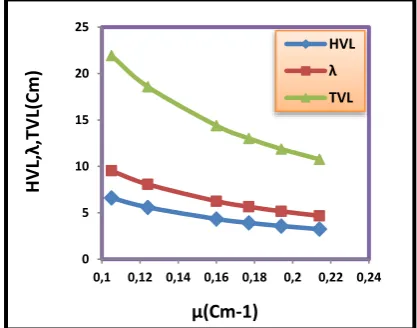
Plotted the half-value layer, a tenth value layer value and mean free path which were calculated from equations( 4,5and6)as a function of the type of shields, plot graph in Figure(6)shows that the values of these quantities are larger sample of what can be pure polyester and gradually decreases with increasing concentration of additive. On the other hand, Figure (7) shows the behavior of variation of HVL, λ and TVL values as a function of µ for studied shields samples. It was noticed curves of decreasing values of HVL, λ and TVL with increasing µ values and a negative change curve in the values of TVL is more clearly.
0 0,1 0,2 0,3 0,4 0,5 0,6 0,7 0,8 0,9 1
Tr
an
smi
ss
ion
Fa
ct
or
(T.F)
Type of Specimen
0.6Cm
1.2Cm
1.8Cm
2.4Cm
3Cm
0,5 0,6 0,7 0,8 0,9 1
0 0,3 0,6 0,9 1,2 1,5 1,8 2,1 2,4 2,7 3 3,3
Transmissio
n
Fac
tor (
T.
F
)
Specimen Thickness(X)Cm
UPE UPE+10%G
UPE+10%G +5%Fe UPE+10%G +10%Fe UPE+10%G +15%Fe UPE+10%G +20%Fe
Fig.3: linear attenuation coefficients
values versus the selected shielding types.
Fig.4: Transmission factor versus the selected shielding types for all thickness values used.
Finally, Figure (8) shows the relationship of the penetration depth of gamma rays at the energy of 1.253MeV with the thickness of the shield material and for all shields types used. Table(3) illustrate the variation of penetration depth in unit mfp with the shield type variation and thickness, so one can notice that the penetration depth value of the gamma rays at a specific thickness for all shields can be greatest for UPE filled with 10%granite and 20% Fe.
5. CONCLUSION
From the present work, the experimental results had allowed the following conclusions:
The attenuation of radiation can be achieved using a wide range of materials and understanding the basic principles involved in the physical interaction of radiation with matter that can help in the choice of shielding for a given application. Therefore from measured and calculated results against Co-60 gamma ray attenuation parameters in unsaturated polyester-granite powder composite with different concentrations of iron, it can be concluded that the (UPE+10% granie+20%Fe) composites materials can act as shields against gamma radiation sources with maximum value the linear attenuation coefficient and minimum values of λ, HVL and TVL respectively.
References
[1] J.F. Krocher, R.E. Browman, (Eds.), Reinhold, New York (1984).
[2]M. J. R. AL-Dhuhaibat, F. M. Dashor and Sh. Husain" Effect of Type and Multiplicity the Reinforcement Material in Epoxy Composite Shields on the Gamma-Rays Attenuation of the Co-60 Radioactive Source" Wasit Journal for Science and Medicine9(2), (2016)pp.97-107.
0 5 10 15 20 25
HVL,
λ,TV
L(Cm)
Type of Specimen
HVL λ TVL
0 5 10 15 20 25
0,1 0,12 0,14 0,16 0,18 0,2 0,22 0,24
HVL,
λ,TV
L(Cm)
µ(Cm-1)
HVL λ TVL
0 0,1 0,2 0,3 0,4 0,5 0,6 0,7
Penetratio
n
Depth
(mp
f)
Typeof Spacimen
X=0.6Cm X=1.2Cm X=1.8Cm X=2.4Cm X=3Cm
Fig.6: Variation of HVL, λ and TVL values versus the selected shielding types.
Fig.7: The HVL, λ and TVL values versus the (µ) values for all the selected shielding types.
[3] A A Al-Bayati "Effect of additive materials to concrete on γ-ray absorption coefficient" Indian J. Phys. 78A (3) (2004) pp.405-407.
[4] M.H.Kharita,Z.AL.Ajji and s. Yousef "Preparation of Polymers Suitable for Radiation Shielding and Studying its Properties (Polyester Composite with Heavy Metals Salts)"Syrian Arab Rebablic Atomic Energy Commission.Damascus-P.O.BOX:6091(2010).
[5] ]Daniel R. McAlister" Gamma Ray Attenuation Properties of Common Shielding Materials" Ph.D, PG Research Foundation, Inc. 1955 University Lane Lisle, IL 60532, Rev. 4.0 January 3, USA, (2013).
[6] W. Osei-Mensah , J.J. Fletcher , K. A. Danso" Assessment of Radiation Shielding Properties of Polyester Steel Composite using MCNP5" International Journal of Science and Technology, Volume 2 No. 7 (2012) pp.455-461.
[7] K.H.Mahdi, Z.S.Ahmed*, A.F.Mkhaiber" Calculation and Study of Gamma ray Attenuation Coefficients for Different Composites" Ibn Al-Haitham Journal for Pure and Applied Science, No. 3, Vol. 25(2012)pp.133-141.
[8] N. B. Al-Rawi" Linear attenuation coefficient measurement in polymer composite" Iraqi Journal of Physics, Vol.12, No.25 (2014) PP. 1-7.
[9] M. AL fakhar , H. I. and A. Mohan" Linear attenuation coefficient calculation for both pure silicon (Si) and silicone supported with lead" IJAIEM, Volume 5, Issue 4(2016)pp.146-150.
[10] M. S. Amana "Study the Gamma Ray Attenuation of 60Co in the Polyester Composite_Calcium Ferrite Powder Supported Shields" Wasit Journal for Science and Medicine, 9(3)(2016).
[11] Attix, Frank Herbert" Introduction to Radiological Physics and Radiation Dosimetry" 1 ed. Wiley-VCH(1986).
[12] D. N. Hopkins" Determination of the Linear Attenuation Coefficients and Buildup Factors of MCP-96 Alloy for Ues in Tissue Compensation and Radiation Protection "M.Sc. thesis, Ball State Unversity Munie, INDIANA(2010).
[13] Khan, Faiz M" The Physics of Radiation Therapy" 3 ed. Philadelphia: Lippincott Williams & Wilkins(2003).
[14] Md. Nahid Hossain, K. A. Quadir, Md. N. Islam, T. A. Biman, F.Begum"Measurement of Linear Attenuation Coefficient of Tc-99m using Planar Gamma Camera Image"Bangladesh Journal of Nuclear Medicine, ORIGINAL ARTICLE(2015)pp.61-66.
[15] G.Knoll"Radiation Detection and Measurement" John Wiley and Sons. NewYork ,Third Edition(2010).
[16]S.J. Stankovića, R.D. Ilića , K. Jankovićb , D. Bojovićb and B. Lončarc" Gamma Radiation Absorption Characteristics of Concrete with Components of Different Type Materials"ACTA PHYSICA POLONICA A, Vol. 117, No. 5(2010)pp.812-816.
[17]A. J. Al-Saadi" Study of exposure and energy absorption buildup factor for some building materials available in Iraq"JOURNAL OF KUFA – PHYSICS Vol.6, No.2(2014)pp.59-68.
[18]N. Tsoulfanidis , ,"Measurement and Detection Radiation" MC Graw- Hill, New York(1983).