Pharmacophore 2015, Vol. 6 (1), 13-18 USA CODEN: PHARM7 ISSN 2229-5402
Pharmacophore
(An International Research Journal)
Available online at http://www.pharmacophorejournal.com/
Original Research Paper
ASSESSING OF MARKETED BENZOIN SAMPLES FOR DIFFERENT
QUALITATIVE AND QUANTITATIVE ATTRIBUTES
Kawade Vikram S
1*, Jadhav Sharmila S
2and Killedar Suresh G
21
Department of Pharmaceutical Chemistry, Bharati Vidyapeeth College of Pharmacy, Near
Chitranagari, Kolhapur, 416 013, Maharashtra, India
2
Department of Pharmaceutics, Bharati Vidyapeeth College of Pharmacy, Near
Chitranagari, Kolhapur, 416 013, Maharashtra, India
ABSTRACT
Balsamic resin obtained from certain tropical Asian trees of the genus Styrax and used in perfumery and
medicine. It has been observed that several malpractices exist in market during sale of benzoin, which is typically known as “Dhoop” in the folks. Market is flooded with the adulterated benzoin. Considering the above observations, objective of our experiment is to check and detect the purity of the products under consideration in experiment. Thus, though malpractices are occurring in various forms, this experiment helps in identifying a part of adulterations taking place under the name of pure benzoin or pure dhoop in the market. In this experiment we have selected various samples A, B, C and D from market. For identification and purity of samples we performed various tests like morphological test, chemical quantitative test, standardization and estimation of total balsamic acid. By performing different quantitative and qualitative analysis it was found that all samples under consideration were adulterated. Though this experiment it was confirmed that malpractices exist in market. The samples collected from local market were found in different size, shape, color, solubility and some proximate values.
Keywords:
Benzoin, Standardization, Estimation, Malpractice.INTRODUCTION
Generally herbal formulation involves the use of fresh or dried plant parts. Correct knowledge of crude drug is very important aspect in preparation, safety and efficacy of the herbal product (Ahmad, 2013). Standardization is a process of prescribing a set of standards or inherent characteristics, constant parameter, definitive, qualitative and quantitative values that carry an assurance of quality, efficacy, safety and reproducibility. It is a system to ensure that every packet of medicine that is sold has the correct amount and will induce its therapeutic effect. Specific standards are worked out by experimentation and observation, which would
lead to the process of prescribing a set of characteristics exhibited by particular crude product. Hence it is a tool in quality control
process (Kunle, 2012). Benzoin is a balsamic
resin obtained from Styrax benzoin Dry or Styrax
paralleloneurus Perkins and other species of Styrax known in the market as Sumatra benzoin or it may also contain the balsamic resin from
http://www.pharmacophorejournal.com 14 pinaceous odor. Its taste is aromatic and slightly
acrid. Siam benzoin has an agreeable,balsamic, vanilla-like odor. Its taste is aromatic and slightly acrid (USP, 2009). Benzoin resin is obtained from the bark of several species of trees in the genus Styrax. The chemical constituent present in the benzoin are Cinnamic, benzoic and sumaresinolic acid esters, benzoic acid, cinnamic acid, sumaresinolic acid, benzaldehyde and vanillin. Sumatra benzoin contains free balsamic acid (benzoic acid and cinnamic acid) and esters derived from them. Triterpenoids such as summaresinolic and siarsinolic acids are also present. The major constituent of Siam benzoin is an ester coniferyl benzoate. Benzoin has therapeutic actions like stimulant, expectorant, astringent, antispasmodic, antiseptic, carminative, diuretic. It may be applied topically to wounds and ulcers to protect and disinfect the skin. It is also useful in respiratory difficulties, providing useful in cases of bronchits and asthmait in form of tinctures. It acts as a carminative when taken internally and is rapidly absorbed. In this article the description of the results of standardization of benzoin which is available in the market. For the first time we have come with the comparative report of morphological tests, identification tests, standardization and estimation of different samples. In addition since adulteration of other substances like benzoin to be a cumulative process in malpractices of benzoin, it stands to reason that alteration in colours, odor of benzoin may be an early event in the development of malpractices of marketed samples of benzoin. It is our contention that a better understanding of the chemical composition of benzoin may facilitate the discovery of improved strategies for the prevention, detection of malpractices of marketed samples of benzoin.
MATERIALS AND METHODS
Materials
Ethanol (Jiang Huaxi International Trade Co. Ltd., China), Potassium permagnate (Loba Chemie), Toulene (Molychem), Ethyl acetate (Loba Chemie), Chloroform (Molychem), Ether (Loba Chemie), Light petroleum (Loba Chemie), Anisaldehydesulphuric acid reagent (E-Merk),
Sodium hydroxide (Merk Specialities Pvt. Ltd.), Phosphorus pentoxide (Molychem), 0.5 N alcoholic potassium hydroxide (Molychem), Magnesium sulphate (HiMedia Laboritories),
Hydrochloric acid (Molychem), Sodium
bicarbonate (Molychem), Phenol red indicator (Molychem).
Electronic balance (Seico India), Muffle furnace (Meta Lab), Soxhlet Extractor (J-SIL), Steam Bath (Meta Lab), Hot Air Oven (Meta Lab).
Methods
Identification Test for Benzoin
I. Alcoholic solution of benzoin with water
gave milky white solution.
II. Small quantity of benzoin in a test tube
was heated and covered with a glass plate. Contents of the test tube were cooled and the glass plate was examined under the microscope. The crystals of cinnamic acid were observed.
III. About 2.5g of benzoin was added to 10
mL of ether, to this solution 3 drops of sulphuric acid was added. Sumatra benzoin showed the deep brown color and purple color was observed for siam benzoin.
IV. Exactly 4 mL of potassium permanganate
was added to 1 g of benzoin. Odor of Benzaldehyde confirms the sample as
Sumatra benzoin(IP, 2007).
Standardization of Benzoin I. Acid insoluble ash
Standard: Not more than 1% in Sumatra benzoin and not more than 0.5% in siam benzoin, determined on 2 g (IP, 2007).
Procedure
Total Ash: Exactly weighed 2 g of air dried drug was taken in silica crucible and
incinerated at temperature 450oC and the
Acid Insoluble Ash: Ash obtained from the total ash was boiled with 25 mL of 2 M hydrochloric acid for 5 min. Insoluble matter was collected on ashless filter paper, washed with hot water and then kept in vacuum desiccators. Percent of acid insoluble ash was calculated on the
dry drug basis(Ahmad, 2013).
II. Foreign organic matter
Standard: Not more than 1% (IP, 2007).
Procedure
100 g of original sample was weighed and spread out in a thin layer on white glossy paper. The sample was inspected with unaided eye and foreign organic matters were separated manually. After the complete removal of foreign matter from each sample, the separated foreign matter was weighed and percent of foreign organic matter was calculated (Kunle, 2012).
III. Ethanol soluble extractive
Standard: Not less than 75% in Sumatra benzoin and not less than 90% in siam benzoin (IP, 2007).
Procedure
2 g of accurately weighed coarse powder was taken in trade extraction thimble and subjected for soxhelation. 0.1 g of NaOH was placed in the receiving flask. Sample was extracted with ethanol (95%) for 5 h. After the complete extraction, thimble was
dried to constant weight at 105oC. Ethanol
soluble extractive was calculated from the increase in weight of the thimble (Ahmad, 2013).
IV. Loss on drying
Standard: Not more than 10% (IP, 2007).
Procedure
2 g of coarse powdered sample was dried over phosphorus pentaoxide at pressure 2.7 kPa for 4h (Gautam, 2010).
Estimation of Balsamic Acid Procedure
2 g of benzoin was boiled with 25 mL of 0.5 N alcoholic potassium hydroxide solution under the reflux condenser for 1 h. The alcohol was removed and the residue was digested with 50 mL hot water. The liquid was cooled and 150 mL of water was added to it. 2.5 g of magnesium sulphate was added to 50 mL of water and allowed it to stand for 10 min. Further filter under vacuum. The residue was again washed with 20 mL of water. The liquid was acidified with HCl and extracted with successive quantities of 50, 40, 30, 30, 30 mL of solvent ether. The combined ethereal extract was shaken with the successive quantities of 20, 20, 10, 10 mL of sodium bicarbonate solution. Mixed aqueous extract was acidified with HCl. Acidified aqueous extract was shaked with successive quantities of 30, 20, 10, 10 mL of chloroform. Chloroform layer was separated, evaporated and the residue was dissolved by warming with 10 mL of alcohol. Solution was titrated against 0.1 N NaOH using phenol red as indicator. Total balsamic acid was calculated as:
Each mL of 0.1 N sodium hydroxide is equivalent to 0.01482 g of total balsamic acids calculated as cinnamic acid (Kokate, 1994).
RESULTS AND DISCUSSIONS
From above experiment following results were found.
http://www.pharmacophorejournal.com 16 it is confirmed that commercial samples tested
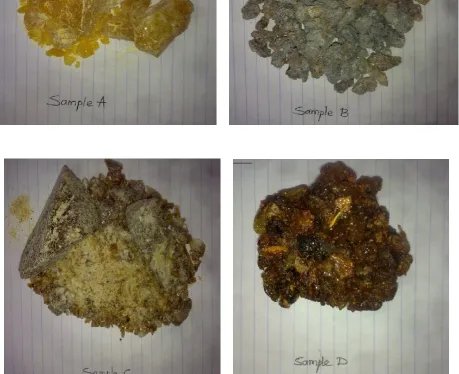
shows close resemblance to Sumatra benzoin except sample D. Overall results shows sample D was found to be more impure, more fragrant and sticky in nature.
CONCLUSION
From our experimentation it was concluded that, the marketed products of benzoin are adulterated with other substances and lots of variation among them with respect to physical constants. The values also confirm that sample A, B and C are Sumatra benzoin with respect to ethanol soluble extractive value. Sample D failed to show most of
the specific physico-chemical tests for benzoin and hence it is not the benzoin but adulterated mass. Thus, it was confirmed that the malpractices are occurring in various form in market under the name of benzoin. Further studies are on with some more samples from different regions of our country and estimation of balsamic acid using specific spectral analysis.
ACKNOWLEDGEMENT
Authors are sincerely thankful to Dr. H. N. More for creating driving force in us to carry out something helpful for society.
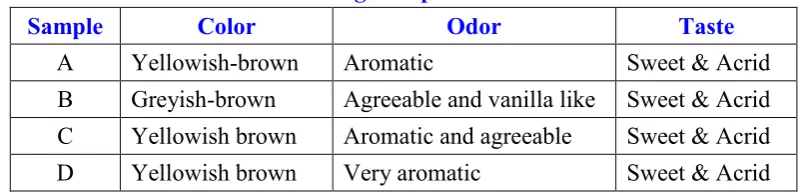
Table 1: Organoleptic characters
Sample Color Odor Taste
A Yellowish-brown Aromatic Sweet & Acrid
B Greyish-brown Agreeable and vanilla like Sweet & Acrid
C Yellowish brown Aromatic and agreeable Sweet & Acrid
D Yellowish brown Very aromatic Sweet & Acrid
Table 2: Comparative identification test of sample
Test Observation Sample A Sample B Sample C Sample D
0.5g Benzoin + 5 mL
KMnO4
Odor of Benzaldehyde Slight Strong Moderate No odor
Benzoin+ Ethanol (95%) + Water
Milky Acidic Seen Seen Seen Not seen
0.5g Benzoin+ Heat (to melt)
White Fumes Seen Seen Seen Not seen
2.5 g of Benzoin + 10 mL Ether + 2-3 mL of
Suphuric acid
Deep Brown or
Deep Purplish Red
Deep Brown
Deep Purplish
Red
Upper layer deep brown and lower layer purplish red
No change
Table 3: Standardization of benzoin Sample Acid insoluble
ash*
Foreign organic matter*
Ethanol soluble extractive*
Loss on drying*
Total balsamic acid*
A 0.41±0.02% 0.62±0.05% 64.83±1.20% 0.82±0.06% 2.37±0.06%
B 0.23±0.03% 0.34±0.01% 82.51±1.50% 1.36±0.60% 3.25±0.09%
C 0.48±0.05% 0.48±0.06% 73.64±1.68% 0.91±0.09% 1.78±0.01%
D 0.92±0.08% 1.32±0.05% 35.24±0.50% 2.15±0.50% 0.59±0.01%
* Mean ± SD
REFERENCES
1. Ahmad, T and Singh, S et al. (2013),
“Phytochemical Screening and
Physicochemical Parameters of Crude
Drugs: A Brief Review”, International
Journal of Pharma Research & Review, Vol. 2 (12), 53-60.
2. Kunle, Folashade O et al. (2012),
“Standardization of herbal medicines - A
review”, International Journal of
Biodiversity and Conservation, Vol. 4 (3), 101-112.
3. United State Pharmacopoeia,
Pharmacists’ Pharmacopoeia, 2009, 2nd
Edition, 3rd Supplement, S3/1-S3/130.
4. http://en.wikipedia.org/wiki/Styrax.
5.
http://www.webmd.com/vitamins-
supplements/ingredientmono-351-benzoin.aspx?activeingredientid=351&act iveingredientname=benzoin
6. Government of Indian Ministry of Health
and Family Welfare (2007), “Indian
http://www.pharmacophorejournal.com 18
7. Kar, A (2007), “Pharmacognosy and
Pharmacobiotechnology”, New Age International Publisher, 20.
8. Gautam, A and Kashyap, S et al. (2010),
“Identification, evaluation and
standardization of herbal drugs: A
review”, Scholars Research Library Der
Pharmacia Lettre, 2 (6), 302-315.
9. Kokate, CK (1994), Practical
Pharmacognosy, 4th Edition, Vallabh Prakashan, Delhi, 131-132.
10.Barnes, J and Anderson, L et al. (2007),
“Herbal Medicine”, 3rd Edition, Pharmaceutical Press, London, 1-23.
11.Kashio, M and Johnson, D (2001),
“Monograph On Benzoin (Balsamic Resin From Styrax Species)”, Food and Agriculture Organisation of United Nations Regional office for Asia and Pacific Bankok, Thailand, 1- 211.
12.Khandelwal, R (2002), “Practical
Pharmacognosy Techniques and
Experiments”,
9th Edition, Nirali Prakashan, 1-20,157.
13.Kokate, C and Purohit, A et al. (2008),
“Pharmacogonosy”, 42nd Edition, Nirali Prakashan, Pune, 11.126-11.127.
14.Mehta, S and Shah, D et al. (2011),
“Compendial testing method on herbal crude drug -a review”, Asian Journal Of Pharmaceutical Research, Vol. 1 (2), 49-52.
15.Mukharji, P (2001), “Quality Control
Methods of Herbal Drugs”, 1st Edition,
Business Horizon Pharmaceutical,
Kolkata, 578-80.
16.Sanmugarajah, V and Thabrew, I et al.
(2013), “Phyto, Physicochemical
Standardization of Medicinal Plant Enicostemma Littorale Blume”, IOSR Journal of Pharmacy, Vol. 3 (2), 52-58.
17.Shrikumer, S and Maheshwari, U et al.
(2006), “WHO Guidelines For Herbal
Drugs Standardization”.
Correspondence Author:
Kawade Vikram S
1Department of Pharmaceutical Chemistry, Bharati Vidyapeeth College of Pharmacy, Near Chitranagari, Kolhapur, 416 013, Maharashtra, India