_____________________________________________________________________________________________________
International
23(1): 1-8, 2019; Article no.JGEESI.50864
ISSN: 2454-7352
Green Areas and Outdoor Recreational Centres in
Ibadan, Nigeria: An Appraisal
A. F. Aderounmu
1and A. T. Oladele
2*1
Federal College of Forestry, P.M.B. 5087, Jericho Hill, Ibadan, Oyo State, Nigeria.
2Department of Forestry and Wildlife Management, University of Port Harcourt, Nigeria.
Authors’ contributions
This work was carried out in collaboration between both authors. Author AFA designed the study, performed the statistical analysis, wrote the protocol and wrote the first draft of the manuscript. Author ATO managed the analyses of the study and the literature searches. Both authors read and approved the final manuscript.
Article Information
DOI: 10.9734/JGEESI/2019/v23i130158
Editor(s):
(1) Dr. Wen-Cheng Liu, Senior Professor, Department of Civil and Disaster Prevention Engineering, National United University, Taiwan and Deputy Director General Taiwan Typhoon and Flood Research Institute, National United University, Taipei, Taiwan.
Reviewers:
(1) Gul Sayan Atanur, Bursa Technical University, Turkey. (2)Ariya Aruninta, Chulalongkorn University, Thailand. (3)Maram Tawil, German Jordanian University Jordan. Complete Peer review History:http://www.sdiarticle3.com/review-history/50864
Received 21 May 2019 Accepted 13 August 2019 Published 19 August 2019
ABSTRACT
Aim: To investigate outdoor recreational potentials and constraints in relation to forestry in five recreational sites within Ibadan metropolis, Nigeria.
Study design: The survey was purposively conducted in five (5) locations based on recreational potentials associated with forests and other green environments.
Place and Duration of Study: Bower’s Tower; UI Zoological Gardens; Polo Club; Trans Amusement Park and Agodi Gardens between January and February, 2019.
Methodology: Total enumeration of visitors who patronized the recreation sites during the course of the study was carried out. Structured questionnaires focused on demographic and perception of visitors on benefits and problems of the green recreational centres were sought. In all, 160 respondents were interviewed. The data collected were analyzed using descriptive statistics and chi-square to test for association between the demographic factors of respondents and their perceptions towards the benefits of green areas.
Results: Most of the visitors were within 21- 40 years (57.5%) old; males (61.2%), unmarried/singles (48.8%) while 89.7% had a tertiary education. Recreational visitors spend
between N500:00 and N2000:00 averagely per visit and were acquainted with environmental amelioration benefits such as shade, air purification and watershed protection. Visitors identified poor awareness as a major hindrance towards proper management of the centres. Age, marital status and academic qualifications had significant influence on how respondents spend their leisure using chi-square test at p = 0.01. Age (21–40years) is positively associated with outdoor recreation activities.
Conclusion: Tourists in Ibadan are aware of multiple benefits associated with green space recreation. Also visitors of all ages and marital status visit green spaces for recreational activities. It is recommended that efforts should be made by owner agencies to improve recreational facilities in the existing urban green areas such as tree planting for improved landscape and engage trained professionals for improved management.
Keywords: Appraisal; green areas; outdoor - recreational centres; awareness.
1. INTRODUCTION
Cities cover about 3% of the Earth’s land surface with green spaces as a major environmental resource of urban landscape [1]. The ambience of urban planning does not only cover matters of the built environment such as housing and transportation network but also the integration of green spaces into the physical urban landscape [2]. These urban green spaces literally covers all public and private open spaces in urban areas mostly covered by vegetation which are directly (e.g. active or passive recreation) or indirectly
(e.g. positive influence on the urban
environment) available for use [3]. Designated urban green areas such as city recreational parks have common occurrence in Europe and America cities [4] compared to the developing sub-Sahara West African cities. In Nigeria, urban planning integrates green areas for recreation purposes only on paper; however, there is extremely poor execution of such plans in most cases [5]. Scanty occurrence of urban green spaces for recreation in developing West Africa countries may be linked to poor execution of urban plans.
Forests play many diverse and complicated roles in our lives. Besides the production of biological resources and provision of societal benefits and service functions, forests are renewable natural assets. Thus, with good policies and protective planning, they can be increased and sustained. Psychologist, sociologist and mass media agree on the view that the quality of urban life depends largely on the amount and quality of green areas within [6,7]. Trees and shrubs provide their own inherent beauty in all settings. It’s the aesthetic and recreational values of trees, forest, and parks that are directly identified by most urban dwellers. Trees fulfill certain psychological, social and cultural needs of urban dwellers [8]. They
play a very important social role in easing tension and improving psychological health. People simply feel better living around the trees. The rustling of leaves and the whistle of the wind through a canopy produce pleasant sounds. The development of whispering palms tourist resort at Iworo, Badagry in Nigeria has led to the development and influx of people to the area [9]. Urban green areas do not only improve ecological and psychological environment of urban population, but also uplift economic conditions of the community. Green space/areas bring back certain harmony to the urban environment and therefore, play a vital social role in ceasing urban tensions. Urban green
areas/spaces are usually developed and
managed exclusively on the basis of their
utilitarian benefits such as aesthetic,
recreation/social, health and spiritual values. Only recently has their full value to urban dwellers been considered and a closer look is given to the environmental services and economic benefit they provide [10]. The primary functions of urban parks and green areas are to ensure satisfactory surroundings for recreational and social activities [11].
deterioration of air quality, higher air temperature and increased noise levels. Also, there were greater psychological stress and deceased sense of community participation in the rational use of earth resources to achieve the highest quality of living at it simplest. This study therefore investigated the perception of urban dwellers on the value of green areas, recreation and their impacts on socio, physical and psychological lives in Ibadan, one of the largest cities in Nigeria.
2. METHODOLOGY
2.1 Study Area
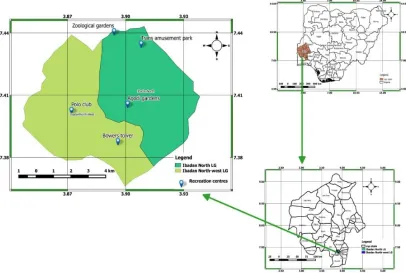
The study was carried out in Ibadan, the largest city in West Africa [13]. It comprises of eleven (11) local government areas, and has a substantial and self-sustaining economic base. It lies in the extreme South-West of Nigeria between latitude 70251 North and longitude 3031 East (Fig 1). The city and its surroundings were naturally rich with green vegetation of panoramic beauty and elegance, but in recent years deforestation associated with city expansion, firewood collection as well as hill cutting
principally for brick-making and housing
development have stripped the hills bare. However, a limited number of green areas/green spaces still exist in the urban area of metropolitan Ibadan which is our sampling area.
2.2 Sampling Procedure
The survey was purposively conducted in five (5) locations based on recreational potentials associated with forests and other green environments. Indoor recreation centres and sites without green vegetation were not considered for questionnaire administration hence; all sites with green spaces in Ibadan metropolis were selected for the study. Selected recreational centres were: Bower’s Tower, Oke Aare; Zoological Gardens, University of Ibadan; Polo Club, Onireke GRA; Trans Amusement Park, Bodija and Agodi Gardens, Parliament road Secretariat, Total enumeration of the people who patronized the selected recreation sites during the course of the study was carried out. The study was conducted with the administration of structured questionnaire consisting of two sections. These included demographic and
socio-economic section which provided
answers to questions on personal data while
the other section sought information on
perception of visitors on management
techniques, benefits of green areas and problems associated with the management of the green areas and recreational centres. In all, 178 visitors were encountered during the survey and structured questionnaires administered out of which 18 did not return the questionnaires for analysis, hence, 160 questionnaires were retrieved from the field which represents 89.90% returns. The data collected were analyzed on the basis of socio-economic and demographic factors of the respondents using descriptive statistics while chi-square was used to test for association between the demographic factors of respondents and their perceptions towards the benefits of green areas.
3. RESULTS AND DISCUSSION
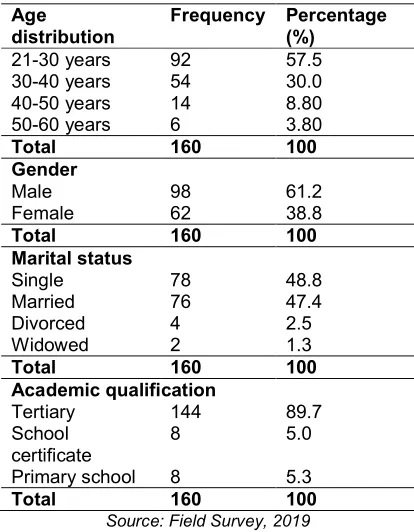
Most visitors to the recreation centres were within 21- 40 years (87.5%) while 41-50 years and 50 years above age ranges were just 8.80% and 3.80% respectively (Table 1). This shows that the people that visit recreation centres were mainly youth, who are full of activities and would like to find ways of relaxing after work. They are usually fascinated about recreation and found relaxation necessary as a way of catching fun as well as renewing their strength after the daylong stress and in preparation for the next day. Similar finding was reported by [14] who observed that recreational sites are more attractive to 21- 40 age class. Moreover, [15] reported teenagers form more than 50% of visitors to recreational centres in Faisalabad, Pakistan for exercises such as jogging and walking while [16] noted 45.5% of visitors to Makurdi zoo in Nigeria consist 15 – 30 years in age. Influx of youth recorded in recreational centres is usually connected but not limited to refreshment and exercise; it also serves as education tour for the young people. Patronage of more males (61.2%) and 38.8% females implies that males are less occupied after day’s work and so visit recreation centres frequently than females. Similar trend was also observed in Victoria Falls Rainforest, Zimbabwe [17]. The reason for reduction in female patronage may be connected
to attending home duties after work
especially in black African setting where most home chores are left to the female folk. Outside black Africa, female frequents recreational centres than males as observed in Barbados [18]. The percentages of singles, married, divorced and widowed respondents were 48.8%, 47.4% 2.5% and 1.3% respectively. Also,
academic qualification had some influence on people’s perception of recreation centres, green areas and their consideration about leisure. Sum of 89.7% had tertiary education experience while school certificate holders were just 5%. This showed that the learned patronize, appreciate and have passion for green environment; meanwhile it has been observed by [19] that higher educational attainment tends to increase the awareness and relevance of recreational park.
Table 1. Demographic factors of visitors to selected recreation centres in Ibadan
Age
distribution
Frequency Percentage (%)
21-30 years 92 57.5
30-40 years 54 30.0
40-50 years 14 8.80
50-60 years 6 3.80
Total 160 100
Gender
Male 98 61.2
Female 62 38.8
Total 160 100
Marital status
Single 78 48.8
Married 76 47.4
Divorced 4 2.5
Widowed 2 1.3
Total 160 100
Academic qualification
Tertiary 144 89.7
School certificate
8 5.0
Primary school 8 5.3
Total 160 100
Source: Field Survey, 2019
Fig. 2 shows that the amount spend per visit by majority of the respondents during the survey ranged between N500.00 and N2,000.00 only. A higher number of the respondents spent between N1500.00 - N2,000.00 (37.50%), 8.8% spent above N2,000.00 while 5.0% spent below N500.00 per visit. Valuing services such as Recreation Park can be quite difficult, because markets and prices for such ecosystem services do not exist. Approaches such as stated preference approach and revealed preference approach are often used to estimate public goods [20], while market and demand for
ecosystem services is simulated using
Fig. 3 revealed that most respondents were very much aware of various environmental values of green areas and leisure centres. The major environmental benefits visitors acquainted with are shade effect (95.0%), recreation/aesthetic (93.8%), air purification (90.0%), environmental amelioration (92.5%) and watershed protection (82.00%). It also indicated that majority of the respondents are more conscious of their values on environmental development. [22] opined that adequate leisure for people can reduce various
societal problems ranging from idleness,
depression, violence, alcoholism, drug abuse and other related vices. These are golden roles played by recreational green spaces among others in the society both in developing and
developed countries which cannot be
overemphasized.
Respondents enjoyed different facilities in the centres which include tree shading (15.0%), games for adult and young people (21.3%), nature viewing (26.3%), wildlife (22.5%), cool breeze (13.8%) and bar/restaurant service for drinks (1.35%). The human love for green areas associated with natural shading has sustained tourism and recreation around the world for decades. This unique natural scenery is one of recreation’s greatest assets and a fundamental cornerstone that provides opportunities for relaxation as well as appreciating the wonders of nature. [23] listed basic facilities of public park to include; grassed area for field sports, paved
areas for court games (basketball, volleyball), swimming pool, recreational building, picnic facilities, space for adult passive recreation,
parking areas and rest rooms. Outdoor
recreation activities have the capacity to bring joy, pleasure and improved health provided the necessary facilities are in place and functional [24].
Good management is a vital aspect in the realization of set goals and objectives of any organization, institution of government especially in the case of those in charge of open space
development. It demands the need,
aspiration and interests of people taken into consideration. The perceived hindrances towards proper management of recreational centres in Ibadan enumerated by the visitors consists poor awareness (55.1%) to lack of fund (16.3%), resource mismanagement (16.3%), lack of maintenance (8.8%) and lack of organization (3.8%) is shown in Fig. 4. Lack of awareness of existence of green space recreation centres
constitute the major hindrance amongst
others, however, the 2006 National Population Census estimated Ibadan metropolis to be inhabited by 1.34 million people [25]. Operators of outdoor recreation centres need to cash in on the advantage of the teeming population and launch proper awareness campaign to unleash the huge potential for social and economic gains from green space recreational centres in Ibadan.
Fig. 2. Amount spent on outdoor - recreation per visit by tourists in Ibadan 5.00%
28.40%
20.30%
37.50%
8.80%
0.00% 5.00% 10.00% 15.00% 20.00% 25.00% 30.00% 35.00% 40.00%
Fig. 3. Perceived environmental benefits enjoyed by visitors from green areas in Ibadan
Fig. 4. Respondents’ views on challenges of green space recreation centres in Ibadan
Table 2. Chi-square analysis on the visitors’ socio economic status and knowledge of environmental benefits of green areas in Ibadan
Socio-economic value Value
Gender 6.37
Age 31.59
Marital status 49.63
Academic qualification 82.20
Aesthetic/Recreational Shade effect Air purification Watershed protection Environmental amelioration
Lack of fund Resources mismanagement Poor awareness Lack of maintenance Lack of organization
Fig. 3. Perceived environmental benefits enjoyed by visitors from green areas in Ibadan
Respondents’ views on challenges of green space recreation centres in Ibadan
square analysis on the visitors’ socio economic status and knowledge of environmental benefits of green areas in Ibadan
Value Df Significant
6.37 10 .27ns
31.59 30 .01**
49.63 30 .00**
82.20 50 .00**
**Significant at = 0.01
Aesthetic/Recreational Shade effect Air purification Watershed protection Environmental amelioration
93.80% 95.00% 90.00% 82.00%
92.50%
6.20% 5.05% 10.00% 17.40% 7.55%
Acquainted Not Acquainted
Lack of fund Resources mismanagement Poor awareness Lack of maintenance Lack of organization
16.30% 16.30%
55.00% 8.80%
3.80%
Fig. 3. Perceived environmental benefits enjoyed by visitors from green areas in Ibadan
Respondents’ views on challenges of green space recreation centres in Ibadan
square analysis on the visitors’ socio economic status and knowledge of
Significant 6.20% 5.05% 10.00% 17.40% 7.55%
Age, marital status and academic qualification had significant influence on how respondents spent their leisure in Ibadan. Youths and persons with at least secondary education were aware of the benefits of green spaces recreation hence; visit more than persons with less educational qualification. The inferential statistics showed no significant difference on visitors gender when subjected to chi-square (Pearson) at = 0.01 probability level.
4. CONCLUSION AND RECOMMENDA-TION
In the light of what seemed to be considerable ecological, social and psychological advantages of urban green areas, its systematic promotion could be one of the most direct means of
promoting environmental development and
meaningful participation in outdoor recreational activities by the urban dwellers. Green areas in urbanized areas are usually located on left-over or challenging building sites. However, for maximum benefits in terms of active use, green areas need to be established near the people. Green areas that can only be viewed, where the public cannot enter, are only valuable as habitat for animal and also for improvement of air and water quality. In designing more sustainable and diverse landscape in highly visible areas, care must be taken to see that they are cared for.
Based on findings from this work, it
recommended that the green areas with potential recreational sites of tourist attractions should be stocked with varied suitable indigenous and exotic tree species to provide aesthetics,
ecological, economic benefits and other
recreational values to urban dwellers of Ibadan metropolis.
COMPETING INTERESTS
Authors have declared that no competing interests exist.
REFERENCES
1. Mensah CA. Urban green spaces in Africa:
Nature and Challenges, International
Journal of Ecosystem. 2014;4(1):1-11. DOI: 10.5923/j.ije.20140401.01
2. Baycan-Levent T, Vreeker R, Nijkamp, P.
A multi-criteria evaluation of green spaces in European cities. European Urban and Regional Studies. 2009;16(2):193-213.
3. URGE Team. Making greener cities – A
practical guide, No. 8/2004, Leipzig-Halle:
UFZ Centre for Environmental Research; 2004.
4. Clark P, Niemi M, Niemelä. J. Sport,
recreation and green space in the European City, Studia Fennica Historica. 16:9-24.
DOI: http://dx.doi.org/10.21435/sfh.16
5. Oladele AT, Udo NE. Ecosystem services
and mapping of amenity trees in Port Harcourt Zoo, Nigeria. African Journal of Agriculture Technology and Environment 2017;6(1):106-117.
6. Mensah CA, Andres L, Perera U, Roji, A. Enhancing quality of life through the lens of
green spaces: A systematic review
approach. International Journal of
Wellbeing. 2016;6(1):142-163. DOI: 10.5502/ijw.v6i1.445
7. Braubach M, Egorov A, Mudu P, Wolf T,
Ward TC, Martuzzi M. Effects of Urban green space on environmental health, equity and resilience. In: Kabisch N, Korn H, Stadler J, Bonn A. (eds) Nature-Based Solutions to Climate Change Adaptation in Urban Areas. Theory and Practice of Urban Sustainability Transitions. Springer, Cham. 2017;187-205.
Available:https://doi.org/10.1007/978-3-319-56091-5_11
8. Dwyer JF, Nowak DJ, Watson GW. Future
directions for urban forestry research in the United States. J. Arboric. 2002;28:231-236.
9. Ajani F, Olaoluwa DO. Ecotourism at
whispering palms, Lagos state, profiling tourists to its ecotourism operations. mangroves and wetlands of Sub-saharan Africa: Potential for Sustainable
Liveli-hoods and Development. Ed. O.Y
Ogunsanwo and A.O. Akinwole.
Proceedings of the 38th Annual Conference
of the Forestry Association of Nigeria held on 7th -11th March, in Port Harcourt, Rivers State. 2016;426-435
10. Gascon M, Triguero-Mas M, Martínez D,
Dadvand P, Rojas-Rueda D, Plasència A and Nieuwenhuijsen MJ. Residential green spaces and mortality: A systematic review. Environ. Int. 2016;86:60–67. DOI: 10.1016/j.envint.2015.10.013
11. Nilsson K, Randrup TB. Urban and
peri-urban forestry. In Proceedings of the Xi World Forestry Congress. 1997;1:970-110.
12. Bonsignore RE. Urban green space:
13. Azeez T, Adeleye O, Olayiwola L. Spatial variation in residents’ accessibility to land
for housing development in Ibadan
metropolis, Oyo state, Nigeria. Ethiopian Journal of Environmental Studies &
Management. 2016;9(Suppl. 2):1047–
1058.
Available:http://dx.doi.org/10.4314/ejesm.v 9i2.10S
14. Limaei SM, Ghesmati H, Rashidi R, Yamini
N. Economic evaluation of natural forest park using the travel cost method (Case study; Masouleh Forest Park, North of
Iran). Journal of Development and
Agricultural Economics.
2014;3(6):230-235.
15. Saleem A, Kamboh K. Why people visit
parks? The role of gender, age and education among urban park visitors in Faisalabad. International Journal of Asian Social Science. 2013;3(10):2196-2203.
16. Alarape AA, Yager GO, Salman KK.
Assessment of Tourists satisfaction and perception in Makurdi zoological garden, Benue State, Nigeria. Journal of Research in Forestry, Wildlife and Environmental. 2015;7(1):1-12.
17. Zhou Z. A survey of visitor satisfaction at Victoria Falls Rainforest. African Journal of Hospitality, Tourism and Leisure. 2018, 7(1):1-21.
18. Jonsson C, Devonish D. Does nationality, gender, and age affect travel motivation? a Case of Visitors to The Caribbean Island of Barbados. Journal of Travel & Tourism Marketing. 2008;25:3-4,398-408.
DOI: 10.1080/10548400802508499
19. Luke OO, Amujo BT. Socio-economic
determinants of on-day site demand for recreation in old Oyo National Park, Nigeria Journal of Development and Agricultural Economics. 2011;3(6):230-235.
20. Popoola L, Ajewole OI. Willingness to pay for Ibadan urban environment rehabilitation through reforestation projects. The Inter-national Journal of Sustainable Develop-ment and World Ecology. 2002;9:256-268. (U.K).
21. Nielsen-Pincus M, Sussman P, Bennet DE,
Gosnell H, Parker R. The influence of place on the willingness to pay for ecosystem services. Society & Natural Resources. 2017;30(12):1423-1441. DOI: 10.1080/08941920.2017.1347976
22. Oladeji SO, Adedapo OO. Performance
and visitor’s satisfaction of recreation facilities in Akure metropolis: A veritable tool for impacts studies in Undp Mdg’s cities in Nigeria. British Journal of Economics, Management & Trade. 2014; 4(8):1230-1250
23. Runte A. National parks: The American
experience. U of Nebraska Press. 1997; 27.
24. Cooper C, Fletcher J, Gilbert D, Wanhill S.
Tourism – principles and practice (4th ed.). FT Prentice Hall, UK; 2008.
25. Adelekan IO. Ibadan City Diagnostic
Report, Working Paper #4. Urban Africa Risk Knowledge. 2016;21.
[Retrieved July 2019]
Available:https:www.urbanark.org/Ibadan-city-diagnostic-report
_________________________________________________________________________________ © 2019 Aderounmu and Oladele; This is an Open Access article distributed under the terms of the Creative Commons Attribution License (http://creativecommons.org/licenses/by/4.0), which permits unrestricted use, distribution, and reproduction in any medium, provided the original work is properly cited.
Peer-review history: