http://www.jedem.org
Pathfinder: e-Estonia as the β-version
Wolfgang Drechsler
Ragnar Nurkse Department, Tallinn University of Technology; Davis Center, Harvard University; [email protected]
Abstract: Estonia is often presented as the leading Digital Governance country globally, but this is not backed up by any of the standard rankings. This essay attempts to answer why this is so, by demonstrating that while the official communications strategy of the Estonian Government emphasizes the country's role as a pathfinder, global media demand, and some of the local pro-tagonists also push, the perfection narrative. This is partially related to the specific historical and geopolitical situation of Estonia, and the subsequent local attitude towards the (Nation) State, which renders (since it is rather unique) the Estonian overall model of only limited use for e-policy transfer.
Keywords: e-Governance, Digital Governance, Digital Transformation, Estonia, State
Acknowledgement: This essay is based on a book project tentatively entitled Software is eating the (Nation) State (but not really): Estonian Transformations, begun at Harvard’s Davis Center during the Fall Term of 2017. It was presented there in November 2017, at the Nurkse Depart-ment’s faculty seminar in February 2018, and another essay focused specifically on state theo-ry, based on texts, is in its first published iteration (Drechsler, 2018b). The current essay, the basis for a keynote at the EGOV-CeDEM-ePart conference at Danube University Krems on Sep-tember 3, 2018, is in itself fully based on the earlier text. However, it focuses on e-Estonia as a global brand and model, and it also includes interviews. For discussion of and help with the current version, I would like to thank: in-house, Erkki Karo, Rainer Kattel, Robert Krimmer, Keegan McBride, Anu Masso, Tiina Randma-Liiv and Shobhit Shakya; as well as Beth Simone Novek, Dario Cavegn, Matti Ylönen, and Guénaëlle Gault, almost all of which disagreed at least with some parts; the interview partners listed below; Noella Edelmann and Peter Parycek for the invitation to Krems; and the Krems audience for excellent feedback.
1.
A cognitive dissonance
(https://timesofindia.indiatimes.com/business/india-business/Indian-Railways-Army-among-worlds-biggest-employers-Study/articleshow/47853593.cms). Factually, if not legally, a successor state of the Soviet Union, and in many ways the most successful one, it is now part of the European Union, boasting a very liberal economic regime (for instance, a flat income tax), the Euro, and quite some outstanding ranking positions. But it is tech, specifically ICT, that made Estonia globally known in the 2000s: The technological home of Skype (at one time, Europe’s only significant Internet platform), Estonia cornered, in the global media’s mind, the market for what used to be called e-Government or e-Governance (e-Gov) and what is now mostly referred to as digital(-era) governance (DG). This was accomplished first with paperless cabinet meetings, then with the first truly successful e-elections, and finally with the overall transformation of the country in a digital way. Recent headlines have been:
“Where in the world will you find the most advanced e-Government? Estonia” (Keen, 2018)
“Lessons From The Most Digitally Advanced Country In The World” (High, 2018a)
“Estonia has turned government into a website. Other countries are trying to follow suit. – Es-tonia has become a tech utopia” (Matthews, 2018)
“Estonia, the Digital Republic. Its government is virtual, borderless, blockchained, and secure” (Heller, 2017)
None of these claims are true, however. Estonia prioritizes DG, and indeed in many respects more strongly than almost any other country, but the hype is exactly that.In not a single one of the generally used, overall DG indicators is Estonia the number one today. However, it is often in the top five, both on the European and the global level.1 As an Estonian self-analysis puts it, “rankings
OK, but not great” (Vaarik, 2015). Another piece in Forbes by IT consultant Peter High is called “An Interview with the Architect of the most digitally savvy Country on Earth” (2018b), and baf-flingly in several ways, it is not about Lee Kuan Yew, which one would expect, but about former Estonian President Toomas Hendrik Ilves.
1 As of September 3, 2018, the day of the keynote. Waseda-IAC at
http://iacio.org/pdf/2017_Digital-Government_Ranking_Press_Release.pdf, UN-EGDI at
https://publicadministration.un.org/egovkb/Portals/egovkb/Documents/un/2018-Survey/E-Government%20Survey%202018_FINAL%20for%20web.pdf, DESI at https://ec.europa.eu/digital-single-market/en/desi (Estonia at
http://ec.europa.eu/information_society/newsroom/image/document/2018-20/edesi_2018-country-profile_eng_B43FFF58-F3FD-633C-F5833D8295BB9EB0_52221.pdf) and the 2017 EU
e-Government Benchmark Report at http://ec.europa.eu/newsroom/dae/document.cfm?doc_id=48587; the Country Report at http://ec.europa.eu/newsroom/dae/document.cfm?doc_id=48586. It is then sometimes claimed that at least Estonia is no. 1 in Digital Public Service Delivery, but currently, that is not the case either, not even in Europe – Finland is currently in the lead again;
Altogether, Estonia becoming the, rather than a, DG role model has not only been something that has been pushed from the Estonian side; rather, this position was also and perhaps even more so pulled by the global-Western media (Vaarik, i2018; Viik, i2018), which frequently seems to have eased its verification standards. This is perhaps because a digital role-model seemed to be so much needed for the laggard dinosaurs in the old “first world” (“look, it can be done”), possibly because ICT is just the paradigmatic, modern, cool story of our time (Perez, 2002). Maybe the most aston-ishing example is the much-shared article in the 2017 Christmas New Yorker issue by Nathan Heller already cited above. Reading almost like a comped influencer piece, this is just about the only New Yorker article I know of that only features people who are profiting financially or politically from the narrative of the story; not a single citizen, critic, or even neutral observer gets a voice (Hartschuh, 2018 is similar but much less prominent).
Actually, Estonia, Estonian DG, and the Estonian digit(al)ization of contemporary life are some-times really as cool and often almost as real as propagated. It is indeed true that Estonia is counter-ing annoycounter-ing delays in daily life that seem to still be present from the past in other locales, and just remain propped up by path-dependencies and special interests. Uber is better for normal people (who don’t drive for the company); nobody wants or needs to go to public offices and fill out forms in triplicate; the lives of many people have become internationalized via travel and work; one’s health is better if all doctors that are consulted, or hospitals that are visited, have access to one’s most recent as well as oldest x-rays and test results. Estonia is catering to those needs or at least desires, and this is a substantive success story, not only in Public Relations for Estonia—but for its DG leaders and also for the consumer citizen.
For various reasons, however, this true success story of genuine achievements and their specif-ics has become overshadowed by the powerful myth of a real-existing digital society and state, and this has obscured the real messages. And that is not solely the international media’s fault. As even the already above-quoted Andrew Keen, one of e-Estonia’s less critical friends, admits:
“All the policy makers and legislators with whom I spoke have, in the best Silicon Valley fashion, drunk the Kool-Aid and loudly proclaim the triumph of their ‘country in a cloud.’ But the truth is less triumphant. The revolution remains a work in progress, and many ordinary Estonians remain indifferent to a lot of these digital abstractions“ (2018).
A key Estonian government expert, in a Chathamized seminar discussion this spring in Tallinn, referred to 90% of Estonian DG propaganda as hype and 10% as true; one or two others in the room argued for up to 50% reality and 50% “you know, not lies, but the kind of stuff government people just say.”
2.
The β-version
The dichotomy of Estonia as the e-leader (which it is not) and an e-leader (which it is), however, is not an outside perspective; it has been quite strongly and even sometimes explicitly present within the Estonian discourse of the DG stakeholders for a decade now. Over the years, there has been a shift towards the former; however, since there have been almost universally positive feedback loops, i. e. international observers have “bought” what has been sold, there was also relatively little reason to question this internally, either.
The dichotomy of the two stories has been well theorized in 2015 by Daniel Vaarik in the al-ready cited 2015 analysis called, “Where Stuff Happens First: White Paper on Estonia’s Digital Ideology”; it is still publicly available on the responsible Ministry of Economic Affairs and Com-munication’s website (Vaarik, 2015). Vaarik, speaker of the Estonian Government under Siim Kallas; former CEO of Hill & Knowlton Estonia; and former Chairman of the Board of PRAXIS, Estonia’s most important public-policy think tank, is an insider’s insider. All of this makes this paper somewhat “officious”.
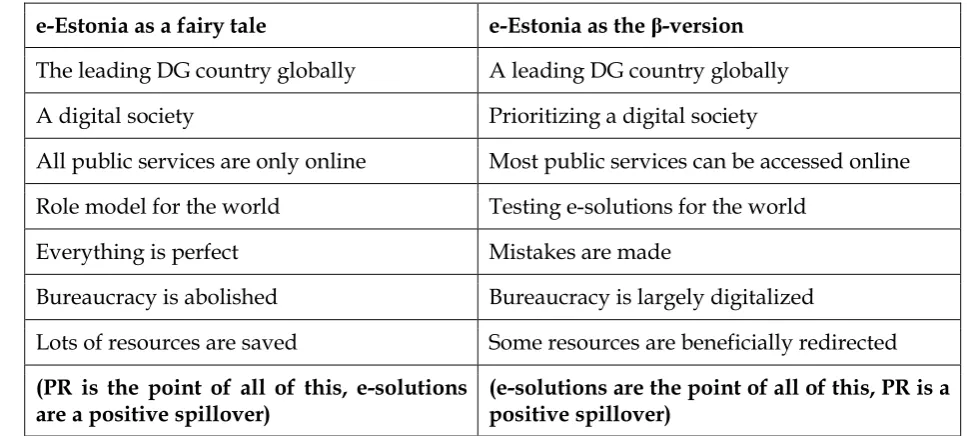
Vaarik differentiates between an “e-Narnia”, a fairy-tale version of e-Estonia, which he regards as a mistake to promote, and “e-Estonia as the beta-model”, which is more believable, truer, and more sustainable (2015); this essay owes its subtitle to the second concept. More detailed key rec-ommendations from the Vaarik white paper include positioning Estonia as a pathfinder (the title of this essay), becoming a DG think tank, and especially, “6. Learn to talk to sceptics. – Sceptics are allies – Involve sceptics in development” (2015; this was done during a recent conference on secu-rity problems with the ID cards; https://www.ria.ee/en/researchers-and-specialists-from-all-over-the-world-will-gather-to-tallinn-for-an-id-card-conference.html).
Table 1: The two e-Estonias
e-Estonia as a fairy tale e-Estonia as the β-version
The leading DG country globally A leading DG country globally
A digital society Prioritizing a digital society
All public services are only online Most public services can be accessed online Role model for the world Testing e-solutions for the world
Everything is perfect Mistakes are made
Bureaucracy is abolished Bureaucracy is largely digitalized
Lots of resources are saved Some resources are beneficially redirected
(PR is the point of all of this, e-solutions
are a positive spillover) (e-solutions are the point of all of this, PR is a positive spillover)
However, many in Estonia were push-pulled, or jumped, into the fairy-tale version, which was intended as a warning, not as a model (Vaarik, i2018). Also, with exceptions, the β-version is not the official narrative right now either (Vaarik, i2018), although almost all reasonable people (and every single interviewee I broached this subject with) agree that this should be the official story. Just a glance at the website of the best example (or the most obvious instance), for the official mar-keting of e-Estonia, the e-Estonia showroom (https://e-estonia.com/showroom/; also Piperal, 2018), demonstrates that this is not the case and the choice is, indeed, the fairy tale.2
Vaarik, however, was also able to explain how currently embracing the e-Narnia story might be a relatively low-risk strategy: As with Apple or even Facebook, negative news would not harm the narrative, so that the story would not crash (i2018). This may be a reason why so many e-Estonia protagonists embrace it—and most of the key ones know that telling the e-Narnia story means gal-loping across frozen Lake Constance, even though there are those that truly believe it, as well.
But why take this risk? Why is it so important for so many e-Estonia stakeholders to sell Estoni-an DG as more thEstoni-an it actually is? It is importEstoni-ant to understEstoni-and that the e-Estonia showroom is, to a considerable extent, not the façade of Estonian DG, but it is the real thing in itself—actual DG is
2 The e-Estonia website, although very much part of the e-Narnia set, shows on its homepage a summary of
only the back office (see Tikerpe, 2018, who lists the showroom as a DG-accomplishment like the e-residency; generally, Tammpuu & Masso, 2018). It cannot be emphasized enough that there is something there—quite a lot, in fact—but DG solutions seem (by now) to be positive spillovers. Clearly, the point is to increase PR.
One reason might be, as it came out in many discussions, that ICT and specifically DG are quite literally all that Estonia has to show for itself; from moors and elks to low taxes, other nice features seemed not really special enough, and few non-expert non-neighbors could guess where Estonia was on a map before and even after the rise of Skype. Also, while moors and elks are real, Estonian taxes are actually just flat, simple, and thus regressive, but not really that low (Taagepera, 2018, p. 124). In global leadership circles, e-Estonia changed that (or at least added significantly to the mar-ket-radical reform image of the mid-1990s). So, by now, Estonians have embraced that fact and use the e-narrative to present themselves internationally, which of course enforces the tendency to say “we are the best”, rather than “we are among the best”. Along with it, ICT has become the central identity element of many Estonians, even perhaps in a wider sense (so Vaarik, i2018 and Riisalo, i2018) than the functional elite that originally came up with the idea. Estonia, to a significant ex-tent, has become e-Estonia.3
This makes it difficult and even risky to challenge the narrative, especially because Estonia per-petually feels to be under an outright existential threat from its erstwhile colonial overlord and Eastern neighbour (Russia). So, being known and thus potentially defended by one’s allies, which is not automatic for tiny Estonia, is therefore truly essential (more about that later). Therefore, e-sceptics are, it is fair to say, sometimes seen as the enemy. The latest e-Estonia institution, Digital Embassies (Kotka et al., 2016), transfers state information into a cloud, servers in Estonian embas-sies in friendly countries, and commercial clouds, specifically Microsoft Azure (part of their big e-Gov initiative). It is designed so that if Estonia is conquered, it can continue to exist, as it would “preserve the core records of government to allow the country to essentially continue to operate even in the face of physical occupation or destruction. Or, as one advisor put it, ‘we will be the first country in the world that can exist without physical land’” (Leetaru, 2017).
Therefore, the accusation of being a Putinite just for wanting to vote on paper always hangs in the air. Although, as my colleague Robert Krimmer (who was with the OSCE-ODHIR at that time), recollects it was Putin who pushed for e-voting in Europe. When confronted with Finland’s
3 The doyen of Estonian political science and former Presidential candidate Rein Taagepera, in a centennial
sion, in January 2018, to continue keeping their Presidential elections analog, Marten Kaevats, the Government’s Digital Advisor, called “the Finnish train of thought ‘absurd’. ‘There is a working case study that Estonia represents. There is significant research how safe it is, the dynamics and everything. There are numbers to prove it’” (Macdougall, 2018). In fact, while there is indeed plen-ty of scholarship that is in favor of e-voting, there is as much that speaks against it (Sutcliffe, 2017, which tries to make another point but confirms this one). But why should Estonia mind if Finland, which is better ranked in almost all indicators (not only in DG), decides for itself to stay on in the usual European way?
As former Prime Minister Taavi Rõivas said in an (Estonian-language) op-ed that quite openly pushed further e-Estonia “solutions” for the sake of novelty positioning, “At the beginning of 2018, we are the best in the world as the undisputed e-state. Our success has been based on smart, auda-cious choices and the intolerable slowness of other countries” (Rõivas, 2018; note that the state-ments in the first sentence are false). Intolerable for whom? In order to get closer to the answer, we must look at the genesis of Estonian DG.
3.
Historical: The Rise of e-Estonia
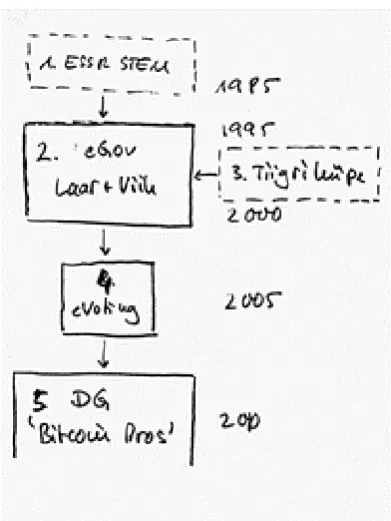
Although the rise of e-Estonia and Estonian DG is quite linear, and the arsenal of players limited, this history has, amazingly, not yet been written—the first credible attempt (Kattel & Mergel, 2019) is in press with longer treatments that are set to follow.4 There are, therefore, also no agreed
periodizations yet. Since these, however, are somewhat necessary to make sense of the story, the following is suggested as a working hypothesis that is very much open to corrections.
3.1.
Soviet pre-history
The entire development is premised on a long, already Soviet-era history of STEM investment and training especially in Estonia (Högselius, 2005), beginning in the mid-1960s. There was a very high local literacy rate just when independence became realistic again, or at least a large reservoir of e-literate people (Velmet, i2018, Põder, i2018, Viik, i2018, Madise, i2018). It is this reservoir of competence that e-Estonia tapped into, but it did not in itself result in any form of e-Gov. It is, however, one key answer to the “why here?” question.
4 Intellectual and science historian, Aro Velmet, is “in the early stages of preparing a book-length project on
3.2.
e-Gov emerges
It was then, in the early to mid-1990s, that the idea to technologically leap ahead via e-Gov, in light of a Soviet legacy that was perceived as unattractive (never mind that in ICT, this was not so). In addition, it was considered at the same time important to do “modernist positioning” in order to develop a more Western look. It is difficult today, to argue against the main interest as being both in state modernization in a constructive way and (perhaps also secondly) in a modernist positioning for PR purposes (Viik, i2018). This, however, soon took, kept, and later expanded to center stage.5 However, as a direct and daily participant observer since 1993, I myself have always
seen PR in the functional lead (plus the engineers’ drive to do what can be done) and actual reform second, even a positive spillover. Estonia had put its chips on the right number. However, it is too dismissive to say that it unwittingly stumbled upon the truth, but there was an actual effect along these lines. The credit goes primarily to Prime Minister Mart Laar, the father of DG in Estonia, and his visionary e-advisor, Linnar Viik, whom he just let do things and that acted like an independent minister (Viik, i2018; Kattel & Mergel, 2019), especially during the crucial years around 2000; however, we can safely date the beginnings of this to the mid-1990s (August 2000 is the first paperless cabinet meeting and is for many the “big bang” of Estonian DG).
5 Nonetheless, Public Administration in Estonia—and that I say as the first PA professor in Estonia since
1938—had been going extremely strong by then, indeed for almost a decade, so that the argument that Estonia “could not afford a classical bureaucracy” (Viik, i2018 etc., Kristina Kallas in Hartschuh, 2018) seems not valid and post facto to me. DG came to Estonia years after a somewhat hybrid but in many respects very traditional, German-legalistic civil service that had been established (married with some then-fashionable NPM tools which are highly bureaucratic as well; Drechsler, 1997, 1998). There was no reduction in civil service numbers, as in all CEE states except East Germany (Drechsler, 2003). And still today, as anyway, DG does not reduce bureaucracy but digit(al)izes it. And even then, that is only in some respects; in fact, the new Tallinn “Superministry Towers” that just opened look like Kafka’s Schloß reloaded, or in bad light, even like something out of Mordor
Table 2: A rough sketch of the history of e-Estonia
3.3.
e-literacy
The third, more digital-society-related layer of Estonian DG is that of the “Tiger Leap” program (tiigrihüpe), an overall e-access program for citizens including, importantly, education in schools and later also access for senior citizens. This happened somewhat in parallel with the creation of Estonian e-Gov, for which universal e-literacy was very helpful, perhaps to some extent a conditio sine qua non. But without the Laar-Viik Government initiative, any spontaneous creation of e-Gov just out of the Tiger Leap would be highly unlikely; a country’s e-literacy and e-e-Gov are not related in a linear way. This program is often associated with Ministers Toomas-Hendrik Ilves and Jaak Aaviksoo and their education strategies (Kattel & Mergel, 2019), not least especially by the former himself (High, 2018b). Although, this has recently been called into question, and the Tartu State University Sociological Laboratory and the Estonian Academy of Sciences Institute of Cybernetics have been suggested as the true founding locations (Velmet, i2018; see also Maidla, 2018).
3.4.
The gap years
(https://www.microsoft.com/en-us/stories/skype/skype-chapter-2-welcome-to-estonia.aspx) had created positive feedback loops for Internet use and access.
3.5.
The present
Finally, the fifth and current layer, that of DG, is promoted by a group of new people—and some of the old—who often do not aim for acceptance but dominance of Estonian e-leadership; they see Estonia as e-leading and indeed e-ruling. More than any of the previous generations, they are de-coupled from actual problem-solving, but the focus is sometimes (certainly not always) on constructing problems that then can be solved in a good-looking way. We can date this as starting from 2010 or so. To call this a “Nordic” version of California thinking and the Silicon Valley set (Barbrook & Cameron, 1996) gets us close to the mindset. I think Nian Hu’s recent label of “Bitcoin Bro” fits them well enough to understand who and how they are:
“We all know a bitcoin bro. Also called the tech bro or the brogrammer, they can be found trading bitcoin, or some other form of cryptocurrency, and providing regular – and often unsolicited – updates on how much money they’re making. They write long-winded Facebook statuses on entrepreneurship, the power of positivity, and motivation. They idolize Elon Musk, share countless posts about SpaceX, and drool over the prospect of colonizing Mars one day. They love virtual reality, augmented reality, any reality where the Scarlett Johansson-voiced artificial intelligence from ‘Her’ is real. They are constantly forming startups that seek to ‘disrupt’ an industry, or that seek to be ‘like Uber, but for [groceries/toothbrushes/lint rollers]’“(Hu, 2017).
The disruption in our sense is the one of the state, quite in line with the Californian Ideology, also with their 1990s libertarianism (Madise, i2018), which adds to their dismissiveness of the state. For the Bitcoin Bros, easy switching between the first and second sectors has been normal. While business people can also be patriotic, the lack of borders between firms on the one side and the state on the other, in any case, seems to require (outside of Estonia at least) more faith in the pri-vate sector than experience (especially in the e-sphere), would allow one to have.6
4.
Specific: The State of Estonia
The previous discussion shows that even in the diverse context of Europe, Estonia is, while not unique, certainly very specific in regards to the attitude towards the state. This is worth examining, because it, arguably, is part of the foundation of e-Estonia, and also why Estonian-Estonia can argue that acting as or like a startup is okay for a state, although it is bizarrely risky (startups are
6 Good recent examples are, e. g., a Nortal article on their own website, promoting Estonian e-ID solutions
for Germany of all places (the reason why Germans do not take up e-ID as enthusiastically as Estonians are not related to technology), Lume (2018), which has been promoted unreservedly and undistin-guishably from a promotion at https://e-estonia.com/smartid-authentication-roadblock/, or a direct link and similar makeup of a lookalike website promoting the Estonian e-firms,
meant to fail easily). This is because the current official message from Estonia—the international government message, one that was used as the key note in the literal sense during the EU presidency in 2017—is that the (nation) state, the Western, our state is dying. Therefore, somehow it must fall if “we” want to stay on top of things globally. This we find in the pronouncement of those who dominate the discourse: President Kersti Kaljulaid; Kaspar Korjus, one of the leading protagonists of e-Estonia, the managing director of the e-residency program who has been referred to in headlines as “Estonia’s Top Futurist [who] Explains How Tech will Make Countries Obsolete” (Browne, 2017), and who has earned the crown as the by far most media-present Estonian (Lõugas, 2018); and Taavi Kotka, the former CEO of Nortal, Government CIO between 2013 and 2017, and now back in consulting, who is generally credited with the creation (along with others) of both e-residency and the digital embassies, the last of Estonia’s key e-Gov features (Kotka et al., 2015, p. 1).
Since 2014, “e-residency represents the latest in this explosive succession of e-government inno-vations” (Kotka et al., 2015, p. 4). This rather brilliant and much-hyped idea to give foreigners an Estonian ID card upon application (not valid for travel or physical residency) so that they can par-take in Estonian public (and also private) services has made Estonia the darling of the global e-community. The key aspect to remember is that e-residency realistically only works as a supple-ment, not substitute, of classical nation-state citizenship, while its development—the recently launched e-residency 2.0—seems entirely unplanned and somewhat random (Korjus, 2018). But when Kaljulaid habitually claims that “as the President of Estonia, I represent the only truly digital society which actually has a state” (Kaljulaid, 2017; see also the respective anecdote in Heller, 2017), this is a reversal of the classic European idea of a state above and beyond nation/society7
(Hegel, 1820). Therefore, this goes well beyond a neo-liberal public-service-delivery focus, and she ends up going back to the notion of a society/nation (however digital or not) that controls, indeed that owns the state (see Skinner, 2017).8
The reason for this is probably the fact that Estonia has been a nation state in any real-existing sense for only a half-a-century (Mälksoo, 2018; Taagepera, 2018, pp. 11-12). Until then, in modern history, Estonians were colonized from all directions, and mostly they had little connection to state and government (Drechsler & Kattel, 2000). Also, they lived in villages, whereas the cities in Esto-nia were essentially foreign with most of them gaining an EstoEsto-nian majority only in the late-mid-19th century—Tallinn, taani linn, the city of Danes, is a capital city that even in name belongs to “others”. 2018 is the 100th anniversary of the Republic of Estonia, but only if one starts in 1918 and blends out, which legally one doubtlessly can (Drechsler & Annus, 2002; Mälksoo, 2003), the times when there was just a legal-fictive state and in reality a Soviet Republic (1940-1991). That is, unless,
7 In the Estonian context, while there are copious references to the digital society, the discursive antagonism
is not between state and society. Instead, it is between state and nation, with which the ethno-cultural, Estonian, Estonian-speaking group inside Estonia (and outside in the diaspora) is meant.
8 Riisalo (i2018), Vaarik (i2018), and others emphasized that Kaljulaid does not mean that in any
as Mälksoo (2018) very recently emphasized, one is able to see the ESSR as some form of Estonian statehood, and not just as an occupation. But as Aristotle states, “when the type of government changes and becomes different… the state no longer is the same” (Arist. Pol. III 1276b; Drechsler, 1999).
Apart from legal reasoning, this may already give an indication that “Estonia” is in principle not even a nation state, but a small, ethnically homogeneous, conversant unit. Meaning it is essen-tially a tribe—and the modern nation state within which it exists is something that is owed to the world order we have, but not something to which Estonians have any closer relation (see also Tammpuu & Masso, 2018). The 100th anniversary of the Estonian Republic was thus a celebration that 100 years ago, for the first time (or at least again after several hundreds of years), the Estonian nation, (as in people, tribe, or what in other contexts would be called society), was able to govern itself in the international political context (Mälksoo, 2018).9 But this political state is not the core of
one’s identity to the degree that “Estonia” (nation) is. The state is, to quote the Legal Chancellor, often seen as a tool for the Estonian nation (Madise, i2018). Historically, the state as an institution, both as Soviet legacy and over the centuries if not millennia, was always suspect—in Estonian his-tory, the state was evil, the nation was good; the nation was us, the state was them (Drechsler, 1995; 1999).10 It has often been claimed that this is also at the basis of the previously mentioned,
crucial neo-liberal consensus of Estonia politically, where even the Social Democrats are neo-liberal of sorts (Drechsler & Madise, 2004). Thus, the respect for the state as such is low (Skinner, 2017) as well as the fear of one’s (own) state. Hence, an almost cognitively dissonant, and much bigger con-fidence than in most other countries exists. For instance, in the example of e-health, there is a strong belief that nothing negative can be done by the state.11
9 Mälksoo considers whether “celebrating 100 years of statehood can also be too little, an understatement”, if
one considers, e. g., the Livonian Confederation, a predecessor of the Estonian Republic, which already First-Republic legal scholar and erstwhile foreign minister, Ants Piip, has claimed (2018). This would have been a state with entirely ethnic-German control and no say by any ethnic Estonian; however, it may be doubtful how much this would be a thought shared by many Estonian-Estonians today.
10 All interviewees corroborated that, except for Mälksoo (i2018), who insisted that those with a genuine
Estonian State identity do exist, if in a minority.
11 Familiarity with the entire community does also increase trust, but contrary to political speeches, it is
ab-sence of fear rather than trust that marks Estonia’s precondition for successful DG, a feature that e. g. in Germany is completely absent. Trust in government in Estonia is marketed as extremely high and as a foundation of Estonian DG – the President in 2018 for instance, at
https://www.youtube.com/watch?v=FaQf9dSXs8I, or Keen (2018), or the nonsensical
https://www.sunstonecommunication.com/sunstoneblog/estonia-land-of-digital-trust, and according to older Eurobarometer results, it is higher than the EU average –
https://www.baltictimes.com/estonians__trust_in_parliament__government_much_higher_than_eu_a verage/ – but only at 51% and declining. More importantly, according to the standard OECD statistics, it has not only been declining during the last decade but is now, well below the average of the countries measured, below 40%;
Finally, an emphasis on the Estonian Republic state would also mean greater power and im-portance for the Russian(-speaking) population. They still comprise about 30% of the population and are not generally counted into Estonia in the sense of Estonian nation by “Estonian Estonians”. (The situation is improving, partially because of the Refugee Crisis, but very slowly; Aidarov, i2018.) One cannot define a republic exclusively on ethnic-nationalist grounds—but no matter what the external rhetoric, for most ethnic Estonians, the Estonian Republic is probably still ideally an ethnically homogeneous nation state (Aidarov & Drechsler, 2011; 2013; Aidarov, i2018). It is interesting that e-Estonia with its internationalizing tendencies does not seem to better the stand-ing and professional engagement of Estonian Russians, but practically (rather than in policy) it does include to some extent Russian-speaking migrants from the former USSR, including Russia (Aidarov, i2018). A recent Western media piece promoting Tallinn as a hub for digital nomads, on the other hand, cheerily proclaimed about e-residency, “In fact, you could argue that one aim is to reduce Russia’s influence by loading the city with Western entrepreneurs,” referring to Estonian-Russians in the rest of the paragraph (Beech, 2018). The character of Estonian e-Gov as part of that kind of Estonian-Estonian nation-state building is still under scholarly discussion (e. g. Björklund, 2016 vs. Tammpuu & Masso, 2018, who differentiate more between internal and external functions of Estonian e-Gov).
5.
Russia: Tallinn Death Wishes
We have now reached the point where the elephant in the room must be addressed head on—one that is essential for understanding both Estonian DG and why the β-Version is neglected. As Kotka put it, “Another driving factor [for e-Estonia’s success] was Russia’s invasion of Crimea. Estonia has been occupied every century in our history. Russia occupied us just 80 years ago. What if Russia invaded again? Can we become a virtual country?” (Taavi Kotka in High, 2018a).
“To put it bluntly, if more people can point to Estonia on a map then it’s harder to wipe us from it” (Korjus, 2018). Russia experts might explain that the chances that this would happen are ex-tremely low, Crimea annexation or not (e. g. Colton, 2016, pp. 193-199), and show that if anything, Russia is embarrassed by Estonia’s success (pp. 209, 214). But from the Estonian perspective, it does seem that every time the threat seems banned, it comes back (Taagepera, 2018, pp. 125-128). Perhaps, one can say that in regards to the Russian danger, the off-chance that something might happen, is just big enough in Estonia that one can never neglect it.
safety-oriented.12 There is this mélange of hating the state (as such and Russia in particular) and loving it
(one’s own but not really fully), and also of risking the nation state but just in order to retain it. I will try to access this strange scenario with a brief dual vignette, and here we enter an area of complete speculation or even association on my part.
In short, one could argue that the original (in the sense of from the origins/beginnings) virtuali-ty of Estonia as a Nation State, its continued perceived precariousness, and the continued potential threat by another, very successful Nation State (the old Colonial power), are the reasons why Esto-nia can so easily (and even wants to) abandon the idea of the classic Nation State. That is why it can gamble with the state-as-startup concept, and that is one of the reasons (with push-pull and financial/prestige gain) why it may think it has to hype the fairy tale story. It is so that other coun-tries, like it or at least know it, and thus will perhaps do something against a Russian invasion—or not, if you consider that existential threats (especially continuous existential threats), are difficult to handle over long periods of time. All of it seems a bit like the long-term care for a terminally ill person—there may be a secret hope to have the agony end, for the other as well as for oneself. And altogether, this fatigue from defending oneself is sometimes noticeable in the Estonian discourse, if not always easily and not for the casual observer.
Both of these approaches are kitchen-Freudian, an approach that is quite prominent in Estonia (if also beautifully ridiculed by Tartu Psychologist Jüri Allik, the most eminent social scientist working in Estonia; Allik, 1998). The first, easier speculation goes into the direction of parricide, of the Übervatermord (1989b), or at least some similar such phenomenon—and that is, of Putin and Russia as father. If nation states cease to exist, the Russian Empire’s threat ceases to exist as well, and as a tribe, Estonia can theoretically survive where and as what it is in a new ‘Time of the Tribes’.
One notch up, we could also allow the Estonian Nation State something akin to “murder by sui-cide”, i.e. that if just focused on the Eesti Vabariik, if it is finally gone (again), one can relax and make one’s money somewhere else. This is seemingly somewhat in opposition to the state/nation state/Estonia argument, but again, if the nation state is not such a big deal, it is more easily sacri-ficed than elsewhere.
This “death drive” (Freud, 1989a) is actually a receded but still prominent traditional aspect of Tallinn, the old Reval, as in of Venice (“Death in Venice”, etc.). One of its most famous chroniclers, Werner Bergengruen, has emphasized this in his well-known 1939 collection Der Tod von Reval, which is still in press (2006). The German title suggests both “the death that comes from Tallinn” and “the death of Tallinn”, and both are relevant here. The most important artwork in Tallinn is a danse macabre, a Dance of Death, now only a fragment of Bernt Notke’s High Gothic masterpiece in the St. Nicholas Church (created just before 1500; Freytag, 1993). The fragment that survives,
12 Being anything but a website, nor a platform in the Tim O’Reilly sense (2010), Estonian DG is closed and
however, shows death in the form of skeletons with some skin still attached, dancing just with the representatives of Government (indeed of the state) into their graves: Pope, Emperor, Empress, Cardinal, and Duke.
Illustration 1: The Death of Tallinn
(https://de.wikipedia.org/wiki/Niguliste_kirik#/media/File:Bernt_Notke_Danse_Macabre.jpg)
Whether Tallinn really has such a melancholy, Venetian air may be questionable, and the Tal-linn Death refers to the German Balts, which are practically all gone. However, the fact that Old Town and Cathedral Hill practically have no people left, no playing children, and that they have degenerated into a theme-park-like place for tourists that leave the real city strangely empty actu-ally might (for the more sensitive), conjure up images of the smiling skulls in St. Nicholas. And this idea of Tallinn as a memento mori, as a reminder that death comes in the end, may underline the wish, not to kill, but to die, so that the struggle is finally over.
This historical mantle is not only far-fetched but also very likely nothing that the 5th-layer Gen-eration of Tallinn ICT gurus, politicians, e-vangelists, and their global media support would ac-cept. Meaning, it is not supported by those who right now seem to own the e-discourse in Estonia, who make this point of death about killing the state by transforming it into a service platform. However, they do employ an undertaker rhetoric, just like the skeletons, and the danse macabre for the state is by implication one for the Estonian Republic, as well. Nevertheless, the actual effect seems to be the opposite—for now.
6.
Coda: Which narrative should it be?
Convenience is at the core of technology’s non-coercive distribution (Jünger, 2010)13; DG does
require catering to the new needs of citizen customers as perceived by themselves, and it is nice to know when the bus will really arrive. With some luck, as in the cases of Postmodernism and Orientalism, the e-Estonian discourse on the abolition of the state will be good for lesson-drawing, and the scenario of a stateless life will serve as a heuristic utopia at best, not one to be actually pursued (Drechsler, 2002).
13 Kotka (2018) argues for the opposite, however, claiming, “Estonians are very rational people. We didn’t
Since this discourse is highly representative of our current times, paradoxically, both the “kill-ing-the-nation-state” rhetoric by e-Estonia and the fairy tale of e-Estonia itself have actually legiti-mized the Estonian nation state among its peers—the Estonian Republic is in several ways globally stronger and prouder than ever. The intention in launching the e-residency was the opposite of using “new technologies to expand the global reach of a nation-state” (Orgad, 2018), but rather instead to kill it. However, ironically, that is the effect e-tesidency has had.14
But there is the problem that e-Estonia is clearly overhyped. An overblown story is risky, and the question is whether it is even needed. Furthermore, because of the special nature of the Estoni-an state, all of this is highly context specific. Thus, it may happen in some countries or other enti-ties that this narrative will be appropriated for political means, misunderstood as inevitable, or that it is in fashion (which e-Estonia does ride highly successfully), and then creates such a tsuna-mi that all resistance is futile.
But why would that be a problem? As I was asked by a colleague at the Tallinn eGov2018 con-ference (http://2018.tallinnconcon-ference.ee/): Wouldn’t there be cases of (good and needed) digital transformations of government that owed their success to the Estonian model as inspiration that it can be done, never mind whether it is true or not? The answer, I ventured to guess, would be in the affirmative. But on this speculative level, there may also be losses imagined: Statehood abol-ished, capacity reduced, and structures imposed on less unafraid societies where they would never work or only serve for some sort of exploitation. And the Estonian tendency to be tech-driven, ra-ther than tech-based like the Finns, is not only risky reputation-wise, but it also risks abolishing (liberal-democratic) achievements. This is because technology just does not automatically lead to agreed-upon ethical goals (see just Osnos, 2018). However, it is true that not needing any DG in-spiration is also an Estonian perspective; as in Estonia, there are truly relatively few barriers for it, both institutionally and mentally.
Yet, only when we remove the layers of PR do we have the chance to genuinely learn from (and even for) Estonia what can successfully be digitalized and what maybe cannot, and that is still a fantastic story. Unfortunately, if a story sounds too good to be true, then it is probably because it is.
References
Aidarov, A., & Drechsler, W. (2011). The Law & Economics of the Estonian Law on Cultural Autonomy for National Minorities and of Russian National Cultural Autonomy in Estonia. Halduskultuur – Adminis-trative Culture, 12(1), 43-61.
Aidarov, A., & Drechsler, W. (2013). Estonian Russification of Ethnic Minorities in Estonia? A Policy Analy-sis. Trames 17(2), 103-128.
14 As a conspiracy theory, one could assume that this had been planned all along by the e-residency
Allik, J. (1998). Sigmund Freudi elu ja töö. In Sigmund Freud: Inimhinge Anatoomia. (pp. 80-150). Tartu: Tartu UP.
Barbrook, R., & Cameron, A. (1996). The Californian ideology. Science as Culture 6(1), 44-72.
Beech, P. (2018). Wandering stars: are Tallinn’s digital nomads building the city of the future? The Guardian, 15 March. Retrieved from https://www.theguardian.com/cities/2018/may/15/are-tallinn-digital-nomads-building-the-city-of-the-future.
Bergengruen, W. (2006). Der Tod von Reval: Kuriose Geschichten aus einer alten Stadt. Frankfurt/M.: dtv. Björklund, F. (2016). E-government and moral citizenship: the case of Estonia. Citizenship Studies 20(6-7),
914-931.
Browne, M. (2017). Estonia’s Top Futurist Explains How Tech will Make Countries Obsolete. Inverse, 13 October. Retrieved from https://www.inverse.com/article/37384-estonia-bitcoin-q-a.
Colton, Timothy J. (2016). Russia: What everyone needs to know. Oxford: Oxford UP. Drechsler, W. (1995). Estonia in Transition. World Affairs 157(3), 111-117.
Drechsler, W. (1997). Riigiteenistust reformides lõksu [The Traps of Civil Service Reform]. Postimees, 17 April.
Drechsler, W. (1998). Saksa lahenduste või probleemide import Eestisse? [Importing German answers or problems to Estonia?] Sõnumileht, 26 September.
Drechsler, W. (1999). The Estonian State at the Threshold of the 21st Century. In Eesti maailmas 21. sajandi künnisel [Estonia in the World in the 21st Century], Conference in Honor of the President of the Repub-lic of Estonia, Lennart Meri, on Occasion of his 70th Birthday, Aula Lectures (pp. 27-46). Tartu: Tartu University Press.
Drechsler, W. (2002). Hans-Georg Gadamers Plato und die Dichter. In Zukunft braucht Erfahrung. Eine Fest-schrift. 475 Jahre Gymnasium Philippinum (pp. 53-62). Marburg: Gymnasium Philippinum.
Drechsler, W. (2003). Lessons for Latin America and the Caribbean in Managing Public Sector Restructuring: Public Sector Downsizing and Redeployment Programs in Central and Eastern Europe. Study for the Inter-American Development Bank, Regional Policy Dialogue, Public Policy Management and Trans-parency Network. Retrieved from
http://idbdocs.iadb.org/wsdocs/getdocument.aspx?docnum=623667.
Drechsler, W. (2014). The Ombudsman’s Role in the times of e. Lecture, The General Assembly and Confer-ence of the International Ombudsman Institute, European Chapter, first plenary session on “The Om-budsman’s Role in a Democracy: Views from Political Science and Practical Philosophy”, Tallinn, 18 September.
Drechsler, W. (2018b). Will Software eat the State? Lessons from the Estonian Presidency for the Future of Europe. In RFTE – Council for Research and Technology Development (Ed.), Re:thinking Europe: Posi-tions on shaping an idea (pp. 261-275). Vienna: Holzhausen.
Drechsler, W., & Annus, T. (2002). Die Verfassungsentwicklung in Estland von 1992 bis 2001. In Jahrbuch des öffentlichen Rechts der Gegenwart NF 50 (pp. 473-492). Tübingen: Mohr Siebeck.
Drechsler, W., & Kattel, R. (2000). Karl Bücher in Dorpat. In J. G. Backhaus (Ed.), Karl Bücher: Theory – His-tory – Anthropology – Non Market Economies (pp. 11-72). Marburg: Metropolis.
Drechsler, W., & Madise, Ü. (2004). Electronic Voting in Estonia. In N. Kersting & H. Baldersheim (Eds.), Electronic Voting and Democracy. A Comparative Analysis (pp. 97-108). Basingstoke: Palgrave Macmil-lan.
Freud, Sigmund. 1989a (1920). Jenseits des Lustprinzips. In Studienausgabe 3: Psychologie des Unbewussten (pp. 213-272). Frankfurt/M.: Fischer.
Freud, Sigmund. 1989b (1918). Totem und Tabu. In Studienausgabe 9: Fragen der Gesellschaft, Ursprünge der Religion (pp. 287-444). Frankfurt/M.: Fischer.
Freytag, H. (Ed.). (1993). Der Totentanz der Marienkirche in Lübeck und der Nikolaikirche in Reval (Tallinn). Köln: Böhlau.
Hartschuh, A. (2018). Estland – Digitales Wunderkind. Die Rheinpfalz. Retrieved from http://storys.rheinpfalz.de/estland-digitales-wunderkind.
Hegel, G. W. F. (1820). Grundlinien der Philosophie des Rechts. Retrieved from
http://www.zeno.org/Philosophie/M/Hegel,+Georg+Wilhelm+Friedrich/Grundlinien+der+Philosop hie+des+Rechts.
Heller, N. (2017). Estonia, the digital republic. The New Yorker, 18 and 25 December. Retrieved from https://www.newyorker.com/magazine/2017/12/18/estonia-the-digital-republic.
High, P. (2018a). Lessons From The Most Digitally Advanced Country In The World. Forbes, 15 January. Retrieved from https://www.forbes.com/sites/peterhigh/2018/01/15/lessons-from-the-most-digitally-advanced-country-in-the-world/#5ab5920c21ac.
High, P. (2018b). An Interview with the Architect of the Most Digitally Savvy Country on Earth. Forbes, 23 April. Retrieved from
https://www.forbes.com/consent/?toURL=https://www.forbes.com/sites/peterhigh/2018/04/23/a n-interview-with-the-architect-of-the-most-digitally-savvy-country-on-earth/.
Högselius, P. (2005). The Dynamics of Innovation in Eastern Europe: Lessons from Estonia. Cheltenham – Northampton, MA: Edward Elgar.
Hu, N. (2017). The Bitcoin Bro. The devaluation of female intelligence in the tech industry. The Harvard Crimson, 28 September. Retrieved from
http://www.thecrimson.com/column/femme-fatale/article/2017/9/28/hu-bitcoin-bro/.
Kaljulaid, K. (2017). Our citizens are going digital and global. If the state doesn’t keep up it will become ob-solete. The Telegraph, 16 July. Retrieved from
http://www.telegraph.co.uk/news/2017/07/16/citizens-going-digital-global-state-doesnt-keep-will-become/ Open at https://president.ee/en/media/interviews/13471-our-citizens-are-going-digital-and-global-if-the-state-doesnt-keep-up-it-will-become-obsolete-the-telegraph/index.html.
Kattel, R., & Mergel, I. (2019). Estonia’s digital transformation: Invisible vs hiding hand. In M. Compton & P. t’Hart (Eds.), Great Policy Successes: How Governments Get It Right in a Big Way at Least Some of the Time. Oxford: Oxford University Press, in press.
Keen, A. (2018). Where in the world will you find the most advanced e-government? Estonia. Ideas.ted.com, 15 March. Retrieved from
https://ideas.ted.com/where-in-the-world-will-you-find-the-most-advanced-e-government-estonia/.
Korjus, K. (2018). E-Residency 2.0: What do Estonians think of the programme? Medium, e-residency blog, 11 September. Retrieved from https://medium.com/e-residency-blog/e-residency-2-0-what-do-estonians-think-of-the-programme-99853274a55b.
Kotka, T. (2018). ‘We didn’t ask. We just forced it.’ Estonian e-government pioneer says there is no innova-tion without pain. British Journal of Healthcare Computing, 17 May. Retrieved from
https://www.healthcareit.com.au/article/%E2%80%9Cwe-didn%E2%80%99t-ask-we-just-forced-it%E2%80%9D-estonian-e-government-pioneer-says-there-no-innovation.
Kotka, T., & Kask, L., & Raudsepp, K., &. Storch, T., & Radloff, R., & Liiv, I. (2016). Policy and Legal Envi-ronment Analysis for e-Government Services Migration to the Public Cloud. ICEGOV ’15-16, March 01-03, 2016, Montevideo, Uruguay Proceedings (pp. 103-107), New York: ACM.
Kotka, T., &. Vargas, C., & Korjus, K. (2015). Estonian e-Residency: Redefining the Nation State in the Digital Era. University of Oxford Cyber Studies Programme working paper 3, September.
Leetaru, K. (2017). Replacing US Social Security Numbers With Estonia's Cryptographic Model?” Forbes, 15 October. Retrieved from https://www.forbes.com/sites/kalevleetaru/2017/10/15/replacing-us-social-security-numbers-with-estonias-cryptographic-model/#4ef560fd2aab.
Lõugas, H. (2018). Kõige tuntuim e-Eesti nimi oli mullu Kaspar Korjus, kes edestas nii Ratast kui Kaljulaid. Geenius, 16 January. Retrieved from https://geenius.ee/uudis/koige-tuntuim-e-eesti-nimi-oli-mullu-kaspar-korjus-kes-edestas-nii-ratast-kui-kaljulaidi/.
[Macdougall, D.] (2018). Digital Divide: Why Finland And Estonia Disagree About Internet Voting. News Now Finland, 8 January. Retrieved from http://newsnowfinland.fi/news-now-original/digital-divide-why-finland-and-estonia-disagree-about-internet-voting.
McKew, M. (2018). ‘They Will Die in Tallinn’: Estonia Girds for War With Russia. The head of the tiny NATO member’s special forces details his country’s preparations for a conflict many here see as inevitable. Po-litico, 10 July. Retrieved from https://www.politico.com/magazine/story/2018/07/10/they-will-die-in-tallinn-estonia-girds-for-war-with-russia-218965.
Mälksoo, L. (2003). Illegal Annexation and State Continuity: The Case of the Incorporation of the Baltic States by the USSR. Leiden: Brill.
Mälksoo, L. (2018). The Baltic States at 100: The State Continuity Claim in International Law and in Relations with Russia. Keynote, 2018 AABS Conference at Stanford University: The 100th Anniversary of Baltic Independence / Stanford University Libraries, 3 June.
Matthews, P. (2018). Can New Zealand become the digital Estonia of the South Pacific? Stuff, 3 February. Retrieved from http://www.stuff.co.nz/technology/digital-living/100995259/Can-New-Zealand-become-the-digital-Estonia-of-the-South-Pacific.
O’Reilly, T. (2010). Government as a platform. In D. Lathrop & L. Ruma (Eds.), Open Government. Sebasto-pol, CA: O’Reilly Media. Retrieved from
http://chimera.labs.oreilly.com/books/1234000000774/ch02.html.
Orgad, L. (2018). Cloud Communities: The Dawn of Global Citizenship? Retrieved from http://globalcit.eu/cloud-communities-the-dawn-of-global-citizenship/.
Osnos, E. (2018). Can Mark Zuckerberg fix Facebook before it breaks Democracy? The New Yorker, 17 Sep-tember. Retrieved from https://www.newyorker.com/magazine/2018/09/17/can-mark-zuckerberg-fix-facebook-before-it-breaks-democracy.
Perez, C. (2002). Technological revolutions and financial capital: The dynamics of bubbles and golden ages. Cheltenham: Elgar.
Piperal, A. (2018). Estonia and the Digital Enlightenment. Retrieved from https://e-estonia.com/estoniadigital-enlightenment/.
Rõivas, T. (2018). Uus hoog Eesti e-riigile [A new push for the Estonian e-state]. Postimees, 17 January. Re-trieved from https://arvamus.postimees.ee/4378655/taavi-roivas-uus-hoog-eesti-e-riigile.
Skinner, Q. (2017). Thomas Hobbes und die Person des Staates. Berlin: Duncker & Humblot.
Stagliano, R. (2018). Burocrazia addio. Vado a vivere in Estonia [Good-bye bureaucracy. I’m going to live in Estonia]. La Reppublica, 8 March. Retrieved from
https://rep.repubblica.it/pwa/venerdi/2018/03/08/news/estonia_online_burocrazia_digitale_elettro nico-190527562/?refresh_ce.
Ströbele, M., & Leosk, N., & Trechsel, A. H. (2017). Two Countries / Two Decades / Two Outcomes: A brief comparison of e-government solutions in Estonia and Switzerland. Zurich: xUpery Ltd. Retrieved from http://xupery.com/wp-content/uploads/2017/08/A-brief-comparison-of-e-government-solutions-in-Estonia-and-Switzerland.pdf.
Sutcliffe, D. (2017). Does Internet voting offer a solution to declining electoral turnout? The Policy & Internet Blog, OII, 19 September. Retrieved from http://blogs.oii.ox.ac.uk/policy/does-internet-voting-offer-a-solution-to-declining-electoral-turnout/.
Taagepera, R. (2018). Estonian Politics: 100 Years. Tallinn: EC Representation to Estonia.
Tikerpe, S. (2018). E-riik. Mis see on, miks see on ja mis sellega edasi saab? [The e-State. What is it, why is it, and what will happen to it?]. Medium, 30 August. Retrieved from https://medium.com/digiriik/e-riik-mis-see-on-miks-see-on-ja-mis-sellega-edasi-saab-49e5c74ae1aa.
Vaarik, D. (2015). Where Stuff Happens First. White Paper on Estonia's Digital Ideology. Retrieved from the website of the Ministry of Economics and Communication, at
https://www.mkm.ee/sites/default/files/digitalideology_final.pdf.
Interviews
Aidarov, Aleksandr, Counsellor for Integration Policy, Cultural Diversity Department, Ministry of Culture, 11 May 2018.
Madise, Ülle, Chancellor of Justice, Professor of Constitutional Law at the University of Tartu, former Legal Counsellor to the President, 1 June 2018.
Mälksoo, Lauri, Akadeemik, Professor of International Law at the University of Tartu, former Chair of the Estonian Foreign Policy Institute, 4 July 2018.
Põder, Märt, Founder and Member of the Board, Open Knowledge Estonia, 7 May 2018.
Riisalo, Tiit, Director, Chancery of the President (Chief of Staff), former Secretary General, IRL, 16 May 2018. Vaarik, Daniel, PR consultant, former Speaker of the Government, former CEO of Hill & Knowlton Estonia,
14 May 2018.
Velmet, Aro, Assistant Professor of History, University of Southern California, 10 May 2018. Viik, Linnar, founder and program director, Estonian e-Governance Academy, 2 May 2018.
All interviews are marked “i2018”. Aidarov and Madise are my own PhDs; Riisalo was an undergraduate student of mine; Vaarik a colleague on the PRAXIS board—this, in Estonia, is unavoidable. Interview requests for this round were generally not with the usual suspects (who have mostly been interviewed for Kattel and Mergel, 2019), but with Estonia(n) experts when specific points needed to be checked in a context where there is a paucity of scholarly writing. One request remained unanswered (MP); another was first agreed to but further inquiries remained unanswered (government startup executive); a third was conducted but in the end not used (IT specialist).
About the Author
Wolfgang Drechsler