S H O R T R E P O R T
Open Access
Increasing STEM success: a near-peer
mentoring program in the physical sciences
Anna M. Zaniewski
1*and Daniel Reinholz
2Abstract
Background: Mentoring supports professional success in a myriad of fields; in the physical sciences, mentoring increases the retention of diverse groups of students. While physics education has made progress in classifying the availability and structural components related to mentoring programs, little is known about the qualitative nature of mentoring relationships. This article draws from frameworks in science identity and belongs to analyze the nature of relationships in the mentoring program offered by the Sundial Project at Arizona State University, which aims to help new students with diverse backgrounds succeed in physics and related majors. To provide insight into mentoring relationships, we analyze over 150 reports submitted by mentors and mentees in a near-peer mentoring program. Results: Mentoring groups enjoyed positive rapport and often remarked upon becoming friends. As such, mentoring relationships provided mentees with both psychosocial and academic support. Mentoring supported students to deal with a wide variety of topics, ranging from academic to personal, according to the needs of individual mentees. Moreover, outcomes of students in the mentoring program were favorable; the mean GPA of participating mentees was 3.49 for their first college semester.
Conclusions: Mentors acted both as guides who shared information and as caring friends who providing
psychosocial support, including normalizing struggle. These connections supported students to develop a sense of belonging and positive science identities.
Keywords: Mentoring, Diversity, Physics education
Findings Background
Mentoring is an excellent tool for fostering college stu-dents’ success (Crisp and Cruz 2009). Benefits of mentor-ing include improved academic performance (Campbell and Campbell 1997), social integration (Allen et al. 1999), and retention rates (Mangold et al. 2002). Being a part of a trusting mentoring relationship is especially crucial for women (McCormick et al. 2014; Seymour and Hewitt 1997; Whitten et al. 2003), underrepresented minorities (Cohen et al. 1999; Tsui 2007), and first-generation college students (Harrell and Forney 2003; Tsui 2007) in the phys-ical sciences. Such relationships help underrepresented students develop a sense of belonging (Lewis et al.: Fit-ting in or opFit-ting out: a review of key social-psychological factors influencing a sense of belonging for women in
*Correspondence: [email protected] 1Arizona State University, Tempe, AZ, USA
Full list of author information is available at the end of the article
physics, unpublished) and more positive science identities (Potvin and Hazari 2013), which are key for retention and success.
To date, work on mentoring in physics has reported on the effects of and availability of mentoring (Borg et al. 2005; Grant et al. 1992; Thiry et al. 2011). We build on this work, by providing insights into the qualitativenature of mentoring relationships between advanced and incom-ing physical science students. This addresses an identified need to describe mentoring programs in terms of the nature of mentoring relationships, not just the availabil-ity of programs, paying attention to the characteristics of both the mentors and mentees (Crisp and Cruz 2009; Gershenfeld 2014; Jacobi 1991). We highlight how the Sundial Mentoring Program supports students to develop positive mentoring relationships, which helps promote belonging and identity formation, leading to persistence, retention, and success in the discipline.
Theoretical frameworks: science identity and belonging
Sense of belonging is a key factor for student retention and success, particularly in the physical sciences. When students do not “perceive that they are valued, accepted, and legitimate members in their academic domain” (Lewis et al.: Fitting in or opting out: a review of key social-psychological factors influencing a sense of belonging for women in physics, unpublished), they are less likely to per-sist. Unfortunately, for students underrepresented in the physical sciences, there are a number of factors that con-tribute to a lack of this sense of belonging. A dearth of similar peers and role models, as well as negative stereo-types (e.g., about African-American students in science), work against students feeling as though they belong in the discipline (Lewis et al.: Fitting in or opting out: a review of key social-psychological factors influencing a sense of belonging for women in physics, unpublished).
A lack of sense of belonging is closely related to science identity. While science identity is important for all students, it is particularly important for those who are tra-ditionally underrepresented in the physical sciences, who are least likely to identify as a “science person” (Hazari et al. 2013). Lack of identification is a major barrier to retention and success. For example, it threatens women from participating more fully in male-dominated fields (Sinclair et al. 2014), particularly physics (Stout et al. 2013).
Science identity can be understood through a three-factor model, which includes (1) personal identity (related to characteristics of the individual), (2) social identity (related to characteristics as a member of a group), and (3) physics identity (related to characteristics as a physics student) (Potvin and Hazari 2013). Students may identify more or less with each of these factors; similarly, each fac-tor can be considered a site for intervention to improve student experiences.
While positive faculty interactions can impact students’ identities (Komarraju et al. 2010), student characteris-tics such as gender, race, class, and first-generation status strongly influence the type of faculty contact students experience. For instance, first-generation college students experience less frequent and less satisfying faculty inter-actions (Kim and Sax 2009). Similarly, direct interventions targeting academic performance only have an indirect effect on identity (Potvin and Hazari 2013). To support students underrepresented in the physical sciences, a dif-ferent approach is required.
Near-peer mentoring targets students’ social identities, helping them develop a sense of belonging (Inzlicht et al. 2006) by connecting to role models (Stout et al. 2013) from similar groups. Moreover, such role models help allevi-ate negative stereotypes, because students are able to see that others “like them” can be successful in their field. Beyond role models, developing friendships with peers
increases the academic performance of underrepresented students who face uncertainty about belonging in a group (Walton and Cohen 2007). Such friendships are essential to retention, yet they are typically underemphasized in higher education (Wilcox et al. 2005). As such, near-peer mentoring relationships can provide a critical support for students who are typically underrepresented in the phys-ical sciences. In addition to the above benefits, positive social interactions can be beneficial in how learning expe-riences are interpreted. Without a sense of belonging, students negatively interpret ambiguous events, which results in more stress and less success in the classroom (Aguilar et al. 2014).
Aspects of effective mentoring
At least 15 diverse functions of mentoring have been identified in the literature (Jacobi 1991). These functions comprise four distinct domains, with mentors provid-ing (1) psychological or emotional support, (2) a role model, (3) assistance in goal setting and career paths, and (4) subject-specific expertise (Nora and Crisp 2007). We group (1) and (2) together into the category of psy-chosocial support and (3) and (4) into the category of academic support. Psychosocial support is most closely linked to identity formation and belonging, but these functions do not act in isolation (e.g., academic support can promote self-efficacy and thus belonging), so a holistic mentoring model is required (Cramer and Prentice-Dunn 2007). Here, we define a holistic mentoring program as one that attempts to address both psychosocial and aca-demic support. Throughout the paper, we focus on these complementary aspects of mentoring.
In mentoring relationships with a racial or gender divide, extra attention must be paid to the development of trust (Cohen et al. 1999); one mechanism for building trust is the simultaneous expression of high expectations and a high belief in the mentee’s abilities.
Sundial project at Arizona State University
This paper describes a near-peer mentoring program at Arizona State University that is a component of the Sun-dial Project. The goals of SunSun-dial are to (1) support the overall first- to second-year college and science persis-tence (i.e., prevent students from dropping out or switch-ing majors after their first year) and (2) create a supportive community that fosters the success of a diverse group of students with an interest in the physical sciences. It has been well documented that the retention and per-sistence in science depends crucially on the first year of college experience (NA2 2010), especially for students who are underrepresented in their field, have low high school GPAs, or are coming from out of state.
to careers in physics, particularly for traditionally under-represented students. These programs are informed by research on the importance of supportive environments for supporting the success of diverse groups of students (BHEF 2013; NA2 2010; Seymour and Hewitt 1997). These programs help students form a supportive learn-ing community to engage with interestlearn-ing and authentic science; details of these programs are reported on in prior work (Albanna et al. 2013; Dounas-Frazer et al. 2013).
Sundial’s services are offered to incoming students in physics, astrophysics, geology, and related majors. Sun-dial begins with a 2-week summer bridge program prior to the start of the academic year. The summer program is designed to develop a strong student learning community and promote engagement and positive factors in first-year college student success (Kuh et al. 2008). The mentoring program described in this paper occurs during the fall semester immediately following the summer program. In addition to these activities, Sundial also offers informal opportunities for the development of student community, including social events, an off-campus retreat, and student leadership positions.
Potential freshmen participants are recruited into the program via three forms of communication: in-person meetings with academic advisors at orientation, phone calls, and letters sent to the students’ homes. The ben-efits touted to students include that the program will help ease the transition to college, enable them to move into dorms 2 weeks early, make friends, and get to know their major. Academic advisors identified students who could most benefit from the program (by looking at the high school GPA and other factors) and encouraged their participation, though no students were excluded from par-ticipating. There was no additional application to join the program; students merely needed to fill out a straightfor-ward sign-up form.
Mentoring program structure
The Sundial program utilized a formal near-peer men-toring structure, in which mentors and mentees were assigned to one another. This choice was made to pro-vide explicit support to incoming students, in contrast to informal relationships, which develop more organi-cally between junior and senior members of a community (Jacobi 1991). One potential weakness of formal men-toring programs is that the lack of choice in relation-ships can undermine mutual interest in the relationship (Jacobi 1991). Furthermore, personal traits and interper-sonal communication styles are critical factors in mentor-ing outcomes (Bernier et al. 2005). To address the need for a good match between mentors and mentees, spe-cific efforts were made to support student choice and agency; for instance, students were given an opportunity to meet with many potential partners, and the ultimate
assignment of mentors and mentees was based on their preferences from these meetings.
For the purposes of the program and the study, we define near-peer mentoring as a dyadic platonic relation-ship between a more experienced student (mentor) and a less experienced student (mentee) at the same institu-tion, with frequent, direct, face-to-face contact. Near-peer mentors help their mentees manage their transition to ASU, provide guidance on academic and social issues, and help their mentees form a more robust institutional net-work. In some cases, students can participate in more than one dyad. While some programs describe similar activities as coaching, we prefer the term mentoring, as it connotes the personal nature of the relationship. While both mentors and mentees can benefit from the men-torship experience, the primary goal is the growth and development of the mentee.
Our definition of near-peer mentoring is distinct from traditional professional mentoring in which mentors are persons with power in an institution who can provide sponsorship and promote visibility of their mentee. While we acknowledge that near-peer mentoring is a distinct from mentoring in other contexts, we henceforth use the word mentoring to mean near-peer mentoring described above.
The choice of a near-peer mentoring structure was aligned with Sundial’s goal of creating a supportive com-munity of undergraduate and graduate students, ulti-mately to support the development of positive science identities and a sense of belonging in the community; members of the mentoring relationships also participated in other aspects of the Sundial program (e.g., commu-nity events). Near-peer mentoring helps provide both psychosocial and academic support, which significantly increases the college retention rates of underprepared stu-dents (Ward et al. 2012). In addition to meetings between mentor and mentee pairs, the program included in-class components for group mentoring, as will be described below.
Peer mentors were recruited from current ASU stu-dents who had the same set of majors as the mentees. The experience level of mentors ranged from sophomores (second year at ASU) to graduate students. Mentors reg-istered for upper-division course credit to participate and were expected to attend group mentoring meetings every 2 weeks, meet with their mentee individually at least every 2 weeks, complete reports based upon these meetings, complete an outreach project with their mentee, and co-facilitate a group mentoring meeting. Mentees also received graded credit, with a similar set of participa-tion expectaparticipa-tions, with the excepparticipa-tion of co-facilitating a large-group mentoring meeting.
expectations for class attendance and reporting on meet-ings with their mentor). We note that this credit counted towards the GPA of the students. The mentoring program was comprised of 17 mentor-mentee groups, 15 of which were pairs, and two of which had three students. Fourteen of the mentor-mentee groups elected to participate in the study. The demographics of these mentees are given in Table 1. The mentor pairs were required to meet at least six times for 30–60 min.
Mentoring program design for holistic support
To provide holistic support, the mentoring program was designed to address two complementary areas: (1) psy-chosocial support and (2) academic support (Nora and Crisp 2007).
Psychosocial support and role modeling
Psychosocial support involves listening, providing moral support, providing encouragement, helping solve problems, and developing an overall supportive relation-ship (Crisp and Cruz 2009). Ideally, mentees view their mentor as a leader and role model to help them develop a sense of belonging in the new social world of the physi-cal sciences. To help mentors and mentees develop these deep social bonds, the program was built around (1) clear expectations, (2) choice of partners, (3) frequent check-ins, and (4) a supportive community. To address (1)–(4), we utilized the following activities:
1. Mentors and mentees signed contracts clarifying mentor/mentee behavior expectations. These contracts were discussed in the in-class mentoring sessions.
2. The program began with a kick-off event with ice breakers and a chance for mentors and mentees to briefly interview a variety of potential partners, each for 5 min. Whenever possible, mentor and mentee pairs were created based on these preferences. Mentees also stated their preferred demographic characteristics in a mentor (e.g., gender, race). 3. Both mentors and mentees submitted frequent status
reports to the facilitator (Table 2) so that any concerns could quickly be addressed; for instance, two mentoring groups requested reorganization early in the semester due to rapport or scheduling
difficulties and these requests were accommodated.
Table 1Demographic breakdown of mentees. Percentages out of 14 mentees in the study. Mentor demographic data was not collected. Underrepresented minority was defined to be African-American, American Indians/Alaska Natives, and Latino
Demographic group Number Percentage
Women 6 43
Underrepresented minorities 4 28
Table 2Mentoring mini-reports questions
1. What was the date and length of your meeting?
2. How is your student/mentor doing?
3. Are there any concerns you have?
4. What was the nature of your meeting? What activities did you do?
5. Does your mentor/mentee communicate well with you? Show up for prearranged meeting times?
6. Which of the following topics did you talk about:
–course work-general; course work-studied together; time management;
–organization; stress; educational enrichment/research; social issues; using ASU resources; finding employment
These forms also help facilitators ensure that the meetings are covering appropriate topics. When the reports raised a concern, the facilitator would contact the mentor to discuss and provide feedback. 4. An emphasis on community building. Large-group
mentoring meetings were required for all
participants and included instructional games and discussions. The group mentoring meetings each had a theme, which ranged from psychosocial to career development topics: listening skills, science communication, study skills, time management, stress management, impostor syndrome, and finding professional opportunities. These themes were chosen to help create a space that enabled information sharing between students on skills relevant to their success. In addition, mentoring groups were encouraged to participate in social events (held approximately every 2 weeks) and an off-campus overnight retreat. To further integrate mentoring with the community building aspect of Sundial, mentoring groups were formed in the second week of the summer program; approximately half of the mentors were involved with the summer program in some leadership capacity (e.g., as physics instructors).
Students who were leaders in the summer program received approximately 40 h of training on inclusive edu-cational practices. Those who were new to the program as mentors were screened through a written application process.
Academic and career development support
The other pillar of mentoring is career development and subject matter support. To facilitate such support (1) pairs were matched on major, (2) the community was com-prised of mentors with varying levels of experience, and (3) additional support was brought in for career planning. In more detail:
2. Mentors ranged from sophomores to graduate students; having a community with a variety of experience levels allowed for knowledge transfer. For example, during the large-group mentoring events, mentoring pairs would group together and offer a variety of perspectives. Sophomores regularly commented upon the ASU-specific experience, such as residential life, and which math professors were most effective. Graduate students were a resource for longer-term planning and had more connections to research. Mentors became involved with the program through either (1) having been involved in the summer program prior to the fall semester or (2) completing a written application on what they could offer as a mentor. Mentors are given no incentive to participate other than course credit.
3. As discussed above,the goals of the program are to support retention and foster a supportive
community. Thus, results will be reported in the areas of the topics discussed during meetings, concerns raised, the nature of the mentor-mentee relationships, and student outcomes at most
near-peer mentors had little experience with; as such, special guests were invited to help fill in the gaps in mentor expertise. At one large-group mentoring meeting, we invited a guest to talk about her non-academic career in physics. The students responded with enthusiasm for this speaker; such guests and a stronger emphasis on career exploration will be a more regular feature in future versions of the program.
Methods
Participants and context
As described above, 14 mentor pairs elected to participate in the study. They agreed to share data about their meet-ings, which was collected via an online form described below. This dataset includes data from 95 meetings, show-ing that groups reported on 11 more meetshow-ings than the minimum requirement (of six meetings per pair).
Data collected
Mentors and mentees were instructed to submit an online report after each of their meetings (see Table 2). These questions were designed to collect information for grad-ing purposes, seed discussion, and collect information for this study. These questions were based upon themes identified in other work on teaching lifelong learning skills to physics freshmen (Dounas-Frazer and Reinholz 2015). A total of 151 unique reports were collected, cor-responding to 95 meetings. To ensure anonymity, we have removed identification of the three-person men-toring groups and, where appropriate, removed plural grammar.
Analysis
Analyses are organized along the dimensions of psychoso-cial support (emotional support and role modeling) and academic support (subject-knowledge support, goal set-ting, and career advice) (Nora and Crisp 2007). A key focus of our analyses was to determine the extent to which the mentoring relationships provided peer role models, support, and friendships, all of which are key aspects to building science identity and a sense of belonging. To develop a basic sense of the interactions, we analyzed mentor and mentee reports on how frequently they dis-cussed different topics, to see to what extent the meetings focused on psychosocial and academic issues.
Next, we coded reports along three dimensions: ease of meeting, concerns, and satisfaction. After this coding scheme was agreed on, each of the reports was coded as a binary yes or no for each category. The category of con-cerns was used in conjunction with the reports on topics to investigate the frequency of psychosocial and academic support categories. Both ease of meeting and satisfaction were used to gain further insight into the psychosocial aspects of the relationships.
The next level of analysis involved codingstatus (how is your mentor doing?) for signs of positive rapport. For instance, a statement such as “I don’t have any specific examples, but I feel our conversations are always balanced (not one-sided), fun, and informative” was coded as indi-cating positive rapport, because the mentee indicated that it was fun spending time with the mentor. For all of these analyses, all reports were double-coded and inter-rater agreement was computed.
The final level of analysis focused on meetings rather than individual reports by mentors and mentees. This meant that for some meetings, both a report from the mentor and from the mentee could be combined to create a more holistic picture of the meeting. A total of 95 meet-ings were coded for the following characteristics: whether or not the meeting involved food, the location of the meet-ing, and if any special activities (e.g., playing chess) were a part of the meeting. Because most of the characteristics of the reports were non-ambiguous (e.g., whether or not the participants talked about food), these data were not double coded separately; the two coders coded the reports together.
To provide further insight into the academic aspects of the relationships, we sampled representative quotes from four categories related to academic subject matter support and career mentorship. Finally, we discuss areas of possi-ble discrepancy between mentor and mentee reports and outcomes for mentees in the program.
original coding scheme that was developed; changes were not made throughout the inter-rater agreement process.
Results
As discussed above, the goals of the program are to support retention and foster a supportive community. Thus, results will be reported in the areas of the topics discussed during meetings, concerns raised, the nature of the mentor-mentee relationships, and student outcomes.
Topics discussed in meetings
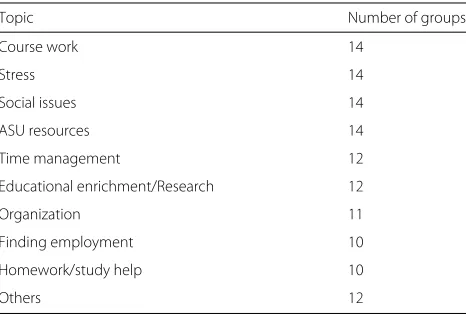
After each meeting, both mentors and mentees used an online reporting form to report on the meeting. This form includes a checklist list of topics; these are shown in Table 3. Students could also write in their own additions in the free-response portion of the form. Figure 1 displays the frequency with which each topic from the checklist was selected.
Mentees used the mentoring relationships for a vari-ety of types of academic support, including course work, educational enrichment, time management, organization, and study help. Most topics were discussed by nearly all groups at some point in the semester, though not all topics were discussed with the same frequency. Course work was the most frequently selected topic from the checklist, possibly because it was a salient aspect of stu-dents’ experiences. Time management and organization were present in about one third of meetings; studies of physics students in other contexts show that these are considerable areas of focus for student growth (Gandhi et al.; Dounas-Frazer and Reinholz 2015). Students also used the relationships for psychosocial support, including discussing social issues and stress, which were the most frequently discussed topics after course work.
Table 3 shows the number of groups that discussed each topic. While most of the topics were discussed by nearly all of the groups, some topics, such asstudying together
Table 3List of topics and how many groups they were discussed by
Topic Number of groups
Course work 14
Stress 14
Social issues 14
ASU resources 14
Time management 12
Educational enrichment/Research 12
Organization 11
Finding employment 10
Homework/study help 10
Others 12
and finding employment varied widely from group to group. For example, mentoring group 2 discussed finding employment during 45 % of their meetings, more often than any other group. Four groups did not discuss finding employment once.
Similarly, mentoring group 11 reported studying together in 58 % of their reports, and four groups did not study together at all. Though mentors and mentees were explicitly instructed that this was not a personal tutor-ing service, 10 of 14 groups reported studytutor-ing together. Though mentoring groups utilized some of their time for direct academic support, it is clear from the frequency analysis (Fig. 1) that more often, groups discussed how to make the best of ASU resources, such as tutoring. Making use of academic support services has been highly correlated with student success (Kuh et al. 2008).
Concerns reported
The online form also allowed for mentors and mentees to report concerns they had. The concerns part of the form consisted of a checkbox and free-response text box. Over the semester, there were a total of 28 concerns reported. Table 4 shows a categorization of the nature of the concerns. These concerns were both academic (e.g., academics, choice of major) and psychosocial (e.g., difficulty communicating, managing the mentor/mentee relationship). The 10 “other” responses were idiosyncratic (e.g., unwanted romantic gestures) and thus were com-bined into a single category. Many of these concerns are related to issues faced by traditionally underrepresented students, such as first-generation college students:
“She mentioned that she was the first person in her family to go to college so I want to make sure she has the right resources and people to help guide her through the difficulties of school.” – Mentor 10
and women,
“Mentee 10 was upset. . . She felt like the guys were flirting with her and generally making her feel uncomfortable. Instead of treating her as a fellow peer in science, she felt like they were treating her as an object to date.” –Mentor 10
As such, the mentoring relationships created a space for students to deal with issues that are typically ignored by a traditional academic structure.
The nature of the mentor-mentee relationships
Satisfaction and ease of meeting
0% 10% 20% 30% 40% 50% 60% 70% 80% coursework
social issues stress ASU resources educational enrichment time management organization other finding employment study help
Fig. 1Mentoring topics. Percent of mentoring reports for which each topic was selected (from a checklist) as a topic for the meeting. Students could report on more than one topic
of 30 min. Students also noted ongoing communication that was not formally reported as a meeting. For instance:
“[W]e see [each other] at SPS [Society of Physics Students room] several times a week. As a
mentor-mentee pair, we probably spend the most time together.” –Mentor 11
and
“[W]e text and talk all the time.” –Mentor 7
In only 9 of 151 reports did students report difficul-ties in coordinating meetings. When students reported difficulty, it was generally because they felt that they were busy and struggled to fit meeting in their schedules.
Students reported being satisfied with their relation-ships 98.7 % of the time. One of the rare instances in which students reported problems was the first meeting for one of the mentor groups, in which there was a mismatch between a mentor and mentee. After that initial meet-ing, the situation was remedied (by finding a new mentor for the student), and the new relationship worked well.
Table 4Concerns that students reported on
Category Number of concerns
Academics 7
Difficulty communicating 4
Choice of major 4
Managing mentor/mentee relationship 3
Others 10
Students’ qualitative descriptions of their relationships were very positive. For instance:
“Mentor 3 has been very helpful with so many things. She is great to talk to about research, social stuff, homework, and classes in general. Mentor 3 is a great listener, and the conversation is always fun and balanced. I love having her as my mentor!” –Mentee 3
Similarly,
“Mentor 11 is wise, sincere, and down-to-earth. His advice in course selection is very helpful, and as we seem to share common interest, conversations with him are very enjoyable. He listens to me carefully, and gives me the feedback I need.” –Mentee 11
These quotes indicate that students were able to see their mentors as positive, relatable advisors. While these quotes are from only two groups, we note that similar positive statements were made inallof the 14 mentoring groups.
Individualizing relationships and budding friendships There was evidence that mentors and mentees formed a favorable rapport with one another. A total of 39 reports were coded as commenting on a positive rapport with their partner. In many reports, this was made explicit, such as:
“We can talk freely about our lives without any judgments and support each other.” –Mentee 1
and
and
“There is a lot of laughter” –Mentor 13
These quotes show that students really did build positive friendships with one another. Relatedly, students reported on engaging in a number of activities not related to aca-demics. In 23 (out of 151) reports (24 % of meetings), men-tors or mentees reported in engaging in non-academic activities such as playing tennis, chess, dancing, working out at the gym, cooking, playing video games, and vol-unteering. In addition, meeting over food and drink was mentioned in 29.5 % of meetings. Students reported meet-ing on campus 30 times, off campus 25 times, and for the other 40 meetings, locations were not specified. Exactly how these activities contributed to the relationships can-not be determined with the current set of data; however, it is evident that the mentor-mentee groups customized their interactions to their interests:
“[W]e baked a cake! A very pink chocolate cake. . . She is currently covered in raspberry puree, the fruit of her labor. The cake while delicious I’m sure it kinda looks like Hagrid, you know the half giant in Harry Potter, sat on it. She is enjoying her college experience and thriving.” –Mentor 13.
and
“We went out to Lake Canyon to have lunch and admire the beauty of nature.” –Mentor 12.
Although there were three reports from early in the semester (approximately the first two reports) that men-tioned apprehension or awkwardness, most were gener-ally comfortable with their partners.
Academic support
The mentoring relationships provided academic support for the mentees along a number of categories. We elabo-rate four of these which were particularly salient. The first two categories (1) studying together and (2) discussion of science relate to subject-matter support, while the last two categories (3) educational enrichment and research and (4) choice of major focus on goals setting and career mentoring (Nora and Crisp 2007).
Studying together
As mentioned in the previous section, 10 of 14 groups studied together. Reports on these activities indicate that these meetings also had psychosocial elements. For instance,
“Mentor 3 is always very helpful and is a great listener. She is sympathetic and has a lot of good pointers for homework. She helped me a bit with my [...] essay and physics lab report.” –Mentee 3
Hence, even when groups were engaged in academic discussions, psychosocial support was often also present.
Discussing science
Mentor-mentee groups also used the relationships as an opportunity to discuss their mutual interests in science:
“We met up at the [astronomy theater] for the Exploring the Unknown show. We talked after the show about what we thought and how interesting the topic of exo-planets is.” –Mentee 6
and
“Mentee 12 and I took a drive [...]. We spent time talking about geology and physics. Since the landscape [...] has very interesting rock formations and
composition, there were many interesting things for us to talk about using the landscape as a basis for
discussion.” –Mentor 12
We categorize these conversations as academic support since they connect to the subject matter of the mentees’ majors. Nevertheless, they still showed aspects of building supportive social relationships.
Discussing educational enrichment
The peer mentors in this study discussed opportuni-ties with their mentees that could directly advance the mentees’ careers, such as participating in research, attend-ing conferences, and completattend-ing internships:
“We looked at some programming stuff and talked about the women’s physics conference.” –Mentee 1
and
“We grabbed some coffee together and sat down to talk about my experience with physics as an undergraduate and Mentee 12’s interest in doing graduate research [...]. We also discussed how to get exposed to research as an undergraduate, including how to explore the research being done by professors and how to get into contact with them.” –Mentor 12
These quotes show some examples of mentors sharing knowledge about career-relevant skills and networking. Twelve of the 14 groups discussed such matters.
Choice of major
Choice of major as a topic of discussion was reported on for two groups. In one case, a student considered adding a second major:
think I’m probably just reading into things too much.” –Mentor 4
In this case, mentee 4 added a finance major, and con-tinued in physics as well, at least for the duration of the study. The other pair that reported on discussing choice of majors was mentor and mentee 5:
“My mentee ... is on track to do well with history, but there is little that I can help him with school wise. I think the winter break will be good for him.”
In this case, mentee 5 did end up leaving the physics major.
Different reports on the same meetings: mentor and mentee role perception
Given that mentors and mentees were tasked with report-ing on each meetreport-ing, a comparison of these reports illu-minates the roles of each in the relationship. Because each report that was coded was associated with a spe-cific mentor or mentee, it is possible to disaggregate the previous analysis by mentors and mentees as subgroups. As an example, on the topic of ease of arranging meet-ings, the mentor and mentee reports were similar, but on other issues, the reports are not so congruent. There were only two instances of not being satisfied reported, both of which were reported by mentees (one was the mismatched pair described above and one was a scheduling difficulty).
Mentors submitted more reports (N = 86) than
mentees (N = 65). Mentors reported a total of 24
concerns, while mentees only reported four. In contrast, mentees more frequently commented on their positive rapport, which occurred a total of 25 times and only 14 times for the mentors. The concerns reported by mentors included mentee’s academic progress, interest in major, and concerns about transitioning to college. On the other hand, mentees more often reported concerns having to do with meeting the requirements of the mentoring pro-gram, such as finding mutually acceptable times to meet. This highlights the differences in roles between the two parties and how they perceived the relationships. Mentees perceive their role as participants, and when filling out the reports, are in the mindset of fulfilling the require-ments. On the other hand, while mentors are filling out the reports, they are engaged with the other student’s struggles.
These roles are also manifest in other areas of the submitted reports, such as the list of topics discussed. To analyze the degree to which mentors and mentees reported discussing different topics, we calculated the dif-ference between mentors and mentees in their frequency of reporting on each of the nine categories (cf. Fig. 1). The mean differences ranged from 0.18 for mentoring group 8 to 0.48 for mentoring group 4. Over all groups,
the average of these differences was 0.27. This difference of 0.27 was statistically significant atp < 0.05, using a pairedttest.
While these discrepancies could arise from either an imbalanced view of what transpired during the meetings or variable reporting, responses to questions 1–5 (Table 2) provided insight. For instance, a closer look at mentoring group 4 reveals that the large difference in frequency of reported topics is due to the mentor reporting on multiple topics of discussion far more often than the mentee. Fur-thermore, the mentor’s free-response answers are much more in depth, with an average word count of 92. In con-trast, mentee 4’s reports contained an average of 54 words. Mentee 4 reported that mentor 4 was “good” or “very good” in each report (as part of the free-response ques-tion “how is your mentor doing?”)—indicating satisfac-tion with mentor 4’s performance. Furthermore, mentee 4 wrote:
“He is a very good listener. He cares about how I am doing.”
Hence, the large discrepancy may be due to difference in reporting and recall; for instance, this mentee was recall-ing and reportrecall-ing on the meetrecall-ing as berecall-ing a space that they were listened to and cared about, while the mentor recalled and reported on details about problems they were helping to solve.
Student outcomes
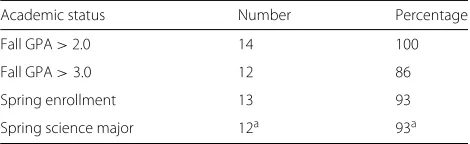
While the sample size of this study was small, overall, stu-dent outcomes were encouraging. While we do not have a matched set of students to compare to, we use popula-tion data to place our students’ outcomes in context. Over an average of 5 years prior to the program, the 1- to 2-year major persistence rate was 59 % for the majors served (i.e., only 59 % of physical science majors continued on in the same major starting their second year). However, most of the students who participated in the summer program had weaker high school preparation than the average stu-dent in these majors. For stustu-dents with high school GPA, SAT, and ACT scores comparable to the summer program students, the 1- to 2-year major persistence rate drops to only 33 %. Yet, in the population served by the men-toring program, fall-spring retention was 93 %; we will continue to track student retention over time. We present detailed outcomes in Table 5. Three of the students joined for the fall mentoring portion of the program and were not summer program participants; their academic prepa-ration is unknown. Since the program is relatively recent, graduation rates are not yet possible to determine.
Discussion and conclusions
Table 5Academic outcomes for mentees. Percentages out of 14 total students participating in the study
Academic status Number Percentage
Fall GPA>2.0 14 100
Fall GPA>3.0 12 86
Spring enrollment 13 93
Spring science major 12a 93a
aCalculated for students still enrolled at ASU (13)
advanced students in physics and related majors. As prior work has suggested, such mentoring relationships are most effective when they focus on holistic support (Cramer and Prentice-Dunn 2007; Nora and Crisp 2007). In our study, we found that relationships included both academic and psychosocial support elements. The theo-retical framework of identity and belonging suggests that such near-peer relationships support the development of positive science identities through social interactions (Potvin and Hazari 2013).
As more advanced peers, mentors both normalized and empathized with the experiences of their mentees, encouraging connection to a community of physical science students. The reports we analyzed showed that mentors provided support for issues common to aca-demic transitions for many majors (e.g., time man-agement) as well as concerns specific to women and underrepresented minorities in the physical sciences (e.g., one of the mentees feeling objectified by her male peers). Having positive role models and address-ing common challenges of underrepresented students both help support a sense of belonging (Lewis et al.: Fitting in or opting out: a review of key social-psychological factors influencing a sense of belonging for women in physics, unpublished). The students also built friendships, a key aspect of retention and success (Seymour and Hewitt 1997; Walton and Cohen 2007). There was clear evidence of budding friendships in stu-dent reports, the type of activities that were engaged in (e.g., baking a cake).
We note that though this is a near-peer program, with mentors and mentees are close in age, and friendly with each other, we see a clear distinction in how mentors and mentees view their roles. In this way, the mentor-mentee relationship diverges slightly from friendship. The mentees view their role as participants in the program and report upon the rapport they experience with their men-tor and their ability to meet the program requirements. The mentors are much more reflective about their rela-tionships and are in tune with the struggles facing their mentees.
Based upon our observations, we suggest that future mentoring programs include the following elements.
1. Give participants a choice in their pairing. Though this program utilized a formal structure, we find that a natural rapport developed between mentors and mentees. We believe this is due to mentors and mentees having the opportunity to meet a variety of potential matches at the beginning of the semester and indicate their preferences for pairings. 2. Make pairs accountable to each other and to the
program facilitators. In our program, we offered credit for mentors and mentees who successfully met the expectations. A code of behavior was discussed and signed by the participants at the beginning of the program.
3. Monitor relationships for concerns. The facilitator read the reports submitted by the mentors and mentees and proactively addressed concerns. For example, unsuitable pairs were rearranged.
4. Build programs in the context of a community. This program had an in-class component for group discussions, as well as building upon a community established during a summer bridge program. Other community-building elements included student-led social activities.
5. Enable informal, food-centric meetings. The frequency of informal meetings over food suggests that support for such activities might be a useful feature in future mentoring programs (for example, a debit card to on campus cafes given to mentors). Such resources would be particularly meaningful for mentors and mentees with fewer economic
resources. The presence of food at meetings changes the nature of interactions, making them more informal and social. In addition, students often have limited times in which they can meet and meal times are often the easiest for students to schedule.
Competing interests
The authors declare that they have no competing interests.
Authors’ contributions
AZ designed the data collection, collected the data, anonymized the data, conducted frequency analysis, coded the data, and facilitated the mentoring program. DR designed the coding scheme for the data, coded the data, and analyzed inter-rater reliability. Both authors contributed in the drafting of the manuscript and have read and approve the final manuscript.
Authors’ information
Anna Zaniewski is an associate instructional professional at Arizona State University. She completed a PhD in physics at the University of California Berkeley. Her interests include building inclusive science student communities and nanoscience research.
Daniel Reinholz is an assistant professor in the Department of Mathematics at San Diego State University. He completed his PhD in mathematics and science education at the University of California Berkeley. He uses a holistic design perspective, drawing on perspectives from disciplinary learning, equity, and organizational change.
Acknowledgements
The Sundial Project is funded by the College of Liberal Arts and Sciences, the Department of Physics, and the School of Earth and Space Exploration at Arizona State University. Daniel Reinholz is funded by the Association of American Universities and the Helmsley Charitable Trust through the AAU STEM Education Initiative. The authors thank Gina Quan, Dimitri Dounas-Frazer, and Joel Corbo for feedback on an early version of the manuscript, and Jeff Hyde, Brianna Thorpe, Veronica Meeks, and Jeff Lockridge for being student leaders in the mentoring program.
Author details
1Arizona State University, Tempe, AZ, USA.2Department of Mathematics, San
Diego State University, San Diego, USA.
Received: 27 October 2015 Accepted: 18 May 2016
References
Aguilar, L, Walton, G, Wieman, C (2014). Psychological insights for improved physics teaching.Physics Today,67(5), 43–49.
Albanna, BF, Corbo, JC, Dounas-Frazer, DR, Little, A, Zaniewski, AM (2013). Building classroom and organizational structure around positive cultural values.PERC Conference Proceedings,1513(1), 7–10. doi:10.1063/1.4789638. http://link.aip.org/link/?APC/1513/7/1.
Allen, TD, McManus, SE, Russell, JEA (1999). Newcomer socialization and stress: formal peer relationships as a source of support.Journal of Vocational
Behavior,54(3), 453–470.
Bernier, A, Larose, S, Soucy, N (2005). Academic mentoring in college: the interactive role of student’s and mentor’s interpersonal dispositions.
Research in Higher Education,46(1), 29–51. ISSN 0361–0365, 1573-188X.
doi:10.1007/s11162-004-6288-5. http://link.springer.com/article/10.1007/ s11162-004-6288-5.
BHEF (2013). The U.S. STEM undergraduate model: applying system dynamics to help meet President Obama’s goals for one million STEM graduates and the U.S. Navy’s civilian STEM workforce. Technical report, Business-Higher Education Forum.
Borg, A, Budil, K, Ducloy, M, McKenna, J (2005). Attracting girls into physics, In
AIP Conference Proceedings, volume 795, page 7. Rio de Janeiro, Brazil:
Institute of Physics Publishing.
Campbell, TA, & Campbell, DE (1997). Faculty/student mentor program: effects on academic performance and retention.Research in Higher Education, 38(6), 727–742.
Cohen, GL, Steele, CM, Ross, LD (1999). The mentor’s dilemma: providing critical feedback across the racial divide.Personality and Social Psychology
Bulletin,25(10), 1302–1318.
Cramer, RJ, & Prentice-Dunn, S (2007). Caring for the whole person: guidelines for advancing, undergraduate mentorship.College Student Journal,41(4), 771–778. ISSN 01463934.
Crisp, G, & Cruz, I (2009). Mentoring college students: a critical review of the literature between 1990 and 2007.Research in Higher Education,50(6), 525–545.
Dounas-Frazer, DR, & Reinholz, DL (2015). Attending to lifelong learning skills through guided reflection in a physics class.American Journal of Physics,83, 881–891.
Dounas-Frazer, DR, Lynn, J, Zaniewski, AM, Roth, N (2013). Learning about non-Newtonian fluids in a student-driven classroom.The Physics Teacher, 51(1), 32–34. doi:10.1119/1.4772035. http://link.aip.org/link/?PTE/51/32/1. Gandhi, PR, Livezey, JA, Zaniewski, AM, Reinholz, DL, Dounas-Frazer, DR.
Attending to experimental physics practices and lifelong learning skills in an introductory laboratory course. in press.
Gershenfeld, S (2014). A review of undergraduate mentoring programs.Review
of Educational Research,84(3), 365–391.
Grant, L, Ward, KB, Forshner, C (1992). Mentoring experiences of women and men in academic physics and astronomy, InProceedings of the Women in
Astronomy Meeting. Baltimore, MD: Space Telescope Science Group.
Harrell, PE, & Forney, WS (2003). Ready or not, here we come: retaining Hispanic and first-generation students in postsecondary education.
Community College Journal of Research & Practice,27(2), 147–156.
Hazari, Z, Sadler, PM, Sonnert, G (2013). The science identity of college students: exploring the intersection of gender, race, and ethnicity.Journal
of College Science Teaching,42(5), 82.
Inzlicht, M, Good, C, Levin, S, van Laar, C (2006). How environments can threaten academic performance, self-knowledge, and sense of belonging.
Stigma and group inequality: Social psychological perspectives, 129–150.
Jacobi, MM (1991). Mentoring and undergraduate academic success: a literature review.Review of Educational Research,61(4), 505–532. ISSN 00346543. http://www.jstor.org/stable/1170575.
Kim, YK, & Sax, LJ (2009). Student–faculty interaction in research universities: differences by student gender, race, social class, and first-generation status.Research in Higher Education,50(5), 437–459.
Komarraju, M, Musulkin, S, Bhattacharya, G (2010). Role of student–faculty interactions in developing college students’ academic self-concept, motivation, and achievement.Journal of College Student Development, 51(3), 332–342.
Kuh, GD, Cruce, TM, Shoup, R, Kinzie, J, Gonyea, RM (2008). Unmasking the effects of student engagement on first-year college grades and persistence.The Journal of Higher Education,79(5), 540–563.
Mangold, WD, Bean, LG, Adams, DJ, Schwab, WA, Lynch, SM (2002). Who goes who stays: an assessment of the effect of a freshman mentoring and unit registration program on college persistence.Journal of College Student
Retention: Research, Theory and Practice,4(2), 95–122.
McCormick, M, Barthelemy, RS, Henderson, C (2014). Women’s persistence into graduate astronomy programs: the roles of support, interest, and capital.
Journal of Women and Minorities in Science and Engineering,20(4), 317–340.
ISSN 1072-8325.
NA2 (2010). Expanding underrepresented minority participation: America’s science and technology talent at the crossroads. Technical report, National Academy of Sciences, National Academy of Engineering, Institute of Medicine.
Nora, A, & Crisp, G (2007). Mentoring students: conceptualizing and validating the multi-dimensions of a support system.Journal of College Student
Retention: Research, Theory and Practice,9(3), 337–356. ISSN 1521-0251,
1541-4167. doi:10.2190/CS.9.3.e. http://csr.sagepub.com/content/9/3/337. abstract.
Potvin, G, & Hazari, Z (2013). The development and measurement of identity across the physical sciences, InProceedings of the Physics Education
Research Conference (PERC). Portland, OR.
Seymour, E, & Hewitt, NM (1997).Talking about Leaving: Why Undergraduates
Leave the Sciences: Westview Press, Boulder,Co. ISBN 9780813389264.
Sinclair, S, Carlsson, R, Björklund, F (2014). The role of friends in career compromise: same-gender friendship intensifies gender differences in educational choice.Journal of Vocational Behavior,84(2), 109–118. Stout, JG, Ito, TA, Finkelstein, ND, Pollock, SJ (2013). How a gender gap in
belonging contributes to the gender gap in physics participation, InAIP
Conference Proceedings, volume 1513, pages 402–405. Philadelphia, PA:
Institute of Physics Publishing.
personal and professional gains for stem undergraduates.The Journal of
Higher Education,82(4), 357–388.
Tsui, L (2007). Effective strategies to increase diversity in STEM fieldsa review of the research literature.The Journal of Negro Education,76(4), 555–581. ISSN 0022-2984. http://www.jstor.org/stable/40037228.
Walton, GM, & Cohen, GL (2007). A question of belonging: race, social fit, and achievement.Journal of personality and social psychology,92(1), 82. Ward, EG, Thomas, EE, Disch, WB (2012). Protégé growth themes emergent in a
holistic, undergraduate peer-mentoring experience.Mentoring & Tutoring:
Partnership in Learning,20(3), 409–425.
Whitten, BL, Foster, SR, Duncombe, ML, Allen, PE, Heron, P, McCullough, L, Shaw, KA, Taylor, BAP, Zorn, HM (2003). What works? Increasing the participation of women in undergraduate physics.Journal of Women and
Minorities in Science and Engineering,9(3–4), 30–50.
Wilcox, P, Winn, S, Fyvie-Gauld, M (2005). ‘It was nothing to do with the university, it was just the people’: the role of social support in the first-year experience of higher education.Studies in higher education,30(6), 707–722.
Submit your manuscript to a
journal and benefi t from:
7Convenient online submission
7Rigorous peer review
7Immediate publication on acceptance
7Open access: articles freely available online
7High visibility within the fi eld
7Retaining the copyright to your article