Volume 2008, Article ID 524793,8pages doi:10.1155/2008/524793
Research Article
Improved Motion Estimation Using Early
Zero-Block Detection
Y. M. Lee, Y. J. Tsai, and Y. Lin
Department of Communication Engineering, National Central University, Chungli 32054, Taiwan
Correspondence should be addressed to Y. M. Lee,[email protected]
Received 23 December 2007; Revised 13 May 2008; Accepted 24 June 2008
Recommended by Jian Zhang
We incorporate the early zero-block detection technique into the UMHexagonS algorithm, which has already been adopted in H.264/AVC JM reference software, to speed up the motion estimation process. A nearly sufficient condition is derived for early zero-block detection. Although the conventional early zero-block detection method can achieve significant improvement in computation reduction, the PSNR loss, to whatever extent, is not negligible especially for high quantization parameter (QP) or low bit-rate coding. This paper modifies the UMHexagonS algorithm with the early zero-block detection technique to improve its coding performance. The experimental results reveal that the improved UMHexagonS algorithm greatly reduces computation while maintaining very high coding efficiency.
Copyright © 2008 Y. M. Lee et al. This is an open access article distributed under the Creative Commons Attribution License, which permits unrestricted use, distribution, and reproduction in any medium, provided the original work is properly cited.
1. INTRODUCTION
The newest international video coding standard H.264/AVC has recently been approved by the ITU-T (as recommenda-tion H.264) and by ISO/IEC as the internarecommenda-tional standard MPEG-4 part 10 advanced video coding (AVC) standard [1]. The emerging H.264/AVC achieves significantly better performance in both PSNR and visual quality at the same bit-rate compared with prior video coding standards such as MPEG4 part 2 and H.263. One important technique is the use of the variable block-size motion estimation and rate distortion optimization techniques; the computational complexity of H.264/AVC is dramatically increased due to the variable block-size modes performed.
Many fast and efficient methods for motion estima-tion (ME) have been proposed in recent years to reduce computational cost and maintain coding performance. In general, there are two ways to reduce computation. One is to speed up the ME algorithms themselves, such as the hybrid unsymmetrical-cross multihexagon-grid search (UMHexagonS) algorithm [2], which has been adopted in JM reference software. The other is to terminate the ME calculation by early detection of the zero-blocks (ZBs) of dis-crete cosine transform (DCT) coefficients after quantization.
Xie et al. [3] established a zero-block condition based on the following criterion:
X(0, 0)≤Qstep,
N−1
i=0 N−1
j=0
x2(i,j)−X2(0, 0)≤N2
12 ×
Qstep
2
, (1)
where X(0, 0) = (1/N)iN=−01Nj=−01x(i,j), and x(i,j) is residual samples between the current macroblock and the reference macroblock. For H.264, the relation betweenQstep
and quantization parameter is Qstep = 0.625·2QP/6. This
criterion has been employed in the JM reference software. In [4,5], the early zero-block detection approach was applied to the motion search process using a threshold of 20Qstep
for comparison with the sum of difference of 8×8 block size (SAD8×8) and deciding whether 8×8 DCT is a
zero-block. The motion search stops when all zero-blocks are detected. This results in significant computational savings, especially for low bit-rate coding. The threshold of 20Qstep
(corresponding to 5Qstepin 4×4 discrete cosine transform
Some sufficient but not necessary conditions for zero-block detection of DCT coefficients after quantization were derived by examining the sum of absolute differences (SADs) between the current macroblock and the reference mac-roblock [6,7]. Although the zero-blocks of DCT coefficients can be detected correctly, numerous zero-blocks still remain undetected. Based on Moon’s method [7], a technique using an adaptive threshold was suggested to enhance zero-block detecting capability [8].
In this work, we derive a nearly sufficient condition based on the ensemble average of all 4×4 DCT coefficients. The nearly sufficient condition for zero-block detection is then applied to both motion search and DCT/Q calculation in the UMHexagonS algorithm. The experimental results reveal that a significant improvement in computation reduction can be achieved compared to methods using the other two sufficient conditions, while high coding efficiency is still maintained.
2. A NEARLY SUFFICIENT CONDITION FOR
ZERO-BLOCK DETECTION
To guarantee integer transform, the 4×4 DCT in H.264/AVC is approximated to the following form:
Y =CXCT⊗PF
= ⎡ ⎢ ⎢ ⎢ ⎣
1 1 1 1
2 1 −1 −2 1 −1 −1 1 1 −2 2 −1
⎤ ⎥ ⎥ ⎥ ⎦·[X]·
⎡ ⎢ ⎢ ⎢ ⎣
1 2 1 1
1 1 −1 −2 1 −1 −1 2 1 −2 1 −1
⎤ ⎥ ⎥ ⎥ ⎦ ⊗ ⎡ ⎢ ⎢ ⎢ ⎣
a2 ab/2 a2 ab/2
ab/2 b2/4 ab/2 b2/4
a2 ab/2 a2 ab/2
ab/2 b2/4 ab/2 b2/4
⎤ ⎥ ⎥ ⎥ ⎦, (2)
where a = 1/2,b = √2/5, and c = 1/2. The basic quantization operation is given by
Zi j=round Y
i j
Qstep
. (3)
The value of quantization parameter (QP) varies in the range 0–51. The quantizer step sizeQstepis used to control bit-rate
and video quality. With postscaling factor (PF) considered with the quantizer, the quantized outputZi j can be written as
Zi j=round
Wi j· PF
Qstep
, (4)
whereWi jis the entry of the core 2D transformW=CXCT. To avoid any division operation, the factor (PF/Qstep) is
implemented by a multiplication factor and a right shift:
Zi j=round
Wi j·M
(QP%6;r) 2qbit
,
PF
Qstep =
M(QP%6;r) 2qbit
(5)
with
M(QP%6;r)= ⎡ ⎢ ⎢ ⎢ ⎢ ⎢ ⎢ ⎢ ⎣
5243 8066 13107 4660 7490 11916 4197 6554 10082 3647 5825 9362 3355 5243 8192 2893 4559 7282 ⎤ ⎥ ⎥ ⎥ ⎥ ⎥ ⎥ ⎥ ⎦
, r=0, 1, 2,
qbit=15 +
QP 6 , (6)
where r = 2−(i%2)−(j%2), % denotes the modular operator, andM(QP%6;r) is the multiplication factor. The quantized coefficient can be implemented using integer arithmetic:
Zi j=
Wi j·M(QP%6;r) + f
qbits, (7)
whererepresents a binary shift right, andf is 2qbit/6 for
interblocks or 2qbit/3 for intrablocks.
Sousa [6] derived a simple sufficient condition under which each quantized coefficient becomes zero for 8×8 DCT. To derive the sufficient condition for 4×4 DCT, the PF factor is absorbed back into the core 2D transform and 4×4 DCTcoefficients are rewrittenY:
Y =CXCT⊗PF=DXDT
= ⎡ ⎢ ⎢ ⎢ ⎣
a a a a
b c −c −b
a −a −a a
c −b b −c
⎤ ⎥ ⎥ ⎥ ⎦·[X]·
⎡ ⎢ ⎢ ⎢ ⎣
a b a c
a c −a −b
a −c −a b
a −b a −c
⎤ ⎥ ⎥ ⎥ ⎦, (8)
wherea = 1/2,b = √2/5, andc =(1/2)√2/5. Each coeff -icientYi jcan be written as
Yi j= 3
l=0 3
k=0
dilxlkdk j, i,j=0, 1, 2, 3, (9)
|Yi j| ≤ 3
l=0 3
k=0
|xlk| · |dildk j| ≤dmax· 3
l=0 3
k=0
|xlk| = 2 5SAD4×4
(10)
for all DCT coefficients. For interblock encoding, the DCT coefficient is quantized as zero when the quantized coefficientZi jsatisfies|Zi j|<1, that is,
Zi j=|Yi j|
Qstep
+1
6 <1. (11)
From (10) and (11), it is easy to show that the 4×4 DCT is a zero-block if the sum of absolute differences SAD4×4satisfies
SAD4×4<
25
12Qstep. (12)
4×4 transform and quantization in H.264/AVC, which is summarized as follows:
(1) if SAD4×4≤T0, then 4×4 DCT is a zero-block, and
where
T(0)=
5/6·215+QP/6
4·M(QP%6; 0); (13)
(2) if SAD4×4 > T0 and SAD4×4 ≤ min{T0+γ/2,T1},
then 4 × 4 DCT is also a zero-block where the parametersT(1) andγare, respectively, given by
T(1)=
5/6·215+QP/6
2·M(QP%6; 1),
γ=min
3
j=0
x0j+x3j
,
3
j=0
x1j+x2j
.
(14)
Interestingly, note that T(0) is exactly identical to Sousa’s condition. As can be seen, the condition varies withxi j. An intensive study indicates that this sufficient condition varies within a range 2.2Qstep∼2.5Qstep, which is a little higher than
the Sousa’s condition (2.08Qstep).
2.1. A nearly sufficient condition based on ensemble average of DCT coefficients
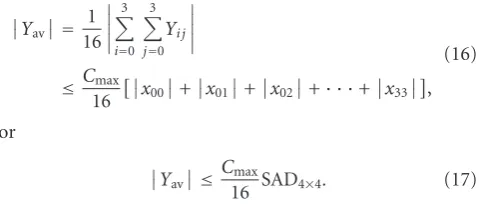
In this section, a nearly sufficient condition is derived based upon the ensemble average of all 4×4 DCT coefficients by summing up all 4×4 DCT coefficientsYi j. The summation over all DCT coefficients can be written as
3
i=0 3
j=0
Yi j=C00·x00+C01·x01+C02·x02+· · ·+C33·x33
= 3
i=0 3
j=0
Ci jxi j.
(15)
DefineCmax =max{|C00|,|C01|,. . .,|C33|}, and the
ensem-ble average|Yav|can be upper-bounded as follows:
Yav= 1 16
3
i=0 3
j=0
Yi j
≤Cmax
16 x00+x01+x02+· · ·+x33, (16)
or
Yav≤ Cmax
16 SAD4×4. (17) After some manipulation, Cmax was found to be 3.7975.
Instead, using|Yi j|, if the ensemble average of DCT coeffi -cients|Yav|is applied to (11), the following upper bound for
zero-block detection can be obtained:
SAD4×4<3.5Qstep. (18)
0 200 400 600 800 1000 1200
Thr
eshold
10 13 16 19 22 25 28 31 34 37 40 43 46 49 52
QP
Sousa Moon
3.5Qstep 5Qstep
Figure1: Thresholds versus QP.
Table1: Encoding time saving and PSNR loss in DCT/Q. News Time Saving (%) (ΔPSNR, dB)
QP Sousa Moon 3.5Qstep 5Qstep 20 −0.16% −0.35% −0.64%(−0.001) −0.78%(−0.145) 24 −0.56% −0.84% −1.09%(0.001) −1.10%(−0.139) 28 −0.84% −1.11% −1.38%(−0.010) −1.32%(−0.138) 32 −1.19% −1.47% −1.78%(0.001) −1.73%(−0.102) 36 −1.36% −1.64% −1.70%(0.002) −1.89%(−0.069) 40 −1.61% −1.83% −1.95%(0.006) −2.16%(−0.063) 44 −1.81% −2.04% −2.36%(−0.026) −2.87%(−0.046) 48 −2.09% −2.29% −3.06%(−0.005) −4.06%(−0.024)
Although the ensemble average condition is not sufficient and it might detect a zero-block incorrectly, the experiment indicates that only a very small portion of DCT coefficients is incorrectly detected as a zero-block. However, compared to both Sousa’s and Moon’s conditions, more zero-blocks can be detected correctly using the derived condition.
2.2. Zero-block detection capability and computation reduction in DCT/Quantization
The various thresholds for zero-block detection as a function of QP are plotted inFigure 1. Note that both Sousa’s and Moon’s conditions are theoretically sufficient, but not for the thresholds 3.5Qstepand 5Qstep. The zero-block detecting
capability of all various thresholds carried on the news
andparissequences are plotted inFigure 2. Although both Sousa’s and Moon’s conditions are theoretically sufficient, fewer zero-blocks can be detected using these two sufficient conditions compared to the other two conditions. The threshold 5Qstep brings out the best zero-block detecting
0 10 20 30 40 50 60 70 80 90 100
ZB
(%)
14 18 22 26 30 34 38 42 46 50
QP
Sousa Moon
3.5Qstep 5Qstep (a) News
0 10 20 30 40 50 60 70 80 90 100
ZB
(%)
14 18 22 26 30 34 38 42 46 50
QP
Sousa Moon
3.5Qstep 5Qstep (b) Paris
Figure2: Zero-block detecting capability.
3.5Qstep, while more than 9% for the threshold 5Qstep for
QP=16.
To evaluate the performance of previously mentioned conditions for early zero-block detection, an experiment was performed in DCT/Qcalculation. Table 1 displays the savings of total encoding time in DCT/Qas well as PSNR loss, conducted on thenewssequence, for differentQPs. The integer transform and quantization only occupies about 5% of the total encoding time. Note that no loss in either PSNR or bit-rate were found for Sousa’s and Moon’s conditions. As shown, the threshold 3.5Qstep can achieve a significant
reduction in DCT/Qcomputation with a negligible PSNR loss. Up to 3% of total encoding time can be saved with PSNR loss of only 0.005 dB for QP = 48. The threshold 5Qstep[4], however, runs into a severe PSNR degradation due
to improper zero-block detection, although computation in DCT/Qcan be further reduced. Consequently, the threshold 5Qstepis not subsequently analyzed.
3. CONVENTIONAL METHODS TO
ADOPT ZERO-BLOCK DETECTION IN UMHEXAGON ALGORITHM
In the H.264/AVC, interframe motion estimation is per-formed for 7 different block sizes (denoted as modes), varying among 16×16, 16×8, 8×16, 8×8, 8×4, 4×8, and 4×4. The motion estimation involves finding a macroblock in a previously encoded reference frame that best matches the current macroblock using SADs between current and reference area samples:
SADM×N = M−1
i=0 N−1
j=0
C(i,j)−R(i,j)
= M/4−1
i=0 N/4−1
j=0
3
l=0 3
k=0
xi jlk
= M/4−1
i=0 N/4−1
j=0
SADi j4×4, M,N=4, 8 or 16.
(19)
Table2: Simulation conditions. Code version JM86
Profile Baseline
RDOptimization on Entropy coding CAVLC Encoding frames 21 Reference frames 5
Frame rate 30
Block type all
Search range ±16
Resolution 1/4
GOP structure IPPP. . .
Table 3: Average search points per frame achieved by various thresholds.
QP UMH. U.+Sousa U.+Moon U.+3.5Qstep
20 10.28 10.25 10.15 9.01
24 10.38 10.08 9.76 8.39
28 10.59 9.85 9.51 7.75
32 11.23 10.11 9.75 7.18
36 12.32 10.68 10.06 6.42
40 12.86 10.66 9.49 5
44 13.23 10.05 8.38 3.67
48 14.09 9.11 7.26 3.04
In the early termination method of motion estimation, each SADi j4×4 in SADM×N is compared with a threshold; and if all SADi j4×4 satisfy sufficient or nearly sufficient
conditions, the motion search stops. In addition, the DCT/Q
calculation need not be done if the 4×4 DCT is a zero-block. This leads to a great reduction in computation. Since the conventional early zero-block detection method only requires a comparison of SADi j4×4 with a threshold, this
0 2 4 6 8 10 12
ZB
er
ro
r
d
et
ection
(%)
14 18 22 26 30 34 38 42 46 50
QP
3.5Qstep 5Qstep
(a) News
0 1 2 3 4 5 6 7 8 9 10
ZB
er
ro
r
d
et
ection
(%)
14 18 22 26 30 34 38 42 46 50
QP
3.5Qstep 5Qstep
(b) Paris
Figure3: Percentage of improper zero-block detected.
0 2000 4000 6000 8000 10000 12000 14000 16000
SAD
20 10
0
−10
−20
ydirection
−20 −10
0 10 20
xdirection
(a)
600 800 1000 1200 1400 1600 1800 2000
SAD
0 10 20 30 40 50 60 70 80 90 100 110 Search point (th)
(b)
Figure4: Foreman (42nd MB,10th frame) (a) SAD error surface (b) search iteration using UMHexagonS algorithm.
as full search and all other fast search algorithms. This has been investigated in [4,5].
In this section, we apply the various zero-block detection methods to the UMHexagonS algorithm and investigate the performance. The simulation conditions are tabulated in Table 2. Table 3 displays the average search points per block for different QPs conducted on the news sequence achieved using various zero-block detection thresholds. As shown, the average search points decrease with increasing threshold. For the news sequence and QP = 48, up to 78% of average search points (14.09 reduced to 3.04) in the motion estimation can be saved when utilizing the zero-block detection approach using threshold 3.5Qstep : much
higher than the other two sufficient conditions (9.11 and 7.26, resp.). The average PSNR loss, bit-rate increment, and motion estimation time saving versus QP are also compared using various thresholds and tabulated inTable 4. As shown, the early zero-block detection using a nearly sufficient condi-tion (i.e., with threshold 3.5Qstep) significantly outperforms
other thresholds in terms of computation for any bit-rate
coding. As high as 56% of motion estimation time can be saved for QP=48 compared to the UMHexagonS algorithm. The PSNR degradation, to whatever extent it occurs, becomes strict for low bit-rate coding or high QP. Table 5 displays PSNR loss conducted on several video sequences for QP = 48. As shown, the conventional zero-block detection runs into a PSNR loss of 0.212 dB on theforeman
sequence. This phenomenon is illustrated inFigure 4, which demonstrates the SAD error surface and the corresponding search iterations using the UMHexagonS algorithm in mode 16 ×16 for a macroblock (42nd MB, 10th frame) in the
foreman sequence. As shown, it requires 110 search points for the UMHexagonS algorithm to find the minimum error (SAD16×16 = 864 at the 26th iteration). The search stops
at the 26th iteration and the minimum error can also be found when the conventional zero-block detection method is employed to the UMHexagonS algorithm with QP = 30 (threshold 3.5Qstep = 70). However, the search stops at the
first iteration where SAD16×16 =1210 as QP is increased to
Initial search point
Cross search
Multi-hexagon-grid search
All SADi j4×4≤3.5·Qstep Yes
No
End of multi-hexagon-grid search
No
Yes Extended hexagon search
All SADi j4×4≤3.5·Qstep No
Yes Extended diamond search
Stop
Figure5: Early zero-block detection for motion search and DCT/Q.
and this leads to severe performance degradation. As the quantization parameter increases, the degradation becomes harsher.
4. IMPROVED UMHEXAGONS ALGORITHM
The conventional early zero-block detection technique can-not give a satisfactory coding performance when applied to the UMHexagonS algorithm for large quantization step sizes. In this section, we modify the UMHexagonS algorithm using the early zero-block detection technique to achieve high coding efficiency. Many commonly used video sequences (4 QCIF sequences: foreman, carphone, football, coastguard
and 4 CIF sequences: stefan, mobile, paris, tempete) with different motion contents are simulated by exploiting full search algorithms on these video sequences with a search range w = ±16. The experimental results indicate that a large number of global minimum are occupied near the search center especially at the zero MV (0,0) (average 38%),
Table4: Performance comparison on news sequence. (a) PSNR loss (dB)
QP UMH. U.+Sousa U.+Moon U.+3.5Qstep 20 43.240 0.000 −0.002 0.004 24 40.786 0.001 −0.001 −0.004 28 38.229 −0.003 −0.002 −0.008 32 35.528 −0.005 −0.009 −0.023 36 32.882 0.002 −0.002 −0.008 40 30.247 0.000 −0.016 −0.046 44 27.596 0.014 −0.017 −0.057 48 25.141 0.000 −0.025 −0.096
(b) Bit-rate (%)
QP UMH. U.+Sousa U.+Moon U.+3.5Qstep 20 619528 0.04% 0.01% −0.04% 24 375248 0.10% 0.14% 0.29% 28 232072 0.10% −0.02% 0.05% 32 146304 0.06% −0.07% −0.42% 36 92264 −0.29% 0.19% 0.19% 40 58792 −0.38% −0.39% 0.24% 44 36840 0.46% 0.62% 0.46% 48 22688 0.92% −0.49% 0.56%
(c) ME time (%)
QP UMH. U.+Sousa U.+Moon U.+3.5Qstep 20 145357 −2.52% −3.14% −13.13% 24 142223 −4.41% −8.75% −21.10% 28 141105 −9.83% −13.71% −27.84% 32 142706 −16.28% −19.82% −35.21% 36 139912 −19.19% −23.62% −39.93% 40 136736 −21.18% −26.33% −45.74% 44 133039 −25.82% −31.72% −49.50% 48 129425 −32.14% −38.22% −56.62%
Table5: PSNR loss using nearly sufficient condition for QP=48. Sequence UMH.(dB) UMH. + 3.5Qstep(dB)
Mobile 20.164 −0.057
Paris 21.777 −0.06
News 25.141 −0.096
Foreman 23.068 −0.212
Carphone 24.115 −0.129
Claire 27.134 −0.104
Table6: PSNR loss, bit-rate and ME time saving.
PSNR (ΔdB) Bit rate (Δ%) Time (Δ%)
Sequence QP UMH. Proposed UMH. Proposed UMH. Proposed
Mobile
24 35.577 −0.004 2972640 −0.01% 105142 −0.97%
36 28.051 0.001 410304 0.10% 102171 −7.69%
48 20.164 −0.020 91088 −0.38% 104937 −33.95%
Paris
24 38.507 0.001 980656 −0.09% 71549 −3.65%
36 29.662 −0.009 210880 0.13% 73119 −18.76%
48 21.777 −0.035 41760 0.00% 71174 −43.46%
News
24 40.786 0.005 375248 0.29% 64892 −16.09%
36 32.882 0.002 92264 0.05% 62842 −35.75%
48 25.141 −0.038 22688 0.38% 57940 −52.52%
Foreman
24 38.514 −0.011 211368 −0.31% 22155 −1.79%
36 30.795 −0.013 38560 −1.51% 21732 −20.69%
48 23.068 −0.084 13368 −1.17% 19830 −54.61%
Carphone
24 40.072 −0.008 199816 0.05% 20701 −7.19%
36 31.892 0.005 38376 −0.13% 19247 −27.25%
48 24.115 −0.038 9112 −0.09% 16112 −54.99%
Claire
24 42.565 −0.035 69264 −0.29% 14952 −21.39%
36 34.724 0.001 15864 −1.36% 14042 −37.47%
48 27.134 −0.062 5872 −0.77% 12764 −54.36%
Step 1. Predict the initial search point.
Step 2. Perform unsymmetrical-cross search.
Step 3. Perform uneven multi-hexagon-grid search. If all SADi j4×4 satisfy the nearly sufficient condition in (16), the
motion search stops in this step and jumps to the diamond search in Step4and perform the diamond search.
Step 4. Perform extended hexagon based search. Similarly, if all SADi j4×4 satisfy the nearly sufficient condition in the
hexagon search, then jump to perform the diamond search.
The average PSNR loss, bit-rate increment, and ME time saving of the improved algorithm versus QP are also compared with the UMHexagonS algorithm and tabulated inTable 6. As shown, a great improvement in computation and up to 55% of ME computation can be saved, while maintaining a very good rate distortion performance. A gain of 0.128 dB in PSNR can be obtained for the improved algorithm on theforemansequence for QP=48 with a slight increase in computation, compared to the conventional early zero-block detection method.
5. CONCLUSION
In this paper, we modified the early termination of UMHexagonS algorithm to avoid the serve performance degradation in high QP. In addition, we derived a nearly sufficient condition for zero-block detection of 4×4 DCT coefficients after quantization, based upon the ensemble average of all 4×4 DCT coefficients. The nearly sufficient
condition for zero-block detection is shown to have excel-lent block detecting capability, while improper zero-block detection is negligible. The early zero-zero-block detection approach with a nearly sufficient condition (threshold 3.5Qstep) was then applied to both motion search and
DCT/Q calculation in a fast-motion estimation algorithm (UMHexagonS algorithm). The simulation results reveal that a significant improvement in computation reduction (up to 55%) can be achieved with negligible performance degradation compared to the UMHexagonS algorithm.
REFERENCES
[1] T. Wiegand, G. J. Sullivan, G. Bjontegaard, and A. Luthra, “Overview of the H.264/AVC video coding standard,” IEEE Transactions on Circuits and Systems for Video Technology, vol. 13, no. 7, pp. 560–576, 2003.
[2] Z. Chen, J. Xu, Y. He, and J. Zheng, “Fast integer-pel and fractional-pel motion estimation for H.264/AVC,”Journal of Visual Communication and Image Representation, vol. 17, no. 2, pp. 264–290, 2006.
[3] Z. Xie, Y. Liu, J. Liu, and T. Yang, “A general method for detecting all-zero-blocks prior to DCT and quantization,”IEEE Transactions on Circuits and Systems for Video Technology, vol. 17, no. 2, pp. 237–241, 2007.
[4] J.-F. Yang, S.-C. Chang, and C.-Y. Chen, “Computation reduction for motion search in low rate video coders,”IEEE Transactions on Circuits and Systems for Video Technology, vol. 12, no. 10, pp. 948–951, 2002.
[6] L. A. Sousa, “General method for eliminating redundant computations in video coding,”Electronics Letters, vol. 36, no. 4, pp. 306–307, 2000.
[7] Y. H. Moon, G. Y. Kim, and J. H. Kim, “An improved early detection algorithm for all-zero blocks in H.264 video encoding,”IEEE Transactions on Circuits and Systems for Video Technology, vol. 15, no. 8, pp. 1053–1057, 2005.