Scalable High Performance Dimension Reduction
Seung-Hee Bae
School of Informatics and Computing, Indiana University, Bloomington IN, USA
April 9, 2010
Contents
1 Motivation 2
2 Background and Related Work 4
2.1 Multidimensional Scaling (MDS) . . . 4
2.2 Scaling by MAjorizing a COmplicated Function (SMACOF) . . . 4
2.3 Deterministic Annealing Approach (DA) . . . 6
2.4 Out-of-SampleProblems . . . 7
3 Deterministic Annealing SMACOF 8 4 Majorizing Interpolation MDS (MI-MDS) 10 5 Non-uniform Weights 13 6 Parallel MDS algorithms 13 6.1 Message Passing Model SMACOF . . . 14
6.2 Hybrid Model SMACOF . . . 17
6.3 Parallelization of MI-MDS . . . 17
7 Performance Analysis 18 7.1 SMACOF vs. DA-SMACOF . . . 18
7.2 Parallel Performance of MPI-SMACOF . . . 19
7.3 Interpolation Performance . . . 22
Abstract
Dimension reduction is a useful tool for visualization of such high-dimensional data to make data analysis feasible for such vast volume and high-dimensional scientific data. Among the known dimension reduction algorithms, multidimensional scaling algorithm is investigated in this proposal due to its theoretical robustness and high applicability. Mul-tidimensional scaling is known as a non-linear optimization problem so that it is easy to be trapped in local optima if EM-like hill-climbing approach is used to solve it. In order to avoid local optima, the author has applied deterministic annealing (DA) approach to the well-known EM-like multidimensional scaling algorithm called SMACOF. Furthermore, the MDS algorithm is necessary to be parallelized to deal with large amount of data via distributed-memory environment, such as multicore cluster systems, since multidimensional scaling requires O(N2) physical memory as well as O(N2) computational resources.
Al-though parallelization enables SMACOF algorithm to deal with tens of thousands or even hundreds of thousands points, it is still difficult to run parallel SMACOF algorithm with millions points, since it requires too much memory and computation to execute. Thus, the author proposes an interpolated approach to utilizing the known mapping of only a subset of the given data, namedin-sampledata. This approach effectively reduces computational complexity. With minor trade-off of approximation, interpolation method makes it possi-ble to process millions of data points with modest amounts of computation and memory requirement. Since huge amount of data are dealt, the author presents how to parallelize proposed interpolation algorithms, as well. As we expected, the applying DA approach to SMACOF algorithm enables the proposed algorithm not to be stucked in the local optima but to find better results consistently with tested biological sequence data. Also, applying distributed parallelism to SMACOF algorithm helps to run with bigger data size which is not apt to a single compute node. The author is going to compare pure MPI parallel model with hybrid (MPI-Threading) parallel model to aim at finding better parallel model for the SMACOF (and DA-SMACOF) algorithm. Also, the experimental results illustrate that the quality of interpolated mapping results are comparable to the mapping results of original algorithm only. In parallel performance aspect, the interpolation method is parallelized with high efficiency. With the proposed interpolation method, it is possible to construct a configuration of two-millionout-of-sampledata into the target dimension, and the number of out-of-sample data can be increased further. The affect of the weight function in the STRESS value will also be investigating with several non-uniform weight function as well as uniform weight function.
1
Motivation
Most of the scientific data are high-dimensional data, so it is hard to understand data dis-tribution in the original data space. Thus, it is beneficial to reduce their dimensionality to the visible dimension, i.e. two- or three-dimension. That is the reason why many dimension reduction algorithms have been proposed and applied to many applications. Many dimen-sion reduction algorithms, such as principal component analysis (PCA), generative topographic mapping (GTM) [3, 4], and self-organizing map (SOM) [16], assume that the given data are presented in the form of vectors. However, for certain data, like biological sequences, it is hard to be represented by feature vectors though we could have some proximity information, such as distance or dissimilarity. Due to the above listed reasons, it is really interesting and useful to have high performance parallel dimension reduction algorithms, such as multidimensional scal-ing (MDS) [5,18], which build a configuration of the given data (points) in the target dimension based on proximity information, but not necessary to have feature vectors.
MDS algorithm is well-known as a non-linear optimization problem to configure a target dimensional mappings of high-dimensional data with respect to the given proximity informa-tion, whose Euclidean distance between two mapping points are similar to the corresponding proximity information as much as possible. Therefore, if we apply hill-climbing approach (or gradient descent approach) to MDS problem for finding optimal mapping, it will generally be kept at local optima. Since the local optima problem of hill-climbing approach is a typical issue of optimization problems, lots of alternative method has been proposed and used a lot in many applications. Here, deterministic annealing (DA) [22, 23] approach is one of the alterna-tives which shows two merits: (1) faster execution than stochastic approach, and (2) ability of escaping local optima.
In addition, MDS requires O(N2) computation and memory, which becomes huge if we apply to large data set. Due to the memory resource limitation, it can be thought of as an memory-bounded application for large data set. For the purpose of dealing with large data set, it is essential to parallelize MDS algorithms in distributed memory model which results in utilizing distributed memory systems, such as cluster systems, to overcome out of memory problem.
Though we parallelize MDS application, it is impractical to run MDS with millions of points since the MDS algorithms requires memoryO(N2) as well as computation. This hinders to run even parallel MDS algorithm with millions of points due to out of memory. From that initiative, the interpolated approach of MDS is also proposed here to reduce the memory requirement dramatically so that it is possible to run MDS with even millions points with trade-off of a little quality deficience.
2
Background and Related Work
2.1 Multidimensional Scaling (MDS)
Multidimensional scaling(MDS) [5, 18] is a general term for the techniques of configuration of the given high dimensional data into target dimensional space based on the pairwise proximity information of the data, while each Euclidean distance between two points becomes as similar to the corresponding pairwise dissimilarity as possible. In other words, MDS is a non-linear optimization problem that pursues a mapping in the target dimension whose pairwise distances are as similar as possible to the original proximity information.
Formally, the pairwise proximity information is given as anN×N matrix (∆= [δij]), where
N is the number of points and δij is the given dissimilarity value of the original data space
between point i and j. Dissimilarity matrix ∆ has the following constraints: (1) Symmetric (δij = δji), (2) non-negative (δij ≥ 0), and (3) zero diagonal (δii = 0). By MDS algorithm,
the lower dimensional mapping is generated in target dimension, say L dimension, and the generated mapping could be also represented as an N ×L matrix (X), and each data point xi∈RL(i= 1, . . . , N) resides in i-th rows of X.
The evaluation of the constructed configuration is done by the well-known objective func-tions of MDS, namely STRESS [17] or SSTRESS [25]. Below equafunc-tions are the definition of STRESS (1) and SSTRESS (2):
σ(X) = X
i<j≤N
wij(dij(X)−δij)2 (1)
σ2(X) = X
i<j≤N
wij[(dij(X))2−(δij)2]2 (2)
where 1≤i < j ≤N andwij is a weight value, sowij ≥0. As STRESS and SSTRESS describe,
the MDS problem is a non-linear optimization problem to find a mapping in target dimension which minimize the given objective function.
2.2 Scaling by MAjorizing a COmplicated Function (SMACOF)
Scaling by MAjorizing a COmplicated Function (SMACOF) [7, 8] is an iterative majorization algorithm to solve MDS problem with STRESS criterion. The iterative majorization procedure of the SMACOF is essentially the Expectation-Maximization (EM) [9] approach. Although SMACOF has a tendency to find local minima due to its hill-climbing attribute, it is still a powerful method since it is guaranteed to decrease STRESS (σ) criterion monotonically. Instead of mathematical detail explanation of SMACOF algorithm, the SMACOF procedure is shown in Alg. 1. The mathematical details of SMACOF algorithm is described well in [5].
Alg. 1 illustrates the SMACOF algorithm for MDS solution. The main procedure of SMA-COF is iterative matrix multiplications, called Guttman transform, as shown at Line 9 in Alg. 1, where V† is the Moore-Penrose inverse [19, 20] (or pseudo-inverse) of matrix V. The Guttman transform is induced by the stationary equation∇σ(X) = 0 which can be written as
Algorithm 1 SMACOF algorithm
Input: ∆,V†
1: Generate random initial mappingX[0].
2: k⇐0;
3: ε⇐ small positive number;
4: M AX ⇐ maximum iteration; 5: Computeσ[0]=σ(X[0]);
6: whilek= 0 or (∆σ > ε and k≤M AX) do 7: k⇐k+ 1;
8: UpdateB(X[k−1]).
9: X[k]=V†B(X[k−1])X[k−1]
10: Computeσ[k]=σ(X[k])
11: Z⇐X[k];
12: end while 13: return Z;
V = (vij) (3)
vij =
(
−wij ifi6=j
P
i6=jwij ifi=j
(4)
B(Z) = (bij) (5)
bij =
−wijδij/dij(Z) ifdij(Z)6= 0, i6=j
0 ifdij(Z) = 0, i6=j
−Pi6=jbij ifi=j
(6)
If the weights are equal to one (wij = 1) for all pairwise dissimilarity, then
V = N I−ee
t
N
!
(7)
V† = 1
N I−
eet
N
!
(8)
wheree= (1, . . . ,1)t is one vector whose length is N.
mem-ory systems, i.e. cluster systems, with process level parallelism via message passing interface (MPI). It is illustrated in Section 6.1.
2.3 Deterministic Annealing Approach (DA)
SMACOF is a quite powerful algorithm, since it will monotonically decrease the STRESS cri-terion. However, the well-known problem of the gradient descent approach is to be kept easily by a local optima due to its hill-climbing property. Stochastic optimization approaches, such as simulated annealing (SA) [14] and genetic algorithms (GA) [11, 13], have been used in order to avoid local optima, but those algorithms generally also suffer from using a huge amount of running time due to their random movement property.
Since the simulated annealing (SA) was introduced by Kirkpatrick et al. [14], people widely accepted SA and other stochastic maximum entropy approach to solve optimization problems for the purpose of finding global optimum instead of hill-climbing deterministic approaches. SA is a Metropolis algorithm, which accepts not only the better proposed solution than previous solution but even worse proposed solution than the previous solution based on a certain prob-ability which is related to computational temperature (T). Also, it is known that Metropolis algorithm converges to an equilibrium probability distribution known as Gibbs probability dis-tribution. If we denote H(X) as the energy (or cost) function and F as a free energy, then Gibbs distribution density is following:
PG(X) = exp
−T1(H(X)− F)
, (9)
F =−Tlog Z
exp
−T1H(X)
dX. (10)
and thefree energy (F), which is an objective function, is minimized by the Gibbs probability density PG. Also, free energy can be written as following:
FP =<H >P −TS(P) (11)
where < H >P represents the expected energy and S(P) is entropy of the system with
DA method is used for many optimization problems, including clustering [22, 23], pairwise clustering [12], and MDS [15]. Since it is intractable to calculate F in Eq. (10) exactly, an approximation technique called mean field approximation is used for solving MDS problem by DA in [15], in that Gibbs distributionPG(X) is approximated by a factorized distribution with
density
P0(X|Θ) =
N
Y
i=1
qi(xi|Θi). (12)
where Θi is a vector of mean field parameter of xi and qi(xi|Θi) is a factor serves as a
marginal distribution model of the coordinates of xi. To optimize parameters Θi, Klock and
Buhmann [15] minimized Kullback-Leibler (KL) divergence between the approximated density
P0(X) and the Gibbs density PG(X) through EM algorithm [9]. The alternatively proposed DA-MDS algorithm is described at Section 3.
2.4 Out-of-Sample Problems
Embedding new points with respect to previously configured points, or known asout-of-sample problem, has been actively researched for recent years, aimed at extending the capability of various dimension reduction algorithms, such as LLE, Isomap, multidimensional scaling (MDS), generative topographic mapping (GTM), to name a few. Among many efforts, a recent study by S. Xiang et. al. in [29] provides a generalized out-of-sample solutions for non-linear dimension reduction problems by using coodinate propagation. In sensor network localization field, one of the interesting problem is how to find out the locations of the remaining sensors, when there are only a subset of pairwise distances between sensors and a subset of anchor locations are available. For that problem, semi-definite programming relaxation approaches and its extended approaches has been proposed to solve it by Wang et. al. in [28].
3
Deterministic Annealing SMACOF
If we use STRESS (1) objective function as an expected energy (cost) function in Eq. (11), then we can defineHM DS and H0 as following:
HM DS =
N
X
i<j≤N
wij(dij(X)−δij)2 (13)
H0 =
N
X
i=1
(xi−µi)2
2 (14)
where H0 corresponds to an energy function based on a simple multivariate Gaussian distri-bution and µi represents the average of the multivariate Gaussian distribution of i-th point (i= 1, . . . , N) in target dimension (L-dimension). Also, we define P0 and F
0 as following:
P0(X) = exp
−T1(H0− F0)
, (15)
F0 =−Tlog Z
exp
−T1H0
dX =−Tlog (2πT)L/2 (16)
We need to minimize FM DS(P0) =< HM DS − H0 > +F0(P0) with respect to µi. Since
−<H0 >+F0(P0) is independent to µi, only <HM DS > part is necessary to be minimized
with regard to µi. If we apply<xixi>=µiµi+T Lto <HM DS >, then <HM DS > can be
deployed as following:
<HM DS>= N
X
i<j≤N
wij(<kxi−xjk>−δij)2 (17)
≈
N
X
i<j≤N
wij(kµi−µjk+
√
2T L−δij)2 (18)
where kak is Norm2 of a vectora. Eq. (17) can be approximated to Eq. (18), since the bigger
T, the smaller kµi−µjkand vice versa.
In [15], Klock and Buhmann tried to find an approximation of PG(X) with mean field factorization method by minimizing Kullback-Leibler (KL) divergence using EM approach. The found parameters by minimizing KL-divergence betweenPG(X) andP0(X) using EM approach are essentially the expected mapping in target dimension under current problem space with computational temperature (T).
In contrast, we try to find expected mapping, which minimizeFM DS(P0), directly with new
objective function (ˆσ) which is applied DA approach to MDS problem space with computational temperature T by well-known EM-like MDS solution, called SMACOF [7, 8]. Therefore, as T
algorithm, we substitute the original STRESS equation (1) with Eq. (18). Note that µi and µj are the expected mappings we are looking for, so we can consider kµi−µjk as dij(XT),
where XT represents the embedding results inL-dimension at T and dij means the Euclidean
distance between mappings of pointiand j. Thus, the new STRESS (ˆσ) is following:
ˆ
σ=
N
X
i<j≤N
wij(dij(XT) +
√
2T L−δij)2 (19)
=
N
X
i<j≤N
wij(dij(XT)−δˆij)2 (20)
with defined ˆδij as following:
ˆ
δij =
(
δij −
√
2T L ifδij >
√ 2T L
0 otherwise (21)
In addition,T is a lagrange multiplier so it can be thought of asT = ˆT2, then √2T L= ˆT√2L
and we will use T instead of ˆT for the simple notation. Thus, Eq. (21) can be written as following:
ˆ
δij =
(
δij −T√2L ifδij > T√2L
0 otherwise. (22)
Now, we can apply DA approach to SMACOF algorithm by adapting the problem space based on computational temperature T via new STRESS (20). The MDS problem space could be smoother with higher T than with lower T, since T represents the portion of entropy to the free energy F as in Eq. (11). Generally, DA approach starts with high T and gets cool down T as time goes on, like physical annealing process. However, if starting computational temperature (T0) is very high which results in all ˆδij become ZERO, then all points will be
mapped at origin (O). Once all mappings are at the origin, then the Guttman transform which is shown at Line 9 in Alg. 1 is unable to construct other mapping except the mapping of all at the origin, since Guttman transform does multiplication iteratively with previous mapping to calculate current mapping. Thus, we need to calculate T0 which makes at least one ˆδij is
bigger than ZERO, so that at least one of the points is not located at O. If δmax denotes the
max(δij), where 0< i < j ≤N, then we can compute T0 like:
T0 =
α
√
2Lδmax (23)
where α (0 < α < 1) is the cooling parameter to reduce computational temperature, as DA method proceeds. With computed T0, the c∆0 = [ˆδij] can be calculated, and we are able to
run SMACOF algorithm with respect to Eq. (20). After new mapping generated with T0 by SMACOF algorithm, say X0, then we will cool down the temperature in exponential way, like
Algorithm 2 DA-SMACOF algorithm
Input: ∆,V† and α
1: ComputeT0 in Eq. (23).
2: Computec∆0 withT0 based on Eq. (22)
3: Generate random initial mappingX0.
4: k⇐0;
5: whileTk≥Tmin do
6: Xk+1 = output of SMACOF in Alg. 1 with c∆k,V† and Xk. Xk is used for initial
mapping of the current SMACOF running.
7: Cool down computational Temperature Tk+1 =αTk
8: Update∆ck+1 w.r.t. Tk+1.
9: k⇐k+ 1; 10: end while
/* Finally, we will run SMACOF with original dissimilarity matrix (∆) by usingXk as the
initial mapping. */
11: X = output of SMACOF based on∆,V†and Xk.
12: return: X;
STRESS (1). We will assume the uniform weight∀wij = 1 where 0< i < j ≤N, so that Eq. (8)
is used to SMACOF running. The proposed deterministic annealing SMACOF algorithm, called DA-SMACOF is illustrated in Alg. 2.
4
Majorizing Interpolation MDS (MI-MDS)
One of the main limitation of most MDS applications is that it requires O(N2) memory as well as O(N2) computation. Thus, though it is possible to run them with small data size without any trouble, it is impossible to execute it with large number of data due to memory limitation, so it could be considered as memory-bound problem. For instance, Scaling by MAjorizing of COmplicated Function (SMACOF) [7, 8], a well-known MDS application via Expectation-Maximization (EM) [9] approach, uses six N ×N matrices. If N = 100,000, then one N×N
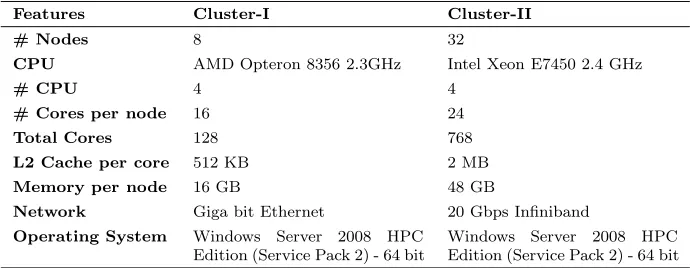
matrix of 8-byte double-precision numbers requires 80 GB of main memory, so the algorithm needs to acquire at least 480 GB of memory to store sixN ×N matrices. It is possible to run parallel version of SMACOF with MPI inCluster-IIin Table 2 withN = 100,000. If the data size is increased only twice, however, then SMACOF algorithm should have 1.92 TB of memory, which is bigger than total memory ofCluster-II in Table 2 (1.536 TB), so it is impossible to run it within the cluster. Increasing memory size will not be a solution, even though it could increase the runnable number of points. It will encounter the same problem as the data size increases.
instead of classifying it. For the purpose of deciding new mapping position in relation to the
k-NN positions, iterative majorization method is used as in SMACOF [7, 8] algorithm, with modified majorization equation, as shown in below. The algorithm proposed in this section is called Majorizing Interpolation MDS (MI-MDS).
The proposed algorithm is implemented as follows. We are givenN data in high-dimensional space, sayD-dimension, and proximity information (∆= [δij]) of those data as in Section 2.1.
Among N data, the configuration of the nsample points in L-dimensional space, x1, . . . ,xn∈
RL, called X, are already constructed by an MDS algorithm, here we use SMACOF algorithm. Then, we selectknearest neighbors,p1, . . . ,pk∈P, of the given new point amongnpre-mapped points with respect to corresponding δix, where x represents the new point. Finally, the new
mapping of the given new point x in RL is calculated based on the pre-mapped position of selectedk-NN and corresponding proximity informationδix. The finding new mapping position
is considered as a minimization problem of STRESS (1) as similar as normal MDS problem withk+ 1 points in S, where S =P ∪x. However, only one point xis movable among k+ 1 points, so we can summarize STRESS (1) as belows, and we set wij = 1, for ∀i, j in order to
simplify.
σ(S) = X
i<j≤k+1
(dij(S)−δij)2 (24)
= C+
k
X
i=1
d2ix−2
k
X
i=1
δixdix (25)
where δix is the original dissimilarity value between pi and x,dix is the Euclidean distance in
L-dimension between pi and x, and C is constant part. The second term of Eq. (25) can be deployed as following:
k
X
i=1
d2ix = kkxk2+
k
X
i=1
kpik2−2xtq (26)
whereqt= (Pki=1pi1, . . . ,Pik=1piL),pij representsj-th element ofpi, and kmeans the number
of nearest neighbors. In order to establish majorizing inequality, we apply Cauchy-Schwarz inequality to −dix of the third term of Eq. (25). Please, refer to chapter 8 in [5] for details
of how to apply Cauchy-Schwarz inequality to −dix. Since dix = kpi −xk, −dix could have
following inequality based onCauchy-Schwarz inequality:
−dix ≤
(pi−x)t(p
i−z)
diz
(27)
wherezt= (zi, . . . , zL) anddiz =kpi−zk. The equality in Eq. (27) occurs ifxandzare equal.
If we apply Eq. (27) to the third term of Eq. (25), then we obtain
−
k
X
i=1
δixdix ≤ −xt k
X
i=1
δix
diz
where Cρ is a constant. If Eq. (26) and Eq. (28) are applied to Eq. (25), then it could be like
following:
σ(S) =C+
k
X
i=1
d2ix−2
k
X
i=1
δixdix (29)
≤ C+kkxk2−2xtq+
k
X
i=1
kpik2−xt
k
X
i=1
δix
diz
(z−pi) +Cρ (30)
=τ(x,z) (31)
where both C and Cρ are constants. In the Eq. (31), τ(x,z), a quadratic function of x, is a
majorization function of the STRESS. Through setting the derivative ofτ(x,z) equal to zero, we can obtain minimum of it; that is
∇τ(x,z) = 2kx−2q−2
k
X
i=1
δix
diz
(z−pi) = 0 (32)
x= q+
Pk
i=1 δdixiz(z−pi)
k . (33)
The advantage of the iterative majorization algorithm is that it guarantees to produce a series of mapping with non-increasing STRESS value as proceeds, which results in local minima. It is good enough to find local minima, since the proposed MI algorithm simplifies the complicated non-linear optimization problem as a small non-linear optimization problem, such ask+ 1 points non-linear optimization problem, wherek≪N. Finally, if we substitutez with x[t−1] in Eq. (33), then we generate an iterative majorizing equation like following:
x[t]=p+ 1
k
k
X
i=1
δix
diz
(x[t−1]−pi) (34)
where diz = kpi −x[t−1]k and p is the average of k-NN’s mapping results. Eq. (34) is an
iterative equation used to embed newly added point into target-dimensional space, based on pre-mapped positions ofk-NN. The iteration stop condition is essentially same as that of SMACOF algorithm, which is
∆σ(S[t]) =σ(S[t−1])−σ(S[t])< ε, (35)
whereS =P ∪ {x} andε is the given threshold value.
Process of the out-of-sample MDS could be summarized as following steps: (1) Sampling, (2) Running MDS with sample data, and (3) Interpolating the remain data points based on the mapping results of the sample data.
Algorithm 3 Majorizing Interpolation (MI) algorithm
1: Find k-NN: findknearest neighbors of x, pi ∈P i= 1, . . . , k of the given new data based on original dissimilarity δix.
2: Gather mapping results in target dimension of thek-NN.
3: Calculate p, the average of pre-mapped results of pi∈P.
4: Generate initial mapping ofx, calledx[0], either por a random point.
5: Computeσ(S[0]), where S[0] =P ∪ {x[0]}.
6: whilet= 0 or (∆σ(S[t])> εand t≤MAX ITER) do 7: increase t by one.
8: Computex[t] by Eq. (34).
9: Computeσ(S[t]).
10: end while 11: return x[t];
p as an initial mapping of the new pointx[0] unless initialization with p makesdix = 0, since
the mapping is based on the k-NN. If p makes dix = 0 (i = 1, . . . , k), then we use a random
generated point as an initial position ofx[0].
5
Non-uniform Weights
The STRESS equation (1) could be considered as the sum of weighted squared error. Due to the simplicity and easy computation,uniformweight (where∀wij= 1,1≤i, j≤N) is assumed
in many case. However, the MDS mapping result can be quite different with respect to weight function, as in [15, 24]. Generally,uniformweight method will do more focus on larger distance entries than smaller distances, but reciprocal weight method (wij = 1/δij) gives more weights
on the shorter distance. However, it is hard to say which weight function is generally better than the other. It depends on the purpose of the finding embeddings of the given data in target dimension. In this dissertation, the author will investigate various weight function, such as 1/δ2 and 1/√δ as well asuniform andreciprocal weight which is used for Sammon’s mapping [24].
6
Parallel MDS algorithms
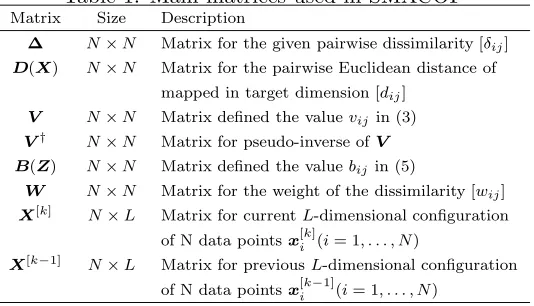
Table 1: Main matrices used in SMACOF Matrix Size Description
∆ N×N Matrix for the given pairwise dissimilarity [δij]
D(X) N×N Matrix for the pairwise Euclidean distance of
mapped in target dimension [dij]
V N×N Matrix defined the valuevijin (3)
V† N×N Matrix for pseudo-inverse ofV B(Z) N×N Matrix defined the valuebijin (5)
W N×N Matrix for the weight of the dissimilarity [wij] X[k] N×L Matrix for currentL-dimensional configuration
of N data pointsx[k]
i (i= 1, . . . , N)
X[k−1] N×L Matrix for previousL-dimensional configuration of N data pointsx[k−1]
i (i= 1, . . . , N)
parallel model MDS.
6.1 Message Passing Model SMACOF
Table 1 describes frequently used matrices in SMACOF algorithm, and memory requirement of SMACOF algorithm increases quadratically asN increases. For the small dataset, memory would not be any problem. However, it turns out to be critical problem when we deal with large data set, such as thousands or even millions. For instance, ifN = 10,000, then oneN×N matrix of 8-byte double-precision numbers consumes 800 MB of main memory, and ifN = 100,000, then oneN ×N matrix uses 80 GB of main memory. To make matters worse, SMACOF algorithm generally needs sixN×N matrices, so at least 480 GB of memory is required to run SMACOF with 100,000 data points without considering two N×L configuration matrices in Table 1. If the weight is uniform (wij = 1,∀i, j), we can use only four constants for representingN×N V
andV† matrices in order to saving memory space. We, however, still need at least threeN×N
matrices, i.e. D(X), ∆, and B(X), which requires 240 GB memory for the above case, which is still infeasible amount of memory for a typical computer. That is why we have to implement parallel version of SMACOF with MPI.
x
=
M
M
00M
01M
02M
10M
11M
12X0
X1
X2
C0
C1
[image:15.612.212.384.96.215.2]C
X
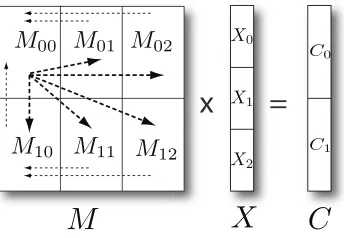
Figure 1: Parallel matrix multiplication ofN ×N matrix and N×L matrix with 6 processes and m= 2, n= 3.
A process Pk,0≤k < p (sometimes, we will use Pij for matching Mij) is assigned to one
rectangular block Mij with respect to simple block assignment equation in (36):
k=i×n+j (36)
where 0 ≤ i < m,0 ≤j < n. For N ×N matrices, such as ∆,V†,B(X[k]), and so on, each block Mij is assigned to the corresponding process Pij, and for X[k] and X[k−1] matrices,
N×Lmatrices, each process has fullN×Lmatrices because these matrices are relatively much small size and it results in reducing a number of additional message passing. By scattering decomposed blocks to distributed memory, now we are able to run SMACOF with huge data set as much as distributed memory allows in the cost of message passing overheads and complicated implementation.
At the iteration k in Alg. 1, the application should be possible to acquire following infor-mation to do Line 9 and Line 10 in Alg. 1: ∆, V†, B(X[k−1]), X[k−1], and σ[k]. One good feature of SMACOF algorithm is that some of matrices are invariable, i.e. ∆and V†, through the iterations. On the other hand, B(X[k−1]) and STRESS (σ[k]) value keep changing at each iteration, sincedij(X[k]) varies every iteration. In addition, in order to update B(X[k−1]) and
STRESS (σ[k]) value in each iteration, we have to takeN×N matrices information into account, so related processes should communicate via MPI primitives to obtain necessary information. Therefore, it is necessary to design message passing schemes to do parallelization for calculating B(X[k−1]) and STRESS (σ[k]) value as well as parallel matrix multiplication in Line 9 in Alg. 1. Computing STRESS in (1) can be implemented simply through MPI_Allreduce. On the other hand, calculation ofB(X[k−1]) and parallel matrix multiplication is not simple, specially for the case of m 6= n. Fig. 1 depicts how parallel matrix multiplication applies between an
N ×N matrix M and an N ×L matrix X. Parallel matrix multiplication for SMACOF
algorithm is implemented in three-step of message communication via MPI primitives. Block matrix multiplication of Fig. 1 for acquiringCi (i= 0,1) can be written as follows:
Ci =
X
0≤j<3
Mij·Xj (37)
Algorithm 4Pseudo-code for distributed parallel matrix multiplication in SMACOF algorithm
Input: Mij,X
1: /* m=Row Blocks,n=Column Blocks*/
2: /* i=Rank-In-Row,j=Rank-In-Column*/
3: Tij =Mij ·Xj
4: if j 6= 0 then 5: SendTij to Pi0
6: else
7: for j= 1 to n−1 do 8: Receive Tij from Pij
9: end for 10: GenerateCi
11: end if
12: if i== 0 andj== 0 then 13: for i= 1 to m−1 do 14: Receive Ci from Pi0
15: end for
16: Combine C withCi wherei= 0, . . . , m−1
17: BroadcastC to all processes
18: else if j == 0then 19: SendCi to P00
20: Receive Broadcasted C
21: else
22: Receive Broadcasted C
23: end if
part is done by Pij, and the each computed sub-matrix, which is N2 ×L matrix for Fig. 1, is
sent to the process assignedMi0 by MPI primitives, such asMPI_SendandMPI_Receive. Then the process assigned Mi0, sayPi0, sums the received sub-matrices to generateCi, and sendCi
block toP00. Finally,P00combines sub-matrix blockCi(0 ≤i < m) to constructN×Lmatrix
C, and broadcast it to all other processes byMPI_Broadcast. Each arrows in Fig. 1 represents
message passing direction. Thin dashed arrow lines describes message passing of N2 ×L sub-matrices byMPI_Sendand MPI_Receive, and message passing of matrix C byMPI_Broadcast
is represented by thick dashed arrow lines. The pseudo code for parallel matrix multiplication in SMACOF algorithm is in Alg. 4
For the purpose of parallel computing B(X[k−1]), whose elements bij is defined in (6),
message passing mechanism in Fig. 2 should be applied under 2×3 block decomposition as in Fig. 1. Since bss =−Ps6=jbsj, a process Pij who is assigned toBij should communicate a
vector sij, whose element is the sum of corresponding rows, with processes assigned sub-matrix
of the same block-row Pik, where k = 0, . . . , n−1, unless the number of column blocks is 1
B
00
B
01
B
02
B
11
B
12
[image:17.612.212.379.97.274.2]B
10
Figure 2: Calculation of B(X[k−1]) matrix with regard to the decomposition of Fig. 1.
is a block which contains at least one diagonal element of the matrix B(X[k]). Also, dashed arrow lines illustrate message passing direction.
6.2 Hybrid Model SMACOF
In the above, the author discussed the pure MPI model SMACOF implementation. The MPI model has been widely accepted by parallel computing community in order to utilize distributed memory computing resources, such as cluster, since it enables us to run such programs that require too large computation and memory to run in a single node. Though MPI model is still used very much and shows good performance, you should note that the model proposed several decades ago, when the increase of clock speed is the main method of improving CPU performance. After Multicore chip was invented, most of the cluster systems are actually composed of multicore compute nodes. For instance, bothCluster-IandCluster-IIin Table 2 are multicore cluster systems whose compute nodes contain 16 and 24 cores, correspondingly.
In [10], the authors investigated the overhead of pure MPI and hybrid (MPI-Threading) model with multicore cluster systems. In the paper, pure MPI outperforms hybrid model for the application with relatively fast message passing synchronization overhead. However, for the case of high MPI synchronization time, hybrid model outperforms pure MPI model with high parallelism. Not only collective MPI operations but also pairwise MPI operations, such as
MPI_SENDRECV, are used for implementing parallel SMACOF, so that it is worth to investigate
hybrid model SMACOF. For this dissertation, the author will analyze which parallel model is better-fitted to SMACOF algorithm.
6.3 Parallelization of MI-MDS
Suppose that, amongN points, mapping results ofnsample points in the target dimension, say
Table 2: Compute cluster systems used for the performance analysis
Features Cluster-I Cluster-II
# Nodes 8 32
CPU AMD Opteron 8356 2.3GHz Intel Xeon E7450 2.4 GHz
# CPU 4 4
# Cores per node 16 24
Total Cores 128 768
L2 Cache per core 512 KB 2 MB
Memory per node 16 GB 48 GB
Network Giga bit Ethernet 20 Gbps Infiniband
Operating System Windows Server 2008 HPC Edition (Service Pack 2) - 64 bit
Windows Server 2008 HPC Edition (Service Pack 2) - 64 bit
interpolation approach is much faster than full running MDS algorithm, i.e. O(M n+n2) vs. O(N2), implementing parallel MI algorithm is essential, sinceM can be still huge, like millions. In addition, most of clusters are now in forms of multicore-clusters after multicore-chip invented, so we are using hybrid-model parallelism, which combine processes and threads together.
In contrast to the original MDS algorithm that the mapping of a point is influenced by the other points, interpolated points are totally independent one another, except selected k-NN in the MI-MDS algorithm, and the independency of among interpolated points makes the MI-MDS algorithm to be pleasingly-parallel. In other words, there must be minimum communication overhead and load-balance can be achieved by using modular calculation to assign interpolated points to each parallel unit, either between processes or between threads, as the number of assigned points are different at most one each other.
7
Performance Analysis
In this section, the author analyzes the experimental results of those proposed methods, such as parallelization, DA-SMACOF, and MI-MDS. All the applications are implemented in C# language and tested at multicore cluster systems in Table 2.
7.1 SMACOF vs. DA-SMACOF
In this section, the quality difference between EM-like SMACOF algorithm and the DA-SMACOF proposed in Section 3 is analyzed with respect to the well-known objective function STRESS (1). Biological sequence data, such as ALU sequence data and meta genomics sequence data, is used for the experiments. Note that it is difficult to find a vector representation of those biologi-cal sequence data, but the pairwise dissimilarity information between two different sequence is available.
Threshold
Nor
maliz
ed STRESS
0.00 0.01 0.02 0.03 0.04 0.05 0.06 0.07
E(−6) E(−8)
DA−exp90 DA−exp95 DA−exp99 EM−SMACOF
(a) ALU sequence 2D
Threshold
Nor
maliz
ed STRESS
0.000 0.005 0.010 0.015 0.020 0.025 0.030 0.035
E(−6) E(−8)
DA−exp90 DA−exp95 DA−exp99 EM−SMACOF
[image:19.612.91.506.111.335.2](b) ALU sequence 3D
Figure 3: The normalized STRESS comparison between EM-SMACOF and DA-SMACOF with ALU sequence data with 3000 sequences for mapping in 2D and 3D space. Bar graph illustrates the average of 30 runs with random initialization and the corresponding error bar represents the minimum and maximum of the normalized STRESS value of EM-SMACOF and DA-SMACOF with different cooling parameters (α= 0.9, 0.95, and 0.99). Note that the x-axis of both plots is the threshold value for the stop condition of SMACOF algorithm.
EM-SMACOF shows variation in quality for all experimental results. You should also note that the minimum of EM-SMACOF in 2D mapping results is clearly larger than average of all DA-SMACOF experiments. Even in 3D mapping comparison, the minimum of EM-SMACOF is still larger than the average of DA-SMACOF, although it seems to be similar to the average of DA-SMACOF in Fig. 3b. The results illustrates that the DA-SMACOF shows better and more reliable than the normal SMACOF with ALU sequence data.
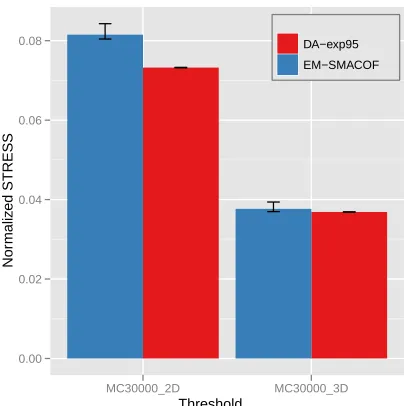
Fig. 4 is the comparison between the average of 10 random initial runs of DA-SMACOF (DA-exp95) and EM-SMACOF with metagenomics data set. The threshold value of the stop condition for SMACOF algorithm is 10−8. As expected, EM-SMACOF shows a tendency to be trapped in local optima by depicting some variation and larger STRESS values, and even the minimum values are bigger than any results of DA-exp95. In contrast to EM-SMACOF, all of the DA-exp95 results are very similar to each other. In fact, for 3D mappings, all of the DA-exp95 mappings reach at 0.0368854.
7.2 Parallel Performance of MPI-SMACOF
Threshold
Nor
maliz
ed STRESS
0.00 0.02 0.04 0.06 0.08
MC30000_2D MC30000_3D
[image:20.612.195.397.100.303.2]DA−exp95 EM−SMACOF
Figure 4: The normalized STRESS comparison between SMACOF and DA-SMACOF with Metagenomics sequence data with 30000 sequences for mapping in 2D and 3D space. Bar graph illustrates the average of 10 runs with random initialization and the corresponding error bar represents the minimum and maximum of the normalized STRESS value of EM-SMACOF and DA-SMACOF with α= 0.95.
the dataset obtained from PubChem database1, which is a NIH-funded repository for over 60 million chemical molecules and provides their chemical structure fingerprints and biological ac-tivities, for the purpose of chemical information mining and exploration. Among 60 Million PubChem dataset, the author has used randomly selected up to 100,000 chemical subsets and all of them have a 166-long binary value as a fingerprint, which corresponds to maximum input of 100,000 data points having 166 dimensions. With those data as inputs, we have performed our experiments on our two decent compute clusters as summarized in Table 2.
In the following, the performance results of the parallel SMACOF are shown with respect to 10,000, 20,000, 50,000 and 100,000 data points having 166 dimensions, represented as 10K, 20K, 50K, and 100K dataset respectively.
Fig. 5 shows the performance comparisons for 10K and 20K PubChem data with respect to how to decompose the given N ×N matrices with 32, 64, and 128 cores in Cluster-I and
Cluster-II. A significant characteristic of those plots in Fig. 5 is that skewed data decomposi-tions, such as p×1 or 1×p, which decompose by row-base or column-base, are always worse in performance than balanced data decompositions, such as m×nblock decomposition which
m and n are similar as much as possible. The reason of the above results is cache line effect that affects cache reusability, and generally balanced block decomposition shows better cache reusability so that it occurs less cache misses than the skewed decompositions [1, 21]. As in Fig. 5, Difference of data decomposition almost doubled the elapsed time of 1×128
Decomposition
Elapsed Time (min)
40 45 50 55
32x1 16x2 8x4 4x8 2x16 1x32
Node
Cluster−I Cluster−II
(a) 10K with 32 cores
Decomposition
Elapsed Time (min)
30 40 50 60 70
64x1 32x2 16x4 8x8 4x16 2x32 1x64
Node
Cluster−I Cluster−II
(b) 10K with 64 cores
Decomposition
Elapsed Time (min)
16 18 20 22 24 26 28
128x1 64x2 32x4 16x8 8x16 4x32 2x64 1x128 Node
Cluster−II
(c) 10K with 128 cores
Decomposition
Elapsed Time (min)
160 180 200 220
32x1 16x2 8x4 4x8 2x16 1x32
Node
Cluster−I Cluster−II
(d) 20K with 32 cores
Decomposition
Elapsed Time (min)
80 90 100 110 120 130 140 150
64x1 32x2 16x4 8x8 4x16 2x32 1x64
Node
Cluster−I Cluster−II
(e) 20K with 64 cores
Decomposition
Elapsed Time (min)
50 55 60 65 70
128x1 64x2 32x4 16x8 8x16 4x32 2x64 1x128 Node
Cluster−II
[image:21.612.79.527.106.437.2](f) 20K with 128 cores
Figure 5: Performance of Parallel SMACOF for 10K and 20K PubChem data with 32,64, and 128 cores inCluster-Iand Cluster-IIw.r.t. data decomposition ofN ×N matrices.
tion compared to 8×16 decomposition with 10K PubChem data. From the above investigation, it is derived that the balanced data decomposition is generally good choice. Furthermore,
Cluster-IIperforms better than Cluster-Iin Fig. 5, although the clock speed of cores is simi-lar to each other. There are two different factors betweenCluster-IandCluster-IIin Table 2 which we believe that those factors result in Cluster-IIoutperforms than Cluster-I, i.e. L2 cache size and Networks, and the L2 cache size per core is 4 times bigger in Cluster-IIthan
Cluster-I. Since SMACOF with large data is memory-bound application, it is natural that the bigger cache size results in the faster running time.
number of processes
Elapsed Time (min)
27.5
28
28.5
29
29.5
210
210.5
26 26.5 27 27.5 28 28.5
Size
[image:22.612.213.382.100.270.2]100k 50k
Figure 6: Performance of parallel SMACOF for 50K and 100K PubChem data in Cluster-II w.r.t. the number of processes. Based on the data decomposition experiment, we choose balanced decomposition as much as possible, i.e. 8×8 for 64 processes. Note that both x and y axes are log-scaled.
increases. However, performance enhancement ratio is reduced, because the ratio of message passing overhead over the assigned computation per each node increases due to more messag-ing and less computmessag-ing per node as p increases. Note that we used 16 computing nodes in
Cluster-II(total number of cores in 16 computing nodes is 384 cores) to perform the scaling experiment with large data set, i.e. 50k and 100k PubChem data, since SMACOF algorithm requires 480 GB memory for dealing with 100,000 data points, as we disscussed in Section 6.1, and Cluster-IIis only feasible to perform this experiment with more than 10 nodes.
7.3 Interpolation Performance
To measure the quality and parallel performance of the proposed MI-MDS discussed in Section 4, we have used 166-dimensional chemical dataset obtained from PubChem project database as in Section 7.2. In this section, the author has used randomly selected up to 2 million out-of-sample chemical subsets for interpolation testing.
In the following, The author will show i) the quality of the interpolation result of perform-ing MI-MDS, and ii) performance measurement of the parallelized MI-MDS on the clusterperform-ing systems as listed in Table 2.
Sample size
STRESS
0.00 0.02 0.04 0.06 0.08 0.10
2e+04 4e+04 6e+04 8e+04 1e+05
Algorithm
MDS INTP
(a) normalized STRESS
Sample size
Elapsed time (sec)
0 5 10 15 20
12.5k 25k 50k
Algorithm
INTP
(b) Elapsed Time
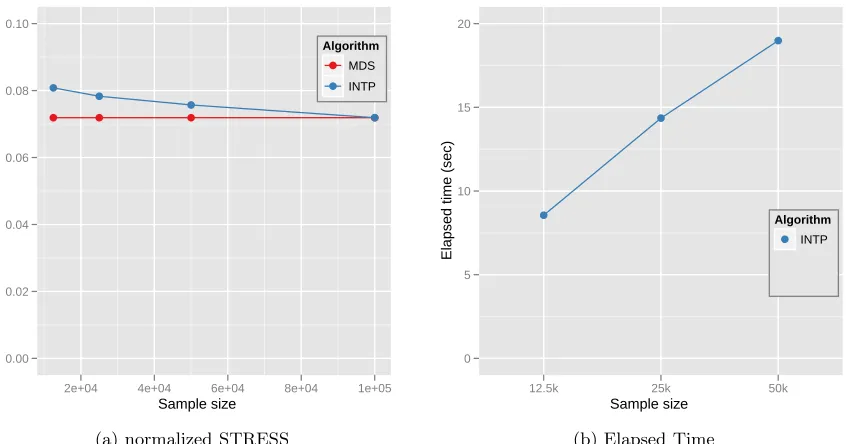
Figure 7: (a) Quality comparison between Interpolated result upto 100k based on the sample data and 100k MDS result. (b) Elapsed time of parallel MI-MDS upto 100k data w.r.t. the sample size using 16 nodes of the Cluster-II in Table 2. Note that the computational time complexity of MI-MDS is O(M n) wherenis the sample size and M =N−n.
the authors use 2-NN for the MI algorithm.
Fig. 7-(a) shows the comparison of quality between interpolated results upto 100K data with different sample size data by using 2-NN and MDS (SMACOF) only result with 100k pubchem data. The y-axis of the plot is STRESS (1) normalized withPi<jδ2
ij, and the difference between
MDS only results and interpolated with 50k is only around 0.004. Even with small portion of sample data (12.5k data is only 1/8 of 100k), the proposed MI-MDS algorithm produces good enough mapping in target dimension using very smaller amount of time than when we run MDS with full 100k data. Fig. 7-(b) shows the MI-MDS running time with respect to the sample data using 16 nodes of theCluster-IIin Table 2. The plot demonstrates that the running time is fitted to O(M n). The running time of SMACOF with the sampled data (i.e. 12.5k, 25k, and 50k) and MI-MDS upto 100k data is substantially faster than running SMACOF with full 100k data. Note that the full MDS running time with 100k using 16 nodes of theCluster-II
in Table 2 is around 27006 sec.
[image:23.612.89.512.110.332.2]Total size
STRESS
0.00 0.02 0.04 0.06 0.08 0.10
[image:24.612.197.398.100.305.2]500000 1000000 1500000 2000000
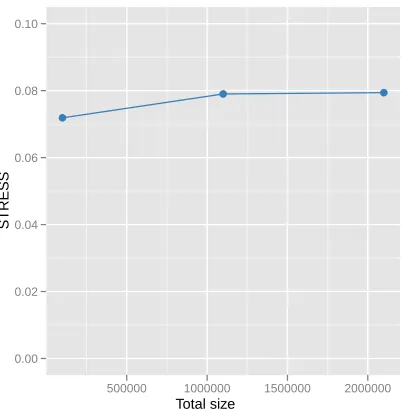
Figure 8: The normalized STRESS value of Interpolation larger data, such as 1M and 2M data points, with 100k sample data. The STRESS value of pre-mapped MDS result of 100k data is 0.0719.
the full MDS running result with 100k data and the 1M interpolated results based on that 100k mapping, which is about 0.007 difference in normalized STRESS criteria. However, there is no much difference between the 1M interpolated result and 2M interpolated result, although the sample size is quite small portion of total data and the out-of-sample data size increases as twice. From the above result, we could consider that the proposed MI-MDS algorithm works well and scalable if we are given a good enough pre-configured result which represents well the structure of the given data. Note that it is not possible to run SMACOF algorithm with only 200k data points due to memory bound, within the systems in Table 2.
Here, the author would like to investigate the parallel performance of the proposed paral-lel MI-MDS implementation in terms of efficiency with respect to the running results within
Cluster-Iand Cluster-IIin Table 2.
Both plots in Fig. 9 illustrate the efficiency of the parallel MI-MDS running results with different sample size - 12.5k, 25k, and 50k - with respect to the number of parallel units using
Cluster-Iand Cluster-II, correspondingly. Equations for the efficiency is following:
f = pT(p)−T(1)
T(1) (38)
ε= 1
1 +f (39)
Number of cores
Efficiency
0.0 0.2 0.4 0.6 0.8 1.0 1.2
24 24.5 25 25.5 26 26.5 27
Type
INTP_12.5k INTP_25k INTP_50k
(a) Cluster-I
Number of cores
Efficiency
0.0 0.2 0.4 0.6 0.8 1.0 1.2
25 25.5 26 26.5 27 27.5 28 28.5
Type
INTP_12.5k INTP_25k INTP_50k
(b) Cluster-II
Figure 9: Efficiency of runtime in parallel MI-MDS application with respect to different sample data size usingCluster-Iand Cluster-IIin Table 2. Total data size is 100K.
f = αT(p1)−T(p2)
T(p2)
(40)
whereα=p1/p2 and p2 is the smallest number of used cores for the experiment, soalpha≥1. Here, Eq. (40) is used for calculating f in (39).
In Fig. 9-(a), 16 to 128 cores are used to measure parallel performance with 8 processes, and 32 to 384 cores are used to evaluate the performance of the proposed parallel MI-MDS with 16 processes in Fig. 9-(b). Processes communicate via MPI primitives and each process is also parallelized in thread level. Both Fig. 9-(a) and Fig. 9-(b) show very good efficiency with appropriate degree of parallelism.
8
Contributions
[image:25.612.91.507.111.337.2]DA-SMACOF algorithms are parallelized via pure MPI and hybrid parallel model so that it is possible not only to run faster but also to deal with larger data.
References
[1] Seung-Hee Bae. Parallel multidimensional scaling performance on multicore systems. In Proceedings of the Advances in High-Performance E-Science Middleware and Applications workshop (AHEMA) of Fourth IEEE International Conference on eScience, pages 695–702, Indianapolis, Indiana, Dec. 2008. IEEE Computer Society.
[2] Y Bengio, J-F Paiement, P Vincent, O Delalleau, N L Roux, and M Ouimet. Out-of-sample extensions for lle, isomap, mds, eigenmaps, and spectral clustering. InAdvances in Neural Information Processing Systems, pages 177–184. MIT Press, 2004.
[3] C.M. Bishop, M. Svens´en, and C.K.I. Williams. GTM: A principled alternative to the self-organizing map. Advances in neural information processing systems, pages 354–360, 1997.
[4] C.M. Bishop, M. Svens´en, and C.K.I. Williams. GTM: The generative topographic map-ping. Neural computation, 10(1):215–234, 1998.
[5] Ingwer Borg and Patrick J.F. Groenen. Modern Multidimensional Scaling: Theory and Applications. Springer, New York, NY, U.S.A., 2005.
[6] Thomas M. Cover and Peter E. Hart. Nearest neighbor pattern classification. IEEE Transaction on Information Theory, 13(1):21–27, 1967.
[7] Jan de Leeuw. Applications of convex analysis to multidimensional scaling. Recent Devel-opments in Statistics, pages 133–146, 1977.
[8] Jan de Leeuw. Convergence of the majorization method for multidimensional scaling. Journal of Classification, 5(2):163–180, 1988.
[9] A Dempster, N Laird, and D Rubin. Maximum likelihood from incomplete data via the em algorithm. Journal of the Royal Statistical Society. Series B, pages 1–38, 1977.
[10] G. Fox, S. Bae, J. Ekanayake, X. Qiu, and H. Yuan. Parallel data mining from multicore to cloudy grids. In Proceedings of HPC 2008 High Performance Computing and Grids workshop, Cetraro, Italy, July 2008.
[11] David E. Goldberg. Genetic algorithms in search, optimization and machine learning. Addison-Wesley, 1989.
[12] Thomas Hofmann and Joachim M. Buhmann. Pairwise data clustering by deterministic annealing. IEEE Transactions on Pattern Analysis and Machine Intelligence, 19:1–14, 1997.
[13] John H. Holland. Adaptation in natural and artificial systems. University of Michigan Press, Ann Arbor, MI, 1975.
[15] Hansj¨org Klock and Joachim M. Buhmann. Data visualization by multidimensional scaling: a deterministic annealing approach. Pattern Recognition, 33(4):651–669, 2000.
[16] T. Kohonen. The self-organizing map. Neurocomputing, 21(1-3):1–6, 1998.
[17] Joseph B. Kruskal. Multidimensional scaling by optimizing goodness of fit to a nonmetric hypothesis. Psychometrika, 29(1):1–27, 1964.
[18] Joseph B. Kruskal and Myron Wish. Multidimensional Scaling. Sage Publications Inc., Beverly Hills, CA, U.S.A., 1978.
[19] Eliakim H. Moore. On the reciprocal of the general algebraic matrix. Bulletin of American Mathematical Society, 26:394–395, 1920.
[20] Roger Penrose. A generalized inverse for matrices. Proceedings of the Cambridge Philo-sophical Society, 51:406–413, 1955.
[21] Xiaohong Qiu, Geoffrey C. Fox, Huapeng Yuan, Seung-Hee Bae, George Chrysanthakopou-los, and Henrik Frystyk Nielsen. Data mining on multicore clusters. In Proceedings of 7th International Conference on Grid and Cooperative Computing GCC2008, pages 41–49, Shenzhen, China, Oct. 2008. IEEE Computer Society.
[22] Kenneth Rose. Deterministic annealing for clustering, compression, classification, regres-sion, and related optimization problems. Proceedings of IEEE, 86(11):2210–2239, 1998.
[23] Kenneth Rose, Eitan Gurewitz, and Geoffrey C. Fox. A deterministic annealing approach to clustering. Pattern Recognition Letters, 11(9):589–594, 1990.
[24] John W. Sammon. A nonlinear mapping for data structure analysis. IEEE Transactions on Computers, 18(5):401–409, 1969.
[25] Yoshio Takane, Forrest W. Young, and Jan de Leeuw. Nonmetric individual differences multidimensional scaling: an alternating least squares method with optimal scaling fea-tures. Psychometrika, 42(1):7–67, 1977.
[26] Warren S. Torgerson. Multidimensional scaling: I. theory and method. Psychometrika, 17(4):401–419, 1952.
[27] Michael W. Trosset and Carey E. Priebe. The out-of-sample problem for classical multidi-mensional scaling. Computational Statistics and Data Analysis, 52(10):4635–4642, 2008.
[28] Zizhuo Wang, Song Zheng, Yinyu Ye, and Stephen Boyd. Further relaxations of the semidef-inite programming approach to sensor network localization. SIAM Journal on Optimiza-tion, 19(2):655–673, 2008.
![Figure 2: Calculation of B(X[k−1]) matrix with regard to the decomposition of Fig. 1.](https://thumb-us.123doks.com/thumbv2/123dok_us/8121375.239514/17.612.212.379.97.274/figure-calculation-b-x-matrix-regard-decomposition-fig.webp)