Volume 2011, Article ID 365307,21pages doi:10.1155/2011/365307
Research Article
Behavioural Analysis with Movement Cluster Model for
Concurrent Actions
Zsolt L. Husz, Andrew M. Wallace (EURASIP Member), and Patrick R. Green
Joint Research Institute of Signal and Image Processing, Heriot-Watt University, Edinburgh EH14 4AS, UK
Correspondence should be addressed to Andrew M. Wallace,[email protected]
Received 1 April 2010; Revised 27 August 2010; Accepted 20 September 2010
Academic Editor: Dan Schonfeld
Copyright © 2011 Zsolt L. Husz et al. This is an open access article distributed under the Creative Commons Attribution License, which permits unrestricted use, distribution, and reproduction in any medium, provided the original work is properly cited.
We present an approach to model articulated human movements and to analyse their behavioural semantics. First, we describe a novel dynamic and behavioural model that uses movements, a sequence of consecutive poses, from motion captured video data to establish priors for both tracking and behavioural analysis. Second, using that model, we show how we can both learn and subsequently recognise human activity. Activities are modelled and recognised independently to allow concurrent and complex actions. Finally, we combine activity recognition with tracking to produce an overall evaluation of the effectiveness of the approach using publicly available datasets.
1. Introduction
The analysis of human activity and behaviour from video
sequences, often termed video analytics, has applications
in surveillance, entertainment, intelligent domiciles, and
medical diagnosis. Human tracking [1] is the first phase of
most video analytic systems, and indeed, we have previously described a hierarchical particle filter to recover torso and limb positions and movements from video sequences
[2]. However, in this paper, we focus on the behavioural
understanding of human movements or transitions between poses.
Video analytics requires inferences on human behaviour, but this can vary widely in complexity from simple actions (walk, run, jump, etc.) to more complex deductions on intent or interaction (shoplifting or holding a conversation). Turaga
et al. [3] provides an overview of recent algorithms to classify
such a range of behaviours, some classified as simple motion
patterns, theactions, and some as more complex, frequently
multipersonactivities, which may be composed from simple
actions. For example, Ma et al. [4] extract motion trajectories
from human subjects (considered as single entities) and can infer interactive behaviour (fight, chase) from the relative motion in comparison with learnt examples. Similarly, Li
et al. [5] use the motion trajectories of football players to
determine the “plays” of activities of the football groups
from analysis of these combined tracks. The assumption in these works is that the movement of a single entity, a human
blob, is sufficient to describe a singular motion, and that
more complex behaviour can be inferred from interactions between trajectories. The tactical arrangement of a football team is an obvious example of this. However, more complex human activities may require more detailed analysis of the structure within the human movement, as for example using limb positions and movements in our work, and indeed in
other work such as that of Deutscher and Reid [6]. However,
whereas limbs are the building blocks of the human form, it is also possible to analyse behaviour on the basis of more abstract features, such as the extremities of a contour used
by Yu and Aggarwal [7], or the signed distance transform
used by Nater et al. [8]. These latter examples are effectively
forms of 2D blob analysis for action recognition and anomaly detection, that echo the early days of binary computer vision using extracted human silhouettes.
The novelty of this paper is that we describe complex behavioural analysis that infers multiple conclusions using
a Movement Cluster Model (MCM). This generalises both
The work we describe has some parallels with manifold
analysis by Lui et al. [9] and with Hierarchical Gaussian
Process Latent Variable Models (HGPLVM) [10–13]. A
HGPLVM is similar to an MCM in that it decomposes the pose-space into hierarchical subspaces. However, the key dif-ference between our model and that of the previous examples is that rather than use static poses, these are substituted within an MCM with movements, that is sequences of poses.
Returning to the classification of Turaga et al. [3], the
MCM belongs to the class of parametric action detection
algorithms. This is the most complex class of action recog-nition, followed by activity recognition algorithms. We use
movement, action and activity, defined inSection 2.2, as our
three abstraction levels of perception, similar to Bobick [14].
In [14], a movement is a continuous motion characterised
by the trajectory in some configuration space. An activity is a statistical temporal combination of movements, and if understood within a context, it becomes an action. ˙Ikizler
and Forsyth [15] used acts and activities as basic blocks of
recognition. Acts, similar to the actions above, are expressed
as Hidden Markov Models (HMM) with a low number of
states. Similar states are interconnected in a larger HMM
representing activities. Similarly, Green and Guan [16]
have four abstraction levels: the dyname, skill, activity and context. The first three corresponded to movement, action and activity while the context is a prior knowledge about the conditional probabilities of the skills.
The MCM is introduced in Section 2. The MCM is
then trained and used for motion prediction in Section 3,
while Section 4 evaluates the semantic analysis on motion
captured (MOCAP) data. InSection 5we present results of
behavioural analysis on video sequences using tracked data
from the HPPF [2] tracker incorporating MCM movement
prediction. InSection 6we compare and contrast our results
with those of other workers on the basis of the published
results. Finally we conclude our paper inSection 7.
2. Behaviour Analysis and the Movement
Cluster Model
Using the Movement Cluster Model (MCM), we learn,
simulate and subsequently analyse human movement and behaviour by extracting common poses and transitions between those poses, leading to definitions of activities and actions that represent similar movements and transitions using a clustering approach.
2.1. Human Model and Tracking. Analysis may use direct
image features [17, 18] or extracted pose features [7,13].
For MCM, the input is extracted pose sequences of the
Articulated Hierarchical Human Model (AHHM) [2,19]. A
Pose Vector (PV) is the set of body configuration parameters that completely define a pose. For an articulated model, this is the torso position and the set of joint angles of the limbs. Fixed parameters, such as body part shape and size, are constant for an individual, and are therefore not included into the PV.
A Body Feature Vector (BFV) is a partition φ of the
PV p, b = pφ. It is a subset of joint angle, body position
and orientation parameters. While a pose is completely and uniquely defined by a PV, several BFVs prescribed by a
partitionφexist for a pose. This is important, since models
for individual body parts (e.g., lower leg, arm, etc.) or for the whole body can be built from the appropriate partition and its BFV.
The principal source of AHHM data in this paper is the verification set of the HumanEva dataset. Later, we use AHHM data acquired by applying an articulated body tracker to video sequences, the Hierarchical Partitioned
Particle Filter (HPPF) [2, 19]. The HPPF recovers the
probability density of an AHHM, and each pose hypothesis,
a.k.a. particle, is a PV.Figure 1shows some poses recovered
by the HPPF, as wireframe human bodies on top of the input image sequence.
However, in the rest of this paper, we consider that a tracking algorithm is already in place, and focus on the semantic analysis of the AHHM model. The behavioural analysis should be independent of the prior tracking, and therefore the HPPF may be replaced with any of the recent articulated human tracking algorithms such as those of Qu
and Schonfeld [20], Bo and Sminchisescu [21], Raskin et al.
[12], Rius et al. [22], and Taylor et al. [23].
2.2. The Movement Cluster Model. With no intentional
content, a movement is a short, continuous sequence of
poses, which are represented as a BFV. For example,
m=blm−1,. . ., b1, b0
(1)
is a sequence of consecutive poses, represented by a vector of the current b0, and previous b1,. . ., blm−1.lmis the length
or duration of the movement. Anactionis a short sequence
of poses (e.g., leg rising, arm still). It is usually, but not
exclusively, defined by one or more body parts. An action and a movement are similar, but actions have an intentional
content that can be described semantically by a labelλ. An
activity is a symbolic characterization of the body over a
limited time, bearing an intention.
AMovement Cluster(MC) is a set of similar movements.
MCs are the building elements of actions, and an MC can be part of multiple actions. If a movement is part of an MC then the statistical probability of the MC being an Action A results in the probability of movement being Action A.
To make an analogy with language, activities are sen-tences, actions are words, movements are letters, and BFVs are the sequences of curves forming the letters. This structure
is shown in Figures 2 and 3. Like previous authors [14–
16,24], we build semantic knowledge from simpler towards
complex structures. The translation of the PV (e.g., the tracking data) to symbolic description is performed through MCs.
Frame 4 Frame 10 Frame 16
Frame 460 Frame 463 Frame 466
Frame 469 Frame 472 Frame 475
Frame 766 Frame 769 Frame 772
Frame 775 Frame 778 Frame 781
Figure1: Tracking results for the HumanEvaS2 Combo 1camera C4 sequence. Recovered poses of walking (frames 4–16), jogging (frames 460–475) and balance (frames 766–781) are superimposed with the input image.
this Semantic MCM (SMCM) provides the behavioural semantics of a movement sequence.
2.3. Training Movement Clusters. The learning process
shown in Figure 4 proceeds from a set of of movements
that are acquired from an MOCAP system as input data, to generate the dynamic MCM as output. Within the MCM, there is a statistical description for each MC, and for each transition between MCs.
Movements have high internal correlation, as they are
made up fromconsecutive, therefore related, BFVs. Further,
a single BFV has correlated parameters since body parts have synchronised movements. Consequently, we employ compression by principal component analysis (PCA) as the first stage to reduce the dimensionality of movements.
Clustering with expectation maximisation is employed to
group similarlm+ 1 long compressed training movements.
This results in a set of MCs. If a movement is separated
MC1
MC2
MC3
MC4
MC5
MC6
Action C Action B
Action A
Figure2: Movement clusters and actions. Action A results from
any of the clusters MC1· · ·MC3, Action B from MC4 or MC5,
while Action C from MC1, MC3, MC4or MC6. On the other hand a
movement classified as MC1produces either Action A or Action C,
etc., with a probability characteristic to MC1.
Input:M-the MCM
m-current movement
Output: b-generated BFV (NBFV)
(1) b∗=0m //the last BFV of the movement
(2)c=MC(m)
(3) b∼N(b∗;M.Cc.NBFV.μ,M.Cc.NBFV.P)
Algorithm 1: NextBFV algorithm to generate the NBFV of the current movement.
movement to a new BFV transition. Therefore in thecluster
modelling phase, for each MC, we compute a Gaussian distribution (i.e., the mean and covariance) of the PCA
compressed lm long movements, and a similar statistical
representation of thenext BFV(NBFV). The first defines the
membership of an arbitrary movement within an MC, while the second provides the transitions to the NBFV, as suggested inFigure 5. This process is unsupervised and uses as input only the set of movements.
2.4. Movement Prediction. MCM allows pose prediction
if the current movement is known. This prediction is a necessary step for generative tracking algorithms, such as the HPPF, but a synthetic motion sequence can also be used to verify if the model captures the correct dynamics of the human body.
Let us assume that the current movement, m, is known,
with its last BFV, b∗. Algorithm 1 predicts the next BFV.
First, the current movement’s cluster is found (MC, line
2). Then, a new BFV is drawn from the learnt Gaussian
distribution of the NBFV, with mean (Cc.NBFV.μ) and
variance (Cc.NBFV.P) in line 3.
A repeated process of MC to MC transitions is illustrated in Figure 5. Since the current MC is known, the statistical model of each MC provides possible transitions to a next MC. This next MC is explicit. A new movement is created from circularly replacing the oldest BFV in the previous
Table1: The set of MCMs from partition BFV of the whole PV. Each MCM has different complexity and refers to one or more body parts.
Model/level Description
M1 Whole body
M2 Head
M3 Left full arm
M4 Right full arm
M5 Left full leg
M6 Right full leg
M7 Left upper arm
M8 Right upper arm
M9 Left upper leg
M10 Right upper leg
M11 Left lower arm
M12 Right lower arm
M13 Left lower leg
M14 Right lower leg
movement with the new BFV, b. Then, the new MC is that cluster which has the closest similarity to the new movement. Unlike an HMM, where the new state is explicitly defined by transition probabilities that can be drawn directly, in the MCM the transitions are hidden by the Gaussian model of the NBFV. However, compared to an HMM they estimate continuous parameters and define the transitions using movement, not just a single pose.
2.5. Model Parameters. The MCM has three parameters,
which are the number of MCs, the length of a movement in video frames and the BFV components. A BFV can include either the full PV, or merely a subset. The latter is advantageous when considering the independence of limbs,
each modelled with distinct MCMs. Table 1 defines 14
MCMs (Mi) with different levels of detail: the full articulated
body joint angle BFV (i.e., Whole body), the complete (Head, Left/Right Arm/Leg), the lower and upper limbs. Duplication
(e.g.,M10is included inM6, while this is a part ofM1) allows
model specialisation for individual body parts.
We have observed that the head parameters are unstable,
both in the training and tracking data. ThereforeM2is not
used further in this study for prediction or analysis.
2.6. Movement Likelihood and Conditioned MC Probability. The probability of an arbitrary movement, m, from an MC is
MC(m). To determine this value, we use the prior probability of the clusterCi,
Pr(Ci)=Ci.Prior, (2)
that is learnt during the training phase. To simplify the
notation, the model M is implicit when referring to its
MC1
MC3
MCk Action 1
Action 1 Action 3
Action 3
Action 3 Action 4 Action 5
Activity 1 · · · · · ·
· · · · · ·
b1 b2 b3 b4 b5 bi
m1
m2
mi−3
(a)
Activity Action Movement cluster
Movement Body feature vector
(b)
Figure3: BFVs, movements, actions and activities. For an action primitive of lengthlm=4 body features b1,. . ., b4result in the movement m1. The cluster MC1, to which m1belongs, defines the possible actions (i.e., 1 and 3). Similarly, b2,. . ., b5define a different set of actions,
Actions 3and5, by means of MC3. Presence or absence of actions (over a time), or the coexistence of different actions in a temporally ordered
manner, result in activities.
Compression Clustering Cluster modelling
MOCAP Compressed MOCAP Clusters Dynamic model
Figure4: Motion model learning overview. First, the MOCAP training data is compressed to reduce the number of the correlated body parameters. Then, based on similarities, clusters are formed from the alike training data. Finally, features of these cluster are learnt.
With PCA compression the probability of a movement m conditioned by the MC is expressed by the probability of the compressed representation:
Pr(m|Ci)=Pr
pcam|Ci
. (3)
A normal probability density function models the cluster of the compressed movements, therefore
Pr(m|Ci)=ct·eδ T
Cc(pcam)·(Cc.PCA.P)−1·δCc(pcam), (4)
whereδCc(pcam)=pcam−Cc.PCA.μandctis a constant.
Further, the probability of a movement m being cluster
Ccusing Bayes rule is
SimCc(m)=Pr(Cc|m)
=Pr(m|Cc)Pr(Cc)
Pr(m)
=ct
1
Pr(m)·Ci.Prior·e
ρ,
ρ=δT
Cc
pcaap
·(Cc.PCA.P)−1·δCc
pcaap
.
(5)
Finally, with maximum a posteriori likelihood, the MC of an arbitrary movement m is the most similar cluster:
MC(m)=arg max
Cc
SimCc(m). (6)
2.7. Action Learning. MC formation is unsupervised, based
on clustering similar movements, but they do not necessarily have semantics. If some movements are labelled, these are used to assign semantic labels to MCs, as now described.
The ground truth probability P(λ | m) is one if a
movement m has the action label λ, and zero if not. Since
movements are defined over a duration, it is important to
specify the time of reference forλ. Here, it is given by the
lastframe, that is,λis defined by the previous and current
BFVs.
The probability of a labelλconditioned by a movement
cluster, Ci, is the frequency of the label weighted by the
movement similarity within the cluster:
Pr(λ|Ci)=
mSimCi(m)·P(λ|m)
mSimCi(m)
MC3
MC7
MC6
MC5
MC2
MC4
MC1
Figure5: Visual example of an MCM. The MCs are represented
by smaller continuous disks MCi. The MC generates a new BFV
suggested by larger, dotted circle and with all but the first BFV of the the current MC results in the new movement that is classified into
an MC. MC1transforms into MC3 or MC4; MC2transforms into
MC1or stays in the same state (but changes the parameter values);
MC3to MC3or MC4; MC4to MC5, MC6 or MC7; MC5 to MC4;
MC6to MC1or MC2; and MC7to MC5, MC6or MC7.
The inferred probability of a label, given the current movement m, is the integrated marginal probabilities over all clusters:
Pr(λ|m)=
Ci
Pr(λ,Ci|m)
=
Ci
Pr(λ|Ci, m)Pr(Ci|m)
=
Ci
Pr(λ|Ci)Pr(Ci|m),
(8)
with Pr(λ | Ci, m) = Pr(λ | Ci) from the functional
dependence of the clusterCon the movement m.
A MCM with allocated movement similarities Pr(λ|m)
is a Semantic Movement Cluster Model (SMCM). A SMCM
can infer with (8) the probability of any action label,λ, given
a movement, m.
2.8. Behavioural Analysis from Multihypothesis Tracking. When the input to behavioural analysis is from a
mul-tihypothesis tracker, such as the HPPF [2, 19], then the
probability distribution of the AHHM recovered from the input video sequence is represented by the set of the particles,
Ψt:
Ψt=
pt(i)
i∈1,...,np. (9)
Tracking recovers the parameter distribution of the pose or the movement, which is used as input to the behavioural analysis. However, tracking benefits from the analysis of
previous movement as inputs to the tracking process. There are two alternatives to how the PVs produce movements that are analysed.
First, since the particles of the HPPF can have a history in addition to the current PV, that is, they are movements, the
movement distribution at timetbecomes the current particle
distribution:
Ψφ
t =
pφt(i)
i∈1,...,np. (10)
Therefore, the label probability from (8) is computed as the
expectation over the movement distribution, equal to the particle distribution. Hence,
Prλ|mφt=Ei=1,...,np
C
Pr(λ|C)PrC|pφt(i), (11)
is the probability of the labelλ.
With the second alternative, the movement is composed
by conjoining the lm consecutive current BFVs of the pt
estimated particle of theΨτ. The current movement for the
partitionφfrom the estimated particle is0pφt−lm+1, hence the
current movement results in:
mφt =
0pφt−lm+1,0p φ
t−lm+2,. . .,0p
φ t
. (12)
This with (8) and (9) define completely the probability of
labelλ.
While formulation (11) requires the same MCM to be
used for tracking and analysis, the latter allows use of an
MCM with differentlm andnC, independent of the MCM
used for tracking.
3. Analysis of a Trained MCM
In this section, to validate the MCM methodology, we analyse a trained MCM, and predict the transitions between MCs.
For this, the MOCAP data of the HumanEva datasets [25]
is used. The training videos and motion-capture (MOCAP) data provide ground truth on the limb positions in sequences
of Walk, Jog, Throw/Catch, Box and Gesture activities. We
follow the procedure described inSection 2.3.
3.1. Analysis of MCs. First, we analyse if the MCs resulted
from the training are consistent semantically. For this, for
each MC we show in Figures 6 and7 the distributions of
the constituent movements classed into the five categories Walking, Jog, Box, Gesture, Throw and Catch. For good classification, clusters should have similar movements arising
from the same activity, while movements from different
activities are expected to fall into different clusters. For
example, inFigure 6(a)MC 13 is entirely composed of more
than 2000 movements from theJogactivity. Conversely, MC
11 has in total 883 movements from theBox,Throw/Catch
andJog sequences. This cluster is the worst inFigure 6(a),
since the membership of a movement in a cluster provides the least constraint on the activity of which the motion is a member. This artefact is motivated by the similarity of the
1 3 5 7 9 11 13 15 17 19 0
500 1000 1500 2000
Movement cluster
M
o
ve
ment
n
umber
2500
(a)lm=3
0
1 3 5 7 9 11 13 15 17 19
Movement cluster 200
400 600 800 1000 1200 1400 1600 1800 2000
M
o
ve
ment
n
umber
(b)lm=5
Jog Box
Gesture 0
1 3 5 7 9 11 13 15 17 19
Movement cluster 200
400 600 800 1000 1200 1400 1600 1800
M
o
ve
ment
n
umber
Walking
Throw/Catch
(c)lm=15
Jog Box
Gesture 0
1 3 5 7 9 11 13 15 17 19
Movement cluster 200
400 600 800 1000 1200 1400
M
o
ve
ment
n
umber
Walking
Throw/Catch
(d) lm=25
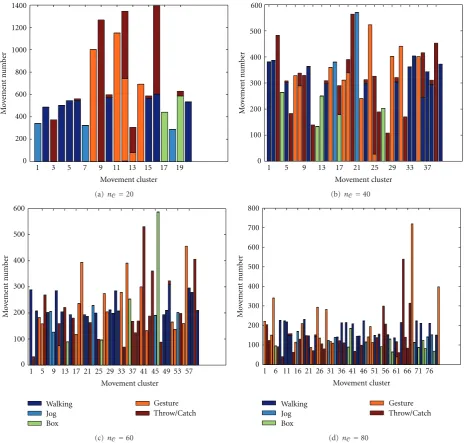
Figure6: Movement length dependent cluster composition for the HumanEva basic activities,nC =20 clusters and varying movement
lengthlm. The number of clusters with a mix of three activities reduces from 3 in (a) and (b), to 1 in (c) and 0 in (d).
having greaterlm, the clusters have more dominant activities.
Thus, for nC = 20 clusters an increase in lm results in
better classification, since over a longer observation period
the classification is more stable. Figure 7 shows the MC
composition forlm=25 long movements for several cluster
numbers. It suggests that with an increase ofnC, the clusters
with larger covariance are split and hence clusters are more discriminatory.
For objectivity, a measure of cluster uniformity is defined as
u=
χ∈X
cmax
χ
2
/α∈A(χ)cχ,α
χ∈Xcmaxχ
, (13)
with
cmax
χ = max α∈A(χ)
cχ,α
, (14)
where X is the set of MCs, A(χ) is the set of activities
of clusterχ, andcχ,αis the histogram value of movements
of activity α in bin (i.e., cluster) χ. The uniformity u is
one if all clusters have movements from a single cluster only; otherwise it favours clusters with a higher number of movements, penalising those with fewer. The minimum
value is 1/|A|, the inverse of the cardinality of the activity
0
1 3 5 7 9 11 13 15 17 19
Movement cluster 200
400 600 800 1000 1200 1400
M
o
ve
ment
n
umber
(a)nC=20
Movement cluster
M
o
ve
ment
n
umber
0 100 200 300 400 500 600
1 5 9 13 17 21 25 29 33 37
(b)nC=40
Movement cluster
M
o
ve
ment
n
umber
0 100 200 300 400 500 600
1 5 9 13 17 21 25 29 33 37 41 45 49 57
Jog Box
Gesture Walking
Throw/Catch 53
(c)nC=60
Movement cluster
Jog Box
Gesture Walking
1 6 11 16 21 26 31 36 41 46 51 56 61 66 71 76
M
o
ve
ment
n
umber
0 100 200 300 400 500 600 800
700
Throw/Catch
(d)nC=80
Figure7: MC number-dependent cluster composition for the HumanEva basic activities,lm =25 movement length and varying cluster numbernC.
Table2: Cluster uniformity u[%], in relation to the number of clustersnCand the sequence lengthlm.
nC lm
1 3 5 15 25 35
20 91.5 91.7 90.4 91.5 93.0 95.7
40 94.6 93.6 94.9 94.5 97.3 97.4
60 96.2 95.7 96.7 96.9 99.5 99.1
80 96.4 96.8 97.6 98.5 99.3 99.0
100 96.5 97.4 97.9 98.8 99.6 99.4
Table 2 confirms that increases in both the movement length and the number of clusters enhance the MC
uni-formity. This is maximal for nC = 60 and lm = 25.
Summarising, we can conclude that MCs contain similar movements and the discrimination between global actions is enhanced with more clusters and longer movements.
One would expect the number of clusters to be equal to the number of activities (i.e., five for HumanEva). This is not the case for many reasons: the high dimensional parameter space is multimodal, and clusters are used to classify not just one cluster of exclusive activities, but also actions, which can overlap and combine independently with
other actions. This requires a value fornC high enough to
allow combinations between different actions. Adding more
MC: 96 MC: 31 MC: 64 MC: 49
MC: 75 MC: 7 MC: 42 MC: 42
MC: 66 MC: 66 MC: 66 MC: 66
Figure8: Left leg random motion (mode=poseonly) with MCMModel5.nC=100,lm=3. The initial MC ismc0 = 1, not shown in the figure. This model is for the left leg only, therefore all other parameters are fixed.
1 38
31 67
96
77 68
7 42
47
66 39
11 100 60
21 22
64 49
37 72
97
65
75 57 3
Figure9: A leg MC transition sequence. The graph of 100 randomly generated transitions between leg MCs, with the first 12 poses shown inFigure 8.
3.2. Synthetic Motion Generation. An effective motion
generator,Algorithm 1, with a good MCM should generate
a natural motion. To demonstrate this, we show inFigure 8
a sequence of generated leg poses (i.e., BFVs) from a single
initial pose using the left whole leg MCM (i.e.,M5fromTable
1). It worth remarking that the corresponding MC transition
diagram,Figure 9, is cyclic and allows different dynamics for
the body part such as walking or other trained actions. Transitions to the same MC are present, since consecutive poses are similar, but the stochastic component of the MC ensures that the poses are not identical. No interpenetration of body parts was observed for an MCM that includes multiple parts, however MCMs that model independent limbs only may allow this.
4. Semantic Analysis
Next, we evaluate our approach to behavioural analysis using the SMCM against ground truth and verification data from MOCAP poses of the HumanEva datasets.
4.1. Action in the HumanEva Dataset. The HumanEva
dataset includes Walk, Jog, Throw/Catch, Box and Gesture
activities. A movement is part of one of the five actions that directly corresponds to an activity that a video sequence
represents. Therefore a movement can be explicitly described
with thisgloballabel. Consequently, all 20 training sequences
of HumanEva have been labelled for subjects S1 and S2
with one of the Walk, Throw/Catch, Jog, Gesture and Box
global activity labels. Further to these global labels, five of
the HumanEva trainsequences were described by us with
detailedlabels fromTable 3. As a result of this training phase,
we can define a SMCM,M1, trained with labels fromTable 3.
The global (e.g., Walk, Throw/Catch, etc.) and the
detailed labels (e.g., left stride back, left hand throw) are
considered at the same semanticactionlevel. One can argue
that global labels are activities, however components of a long sequence can be viewed as an action that defines the
activity with the same name. Hence,Walkis an action and
is part of theWalkactivity. TheWalkactivity could also be
inferred using detailed labels, but this is not the current aim.
Further, aWalkaction may be part of a more complex activity
such as Shopping. Here, activity description is composed
from concurrently detected global and local actions that provide detailed behavioural information.
4.2. Behavioural Analysis of HumanEva Dataset with the
SMCM. Figures10 and11 show the behavioural
probabil-ities of actions resulting from (8) for up to 190 movements
Table3: Detailed labels with descriptions and training sequences. For each left and right side, five pairs of action labels are trained with two or five HumanEva sequences.
Label Description Sequence
Left/right stride back Left/right leg is moving forward from behind the right/left leg S1 Walking 1, S1 Walking 3.
Left/right stride front Left/right leg is moving forward ahead of the right/left leg S1 Walking 1, S1 Walking 3.
Left/right arm forward Left/right arm is moving forward
S1 Walking 1, S1 Walking 3, S1 ThrowCatch 1, S2 ThrowCatch 1, S2 ThrowCatch 3.
Left/right arm backward Left/right arm is moving back-wards
S1 Walking 1, S1 Walking 3, S1 ThrowCatch 1, S2 ThrowCatch 1, S2 ThrowCatch 3.
Left/right hand throw Right/left hand throw
S1 Walking 1, S1 Walking 3, S1 ThrowCatch 1, S2 ThrowCatch 1, S2 ThrowCatch 3.
The model parameters fromSection 2.5, that is, sequence
lengthslm, cluster numbersnC, and BFV partition selection
all affect recognition. The effect of these parameters are
investigated next.
First, a whole body model,M1, was trained as described
in the previous section, we then used thevalidateHumanEva
sequences to assess the reliability of activity recognition on unseen video sequences. While subjects S1 and S2
have training data (from thetrainsequences, distinct from
validate), subject S3 was not included in training. Hence, S3 evaluates recognition for an unseen subject. For each frame, that is, each movement ending at the current frame within S1
and S3, the label probabilities resulting from (8) are shown
inFigure 10. TheWalklabel for the wholeS1 Walking 1test sequence is well recognised; the four stride labels and the four arm forward and backward labels are observed with excellent periodicity, even though neither the training nor the analysis process was aware of this recurring nature. The least accurate
recognition is for theS3 Gesture 1sequence, because of its
similarities with theThrow/Catchactivity.
The visual evaluation of sequence lengthslmand cluster
numbers nC of theS1 Walking 1 sequence from Figure 11
suggests that selection of sequence length is more important than the number of clusters. With higher sequence length, recognition of shorter actions degrades, especially for low
cluster numbers. An increase ofnCresults in finer detail. The
transitions between detailed labels are smoother and have intermediate probability values.
Finally, Figure 12 shows the confusion matrices of the
global actions, defined as
C(λa,λb)=Em∈(sequences of actionλb)P(λa|m), (15)
the expectation ofλadetected labels over all movements with
ground truth labelλb.
The figure represents the overall recognition
perfor-mance in classifying all movements of the validate dataset
sequences. Misclassification ofThrow/Catch,GestureandBox
activities withGestureorBoxforlm=15, or no-detection for
(lm = 25,nC = 100) are emphasised with longer sequence
length.
Generally, the SMCM supplies independent action
prob-abilities and therefore concurrentlyWalkandThrow/Catch,
or evenWalkandJog can be recognised and their
probabil-ities of actions do not sum up to one. In this test, we have exclusive actions, hence the lines of the confusion matrices are normalised to one. However, if none of the labels are recognised then all probabilities are zero.
4.3. Actions from Partial SMCMs. In the previous section,
the full body BFV, that is,M1, was employed. However, all
SMCMs (Table 1) provide action labels.Figure 13shows the
recognised label probabilities for theS1 Walking 1sequence
fornC =100 andlm =3 for the 13 SMCMs (all except the
unreliable head MCM), and theOveralllabel with the overall
average label probability of the SMCMs.
The response of the limb level models to a label that is defined by another limb confirms the strong dependence between the parameters. However, as expected, legs, and
specifically whole legs (i.e., M5 and M6), best reproduce
Walk Throw/Catch Jog
Box Left stride (back) Left stride (front) Right stride (back) Right stride (front) Left arm forward Left arm backwards Right arm forward Right arm backwards Right hand throw Right hand catch Left hand catch
Frame number 20 40 60 80 100 120 140 160 180
S1 Walking Gestures Walk Throw/Catch Jog Box Left stride (back) Left stride (front) Right stride (back) Right stride (front) Left arm forward Left arm backwards Right arm forward Right arm backwards Right hand throw Right hand catch Left hand catch
Frame number
20 40 60 80 100 120
Jog Gestures Walk Throw/Catch Jog Box Left stride (back) Left stride (front) Right stride (back) Right stride (front) Left arm forward Left arm backwards Right arm forward Right arm backwards Right hand throw Right hand catch Left hand catch
Frame number 20 40 60 80 100 120
0.1 0.2 0.3 0.4 0.5 0.6 0.7 0.8 0.9 Gesture Gestures Walk Throw/Catch Jog Box Left stride (back) Left stride (front) Right stride (back) Right stride (front) Left arm forward Left arm backwards Right arm forward Right arm backwards Right hand throw Right hand catch Left hand catch
Frame number 20 40 60 80 100 120 140
S3 Gestures Walk Throw/Catch Jog Box Left stride (back) Left stride (front) Right stride (back) Right stride (front) Left arm forward Left arm backwards Right arm forward Right arm backwards Right hand throw Right hand catch Left hand catch
Frame number 20 40 60 80 100 120 Gestures
Walk Throw/Catch Jog
Box Left stride (back) Left stride (front) Right stride (back) Right stride (front) Left arm forward Left arm backwards Right arm forward Right arm backwards Right hand throw Right hand catch Left hand catch
Frame number 20 40 60 80 100 120 140 160
0.1 0.2 0.3 0.4 0.5 0.6 0.7 0.8 0.9 Gestures
Figure10: Recognition with known and unknown human subjects ofWalk,Jog, andGestureactivities. Subject S1 was trained, while S3 was
not. The model hasnC =100 andlm =5. The probability of labels (vertical) for each frame (on horizontal) is colour coded. For the first
lm−1 frames no movement can be defined, and for frames 6–12 and 64–69 forWalkS1, frames 32–40 and 56–63 forWalkS3, frames 80–125
forJogS1, frames 28–35, 41–55, 58–106 and 115–180 forGestureS3 one oflmthe PV is missing, therefore no recognition is possible. This is visible by the vertical zero probability bands.
Walk Throw/Catch Jog
Box Left stride (back) Left stride (front) Right stride (back) Right stride (front) Left arm forward Left arm backwards Right arm forward Right arm backwards Right hand throw Right hand catch Left hand catch
Frame number 20 40 60 80 100 120 140 160 180
lm=5
nC = 20 Gestures Walk Throw/Catch Jog Box Left stride (back) Left stride (front) Right stride (back) Right stride (front) Left arm forward Left arm backwards Right arm forward Right arm backwards Right hand throw Right hand catch Left hand catch
Frame number 20 40 60 80 100 120 140 160 180
lm=15
Gestures
W a l k T h r o w / C a t c h J o g
B o x L e f t s t r i d e ( b a c k ) L e f t s t r i d e ( f r o n t ) R i g h t s t r i d e ( b a c k ) R i g h t s t r i d e ( f r o n t ) L e f t a r m f o r w a r d L e f t a r m b a c k w a r d s R i g h t a r m f o r w a r d R i g h t a r m b a c k w a r d s R i g h t h a n d t h r o w R i g h t h a n d c a t c h L e f t h a n d c a t c h
F r a m e n u m b e r 2 0 4 0 6 0 8 0 1 0 0 1 2 0 1 4 0 1 6 0 1 8 0
0 . 1 0 . 2 0 . 3 0 . 4 0 . 5 0 . 6 0 . 7 0 . 8 0 . 9
lm=25
Gestures
Walk Throw/Catch Jog
Box Left stride (back) Left stride (front) Right stride (back) Right stride (front) Left arm forward Left arm backwards Right arm forward Right arm backwards Right hand throw Right hand catch Left hand catch
Frame number 20 40 60 80 100 120 140 160 180
nC = 60 Gestures Walk Throw/Catch Jog Box Left stride (back) Left stride (front) Right stride (back) Right stride (front) Left arm forward Left arm backwards Right arm forward Right arm backwards Right hand throw Right hand catch Left hand catch
Frame number 20 40 60 80 100 120 140 160 180 Gestures
Walk Throw/Catch Jog
Box Left stride (back) Left stride (front) Right stride (back) Right stride (front) Left arm forward Left arm backwards Right arm forward Right arm backwards Right hand throw Right hand catch Left hand catch
Frame number 20 40 60 80 100 120 140 160 180
0.1 0.2 0.3 0.4 0.5 0.6 0.7 0.8 0.9 Gestures Walk Throw/Catch Jog Box Left stride (back) Left stride (front) Right stride (back) Right stride (front) Left arm forward Left arm backwards Right arm forward Right arm backwards Right hand throw Right hand catch Left hand catch
Frame number 20 40 60 80 100 120 140 160 180
nC = 100 Gestures Walk Throw/Catch Jog Box Left stride (back) Left stride (front) Right stride (back) Right stride (front) Left arm forward Left arm backwards Right arm forward Right arm backwards Right hand throw Right hand catch Left hand catch
Frame number 20 40 60 80 100 120 140 160 180 Gestures
Walk Throw/Catch Jog
Box Left stride (back) Left stride (front) Right stride (back) Right stride (front) Left arm forward Left arm backwards Right arm forward Right arm backwards Right hand throw Right hand catch Left hand catch
Frame number 20 40 60 80 100 120 140 160 180
0.1 0.2 0.3 0.4 0.5 0.6 0.7 0.8 0.9 Gestures
Figure11:S1 Walking 1activity recognition for SMCMs with number of clustersnC=20, 60, 100 and length of sequencelm=5, 15, 25. The
zero probability vertical bands result from the missing pose information for frames 6–10 and 64–67. For these and the subsequentlm−1
Walk T/C Gest. Box Jog Recognised Walk
T/C
Gest.
Box
Jog
Tr
u
th
lm=5
nC
=
20
Walk T/C Gest. Box Jog Recognised Walk
T/C
Gest.
Box
Jog
Tr
u
th
lm=15
Walk T/C Gest. Box Jog Recognised Walk
T/C
Gest.
Box
Jog
Tr
u
th
lm=25
0.1 0.2 0.3 0.4 0.5 0.6 0.7 0.8 0.9
Walk T/C Gest. Box Jog Recognised Walk
T/C
Gest.
Box
Jog
Tr
u
th
nC
=
60
Walk T/C Gest. Box Jog Recognised Walk
T/C
Gest.
Box
Jog
Tr
u
th
Walk T/C Gest. Box Jog Recognised Walk
T/C
Gest.
Box
Jog
Tr
u
th
0.1 0.2 0.3 0.4 0.5 0.6 0.7 0.8 0.9
Walk T/C Gest. Box Jog Recognised Walk
T/C
Gest.
Box
Jog
Tr
u
th
nC
=
100
Walk T/C Gest. Box Jog Recognised Walk
T/C
Gest.
Box
Jog
Tr
u
th
Walk T/C Gest. Box Jog Recognised Walk
T/C
Gest.
Box
Jog
Tr
u
th
0.1 0.2 0.3 0.4 0.5 0.6 0.7 0.8 0.9
Figure12: Confusion matrices for SMCMs with number of clustersnC=20, 60, 100 and length of sequencelm=5, 15, 25.
combining SMCMs from a pool enhances label detection. However, the lower probabilities compared to individual SMCM probabilities convey that some do not contribute.
4.4. Recognition Sensitivity. To analyse the effects of
param-eter errors caused by an inaccurate BFV or movement recovery, the SMCM model was tested against white noise
with 0 ≤ σ ≤ 2 variance, added to ground truth (i.e.,
MOCAP) model parameters of the S1 and S2 subjects from
the HumanEva-I dataset validate partition. The confusion
matrices in Figure 14show that recognition degrades with
σ, and a shift towardsBoxandThrow/Catchactions that are
similar to other activities, or have movements in common with them. This points out the necessity of accurate model recovery for good action recognition.
To evaluate the multiclass classification of actions, we have used either the full confusion matrix, or, for compact-ness, the ratio of the sum of the diagonal matrix to all matrix elements,
ζ=
iCi,i
i,jCi,j. (16)
This gives a measure of classification recognition success rate, but is not a strict percentage because the sum of all
action probabilities may be greater than one, that is, actions are not considered to be mutually exclusive.
The recognition success rateζis a function of the number
of clusters and movement length, and depends on the added
noise. For the full body SMCM,M1, the recognition success
rates for several nC, lm and σ are shown in Figure 15(a).
An average tracking noise standard deviation of about
100mm corresponds to aσ = 0.8 [19, page 151], with the
recognition success rates inTable 4.Figure 15(b)represents
the recognition success rate variation on the right leg SMCM,
M6. Both suggest a decrease in recognition success rate with
increased noise. Similar to the results fromSection 4.2, more
MCs degrade recognition, especially for long movements.
Figures show that error tolerance is best, 87%, forlm = 15
andnC =60 ornC=80, recognition success rate being kept
high for increasedσ. While recognition success rate is higher
forlm=1 the tolerance increases withlmup tolm=15.
On the other hand,Figure 15(b)suggests that for a model
with short BFV (i.e., right leg), the increase of either nC
orlm improves recognition success rate subject to increased
noise. Althoughζ is lower, since independent limbs are less
descriptive than the whole pose for global action detection,
the drop withσ =2 is less significant forM6, around 50%
Walk Throw/Catch Jog
Box Left stride (back) Left stride (front) Right stride (back) Right stride (front) Left arm forward Left arm backwards Right arm forward Right arm backwards Right hand throw Right hand catch Left hand catch
Frame number 20 40 60 80 100 120 140 160 180
Whole body Gestures Walk Throw/Catch Jog Box Left stride (back) Left stride (front) Right stride (back) Right stride (front) Left arm forward Left arm backwards Right arm forward Right arm backwards Right hand throw Right hand catch Left hand catch
Frame number 20 40 60 80 100 120 140 160 180
Left arm Gestures Walk Throw/Catch Jog Box Left stride (back) Left stride (front) Right stride (back) Right stride (front) Left arm forward Left arm backwards Right arm forward Right arm backwards Right hand throw Right hand catch Left hand catch
Frame number 20 40 60 80 100 120 140 160 180
0.1 0.2 0.3 0.4 0.5 0.6 0.7 0.8 0.9 Right arm Gestures Walk Throw/Catch Jog Box Left stride (back) Left stride (front) Right stride (back) Right stride (front) Left arm forward Left arm backwards Right arm forward Right arm backwards Right hand throw Right hand catch Left hand catch
Frame number 20 40 60 80 100 120 140 160 180
Left leg Gestures Walk Throw/Catch Jog Box Left stride (back) Left stride (front) Right stride (back) Right stride (front) Left arm forward Left arm backwards Right arm forward Right arm backwards Right hand throw Right hand catch Left hand catch
Frame number 20 40 60 80 100 120 140 160 180
Right leg Gestures Walk Throw/Catch Jog Box Left stride (back) Left stride (front) Right stride (back) Right stride (front) Left arm forward Left arm backwards Right arm forward Right arm backwards Right hand throw Right hand catch Left hand catch
Frame number 20 40 60 80 100 120 140 160 180
0.1 0.2 0.3 0.4 0.5 0.6 0.7 0.8 0.9
Left upper arm
Gestures
Walk Throw/Catch Jog
Box Left stride (back) Left stride (front) Right stride (back) Right stride (front) Left arm forward Left arm backwards Right arm forward Right arm backwards Right hand throw Right hand catch Left hand catch
Frame number 20 40 60 80 100 120 140 160 180
Right upper arm
Gestures
Walk Throw/Catch Jog
Box Left stride (back) Left stride (front) Right stride (back) Right stride (front) Left arm forward Left arm backwards Right arm forward Right arm backwards Right hand throw Right hand catch Left hand catch
Frame number 20 40 60 80 100 120 140 160 180
Left upper leg
Gestures
Walk Throw/Catch Jog
Box Left stride (back) Left stride (front) Right stride (back) Right stride (front) Left arm forward Left arm backwards Right arm forward Right arm backwards Right hand throw Right hand catch Left hand catch
Frame number 20 40 60 80 100 120 140 160 180
0.1 0.2 0.3 0.4 0.5 0.6 0.7 0.8 0.9
Right upper leg
Gestures
Walk Throw/Catch Jog
Box Left stride (back) Left stride (front) Right stride (back) Right stride (front) Left arm forward Left arm backwards Right arm forward Right arm backwards Right hand throw Right hand catch Left hand catch
Frame number 20 40 60 80 100 120 140 160 180
Left lower arm
Gestures
Walk Throw/Catch Jog
Box Left stride (back) Left stride (front) Right stride (back) Right stride (front) Left arm forward Left arm backwards Right arm forward Right arm backwards Right hand throw Right hand catch Left hand catch
Frame number 20 40 60 80 100 120 140 160 180
Right lower arm
Gestures
Walk Throw/Catch Jog
Box Left stride (back) Left stride (front) Right stride (back) Right stride (front) Left arm forward Left arm backwards Right arm forward Right arm backwards Right hand throw Right hand catch Left hand catch
Frame number 20 40 60 80 100 120 140 160 180
0.1 0.2 0.3 0.4 0.5 0.6 0.7 0.8 0.9
Left lower leg
Gestures
Walk Throw/Catch Jog
Box Left stride (back) Left stride (front) Right stride (back) Right stride (front) Left arm forward Left arm backwards Right arm forward Right arm backwards Right hand throw Right hand catch Left hand catch
Frame number 20 40 60 80 100 120 140 160 180
Right lower leg
Gestures
Walk Throw/Catch Jog
Box Left stride (back) Left stride (front) Right stride (back) Right stride (front) Left arm forward Left arm backwards Right arm forward Right arm backwards Right hand throw Right hand catch Left hand catch
Frame number 20 40 60 80 100 120 140 160 180
Overall
Gestures
Figure13: Recognition with SMCM set (Table 1, except head MCM) on theS1 Walking 1sequence. The last diagram shows the averaged overall performance of all SMCMs. The probability of labels (vertical) for each frame (on horizontal) is colour coded. Zero probability is
Walk T/C Gest. Box Jog Recognised Walk
T/C
Gest.
Box
Jog
Tr
u
th
Walk T/C Gest. Box Jog Recognised Walk
T/C
Gest.
Box
Jog
Tr
u
th
Walk T/C Gest. Box Jog Recognised Walk
T/C
Gest.
Box
Jog
Tr
u
th
0.1 0.2 0.3 0.4 0.5 0.6 0.7 0.8 0.9
Figure14: Action recognition with added noise. From left to right, confusion matrices forσ ∈ {0, 1, 2}for a SMCM withnC =100 and lm=5.
σ
0 0 . 2 0 . 4 0 . 6 0 . 8 1 1 . 2 1 . 4 1 . 6 1 . 8 2 0
2 0 4 0 6 0
8 0 1 0 0
(20, 1) (20, 3) (20, 5) (20, 15) (20, 25) (20, 35) (40, 1) (40, 3) (40, 5) (40, 15) (40, 25) (40, 35) (60, 1) (60, 3) (60, 5) (60, 15) (60, 25) (60, 35) (80, 1) (80, 3) (80, 5) (80, 15) (80, 25) (80, 35) (100, 1) (100, 3) (100, 5) (100, 15) (100, 25) (100, 35)
0 . 1 0 . 2 0 . 3 0 . 4 0 . 5 0 . 6 0 . 7 0 . 8 0 . 9
0 0 . 2 0 . 4 0 . 6 0 . 8 1
3 5 1 5 2 5 3 5
lm
1
σ=0 σ=0.2 σ=0.4 σ=0.6 σ=0.8 σ=1 σ=1.2 σ=1.4 σ=1.6 σ=1.8 σ=2
(
nC
,
lm
)
nC
(a) Whole pose SMCM (M1)
0.2 0.25 0.3 0.35 0.4 0.45 0.5 0.55 0.6 0.65
0.2 0.25 0.3 0.35 0.4 0.45 0.5 0.55 0.6 0.65
0.7
σ
0 0.2 0.4 0.6 0.8 1 1.2 1.4 1.6 1.8 2 20 40 60 80 1001 3 5 15 25 35
lm
(20, 1) (20, 3) (20, 5) (20, 15) (20, 25) (20, 35) (40, 1) (40, 3) (40, 5) (40, 15) (40, 25) (40, 35) (60, 1) (60, 3) (60, 5) (60, 15) (60, 25)
(80, 3) (80, 5) (80, 15) (80, 25) (80, 35) (100, 1) (100, 3) (100, 5) (100, 15) (100, 25) (100, 35)
σ=0 σ=0.2 σ=0.4 σ=0.6 σσσσ===011..82 =1..68 σ=2 σ=1.8 σ=1.4
(60, 35) (80, 1)
(
nC
,
lm
)
nC
(b) Right leg SMCM (M6)
Figure15: Recognition success rate ζ variation for added noiseσ ∈ {0.0, 0.2,. . ., 2.0}. With increasing noise, the recognition is degrading.
4.5. Activities from Actions. Generally, activities are
com-posed of multiple actions, however the SMCM classifies movement into actions only. The simplest inference of activity is the expectation of the activity labels over several,
Nactivity lm, frames and, in the extreme, over the whole
sequence. The confusion matrices resulting from classifying
each complete sequence (i.e., not each movement
individ-ually) are shown inFigure 16. The stationary activities are
misclassified as Gesture, because of the similarities of the
nC
Walk T/C Gest. Box Jog Recognised Walk
T/C
Gest.
Box
Jog
Tr
u
th
=20
Walk T/C Gest. Box Jog Recognised Walk
T/C
Gest.
Box
Jog
Tr
u
th
=60
nC
Walk T/C Gest. Box Jog Recognised Walk
T/C
Gest.
Box
Jog
Tr
u
th
0.1 0.2 0.3 0.4 0.5 0.6 0.7 0.8 0.9 =100
nC
Figure 16: Confusion matrices of sequence classification. Each HumanEva sequence is classified into the activity which has the most corresponding action.
Table4: Recognition success rate [%]ζ forσ =0.8 noise of the
analysed data in relation to the number of clusters nC and the
sequence lengthlm.
lm nC
20 40 60 80 100
1 56 44 40 39 46
3 63 61 58 59 56
5 59 64 59 67 54
15 65 65 79 74 69
25 42 43 60 37 24
35 45 19 40 20 20
Free Grammar [26] as used by Ivanov and Bobick [27].
However, this raises questions about the robust recovery of the shorter, temporal labels.
5. Behavioural Analysis from Tracked Data
5.1. The Influence of the MCM Parameters. Finally, we
evaluate behavioural analysis when the poses are provided
by a tracking algorithm, the HPPF [2,19], rather than the
MOCAP data. The effects ofnCandlmon the joint
tracking-analysis system, connected with (11), are compared for 5×
6, nC and lm values, Table 5, on the Walk, Throw/Catch,
GestureandJogsequences. Resource limits restricted tracking
tests to four out of the five HumanEva sequences, thus the
confusion matrices are 4×5 with no Box activity. Recall
fromSection 4.2that matrices do not normalise to one, since labels are considered independent, each with probability between zero and one. Null-lines are possible if no action cluster is recognised, that is, this is the nonrecognised action.
Random guessing one of four plus anunknownaction
(that includesBox) would result in a recognition success rate
of 0.20 if these actions were mutually exclusive. However,
as explained inSection 4.3our recognition does not classify
actions into one out of five categories, but computes a Bayesian probability that a sequence is an action, so that random guessing would in fact result in a value less than or equal to 0.2.
Table5: Recognition success rate [%] with identical SMCMs for
both tracking and behavioural analysis.M1SMCM is used only for
global action recognition.
lm nC
20 40 60 80 100
1 32 29 28 26 34
3 29 32 25 37 25
5 24 30 26 32 27
15 27 30 17 7 8
25 27 2 1 0 0
35 17 1 0 0 0
The success rates inTable 5are greater for shorter
move-ments. However, for greater lm, none of the independent
actions is recognised and the recognition success rate is zero.
The recognition success rate decreases withlmandnC. This
was expected fromSection 4.4(Figure 15(a)).
5.2. Tracking and Analysis with Independent Models. With the
formulation of (12), the SMCM parameters for behavioural
analysis are independent of the SMCM used in the HPPF tracker for motion prediction. Therefore the dependence of
semantic analysis by the SMCM on nC and lm is further
analysed using the same HPPF-MCM tracker with the lowest
errors (lm = 5,nC = 80). The recognition success rates,
shown inTable 6, are marginally poorer than for the HPPF
integrated model, however they show the same
degrada-tion with both lm and nC. As in Table 5, the recognition
success rates are highest with nC = 80 and lm = 3 or
lm=5.
Comparing Tables 5 and 6, one concludes that only
minor differences exist in the recognition success rates for
identical respectively independent SMCMs used for tracking and for analysis. For both, the recognition success rates are
low. Increasing either movement lengthlm, or cluster number
nC, degrades recognition. If both parameters are increased
concurrently, there are improvements, limited however to
Table6: Recognition success rate [%] for independent SMCMs for
both tracking and behavioural analysis.M1SMCM is used only for
global action recognition.
lm nC
20 40 60 80 100
1 30 34 31 34 35
3 31 23 28 35 26
5 27 29 22 31 33
15 29 32 25 8 4
25 23 3 0 0 0
35 18 1 0 0 0
5.3. The Influence of the SMCM Granularity. Analysis with
the full pose SMCM, M1, leads to the question whether
other modelsMifromTable 1, with reduced BFVs, are better
suitable. Therefore, recognition using the SMCM M7 (i.e.,
left upper arm parameters) has the recognition success rates
shown inTable 7.
Comparing the recognition success rates of M1 and
M7, Tables 5 and7 suggest that a partition of parameters
recognises actions better then the whole set; for models with
smaller partitions (i.e.,M7), a higher value oflm results in
better recognition. The first observation is motivated by the lower dimensional parameter space of the limb compared to the full pose SMCM (i.e., two against 18 dimensions). Since the longer MCs capture longer motion dynamics this explains the second observation. It is also observed that the
effect of increased MC number is not visible using either of
the models.
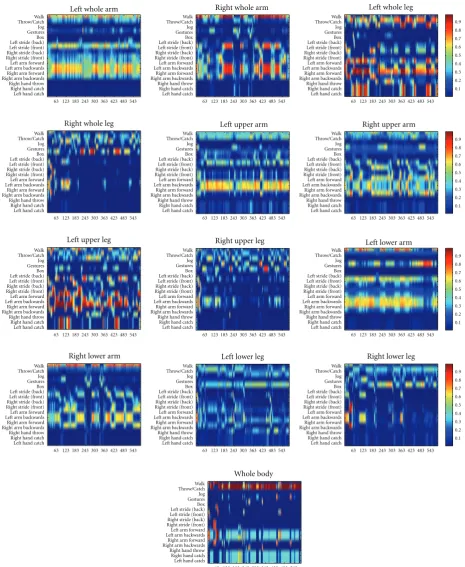
5.4. Recognition of HumanEva Sequences. Frame-by-frame
analysis provides insight into our results, although it is
subjective and qualitative.Figure 17shows for theS1 Walking
1sequence the probability of the labels (horizontal axis) for
each frame (vertical axis). The 13 diagrams for each sequence
correspond to recognition with one of the Mi SMCMs.
Both the tracking and the behavioural analysis use the same
SMCM set, withlm=5 andnC=80.
TheS1 Walking 1with the whole body SMCM recognises
correctly theWalkaction in the initial input, until frame 18,
and in frames 45–72, while the other 90% of the frames have
higher Throw/Catch probabilities. However, the diagrams
show that six out of twelve local SMCMs (whole lower left and right arms, right upper arm, left upper left and right lower arm) produce high walking probabilities. The other
SMCMs fail, and recogniseThrow/CatchorBox.
In addition to the global action labels, local labels provide detailed description of the action. These are evaluated either visually, comparing them frame-by-frame to the image, or qualitatively, by their periodic alternation. The repetitive
patterns ofRight stride backandfront,Left stride back(least
visible) andfrontare best seen on theLeft upper legSMCM.
The antiphase relationship of left arm forward, right arm
backwardsandright arm forward,left arm backwardsis also
visible in this diagram.
Table7: Recognition success rate [%] withM7SMCM is used only for global action recognition.
lm nC
20 40 60 80 100
1 26 26 27 26 26
3 26 25 27 28 28
5 30 29 29 31 31
15 31 41 39 38 34
25 31 34 40 36 35
35 35 38 33 46 42
Figure 18shows the labels recovered from the start of the
S1 Walking 1sequence using theM1SMCM superimposed
on the input S1 Walking 1 sequence frames. For clarity,
labels are grouped into General, Arm (left/right) and Leg
(left/right) semantics. Only labels with probability above
0.5 are displayed, in blue, and those with above 0.8, in
green. The Walk action is recognised in 11 frames, while
it is misclassified as Throw/Catch in 7 frames. Detailed
labels are correctly detected without misclassifications, if
detected, however in frames classified asThrow/Catch, they
are missed. This was expected, since labels attached to MCs
andThrow/CatchMCs, were not trained with arm and leg
actions specific toWalk.
5.5. Tracking Quality. Comparing the results in this section
to those of Section 4.4, which analysed the degradation in
behavioural recognition success rate with noise, it is clear
that the results are much poorer.Table 5compared toTable 4
suggests a drop in the recognition success rate of about 20% for the tracked data compared to the MOCAP sequence.
This is due primarily to the uneven distribution of the
errors for the different HumanEva sequences, which do not
follow a well-behaved Gaussian distribution as with the simulations, but rather are prone to gross outlying errors caused by tracker failure on limbs in particular, a far from trivial task. For example, the lower-limb parameters are particularly error prone when compared to the upper-limb parameters. This suggests that more accurate and stable tracking would greatly improve the analysis with SMCM.
5.6. Recognition of the CAVIAR Sequence. The CAVIAR
(EC Funded CAVIAR project/IST 2001 37540, found at
http://homepages.inf.ed.ac.uk/rbf/CAVIAR) dataset, com-pared to the HumanEva videos, is representative of real CCTV that has increased interest for behavioural analysis. In these lower resolution videos with high perspective, the tracking is less stable and several frames have visual tracking errors. This jeopardises recognition of both whole body movements and longer movements. Similar to the
HumanEva Walk sequence, the full pose SMCM is not
effective in recovering theWalkactions. As for theS1 Walking
1, theLeft upper leg,M9, SMCM provides the most detailed
information about the visible periodic motion patterns,
while seven levels recognise Walk with higher probability
6 3 1 2 3 1 8 3 2 4 3 3 0 3 3 6 3 4 2 3 4 8 3 5 4 3 W a l k
T h r o w / C a t c h J o g
B o x L e f t s t r i d e ( b a c k ) L e f t s t r i d e ( f r o n t ) R i g h t s t r i d e ( b a c k ) R i g h t s t r i d e ( f r o n t ) L e f t a r m f o r w a r d L e f t a r m b a c k w a r d s R i g h t a r m f o r w a r d R i g h t a r m b a c k w a r d s R i g h t h a n d t h r o w R i g h t h a n d c a t c h L e f t h a n d c a t c h
L e f t w h o l e a r m
Gestures
6 3 1 2 3 1 8 3 2 4 3 3 0 3 3 6 3 4 2 3 4 8 3 5 4 3 W a l k
T h r o w / C a t c h J o g
B o x L e f t s t r i d e ( b a c k ) L e f t s t r i d e ( f r o n t ) R i g h t s t r i d e ( b a c k ) R i g h t s t r i d e ( f r o n t ) L e f t a r m f o r w a r d L e f t a r m b a c k w a r d s R i g h t a r m f o r w a r d R i g h t a r m b a c k w a r d s R i g h t h a n d t h r o w R i g h t h a n d c a t c h L e f t h a n d c a t c h
R i g h t w h o l e a r m
Gestures
0 . 1 0 . 2 0 . 3 0 . 4 0 . 5 0 . 6 0 . 7 0 . 8 0 . 9
6 3 1 2 3 1 8 3 2 4 3 3 0 3 3 6 3 4 2 3 4 8 3 5 4 3 W a l k
T h r o w / C a t c h J o g
B o x L e f t s t r i d e ( b a c k ) L e f t s t r i d e ( f r o n t ) R i g h t s t r i d e ( b a c k ) R i g h t s t r i d e ( f r o n t ) L e f t a r m f o r w a r d L e f t a r m b a c k w a r d s R i g h t a r m f o r w a r d R i g h t a r m b a c k w a r d s R i g h t h a n d t h r o w R i g h t h a n d c a t c h L e f t h a n d c a t c h
L e f t w h o l e l e g
Gestures
6 3 1 2 3 1 8 3 2 4 3 3 0 3 3 6 3 4 2 3 4 8 3 5 4 3 W a l k
T h r o w / C a t c h J o g
B o x L e f t s t r i d e ( b a c k ) L e f t s t r i d e ( f r o n t ) R i g h t s t r i d e ( b a c k ) R i g h t s t r i d e ( f r o n t ) L e f t a r m f o r w a r d L e f t a r m b a c k w a r d s R i g h t a r m f o r w a r d R i g h t a r m b a c k w a r d s R i g h t h a n d t h r o w R i g h t h a n d c a t c h L e f t h a n d c a t c h
Right whole leg
Gestures
6 3 1 2 3 1 8 3 2 4 3 3 0 3 3 6 3 4 2 3 4 8 3 5 4 3 W a l k
T h r o w / C a t c h J o g
B o x L e f t s t r i d e ( b a c k ) L e f t s t r i d e ( f r o n t ) R i g h t s t r i d e ( b a c k ) R i g h t s t r i d e ( f r o n t ) L e f t a r m f o r w a r d L e f t a r m b a c k w a r d s R i g h t a r m f o r w a r d R i g h t a r m b a c k w a r d s R i g h t h a n d t h r o w R i g h t h a n d c a t c h L e f t h a n d c a t c h
L e f t u p p e r a r m
Gestures
0 . 1 0 . 2 0 . 3 0 . 4 0 . 5 0 . 6 0 . 7 0 . 8 0 . 9
6 3 1 2 3 1 8 3 2 4 3 3 0 3 3 6 3 4 2 3 4 8 3 5 4 3 W a l k
T h r o w / C a t c h J o g
B o x L e f t s t r i d e ( b a c k ) L e f t s t r i d e ( f r o n t ) R i g h t s t r i d e ( b a c k ) R i g h t s t r i d e ( f r o n t ) L e f t a r m f o r w a r d L e f t a r m b a c k w a r d s R i g h t a r m f o r w a r d R i g h t a r m b a c k w a r d s R i g h t h a n d t h r o w R i g h t h a n d c a t c h L e f t h a n d c a t c h
R i g h t u p p e r a r m
Gestures
6 3 1 2 3 1 8 3 2 4 3 3 0 3 3 6 3 4 2 3 4 8 3 5 4 3 W a l k
T h r o w / C a t c h J o g
B o x L e f t s t r i d e ( b a c k ) L e f t s t r i d e ( f r o n t ) R i g h t s t r i d e ( b a c k ) R i g h t s t r i d e ( f r o n t ) L e f t a r m f o r w a r d L e f t a r m b a c k w a r d s R i g h t a r m f o r w a r d R i g h t a r m b a c k w a r d s R i g h t h a n d t h r o w R i g h t h a n d c a t c h L e f t h a n d c a t c h
Left upper leg
Gestures
6 3 1 2 3 1 8 3 2 4 3 3 0 3 3 6 3 4 2 3 4 8 3 5 4 3 W a l k
T h r o w / C a t c h J o g
B o x L e f t s t r i d e ( b a c k ) L e f t s t r i d e ( f r o n t ) R i g h t s t r i d e ( b a c k ) R i g h t s t r i d e ( f r o n t ) L e f t a r m f o r w a r d L e f t a r m b a c k w a r d s R i g h t a r m f o r w a r d R i g h t a r m b a c k w a r d s R i g h t h a n d t h r o w R i g h t h a n d c a t c h L e f t h a n d c a t c h
R i g h t u p p e r l e g
Gestures
0 . 1 0 . 2 0 . 3 0 . 4 0 . 5 0 . 6 0 . 7 0 . 8 0 . 9
6 3 1 2 3 1 8 3 2 4 3 3 0 3 3 6 3 4 2 3 4 8 3 5 4 3 W a l k
T h r o w / C a t c h J o g
B o x L e f t s t r i d e ( b a c k ) L e f t s t r i d e ( f r o n t ) R i g h t s t r i d e ( b a c k ) R i g h t s t r i d e ( f r o n t ) L e f t a r m f o r w a r d L e f t a r m b a c k w a r d s R i g h t a r m f o r w a r d R i g h t a r m b a c k w a r d s R i g h t h a n d t h r o w R i g h t h a n d c a t c h L e f t h a n d c a t c h
L e f t l o w e r a r m
Gestures
6 3 1 2 3 1 8 3 2 4 3 3 0 3 3 6 3 4 2 3 4 8 3 5 4 3 W a l k
T h r o w / C a t c h J o g
B o x L e f t s t r i d e ( b a c k ) L e f t s t r i d e ( f r o n t ) R i g h t s t r i d e ( b a c k ) R i g h t s t r i d e ( f r o n t ) L e f t a r m f o r w a r d L e f t a r m b a c k w a r d s R i g h t a r m f o r w a r d R i g h t a r m b a c k w a r d s R i g h t h a n d t h r o w R i g h t h a n d c a t c h L e f t h a n d c a t c h
R i g h t l o w e r a r m
Gestures
6 3 1 2 3 1 8 3 2 4 3 3 0 3 3 6 3 4 2 3 4 8 3 5 4 3 W a l k
T h r o w / C a t c h J o g
B o x L e f t s t r i d e ( b a c k ) L e f t s t r i d e ( f r o n t ) R i g h t s t r i d e ( b a c k ) R i g h t s t r i d e ( f r o n t ) L e f t a r m f o r w a r d L e f t a r m b a c k w a r d s R i g h t a r m f o r w a r d R i g h t a r m b a c k w a r d s R i g h t h a n d t h r o w R i g h t h a n d c a t c h L e f t h a n d c a t c h
L e f t l o w e r l e g
Gestures
0 . 1 0 . 2 0 . 3 0 . 4 0 . 5 0 . 6 0 . 7 0 . 8 0 . 9
6 3 1 2 3 1 8 3 2 4 3 3 0 3 3 6 3 4 2 3 4 8 3 5 4 3 W a l k
T h r o w / C a t c h J o g
B o x L e f t s t r i d e ( b a c k ) L e f t s t r i d e ( f r o n t ) R i g h t s t r i d e ( b a c k ) R i g h t s t r i d e ( f r o n t ) L e f t a r m f o r w a r d L e f t a r m b a c k w a r d s R i g h t a r m f o r w a r d R i g h t a r m b a c k w a r d s R i g h t h a n d t h r o w R i g h t h a n d c a t c h L e f t h a n d c a t c h
R i g h t l o w e r l e g
Gestures
6 3 1 2 3 1 8 3 2 4 3 3 0 3 3 6 3 4 2 3 4 8 3 5 4 3 W a l k
T h r o w / C a t c h J o g
B o x L e f t s t r i d e ( b a c k ) L e f t s t r i d e ( f r o n t ) R i g h t s t r i d e ( b a c k ) R i g h t s t r i d e ( f r o n t ) L e f t a r m f o r w a r d L e f t a r m b a c k w a r d s R i g h t a r m f o r w a r d R i g h t a r m b a c k w a r d s R i g h t h a n d t h r o w R i g h t h a n d c a t c h L e f t h a n d c a t c h
W h o l e b o d y
Gestures
Figure17: HumanEvaS1 Walking 1sequence recognition. On each of the 13 MCM levels, for all frames (on horizontal) the probability of each label (vertical) is shown colour coded.
Since there are neither training data nor ground truth labeled activities, we use a SMCM trained with the HumanEva dataset and the results are evaluated visually.
Figure 19 shows the action labels, superimposed on 6 out
of the first 18 frames of the tracked sequence. Frames are
misclassified by the similar but static Throw/Catchactivity.
However, the rest of the frames are classified asWalk, and
![Table 6: Recognition success rate [%] for independent SMCMs forboth tracking and behavioural analysis](https://thumb-us.123doks.com/thumbv2/123dok_us/903988.1588031/16.600.311.549.100.200/table-recognition-success-independent-forboth-tracking-behavioural-analysis.webp)