The development and evaluation of a Learning from Incidents toolkit
Anoush Margaryan (corresponding author)
Goethe University Frankfurt, Theodor-W.-Adorno-Platz 6, PF 14
60629 Frankfurt am Main, Germany
Allison Littlejohn
Open University, Walton Hall, Milton Keynes MK7 6AA, UK
Dane Lukic
Glasgow Caledonian University, 70 Cowcaddens Rd, Glasgow G4 0BA, UK
Abstract
This paper describes the development and evaluation of a toolkit to support organisations in
improving their learning from incidents (LFI) activities. Grounded in adult learning theory,
extensive literature review and empirical research within the energy sector, the LFI Toolkit
has five key components: a Process Model; a Framework; a Questionnaire; a set of
Guidelines; and a series of Engagement Exercises. The LFI Toolkit fosters participatory
2
two large energy companies. The data were drawn from four participatory co-design
workshops and a stakeholder engagement review meeting including practitioners from a
variety of organisations and roles – shopfloor workers, frontline and middle managers, senior
leaders, health and safety specialists and representatives of professional bodies. The findings
provide insight into the clarity, usability and relevance of the Toolkit and the feasibility of its
application across other companies.
Keywords
Learning from incidents; organisational learning; participatory research; participatory action
research; adult learning
1. Background: LFI issues and adult learning principles
Effective learning from incidents (LFI) is critical for safe working. An LFI process is
effective when it enables organisations to accumulate and embed knowledge of causes of
incidents in ways that can prevent future incidents (Lukic, 2012). Many organisations have
invested in LFI, however, near-misses and incidents continue to occur, sometimes at
catastrophic scale, as exemplified by the recent BP’s Deepwater Horizon oil spill or the
Santiago de Compostela train derailment.
A typical LFI process starts with an incident being reported and investigated to identify the
causes (Lindberg et al., 2010). Investigation reports typically produce recommendations for
the organisation or the industry. These ‘learning points’ usually focus on policy or process
changes that need to be put in place to prevent or ameliorate future incidents. Several key
issues in current organisational approaches to LFI have been identified (Lukic, 2012; Lukic et
al, 2010; 2012a; 2012b; Margaryan et al, 2016). An outcome of these literature analyses was
a conceptual framework of LFI that is outlined later in this paper. We shall not reiterate the
full findings of the analyses here, but would like to highlight a few key issues that have
particularly stimulated the work described in this paper.
The first issue identified in the literature is that organisations often miss key opportunities for
learning throughout the incident lifecycle (Cooke and Rohleder, 2004). Often, learning
activities are planned as the last step in the lifecycle, after the incident has been investigated
and analysed by investigators (Lukic, 2012). A thorough investigation is a necessary but
insufficient foundation for learning from incidents. Opportunities for learning occur from the
point of initial reporting and investigation to the implementation of actions to prevent future
incidents. To capitalise on these opportunities, organisations would benefit from integrating
various types of learning activities and pathways to employee participation throughout the
lifecycle of an incident (Lukic et al, 2013). Such continuous and broader engagement with
LFI would help foster organisation-wide learning and improvement in safety practices.
The second issue is that organisational LFI initiatives tend to be limited to dissemination of
findings from incident investigations. This means that in LFI, ‘learning’ is conceptualised as
the knowledge and information about the causes of incidents developed by investigators and
disseminated to others in the organisation who are expected to learn from this information
4
to result in the necessary changes in behaviour and professional practice to prevent future
incidents (Lukic et al., 2012a). In order to learn, people have to use information in ways that
are meaningful to their jobs (Carroll, 1995). Learning initiatives based around unidirectional
flow of information often struggle to engage the workforce, missing the opportunity to
capitalise on employees’ experiential knowledge of their local contexts (Pedler, 2002).
The third issue is that LFI initiatives are seldom grounded in what we know about how
people learn individually and as part of collectives such as teams and organisations (Lukic et
al., 2010). Research in adult learning has demonstrated that people learn not only by reading
reports and circulars, but also by guided reflection, deliberate practice, giving and receiving
feedback and by observing and emulating other people’s behaviour (Ericsson et al, 2006;
Fuller and Unwin, 2004; Malloch et al, 2011; Smith et al, 2008; Snowden, 2002; Weick et al.,
2005). Our literature review suggests that LFI initiatives seldom provide opportunities for
employees to reflect on incident information and to make sense of it in ways that are
meaningful for their specific jobs. This is partly because those responsible for safety in
organisations often have limited knowledge of adult learning principles, how people learn in
the workplace, how to design effective learning processes that lead to improved safety, and
how to rigorously evaluate the effectiveness and quality of the outcomes of these learning
processes (Gordon, 2008).
How can adult learning theory help us address these issues? Several key principles of adult
learning based on nearly a century of research (Knowles et al, 2012; Lindeman, 1926) could
help us rethink LFI initiatives in organisations. The first principle is that adults are motivated
activity will help them satisfy that need (Carver and Scheier, 2005; Knowles, 1972). Adults
engage in learning largely in response to pressures they feel from their current life or work
situation. Therefore, adults’ orientation to learning is problem-centred rather than
topic-centred and their time perspective is focused on immediate rather than postponed application
of knowledge. A key implication for LFI is timing of learning - that is, grounding LFI
activities in real-life concerns and specific workplace contexts of workers. Whilst safety in
the workplace in general is of importance to workers, their engagement in LFI processes and
initiatives may be suboptimal if these do not tap into their specific needs, organisational
context and workplace situations. Because adults need to know why they need to learn
something before undertaking to learn it, LFI initiatives should stimulate workers to discover
for themselves the gaps between where they are now and where they want to be with regards
to safety.
The second fundamental principle of adult learning is that experience is the richest source of
learningfor adults (Smith and De Frates-Densch, 2008). Throughout their life, adults
accumulate a growing well of experience that they bring into their learning activity. Because
adults define themselves largely by their experience, they have a deep investment in the value
of their personal experiences. When adults find themselves in situations in which their
experience is not used or is minimized they will disengage or engage only suboptimally.
Therefore, within LFI initiatives a greater emphasis must be placed on approaches that tap
into the experiences of workers – that is, on experiential learning (Billett, 2010; Boud and
Walker, 1990; Kolb, 1984) such as group discussion, case study, simulation, role play, or
participatory co-design. To make learning more meaningful and integrated, LFI initiatives
6
contextualization and sensemaking rather than transmission of information (Weick, 1995).
The third principle of adult learning is that adults have a deep psychological need to be
self-directing and to be seen and treated by others as being capable of self-direction (Boekaerts et
al., 2005). Adults avoid, resist and resent situations in which they feel treated like children,
for example being told what to do and what not to do, being talked down, punished, or
judged. Adults tend to resist learning situations and learning activities that are inconsistent
with their self-concept as autonomous individuals and that do not take into account their
agency (Billett et al, 2005; Lukic et al., 2013). In adult learning contexts, the role of the
‘teacher’ - in LFI that is safety manager, supervisor or anyone else facilitating LFI - is to
engage in a process of a mutual inquiry with workers rather than to transmit his or her
knowledge to them and then evaluate their conformity to it. Therefore, in LFI initiatives, the
learning climate should lead workers to feel accepted and respected rather than fearing blame,
punishment or ridicule engaging workers in a process of self-diagnoses of their needs and
self-evaluation of their learning (Lukic et al., 2010).
The Engaging with Learning from Incidents project (LFI-Engage,
http://www.gcu.ac.uk/academy/lflengage/ ) project sought to address these issues and
principles by developing a toolkit to support companies in improving LFI processes and
practices - the Learning from Incidents (LFI) Toolkit. Specifically, the LFI Toolkit sought to:
• help organisations integrate various types of learning activities throughout the
lifecycle of an incident (continuous learning)
• engage the workforce in LFI by capitalising on the employees’ knowledge of their
• provide opportunities for employees to reflect on incident information and to make
sense of it in ways that are meaningful for their specific work contexts (sensemaking
and contextualisation)
• integrate experiential learning activities moving away from the information
dissemination model of LFI (experiential learning)
• engage in a process of a mutual inquiry with employees (participatory co-design)
In line with adult learning principles, the development and evaluation process was
underpinned by a participatory action research approach, through which researchers and
practitioners sought to jointly rethink and change organisational LFI practices drawing on
collective inquiry, reflection and experimentation (Chevalier et al, 2013). This paper reports
the development and initial formative evaluation of the LFI Toolkit at two sites of two
multinational energy companies. The individual components of the Toolkit have been
published in several journals as detailed in Section 2. Therefore, rather than elaborating on
the individual components of the Toolkit, the main purpose of this paper is to describe the
methodology, the process and the findings of the evaluation of the overall Toolkit.
2. Learning from Incidents (LFI) Toolkit
The LFI Toolkit is aimed at frontline managers, safety managers and frontline employees to
guide the implementation of LFI initiatives across company sites
http://publishing.energyinst.org/heartsandminds/toolkit/learning-from-incidents The LFI
Toolkit forms a part of the Energy Institute’s Hearts and Minds programme. The Energy
8
programme consists of a variety of toolkits and activities aimed at improving safety and
engaging workforce in safety development http://www.energyinst.org/heartsandminds . The
programme is used by many high-risk organisations around the world, predominantly in the
energy sector, to inform their safety policy and practice. Grounded in adult, workplace and
organisational learning theory, the LFI Toolkit extends the remit of the Hearts and Minds
programme by helping organisations engage employees in continuous, participatory and
experiential learning throughout the incident lifecycle (Littlejohn et al, 2017; Lukic et al.,
2012a; Lukic et al., 2010; Lukic et al., 2013; Margaryan et al, 201).
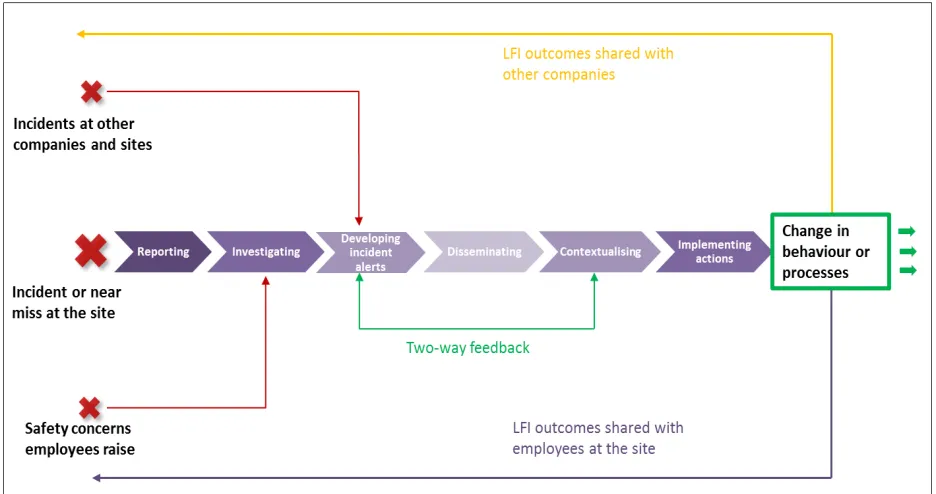
The LFI Toolkit consists of five components. Component 1, the LFI Process Model (Figure
1) helps organisations map LFI activities across a site to phases of the LFI lifecycle: reporting
incidents; investigating incidents; developing incident alerts; disseminating recommendations
and lessons learned from investigation; contextualising this information and implementing
actions (Lukic et al., 2012b). The LFI Process Model is empirical; it was devised from an
analysis of LFI activity on different industrial sites (Lukic, 2012). The model supports
organisations in understanding the inter-relationship of existing LFI activities on sites and
integrating opportunities to learn throughout the lifecycle of an incident rather than only at
Figure 1. The LFI Process Model (diagram adopted from Littlejohn et al, 2017)
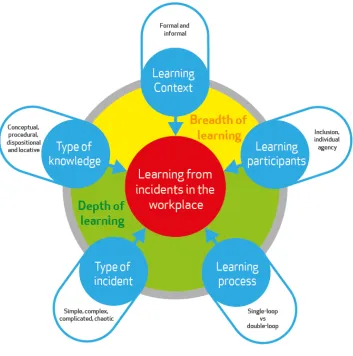
Component 2, the LFI Framework (Figure 2), contributes a set of key concepts and factors
synthesised from theories of adult, workplace and organisational learning to guide the
development of effective LFI activities. The literature review underpinning the LFI
Framework is reported in considerable detail in Lukic et al. (2010) and (2012a). In summary,
five key factors comprise the LFI Framework. First, the context of learning, for example
formal training versus informal, on-the job learning. Second, the participants of learning,
with the emphasis on the importance of engagement with a broad range of employees across
organisational levels by building on their sense of individual agency. Third, the processes of
learning, ranging from relatively ‘quick fix’ solutions such as skills training, punitive
decisions or technical changes (so called single-loop learning (Argyris and Schoen, 1996)) to
deep and open inquiry into causes, values and system failures underpinning incidents
10
simple to complex, complicated and chaotic (Snowden, 2002). Simple problems are those
where the cause and effect relationships are clear and solutions straightforward. Within
complicated problems, causal relationships are not readily evident requiring an in-depth
analysis to uncover these and to identify a solution. In contrast, complex problems involve
non-linear situations where causes and effects are intertwined in complex ways, so that they
can often be surfaced only in hindsight rather than determined in action. Chaotic problems
are usually unforeseen requiring rapid, decisive action, with little time for an in-depth
analysis. The final, fifth component of the LFI framework is type of knowledge and skill to be
learned (e.g. conceptual, procedural, dispositional, locative, recognising that different types
Figure 2. The LFI Framework (diagram adopted from Littlejohn et al, 2017)
Component 3, the Learning from Incidents Questionnaire (LFIQ) is a 46-item diagnostic
instrument to help organisations identify employees’ perceptions and experiences of the LFI
processes and practices. The LFIQ is structured around the six phases of the LFI Process
Model (see Component 1) and the five elements of the LFI Framework (Component 2),
thereby operationalising these for use in practice. The LFIQ was validated through a study
12
Component 4, the LFI Guidelines, includes specific guidance for each of the LFIQ items,
providing recommendations on how to address potential gaps and put the guidelines into
practice, pointing out potential links with other related Hearts and Minds tools where
possible. For example, a guideline on one of the LFIQ items recommends that organisations
‘Encourage employees to reflect on the importance and relevance of incident alerts to their
work’. Suggestions for implementing this guideline include: ‘Within incident alerts, provide
space where employees can add their reflections and actions relevant to their work’ and ‘Ask
all supervisors and team leaders to discuss with their work groups what changes in
behaviour would improve their work. Refer to the Hearts and Minds SAFE Tool for guidance
on how to achieve behavioural change’.
Component 5, the LFI Engagement Exercises, consists of four participatory co-design
workshop exercises to help employees reflect on incidents and apply lessons from these to
their own job, workplace processes and behaviour. The first exercise titled ‘Improving LFI at
your site’ helps employees jointly examine and improve their local LFI process. This exercise
builds on the results of the LFIQ survey for that particular site. The second exercise,
‘Developing incident alerts’, provides an opportunity for employees to devise incident alerts
from real-world investigation reports. This exercise enables employees to provide
suggestions on how incident information can be made relevant for various work groups and
their specific job tasks in their organisations. The third exercise, ‘Engaging with
dissemination’, engages workers in reflecting on the ways in which incident alerts are
disseminated within their site. This activity provides an opportunity to contextualise the
incident alerts relating these to employees’ own work. The fourth exercise, ‘Engaging with
employees in reflecting on how these apply to their own work and developing concrete
actions to address any potential similar issues at their site. The overall structure and the
contents of the LFI Toolkit are summarised in Figure 3:
Figure 3. Overview of the LFI Toolkit
The LFI Toolkit was developed and tested in partnership with two industrial sites, following
a collaborative, participatory co-design approach underpinned by adult learning principles
(Spinuzzi, 2005). The rationale was to enhance the usability of the Toolkit by building on the
local knowledge and expertise of workers (Pedler, 2002). This approach enabled us to engage LFI Process
LFIQ
LFI Guidelines
Engagement Exercises
TheLFI Process Model helps companies map their current LFI initiatives against six phases of an effective learning from incidents process and identify gaps. The LFI phases are: reporting; investigating; developing incident alerts; disseminating; contextualising and implementing actions. The model helps frontline and safety managers integrate all their LFI initiatives in ways that support learning throughout the process.
LFIQ (Learning from Incidents Questionnaire) helps companies diagnose the quality of their LFI practices and processes by measuring employees’ perceptions of these practices and processes. The results of LFIQ can help frontline managers, supervisors and safety managers prioritise and enhance the effectiveness of their LFI activities.
LFI Guidelines can be used by frontline managers, supervisors, safety managers and employees to improve their LFI processes, practices and the overall work environment. The LFI Guidelines are structured around the phases of the LFI Process Model and the components of the LFI Framework.
Engagement exercises are workshop-style group exercises that can help engage employees in the LFI process. There are four options suitable for different contexts. The engagement exercises offer frontline staff an opportunity to make sense of incident information by relating it to their own work.
LFI Framework
14
the beneficiaries of research (workers, frontline managers, safety managers, the
representatives of the Energy Institute) in co-creation of research outputs for practical use
(Klein, 1998; Perkmann & Walsh, 2007; Wierdsma, 2004). The methodology is detailed in
the next section.
3. Evaluation methodology and procedure: Participatory co-design
Participatory co-design methodology is based in participatory action research approach
(Chevalier et al, 2013). As Spinuzzi (2005) emphasised, although participatory co-design
research may draw on various qualitative and quantitative methods or combinations of these,
‘these methods are always used to iteratively construct the emerging design, which itself
simultaneously constitutes and elicits the research results as co-interpreted by the
designer-researchers and the participants who will use the design’ (p. 164). Therefore, participatory
co-design is an appropriate methodology to apply in developing a practitioner-focused LFI
Toolkit. Practitioners contribute deep and tacit understanding of their local contexts.
Traditional intervention research often fails to capture the detail and complexity of the
relevant inputs and tactics missing important information on how the intervention would
work in real-life settings (Stead et al., 2002). Participatory co-design and formative
evaluation allow for this local, contextual knowledge to be integrated into research outputs
making the tools, activities and processes produced by researchers more useful, feasible and
relevant (Glasgow et al., 2003).
Broadly, participatory co-design involves 3 iterative phases through which a product is
exploration, discovery and prototyping. Initial exploration involves researchers familiarising
themselves with the users and their organisational practices. Discovery helps researchers and
users discuss and clarify users’ goals and agree on desired outcome of the project. At
prototyping stage, researchers and practitioners iteratively co-design and shape the product
for organisational fit, usability, clarity and ease of use. All these stages are often conducted
on site involving one or more users. In producing the LFI Toolkit, engagement with a broad
representation of practitioners as early as possible was deemed essential.
In line with the methodology, the development and formative evaluation of the LFI Toolkit
included three steps. First, the Learning from Incidents Questionnaire, LFIQ, was developed
and validated (for a detailed description see Littlejohn et al, 2017). Second, participatory
co-design workshops were used to collaboratively develop the LFI Guidelines and Engagement
Exercises. Third, the resultant draft Toolkit was formatively evaluated at a Stakeholder
Review Meeting organised by the Energy Institute and attended by experts – senior
managers, safety managers, human factors specialists and academics – from a range of
industries and public bodies. This paper reports the outcomes of the second and third phases
focused on the collaborative development and formative evaluation of the LFI Guidelines and
Engagement Exercises. The development and validation of LFIQ are not discussed in this
paper as they are extensively reported elsewhere (Littlejohn et al, 2017).
Two sites in two different, multinational, energy companies in the UK and Canada were
involved in co-design workshops. We deliberately selected diverse sites in order to test the
16
1500 employees and is a part of a multinational oil and gas company. Site 2 is a wind power
plant in the UK. It has approximately 60 employees and is part of a UK energy company.
Two participatory co-design workshops were held at each site (four workshops in total). Each
site had a contact person - someone who was responsible for LFI at the site - whom we
termed the ‘gatekeeper’. This gatekeeper invited employees from across the site to volunteer
for the co-design workshops via an invitation email. The workshop participants were selected
using a combination of stratified and convenience sampling methods. At Site 1, the
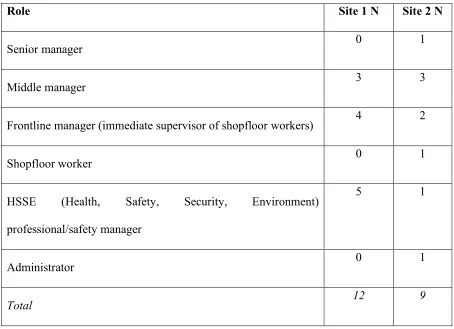
workshops had 12 participants; at Site 2 there were 9 participants. These participants were
engaged in a broad cross-section of roles across each site, ranging from shopfloor workers,
senior and middle managers, frontline managers, safety managers and contractor
Table 1: Participants of co-design workshops, by role
Role Site 1 N Site 2 N
Senior manager 0 1
Middle manager 3 3
Frontline manager (immediate supervisor of shopfloor workers) 4 2
Shopfloor worker 0 1
HSSE (Health, Safety, Security, Environment)
professional/safety manager
5 1
Administrator 0 1
Total 12 9
Each workshop lasted 5-6 hours, excluding lunch and coffee breaks. The majority of
participants at both sites took part in both workshop sessions, with the exception of two
people at Site 1 and one individual at Site 2 who participated in only one of the sessions.
These participants were briefed on the outcomes of the sessions they did not attend by the
gatekeeper who encouraged them to share their ideas by email. Overall, consistency of
participation and views was achieved for the workshop sessions. Facilitated by the third
author of this paper, the workshops followed a set agenda and session plan (for an example
18
During the first workshop at each site, the participants were presented with the LFI Process
Model followed by group discussion centred on mapping out the site’s current activities
corresponding to each of the phases of the Process Model. This activity helped identify gaps
and links in the LFI process at the site. The participants were then asked to comment on the
usefulness of the LFI Process Model (Figure 1) and invited to suggest how the Model could
be used at their site. After this introductory activity, the participants were presented with a
draft version of the LFI Guidelines; each guideline was discussed one-by-one by the
participants. When discussing the Process Model and the Guidelines, the participants were
asked to consider three main criteria:
• Clarity – How clear and understandable are the model and the guidelines?
• Usefulness – How might the model and the guidelines help improve LFI processes and
practices at the site?
• Feasibility – What is the feasibility of embedding the model and the guidelines within
your company?
The researcher encouraged the participants to be critical about the Model and the Guidelines
and to suggest improvements, exclusions and additions. In line with the iterative nature of the
evaluation methodology, the guidelines were revised on the basis of the findings from the
first workshop. The updates ranged from minor changes in wording to improve clarity to the
removal of recommendations which were found to have limited impact at the sites and the
inclusion of suggestions to help operationalise the Guidelines.
The aim of the second workshop was to further refine the LFI Guidelines as well as to
sent the LFI Guidelines, which were updated on the basis of the feedback received during the
first workshop. First, the feedback and comments received through email were discussed and
the wording and content of the Guidelines were revised together with the participants.
Second, one of the LFI Engagement Exercises (Exercise 3 ‘Engaging with dissemination’),
was tested with the participants, using an incident alert from the site as an example. The
participants and the researcher discussed the alert and decided on actions to improve it on the
basis of both the guidelines and participants’ own suggestions. Third, the instructions for
running each of the four LFI Engagement Exercises were discussed in groups. The
participants were asked to comment on the clarity, usefulness and feasibility of the
instructions and to suggest improvements. In this way, the content and the wording of all four
LFI Toolkit components were iteratively updated based on the feedback received. The LFI
Toolkit was then validated through a Stakeholder Review Meeting with a range of industry
experts. Validation was actuated through feedback from a group of safety experts
representing a range of energy organisations located across Europe.
The Stakeholder Review Meeting took place at the Energy Institute and lasted over 5 hours.
The aim of the meeting was to gather views on the usefulness, feasibility and clarity of the
LFI Toolkit and to identify further suggestions for improvement. Invitations to participate in
the event were circulated by the Energy Institute to selected members of the Institute’s
Human and Organisational Factors Committee and representatives of other companies and
public bodies. In total 17 stakeholders from 11 energy and safety sector organisations
participated in the event. All participants were middle or senior managers whose roles
focused on safety and LFI. Prior to the event, the LFI Toolkit and a scoring sheet to evaluate
20
to assess each individual component of the Toolkit according to the three criteria of clarity,
usefulness and feasibility scoring each on a 1 to 5 Likert scale (1 lowest, 5 highest). A sample
scoring sheet is available from https://figshare.com/articles/ScoringSheet_pdf/5082262 Six
out of 17 scoring sheets were returned.
The workshops and the Stakeholder review meeting were audio-recorded and transcribed for
analysis. The dataset generated through the participatory co-design process consisted of
transcripts of the four workshops and the stakeholder review meeting, researcher’s notes, as
well as evaluation sheets filled out by the participants of the stakeholder review. The
transcripts and researchers’ notes were thematically coded and analysed using NVivo. The
researcher’s notes were used to inform the analysis, but were not formally included in the
dataset for thematic analysis.
The analysis produced both pre-defined and emergent themes. The pre-defined themes
reflected the three criteria used for the Toolkit evaluation: clarity, usefulness and feasibility
and also included each of the components of the Toolkit (for example Process Model, LFI
Framework, and so on). The emergent themes focused around participants’ suggestions for
improvement of the various components of the Toolkit, the Toolkit as a whole, and ideas for
future development. For each component of the LFI Toolkit, data were compared by site and
then cross-checked with the other site to identify within-site and between-site similarities and
differences. The scoring sheets collected during the Stakeholder review meeting provided
data assessing each Toolkit component. The analysis of scoring sheets included calculation of
simple mean scores that were used to further inform decisions focusing on the areas of the
Initially, a sample of thematic codes were considered individually by each of the three
researchers, then were discussed, compared and refined by reaching consensus about each
individual categorisation. Any disparity around a specific categorisation within a particular
theme was resolved through team discussion and negotiation. Once overall agreement on the
thematic categorisation was reached for each subset of the data, the remainder of the analysis
was carried out by one of the researchers.
4. Findings
In this section, we discuss findings from the workshops and the Stakeholder Review Meeting.
Workshop participants’ quotes are coded in line with the site they worked at (S1=Site 1,
S2=Site 2, P1=participant 1, P2=participant 2, etc.). The quotes from the Stakeholder Review
Meeting participants are coded by number: SR-S1=Stakeholder 1, SR-S2=Stakeholder 2, etc.
Researcher’s remarks are coded as ‘R’.
The first workshop centred on the LFI Guidelines. Overall, the data suggests that participants
considered all guidelines useful. Several changes in the wording were proposed to improve
the clarity of the Guidelines. Participants marked 24/48 guidelines as unclear. In addition,
participants suggested revisions to enhance the feasibility of some guidelines. The
participants’ feedback on each guideline was compared between both test sites to ensure that
the next iteration represented the diversity of views from the different company settings. In
addition to feedback on the wording, participants made suggestions for improvements to a
22
from both sites suggested that the Guidelines should include a note on clarifying and
standardising a definition of a near-miss:
S1-P1: One thing I feel that’s been missing is a clear understanding, for probably just
everyone has an understanding of what a near-miss is and what an incident is. It’s
like we all have our own near-miss tolerance and I think with near-miss reporting and
incidents, I have an interpretation of a near-miss. We’ve used the ‘hammer on the
beam’ example - to me that’s not a near-miss.
R: Standard definition?
S1-P1: Yes, if it falls and misses somebody it’s a near-miss. If it hits somebody, that
would be an incident. But you can spread it and cut it up in different ways. And I think
there’s an opportunity to educate people. And I think there should be a standard
definition about a near-miss.
Similar suggestions were made at Site 2:
S2-P1: We do see quite a lot [of reports] where it’s reclassified. It may have been put
in as a near-miss and the HSE Advisor might reclassify it as an observation or vice
versa, so there isn’t that clarity.
S2-P2: That wouldn’t take a lot of work, would it? Just a few workshops on clearly
The second workshop centred on testing and discussing an LFI Engagement Exercise on
reviewing an incident alert. The experiential learning activity stimulated extensive discussion
among the participants, not only around the incident alert in question, but also around the
general process of producing incident information and disseminating it at the site.
Participants identified several actions to improve the incident alerts. Overall, the findings
suggest that the participants viewed the LFI Engagement Exercise as useful.
Following the test-run of this Engagement Exercise, the participants were split into groups,
given written instructions for running all four exercises, and asked to discuss the clarity,
usefulness and feasibility of the instructions. Overall, the groups viewed all exercises as
useful and clear, suggesting only minor changes and clarifications to wording (25 changes in
total). The participants also suggested several changes to the format of the Engagement
Exercises (9 suggestions) and these were incorporated into the next draft Toolkit. For
example, participants from both sites thought that the first exercise, which was designed to
examine the whole LFI process at a site and to develop ways of improving it, should be done
only with a cross-section of employees rather than with separate work-groups:
S1-P2: So ‘the workshop can be run with a cross-section of group of employees
representing various work groups or with existing work groups’. We had a bit of
struggle with the ‘existing work groups’, because if you do it with just segregated
group, does that actually give you the learnings across the whole process? And we
24
looking for just their portion of it, but the way that this reads is that you’re looking at
the whole site processes. So, that’s the first item.
S2-P4: The only thing we would say is the ‘Who’s it for?’ could be clearer with the
cross-sections from various disciplines. You would need that, you’d need different
inputs.
Next, the revised LFI Toolkit was sent to the participants in advance of the Stakeholder
Review Meeting and extensively discussed at the meeting. Findings suggest that the
participants viewed the Toolkit as offering a significant potential and benefits in terms of
improving LFI processes and practices as well as general safety. The participants made 23
general remarks on the Toolkit and 39 specific suggestions for additions and clarifications to
wording. Of these changes, 9/23 general remarks and 28/39 specific suggestions were
integrated into the next iteration of the Toolkit as they were found to increasing the potential
impact, usability and clarity of the Toolkit. The remaining suggestions were not incorporated
because they were out of scope or because they contradicted empirical research. An example
of a specific suggestion that was taken on board and addressed in the Toolkit was the idea to
de-emphasise the focus on only shop-floor level employees or safety managers, and clarify
that the Toolkit impacts everyone across the site.
SR-S1: When I read it, it was very focused on the people on the floor. When we do
investigations the findings that really have a learning potential for improving the
where’s line management in this model? It’s very focused on changing behaviour of
the people who are out there working on the floor.
The comment was followed by a discussion where the majority of stakeholders strongly
agreed that using language that clearly highlights shared ownership and responsibility for LFI
across different layers of the organisational hierarchy was very important. Consequently,
sections of the Toolkit that discussed who was to engage in LFI were updated to clearly state
multiple and cross-organisational shared responsibility.
An example of a suggestion that was not incorporated in the Toolkit was a reference to
risk-based prioritisation of learning activities:
SR-S3: To be feasible it needs a risk-based application, especially for Workshops B-D and
in the determination of the work groups that should receive appropriate incident alerts. It
should be based on the those incidents/near misses which involve activities/processes /
technology similar to those on the site and for which an incident under similar
circumstances would bring severe safety or environmental consequences.
Although the use of risk-based matrices for safety prioritisation is wide-spread, this
participant’s suggestion was not included in the Toolkit as it contradicts findings from
research. There is no evidence of a correlation between the learning potential of an incident
and the level of its hazardousness, therefore focussing on the events with potential severe
26
events that could be of great learning importance for the organisation long-term (Drupsteen,
Groeneweg, & Zwetsloot, 2013).
In addition to findings based on the data collected during the Stakeholder Review meeting
directly, scoring sheets sent by email were also analysed to provide further evidence. The
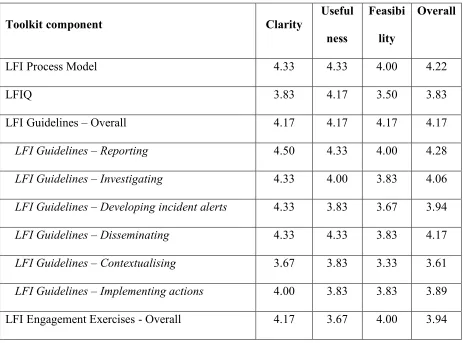
findings from the scoring sheets are summarised in Table 2 (mean scores, out of 5). Although
the data are limited to 6/17 participants (35% response rate), we think it useful to include
these figures here to indicate the overall level of support for the Toolkit. The findings from
the scoring sheets were used to inform the discussions and feedback from the Stakeholder
Review Meeting.
Table 2. Stakeholder evaluation of the Toolkit (N=6/17, mean scores, out of 5)
Toolkit component Clarity Useful
ness
Feasibi lity
Overall
LFI Process Model 4.33 4.33 4.00 4.22
LFIQ 3.83 4.17 3.50 3.83
LFI Guidelines – Overall 4.17 4.17 4.17 4.17
LFI Guidelines – Reporting 4.50 4.33 4.00 4.28
LFI Guidelines – Investigating 4.33 4.00 3.83 4.06
LFI Guidelines – Developing incident alerts 4.33 3.83 3.67 3.94
LFI Guidelines – Disseminating 4.33 4.33 3.83 4.17
LFI Guidelines – Contextualising 3.67 3.83 3.33 3.61
LFI Guidelines – Implementing actions 4.00 3.83 3.83 3.89
LFI Engagement Exercise 1 4.00 4.00 4.17 4.06
LFI Engagement Exercise 2 4.60 4.00 4.20 4.27
LFI Engagement Exercise 3 3.80 3.40 3.00 3.40
LFI Engagement Exercise 4 4.20 3.80 3.80 3.93
The component that achieved the best overall evaluation score was the LFI Process Model.
The participants highlighted the process model as the most useful and implementable at their
site because it helped critically rethink the whole LFI approach enabling identification of
gaps in processes and practices. The LFIQ scored somewhat less. The participants suggested
that some LFIQ questions could be misinterpreted in other cultural contexts. The participants
of the Stakeholder Meeting debated the feasibility of running a moderately long questionnaire
such as LFIQ at their sites, but agreed that collecting such data on the LFI process is
important concluding that an online questionnaire of that length would be warranted. Overall,
findings from the Stakeholder Review Meeting indicated that the Toolkit components were
clear, useful and feasible, with only minor changes needed to improve the Toolkit.
In addition to the suggested changes, the participants highlighted several key questions to be
explored in future development of the Toolkit:
• How will the Toolkit be used in different cultural and organisational contexts?
• What are the ways to measure actual change in behaviour after the LFI process is
completed?
• How best to identify the learning potential of an incident before the LFI activities are
28
5. Conclusions
The paper described the process of developing and evaluating the LFI Toolkit to improve the
LFI process and practices in organisations. The Toolkit sought to address key issues in the
way LFI is currently conceptualised in organisations and to help organisations rethink these
on the basis of adult learning principles. Specifically, the LFI Toolkit sought to help
organisations foster continuous, experiential and participatory learning enabling a broader
employee engagement, sensemaking and contextualisation. The findings provide insight into
the clarity, usability and relevance of the LFI Toolkit and feasibility of applying it in other
companies.
The participatory co-design methodology adopted from the early stages of the Toolkit
development offered qualitative and iterative changes to the product allowing for recognition
of local knowledge enhancing long-term usability of the Toolkit. This approach allowed for
inclusion of views of a diverse sample of practitioners in the energy sector industry as well as
from professional safety organisations, acknowledging the local context and expertise. The
Toolkit was subject to employees’ scrutiny and formative evaluation, whereby the elements
were approved or challenged. The participatory co-design approach helped foster an
environment for surfacing tacit knowledge of the industry context which is not represented in
formal and codified knowledge usually accessible to university researchers. It was important
to establish good working relationship within the co-design sessions so that they could be
based on openness and trust between the researchers and the participants. The iterative nature
of the sessions allowed for the impact of the research to be constantly evaluated. In this way,
development of the Toolkit represents a productive approach in engaging the employees and
stakeholders translating research into practice.
The limitations of the study stem from the difficulties of conducting research in real-world
workplace settings (Bruneel et al., 2010). The relatively small size and limited diversity of
the groups imposed limitations on the breadth of findings. The study would have benefited
from more participants and from the involvement of other sites. Although effort was made to
include a greater variety of respondents, the use of a mixture of stratified and convenience
sampling was the most pragmatic option (Denzin & Lincoln, 2005). Although the sample size
was small, we undertook steps to compensate by triangulating various sources of data that
strengthened the validity of the findings (Tashakkori & Teddlie, 1998). The study used
qualitative data from two co-design workshops at the two test sites and the Stakeholder
Review Meeting and the quantitative data from the scoring sheets in order to develop and
evaluate the LFI Toolkit. The benefits of data triangulation may have been limited by the fact
that the qualitative and quantitative data were provided by the same participants. However,
the consistency of views of the same participants involved in the process and their detailed
familiarity with the LFI Toolkit outweighed the potential limitations of having the same
respondents. Only one of the four Engagement Exercises could be tested within the co-design
workshop format; comments were collected from practitioners for the remaining three
Engagement Exercises. Finally, the findings may have been affected by self-selection bias,
whereby only those employees who are already engaged in safety and learning from incidents
issues may have volunteered to participate in co-development of the toolkit. Those who are
not engaging with safety issues may have not been included. It is possible that this pattern
30
the toolkit is voluntary. How could those people be encouraged to engage with learning from
incidents? One way would be to understand the reasons why they are not engaging examining
their individual motives, values, constrains and needs and tapping into their specific
experiences and workplace contexts.
Future studies should investigate the validity and usability of the other Engagement Exercises
and determine the impact of the overall LFI Toolkit on behaviour of employees in various
contexts. A further trial of the Toolkit in various contexts – including in non-Western
countries and cultures - is needed to develop a better understanding of the Toolkit’s full
benefits and its applicability across a range of sectors.
References
Argyris, C., & Schoen, D. A. (1996). Organizational learning II: Theory, method and practice. Reading, MA: Addison-Wesley.
Billett, S. (2010). Learning through practice: Models, traditions, orientations and
approaches. Dordercht: Springer.
Billett, S., & Pavlova, M. (2005). Learning through working life: Self and individual’s
agentic action. International Journal of Lifelong Learning 24(3), 195–211.
Boekaerts, M., Pintrich, P., & Zeidner, M. (Eds.), Handbook of self-regulation. San Diego:
Academic Press.
Bruneel, J., D’Este, P., & Salter, A. (2010). Investigating the factors that diminish the barriers
to university–industry collaboration. Research Policy, 39, 858-868.
Boud, D., & Walker, D. (1990). Making the most of experience. Studies in Continuing
Carroll, J. S. (1995). Under ambiguity and accountability. Incident reviews in high-hazard
industries: Sense making and learning. Industrial and Environment Crisis Quarterly, 9(2).
Carver, Ch., & Scheier, M. (2005). On the structure of behavioural self-regulation. In
Boekaerts, M., Pintrich, P., & Zeidner, M. (Eds.), Handbook of self-regulation, (pp.
42-84). San Diego: Academic Press.
Chevalier, J.M., & Buckles, D.J. (2013) Participatory action research: Theory and methods
for Engaged Inquiry. London: Routledge.
Cooke, D. L., & Rohleder, T. R. (2006). Learning from incidents: From normal accidents to
high reliability. System Dynamics Review, 22(3), 213-239.
Denzin, N. K., & Lincoln, Y. S., (Eds.) (2005). The handbook of qualitative research.
Thousand Oaks: Sage.
Drupsteen, L., Groeneweg, J., & Zwetsloot, G. I. (2013). Critical steps in learning from
incidents: using learning potential in the process from reporting an incident to accident
prevention. International journal of occupational safety and ergonomics, 19(1), 63-77.
Drupsteen, L., & Guldenmund, F. (2014). What is learning? A review of the safety literature
to define learning from incidents, accidents and disasters. Journal of Contingencies Crisis
Management, 22(2), 81–96.
Ericsson, K.A., Charness, N., Feltovich, P., & Hoffman, R. (2006) (Eds.). The Cambridge
handbook of expertise and expert performance. New York: Cambridge University Press.
Fuller, A. & Unwin, L. (2004). Expansive learning environments: Integrating organizational
and personal development. In Rainbird, H., Fuller, A., & Munro (Eds), Workplace
32
Glasgow, R., Lichtenstein, E. & Marcus, A. (2003). Why don't we see more translation of
health promotion research to practice? Rethinking the efficacy-to-effectiveness
transition. American Journal of Public Health, 93, 1261–1267.
Gordon, H. (2008). Integrating learning into safety: Developing a robust lessons-learned
program. Professional Safety, 53(9), 30-33.
Kennedy, A., Chew-Graham, C., Blakeman, T., & Gask, L. (2010). Delivering the WISE
(Whole Systems Informing Self-Management Engagement) training package in primary
care: Learning from formative evaluation. Implementation Science, 5(7), 2-15.
Klein, J. (1996). Crossing boundaries: Knowledge, disciplinarities, and interdisciplinarities.
Charlottesville, VA: University Press of Virginia.
Knowles, M. (1972). The modern practice of adult education. New York: Association Press.
Knowles, M, Holton, E., & Swanson, R. (2012). The adult learner. London: Routledge.
Kolb, D. (1984). Experiential learning: Experience as the source of learning and
development. Englewood Cliffs: Prentice Hall.
Lindberg, A., Hansson, S.O., Rollenhagen, C. (2010). Learning from accidents: What more
do we need to know? Safety Science, 48(6), 714.
Lindeman, E. (1926). The meaning of adult education. New York: New Republic.
Littlejohn, A., Margaryan, A., Vojt, G, & Lukic, D. (2017). Learning from Incidents
Questionnaire (LFIQ): The validation of an instrument designed to measure the quality of
learning from incidents in organisations. Safety Science (online first)
https://doi.org/10.1016/j.ssci.2017.02.005
Lukic, D. (2012) Learning from Incidents: A social approach to reducing safety incidents in
Lukic, D., Littlejohn, A., & Margaryan, A. (2012a). A framework for learning from incidents
in the workplace. Safety Science, 50(4), 950–957.
Lukic, D., Littlejohn, A., & Margaryan, A. (2012b). Learning from incidents. Petroleum
Review, 66(790), 36-37.
Lukic, D., Margaryan, A., & Littlejohn, A. (2013). Individual agency in learning from
incidents. Human Resources Development International, 16(4), 409-425.
Lukic, D., Margaryan, A., & Littlejohn, A. (2010). How organisations learn from safety
incidents: A multifaceted problem. Journal of Workplace Learning, 22(7), 428-450.
Malloch, M., Cairns, L., Evans, K., & O’Connor, B. (2011) (Eds.). Handbook of workplace
learning. Thousand Oaks: Sage.
Margaryan, A., Littlejohn, A., & Stanton, N. (2016). Research and development agenda for
learning from incidents. Safety Science (online first).
Pedler, M. (2002). Accessing local knowledge: Action learning and organizational learning in
Walsall. Human Resource Development International 5(4), 523-540.
Perkmann, M., & Walsh, K. (2007). University–industry relationships and open innovation:
Towards a research agenda. International Journal of Management Reviews, 9(4), 259–
280.
Smith, C., & De Frates-Densch, N. (2008) (Eds.), Handbook of research on adult learning
and development. London: Routledge.
Snowden, D. (2002). Complex acts of knowing: Paradox and descriptive self-awareness,
Journal of Knowledge Management, 6(2), 100-111.
Spinuzzi, C. (2005). The methodology of participatory design. Technical
34
Stead, M., Hastings, G., & Eadie, D. (2002). The challenge of evaluating complex
interventions: A framework for evaluating media advocacy. Health Education Research,
17, 351–64.
Tashakkori, A., & Teddlie, C. (1998). Mixed methodology: Combining qualitative and
quantitative approaches. Thousand Oaks: Sage.
Weick, K. (1995). Sensemaking in organizations. Thousand Oaks: Sage.
Weick, K. E., Sutcliffe, K. M., & Obstfeld, D. (2005). Organizing and the process of
sensemaking. Organization Science, 16(4), 409–421.
Wierdsma, A. (2004). Beyond Implementation. In Boonstra, J. (Ed.), Dynamics of