Original Research Article
Quality of life in patients with chronic obstructive pulmonary disease at
Pulmonary Community Health Centre Makassar
Elva Cristy Irianti
1*, Arsunan A. A.
1, M. Tahir Abdullah
2INTRODUCTION
Chronic obstructive pulmonary disease (COPD) is a common, preventable and treatable disease characterized by persistent respiratory symptoms and air flow restriction. The cause is a respiratory or alveolar airway that is usually caused by exposure to dangerous particles or gases. The typical chronic airflow limitations in COPD are caused by a mixture of small airway disease (obstructive bronchiolitis) and parenchymal destruction (emphysema), the relative contribution varies from person to person.1 The Global Burden of Disease Study reports the prevalence of COPD cases of 251 million
globally by 2016. Estimates globally by 2015 have 3.17 million deaths worldwide and are caused by COPD of 5% of all deaths worldwide. Over 90% of COPD deaths occur in low and middle income countries.2
COPD globally was the fourth leading cause of death (5.1%) in 2004 and is projected to occupy the third position (8.6%) by 2030. COPD is also a major cause of chronic morbidity at rank 11 in 2002 and is projected to rise to seventh position by 2030.3 COPD is one of the major non-communicable diseases, which is less known to the general public due to the lack of information related to the disease. United States data in 2007 showed
ABSTRACT
Background: Chronic obstructive pulmonary disease (COPD) that causes damage to lung conditions such as dyspnea that affects to social and psychological life of the sufferer which overall affects the quality of life. This reaserch aims to focuses on factors related to the quality of life patients with COPD at the Pulmonary Community Health Center, Makassar.
Methods: This study used cross sectional study design. Population in this research were patients with COPD who undergo treatment period of October-December 2017 that was as much as 381. Sampling was done by consecutive sampling with total sampel 160 responden. Data analysis consisted of univariate, bivariate with chi square test and multivariate analysis with logistic regression.
Results: The results showed that some respondents had poor quality of life (63.8%) and other respondents had a good quality of life (36.3%). Factors related to quality of life were the severity of COPD (p=0.028), comorbidity (p=0.001) and quality of sleep (p=0.005). A multivariate analysis showed that patients with comorbidity were at risk 2,716 times to have poor quality of life.
Conclusions: The severity of COPD, comorbidity and quality of sleep were related to have poor quality of life. Patients with COPD should early diagnosis of severity and should change their lifestyle better so as not to aggravate the quality of life.
Keywords: COPD, Quality of life, Comorbidity, Severity of COPD, Quality of sleep
1
Department of Epidemiology, 2Department of Biostatistics, Faculty of Public Health, Hasanuddin University, Makassar, Indonesia
Received: 24 July 2018
Accepted: 11 August 2018
*Correspondence:
Dr. Elva Cristy Irianti,
E-mail: [email protected]
Copyright: © the author(s), publisher and licensee Medip Academy. This is an open-access article distributed under the terms of the Creative Commons Attribution Non-Commercial License, which permits unrestricted non-commercial use, distribution, and reproduction in any medium, provided the original work is properly cited.
that the prevalence of COPD by 10.1%, in men by 11.8% and for female 8.5%.4 COPD prevalence in Southeast Asian countries is estimated at 6.3% with the highest prevalence in Vietnam (6.7%) and China (6.5%).5
The Asia Pacific COPD round table group estimates that the number of moderate to severe COPD patients in Asia Pacific countries in 2006 reached 56.6 million patients with a prevalence of 6.3%. Prevalence rates range from 3.5 to 6.7 percent, such as China with cases reaching 38.160 million people, Japan (5.014 million) and Vietnam (2.068 million) while in Indonesia there are an estimated 4.8 million people with a prevalence of 5.6%. This number can increase with the increasing number of smokers because 90% of people with COPD are smokers or ex-smokers.6
The quality of life of patients with COPD is associated with a number of factors, such as smoking, symptoms of illness (shortness of breath, wheezing, coughing and weight loss), frequency of disorders, natural development of respiratory dysfunction, disease severity, anxiety and depression, comorbidities and sleep disturbances 7. Data from the Pulmonary Community Health Center Makassar related to 10 major lung diseases in 2016 COPD as many as 1.248 cases and in 2017 experienced an increase of 1480 people in outpatient, while for inpatients as many as 35 people.8 This study aims to determine the factors related to the quality of life of patients with COPD at the Pulmonary Community Health Center Makassar.
METHODS
Design of the study
Location and research design the study was conducted at the Pulmonary Community Health Center Makassar. Design of this research is analytic observational study with cross sectional study design.
Population and sample
The population in the study were all patients of COPD who underwent treatment and recorded in the medical record of the Pulmonary Community Health Center, Makassar period October-December 2017 that is as much as 381 respondents. Sampling was done with consecutive sampling that all patients of COPD that meet the criteria of research inclusion during the study took place until the number of samples met so as to get the number of samples as many as 160 respondents. The inclusion criteria for the study were patients diagnosed with COPD, aged ≥40 years, moderate or had been treated and willing to be interviewed.
Data collection methods collection was obtained from medical record data and interview results using questionnaires with patients. Data on respondent characteristics (age, sex, marital status and education) and smoking status were measured by interviews using
questionnaire was made by the researcher. Comorbidity and severity of COPD were obtained from the patient's medical record. Quality of sleep using Pittsburgh quality of sleep index (PSQI). While for the quality of life of COPD patients was measured using The St. George's Respiratory Questionnaire (SGRQ).
Data analysis
Data processed and analyzed with the help of computer using program microsoft office excel 2007 and SPSS for windows version 20.0. Data analysis consisted of univariate analysis (to know respondent characteristic), bivariate analysis with Chi-square (to know relation between dependent and independent variable) and multivariate analysis (to see the relationship between one dependent variable with all independent variables, so it can be known the most dominant independent variable related to quality of life) with logistic regression using Backward LR method.
RESULTS
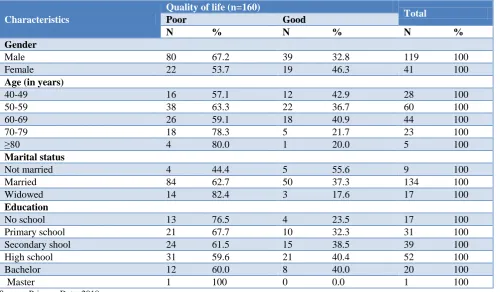
Table 1 shows the quality of life of COPD patients in the Pulmonary Community Health Center Makassar that some respondents have poor quality of life (63.8%) and only a small proportion of respondents who have a good quality of life (36.3%). Table 2 shows the characteristics of COPD patients in this study. Based on sex, 119 male suffering from COPD compared to female as many as 41 people. Male gender showed more suffer from COPD with poor quality of life that is equal to 67.2%.
Table 1: Quality of life of COPD patients at the Pulmonary Community Health Center Makassar.
Quality of life Frequency (n=160) Percentage
Good 58 36.3
Poor 102 63.8
Source: Primary Data 2018.
Based on the characteristics of age group, most of which have poor quality of life that is in age group 50-59 year equal to 63.3% while good life quality equal to 36.7%. Based on the characteristics of marital status, married respondents have poor quality of life that is equal to 62.7% while those with a good quality of life of 37.3%. Based on the characteristics of the highest level of education at the level of high school education with poor quality of life that is equal to 59.6% and good quality of life 40.4%.
3 shows that there is a correlation between the severity of COPD and quality of life (p=0.028). Percentage of respondents with severe/very severe of severity COPD
and poor quality of life (70.4%) compared with respondents with mild/moderate of severity COPD and poor quality of life (53.2%).
Table 2: Distribution of respondents by characteristics at the Pulmonary Community Health Center, Makassar.
Characteristics
Quality of life (n=160)
Total
Poor Good
N % N % N %
Gender
Male 80 67.2 39 32.8 119 100
Female 22 53.7 19 46.3 41 100
Age (in years)
40-49 16 57.1 12 42.9 28 100
50-59 38 63.3 22 36.7 60 100
60-69 26 59.1 18 40.9 44 100
70-79 18 78.3 5 21.7 23 100
≥80 4 80.0 1 20.0 5 100
Marital status
Not married 4 44.4 5 55.6 9 100
Married 84 62.7 50 37.3 134 100
Widowed 14 82.4 3 17.6 17 100
Education
No school 13 76.5 4 23.5 17 100
Primary school 21 67.7 10 32.3 31 100
Secondary shool 24 61.5 15 38.5 39 100
High school 31 59.6 21 40.4 52 100
Bachelor 12 60.0 8 40.0 20 100
Master 1 100 0 0.0 1 100
Source: Primary Data, 2018
Table 3: Distribution of independent variable relationship with quality of life of COPD patients at the Pulmonary Community Health Center, Makassar.
Independent variables
Quality of life
P value
Poor Good
N % N %
Smoking
Yes 74 63.3 36 32.7 0.169
No 28 56.0 22 44.0
Severity of COPD
Mild & moderate 33 53.2 29 46.8 0.028*
Severe and very severe 69 70.4 29 29.6
Comorbidities
There are 68 74.7 23 25.3 0.001*
None 34 49.3 58 36.3
Quality of sleep
Good 13 41.9 18 58.1 0.005*
Poor 89 69.0 40 31.0
*Significant; Source: Primary Data, 2018.
Result of analysis of comorbidity relationship with quality of life of COPD patient in table 3 shows that there is correlation between severity of COPD with quality of life (p=0.001). Percentage of respondents who had comorbidity and had poor quality of life more (74.7%) than respondents who did not have comorbidity and had
Table 4: Results of multivariate analysis quality of life of COPD patients at the Pulmonary Community Health Center, Makassar.
Research Variables B Wald Sig. Exp(B) CI 95%
LL UL Step 1
Smoking 0.520 1.895 1.895 1.895 1.895 1.895
Severity of COPD -0.683 3.616 3.616 3.616 3.616 3.616
Comorbidities 1.004 8.003 8.003 8.003 8.003 8.003
Quality of sleep -1.041 5.654 0.017 0.353 0.150 0.833
Step 2
Severity of COPD -0.699 3.856 0.050* 0.497 0.247 0.999
Comorbidities 0.999 8.042 0.005* 2.716 1.362 5.419
Quality of sleep -1.009 5.464 0.019* 0.364 0.156 0.850
Constant 0.526 2.840 0.092 1.693
*Significant; Source: Primary Data, 2018.
Table 4 shows that the results of further analysis using backward stepwise (LR) method. The result of multivariate analysis showed that the most significant variable to quality of life of COPD was comorbidity with OR=2.716 (95% CI: 1.362-5.419), p=0.005. The results of this statistical test conclude that comorbid variables are significantly at risk for quality of life of COPD patients by 2.7 times.
DISCUSSION
This study shows that the quality of life of COPD patients who smoke has a poor quality of life. But in statistical analysis test showed no correlation between smoking with quality of life. A similar cross-sectional study aimed to determine the smoking status of COPD patients with quality of life and stated that smokers (active and never smoked smokers) were not associated with good quality of life (p=0.64).9 The results of the previous study concluded that patients who smoked had a 2.88 chance of having poor quality of life than not smoking and 2.2 times chance of having a better quality of life than patients who quit smoking.10-11
As many as quarter of the respondents of COPD in this study were non-smokers (31.3%), because the respondents were mostly female. This indicates that female have the same risk as male for COPD, although not smoking. Female get exposure to secondhand smoke from family members who are at home, workplace or in the neighborhood such as air pollution from the highway. The proportion of COPD patients who do not smoke is higher in female, the prevalence of COPD among non-smokers is the same in men and female. Thus, gender is not an independent risk factor for COPD that does not smoke (OR=0.82).12 Based on interviews from a number of respondents who do not smoke say that they do not smoke because since the young have been diagnosed with certain lung diseases such as asthma and bronchitis.
The severity of COPD measured by spirometry serves to measure objectively the patient's lung capacity or
function. In this study the severity level is divided into two, namely mild/moderate and severe/very severe severity. The results of this study found that there is a strong relationship between the severity of COPD and quality of life. Spirometry examination showed that 40.41% of patients had moderate level and multivariate analysis showed that very severe level was associated with quality of life and could worsen the quality of life of COPD patients (p<0.05).13 Similarly, the research conducted in Outpatient Polyclinic of Ariu Wirawan Salatiga Hospital where the severity of COPD had an effect on the quality of life of COPD patients on activity domain (p=0.000), domain impact (p=0.011) and total score (p=0.001). The more severe the level of severity of COPD, the quality of life of the patient decreases.14
In contrast to previous research, the more severe the level of COPD severity, the worse the quality of life of the patient, while the study conducted in West Sumatera was cross sectional to 35 patients with stable COPD taken by accidental sampling that 45.7% of patients had obstructive pulmonary degrees medium and 77.1% have good quality of life. Based on statistical test, there was correlation between degree of COPD on quality of life of stable COPD patients (p<0.05).15
A review of systematic review states that there is a significant relationship between the severity of COPD and the quality of life of patients. The severity of COPD caused by airway obstruction will affect the quality of life of COPD patients regardless of how long COPD has been suffered.16 Exacerbations of COPD also play a role in aggravating the quality of life of COPD patients regardless of the duration of COPD that has been suffered. Exacerbation is the incidence of worsening compared to previous conditions. Exacerbations may be caused by infection or other factors such as air pollution, fatigue or complication.17
asthma, bronchitis, pulmonary TB, SOPT and hemaptoe. The result of analysis showed that there was correlation of comorbidity with quality of life. The reason the researcher chooses the type of comorbidities only in the class of lung disease rather than other diseases such as cardiovascular, hypertension or diabetes, because lung disease has almost the same signs and symptoms of lung function impairment, which allows the severity of COPD and worsens the quality of life of patients compared with COPD patients without such symptoms.
The multivariate analysis of this study showed that patients with comorbidities were 2.7 times at risk for poor quality of life. This study is in line with studies conducted in Sweden that show that comorbidities (chronic bronchitis, osteoporosis and musculoskeletal symptoms) are related to quality of life. The conclusion of the study was that the chronic bronchitis phenotype in COPD patients had the highest risk of poor quality of life (OR=3.78, 95% CI [2.35-5.20]).18 Comorbidities are defined as other chronic diseases associated with COPD (irrespective of the nature of the cause or not of their association with the disease), often present in COPD patients and their effects are increasingly recognized. High rates of cardiovascular disease, diabetes, and mood disorders (eg, anxiety and depression) are reported in COPD patients. Comorbidities may increase the risk of mortality and hospitalization in COPD patients and exponentially increase treatment costs.19
Previous studies have confirmed that shortness of breath and exacerbations, but not the limitations of airflow, are the major determinants of the decline in the quality of life of COPD patients in the cohort study (R2=0.43). It is explained that some variables such as bronchitis, depression, BMI and coronary artery disease affect quality of life but the effect is not great. In contrast to cardiovascular comorbidities, diabetes and obesity have no significant impact.20 Comorbidities in COPD are significantly associated with worse quality of life. Cardiovascular disease, depression and anxiety as well as diabetes but also other comorbid conditions such as musculoskeletal disease, have an effect to worsen the quality of life in COPD. The presence of single comorbidities also relates to a lower quality of life.21
Good quality of sleep is very important for health. In COPD patients often experience sleep disturbances that can decrease quality of sleep and sleepiness in the afternoon, this condition can also worsen the quality of life. Based on the results of this study note that the respondents who experienced poor quality of sleep that is equal to 80.6%. The result of relationship analysis showed that there was correlation between quality of sleep and quality of life. Just like what happened in South Korea. A study of sleep problems in patients with mild to severe COPD on quality of life concluded that quality of sleep of COPD patients was significantly correlated with quality of life (r=0.376, p<0.001).22
Quality of sleep is affected in most patients with COPD. It is associated with symptoms, functional capacity, peripheral muscle strength and quality of life in general. Sleep problems interfere with health status and quality of life in patients with COPD.23 Quality of sleep has proven to be an independent predictor of St. George Respiratory Questionnaires. The PSQI domain that assesses overall quality of sleep, sleep duration and disorders is strongly associated with health status. Previous studies have concluded that quality of sleep assessment should be considered because there is a relationship between quality of sleep, functional capacity, muscle strength and quality of life. Poor quality of sleep can affect symptoms of COPD and may affect participation in daily life activities.24
COPD respondents may experience wake-ups during the night that interfere with sleep, often causing dizziness or wandering when waking up in the morning and even feeling tired during the day. The thing that causes waking up at night is the appearance of symptoms of the disease such as cough, shortness of breath, wheezing or difficulty breathing. Sleep disorders are very common in patients with chronic obstructive pulmonary disease (COPD). However, it is unclear how sleep disorders and quality of life affect each other in various stages of disease progression.
The disease factor in this study became one of the causes of decreased quality of sleep. In this study the majority of respondents experienced cough and shortness of breath that stimulate to wake up from sleep. This will cause the normal time to sleep on the respondent is reduced and can experience sleep disorders. Any disease that causes pain, physical discomfort such as difficulty breathing or mood problems such as anxiety or depression can cause sleep problems.25
Decreased lung function in COPD will lead to physiological decline of other organs that may affect health status and quality of life of COPD clients. At a later stage, COPD results in impaired activity, fatigue, loss of appetite, weight loss, and sleep disturbance.26 Sleep disorders that occur in COPD patients can be influenced by one of the factors that affect the quality of sleep is emotional stress. Another factor that affects the quality of one's sleep is age. The results showed that the average age of respondents was 50-59 years. Age is included in the age group above 55 years where at that age there is a natural aging process that cause physical, mental, social, economic, and psychological problems. This results in healthy elderly people often experience changes in sleep patterns such as it takes a long time to start falling asleep, so that sleep time becomes shorter and quality of sleep decreases.
CONCLUSION
Patients with COPD should make early diagnosis of severity to find the right intervention strategy to maintain a good quality of life and who have more than one disease of comorbidity should change their lifestyle better so as not to aggravate the quality of life.
ACKNOWLEDGEMENTS
We thank to all respondents and the staff at the Pulmonary Community Health Center Makassar who had helped and participated in providing information on this research.
Funding: No funding sources Conflict of interest: None declared
Ethical approval: The study was approved by the Institutional Ethics Committee
REFERENCES
1. GOLD. Global Initiative for Chronic Obstructive Lung Disease. Pocket Guide To Copd Diagnosis, Management, And Prevention A Guide for Health Care Professionals 2017 edition. 2017.
2. WHO. Chronic obstructive pulmonary disease (COPD). World Organization Health; 2017. Available at: http://www.who.int/respiratory/ copd/en/. Accessed on 13 January 2018.
3. Mathers CD, Loncar D. Projections of global mortality and burden of disease from 2002 to 2030. PLoS Med. 2006;3(11):e442.
4. Buist AS, McBurnie MA, Vollmer WM, Gillespie S, Burney P, Mannino DM, et al. International variation in the prevalence of COPD (the BOLD Study): a population-based prevalence study. Lancet. 2007;370(9589):741-50.
5. Chan-Yeung M, Ait-Khaled N, White N, Ip M, Tan W. The burden and impact of COPD in Asia and Africa [State of the Art]. Int J Tuberculosis Lung Dis. 2004;8(1):2-14.
6. PDPI. PPOK (Penyakit Paru Obstruktif Kronik), Diagnosis dan penatalaksanaan. Jakarta: Perhimpunan Dokter Paru Indonesia. 2011.
7. Dignani L, Toccaceli A, Lucertini C, Petrucci C, Lancia L. Sleep and quality of life in people with COPD: a descriptive-correlational study. Clinical Nursing Res. 2016;25(4):432-47.
8. BBKMP. Daftar 10 Besar Penyakit di Balai Besar Kesehatan Paru Masyarakat Makassar Tahun 2016-2017. Makassar: Balai Besar Kesehatan Paru Masyarakat Makassar., 2017.
9. Hidayati T, Rani FRD. Permasalahan Status Merokok Dan Kualitas Hidup (St George’s Respiratory Questionnaire/SGRQ) Pada Pasien Penyakit Paru Obstruktif Kronis/PPOK. 2017. 10. Ståhl E, Lindberg A, Jansson S-A, Rönmark E,
Svensson K, Andersson F, et al. Health-related quality of life is related to COPD disease severity. Health and quality of life outcomes. 2005;3(1):56.
11. Cheruvu VK, Odhiambo LA, Mowls DS, Zullo MD, Gudina AT. Health-related quality of life in current smokers with COPD: factors associated with current smoking and new insights into sex differences. International J Chronic Obstructive Pulmonary Dis. 2016;11:2211.
12. Hagstad S, Ekerljung L, Lindberg A, Backman H, Rönmark E, Lundbäck B. COPD among non-smokers–report from the obstructive lung disease in Northern Sweden (OLIN) studies. Respiratory Med. 2012;106(7):980-8.
13. Rosha PT. Faktor-Faktor Yang Mempengaruhi Kualitas Hidup Pasien Rawat Jalan Penyakit Paru Obstruksi Kronis (PPOK) Di Poli Paru Rs Pku Muhammadiyah Dan Rsud Kabupaten Temanggung [Tesis]. Program Pascasarjana, Fakultas Kedokteran, Universitas Gadjah Mada-Yogyakarta: Universitas Gadjah Mada, Yogyakarta; 2017. 14. Hidayat L. Pengaruh Karakteristik Penyakit Dan
Jenis Terapi Terhadap Kualitas Hidup Penderita Penyakit Paru Obstruksi Kronik (PPOK) Di Poliklinik Rawat Jalan Rumah Sakit Paru Ario Wirawan Salatiga. Program Pascasarjana Program Studi Ilmu Farmasi Fakultas Farmasi: Universitas Gadjah Mada Yogyakarta; 2016.
15. Astika J. Hubungan Derajat PPOK Terhadap Kualitas Hidup pada Pasien PPOK di Poliklinik Paru RSUP Dr. M. Djamil Padang dan Rumah Sakit Khusus Paru Sumatera Barat: Universitas Andalas; 2016.
16. Jones P, Brusselle G, Dal Negro R, Ferrer M, Kardos P, Levy M, et al. Health-related quality of life in patients by COPD severity within primary care in Europe. Respiratory Med. 2011;105(1):57-66.
17. PDPI P. Pedoman praktis diagnosis & penatalaksanaan di Indonesia. Jakarta: PDPI. 2003:1-18.
18. Sundh J, Johansson G, Larsson K, Linden A, Löfdahl C-G, Janson C, et al. Comorbidity and health-related quality of life in patients with severe chronic obstructive pulmonary disease attending Swedish secondary care units. Int J Chronic Obstructive Pulmonary Dis. 2015;10:173.
19. Fabbri L, Luppi F, Beghé B, Rabe K. Complex chronic comorbidities of COPD. Eur Resp J. 2008;31(1):204-12.
20. Burgel P-R, Escamilla R, Perez T, Carré P, Caillaud D, Chanez P, et al. Impact of comorbidities on COPD-specific health-related quality of life. Respiratory medicine. 2013;107(2):233-41.
21. Huber MB, Wacker ME, Vogelmeier CF, Leidl R. Comorbid influences on generic health-related quality of life in COPD: a systematic review. PloS one. 2015;10(7):e0132670.
22. Kang HH, Kim SB, Lee SH, Moon HS. Sleep Quality and Quality of Life in Patients With COPD. Chest. 2017;152(4):1065.
outcomes in elderly patients with asthma and COPD using disease-specific and generic instruments: the Salute Respiratoria nell’Anziano (Sa. RA) Study. Chest. 2001;120(3):734-42.
24. Vardar-Yagli N, Saglam M, Savci S, Inal-Ince D, Calik-Kutukcu E, Arikan H, et al. Impact of sleep quality on functional capacity, peripheral muscle strength and quality of life in patients with chronic obstructive pulmonary disease. Expert Rev Resp Med. 2015;9(2):233-9.
25. Cahyono KH. Pengaruh senam lansia terhadap kualitas tidur pada lansia di Desa Leyangan
Kecamatan Ungaran Timur Kabupaten Semarang. Ungaran: STIKES Ngudi Waluyo. 2012.
26. Smeltzer S, Bare B. Textbook of medical surgical nursing 8th edition. Jakarta: EGC (Buku ajar keperawatan medikal-bedah brunner & suddarth edisi 8 volume 2). 2001.