Original Research Article
Biosocial and awareness profile of adolescent clients and utilization
patterns of the services at an ARSH clinic at Patna, Bihar
Nivedita Sinha
1, Amar Kumar
2, Rashmi Singh
1*
INTRODUCTION
Adolescents constitute about 21% of India‟s population.1
Due to their immaturity, peer pressure, lack of awareness or shyness, they become vulnerable to many medical and psychosocial problems. This may have serious health, social, and economic implications. It is important to influence the health seeking behavior of adolescents and address their problems. Realizing the special needs of adolescents in achieving good physical and mental health, GOI launched the adolescent reproductive and sexual
health (ARSH) program in 2006. Among other issues, ARSH strategy aimed to achieve promotive, preventive, curative and awareness services for adolescents by strengthening facility based interventions and peer education to safeguard India‟s future health and vitality. This led to the establishment of adolescent friendly health services (AFHS) in public hospitals and medical colleges of India in phased manner.
ARSH clinic was established for the first time in Bihar in 2012 at Patna Medical College Hospital (PMCH) by the
ABSTRACT
Background: Adolescents constitute about 21% of India‟s population. Realizing the special needs of adolescents, GOI launched the adolescent reproductive and sexual health (ARSH) program in 2006. „Yuva‟ clinic was established for the first time in Bihar in 2012 at Patna Medical College for providing services as per ARSH protocols. This study aimed at analyzing the biosocial and awareness profile of the adolescent clients vis a vis ARSH strategy, and the utilization of services at the clinic.
Methods: Cross-sectional study using semi-structured questionnaire.
Results: Total of 1180 adolescents (950 males, 230 females) was studied. Sixty-six percent males, 74.8% females were urban; about 90% were unmarried. Majority were from upper middle class. No females but 66.6% and 86.7% of males were taking alcohol and tobacco respectively. More than 90% of attendees reported regular physical exercise; 36.8% males and 58% females had abnormal BMIs. Seventy-six percent were nutritionally aware, 24.06% aware about reproductive and sexual health (RSH), and 64.74% about ARSH services. Rural and SES were significantly associated with the adolescents‟ awareness of nutrition, RSH, and services available. Females had significantly more knowledge regarding RSH. Sixty-seven percent availed counseling services and 1.35% was referred, 50.6% came for clinical services out of which 69.8% remained unmet.
Conclusions: ARSH clinic is a useful initiative. However there are gaps in services vis-a-vis ARSH strategies. If addressed, clinic is likely to attract more adolescents and achieve the objectives of improving their health and capacity to deal with their myriad problems in a better way.
Keywords: Adolescents, ARSH clinic, Nutritional awareness, RSH
Department of Community Medicine, 1Patna Medical College and Hospital, Ashok Raj Path, Patna, 2ANM Medical
College and Hospital, Gaya, Bihar, India
Received: 23 April 2019 Accepted: 05 June 2019
*Correspondence: Dr. Rashmi Singh,
E-mail: [email protected]
Copyright: © the author(s), publisher and licensee Medip Academy. This is an open-access article distributed under the terms of the Creative Commons Attribution Non-Commercial License, which permits unrestricted non-commercial use, distribution, and reproduction in any medium, provided the original work is properly cited.
name of „Yuva‟ clinic. Clinical, counseling and referral services were provided as per ARSH strategy. Clinical services included management of RTI/ STI, menstrual problems, skin, anaemia, availability of contraceptives and vaccination with tetanus toxoid. Counseling on myriad of adolescent issues such as reproductive and sexual health (RSH), nutrition, substance abuse and mental health including depression were provided. Those who needed further evaluation and work up were referred to appropriate facility in PMCH.
ARSH was followed by two other adolescent-centric programs by Government of India (GOI): RMNCH+A under the RCH II program in the year 2013 and Rashtriya Kishori Shakti Karyakram (RKSK) launched in 2014, underlining its commitment to capacity building and enhancing life skills of adolescents. Both these programs also found convergence at the „Yuva‟ Clinic of PMCH which has been giving uninterrupted ARSH services since 2012. It was now considered important to know the biosocial profile of the visiting adolescents their knowledge in key domains of ARSH strategy, and the services for which they visited the clinic. This would give valuable feedback about the functioning of the clinic, gaps in services and scope for further handholding and improvement.
Aims and objectives
Aims and objectives of this study were:
To study the profile and biosocial characteristics of
adolescents visiting Yuva (ARSH) clinic, PMCH.
To know the awareness about nutrition, RSH and
services of the clinic among the adolescents and factors contributing to it.
To study the reasons for which the beneficiaries visit
the Yuva clinic, PMCH (vis-a vis ARSH strategies).
To know the gaps in services offered at PMCH
facility as per ARSH strategy.
METHODS
The study was a cross-sectional observational one,
conducted over a period of one year (1st June 2015 to 31st
May 2016) at the ARSH (Yuva) Clinic of Patna Medical College and Hospital (PMCH), Patna. Ethical approval was obtained from Institutional Ethics Committee (IEC)
before initiation of the study. The protocol,
questionnaires, participant information sheet and the informed consent/assent forms were approved by the IEC.
Sampling methodology
All consenting adolescents (age 10 to 19 years) attending the Yuva clinic, PMCH over a continuous period of one year were studied by consecutive sampling method.
Study instruments
Pre-tested and semi-structured questionnaire proformae were used for data collection. ARSH District Level Consolidated Monthly Report was used to tally the number of adolescent clients and cross check the services availed by them.
Study technique
In- depth interview using the proforma was conducted among consenting adolescents after taking informed consent. Privacy and confidentiality was maintained during recording of data. Socio demographic and personal lifestyle details such as residence (rural/urban), social class, consumption of alcohol or tobacco in any form and its duration, physical exercise were enquired for and recorded. Awareness of the adolescent was assessed in the domains of nutrition, RSH, knowledge about Yuva clinic and services. Enquiry was also made about the purpose of their visit and services rendered. For counseling services, content of counseling was enquired about; for referral services, place of referral was
recorded; for clinical services, medicines and
commodities availed were noted.
Height was recorded to the nearest cm using stadiometer and weight recorded to nearest half kg by standard bathroom scale. BMI was calculated by standard formula of weight in kg/square of height in meters, and BMI was categorized according to WHO cut-off points for adolescent range of 10-18years of both sexes: less than 3standard deviation (SD) classified as severe thinness, between -2SD to -3SD as thinness, between -2SD to +1SD as normal, between +1SD to +2SD as overweight
and more than +2SD as obesity.2 For the adolescent aged
18 to19 years, reference WHO BMI standards for adults were applied.
The socio-economic status (SES) was assessed using the Kuppuswamy scales taking into account average monthly income of family, their educational status, occupation of head of the family.
Guidelines of National Drug Dependence Treatment
Center, India were adopted for classifying alcoholism.3
Similarly a regular smoker was defined as “who has smoked at least 100 cigarettes in his/her lifetime and who
now smokes everyday”.4
In case of smokeless, only everyday use was enquired.
As per WHO guidelines physical exercise means planned, structured, repetitive and purposeful performance of some activities in the sense that the improvement or maintenance of one or more components of physical
fitness is the objective.5 Adolescents adhering to this
While assessing awareness, five questions regarding nutrition and five regarding RSH were asked. If 3 or more out of 5 questions were correctly answered, the subject was labeled as “having awareness”. Similarly for assessment of awareness regarding health services available at ARSH, 3 questions were asked, if 2 or more were correct, knowledge was deemed adequate.
Statistical analysis
Data obtained through the predesigned performa was entered into MS Excel Worksheet 2016 and analyzed for percentages and proportions. Also their statistical association, if any, to sex, place of residence and social class were determined.
RESULTS
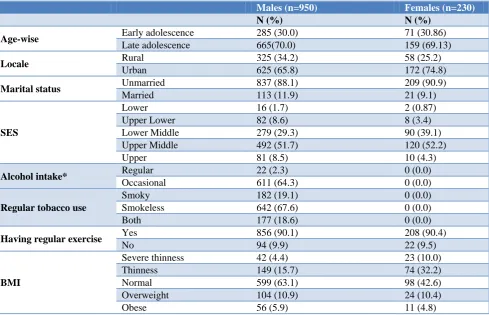
A total of 1180 consenting adolescents were enrolled for the study during the study period. Out of these 950 were males and 230 were females. Age-wise 70% of both sexes were late adolescents; 625 (65.8%) of males and 174 (74.8%) females were from urban background; 88.1% males and 90.9% females were unmarried. Social class break up showed that majority (51.7% males and 52.2% females) were from upper middle class and lowest proportion (1.7% males and 0.87% females) were from lower class. Out of 950 males, only 22 and 611 admitted to regular or occasional alcohol intake respectively giving
a proportion of 66.7%. Approximately 86.7% males were regularly using tobacco, while none of the females admitted to either alcohol or tobacco use. More than 90% of both sexes professed regular physical exercise. While 63.1% males were having normal BMI for age, about 20.1% were below normal (4.4% very thin and 15.7% thin) and 16.8% (10.9% overweight and 5.9% obese) were above normal for their respective ages. Among the females 42.6% were having normal BMI for age; 42.2% below normal (10.0% very thin and 32.2% thin) and 15% above normal (10.4% overweight and 4.8% obese) (Table 1).
Among the 894 (75.76%) adolescents, who knew about nutrition, 75.9% were males and 75.22% were females; 74.94% were urban and 77.59% from rural background. Social class break up revealed 68.18% among lower class, 66.67% among upper lower, 80.25% among upper class adolescents were nutritionally aware. The subjects varied significantly with respect to place of residence and social class. Only 24.06% of adolescents had knowledge
about reproductive and sexual health, females
significantly more aware than their male counterparts. The urban-rural and social class differences were not statistically significant. In contrast the urban-rural and SES differences in knowledge about ARSH services were statistically significant – rural and upper class adolescents more aware compared to respective counterparts (Table 2).
Table 1: Biosocial profile of adolescent clients.
Males (n=950) Females (n=230)
N (%) N (%)
Age-wise Early adolescence 285 (30.0) 71 (30.86)
Late adolescence 665(70.0) 159 (69.13)
Locale Rural 325 (34.2) 58 (25.2)
Urban 625 (65.8) 172 (74.8)
Marital status Unmarried 837 (88.1) 209 (90.9)
Married 113 (11.9) 21 (9.1)
SES
Lower 16 (1.7) 2 (0.87)
Upper Lower 82 (8.6) 8 (3.4)
Lower Middle 279 (29.3) 90 (39.1)
Upper Middle 492 (51.7) 120 (52.2)
Upper 81 (8.5) 10 (4.3)
Alcohol intake* Regular 22 (2.3) 0 (0.0)
Occasional 611 (64.3) 0 (0.0)
Regular tobacco use
Smoky 182 (19.1) 0 (0.0)
Smokeless 642 (67.6) 0 (0.0)
Both 177 (18.6) 0 (0.0)
Having regular exercise Yes 856 (90.1) 208 (90.4)
No 94 (9.9) 22 (9.5)
BMI
Severe thinness 42 (4.4) 23 (10.0)
Thinness 149 (15.7) 74 (32.2)
Normal 599 (63.1) 98 (42.6)
Overweight 104 (10.9) 24 (10.4)
Obese 56 (5.9) 11 (4.8)
Table 3: Utilization of services at Yuva clinic.
N %
Counselling n=792 (67.75%)
Weakness 136 17.1
Mood upset during menses 30 3.8
Regarding nutrition 80 10.1
To know about HIV 21 2.6
To know about YUVA Clinic 03 0.3
Regarding sexual problems 233 29.4
Psychological upsets 243 30.7
Image consciousness 84 10.6
Referral n=16 (1.35%)
ICTC 2 12.5
Skin &VD 4 25
OBG 4 25
Psychiatry 6 37.5
Clinical n=598 (50.57%)
Sanitary pads * 102 17%
Anti helminthics 31 5.2
IFA tabs 79 13.2
Contraceptives/Condoms* 316 52.8
Immunization 139 23.2
*These services / commodities remained unavailable in the clinic during the study period.
Among the services for which the adolescents came, 792 (67.1%) came for counseling. Of these 17.1% were counseled regarding physical weakness, 3.8% for mood upset during menses and 10.1% about nutrition. Apart from these 0.38% came for information regarding ARSH clinic, 29.4% had queries regarding sexual problems, about 30.7% were counseled for psychological upsets and 10.6% about body image consciousness. There was also cross counseling on different issues. Sixteen (1.35%) were referred (ICTC 12.5%, skin and VD 25%, OBG -25% and to psychiatry department-37.5%). Five hundred and ninety eight (50.67%) came for clinical services and commodities (sanitary pads- 17%, anti helminthics-5.2%,
IFA tabs-13.2%, contraceptives-52.8% and
immunization- 23.2%). Sanitary pads and contraceptives could not be made available hence 69.8% of demand for services were not met (Table 3).
DISCUSSION
As it had been about four years since the rolling out of the first Yuva (ARSH) clinic in Bihar, it was considered pertinent to know the background characteristics and awareness of the attendees, purposes for which they came, what services they expected from us which were under provision of ARSH protocols.
Biosocial characteristics
Most of the clients were in the late adolescence and 67.5% hailed from urban background, that too from localities close to PMCH. So proximity to clinic was the
Table 2: Awa reness am ong adolesc ent s in key A RSH d om ains. Aw are
Total (n=1180)
Sex Loc ale Socio -Ec onom ic S tat us M ( n=950) F (n =230)
Urban (n=814) Rural (n=284)
L (
N=23)
U L (n=90) L M (n=374) UM (n=612)
U( n =81) N ( %) N ( %) N ( %) N ( %) N ( %) N ( %) N ( %) N ( %) N ( %) N ( %) Nutrit ion Aw areness
894 (75.
76)
721
(75.
9)
173 (75.
22)
X
2= 0.
046
p=0.8297
610 (74.
94)
284 (77.
59)
X
2 =4.092
p=0.0431
15 (65.
21)
60
(66.
67)
266 (70.
93) 483 (79. 74) 65 (80. 25) X 2 =15.66 p=0.0035
RSH Aw
areness
284 (24.
06) 172 (18. 1) 112 (48. 7) X 2 =94.81 p=0.0001
196 (24.
08) 88 (24. 04) X 2 =0.000 p=0.9896 5 (22. 73) 15 (16. 67) 83 (22. 13) 156 (25. 49) 25 (30. 56) X 2 =6.21 p=0.184 Aw areness
About ARSH Service
s
764 (64.
74) 613 (64. 3) 151 (65. 5) X 2 =0.103 p=0.7485
511 (62.
78)
253 (69.
13)
X
2= 4.
49
p=0.0347
14 (63.
64)
46(51.
11)
251 (66.
possible factor for the urban – rural difference. Number of male clients was more than females who were only 19.5%. These points towards possible lack of awareness, confidence or empowerment among the girls to come forward to seek the services of the clinic. About 90% of the adolescents were unmarried; which is quite usual for this age and also attributable to the fact most adolescents were from urban background where marriage during adolescence is not a usual phenomenon.
Majority of adolescents in both sexes belonged to upper middle class and least to lower social class. Possible reason could be more consciousness in upper classes about adolescent problems and lack of dissemination of knowledge in the lower classes regarding the ARSH Clinic. Efforts should be made to attract more girls and adolescents of lower social classes to the clinic as members of these two groups are most vulnerable. As per protocol outreach activities to nearby schools and slums were done in early days of the clinic to woo adolescents, but could not be continued. Literature search did not reveal any study on background characteristics of attendees of ARSH clinic.
About 86.7% of males were using tobacco in some form, but none of the girls were using it. The findings regarding smoking are crucial to adolescent health as this is generally the first “drug” consumed by adolescents and often points to increased risk behavior among them like consumption of illegal drugs and alcohol in future. While 66.6% boys reported occasional consumption of alcohol, 2.3% of them were regularly taking it. Tobacco or alcohol use in adolescents is to be flagged and followed up to prevent untoward effects. It is pertinent to note that none of the females reported tobacco or alcohol use. NFHS 3 data showed that in age group 15-19 years 11% boys and 1% adolescent girls had consumed alcohol at some time and 3% consumed it daily.
Only 63.1% of males and 42.6% of females had BMI within normal limits. About 20% (4.4% and15.7%) males classified as severely thin and thin respectively. About 17% (10.9% and 5.9%) males were overweight or obese. Among females thinness was 42% (10% severe 32.2% thin); overweight and obesity was 15% (10.4% and 4.8%). These findings are similar to that found in children aged 6-12 years conducted in Bihar and points towards underlying prevalence of malnutrition especially
in girls which is forward to adolescence.6 Normal BMIs
translate into bad body image issues for adolescents which are very important as it lowers their self esteem
and affects their mental health.7 Given their immaturity
and pressure to look good, this can be a flag sign for appropriate counseling. In our study, about 90% adolescents reported having an active lifestyle. In a study
conducted in Gujarat, 12.64% were overweight and
3.39% were obese which correlated to inadequate
physical activity in the sample studied.8 The unexpected
findings in our study could be due to improper or deficient eating among our attending adolescents.
Awareness
In our study majority (75%) of both sexes had good knowledge of nutrition. In a study conducted in 2012 across India, a little less than two-fifths of the adolescents followed a healthy active daily routine (with yoga and
physical exercises).9 Our findings emphasize the need for
reinforce counseling services in the clinic to bring about the desired behavior change.
More boys than girls, more rural than urban, more adolescents of higher socio-economic status than lower, had the knowledge regarding nutrition. The difference was statistically significant in case of urban rural difference and socio-economic status. It is relevant to mention here that people who came from rural areas to our clinic were generally more motivated whereas urban clientele also included casual walk-ins. This could probably explain the finding. While the gender and SES differences in this case were explainable by the general increased weight consciousness among girls and increased internet accessed knowledge among the higher class adolescents about nutrition, the rural urban difference was a surprise.
Only 23.6% of the adolescents in our study had adequate knowledge of reproductive and sexual health, while in a
similar study in Nepal, 73.2% had high level of RSH
knowledge.10 Higher percentage of girls than boys (48.7
against 18.1) had the knowledge. It is worth mentioning here that the girls, during interview, admitted that most of them were told about reproductive/ sexual facts once they started menstruating. Many of them were also told about the various taboos regarding these.
Similarly, rural adolescents and higher social class adolescents had significantly more RSH knowledge than urban and lower SES adolescents. Their source of knowledge were mostly friends and relatives and not internet, as was expected. This explained the unusual findings.
Utilization of services
Among utilizers of services of the clinic, girls were ahead of boys. More females knew about „Yuva‟ clinic, about availability of antihelminthics and IFA etc. in the clinic. Similar preponderance of females in health service
utilization was seen in a study.11 Among the rural
attendees, the knowledge regarding the services was more than urban. The finding was found to be statistically significant. This is in sharp contrast to another study conducted in Chandigarh, where knowledge regarding health services and contraception (RSH) was significantly
lower in rural adolescents compared to urban.12 The
As expected, majority of our attendees (about 66%) came for counseling regarding their psychosexual and nutritional problems, to know about HIV and services of ARSH clinic. As per the last estimates of UNICEF in 2009 there were about 1.2 billion adolescents around the world out of which nearly 88% were in the developing
countries.13 These developing countries of which India is
one, are experiencing a rapid change due to migration,
development, urbanization, cultural transition,
technological upheaval and increasing education and awareness. These contribute to increasing psychosexual disturbances. In our study, out of 792 subjects who came
for counseling, 30.7% came for psychological
disturbances like depression, irritability, picking quarrels etc. while 29.4% came with sexual problems. Also 2.6% of 792 (and 1.78% of total) came to the facility to know about HIV/AIDS as they did not receive convincing knowledge from friends, families and media. In a study conducted in 2011 in Assam it was found that about 52.4% girls and 39.1% boys were well-aware
(comprehensive knowledge) about HIV/AIDS.14
A total of 10.6% adolescents at our clinic came with complains of body image, majority of them being girls. In a study conducted in Uttar Pradesh, India, 26.6% of
adolescent girls were dissatisfied with their body image.15
According to another study79% of adolescent boys and
44% adolescent girls were satisfied as far as their body
weight was concerned.16 However, in our a large since a
large proportion of the clients had abnormal BMIs, this should also be taken as a flag sign for further counseling to prevent escalating tensions and pressure to „look good‟.
It is worth mentioning here that 102 adolescents came for procuring sanitary napkins and 316 for contraceptives, both of which were not available at our facility. This amounted to an unmet need for services/commodities as per ARSH protocols to the tune of 69.8%. This makes a strong case for the social marketing of these items to overcome the gap in service.
Outreach services and distribution of IEC materials, that used to be carried out in the initial days of our centre, could not be continued due to lack of support from government during the period of study. In an overall appraisal of „Yuva‟ clinic it can be said that it served the purpose of picking up important indicators of physical and mental health of adolescents such as substance use, abnormal BMIs, lack of awareness for further follow up and action.
CONCLUSION
It is obvious from the encouraging numbers and widely heterogeneous profile of clients coming to the Yuva clinic that the ARSH clinic is a successful initiative. Counseling was crucial and life –changing in many of our adolescent clients. The attendance can be further improved by ensuring regular and free supply of drugs
and commodities like anti-helminthics, iron tablets etc. These would act like incentives and attract more adolescents. However, critical gaps in clinical services exist which if addressed will certainly increase the footfalls and serve the purpose of improving the capacity of dealing with the exigencies of adolescence. Given the number of urban clients from well to do families online telephone consultations could be started to increase the reach of the clinic. Dedicated counselors from both sexes would be very helpful in breaking inhibitions in a conservative society like ours.
ACKNOWLEDGEMENTS
We would like to thank State Health Society, Bihar for establishing the clinic.
Funding: No funding sources Conflict of interest: None declared
Ethical approval: The study was approved by the Institutional Ethics Committeeof Patna Medical College
REFERENCES
1. Census of India website: Office of Registrar General
and Census Commissioner India. Available at www.censusindia.gov.in. Accessed on 12 March 2019.
2. WHO. BMI-for-age (5-19 years). Available at
https://www.who.int/growthref/who2007_bmi_for_a ge/en/. Accessed on 30 March 2019.
3. Drinking Guidelines: General Population. Available
at www.iard.org/resources/drinking guidelines
general population. Accessed on 12 March 2019.
4. Al –IbrahimMS, Gross JY. Tobacco Use. In: Walker
HK, Hall WD, Hurst JW, eds. Clinical Methods: The History, Clinical And Laboratory Examinations 3rd edition. Boston: Butterworths; 1990: 40.
5. WHO. Physical Activity-World Health
Organisation. Available at https://www.who.
int/dietphysicalactivity/pa/en/. Accessed on 12 March 2019.
6. Kumar H, Kumar D, Kumar B, Sinha RK, Singh R.
Nutritional assessment of rural children (6- 12 years) of north Bihar: A cross-sectional study. Indian J Child Health. 2019;6(1):25-9.
7. Prabhu S, D‟Cunha D. Comparison of Body Image
Perception and the Actual BMI and Correlation with Self Esteem and Mental Health.A Cross sectional Study Among Adolescents. Int J Health Allied Sci. 2018;7;145-9.
8. Dave H, Nimbalkar SM, Vasa R, Phatak AG.
Assessment of Physical Activity Among
Adolescents: A Cross-sectional Study. J Clin Diagnos Res. 2007;1(11)SC21-SC-24.
9. Anjana RM, Pradeepa R, Das AK, Deepa M,
Bhansali A. Int J Behav Nutr Phys Act. 2014;11:26.
10. Paudel D, Nepal L. Awareness on Reproductive and
sectional study from Higher Schools of Kathmandu, Nepal”. Health Sci J. 2012;5:31-7.
11. Keene J, Li X. Age and Gender differences in
Health Service Utililization. J Public Health. 2005;27(1):74-9.
12. Gupta M, Bhatnagar N, BahugunaP.Inequity in
awareness and utilization of adolescent reproductive and sexual health services in union territory, Chandigarh, North India. Indian J Public Health. 2015;59:9-17.
13. Available at: https://data.unicef.org/topic/
adolescents/overview/. Accessed on 13.03.2019
14. Pegu B, Gaur BPS. HIV /AIDS Knowledge And
attitude among adolescents of Kamrup Metro district, Assam. Int J Community Med Public Health 2018;5:4835-9.
15. Dixit S, Agarwal GG, Singh JV, Kant S, Singh N. A
Study on Consciousness of Adolescent Girls About Their Body Image. Indian J Community Med. 2011;36(3)197-202.
16. Lawler M, Nixon E. Body Dissatisfaction Among
Adolescent Boys And Girls: The Effects of Body Mass, Peer Appearance Culture and Internalization
of Appearance Ideals. J Youth Adolesc.
2011;40(1):59-71.