Original Research Article
Child rearing practices in a rural community in Manipur:
a cross-sectional study
Haobam Danny Singh, Avinash Keisam*, Bishwalata Rajkumari
INTRODUCTION
One of the determinants of child morbidity and mortality is the “child rearing practices.” Socio-economic environment, child rearing practices and nutrition and health status play a synergistic role that can alter growth and development of a child.1-3 Children's development has several dimensions, which are interdependent. They
include social, emotional, cognitive and motor
development as well as health and nutritional status.4 The subject of child rearing practices encompasses feeding practices as well as traditional practices followed during various stages of the child's growth and development. Factors such as religion, literacy, socio-economic status
of a family influence the child rearing practices in India.
Infant feeding and rearing practices differ in
communities, depending on social customs, traditional beliefs and prejudices of the community.5 Mother‟s health, her education, her beliefs and attitude regarding child rearing are important milestone on the road of child‟s health right from in utero period. Child rearing practices are a major determinant of morbidity status of infants. Most important of these are the feeding practices. Inadequate and faulty practices of feeding newborns and children also results in under nutrition as reflected by their anthropometric measurement.6 According to NFHS 4, Infant mortality rate (IMR) was 16 in urban and 25 in rural areas of Manipur while the Under-five mortality rate
ABSTRACT
Background: The child rearing practices differ in communities, depending on their social customs, traditional beliefs and prejudices. Understanding these practices is important for the successful delivery of health messages and services. The present study was conducted in a rural setting to determine the child rearing practices as well as to determine its association with relevant socio-demographic factors.
Methods: This cross-sectional study was conducted among 369 mothers residing in Kshetrigao area under Kshetrigao Urban Health Centre, Porompat, Imphal East. A pre-tested interview schedule developed by the investigator was used for data collection. Descriptive statistics like mean, percentage and proportion as well as chi-square and t-test were used for data analysis.
Results: Majority (79%) of the mothers breast-fed their newborn within 6 hours after birth. Almost half (46%) of the mothers gave pre-lacteal feeds to their newborn. Majority of the mothers (57%) did not practice exclusive breastfeeding. About 90% of the children were completely immunized for age. Mothers who got married before the age of 20 years, being Muslim and who had caesarean section were significantly less likely to practice exclusive breast feeding (p value of 0.025, 0.012 and 0.000 respectively). Children whose mother belongs to Muslim religion, lower educational status, lower family income and who delivered at home were significantly less likely to be completely immunized (p value of 0.001, 0.003, 0.014 and 0.003 respectively).
Conclusions: Giving pre-lacteal feed and not practicing exclusive breast-feeding were very common among the studied population.
Keywords: Childrearing practices, Cross-sectional study, Immunization, Manipur
Department ofCommunity Medicine, Jawaharlal Nehru Institute of Medical Sciences, Imphal, Manipur, India
Received: 12 December 2018
Accepted: 30 January 2019
*Correspondence:
Dr. Avinash Keisam,
E-mail: [email protected]
Copyright: © the author(s), publisher and licensee Medip Academy. This is an open-access article distributed under the terms of the Creative Commons Attribution Non-Commercial License, which permits unrestricted non-commercial use, distribution, and reproduction in any medium, provided the original work is properly cited.
(U5MR) was 18 and 30 in rural and urban areas respectively. Exclusive breastfeeding was done in 78.9% and 71.3% in rural and urban areas respectively.7 The reasons for these relatively poor indicators in rural areas need to be explored. Thus, the present study was conducted in a rural setting to determine the child rearing practices in relation to feeding history, immunization, health care and psychosocial development as well as to determine the association between child rearing practices and socio-demographic factors like age at marriage, educational level, family income, religion etc.
METHODS
This was a cross-sectional study conducted among 369 mothers residing in Kshetrigao area under Kshetrigao Urban Health Centre, Porompat, Imphal East. Study period extends from 1st March 2017 till 29th March 2017. Participants includes currently married women of reproductive age group (15 to 49 years) who were rearing children of age group 6 months to less than 5 years and are the resident of the area. The youngest child of the family within the said age group was taken as the index child. Those mothers who were absent on the day of data collection, who refuses to participate and who were seriously ill and mentally unsound were excluded from the study.
Sample size and sampling
Sample size was calculated based on the formula,
,
where: Z=1.96 at 95% confidence level; P=percentage of mothers practicing exclusive breast feeding according to NFHS-4; E=the allowable error was taken as 5%.7 Assuming a non-response rate of 15%, the sample size was calculated as 364. A purposive sampling method was employed.
A pre-tested questionnaire schedule developed by the investigator was used for data collection. It consists of information regarding the following domain:
socio-demographic characteristics, feeding history,
immunization history, health care and psychosocial development. Data were collected using the questionnaire schedule. After entering each household, a brief introductions as well as the purpose of the visits were told. Informed verbal consents were obtained before the interview. The participants were requested to provide accurate information as the information obtained will be used for the research purpose only. Maintenance of strict confidentiality was assured to all the participants. Data collected were sorted and checked for completeness, consistency and errors. Data were entered using SPSS version 21 software. Descriptive statistics like mean,
percentage and proportion were used. t-test and chi-square test were used for analytical statistics.
RESULTS
Table 1 shows the socio-demographic profile of the participants. Altogether 369 mothers were interviewed. The mean age of the mothers was 28.68±6.39. The mean age at marriage of the participants was 21.80±5.01. Majority (66.1%) of the mothers studied up-to high school and above.
Majority (81.9%) were housewife/unemployed. The median monthly family income was Rs.10,000 with a range of Rs.1500 to Rs.100,000. Majority (71%) of the mothers were Muslims.
About 55% of the families belong to joint type of family. The median age of the index child was 26 months with a range of 6 to 60 months. About 3.3% of the index child have single parent. Majority (63.4%) of the index children were delivered through normal vaginal delivery and majority (86.7%) were delivered at hospital.
Feeding practices
Majority (96%) of the index child were breastfed. Among those who were not breastfed, infant‟s formula (93.75%) were mainly used as a substitute for breast-milk. Majority (79%) of the mothers breast-fed their newborn within 6 hours after birth.
Almost half (46%) of the mothers gave pre-lacteal feeds to their newborn. The reason for giving pre-lacteal feeds were lack of milk production (34.8%), mothers weakness due to the effect of anaesthesia (31.7%), old tradition (31%) and baby unable to suck (2.5%).
Honey (52.8%) and infant‟s formula (43.5%) were the most common pre-lacteal feeds given. Majority (94%) of the mothers fed colostrum to their babies. Majority of the mothers (57%) in the study did not practice exclusive breastfeeding. Majority of the mothers (76.5%) breast-fed their child 8 or more times daily. About 37.7% of the mothers initiate weaning before 6 months of age. Soft cooked rice, vegetable soup, dal water and mashed vegetables were the food item commonly given as complementary food.
Immunization history
Table 1: Socio-demographic characteristics of the participants.
Characteristics Mean±SD/ Median (range)/ N (%)
Age (years) 28.68±6.39
Age at marriage (years) 21.80±5.01
Educational level
Below high school 125 (33.9)
High school and above 244 (66.1)
Occupation of the mothers
Housewife/unemployed 302 (81.9)
Self-employed/weaver/daily wager 43 (11.6)
Salaried govt. employee 14 (3.8)
Salaried private employee 7 (1.9)
Student 3 (0.8)
Family income per month in rupee (median and range) 10,000 (1500-100,000)
Religion
Muslim 262 (71)
Hindu 58 (15.7)
Meitei marup (Sanamahi) 48 (13)
Christian 1 (0.3)
Family type
Joint 204 (55)
Nuclear 165 (45)
Age of the index child in months (median and range) 26 (6-60)
Parent type
Single 12 (3.3)
Both 357 (96.7)
Table 2: Association between exclusive breastfeeding practice and demographic characteristics.
Characteristics
Whether exclusive breastfeeding practiced
P value Yes
N (%)
No N (%)
Age at marriage (years)
0.025
<20 55 (36.2) 97 (63.8)
≥20 104 (47.9) 113 (52.1)
Educational status of the mother
0.635
Below high school 56 (44.8) 69 (55.2)
High school and above 103 (42.2) 141 (57.8)
Family income (Rs./month)
0.158
<10,000 64 (39.0) 100 (61.0)
≥10,000 95 (46.3) 110 (53.7)
Religion
0.012
Muslim 102 (38.9) 160 (61.1)
Others* 57 (53.3) 50 (46.7)
Occupation
0.850
Housewife/unemployed 129 (42.9) 172 (57.1)
Others** 30 (44.1) 38 (55.9)
Family type
0.060
Joint 79 (38.7) 125 (61.3)
Nuclear 80 (48.5) 85 (51.5)
Parent type
0.488
Single 4 (33.3) 8 (66.7)
Characteristics
Whether exclusive breastfeeding practiced
P value Yes
N (%)
No N (%)
Type of delivery
0.000
Normal vaginal delivery 118 (50.4) 116 (49.6)
Caesarean section 41 (30.4) 94 (69.6)
Place of delivery
0.335
Hospital 141 (44.1) 179 (55.9)
Home 18 (36.7) 31 (63.3)
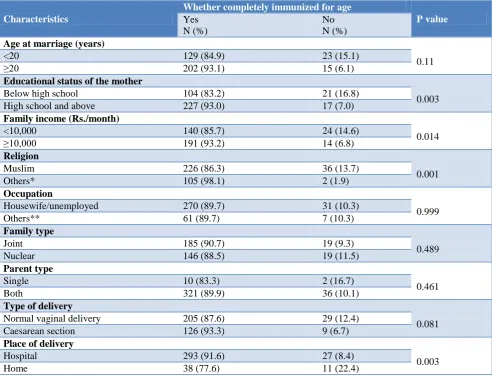
Table 3: Association between immunization status and demographic characteristics.
Characteristics
Whether completely immunized for age
P value Yes
N (%)
No N (%)
Age at marriage (years)
0.11
<20 129 (84.9) 23 (15.1)
≥20 202 (93.1) 15 (6.1)
Educational status of the mother
0.003
Below high school 104 (83.2) 21 (16.8)
High school and above 227 (93.0) 17 (7.0)
Family income (Rs./month)
0.014
<10,000 140 (85.7) 24 (14.6)
≥10,000 191 (93.2) 14 (6.8)
Religion
0.001
Muslim 226 (86.3) 36 (13.7)
Others* 105 (98.1) 2 (1.9)
Occupation
0.999
Housewife/unemployed 270 (89.7) 31 (10.3)
Others** 61 (89.7) 7 (10.3)
Family type
0.489
Joint 185 (90.7) 19 (9.3)
Nuclear 146 (88.5) 19 (11.5)
Parent type
0.461
Single 10 (83.3) 2 (16.7)
Both 321 (89.9) 36 (10.1)
Type of delivery
0.081
Normal vaginal delivery 205 (87.6) 29 (12.4)
Caesarean section 126 (93.3) 9 (6.7)
Place of delivery
0.003
Hospital 293 (91.6) 27 (8.4)
Home 38 (77.6) 11 (22.4)
Health care
About 71% of the index children experienced episodes of illness in the past 6 month. Among them, those who had diarrhea and ARI were 35.4% and 30% respectively. About 16% of those who had experienced illness were hospitalized. Majority (85.1%) of the mothers sought the advice of doctor‟s during their child‟s illness. A little more than half (54.7%) of the mothers checked their child‟s weight. About 43% of the mother‟s had done deworming for their child.
Psychosocial development
About 84.8% of the mothers initiate „rooming in‟ in less than 6hrs after delivery. About 99% of the mothers slept together with their child. Majority (96%) of the mother did not keep any helper for their child. About 14% of the mother kept their child at child care center.
Table 2 shows the association between exclusive
breastfeeding practice and socio-demographic
0.000 respectively). Educational status of the mother, occupation of the mother, family income, family type, parent type of the child and place of delivery were not associated with the practice of exclusive breast feeding.
Table 3 shows the association between immunization status of the child and socio-demographic characteristics. Children whose mother belongs to Muslim religion, lower educational status, lower family income and who delivered at home were significantly less likely to be completely immunized (p value of 0.001, 0.003, 0.014 and 0.003 respectively). However, age at marriage, occupation of the mothers, types of family, parent type and mode of delivery were not associated with the immunization status of the child.
DISCUSSION
In this study 43% of the mothers practiced exclusive breastfeeding. A similar study by Cacodar et al in rural Goa also observed that 37.51% of mother‟s practiced exclusive breastfeeding.5 In the study by Deshpande et al, 60.3% of the mother‟s practiced exclusive breastfeeding.8
Similar studies conducted by Srinivasa et al and Kumar et al also found that the proportion of mothers practicing exclusive breastfeeding were 76.2% and 57.9% respectively.9,10 However, only 15.9% of the mothers practiced exclusive breastfeeding in the study by Boralingiah et al.11
In our study 56.9% of newborns were breastfed within half an hour of delivery. Most of the delays in initiation of breastfeeding were due to weakness of the mothers as many of them undergo caesarean section under general anaesthesia. In a study conducted by Joseph et.al in South India, 34.5% of the newborns were breastfed within half an hour of delivery whereas in another study conducted by Kaur et al in Manakpur, Patiala, 76% of the mothers gave breast feeding within half an hour of delivery.6,12 In a study conducted by Singh et al in UP, 75% mother‟s initiate breastfeeding within 1 hour of delivery whereas in a study conducted by Srinivasa et al in rural Karnataka, only 22.7% initiate breastfeeding within 1 hour of delivery.9,13
Giving pre-lacteal feeds delays the establishment of lactation and can cause diarrhea and electrolyte imbalance in the newborn. In our study, 46% of the mothers gave pre-lacteal feeds to their newborn. In the study by Kaur et al in Manakpur, Patiala, 74% of the newborns were given pre-lacteal feeding whereas in the study by Joseph et al 33.5% of the newborns were given pre-lacteal feeding.6,12 Only 8.3% of the mother‟s gave pre-lacteal feeds to their babies in the study by Deshpande et al in Maharashtra.8 In the studies by Srinivasa et al in rural Karnataka, Vyas et al in rural Uttarakhand, Kumar et al in coastal South India, Kulkarni et al in urban Mumbai, Boralingiah et al and Abdulkader et al, the proportion of mothers giving pre-lacteal feeds to their newborns were 23.76%, 61.80%, 34.9%, 36.1%,
29% and 53% respectively.9-11,14-16 Thus the practice of giving pre-lacteal feeds varied widely among regions depending on local customs and belief. In this study honey and infant formula were commonly given as pre-lacteal feeds. In the study by Deshpande et al sugar water, ghee, honey, gripe water, jaggery water etc were commonly given as pre-lacteal feeds.8 Similarly, sugar water, boiled water, honey, animal milk, castor oil etc were given as pre-lacteal feeds in the study by Srinivasa et al.9 In the study by Boralingiah et al, sugar water (67.7%) was the most common pre-lacteal feeds given followed by honey (22.6%) and gripe water (9.7%).11 Colostrum provides a concentrated source of food for the newborn and offers protection against URTI, allergies and GI infections. In this study, 94% of the newborns were fed with colostrum. In the studies conducted by Singh et al, Deshpande et al, Srinivasa et al, Vyas et al, Puri et al and Boralingiah et al, the proportions of newborns fed with colostrum were 80%, 91.7%, 82.1%, 87.18%, 80.9% and 97.2% respectively.8,9,11,13,14,17 However in the study by Kaur et al, all (100%) the newborns were fed with colostrum.12
In our study about 90% of the children were completely immunized for age. This finding was similar to the study by Deshpande et al where 92.7% of the children were completely immunized for age.8
In a study by Sahoo only 43.3% of children were fully immunized.18 In this study, immunization status among non-muslim children (98.1%) was higher than among the muslim children (86.3%).
The trend of immunisation among the muslim and non-muslim children was similar to our study, 33% among the muslim and 45% among the hindu. In this study a significant association was observed between religion and the practice of exclusive breast feeding. A similar finding was also seen in a study conducted by Despande et al at Pravara Rural Hospital.8
The strength of the study is the adequate sample size of 369 which could be achieved during the study period. Moreover, the method of conducting the study by interviewing can also be regarded as one of the strength since the respondent can be probed further to assess their child rearing practices more accurately. The way the sample was selected raise some doubt regarding generalizability to other similar population.
ACKNOWLEDGEMENTS
The authors also like to express gratitude to Mr. Loken, Mrs. Sanatombi, Mr. Ibomcha and all the participant mothers for their help and co-operation during the study.
Funding: No funding sources Conflict of interest: None declared
Ethical approval: The study was approved by the Institutional Ethics Committee
REFERENCES
1. Vazir S, Naidu AN, Vidyasagar P. Nutritional status, psychosocial development and the home environment of Indian rural children. Indian Pediatr. 1998;35:959-66.
2. Vasir S, Bogle S, Naidu A. Influence of
psychosocial factors on nutritional status of preschool children. J Indian Acad Appl Psychol. 1998;14:1-8.
3. Bhogle S. A study of weaning practices, socio
economic status and their effect on the
anthropometric measures of babies. J Hum Dev. 1998;42:18-20.
4. UNICEF. Rapid assessment of child rearing
practices likely to affect child's emotional, psychological and psychomotor development 2001,
Dec. Available at: https://www.unicef.org/
evaldatabase/files/TNZ_01-25.pdf. Accessed 15
March 2017.
5. Cacodcar J, Shilpa J, Dubhash A. Breast feeding and infant feeding practices among rural mothers in Goa. Int. J Com Med Pub Health. 2016;3(1):184-9. 6. Joseph N. A longitudinal study on infant rearing
practices. J Family Med Primary Care. 2013;2:37-43.
7. Ministry of Health and Family Welfare,
Government of India. State Fact Sheet Manipur: NFHS IV 2015-2016.
8. Desphande JD, Giri PA, Phalke DB, Phalke VD, Kalakoti P, Syed MMA. Socio-cultural practices in relation to breastfeeding, weaning and childrearing among Indian mothers and assessment of nutritional status of children under five in rural India. AMJ. 2010;3(9):618-24.
9. Srinivasa K, Patel A, Ajay J, Manjunath GA. Infant feeding practices among nursing mothers at rural
tertiary care hospital. Int J Contemp Pediatr. 2017;4(3):837-42.
10. Kumar N, Unnikrishnan B, Rekha T, Mithra P, Kulkarni V, Kumar MP, et al. Infant feeding and rearing practices adapted by mothers in Coastal South India. Int J Collab Res Internal Med Pub Health. 2012;4(12):1988-99.
11. Boralingiah P, Polineni V, Kulkarni P, Manjunath R. Study of breastfeeding practices among working women attending a tertiary care hospital, Mysore, Karnataka, India. Int J Community Med Public Health. 2016;3(5):1178-82.
12. Kaur M, Kaur MG. A Study to Explore Cultural Child Rearing Practices among Women in Village Manakpura, Patiala. IJSR. 2017;6(1):346-50. 13. Singh S, Tiwari N, Kumar AM. A cross-sectional
study on exclusive breastfeeding practice among lactating females attending medical college, district Jhansi (U.P). Int J Med Sci Pub Health. 2017;6(2):377-81.
14. Vyas S, Sharma P, Kandpal SD, Semwal J,
Srivastava A, Nautiyal V. A community based study on breastfeeding practices in a rural area of
Uttarakhand. National J Community Med.
2012;3(2):283-7.
15. Kulkarni RN, Anjenaya S, Gujar R. Breast Feeding Practices in an Urban Community of Kalamboli, Navi Mumbai. IJCM. 2004;29(4):179-80.
16. Abdulkader RS, Kankaria A, Roy R, Chellaiyan VG, Kharya P, Upadhyay RP, Chinnakali P. Knowledge and practices regarding child rearing and its association with literacy among married women in a rural area of Tamil Nadu, India. Int J Med Pub Health. 2013;3(4):313-6.
17. Puri S, Bhatia V, Sharma M, Swami H, Magnat C. Comparison Of Prevalent Newborn Rearing Practices, In Urban And Slum Population Of Chandigarh, Ut, India. Internet J Pediatr Neonatol. 2007;9(1):1-9.
18. Sahoo H. Coverage of Child Immunisation and Its Determinants in India. Social Change. 2012;2:187-202.