Original Research Article
Assessment of patient safety culture in a rural tertiary health care
hospital of Central India
R. C. Goyal
1, Sonali Choudhari
2*
INTRODUCTION
‗Patient safety‘ is a crucial element of health care quality. As health care organizations continually strive to improve, there is growing recognition of the importance of establishing a patient safety culture. Achieving this requires an understanding of the values, beliefs, and norms about what is important in an organization and
what attitudes and behaviours related to patient safety are supported, rewarded, and expected.1 Organizations with a positive safety culture are characterized by communications founded on mutual trust, by shared perceptions of the importance of safety and by confidence in the efficacy of preventive measures.2
Increasing emphasis on patient safety has led healthcare experts to discover that the most patient safety errors are ABSTRACT
Background: A safety culture assessment provides an organization with a basic understanding of the safety related perceptions and attitudes of its managers and staff. While patient safety has been a major area of research in industrialized nations for over a decade, data on the root causes of unsafe care in low-income settings is sparse. The objective of the study was to assess the patient safety culture in a rural tertiary health care hospital situated in Central India.
Methods: A survey conducted during year 2015, in a rural tertiary health care teaching hospital, Maharashtra (India). The study participants were the 156 hospital staff working in various clinical work areas. The agency for healthcare research and quality hospital survey on patient safety culture, a validated instrument is used as an assessment tool.
Results: Total 144 participants included in the study, 75 (52%) were females and rest were males 48%. Out of these 111 (77),maximum number of staff (57.05%) was belonging to different intensive care units. 57% of participants had worked in the hospital for 1 to 5 years. For the unit level safety culture dimension, the maximum composite score of positive responses was obtained for ―Organizational learning- continuous improvement‖ (67%) followed by ―Hospital management support for patient safety‖ (65%). On the other hand only 48% survey participants gave an affirmative opinion with respect to ―Feedback and communication about error‖. For the hospital wide dimensions response rate was obtained as 62% for the ―Teamwork across Hospital Units‖ while for the dimension ―Hospital Handoffs & Transitions‖, the score came out as 55%.
Conclusions: The perception of patient safety and standards of patient safety were fairly good in the present rural tertiary health care hospital, but there is an ample of prospect in improvement with regard to event reporting, feedback and non punitive error.
Keywords:Assessment, Patient safety culture, Hospital survey
1AVB Rural Hospital, DMIMS (DU), Wardha, Maharashtra, India
2Department of Community Medicine, Jawaharlal Nehru Medical College, DMIMS (DU), Wardha,Maharashtra, India
Received: 23 May 2018
Revised: 29 May 2018
Accepted: 30 May 2018
*Correspondence:
Dr. Sonali Choudhari,
E-mail: [email protected]
Copyright: © the author(s), publisher and licensee Medip Academy. This is an open-access article distributed under the terms of the Creative Commons Attribution Non-Commercial License, which permits unrestricted non-commercial use, distribution, and reproduction in any medium, provided the original work is properly cited.
due to issues with systems rather than ―bad‖ individuals, and that some systems are more prone to errors than others. In an attempt to reduce and prevent medical errors, the health care industry has begun to focus on developing predictive measures of safety culture such as management and leadership behaviour, effective team functioning, communication, and employee perceptions of safety.3
Growing interest in patient safety culture has been accompanied by the need for assessment tools focused on the cultural aspects of patient safety improvement efforts. A safety culture assessment provides an organization with a basic understanding of the safety related perceptions and attitudes of its managers and staff. Safety culture measures can be used as diagnostic tools to identify areas for improvement.4
While patient safety has been a major area of research in industrialized nations for over a decade, data on the root causes of unsafe care in low-income settings is sparse.5 In India, public health system is chronically underfunded characterized by extremely high volumes of patients and a dearth of educated health workers. Very little evidence exists, however, about the perceptions of Indian health care providers regarding interventions to improve patient safety there.6
A tertiary health care hospital represents the higher level of health care delivery system wherein the turnover of patient is huge as well as the health staff has to deal with patients with advanced disease and complications referred from the periphery. Resultantly, there is more incidence of mortality. The patients and the relatives also have the risk of morbidity due to nosocomial infections. Thus a sound safety climate is needed to prevent adverse outcomes.
In this context, in the present study, a survey is conducted with the objective to assess the patient safety culture in a rural tertiary health care hospital situated in Central India.
METHODS
The present study is a hospital based survey conducted during August to November 2015 in a tertiary health care teaching hospital, of Wardha district (Maharashtra) India. The hospital has the bed strength of 1300 and caters mainly to the rural population, especially of low and middle income group with speciality and super speciality health care services.
The survey undertaken was paper based considering the non feasibility of web based survey in the current set up. The study participants were the hospital staff which included the doctors, nursing staff and the attendants working in various clinical work areas/units including different intensive care units too, to ensure that an adequate variety of job classifications and hospital units
would be represented. The work areas/units like Medicine, Paediatrics, Surgery, respective Intensive care units, Cath lab, etc. wherein the issue of patient safety, occurrence of adverse outcome is of great concern, were taken into consideration.
After receiving approval from the institutional ethical committee, a total of 200 hospital staff was initially included in the study using the convenience sampling method. But the duly complete proforma were obtained from 156 staff which constituted the final sample/study participants of the study.
The Agency for Healthcare Research and Quality (AHRQ) Hospital Survey on Patient Safety Culture (HSOPSC), a validated instrument is used as an assessment tool. It has 10 safety culture dimensions and 4 outcome measures listed as follows:7
Table 1: Safety culture dimensions and reliabilities.
I. Safety culture dimensions (Unit level) 1) Supervisor/manager expectations & actions
promoting safety
2) Organizational learning—continuous improvement
3) Teamwork within hospital units 4) Communication openness
5) Feedback and communication about error 6) Non punitive response to error
7) Staffing
8) Hospital management support for patient safety
II. Safety culture dimensions (Hospital-wide)
1) Teamwork across hospital units 2) Hospital handoffs & transitions
III. Outcome measures
1) Frequency of event reporting 2) Overall perceptions of safety 3) Patient safety grade
4) Number of events reported
This survey is primarily useful for assessing the safety culture of a hospital as a whole, or for specific units within hospitals, and not for assessing individual patient safety perceptions or skills. The 10 safety culture dimensions measure the perception of the respondent with respect to the safety of patients in their patient care unit (8 dimensions) and also their overall view of the safety of patients in the hospital in its entirety (2 dimensions). Each dimension has 3 to 5 questions and uses a 5-point Likert scale of agreement (―Strongly disagree‖ to ―Strongly agree‖) or frequency (―Never‖ to ―Always‖).
consistency (Cronbach's alpha= 0.63 to 0.84 and 0.31 to 0.83). Data analysis was done using the scoring methods as given in the guidelines for computing patient safety dimensions, for the HSOPSC.7
RESULTS
A total of 200 survey proforma were administered to the
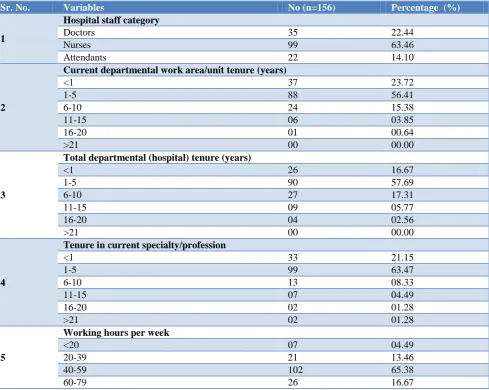
hospital staff, while by the time the data set was compiled, 156 duly filled and complete responses were received. This resulted in a 78% overall response rate. Maximum number of staff i.e. 89 out of 156 (57.05%) was belonging to different intensive care units. Majority (57%) of participants had worked in the hospital for 1 to 5 years, and about 63% staff had worked in their speciality for 1 to 5 years.
Table 2: Background information of the survey participants.
Sr. No. Variables No (n=156) Percentage (%)
1
Hospital staff category
Doctors 35 22.44
Nurses 99 63.46
Attendants 22 14.10
2
Current departmental work area/unit tenure (years)
<1 37 23.72
1-5 88 56.41
6-10 24 15.38
11-15 06 03.85
16-20 01 00.64
>21 00 00.00
3
Total departmental (hospital) tenure (years)
<1 26 16.67
1-5 90 57.69
6-10 27 17.31
11-15 09 05.77
16-20 04 02.56
>21 00 00.00
4
Tenure in current specialty/profession
<1 33 21.15
1-5 99 63.47
6-10 13 08.33
11-15 07 04.49
16-20 02 01.28
>21 02 01.28
5
Working hours per week
<20 07 04.49
20-39 21 13.46
40-59 102 65.38
60-79 26 16.67
The background information of all the survey participants is as shown in Table 2.
Safety culture dimensions
On analysing the unit level safety culture dimension, the maximum composite score of positive responses was obtained for ―Organizational learning- continuous improvement‖ (67%) followed by ―Hospital management support for patient safety‖ (65%). On the other hand only 48% survey participants gave an affirmative opinion with
respect to ―Feedback and communication about error‖. (Table 3).
For the hospital wide dimensions, the composite positive response rate was obtained as 62% for the ―Teamwork across Hospital Units‖ while for the dimension ―Hospital Handoffs & Transitions‖, the score came out as 55% (Table 4).
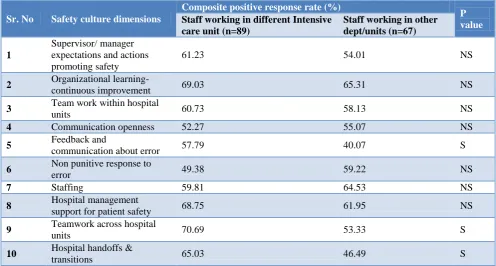
of the patient safety culture dimensions except for
‗Feedback and Communication About Error‘, ‗Teamwork Across Hospital Units‘ and ‗Hospital Handoffs & Transitions‘ (p<0.05) (Table 5).
Table 3: Perception of hospital safety culture dimensions in the unit.
Sr. No Safety culture dimensions in the unit Composite positive response rate (%)
1 Supervisor/ manager expectations and actions promoting safety 57.62
2 Organizational learning- continuous improvement 67.17
3 Team work within hospital units 59.43
4 Communication openness 53.67
5 Feedback and communication about error 48.83
6 Non punitive response to error 54.30
7 Staffing 62.17
8 Hospital management support for patient safety 65.35
Table 4: Perception of hospital safety culture dimensions (Hospital wide).
Sr. No Safety culture dimensions (hospital wide) Composite positive response rate (%)
1 Teamwork Across Hospital Units 62.01
2 Hospital Handoffs & Transitions 55.76
Table 5: Comparison of composite response rate among staff of intensive care units (emergency care) and other departments.
Sr. No Safety culture dimensions
Composite positive response rate (%)
P value
Staff working in different Intensive care unit (n=89)
Staff working in other dept/units (n=67)
1
Supervisor/ manager expectations and actions promoting safety
61.23 54.01 NS
2 Organizational learning-
continuous improvement 69.03 65.31 NS
3 Team work within hospital
units 60.73 58.13 NS
4 Communication openness 52.27 55.07 NS
5 Feedback and
communication about error 57.79 40.07 S
6 Non punitive response to
error 49.38 59.22 NS
7 Staffing 59.81 64.53 NS
8 Hospital management
support for patient safety 68.75 61.95 NS
9 Teamwork across hospital
units 70.69 53.33 S
10 Hospital handoffs &
transitions 65.03 46.49 S
Outcome measures
With regard to ‗Frequency of event reporting‘, when the participants were asked the question as ―When a mistake is made, but is caught and corrected before affecting the patient, how often is this reported‖, majority i.e. 110 (67%) marked the option as ―most of the time‖. On the other hand, when asked another question ―When a mistake is made, but has no potential to harm the patient, how often is this reported‖, maximum responses 114
(73.07%) were in favour of option ―always‖. Again for the last question regarding ―reporting of event/mistake that could harm the patient, but does not,‖ highest no of responses 123 (78%) were for ―always‖ option.
However, only 15% of participants reported the ‗events‘ with regard to patient safety in the last twelve months while majority i.e. 133 (85%) either didn‘t come across or report any event in the last one year.
Table 6: Outcome measures of patient safety culture survey.
Sr.
No Components
Composite positive response rate (%)
1 Overall perception of safety 67.13
2
Number of events reported in the past 12 months
No. () (n=156)
No event 133 (85.25)
1 to 2 18 (11.53)
3 to 5 05 (3.20)
6 to 10 00 (00.00)
11 to 20 00 (00.00)
>21 00 (00.00)
Figure 1: Bar diagram showing patient safety grade of work area/units.
DISCUSSION
‗Patient safety‘ is defined as the avoidance and prevention of patient injuries or adverse events resulting from the process of health care delivery.1 The Institute of medicine stated that healthcare organizations should develop and promote a safety culture where adverse events are reported without people being blamed, give scope of improvement to doctors by learning from their mistakes and prevent further errors.3 Getting the ‗right patient safety culture‘ is an important component in improving patient safety which can be assessed by various surveys like safety attitude questionnaire (SAQ), HSOPS questionnaire which have similar reliability, predictive validity. HSOPS safety culture dimensions were the best predictors of frequency of event reporting and overall perception of patient safety while SAQ and HSOPS dimensions both predicted patient safety grade.8
In the present study , the composite frequency of the positive responses for the various patient safety dimensions was above 50%, but still there is reasonable scope for improvement in almost all the domains like evidence based practices, communication, learning and patient cantered practices, leadership, teamwork,...etc. Though the composite score for ‗Teamwork across the hospital unit‘‖ came out as 62%, still with regard to ‗Hospital handoff & transitions‘, only 55% of the hospital staff were in agreement of smooth and hassle free working during patient transfer & exchange of information between the units. Similarly in a study by William et al out of 328 case descriptions, 87 reports were of blurred responsibility and 67 reports were of inhibited communication, leading to 31% adverse patient consequences.9 In order to overcome the difficulties during transfer of patients across the units/work areas, there is need of use of standardized handoff protocols.
Even for the dimension ‗Feedback and Communication about Error‘ the score is not up to the mark (48%), which is mainly due to the common fact that the feedback giving is seldom practiced by the staff or even if the feedback is given it is provided unwillingly, in an ineffective and/or inappropriate manner. It leads the undesirable behaviour uncorrected or may reinforce wrong and unacceptable behavior of the staff.
Comparison of response rate among staff of intensive care units (emergency care) and other departments revealed no significant difference for most of the patient safety culture dimensions. This may indicate that the patient safety culture is uniform throughout the hospital. The better score for some of the dimensions (‗feedback and communication about error‘, ‗teamwork across hospital units‘ and ‗hospital handoffs & transitions‘) in the units providing emergency care may be because of the nature of their work and constant need to provide time urgent critical care throughout the year.
Identification and mandatory reporting of events/ incidents is an important strategy to improve patient safety.10 An ‗Event‘ is defined as any type of error, mistake, incident, accident or deviation, regardless of what whether or not it results in patient harm1. Event reporting needs to be improved and standardized as in the present study, quite a high proportion of survey participants didn‘t report any event in the last twelve months which might be because of less occurrence of adverse outcomes or reluctance on the part of staff to report any event they came across.
correct balance between individual responsibility and punishment for an unintended human error.12
CONCLUSION
Survey findings, showed that the perception of patient safety and standards of patient safety were fairly good in the present rural tertiary health care hospital, but there is an ample of prospect in improvement with respect to event reporting, feedback and non punitive error.
Limitation
Although surveying all hospital staff is most desirable, but in the present study considering the constraints with regard to resources, time, a sample of the varied hospital staff is included in the study.
Recommendation
Improving patient safety is integral to enhanced safety in medical care. Training programs and simulation exercises on patient safety culture must be periodically organised and a non punitive approach to adverse events should be practised.
Funding: No funding sources Conflict of interest: None declared
Ethical approval: The study was approved by the Institutional Ethics Committee
REFERENCES
1. Sorra JS, Nieva VF. Hospital Survey on Patient Safety Culture. (Prepared by Westat, under Contract No. 290-96-0004). AHRQ Publication No. 04-0041. Rockville, MD: Agency for Healthcare Res Quality. 2004.
2. Health and Safety Commission (HSC). Organizing for safety: Third report of the human factors study group of ACSNI. Sudbury: HSE Books; 1993. 3. Agency for Healthcare Research and Quality (2007,
April). Patient safety culture surveys. Rockville, MD: Author. Available at: http:/www.ahrq.gov/
qual/ hospculture. Accessed on 3 March 2018. 4. Nieva VF, Sorra J. Safety culture assessment: a tool
for improving patient safety in healthcare organizations. Qual Saf Health Care. 2003;12:217-23.
5. Jha AK, Prasopa-Plaizier N, Larizgoitia I, Bates DW. Research Priority Setting Working Group of the WHO World Alliance for Patient Safety. Patient safety research: An overview of the global evidence. Qual Saf Health Care. 2010;19:42-7.
6. Horton R, Das P. Indian health: The path from crisis to progress. Lancet. 2011;377:181-3.
7. Sorra JS, Nieva VF. Hospital Survey on Patient Safety Culture. Rockville, MD: Agency for Healthcare Research and Quality; 2004. Report No.: AHRQ publication 04-0041.
8. Etchegaray JM, Thomas EJ. Comparing two safety culture surveys: safety attitudes questionnaire and hospital survey on patient safety. BMJ Qual Saf. 2012;21:490-8.
9. Williams RG, Silverman R, Schwind C, Fortune JB, Sutyak J, Horvath KD, et al. Surgeon information transfer and communication: factors affecting quality and efficiency of inpatient care. Ann Surg. 2007;245(2):159-69.
10. Kohn LT, Corrigan JM, Donaldson MS. To err is human: building a safer health system. Washington, DC: National Academy Press; 1999.
11. Youngberg BJ. Event reporting: the value of a nonpunitive approach. Clin Obstet Gynecol. 2008;51:647–55.
12. Watcher RM, Provonost PJ. Balancing ‗‗no blame‘‘ with accountability in patient safety. N Engl J Med. 2009;361:1401-6.
Cite this article as: Goyal RC, Choudhari S.