© 2018 IJSRSET | Volume 4 | Issue 8 | Print ISSN: 2395-1990 | Online ISSN : 2394-4099 Themed Section : Engineering and Technology
Implementation of Log Mining and Forensic Analysis for
Database Intrusion Detection and Protection System
Swati Baburao Wankar 1
1M.Tech Scholar, Department of Computer Science &Engineering, Wainganga College of Engineering &
Technology, Nagpur, Maharashtra, India
ABSTRACT
Most PC systems utilize user IDs and passwords as the login examples to validate users. Be that as it may, numerous individuals share their login designs with colleagues and demand these collaborators to help co-errands, accordingly making the example as one of the weakest purposes of PC security. Insider attackers, the legitimate users of a system who assault the system internally, are difficult to distinguish since most intrusion detection systems and firewalls identify and disconnect pernicious practices propelled from the outside universe of the system as it were. Accordingly, in this undertaking, a security system, named the Internal Intrusion Detection and Protection System (IIDPS), is proposed to distinguish insider assaults at IMAGE PATTERN BASED SIGNATURE GENERATION by utilizing data mining and legal techniques. This system checks user conduct profile and picture design at that point play out the activity.
Keywords: IIDPS, System Calls, Forensic Techniques, Computer Security, User Behavior Profile, Image Pattern Based Signature Generation
I.
INTRODUCTIONIn the previous decades, PC systems have been generally utilized to furnish users with less demanding and more advantageous lives. In any case, when individuals misuse great capacities and handling intensity of PC systems, security has been one of the major issues in the PC space since attackers for the most part endeavor to enter PC systems and carry on malignantly, e.g., taking basic data of an organization, influencing the systems to out of work or notwithstanding obliterating the systems. For the most part, among all outstanding assaults, for example, pharming assault, appropriated dissent of-benefit (DDoS), listening stealthily assault, and lance phishing assault [1], [2], insider assault is a standout amongst the most troublesome ones to be recognized in light of
substantially more supportive in distinguishing attackers and identifying users [6], preparing a huge volume of SCs, mining vindictive practices from them, and identifying conceivable attackers for an intrusion are as yet building challenges.
Along these lines, in this paper, we propose a security system, named Internal Intrusion Detection and Protection System (IIDPS), which distinguishes vindictive practices propelled toward a system at SC level. The IIDPS utilizes data mining and scientific profiling techniques to mine system call designs (SC-designs) characterized as the longest system call succession (SC-arrangement) that has more than once seemed a few times in a user's log petition for the user. The user's legal highlights, characterized as a SC-design as often as possible showing up in a user's submitted SC-successions however seldom being utilized by different users, are recovered from the user's PC use history.
Intrusion implies any arrangement of exercises that endeavor to hurt the security objectives of the data. Different methodologies like as encryption, firewalls, virtual private system, and so on., But they were insufficient to anchor the system completely. Henceforth, Internal Intrusion Detection and Protection System criminological highlights and decides if an approved login of user or not and if not then contrasting users current computerized signature and the picture designs gathered in the user's close to home profile. After the user has been enrolled with the system, a picture design advanced secret key is produced by the user. Subsequent to making another record in the wake of making another document, this picture example will utilize the advanced secret key, to spare it and to alter the document, it will likewise give this picture design watchword.
The commitments of this paper are: 1) identify a user's measurable highlights by breaking down the comparing SCs to upgrade the precision of assault detection; 2) ready to port the IIDPS to a parallel
system to additionally abbreviate its detection reaction time; and 3) successfully oppose insider assault.
II.
RELATED WORKSPC forensics science, which sees PC systems as wrongdoing scenes, means to identify, safeguard, recuperate, break down, and display actualities and sentiments on data gathered for a security occasion [7]. It breaks down what attackers have done, for example, spreading PC infections, malwares, and vindictive codes and leading DDoS assaults [8]. Most intrusion detection techniques center around how to discover vindictive system practices [9], [10] and secure the qualities of assault bundles, i.e., assault designs, in view of the accounts recorded in log documents [11], [12]. Qadeer et al. [13] utilized self-created bundle sniffer to gather organize parcels with which to segregate arrange assaults with the assistance of system states and bundle appropriation. O' Shaughnessy and Gray [14] gained organize intrusion and assault designs from system log records. These records contain hints of PC abuse. It implies that, from artificially created log records, these follows or examples of abuse can be all the more precisely imitated. Wu and Banzhaf [15] diagramed look into advance of applying strategies for computational insight, including fake neural systems, fluffy systems, developmental calculation, fake resistant systems, and swarm knowledge, to distinguish noxious practices. The creators systematically abridged and analyzed distinctive intrusion detection techniques, hence enabling us to unmistakably see those current research challenges.
which gathers legal highlights for users at summon level instead of at SC level, by conjuring data mining and legal techniques, was produced. Additionally, if attackers utilize numerous sessions to issue assaults, e.g., multistage assaults, or dispatch DDoS assaults, at that point it is difficult for that system to identify assault designs. Hu et al. [17] introduced a canny lightweight IDS that uses a scientific system to profile user practices and a data mining strategy to complete agreeable assaults. The creators guaranteed that the system could identify intrusions viably and proficiently progressively.
Be that as it may, they didn't say the SC channel. Giffin et al. [18] gave another case of incorporating PC forensics with an information based system. The system embraces a predefined demonstrate, which, permitting SC-successions to be regularly executed, is utilized by a detection system to confine program execution to guarantee the security of the ensured system. This is useful in distinguishing applications that issue a progression of malignant SCs and identifying assault groupings having been gathered in information bases. At the point when an undetected assault is displayed, the system every now and again finds the assault grouping in 2 s as its calculation overhead. Fiore et al. [19] investigated the viability of a detection approach in light of machine picking up utilizing the Discriminative Restricted Boltzmann Machine to join the expressive intensity of generative models with great characterization exactness abilities to construe some portion of its learning from inadequate preparing data so the system inconsistency detection plan can give a sufficient level of protection from both outer and internal dangers. Faisal et al. [20] investigated the likelihood of utilizing data stream mining to improve the security of cutting edge metering framework through an IDS. The progressed metering framework, which is a standout amongst the most urgent segments of shrewd card, fills in as a scaffold for giving bidirectional data stream between the user space and the utility area. The creators regard an IDS as a second-line security measure after the
main line of essential progressed metering foundation security techniques, for example, encryption, approval, and verification.
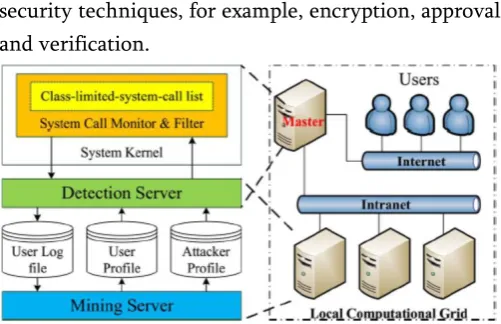
Figure 1. IIDPS System Structure
III.
EXISTING SYSTEM
In existing can use the Internal Intrusion Detection and Protection System (IIDPS) It perform process of easy detect attacker in SC level inside using data mining and forensic techniques. This method to create user personal profile based on usage habit's and also determine authorized and unauthorized user based on usage behaviour in patterns collected in the account holder’s personal profile. But habit pattern may be misled the system. So solution is our new approach Image Pattern Based Signature Generation algorithm.
IV.
PROPOSED SYSTEMsystem got the chance to ponder the SCs created and furthermore the SC-designs made by these orders all together that the IIDPS will locate those malevolent practices issued by them so prevent the shielded system from being assaulted. The System Architecture of the proposed system is shown in figure 1.
A.Graphical Pattern Matching Algorithm
The workflow of pattern matching phase is as below: Step1. C: (A, ID) S [User A sends his ID to the server for pattern matching]
Step2. S: DQ (ID)[in the server side the user’s information will find from data base]
Step3. S: IMX (DI, INi) C [Server generate a matrix from the decoy images and user’s password images and sent to the client side]
Step4. C: CWCP (IMX (Di,INi)) [the algorithm check the copyright protection info in them image matrix] Step5. C: If attack Break [if there is any error in copyright protection check] Else Continue
Step5: C: RCS (IMX (Di,INi))[In the client side for each image in the matrix a set of random character set will generate and show to the user]
Step5: C: INi [user selects his/her password images by write the related characters and algorithm fin the related ID regarding to the users entered characters as INi]
Step6. C: ID || INi [in the client side the ID of user and selected images INi will be concatenate and make the signature data pack]
Step7. C: ID|| INiS [Client send the generated signature data pack to the server]
Step8. S: Success/Reject C[check the signature data pack and if the pack is true then reply successfully to the client side and If signature data pack is not true then reject the user in request]
B. Graphical Pattern Generating Algorithm
Step1. C: (A) S [User A sends the new pattern generating request to the server]
Step2. S: C [Server sends the new user ID and random matrix of images with INito the client side]
Step3. C: If (UAI) then [User can add his/her images in the system] WCP (UI) [algorithm must run the watermarking method to copyright info in users’ images]
Step3: C: INi [user selects his/her pattern images as INi] Step4.C: ID ||INi [in the client side the ID of user and selected images INi will be concatenate and make the data pack]
Step5.C: ID|| INiS [Client send the generated data pack to the server]
Step6.S: DW (ID||Ij)| [on the server site the information inside the data pack (digital signature) will write in the database]
V.
SYSTEM IMPLEMENTATIONAt the point when user store his data to server user need to produce a profoundly secure computerized signature. We proposed another picture design based mark age. We utilized various watermark picture for this. The watermarked picture grid contains the secret word. User can choose a few pictures from the grid as secret key and submit to the system, for instance, in the picture underneath marked some arbitrary characters. User enter character and chooses three pictures as the example. Yet, in this strategy the user can include his own picture additionally that calculation must utilizing the watermarking procedure and put the copyright protection in the user's pictures.
The IDPS, as appeared in Fig. 1, comprises of a SC screen and channel, a mining server, a detection server, a nearby computational matrix, and three vaults including
1. User log Files 2. User Profiles 3. Attacker Profile.
When user update his data to server user need to match his highly secure digital signature. For matching digital signature pattern user make a request to the server. The server sends matrix of water marked images for user digital signature matching.
The user selects his pattern images and make a temporary signature and match with user original digital signature which stores into the database. When both signature match user data modification process start and inform the user.
When both signatures do not match server make alert to the user. When user update his data to server user need to match his highly secure digital signature. For matching digital signature pattern user make a request to the server. The server sends matrix of water marked images for user digital signature matching.
The user selects his pattern images and make a temporary signature and match with user original digital signature which stores into the database. When both signature match user data modification process
start and inform the user. When both signatures do not match server make alert to the user.
VI.
CONCLUSION AND FUTURE WORK
The IIDPS (Internal Intrusion Detection and Protection System) employs data mining and forensic techniques to identify the user behavioral patterns for a user. The time that a habitual behavior pattern appears in the user’s log file is counted, the most commonly used patterns are filtered out, and then a user’s profile is established. By identifying a user’s behavior patterns as his/her computer usage habits from the user’s current input, the IIDPS resists suspected attackers. The future work of insider attack detection research will be about collecting the real data in order to study general solutions and models. It is hard to collect data from normal users in many different environments. It is especially hard to acquire real data from a masquerade or traitor while performing their malicious actions. Even if such data were available, it is more likely to be out of reach and controlled under the rules of evidence, rather than being a source of valuable information for research purposes.
VII.
REFERENCES[1] S. Gajek, A. Sadeghi, C. Stuble, and M. Winandy, ―Compartmented security for browsers—Or how to thwart a phisher with trusted computing,‖ in Proc. IEEE Int. Conf. Avail., Rel. Security, Vienna, Austria, Apr. 2007, pp. 120–127.
[2] C. Yue and H. Wang, ―BogusBiter: A transparent protection against phishing attacks,‖ ACM Trans. Int. Technol., vol. 10, no. 2, pp. 1–31, May 2010.
Autonomic Comput. Conf., Miami, FL, USA, 2013, pp. 1–10.
[4] F. Y. Leu, M. C. Li, J. C. Lin, and C. T. Yang, ―Detection workload in a dynamic grid-based intrusion detection environment,‖ J. Parallel Distrib. Comput., vol. 68, no. 4, pp. 427–442, Apr. 2008.
[5] H. Lu, B. Zhao, X. Wang, and J. Su, ―DiffSig: Resource differentiation based malware behavioral concise signature generation,‖ Inf. Commun. Technol., vol. 7804, pp. 271–284, 2013.
[6] Z. Shan, X. Wang, T. Chiueh, and X. Meng, ―Safe side effects commitment for OS-level virtualization,‖ in Proc. ACM Int. Conf. Autonomic Comput., Karlsruhe, Germany, 2011, pp. 111–120.
[7] M. K. Rogers and K. Seigfried, ―The future of computer forensics: A needs analysis survey,‖ Comput. Security, vol. 23, no. 1, pp.12–16, Feb. 2004.
[8] J. Choi, C. Choi, B. Ko, D. Choi, and P. Kim, ―Detecting web based DDoS attack using MapReduce operations in cloud computing environment,‖ J. Internet Serv. Inf. Security, vol. 3, no. 3/4, pp. 28–37, Nov. 2013.
[9] Q. Wang, L. Vu, K. Nahrstedt, and H. Khurana, ―MIS: Malicious nodes identification scheme in network-coding-based peer-to-peer streaming,‖ in Proc. IEEE INFOCOM, San Diego, CA, USA, 2010, pp. 1–5.
[10] Z. A. Baig, ―Pattern recognition for detecting distributed node exhaustion attacks in wireless sensor networks,‖ Comput. Commun., vol. 34, no. 3, pp. 468–484, Mar. 2011.
[11] H. S. Kang and S. R. Kim, ―A new logging-based IP traceback approach using data mining techniques,‖ J. Internet Serv. Inf. Security, vol. 3, no. 3/4, pp. 72–80, Nov. 2013.
[12] K. A. Garcia, R. Monroy, L. A. Trejo, and C. Mex-Perera, ―Analyzing log files for postmortem intrusion detection,‖ IEEE Trans. Syst., Man,
Cybern., Part C: Appl. Rev., vol. 42, no. 6, pp. 1690–1704, Nov. 2012.
[13] M. A. Qadeer, M. Zahid, A. Iqbal, and M. R. Siddiqui, ―Network traffic analysis and intrusion detection using packet sniffer,‖ in Proc. Int. Conf. Commun. Softw. Netw., Singapore, 2010, pp. 313–317.
[14] S. O’Shaughnessy and G. Gray, ―Development and evaluation of a data set generator tool for generating synthetic log files containing computer attack signatures,‖ Int. J. Ambient Comput. Intell., vol. 3, no. 2, pp. 64–76, Apr. 2011.