In the search for new, improved energy systems for the 21st century, the emphasis is on environmentally friendly, efficient means of energy conversion and storage. High temperature fuel cells offer energy conver-sion efficiencies as high as 70% although there are still problems to overcome before the optimum fuel – natural gas – can be used without difficulty. Future applications of high temperature fuel cells in addition to power generation, is an area of considerable excitement. There is growing interest in transport applications and the use of
alter-native fuels. High temperature fuel cells offer considerable promise for working with more complex fuels, such as biogas or reformed higher alkanes, as their high temperature of operation facilitates reform-ing engineerreform-ing. Closely allied to these applications in fuel cell technology is the use of electrochemical reactors for the industri-ally important electrocatalytic oxidation of hydrocarbons. In the long term solid oxide fuel cell (SOFC) technology is foreseen as a candidate for a much more efficient elec-trolysis of steam and carbon dioxide. The OSSEP Programme focuses on both funda-mental and applied aspects.
The high temperature electrochemical oxidation of hydrocarbons is an area of considerable strategic, environmental and economical importance. The purpose of this ESF Programme is to promote investigations into the processes involved in the solid state electrochemical oxidation of hydrocarbons and hence to develop new fuel cell materials and systems to meet the challenges of the new millennium. The Programme will facilitate the exchange of ideas and develop common programmes of activity. This will be achieved by organising workshop meet-ings each year, by regular exchange of personnel on short-term visits, short Fellow-ships and by shared FellowFellow-ships involving periods of research at two or more host
The European Science Foundation acts as a catalyst for the development of science by bringing together leading scientists and funding agencies to debate, plan and
Optimisation of Solid State Electrochemical
Processes for Hydrocarbon Oxidation
(OSSEP)
Introduction
At the forefront of developing energy technologies is the Solid Oxide Fuel Cell (SOFC) which should find widespread application in the conversion of chemical to electrical energy. The Solid Oxide Fuel Cell (SOFC) is an all-ceramic device that operates at temperatures in the range 850-1000oC. This design holds
particular promise for power
generation, particularly for combined heat and power operation. Most current development centres on designs based on the yttria-stabilised zirconia (YSZ) electrolyte, with (La,Sr)MnO3 as the preferred cathode, Ni/ZrO2 cermets as the preferred anode, and lanthanum chromite or special alloys as interconnects.
Background
Probably the most important materi-als problem to be addressed in the development of the first and succeed-ing generations of SOFCs is the fuel electrode. A major objective is the development of SOFC anodes capable of operating in natural gas, without suffering from carbon build up due to catalytic cracking; this objective is still far from being achieved. At present Ni/ZrO
2 cermet anodes, which are
inexpensive and exhibit high catalytic activity for hydrogen oxidation have been widely used in SOFCs with hydrogen fuel. The Nickel loading is generally chosen to be slightly in excess of the limit for percolation electronic conduction. At higher Ni loadings there are problems with thermal expansivity mismatch between the Ni and the zirconia electrolyte substrate. The major disadvantage of the Ni cermet elec-trode arises from the promotion of competitive catalytic cracking of hydrocarbon reactions. The rapid deposition of carbon at Ni cermets means that direct oxidation of meth-ane is not technically viable in Ni-containing solid oxide fuel cells. In order to use methane as fuel in this type of SOFC the fuel needs to be externally or internally reformed with steam4. The reforming reaction
(1) is generally associated with a following water gas shift equilibrium reaction (2).
Both these reactions are favoured by low pressures and high temperatures and by large steam partial pressures. If insufficient steam is present, carbon may be deposited according to
This cracking reaction is even more problematic with higher
hydrocar-bons, which also are present in natural gas.
In the next generation of SOFC
devices, there is considerable empha-sis on moving to lower temperatures
of operation as this will reduce sealing problems and allow cheaper
and interconnect materials to be used. The initial problem to be addressed is
finding a suitable electrolyte material that performs well at lower tempera-tures; good progress has been made
using thin film YSZ electrolytes or alternative oxygen-ion conductors
such as scandia-stabilised zirconia, lanthanum gallate-based perovskites
or gadolinia cerium oxide. Another, highly attractive alternative may be to
use proton conducting electrolytes such as the perovskite BaCeO
3 or
perovskite-related materials such as
Ba3(Ca1+xNb2-x)O9-d to provide good ionic conductivity in the temperature
range 500-750oC. In order to use
these alternative electrolytes systems,
new or improved electrode materials with suitable electrochemical
proper-ties for operation at lower tempera-tures, i.e. < 850oC are required.
The requirements for efficient fuel
electrode operation are many, so the search for alternative materials is not
a simple task. These materials must be stable both at the low oxygen
partial pressures prevalent in the fuel gas and at the more oxidising
conditions at the fuel outlet. Fuel
electrodes must also exhibit suitable catalytic and electrical properties and
they must also be structurally and mechanically compatible with the
electrolyte up to operating temperatures.
There is growing interest in high
temperature fuel cells for transport applications and the use of alternative fuels such as biogas for power
genera-tion. Recently a number of car manufacturers have developed
prototype vehicles using hydrogen powered fuel cells. Despite these
advances, hydrogen is not an ideal fuel due to potential safety hazards
and difficulties in distribution. Attention is, therefore moving towards hydrocarbons with initial
developments focusing on methanol; however further development is likely
to move towards more energy rich fuels such as dimethyl ether, gasoline
and diesel, especially if the methanol is to be derived from fossil fuels.
High temperature fuel cells offer considerable promise for working
with more complex fuels, such as gases derived from gasification of biomass, waste and coal or reformed
higher alkanes, as their high tempera-ture of operation facilitates reforming
engineering. Reforming systems typically require temperatures of
600oC and thus can easily be
inte-grated into a high temperature fuel
cell stack.
SOFC technology may be also used for high temperature electrolysis of water and carbon dioxide, which results in synthesis gas as the product. From synthesis gas several valuable com-pounds, e.g. methanol or dimethyl ether, may be produced. This technol-ogy could eventually be developed for the transport of renewable energy such as hydropower from remote areas or for better distribution of energy from gasfields to urban areas.
Intimately linked with fuel cell technology is electrocatalysis. In developing new fuel cell anodes, catalytic activity for hydrocarbon oxidation is very important.
Electrocatalysis at solid electrolytes is a topic of growing importance and is
potentially an excellent tool for the partial oxidation of hydrocarbons, e.g. in the preparation of olefins from alkanes. Catalytic processes at solid electrolytes are of great interest to the chemical industries as they offer improved yields and selectivity. An important phenomenon, the Non-Faradaic Modification of Catalytic Activity (NEMCA) effect can give rise to substantial increases in catalytic activity due to small changes in the electrode potential at a solid electro-lyte. These phenomena are not well understood and provide a fruitful area for basic investigations.
Research topics and methodology
Transport properties
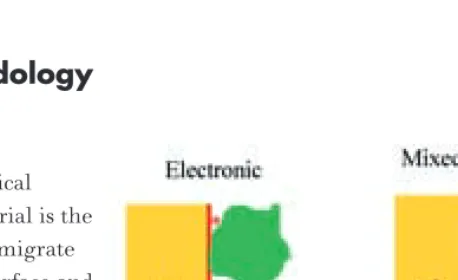
Underlying the electrochemical activity of an electrode material is the ability of charged species to migrate from the electrolyte to the surface and their availability at the surface to perform electrochemical reactions. If an electrode can transport both electrons and ions from electrolyte to the surface, then it will allow electro-chemical reactions to occur across the complete electrode surface, not just at the three phase boundaries between electrode, electrolyte and gas phase, figure 2. This affords much better activity and may be viewed as a catalytic effect. One of the major topics to be discussed and investigated during this programme is charge transport. O2-, H+ and e- conductivity
will be investigated as functions of temperature, atmosphere and compo-sition. The extent of mixed
conduc-permeation techniques. Bulk trans-port and surface exchange will be investigated using diffusion tech-niques such as secondary ion mass spectrometry. Modelling will be used to compare theoretical and observed characteristics.
Catalytic activity
Another major activity of this programme relates to catalytic activity. The ability of potential electrode materials to oxidise, dehy-drogenate or reform a wide range of hydrocarbons will be investigated using temperature-programmed techniques with GC and mass spectro-metric analysis. Sensitivity to sulphur and other impurities will be tested. Electrocatalysis will be investigated both in fuel cell and reactor opera-tional modes. For fuel cells I-V characteristics will be investigated in association with evolved gas analysis. The possibility of gradual reforming of natural gas in SOFCs using a methane steam reforming catalyst coated onto an anode material will be studied. For electrochemical reactors hydrocarbon gas will be fed across the fuel electrode and the conditions required to optimise partial oxidation or dehydrogenation determined.
Structure and microstructure
In situ and ex situ techniques such as X-ray, electron and neutron diffrac-tion, EXAFS, Raman and NMR spectroscopy will be used to perform basic structural studies on candidate electrode materials. The resulting information will provide details of structural changes that occur on changing temperature, atmosphere and polarisation. Post-mortem studies will also be performed to investigate degradation on operation.
Thermodynamic properties and stability
Weight and volume changes as functions of gas composition and temperature will be investigated. Oxygen exchange will be investigated in atmospheres relevant to SOFC anodes and electrochemical oxidation
Transmission Electron Micrograph of Layered Perovskite Titanate
cells, e.g. exchanges from isotopically labelled water, CO2 etc. Chemical compatibility between electrodes and electrolytes will also be investigated after co-firing using microscopy and diffraction techniques to analyse for reaction products.
Electrochemistry
Techniques such as voltammetry and ac impedance spectroscopy will be used to study reactions occurring at electrode interfaces. Both point and macroscopic electrode geometries will be used. Experiments will be per-formed in different gases and compo-sitions with the aim of resolving different stages of the electrochemical oxidation processes and relating this to the catalytic and electrical proper-ties of the electrodes.
Materials
low-temperature densification tech-niques which result in high densities and special microstructures. These densification techniques are available to the participants of the ESF-OSSEP programme.
Systems
Work will also be performed in order to test systems for use in SOFCs, electrolysis systems and electrochemi-cal modification. This will involve fabrication and testing of partial and complete single cells, but not, gener-ally cell stacks.
for cell preparation. Cells will be fabricated using a range of techniques such as ceramic processing of bulk electrolytes, e.g. tape and slip casting, thick film electrolyte deposition and slurry coating and screen printing of electrodes.
Normally static compaction tech-niques are used to densify powders of solid electrolytes, applying a constant pressure for a certain period of time. Dynamic compaction uses a pressure pulse with a typical duration of microseconds. The pulse results in a pressure wave that travels through the sample. Both Explosive Dynamic Compaction and Magnetic Pulse Dynamic Compaction are relatively
ESF OSSEP programme
Workshops
One or more topical workshops will be held each year involving research-ers from the participating laborato-ries. Each workshop is expected to last for 2-3 days and involve 20-30 participants. The workshop will be comprised of contributed oral papers, round table discussions and overview presentations. The Workshop Programme is detailed below:
.
Optimisation of Solid StateElectrochemical Processes for Hydrocarbon Oxidation
St Andrews, Scotland, 22-24 June 2000
.
Solid Oxide Fuel Cell Materialsand Mechanisms (jointly with IEA)
Les Diablerets, Switzerland, 16-19 January 2001
.
Synthesis and Processing.
Fuel Cells based uponProton-Conducting Electrolytes
Risø, Denmark, April 2002
(to be confirmed)
.
Electrocatalytic Processes.
Novel Materials and Processes forHydrocarbon-Fuelled High Tem-perature Fuel Cells
.
Electrochemical Oxidation ofHigher Hydrocarbons
Grants
The Programme also supports longer term collaborative research projects for younger researchers of up to three months duration or occasionally for six months. The latter involves researchers spending two three-month spells working on a collabora-tive project at two laboratories in-volved in the OSSEP Programme.
Selection is based on the quality and appropriateness of the applicant’s previous research and the quality of the proposed research project. Short-term fellowships require that the applicants already have some relevant experience, although it is important that they can also expand their expertise as a result of the visit.
For the latest information on this programme consult the OSSEP home page at:http://www.esf.org/ossep
An electronic newsletter will be circulated two or three times per year.
To subscribe to the OSSEP mailing list, please send an email as shown below:
Subject: <should remain blank> Content: join ossep-list
Funding
ESF scientific programmes are principally financed by the
Foundation’s Member Organisations on an à la carte basis. OSSEP is supported by:
Statens Teknisk-Videnskabelige Forskningsråd, Denmark; Hermann von Helmholtz-Gemeinschaft Deutscher Forschungszentren, Germany; Consiglio Nazionale delle Ricerche, Italy; Nederlandse Organisatie voor Wetenschappelijk Onderzoek, Netherlands; Norges Forskningsråd, Norway; Instituto de Cooperação Científica e Tecnológica Internacional, Portugal; Consejo Superior de Investigaciones
Científicas, Spain; Oficina de Ciencia y Tecnología, Spain; Schweizerischer Nationalfonds zur Förderung der Wissenschaftlichen Forschung/Fonds National Suisse de la Recherche Scientifique, Switzerland;
OSSEP Steering Committee
Cover picture:
Oxygen vacancy in fluorite lattice.
For the latest information on this programme consult the OSSEP home page:
www.esf.org/ossep
Dr. Svenje Mehlert
ESF Scientific Secretary
Mrs. Marie Clifford Gruber
ESF Administrator
European Science Foundation
1 quai Lezay-Marnésia 67080 Strasbourg Cedex France
WWW Home Page: http://www.esf.org
Tel: +33 (0)3 88 76 71 07 Fax: +33 (0)3 88 37 05 32 E-mail: [email protected]
Professor John T.S. Irvine (Chairman)
School of Chemistry University of St Andrews
St Andrews Fife KY16 9ST United Kingdom
Tel: +44 1334 463817 Fax: +44 1334 463808 Email: [email protected] http://ch-www.st-andrews.ac.uk/~jtsi/
Professor Jorge R. Frade
Departamento de Eng. Cerâmica e do Vidro
Universidade de Aveiro
Campus Universitario de Santiago 3810 Aveiro
Portugal
Tel: +351 234 37 02 54 Fax: +351 234 42 53 00 Email: [email protected]
Professor Ellen Ivers-Tiffee
Institut für Werkstoffe der Elektrotechnik
Universität Karlsruhe
Adenauerring 20 76131 Karlsruhe Germany
Tel: +49 721 608 7491 Fax: +49 721 608 7492
Email: [email protected] http://www-iwe.etec.uni-karlsruhe.de/
Professor Jose R. Jurado
Instituto de Ceramica y Vidrio Consejo Superior de Investigaciones Cientificas
Antigua Ctra. de Valencia 28500 Arganda del Rey Madrid Spain
Tel: +34 91 871 18 00 Fax: +34 91 870 05 50 Email: [email protected]
Professor John A. Kilner
Department of Materials Imperial College
Prince Consort Road London SW7 2BP United Kingdom
Tel: +44 20 7594 6720 Fax: +44 20 7584 3194 Email: [email protected] http://www.mt.ic.ac.uk/
Dr. Augustin J. McEvoy
Institut de Chimie Physique Ecole Polytechnique Fédérale de Lausanne
1015 Lausanne Switzerland
Tel: +41 21 693 3689 Fax: +41 21 693 4111 Email: [email protected]
Dr. Mogens Mogensen
Materials Research Department Risø National Laboratory
PO Box 49 4000 Roskilde Denmark
Tel: +45 4677 5726 Fax: +45 4677 5758
Email: [email protected] http://www.risoe.dk
Dr. Truls Norby
Centre for Materials Science University of Oslo
0349 Oslo
Norway
Tel: +47 22 958 722 Fax: +47 22 958 749 Email: [email protected]
Professor Joop Schoonman
Department of Inorganic Chemistry Delft University of Technology
Julianalaan 136 2628 BL Delft The Netherlands
Tel: +31 15 278 26 58 Fax: +31 15 278 80 47 Email: [email protected]
Professor Bruno Scrosati
Dipartimento di Chimica Universita degli Studi di Roma “La Sapienza”
Piazalle Aldo Moro 00185 Roma Italy
Tel: +39 06 446 2866 Fax: +39 06 49 1769 Email: [email protected]
épôt léga
l:
novembre 2000 - N
°
d’ordr
e