doi:10.5194/astra-7-251-2011
© Author(s) 2011. CC Attribution 3.0 License. Astrophysics and Space Sciences
Transactions
The depth of maximum shower development and its fluctuations:
cosmic ray mass composition at
E
0
≥
10
17
eV
S. P. Knurenko and A. Sabourov
Yu. G. Shafer Institute for Cosmophysical Research and Aeronomy, 31 Lenin Ave., 677980 Yakutsk, Russia Received: 15 October 2010 – Revised: 26 January 2011 – Accepted: 30 January 2011 – Published: 4 July 2011
Abstract. We present new data on Cherenkov light obser-vations obtained during 1994–2009 period, after a modern-ization of the Yakutsk EAS array. A complex analysis of xmax and its fluctuationsσ (xmax)was performed in a wide energy range. With the new data, according to QGSJet II model, an estimation was made of cosmic rays mass com-position for E0∼1017−3×10¹⁹eV. The result points to-wards a mixed composition with a large portion of heavy nuclei atE0∼1017eV and the dominance of light nuclei at E0∼1019eV. The analysis ofσ (xmax) energy dependence for the same energies qualitatively confirms this result. A shape of xmax distribution at fixed energy 1018eV is anal-ysed to make more precise conclusion on cosmic ray mass composition.
1 Introduction
The Yakutsk array is for detection of extensive air show-ers (EAS) from ultra-high energy cosmic rays (UHECR) and effectively controls energy domain from 1015eV to 5×10²⁰eV by measuring charged particles, muons with εthr≥1 GeV·secθand Cherenkov light emission. In the same energy region two irregularities of cosmic ray (CR) energy spectrum are observed – the knee (3×10¹⁵eV) and the an-kle (8×10¹⁸eV). The nature of these irregularities is yet to be explained. From the work by Berezinsky et al. (2006) it follows that such spectrum shape could be a consequence of transition between galactic and extragalactic components in total CR flux, i.e. there must be some region in CR spectrum where intensities of these fluxes become equal to each other and then decrease. The boundaries of such a transition region is yet unknown and represents a subject of research at many
Correspondence to: S. P. Knurenko ([email protected])
large EAS arrays. The physics of this phenomenon is tightly connected with particle drift in magnetic fields of our Galaxy and outer space. And since nuclei of different masses behave differently in magnetic field, the CR composition in different points of space will differ. Therefore, it is possible solve the problem of transitional region by measuring CR mass com-position in EAS related experiments.
It is a known fact that the depth of shower maximum (xmax) and fluctuations in EAS development are sensitive to atomic number of primary particle and for this reason they are used to estimate the CR mass composition (Dedenko et al., 1987; Dyakonov et al., 1989; Knurenko et al., 2005). It’s especially important for ultra-high energy region where di-rect measurements of mass composition are impracticable. For example, works by Dyakonov et al. (1986, 1987, 1988) utilized single characteristics and their combinations:hxmaxi, σ (xmax)anddxmax/dlgE0. These works provided initial es-timation of inelastic interaction cross-sections at ultra-high energies.
106 107 108 109 1010
100 1000
Q
(
R
), photon/m
2
core distance, m
E
0 = 1.3×10¹⁹ eV; θ = 25°; xmax = 738 g/cm2
Fig. 1. Measurement of the parameterp=lgQ200/Q550
Fig. 2. Analysis of the shape of Cherenkov light pulseτ1/2
2 Technical aspects of the estimation of the longitudinal EAS development characteristics
The determination ofxmaxin individual showers is based on methods developed at the Yakutsk array and utilize the mea-surements of EAS Cherenkov light emission at different core distances. In the first one,xmaxis determined by the param-eterp=lgQ200/Q550(a relation of Cherenkov light fluxes at 200 and 550 m from the core); the second one involves the reconstruction of EAS development cascade curve, using Cherenkov light lateral distribution function and a reverse solving (Knurenko et al., 2001); the third is based on half-width and half-height of Cherenkov light pulse recorded at 200 m from the core (Khristiansen et al., 1975); the fourth
300 400 500 600 700 800 900 1000
106 107 108 109
xmax
, g/cm
2
Q (400), photon/m2
Fig. 3. Individual EAS events detected in Yakutsk experiment dur-ing 1994 – 2009. HereQ(400)is the energy estimator, Cherenkov light flux at 400 m
method includes recording of Cherenkov track with several detectors based on camera-obscura located at 300−500 m from the array center (Petrov et al., 2008). Examples demon-strating these techniques for xmax estimation are shown in Figs. 1 and 2. The sensitivity of these techniques is de-scribed in works (Dyakonov et al., 1991; Belyaev et al., 1980; Dyakonov, 1981; Hillas and Patterson, 1983).
There are various factors affecting the methods men-tioned above: the way the showers are selected, preci-sion of core location, atmosphere transparency, mathemat-ical methods used to calculate parameters of approximated functions, hardware-related fluctuations and so on. The in-fluence from single and composite factors on physical re-sults of Yakutsk array operation was calculated either with full simulation of measurement procedure or empirically es-timated during special methodical experiments. For instance, estimation of hardware-related errors was performed by the analysis of two nearby detectors that measure charged par-ticles, muons and Cherenkov light emission (Dyakonov et al., 1987, 1981). The accuracy ofxmaxdetermination in in-dividual showers was estimated in simulation of EAS char-acteristics measurements at the array involving Monte-Carlo methods and amounted to 30−45 g cm−2, 35−55 g cm−2, 15−25 g cm−2, 35−55 g cm−2respectively for the first, sec-ond, third and fourth methods. The total error ofxmax es-timation included errors associated with core location, at-mospheric transparency during observational period, hard-ware fluctuations and mathematical methods used to calcu-late main parameters.
3 Mean depth of maximal shower development
Table 1. New data from the Yakutsk array
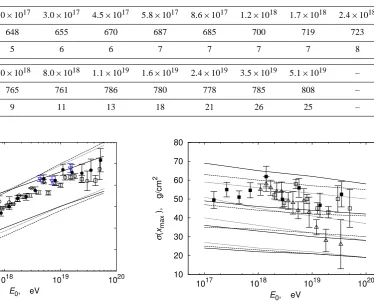
E0, eV 1.5×10¹⁷ 2.0×10¹⁷ 3.0×10¹⁷ 4.5×10¹⁷ 5.8×10¹⁷ 8.6×10¹⁷ 1.2×10¹⁸ 1.7×10¹⁸ 2.4×1018
xmax 632 648 655 670 687 685 700 719 723
σ (xmax) 5 5 6 6 7 7 7 7 8
E0, eV 3.5×10¹⁸ 5.0×10¹⁸ 8.0×10¹⁸ 1.1×10¹⁹ 1.6×10¹⁹ 2.4×10¹⁹ 3.5×10¹⁹ 5.1×10¹⁹ –
xmax 738 765 761 786 780 778 785 808 –
σ (xmax) 8 9 11 13 18 21 26 25 –
550 600 650 700 750 800 850
1017 1018 1019 1020
〈
xmax
〉
, g/cm
2
E0, eV
Fig. 4. Energy dependence ofxmax. Filled circles represent Yakutsk
data (see also Table 1), open circles – CASA-MIA (Abu-Zayyad et al., 2001), squares – AUGER data (Abraham et al., 2010), blue triangles – preliminary results of the Telescope Array (Tameda et al., 2010) experiment. Solid lines – results obtained with QGSJet II, dashed – EPOS 1.6, point line – SIBYLL 1.62
wit an energy above 1017eV. These data were obtained us-ing all four methods and reflect an alteration ofxmaxtowards lower atmosphere depths with increasing energy. Figure 4 showsxmax values averaged over energy intervals together with the data from other experiments. Numerical values for Yakutsk experiment are supplied in Table 1. On the same picture results of different hadron models calculations are shown. All experimental data coincide within experimental errors and demonstrate irregular shift with energy. Up to 3× 10¹⁸eV the elongation rate (E.R.) has value 60−80 g cm−2 and within the interval of 3×10¹⁸−5×10¹⁹eV it equals to 40−60 g cm−2. This might be interpreted as a possible change in mass composition at very high energies. A com-parison with calculations reveals the tendency of light nuclei abundance starting from 5×10¹⁷eV to 2×10¹⁹eV and some heavier abundance above 2×10¹⁹eV.
10 20 30 40 50 60 70 80
1017 1018 1019 1020
σ
(
xmax
), g/cm
2
E0, eV
Fig. 5. Fluctuations of the depth of maximum EAS development: filled squares – Yakutsk data, open squares – HiRes data (Abbasi et al., 2010), open triangles – data from Pierre Auger Observa-tory (Abraham et al., 2010). Straight line – results obtained with QGSJet01, dashed line – QGSJet II, dotted line – SIBYLL 1.62 for various primary nuclei (see Abbasi et al., 2010)
4 Fluctuations ofxmax
0 50 100 150 200
400 500 600 700 800 900 1000 1100
number of events
x
max, g/cm 2
Fig. 6. xmaxdistribution at fixed energy 1018eV. Solid line
rep-resents Yakutsk data (8×10¹⁷< E0<2×10¹⁸eV,hE0i =1.0×
1018eV, 857 events); dotted line – QGSJet01 for mixed composi-tion (70 % p, 30 % Fe); dashed line – QGSJet01 for primary protons, solid grey line – QGSJet01 for CNO group nuclei, dash-dotted line – QGSJet01 for iron nuclei (see Knurenko et al., 2005)
models, are also shown on this figure. Calculations were performed for proton, helium nuclei, CNO group and iron nuclei. Comparison with experimental data has shown that CR composition in this energy region is mixed with domina-tion of protons and helium nuclei. It should be pointed out that according to Fig. 5, the portion of heavy nuclei in the CR flux above 2×10¹⁸eV is small and helium and CNO-group nuclei might play a significant role. We came to the same conclusion (Knurenko et al., 2005) where the shape ofxmax distribution was analyzed within the framework of QGSJet01 model at fixed energies 1018eV and∼1019eV (see Fig. 6).
5 Cosmic ray mass composition
Figure 7 displays the mean natural logarithm of the CR atomic numberhlnAi determined from thexmax data from four experiments – Yakutsk, HiRes (Abbasi et al., 2010), Auger (Abraham et al., 2010) and Telescope Array (Tameda et al., 2010). For the derivation ofhlnAi,xmaxvalues were utilized, obtained in simulations within the framework of the QGSJet II models for proton and iron nuclei. The hlnAi value was calculated according to the relation proposed by H¨orandel (2005):
hlnAi =xmax−x H max xFe
max−xHmax
·ln56 (1)
At first glance, all data reveal a tendency to alterhlnAiwith the energy. For instance, in energy interval 2×10¹⁷−3× 10¹⁸eV, the value ofhlnAi drops from 3 to 1.3 and above 1018eV a slight increase is noted. Such a behaviour is close to the “dip”-scenario from the work by Berezhko (2008), where two peaks are observed in the energy dependence of
0.0 0.5 1.0 1.5 2.0 2.5 3.0 3.5
1017 1018 1019 1020
〈
ln
A
〉
E0, eV
Fig. 7. Mean mass number of primary particle as a function of en-ergy. Circles represent Yakutsk data, triangles – HiRes data (Abbasi et al., 2010), squares – results obtained at Auger observatory (Abra-ham et al., 2010), blue empty triangles – preliminary data from the Telescope Array experiment (Tameda et al., 2010), dotted line – computational results by Berezhko (2008)
hlnAi. The first one, at∼1017eV, corresponds to the end of the galactic component, the second, at 1019eV, to the start of CR intensity change due to GZK-cutoff.
However, there is still a significant data dispersion in this energy region due to poor event statistics. Thus, the reli-ability of our statement is quite limited. For a more precise conclusion on ultra-high cosmic rays origin, a few conditions must be fulfilled: improved statistics, improvement ofxmax estimation precision, adaptation of a single hadron interac-tion model that well describes experimental data and involv-ing several alternative methods forxmaxevaluation.
6 Conclusions
Thus, according to all the data reviewed above, within the framework of QGSJet hadron interaction model it is reason-able to speculate that primary cosmic ray mass composition changes during energy transition from 1017eV to 5×10¹⁸eV. AtE0≥5×10¹⁸eV cosmic rays by∼70 % consists of pro-tons and helium nuclei. The content of other nuclei in the region of ankle of the spectrum does not exceed∼30 %. A large portion of protons and helium nuclei in primary CR near the ankle is most likely associated with a significant con-tribution from particles arriving outside our Galaxy. In such a case the region of transition from galactic to extragalac-tic component might be the energy interval 1017−1019eV. The problem of mass composition changing above 1019eV remains unresolved due to poor event statistics.
Edited by: K.-H. Kampert
References
Abbasi, R. U., Abu-Zayyad, T., Al-Seady, M. et al.: Indications of Proton-Dominated Cosmic-Ray Composition above 1.6 EeV, Phys. Rev. Lett., 104:161101, 2010.
Abraham, J., Abreu, P., Aglietta, M. et al.: Measurement of the Depth of Maximum of Extensive Air Showers above 1018eV, Phys. Rev. Lett., 104, 091101, 2010.
Abu-Zayyad, T., Belov, K., Bird, D. J. et al.: Measurement of the Cosmic-Ray Energy Spectrum and Composition from 1017 to 1018.3eV Using a Hybrid Technique, Astrophys. J., 557, 686 doi:10.1086/322240, 2001.
Belyaev, A. A., Ivanenko, I. P., Kanevsky, B. L. et al.: Elektronno-fotonnye kaskady v kosmicheskikh luchakh pri sverkhvysokikh energiyakh (Electron–Photon Cascades in Ultrahigh-Energy Cosmic Rays), edited by: Abrosimov, A. T., Moscow: Nauka, 306, 1980. (in Russian)
Berezhko, E. G.: Composition of cosmic rays accelerated in active galactic nuclei, Astrophys. J., 698, L138–L141, 2009.
Berezinsky, V., Gazizov, A., Grigorieva, S.: On astrophysical solu-tion to ultrahigh energy cosmic rays, Phys. Rev. D, 74, 043005, 2006.
Dyakonov, M. N., Ivanov, A. A., Knurenko, S. P. et al.: Simulation of measurements at the Yakutsk complex EAS array, in: Proc 17th ICRC, Paris, 6, 78–81, 1981.
Dyakonov, M. N: Prostranstvennoie raspredeleniie plotnosti po-toka cherenkovskogo sheta ShAL i modeli razvitiia ShAL (Lat-eral distribution of Cherenkov light flux in EAS and models of EAS development), Ph.D. thesises. Institute for nuclear research, Moscow, 1981. (in Russian)
Dyakonov, M. N., Egorova, V. P., Ivanov, A. A. et al.: Otsenka nekotoryh parametrov mnozhestvennoi generatsii chastits pri E0≥1017eV po izmereniiam cherenkovskogo sveta ShAL
(Es-timation of some parameters of multiple generation of particles atE0≥1017eV by measurements of Cherenkov light in EAS),
Izv. AN SSSR, ser. fiz., 50, 11, 2168–2171, 1986.
Dyakonov, M. N., Egorova, V. P., Knurenko, S. P. et al.: Shirokie at-mosfernyje livni s energiei vyshe 1017eV. (Extensive air ahowers with energy above 1017eV, Yakutsk: YaF SO FN SSSR, 29–56, 1987. (in Russian)
Dyakonov, M. N., Egorova, V. P., Knurenko, S. P. et al.: Fluctua-tions of the EAS longitudinal development on the Cerenkov light measurements, in: Proc. 5th ISVHECRI, Lodz, 215–220, 1988. Dyakonov, M. N., Egorova, V. P., Ivanov, A. A. et al.: Variation in
nuclear composition of primary cosmic rays in the energy range 1017−1019eV, J. Exp. Theor. Phys. Lett., 50, 10, 442, 1989.
Dyakonov, M. N., Egorov, T. A., Efimov, N. N., et al.: Kosmich-eskie luchi ekstremalno vysokih energii (Cosmic rays of ex-tremely high energues), Novosibirsk: Nauka, 252, 1991. (in Rus-sian)
Dedenko, L. G., Efimov, N. N, Efremov, N. N. et al.: The RO(600) Spectrum and Primary Energy Spectrum atE(0) >1017eV, in: Proc 20th ICRC, Moscow, 5, 490–493, 1987.
Hillas, A. M. anf Patterson, J. R.: The relation of Cerenkov time profile widths to the distance to maximum of air showers, J. Phys. G: Nucl. Phys., 9, 323, doi:10.1088/0305-4616/9/3/013, 1983. H¨orandel, J. R.: A review of experimental results at the knee,
In-vited talk, presented at the “Workshop on Physics of the End of the Galactic Cosmic Ray Spectrum”, Aspen, USA, 2005. Khristiansen, G. B., Kulikov, G. V., Fomin, Yu. A.: Kosmicheskoe
izluchenie sverhvysokoi energii (Ultra-high energy cosmic radi-ation), Moscow: Atomizdat, 256, 1975. (in Russian)
Knurenko, S. P., Ivanov, A. A., Petrov, Z. E. et al.: Longitudinal development of showers in the energy region of 1015−1017eV, in: Proc. 27th ICRC, Hamburg, 1, 157–160, 2001.
Knurenko, S. P., Ivanov, A. A., Kolosov, V. A. et al.: Fluctuations ofxmaxand primary particle mass composition in the range of
energy 5×10¹⁷−3×10¹⁹eV by Yakutsk data, Intern. J. Modern Phys. A, 20, 29, 6894–6896, doi:10.1142/S0217751X05030429, 2005.
Knurenko, S. P., Egorova, V. P, Ivanov, A. A. et al.: Characteristics of EAS and primary particle mass composition in the energy re-gion of 1017−3×10¹⁹eV by Yakutsk data, Nucl. Phys. B (Proc. Suppl.), 151, 92–95, 2006.
Knurenko, S. P., Ivanov, A. A., Sabourov, A. et al.: Average mass composition of primary cosmic rays in the superhigh energy re-gion by the Yakutsk complex EAS array data, in: Proc. 30th ICRC, Merida, 4, 167–170, 2007.
Knurenko, S. P., Ivanov, A. A., Sabourov, A. et al.: Cosmic ray spectrum and mass composition in the ultra-high energy domain, in: Proc. 21st ECRS, Kosice, 461–464, 2008.
Petrov, Z. E., Knurenko, S. P., and Dyachkovsky, N. A.: Cherenkovskii differencialnyi detektor na Yakutskoi ustanovke SHAL (Differential Cherenkov light detector at the Yakutsk EAS array), Sb. Trudov Vseross. konf. “Sovremennyje problemy kos-micheskoi fiziki” (Proc. Russian conf. “Modern problems of the space physics”). Yakutsk, 87–90. 2008. (in Russian)