© 2016 IJSRSET | Volume 2 | Issue 3 | Print ISSN : 2395-1990 | Online ISSN : 2394-4099 Themed Section: Engineering and Technology
Analysis of Packet Dropping Algorithm in Optimized Link State
Routing Protocol (OLSR) in MANET
Alka Pandey, Prof. Nitin Tiwari
Department of Computer Science and Engineering, Gyan Ganga College of Technology, Jabalpur, Madhya Pradesh,
India
ABSTRACT
A mid this last decade, network systems have encountered solid development because of their capacity to give an extra and reciprocal backing for existing infrastruc-ture correspondence frameworks. In such a system, switches should be altered for short (e.g. open security arrangement) or long (e.g. system administrator augmentation) period. This relative solidness of foundation makes proactive directing conventions fitting. One of the understood proactive directing conventions is OLSR (Optimized Link State Routing), which steering choices depend on trades of topology data utilizing all-to-all flooding of nearby data all together for every switch to assemble a worldwide information of the topology. This concentrate first objective is to enhance the execution of topology data flooding in OLSR by presenting system coding methods, which prompts a reduction of flagging overhead.
Keywords : Network Coding; Wireless Networks; Network Resource Efficiency; Topology Information Dissemination; Broad- Cast All-To-All; Multi-Point Relays.
I.
INTRODUCTION
Quickly deployable cross section systems have increased wide notoriety as of late because of their organization straightforwardness and minimal effort usage. They are utilized as a part of numerous application territories, for example, correspondence systems for open security powers and interim augmentations of administrator systems.
Given that work systems are self-sorting out, information for-warding between clients is a test and requires consid-erable endeavors from established researchers. A few sorts of directing conventions have been proposed, each with its own variations. Most basic directing conventions are either responsive ([1], [2], [3], [4]) or proactive ([5], [6], [7]), regardless of the fact that some half and half steering conventions exist ( [8], [9]). On one hand, receptive conventions do create control messages just when important. In this manner, component for course calculation is actuated just when
keeping in mind the end goal to minimize radio asset waste.
Economy of radio assets in a proactive directing ace tocol requires the measure of control messages that permit operation of the convention to be streamlined. In this paper, we concentrate on OLSR (Optimize Link State Routing convention), the most utilized proactive steering convention. OLSR works in four stages: (i) nearby topology revelation, guaranteed by the trading of HELLO messages between neighboring hubs, (ii) neighborhood data sharing by TC (Topology Control) dissemination over the entire system, (iii) course estimation through most limited way calculation, and (iv)directing table upgrade as indicated by course count.
In this paper, we concentrate on TC message dispersion inside of the system and explore how to enhance radio asset utilization while accomplishing an effective spread, i.e. all hubs have the required data for worldwide system learning. At first, TC message dispersion comprised in PF (Pure Flooding), where each hub telecasts each message it gets. Clearly, PF produces transmission excess and one of the real effects of such a convention is the radio asset waste to accomplish complete dissemination. In order to make diffusion of topology information more efficient, several techniques, which actually reduce signalling overhead, have been proposed.
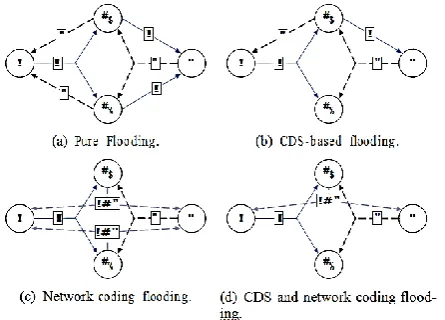
Figure 1. This figure compares, in a simple example, the various existing techniques and shows the number of generated packets for a total diffusion.
In this example, Pure Flooding needs 6 transmissions when Connected Dominating Set based solution and
Network Coding needs 4. The combination of both Connected Dominating Set based flooding and Network Coding requires only 3 to achieve the same goal.
Traditionally, this all-to- all broadcast is implemented by letting each node store and forward received packets. Some of these techniques are based on the selection of a subset of nodes, form- ing a CDS (Connected Dominating Set) [10], in charge of relaying topology information. Among these methods, we can mention the so called MPR (Multi point Relay), which has been adopted by OLSR. More recent proposals are based on information coding techniques, especially NC (Network Coding) mechanisms, which aim to reduce the amount of data required to transmit information in the network. In NC-based approaches, each node overhears bundles transmitted from neighboring hubs, joins them, and advances the subsequent parcels to its neighbors. The objective is to create less transmissions, which spares radio assets and vitality. At long last, a few works endeavor to diminish repetitive transmissions by joining MPR-based flooding and Network Coding either determinist [11] or irregular [12]. The mix of CDS-based flooding and system coding indicates extensive execution picks up for topology data dispersal. Figure 1 shows, by a basic case, the idea and advantages of beforehand depicted methodologies: Pure Flooding, CDS-based Flooding, Network Coding, and CDS-based Flooding utilizing Network Coding.
The reason for this paper is to compress existing arrangements keeping in mind the end goal to investigate conceivable streamlining of TC message dispersal in OLSR. The objective here is not to fundamentally change the working of OLSR but rather to keep up an effective dispersal of TC messages by diminishing the actuated overhead. The commitments of this paper are the accompanying:
• Overview of existing TC message diffusion proposals for OLSR, either based on relay selection and/or net- work coding,
• Proposal of new methods not yet explored combining connected Dominating Set and Network Coding approaches,
• Performance gain assessment of all approaches, existing and proposed ones, by simulations, under the same conditions and parameters, and
This paper is organized as follows. In Section II, we describe main flooding solutions developed either for OLSR or for other goals. In Section III, we summarize existing techniques and describe novel approaches proposed within this paper that aim at filling gaps. Performance comparison between existing and new proposed solutions are performed within Section IV, while Section V discusses the results and concludes the paper.
II.
METHODS AND MATERIAL
1. Flooding Algorithm
A. Preliminary Definition
Let us consider an ad hoc network represented by a graph G = (V, E) where V is the set of wireless nodes and E the set of edges. Each node of V is characterized by its geographic coordinates and the power of transmission. The transmission range of a host u ∈ V is represented by a circle of center u. For all nodes v in this circle there is exists an edge in E, noted (u, v). We call 1-hop neighbours of u, noted N (u), nodes v such as ∀ v ∈ V, ∃ (u, v) ∈ E and 2-hop neighbours of u, noted N (N (u)), nodes w such as ∀ w ∈ N (N (u)), ∃ v ∈ N (u)|∃ (v, w) ∈ E. Obviously, a node in N (N (u) can also belong to N (u).
1) Local topology discovery: Periodically, node u sends an update message towards nodes in N (u) and naturally,receives update message from nodes in N (u). This update message, called HELLO message in OLSR, contains the list of nodes of N (u). After receiving all update messages from N (u) nodes, u has now the knowledge of its 2-hop topology.
2) Local topology dissemination: Periodically, node u disseminates its 2-hop topology knowledge towards all nodes of the network. It first creates a 2-hop topology message, also called a Topology Control (TC) message in OLSR. This message contains the list of nodes in N (N (u)). Once created, the TC message is broadcasted towards all nodes in N (u). When receiving a TC message, nodes forward it towards their own 1-hop neighborhood, and so on. In order to avoid infinite loop, a node only forwards a TC message once. A unique sequence number in the TC message header is used for message identification. This process ends
when all nodes have forwarded this TC message once. This local topology dissemination algorithm is called Pure Flooding. As a main drawback, this algorithm does not prevent from redundant transmissions, i.e. a transmission is considered to be useless when a node u sends a TC message whereas all nodes in N (u) have already received it before.
We now describe tree based Flooding, Network Coding based approaches and finally Network Coding performed on top of tree based Flooding.
B. Connected Dominated Set based approaches
A Connected Dominated Set (CDS) of a graph G is a set N of nodes with the two following properties:
1) The sub graph of G induced by D is connected. 2) The set D is a dominating set of G, i.e. a node
either belongs to D or is adjacent to a node in D.
Connected Dominated Set based approaches consist in selecting nodes to form a CDS and activating forwarding only for this subset. The leaves of the tree do not forward any message. Reducing the number of nodes in the CDS means reducing the number of transmissions required to achieve successful dissemination.
However, finding the CDS with the smallest cardinality is NP-Complete. In the depths of difficulty, building the CDS in ad hoc networks has to be distributed. Many heuristics exist, in this paper we focus on three of them. First we present the one implemented in OLSR -called MPR (Multi Point Relay). Then, we detail two other ones, Dominant Pruning based and Total Dominant Pruning solutions that aim at reducing broadcast Redundancy in ad hoc networks but not in the context of OLSR. The dominant Pruning is one of the first Pruning-based solution proposed and the Total Dominant Pruning is the most efficient one according to literature.
1) Connected Dominated Set: MPR heuristic: MPR stands for Multi Point Relay and is implemented in the last version of OLSR. The heuristic consists, for each node u ∈ G in proactively selecting the subset of nodes in N (u).
The Multi Point Relay selection process for the node u is detailed in Algorithm 1.
Algorithm 1 MPR heuristic
1: procedure MPR(u) 2: M P R(u) = []
3: U ncovered(u) = N (N (u))
4: while !∃v ∈ N (u) | w ∈ N (v), w ∈ N (N (u) do 5: M P R(u) ← v
6: Uncovered(u) = U nC overed(u) − N (v) 7: end while
8: while Uncovered(u) = Ø do 9: if Uncovered (u) ∧ N (vi ) =
maxv∈N (u) (Uncovered (u) ∧ N (vi )) then
10: M P R(u) ← v 11: end if
12: end while 13: return M P R(u) 14: end procedure
When receiving a TC message from u, noted T Cu , each node v ∈ N (u) follows the forwarding rules detailed in Algorithm 2.
Therefore, the MPR heuristic ensures a successful dissemination of all TC messages in the whole network. The procedure stops when all MPR have forwarded once the TC message of nodes that select them as MPR. In the Algorithm 2, MPR nodes broadcast a TC message only once in order to avoid forwarding loops. Indeed, it is possible for a node v to select the node u in its MPR list. Without this clause, the TC message would be forwarded once again byu and so on.
Algorithm 2 MPR Forwarding rules 1: procedure MPR(u)
2: if v ∈ M P R(u) and T Cu was not previously
forwarded then
3: v Broadcasts T Cu 4: end if
5: end procedure
2) Connected Dominated Set: Pruning heuristic:
As the MPR heuristic, Pruning heuristics also use 2-hops information. However, opposing to MPR heuristic where a node u defines a list of forwarding nodes whatever the source node, the Pruning heuristic takes
into account the node from which the message is received. Indeed, if the node t has just sent this message then, all nodes in N (t) have received this message too.
Algorithm 3 Pruning Heurisitic
1: procedure DO M I NA N T PRU N I N G(v) 2: F (u) = ∪t∈N (u) F (t, u)
3: for u ∈ N (v) do 4: F (t, u) = [] 5: Z = Ø
6: K ∪ Si with Si = N (ui ) ∩ U (t, u) for ui ∈ B(t, u)
7: while Z = U (t, u) do
8: if Sk (uk ) = maxSi ∈K (|Si |) then 9: F (t, u) ← uk
10: Z = Z ∪ Sk
11: Sj = Sj − Sk ∀Sj ∈ K 12: end if
13: end while 14: end for 15: return F (v) 16: end procedure
Therefore, the node u can determine its Relay Nodes list F (t, u) from B(t, u) = N (u) − N (t) in order to cover
nodes in U (t, u) = N (N (u)) − N (t) − N (u) (resp.U (t,
u) = N (N (u)) − N (N (t))) for the Dominant Pruning (resp. for the Total Dominant Pruning). Let Z be a subset of U (t, u) covered so far, Si the neighbour set of vi ∈ N (u) and K be the set of Si.
When receiving a TC message from u, noted T Cu that have been sent before by t, each node v ∈ N (u) follows the forwarding rules detailed in Algorithm 4.The node v has to know the 2-hops previous sender of the message before re-broadcasting or not the message.
C. Network Coding Based approaches
Network Coding based approaches aim at reducing a number of transmissions by benefiting of the broadcast nature
Algorithm 4 Pruning forwarding rules
1: procedure MPR(u)
2: if v ∈ F (t, u) and T Cu was not previously for-warded then
3: v Broadcasts T Cu 4: end if
of the wireless medium. In contrary to the flooding tree based solutions, Network Coding techniques do not exclude any nodes from the forwarding activity. Deciding which messages are encoded can be done either deterministically or randomly.
1) Determinist Network Coding: Determinist Network Coding consists in selecting deterministically a subset of messages to be encoded. In [11], messages are encoded in order to maximize the number of neighbours that will be able to immediately decode it. To do so, nodes need to know the list of messages that have all of their neighbour nodes. This can be achieved by an additional protocol [11].
2) Random Network Coding: Random Network Coding consists in combining messages randomly without any knowledge of what have the nodes in the neighbourhood. Crisostomo et al. [13] performed a comparison between MPR diffusion and network coding technique. As a main conclusion, the study shows that network coding clearly outperforms MPR in most of the cases.
D. Hybrid approaches
We refer to hybrid approaches for proposals designed to reduce the number of transmissions required for flooding in wireless ad-hoc networks using network coding on a Connected Dominating Set. Simple distributed coding scheme which can be applied at each node are proposed in [12] and [11] where the efficiency of network coding is further enhanced by applying multiple point relays (MPR).
1) MPR-based flooding tree with Determinist Network Coding: As for simple Determinist Network Coding, a sub- set of messages to be encoded is selected based on neighbour information knowledge. The only difference comes from the fact that this process occurs only on a subset of nodes belonging to a previously defined dominating set. Authors from [11] have used MPR to implement the concept of dominating set coupled with Determinist Network Coding.
2) MPR-based flooding tree with Random Network Cod- ing: A subset of messages to be encoded is chosen randomly without any knowledge about neighbors data. Combining MPR-based flooding and Random Network Coding is per- formed in [12].
2. Synthesis and Novel Approaches
Different solutions, either flooding tree based, network coding based, or hybrid ones have been investigated. Table I gives an overview of those studied solutions. Columns indicate from left to right flooding algorithms that do not implement Network Coding (N o − N C ), those using Determinist Network Coding (D − N C ), and those using Random Network Coding (R − N C ). Stars (⋆) indicate solutions that have not yet been investigated but studied within this paper. Citations that appear in the cells of the table help to position work in the literature.
Table I : Classification of Diffusion Existing Method
No NC D-NC R-NC
PF [14] [11] [12]
MPR-based Flooding Tree [14][11] [11] [12] Dominant Pruning-based [15],[16] ⋆ ⋆ Total Dominant
Pruning-based
[15],[16] ⋆ ⋆
From this table, we can observe that most studies com- pared only two possible techniques. Only one study [11] has compared three of them. The aim of this paper is to compare all possible combination within this paper and fill the blank cells, represented by ⋆: combination of Pruning-based flooding trees and Network Coding techniques (random and deterministic).
III.
RESULTS AND DISCUSSION
1. Performance Analysis
The arrangements that exist in the writing and talked about in this paper have clearly been assessed by their separate writers. In any case, these studies were directed independently and the appraisals were made under various conditions and suspicions. Thus we propose to make a blend of past conclusions and complete those works by propos-ing a worldwide execution pick up evaluation by utilizing the same test system created for this study.
to 80. Without loss of consensus, we consider that PHY/MAC layers guarantee a flawless impact shirking for transmissions. Every point on the accompanying bends is the normal after effect of a hundred recreations of the same situation (number of hubs and dissemination strategy).
We assess here the required measure of information so that every hub's TC message is gotten by all hubs in the system and obliged postponement to scatter information over the whole system.
A. Dissemination solutions for OLSR
According to Table I, Figure 2 shows the comparison results of six techniques that have been proposed in the literature: Pure Flooding (PF), Multi-Point Relay (MPR), Random Network Coding combined to Pure Flooding (RNC- PF), Random Network Coding combined to Multi-Point Re- lay (RNC-MPR), Deterministic Network Coding combined to Pure Flooding (DNC-PF), and Deterministic Network Coding combined to Multi-Point Relay (DNC-MPR).
Figure 2. Comparison of existing solutions for OLSR. Observe how random network coding performs better than the deterministic one, whatever the technique it is associated to.
The first remark we can make is that PF is the method that generates the most data to disseminate the information throughout the network. This result is logical and expected because PF does not use any optimization technique. The second lesson of this study is that the use of network coding gives better results than the use of a broadcast tree in all cases. We can also see that both methods of network coding give substantially the same results whether or not associated with a broadcast tree.
Finally, we note that the use of random network coding gives better results than the deterministic network coding. This last result is surprising because the deterministic network coding is more intelligent and expected to yield better results.
B. TC message dissemination solutions: comparison
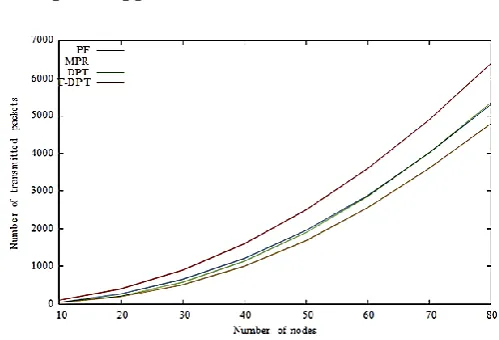
In Figure 3, we compare two methods proposed in the literature for message distribution in a network, but not as part of OLSR. These methods are Partial- and Total- Dominant Prunning tree, respectively noted P-DPT and T- P-DPT in this figure. We have implemented and compared them with the two techniques available in OLSR: pure flooding (PF) and MPR.
We draw two important lessons from this figure: (i) P-DPT yields results similar to MPR whatever the size of the topology and (ii) T-DPT is the best of the four algorithms used here. Unsurprisingly, PF is the technique that generates the most messages.
C. Proposed approaches
Figure 3. Comparison of OLSR and non-OLSR message diffusion techniques. We can remark that Total-Dominant Pruning Tree gives the best result, while the Partial-Dominant Pruning tree is equivalent to MPR.
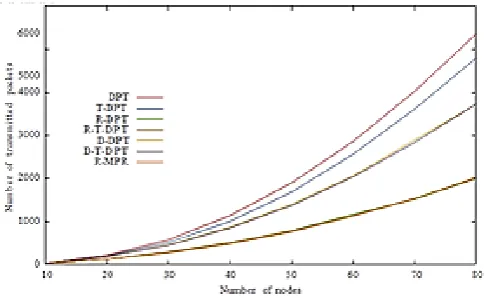
4 compares the results of the seven following algorithms: Partial- and Total-Dominant Pruning Tree (respectively noted P-DPT and T-DPT) without combination with network coding, Partial- and Total-Dominant Pruning Tree combined with random network coding, respectively noted R-P-DPT and R-T-DPT, Partial- and Total-Dominant Pruning Tree combined with deterministic network coding, respectively noted D-P-DPT and D-T-DPT, and, finally, MPR technique combined to random network coding, noted R-MPR.
Figure 4. Proposed approaches compared to best existing ones. We observe that (i) random network coding still outperforms deterministic one and that (ii) using network coding reduces the gap between tree-based techniques.
D. Random vs. Deterministic network coding
The first remark we can do here is on the significant interest in the use of network coding. Therefore it is used, the amount of messages in the network has drastically reduced. Then we can notice that T-DPT and P-DPT behave in almost identical ways since they are used with network coding, whether random or deterministic. We note that using a random network coding on both DPT yields results similar to those of MPR.
Figure 5. Number of useful packets as a function of time for Random and Deterministic network coding.
Finally, we note, again, that the random network coding provides much better results than the deterministic, regardless of the topology and whatever the technique to which it is associated.
As expressed in Sections IV-An and IV-C, arbitrary system coding gives, as opposed to what one may instinctively think, preferable results over deterministic. Since this outcome is to some degree non instinctive, we needed to comprehend why such conduct. For this, we broke down the conduct of both techniques amid a reproduction and we have examined the advancement of the quantity of helpful messages in the system in both cases. The consequence of this study is introduced in Figure 5.
IV.
CONCLUSION AND FUTUREWORK
In this study we investigate the problem of TC message dissemination in OLSR. The main challenge in this context is to achieve a successful dissemination by minimizing the number of required transmissions. To tackle this issue, two main approaches have been proposed yet. The first consists in selecting a subset of nodes in charge of forwarding TC messages, and a second one consists in using Network. Coding techniques to optimize radio resource use. Moreover, that the combination of tree based solutions and network coding improves performance gains in all cases. For the first time, Random Network Coding and Determinist Network when different solutions have been proposed, they have been assessed separately. As a main result, we show that network coding techniques generally outperform tree based ones, reducing by up to 50% the number of transmissions. However, we also show that coding are compared and results observed are not intuitive. Indeed, Random Network Coding which is less complex to implement and requires less information exchanges to function, achieves a successful dissemination by generating less transmissions than Determinist Network Coding. This is an unexpected result in the sense that Determinist Network Coding strives to find the best subset of messages to encode in order to satisfy the maximum of neighbours. Once again, this result shows that local optimization does not always lead to global optimal performances. The major point of this study is that Random Network Coding presents better results of the most of studied solutions. Moreover, because it does not require any addition in terms of data control, Random Network Coding based solutions seem to be one of the most efficient solutions for information dissemination in wireless ad hoc networks.
As future work, we plan to implement those different solutions and integrate them into a tested in order to both prove the concept of our solutions and compare them under real conditions.
V.
REFERENCES
[1] J. Broch, D. A. Maltz, D. B. Johnson, Y.-C. Hu, and J. Jetcheva, “A performance comparison of multi-hop
wireless ad hoc network routing protocols,” in Mobile Computing and Networking, pp. 85–97, 1998.
[2] V. Park and M. Corson, “A Highly Adaptive Distributed
Rout- ing Algorithm for Mobile Wireless Networks,” in Proceedings of IEEE INFOCOM 1997, April 1997.
[3] C. Perkins, E. M. Royer and S. R. Das, “Ad Hoc
On-Demand Distance Vector routing,” In IETF Internet Draft, draft-ietf- manet-AODV-13.txt, February 2003.
[4] C. E. Perkins and E. M. Royer, “Ad hoc on demand distance
vector (AODV) routing,” Feb. 1999.
[5] R. Ogier, F. Templin, and M. Lewis, “Topology
Dissemination Based on Reverse-Path Forwarding (TBRPF).” RFC, February2004. IETF RFC-3684.
[6] T. Clausen and P. Jacquet, “Optimized Link State Routing Protocol,” In IETF Internet Draft, draft-ietf-manet-olsr-11.txt, July 2003.
[7] C. E. Perkins and P. Bhagwat, “Highly dynamic destination-
sequenced distance-vector routing (dsdv) for mobile com- puters,” in SIGCOMM ’94: Proceedings of the conference on Communications architectures, protocols and applications, (New York, NY, USA), pp. 234–244, ACM Press, 1994.
[8] Z. J. Haas and M. R. Pearlman, “Zrp: a hybrid framework
for routing in ad hoc networks,” pp. 221–253, 2001.
[9] C. A. Santivanez, R. Ramanathan, and I. Stavrakakis, “Mak-
ing link-state routing scale for ad hoc networks,” in MobiHoc’01: Proceedings of the 2nd ACM international symposium on Mobile ad hoc networking & computing, (New York, NY, USA), pp. 22–32, ACM Press, 2001.
[10]S. Guha and S. Khuller, “Approximation algorithms for
connected dominating sets,” Algorithmica, vol. 20, pp. 374– 387, 1996.
[11]N. Kadi and K. Al agha, “Optimized mpr-based flooding in
wireless ad hoc network using network coding,” in Wireless Days, 2008. WD ’08. 1st IFIP, pp. 1 –5, nov. 2008.
[12]N. Kadi and K. Al agha, “Mpr-based flooding with
distributed fountain network coding,” in IEEE WCNC 2010 Wireless Communication and Networking Conference, pp. 1 –5, nov.2010.
[13]S. Crisostomo, J. Barros, and C. Bettstetter, “Flooding the network: Multipoint relays versus network coding,” in Cir- cuits and Systems for Communications, 2008. ICCSC 2008. 4th IEEE International Conference on, pp. 119 –124, May2008.
[14]A. Qayyum, L. Viennot, and A. Laouiti, “Multipoint relaying for flooding broadcast messages in mobile wireless networks,” in System Sciences, 2002. HICSS. Proceedings of the 35th Annual Hawaii International Conference on, pp. 3866 – 3875, jan. 2002.
[15]W. Peng and X.-C. Lu, “On the reduction of broadcast redundancy in mobile ad hoc networks,” in Proceedings of the 1st ACM international symposium on Mobile ad hoc networking & computing, MobiHoc ’00, (Piscataway, NJ, USA), pp. 129–130, IEEE Press, 2000.