Original Research Article
A cross sectional study on proper use of iodized salt in communities of
rural areas and its relevant factors in Prakasam district,
Andhra Pradesh, India
P. Sai Deepika, B. Thirumala Rao*, A. Vamsi, K. Valleswary, M. Chandra Sekhar
INTRODUCTION
As per the latest global estimates, 1.88 billion people are at risk of iodine deficiency and 241 million children have an insufficient iodine intake and 50% children with insufficient iodine intake live in South/South-East Asia and Africa.1 In order to achieve universal salt immunization at least 90% of households in the states and
country consumed good amount of iodized salt above15 ppm. In the last two decades, thirty four countries have eliminated IDD and an estimated 70% of households worldwide are currently consuming adequately iodized salt.2 In 2013, our country in India about 200 million people were at risk of IDDs and another 71 million were suffering from goiter and other IDDs. India recognized iodine deficiency as a national public health concern and began supplying iodized salt to its endemic population as
ABSTRACT
Background: The coverage of adequately iodized salt in old Andhra Pradesh was 63.6%, which is below the national average. Despite of high coverage rural households were less likely to consume adequately iodized salt. Objectives were (1) to find out the use of iodized salt and practices among community and knowledge regarding iodine deficiency diseases (2) to test salt at the household level to assess level of iodine.
Methods: Community based cross-sectional study conducted from July to December 2016 in RHTC, Maddipadu, Prakasam district. Proportionate households from four villages of this area were interviewed for the purpose of study. Factors related to use of iodized salt in the communities like type of salt using in houses, storage practices, practices during cooking, knowledge regarding iodine deficiency disorders were assessed. The salt was tested for iodine using iodine rapid test MBI kits. The data was collected using pre-tested questionnaire and analyzed by using SPSS 22.0 version.
Results: Most of households (68.5%) were between 25-50 years age, 68% wives were illiterate and 48.5% wives involved in labor work. Majority (83.6%) of the families were using iodized packed salt, 75% had adequately iodized salt with ≥15 ppm and 25% with inadequate iodized salt <15ppm. Association between illiterate wives and poor knowledge regarding iodized salt found to be significant (p<0.005).
Conclusions: Specific education regarding proper storage, handling, duration and the importance of iodized salt needs to be implemented to increase community awareness and to focus on behavior change communication to bring positive attitude toward utilization of iodized salt.
Keywords: Iodized salt, Iodine deficiency disorder, Parts per million, District gram panchayat
Department ofCommunity Medicine, Rajiv Gandhi Institute of Medical Sciences, Ongole, Prakasam District, Andhra Pradesh, India
Received: 24 October 2018
Revised: 08 December 2018
Accepted: 07 February 2019
*Correspondence:
Dr. B. Thirumala Rao,
E-mail: [email protected]
Copyright: © the author(s), publisher and licensee Medip Academy. This is an open-access article distributed under the terms of the Creative Commons Attribution Non-Commercial License, which permits unrestricted non-commercial use, distribution, and reproduction in any medium, provided the original work is properly cited.
early as 1960s.3 Subsequent studies after the implementation of National Goiter Control Programme (NGCP) showed that the problem was not focal but was present in almost all geographical areas of the country.4 This leads to the expansion NGCP, and it was decided that all edible salts in India to be iodized by 1992 and iodized salt was brought under the revised Prevention of Food Adulteration Act of 1988.
The proportion of households using adequately iodized salt varied widely by state in 2009, ranging from 98% in Manipur to 30% in Chhattisgarh.5 Around 83.2% of households in urban areas used salt with 15 ppm or more iodine content compared to 66.1% of households in rural areas. The proportion of households using non iodized salt was more in rural areas (11.0%) as compared to their urban counterparts (5.1%). The use of iodized salt was high in north eastern states and in states of New Delhi, Goa, Haryana, Himachal Pradesh, Jammu and Kashmir, Punjab, and all union territories ranging from 80% to 94%. In the states of Karnataka, Andhra Pradesh, Tamil Nadu, Madhya Pradesh, Uttar Pradesh, Odessa, and Jharkhand, the use of non-iodized salt seemed more common compared to other states. In addition, the Food Safety and Standard Act 2006 prescribes that iodine content in salt should not be <30 ppm at the point of production and not <15 ppm at the supply level and also at the point of consumption.
In old Andhra Pradesh according to National Family Health Survey (NFHS)-3, the coverage of adequately iodized salt in the state was 46.9%, inadequately iodized salt 35.7% and non-iodized salt 17.4%. The percentage of all households which use iodized salt varies from 81.6% in Andhra Pradesh (AP) to 99.6% in Sikkim. According to NFHS-4, 91.1 per cent urban households, 77.4 per cent rural households and only 71 per cent tribal households are using iodized salt for regular cooking in Andhra Pradesh. The State government is planning to introduce strict monitoring system to ensure that required amount of iodine is being supplied through the meal projects. The officials are planning to conduct awareness campaigns in urban, rural and tribal areas to educate households on using iodized salt. The proportion of households consuming adequately iodized salt (at least 15 ppm at the household level) in Andhra Pradesh has increased from 31.5% in 2005 to 63.5% in 2009, showing the positive impact of universal iodization of salt in Andhra Pradesh.
6-8
Various societal, economic and demographic factors may have differential influences on this practice.9 Identification of such factors that influence the accessibility to iodized salt as it would allow us to plan a better prevention policy and intervention measures. Authorities need to emphasize on the improvement of the salt-iodization coverage, implement ban on the production and sale of non-iodized salt, subsidize the production and distribution of iodized salt, and focus awareness-generation campaign for the socially and
economically disadvantaged population for increasing the consumption and sale of iodized salt and also for good practice of storage.
In this regard a study has been planned to find out the use of iodized salt and practices among the community and to determine the importance of iodized salt in public health. We also planned to assess knowledge regarding iodine deficiency diseases and tested salt in order to find out the level of iodine at household level.
METHODS
MBI Kit International is a very useful monitoring tool, for advocacy of the universal salt iodization and the Field Test Kit consists of 2-3 ampoules of 10 ml each containing test solution, 1 red ampoule containing recheck solution, and a colour chart with circular colour spots printed on handy pocket size kit.10,11 A few spoons of the salt for testing is filled a small cup or on plate and spread flat .The test solution ampoule is opened by piercing it with a pin and the test solution is dropped on the salt surface till the surface is flooded. The reaction generates the iodine in the salt, and depending on the content of iodine, the solution changes the colour of the salt. The intensity of the colour varies with the amount of iodine and by matching it with the colour chart the range of iodine can be assessed .In the absence of the colour formation, a few drops of the recheck solution is to be spread on the salt surface before using the test solution. To assess the iodine content, the color of the salt was compared with accompanying chart (0, 7, 15, and 30 parts/million. The cut-off proportion of 15 ppm and above was considered as adequately iodized salt using the WHO/United Nations International Children’s Emergency Fund reference indicators for monitoring of iodized salt.
The study protocol and questionnaire was approved by Institutional Ethical Committee at Rajiv Gandhi institute of medical sciences (RIMS) medical college and hospital. The informed consent was obtained from each interviewer before enrolment in the study, purpose and benefits of the study were explained to all the study participants and confidentiality of the information was maintained throughout the study. The household family members who are responsible for purchasing food items and mostly involved in food preparation in the selected households was interviewed. The locked houses were excluded from the study immediate household was considered for this study. Families were also informed that participation was on voluntary basis and that they can withdraw at any time if they are not comfortable about the questionnaire.
Data analysis
After data collection, each questionnaire was checked for completeness and its consistency by supervisory staff. The data entered on spread sheet and analyzed with help of Microsoft excel also with SPSS Version 22.0. Descriptive analysis like frequency, percentage, and arithmetic mean and median were used to present the data. Appropriate tests of significance (Chi-square test) were applied wherever necessary at the 5% level of significance. P<0.05 was considered as statistically significant at 95% confidence level.
RESULTS
This study was conducted in 276 households among which most (68.5%) of them were between 25-50 years age and 23.9% were above 50 years. Sixty percent were
belonging to Hindu religion, 38% were Christians, 90% were married and 9% were widowed families. Out of total households 86.5% were having family size up to 5 members and 13.5% were with more than 5 members in the family. Sixty eight percent of wives were illiterate, not attended any school, 27% were completed the schooling and only 5% studied either college or above courses, whereas among the husbands 51% were illiterates, 37% finished schooling and rest (5.7%) were completed higher education. Maximum number of husbands (43.1%) and wives (48.5%) were involved in labor work and 35.5% wives were house wives (Table 1).
Table 1: Socio demographic factors of families in iodized salt study (N=276).
Socio demographic factors Number (%) Age
18-24 21 (7.6)
25-50 189 (68.5)
Above 50 66 (23.9)
Marital status
Married 249 (90.2)
Widow 26 (9.4)
Divorcee 1 (0.3)
Religion
Hindu 164 (59.4)
Christian 105 (37.7)
Muslims 6 (2.1)
Family size
Up to 5 239 (86.5)
>5 37 (13.5)
Education status of wife
Illiterate 188 (68.1) Schooling 74 (26.8) College/degree/diploma 14(5.7)
Education status of husband
Illiterate 142 (51.4) Schooling 102 (36.9) College/degree/diploma 32 (11.5)
Occupation status of wife
Labour 134 (48.5)
Home maker 98 (35.5)
Farmer 11 (3.9)
Others 33 (11.9)
Occupation status of husband
Labour 119 (43.1)
Farmer 47 (17.2)
Business 22 (7.9)
Others 88 (31.8)
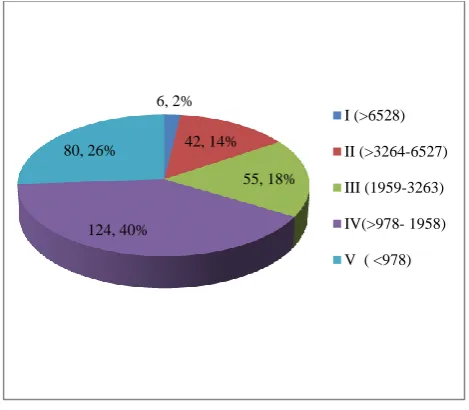
were 18%, upper middle class were 14% and upper class were 2% only with high earnings (Figure 1).
Majority (83.6%) of the families were using iodized packed salt, 8.3% families were using non iodized packed salt, 50% of the families were also using coarse salt and none of them were keeping black salt in their houses. Two sixty eight households were put the salt in dry areas (97.1%) and 20.9% were placed in moist areas. Most of the households (96.0%) preserving the salt in closed and tight lid containers and 2.5% were storing in the lid less opened containers and 1.5% were using polythene bags. More than 13% households were placed the salt in sunlight exposure areas and 3.2% have habit of washing the salt before adding it in the cooking. Maximum number (88.9%) of families were using iodized salt for the last 1-10 years, 9.7% households were using for more than 10 years and only 1.4% households were using for a period of less than 12 months. Concerning on duration of salt storage in the houses 85.5% household families were keeping it up to 30 days and rest (14.5%) were put for more than 30 days. Forty one families (15%) were travelling more than 10 minutes to obtain salt from shopkeepers and rests (85%) of the families were getting their salt within 10 minutes (Table 2).
Table 2: Usage and practices iodized salt among the families.
1. Type of salt using
Iodized packed salt 231(83.6%) Non iodized packed salt 23 (8.3%)
Coarse salt 138 (50.0%)
Black salt 0 (0%)
2. Place of salt storage
Dry area 268 (97.1%)
Moist area 8 (2.9%)
3. Salt storage equipment
Container with lid 265 (96.0%) Container without lid 7 (2.5%)
Polythene bag 4 (1.5%)
4. Exposure to sunlight
Yes 37 (13.5%)
No 239 (86.5%)
5. Washing of salt
Yes 9 (3.2%)
No 267 (96.7%)
6. Total years of iodized salt use
Below 1 4 (1.4%)
1-10 245 (88.9%)
Above 10 27 (9.7%)
7. Duration of salt storage in the house (days)
Up to 30 236 (85.5%)
Above 30 40 (14.5%)
8. Time of travel to obtain salt (minutes)
Up to 10 235 (85.0%)
More than 10 41 (15.0%)
Majority (46%) of households had a habit of adding a salt in the middle phase of cooking, 40% were doing it in early phase, whereas 8% adding in late phase, less number of household families (6%) were put the salt at end phase of cooking (Figure 2).
Figure 1: Socioeconomic status of population (modified Prasad classification).
Figure 2: Time of adding salt during cooking among households.
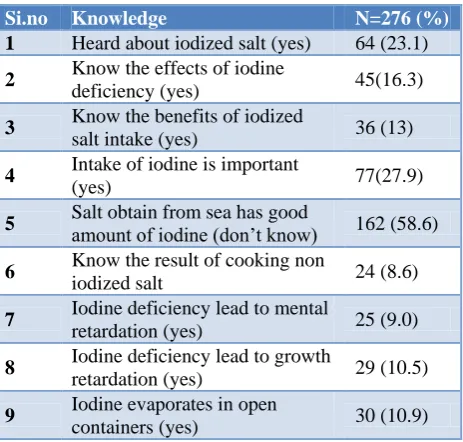
About 23% household families heard about name of the iodized salt, only 16.3% know the effects of iodine deficiency disorders, 13% aware about benefits of iodized salt and 27.9% of families responding that intake of iodized salt in foods is important. More than 58% of household don’t aware of salt obtained from sea have good amount of iodine and 8.6% know regarding results of cooking with non-iodized salt. Very few (8.6%) respondents recognized that iodine deficiency lead to mental retardation, 10.5% households informed that it can cause growth retardation and 10.9% felt iodine evaporates in open containers (Table 3).
6, 2% 42, 14%
55, 18% 124, 40%
80, 26%
I (>6528) II (>3264-6527) III (1959-3263) IV(>978- 1958) V ( <978)
111, 40% 127, 46%
23, 8% 15, 6%
Table 3: Knowledge and awareness about iodized salt among families.
Si.no Knowledge N=276 (%)
1 Heard about iodized salt (yes) 64 (23.1)
2 Know the effects of iodine
deficiency (yes) 45(16.3)
3 Know the benefits of iodized
salt intake (yes) 36 (13)
4 Intake of iodine is important
(yes) 77(27.9)
5 Salt obtain from sea has good amount of iodine (don’t know) 162 (58.6)
6 Know the result of cooking non
iodized salt 24 (8.6)
7 Iodine deficiency lead to mental
retardation (yes) 25 (9.0)
8 Iodine deficiency lead to growth
retardation (yes) 29 (10.5)
9 Iodine evaporates in open
containers (yes) 30 (10.9) Overall knowledge found to be good only in 17% household families and poor among 83% of households, which indicate that even though good number of households utilizing the iodized salt, very few members have good awareness of iodized salt (Figure 3).
Figure 3: Overall knowledge regarding use of iodized salt.
As per respondents awareness received from mass media is not satisfactory, it was from television 18.1%, only 9% from health workers and 3% from newspapers regarding use, practices and benefits of iodized salt (Figure 4). The result of iodized salt field test kit showed that from the total 276 household samples, 75% had adequately iodized salt with ≥15 ppm and 25% were with inadequate iodized salt with less than 15 ppm. Inadequate iodized salt samples with less than 15ppm were highly found in GajulaPalem village (28.9%) followed by Maddipadu (22.6%). Adequate iodized samples with more than 15
ppm were found in Nelaturu (79.5%) and Naganna Palem (78.3%) (Figure 4).
Figure 4: Iodized salt information sources among the households.
Poor literacy among the household family members was a major drawback in understanding and learning the concepts of use and practices of iodized salt in the community and also giving in suggestions and action points for their improvement. We observed an important feedback from the community regarding action points and about 30% households informed that mass media should take active role to create awareness and improving the use of iodized salt and 66% of respondents were in confusion state to say their views. Eighty (28.9%) households suggested that health workers can educate and generate awareness regarding use of iodized salt among the families. More than 67% households expressed a doubt that routine testing of iodized salt in the markets is whether beneficial to community or not. About 28% told that authorities and policy makers need to check iodized salt utilization in the Community and 67.8% were told that authorities may need to check iodized salt practices (Table 5).
Table 4: Proportion of iodine in the household salt samples of various villages.
Village name
Total samples
Inadequately iodized <15 ppm (%)
Adequately iodized >15 ppm (%) Gajula
Palem 121 35 (28.9) 86 (71.1) Maddipadu 75 17 (22.6) 58 (77.4)
Naganna
Palem 46 10 (21.7) 36 (78.3) Nelaturu 34 7(20.5) 27(79.5)
Total 276 69 (25) 207 (75)
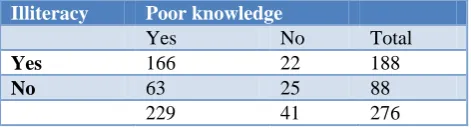
Association between illiterate status of wives and poor knowledge regarding iodized salt was analyzed it was found be significant (Chi-square value- 11.841 and p<0.005) (Table 6).
47, 17%
229, 83%
Good Poor
0 5 10 15 20
1.81 18.1
1.08 9.05
3.6 1.08
Table 5: Suggested action points to improve iodized salt.
Action points Yes (%) No (%) Confusion (%) Mass media
should take active role
82 (29.7) 12 (4.3) 182 (65.9)
Health worker can educate the community
80 (28.9) 14 (5.0) 182 (65.9)
Routine testing for iodized salt in markets
77 (27.8) 13 (4.7) 186 (67.3)
Authorities need to check iodized salt
77 (27.8) 12 (4.3) 187 (67.8)
Table 6: Association between illiteracy and poor knowledge about iodized salt.
Illiteracy Poor knowledge
Yes No Total
Yes 166 22 188
No 63 25 88
229 41 276
Chi-square value – 11.841, p<0.05 significant.
DISCUSSION
The consumption of iodized salt has been reported to be low by the population in Andhra Pradesh. The National Family Health Survey-II conducted in 1998- 1999 also revealed that in Andhra Pradesh as high as 72.5% of the salt samples had iodine content less than 15 ppm.12 The lower iodine content of coarse salt at the production level could lead to a greater vulnerability to iodine deficiency among consumers predominantly using this type of salt. Regular external monitoring can be expected to further encourage salt producers to achieve optimal iodization of salt and there is a need to focus on behavior change communication to increase knowledge, bringing positive attitude toward utilization of iodized salt.
This cross sectional study was conducted in 276 households in rural communities of Prakasam district Andhra Pradesh to know proper use of iodized salt and relevant factors. Most the household families (68.5%) were between 25-50 years age, 90% were married, sixty eight percent of wives were illiterate, and maximum number of wives (48.5%) were involved in labor work. Similar type of iodine salt study conducted on 356 pregnant women in Ada district in Oromia region of Ethiopia country found 45% of illiteracy and 95.2% unemployed not doing any type of work.13 Study conducted by Gebremariam et al in Gondar area of Ethiopia found 14.3% were laborers.14
Among the total households 26% were lower class, 40% were lower middle class. Middle class were 18%, upper
middle class were 14% and upper classes were only 2%. Roy et al study conducted in rural area revealed that most of the household families were belonging to high (30%) and upper middle class (49%) according to modified BG Prasad classification.15
In our study majority (83.6%) of the families were using iodized packed salt and 50% of the families were also using coarse salt. Two sixty eight households were put the salt in dry areas (97.1%), and 96.0% preserving the salt in closed and tight lid containers. A study of similar nature conducted by Konda et al found that 96.3% of the households were using iodized salt.16 The coverage is above what is recommended by international organizations, that is, 90% or more households should consume adequately iodized salt for optimum iodine nutrition in a given community.17 Therefore, it is confirmed that the iodine status of the households in our study is generally adequate according to the WHO criteria. Our results are in conformity with the already published report of the coverage evaluation survey.5 A study conducted by Regassa et al in western Ethiopia revealed that 70.89% families were keeping salt in in dry places and 47.4% preserving salt in closed tight containers.18 Tamil Nadu study conducted in 2012 proved that 68.6% of families stored their salt in closed containers.19
More than 13% households were placed the salt in sunlight exposure areas and 3.2% have habit of washing the salt before adding it in the cooking in our study. Regarding duration of salt storage in the houses 85.5% household families were keeping it up to 30 days and rest (14.5%) were put for more than 30 days. Gebremariam et al study noticed 22.7% families kept their salt in their houses under exposure to sunlight, 92.3% were stored less than 2 months and washing of salt seen in 3.5% families.14 Majority (46%) of households had a habit of adding a salt in the middle phase of cooking, 40% were doing it in early phase, 6% households adding salt at the end of cooking. Another community based cross sectional study revealed that 14.6% families are adding salt early at the beginning of cooking, 8.6% were doing it late in the middle, and 59.8% adding salt at the end.20
Bazezew et al study found that 78% of the respondents had good knowledge of iodized salt use.26 The finding was higher than the 26% reported from Tehran.27 The variation might be due to the nature of study settings in that woman from slum areas and poor communities were included in the Tehran study. Overall knowledge found to be good only in 17% households and poor among 83% of households in our study. Gebremariam et al study also found almost same findings with 26.1% good knowledge among families about iodized salt.14.
Awareness received from mass media is not satisfactory in this study, it was from television 18.1%, only 9% from health workers and 3% from newspapers in our study. The common sources of information (Roy et al) for iodized salt were television (31.1%), followed by radio (30%).15 However, in a study by Sen et al television (66.7%) was the principal source of information.22 In Bazezew et al study observed that respondents’ main sources of information on iodized salt were the media (mainly radio and television), 174 (38.7%), followed by health workers, 91 (20.2%) however, 62 (13.8%) of the respondents could not mention the source of information on iodized salt.26
In our study, the result of Iodized Salt field test kit showed among 276 Household samples, 75% had adequately iodized salt with ≥15 ppm and 25% were with inadequate iodized salt with 15 ppm. Only 109 (24.2%) of the household salts tested contained adequate iodine of ≥15 ppm, 128 (28.4%) was not having any iodine in the salt and 213 (47.4%) having little iodine below 15 ppm.28 A recent study in Orissa reported the use of 45% and 47.7% of adequately-iodized salts at the households and retail outlets respectively this might be because women who lived on higher socioeconomic status had chances to purchase and use different electronic equipment which is important for enhancing nutrition education.22,29
Even though good number of families (83.6%) iodized salt, overall awareness about importance and benefits of iodized was not satisfactory (17%) this may be due poor literacy and most of them were involved in labour work.
CONCLUSION
An efficient Information and education strategy should be adopted with a view to improving knowledge related to iodine deficiency disorders among public and ration shop owners. Education service should intensify health education activities in the schools to increase early awareness among children on the benefits and effects of iodized salt. Regular market surveys should be conducted to identify and remove salt that are not iodized in the market. Regulatory bodies and security agencies should intensify their monitoring activities to ensure that all salt produced in the country are fortified with iodine. Nutrition and Iodine education program regarding proper storage, handling of iodized salt, duration of salt storage at home, and the importance of iodized salt needs to be
implemented to increase community awareness. Educational campaigns through different communication media should target the less educated females who are the most responsible in utilizing adequately iodized salt in the family. There is a need to focus on behavior change communication to increase knowledge, bringing positive attitude toward utilization of iodized salt through AWW and ASHA workers.
ACKNOWLEDGEMENTS
We profusely thank and acknowledge our health staff at the study sites for their support in this work and interns for their participation in collecting the data. We also thank all the family members of households who involved in the study and shared their experiences with us.
Funding: No funding sources Conflict of interest: None declared
Ethical approval: The study was approved by the Institutional Ethics Committee
REFERENCES
1. Andersson M, Karumbunathan V, Zimmermann. Global iodine status in 2011 and trends over the past decade. MBJ Nutr. 2012;142(4):744-50.
2. UNICEF. Sustainable Elimination of Iodine Deficiency: Progress since the World Summit for Children. Global Report. New York: UNICEF; 2008.
3. Pandav CS, Moorthy D, Sankar R, Anand K, Karmarkar MG, Prakash R. National Iodine Deficiency Disorders Control Programme, National Health Programme Series- 5.New Delhi: National Institute of Health and Family Welfare; 2003. 4. Kochupillai N, Pandav CS, Godbole MM, Mehta M,
Ahuja MM. Iodine deficiency and neonatal hypothyroidism. Bull World Health Organ. 1986;64(4):547-51.
5. UNICEF. Coverage Evaluation Survey 2009, All India Report. Ministry of Health and Family Welfare, Government of India, New Delhi, 2010. Available from: http://www.unicef.org/india/ health.html. Accessed 16 January 2016.
6. Summary Report Iodized Salt Coverage Study 2010 Conducted Across Eight States in India. Available at https://www.nutritionintl.org/content/user_files/201 1/06/india-salt-coverage-report-2010.pdf. Accessed 23 May 2018.
7. State Fact Sheets. Available at http://www.rchiips.org/NFHS/factsheet_NFHS 4.shtml. Accessed 28 March 2018.
9. Jooste PL, Marks AS, Van Erkom Schurink C. Factors influencing the availability of iodised salts in South Africa. S Afr J Food Sci Nutr. 1995;7:49-52.
10. Zimmermann MB, Jooste PL, Pandav CS. Iodine-deficiency disorders. Lancet. 2008;372(9645):1251– 62.
11. Assessment of the iodine deficiency disorders and monitoring their elimination. Geneva: WHO/ICCIDD/UNICEF, 2001.
12. NFHS. India 1998-1999- National Family Health Survey-2 (NFHS-2). Nutrition and the prevalence of anemia. International Institute for Population Sciences; Mumbai; 2000: 277.
13. Fereja M, Gebremedhin S, Gebreegziabher T, Girma M, Stoecker BJ. Prevalence of iodine deficiency and associated factors among pregnant women in Ada district, Oromia region, Ethiopia: a cross- sectional study. BMC Pregnancy Childbirth. 2018;18(1):257.
14. Gebremariam HG, Yesuf ME, Koye DN, Availability of Adequately Iodized Salt at Household Level and Associated Factors in Gondar Town, Northwest Ethiopia. ISRN Public Health. 2013;1-6.
15. Roy R, Chaturvedi M, Agrawal D, Ali H. Household use of iodized salt in rural area. J Family Med Prim Care. 2016;5:77-81
16. Konda S, Kumar RBP, Giri PA. Knowledge, attitude and practices regarding iodine deficiency disorders. Int J Med Sci Public Health. 2017;6(8):1297-1301.
17. World Health Organization/International Council for the Control of the Iodine Deficiency Disorders/United Nations Children’s Fund (WHO/ICCIDD/UNICEF). Assessment of the Iodine Deficiency Disorders and Monitoring their Elimination. 3rd ed. Geneva; World Health Organization; 2007.
18. Regassa MD, Wolde TH, Mulatu BJ. Utilization of Adequately Iodized Salt on Prevention of Iodine Deficiency Disorders at Household Level and Associated Factors in Lalo Assabi District, West Ethiopia. J Nutr Food Sci. 2016;6:471.
19. Banumathi GP, Jaiganesh D, Parameshwari P, RavishankarP, Janaki M. KAP study on iodized salt usage among household level in Tirunelveli District, Tamilnadu. Nat J Res Community Med. 2016;5(1):145-8.
20. Hawas SB, Lemma S, Mengesha ST, Demissie HF, Segni MT Proper Utilization of Adequately Iodized Salt at House Hold Level and Associated Factors in Asella Town Arsi Zone Ethiopia: A Community based Cross Sectional Study. J Food Process Technol. 2016;7:573.
21. Strange B, Joseph M, Kaushik S, Dey S, Dutt S, Jha RK. Reaching the Rural Poor in India with Iodized Salt: The Micronutrient Initiative's Iodized Salt Coverage Study 2010. International Council for Control of Iodine Deficiency Disorders Newsletter. 2011;39.
22. Sen TK, Das DK, Biswas AB, Chakrabarty I, Mukhopadhyay S, Roy R. Limited access to iodized salt among the poor and disadvantaged in North Parganas district of West Bengal, India. J Health Popul Nutr. 2010;28:369–74.
23. Buxton C, Baguune B. Knowledge and practices of people in Bia District, Ghana, with regard to IDD and intake of iodized salt. Arch Public Health. 2012;70(1):5.
24. Ersino G, Tadele H, Bogale A, Abuye C, Stoecker BJ. Clinical assessment of goiter and low urinary iodine concentration depict presence of severe iodine deficiency in pregnant Ethiopian women: a cross-sectional study in rural Sidama, southern Ethiopia. Ethiop Med J. 2013;51(2):133–41. 25. Tafere G, Barbara JS. Knowledge, attitude and
practice of rural women in Sidama zone, southern Ethiopia concerning iodized salt, iodine and goiter. FASEB J. 2014;28(1):804–19.
26. Bazezew MM, Yallew WW, Belew AK. Knowledge and practice of iodized salt utilization among reproductive women in Addis Ababa City. BMC Res Notes. 2018;11:734.
27. Mirmiran P, Nazeri P, Amiri P, Mehran L, Shakeri N, Azizi F. Iodine nutrition status and knowledge, attitude, and behavior in Tehranian women following 2 decades without public education. J Nutr Educ Behav. 2013;45(5):412–9.
28. Sarah AN, Prince KA, Yao SA, Geoffrey AA, Wisdom KT, Margaret K. Knowledge on Iodized Salt Use and Iodine Content of Salt Among Households in the Hohoe Municipality, Volta Region - Ghana. Central African J Public Health. 2016;2(1):1-10.
29. Moorthy D, Patro BK, Das BC, Sankar R, Karmakar MG, Pandav CS. Tracking progress towards sustainable elimination of iodine deficiency disorders in Orissa. Indian J Public Health. 2007;51:211–5.