Original Research Article
Awareness about breastfeeding benefits among mothers in maternity
and children hospital of Buraidah Qassim region, Saudi Arabia
Asim A. Alsoqeer*, Ahmad M. Alahmad
INTRODUCTION
Breastfeeding is the ideal source of nourishment in the 1st year of the baby life, it maybe continued to 18 month or more as a primary source of feeding.1 Several studies noted that both baby and mother benefit from breastfeeding whether in short or long terms.2,3 It's a healthy, safe and economical way of providing proper and wholistic nutrition to the newborn. Different studies have shown that breast milk is important for physical, neurological, and cognitive development of child that can
reduces risks of allergies, infection, and non-communicable diseases during stages of their development.4-6 As will as it deepens the bond between the mother and her child, and also it offers a number of health benefits to the mother, studies showed that breastfeeding reduce the risk of mothers having ovarian and breast cancers.4 Despite these profound advantages, it remains under-fulfilled and sometimes missed altogether. This is a common problem worldwide and locally. One of the hypothesized reasons for this is the low level of education of the mothers and a decreased level of
ABSTRACT
Background: Breastfeeding is a healthy, safe and economical way of providing proper and wholistic nutrition to the
newborn. It reduces incidences of infection in the respiratory, gastrointestinal systems and systemic infections. As will as it deepens the bond between the mother and her child, and also it offers a number of health benefits to the mother. Despite these profound advantages, it remains under-fulfilled and sometimes missed altogether. The aim of the study is to assess the knowledge about breastfeeding benefits among mothers.
Methods: The study involved 397 mothers visiting general pediatrics clinics at Maternity and Children Hospital of
Buraidah, Qassim Region, Saudi Arabia from 18 March 2018 to 18 April 2018.
Results: Most of the surveyed women were Saudi (93.5%), (46.1%) university or higher education level. (12.3%) rely
on breastfeeding as the only source. (23.9%) were breastfeeding for more than 6 months. Some questions had as high correct answers as (49.2%), while others had as low correct answers as (20.4%), university or higher education level have the highest correct answers (73%). (61%) discussed the benefits of breastfeeding with a doctor and the correct answers were (72%) while (39%) didn't discuss and the correct answers were (65%).
Conclusions: Analysis of the collected material on the surveyed women showed that Saudi women have insufficient
knowledge about breastfeeding. Knowledge is improving after discussing with a doctor about breastfeeding benefits. Based on these results we highly recommend increasing the efforts to promote and endorse the benefits of breastfeeding by pediatricians and other health professionals.
Keywords: Breastfeeding, Mothers, Exclusive breastfeeding, Family, Lactation initiation, Breastfeeding benefits,
Awareness
Department of Medicine, Qassim University, Saudi Arabia
Received: 18 September 2018
Revised: 13 October 2018
Accepted: 15 October 2018
*Correspondence: Dr. Asim A. Alsoqeer,
E-mail: [email protected]
Copyright: © the author(s), publisher and licensee Medip Academy. This is an open-access article distributed under
the terms of the Creative Commons Attribution Non-Commercial License, which permits unrestricted non-commercial use, distribution, and reproduction in any medium, provided the original work is properly cited.
awareness regarding these advantages. This common and mostly preventable issue requires an accurate assessment of the level of awareness towards the benefits of breastfeeding on the health of the mother and the newborn.
METHODS
All eligible mothers will be identified from the clinics. Consent/assents documents will be presented for signatures to those who express their willingness. Data pertaining to mothers demographics, awareness of benefits to the mother and newborn, awareness of risks to mother and newborn shall be collected on a case report form (copy attached). All collected data will be entered into a computerized database using IBM-SPSS and analyzed appropriately.
Sample size and sampling technique
For this prospective, non-interventional, observational, cross-sectional descriptive study, a consecutive sample of all the pediatric patient's mothers who will fulfill the above-mentioned inclusion criteria, visiting pediatrics clinics at Maternity and Children Hospital of Buraidah, Qassim Region, Saudi Arabia from 18 March 2018 to 18 April 2018 shall be taken. According to a conservative estimate, this will be between 300-500 patients.
Inclusion criteria
Pediatric patients Mothers who attend general pediatrics clinics at Maternity and Children Hospital of Buraidah, Qassim Region, Saudi Arabia from 18 March 2018 to 18 April 2018.
Exclusion criteria
Any woman who has never born a child will be excluded. Ethical considerations
The data thus collected shall be maintained with the P.I. in accordance with the policy on data confidentiality, security, and safety of Maternity and Children Hospital of Buraidah, Qassim Region, Saudi Arabia. No data in any form is retrieved for any purpose without proper approval from appropriate individuals and/or committees/group. Statistical considerations
Dataset will be prepared using IBM-SPPS for Windows Version 20. After performing QA of the dataset, descriptive statistics will be calculated. Outcome analysis will be performed in the light of the identified risk factors. Chi-Square tests along with Fisher's Exact Test would be used to find the relationship between dependent variables and the factors. Bi-variate analysis of the continuous data will be done using Student’s t-test for parametric distributions and relevant non-parametric tests for non-normal data sets. Multivariable binary logistic regression analysis will be performed if the sample size permitted a feasible fit of the model.
RESULTS
Data statistical analysis
Personal information
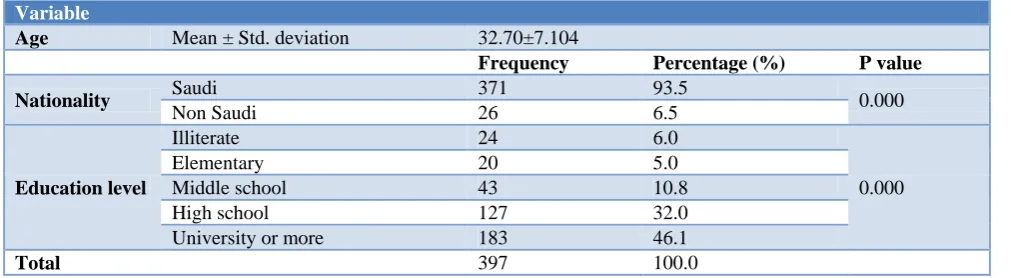
The following table shows the participants' distribution according to personal information.
Table 1: Distribution of the sample study to the demographic data.
Variable
Age Mean ± Std. deviation 32.70±7.104
Frequency Percentage (%) P value
Nationality Saudi 371 93.5 0.000
Non Saudi 26 6.5
Education level
Illiterate 24 6.0
0.000
Elementary 20 5.0
Middle school 43 10.8
High school 127 32.0
University or more 183 46.1
Total 397 100.0
Table 1 shows that the mean age of participants' is 32.7 with a standard deviation of 7.104.
93.5% of them were Saudi, while 6.5% of them were non-Saudi. And their distribution according to education level, 6% of them illiterate, 5% elementary, 10.8 middle school, 32% high school, and 46% university or higher.
Information about the child (children)
5-7 children, while 6% have more than 5-7 children. 42.8% of children are aged (2-3) years, 23% of children are aged (3-4) years, and 35% of children are aged (4-5) years. 49% of children are males, while 51% are females. 12.3% of mothers rely on breastfeeding, 21.2% of mothers rely on formula milk, while 66.5% of mothers rely on breastfeeding and formula milk together. 12.1% of mothers breastfeed less than a month, 16.6% breastfeed their children from (2-3) months, 19.9% breastfeed their children (4-6) months, 3.8% breastfeed their children from (7-9) months and 3.5% breastfeed their children (10-12) months, while 23.9% of mothers breastfeed their
children more than 12 months. 37.5% of mothers stop breastfeeding their babies because inadequate breast milk, 12.6% because of their preoccupation with work, 7.3% because of mother or child's health problems. 13.9% because of the refusal of the child, and 18.1% of them stop breastfeeding their children for other reasons. 1.8% of mothers breastfeed formula milk for 1-3 months, 1.8% of mothers breastfeed ready milk for 4-6 months, 0.5% of mothers breastfeed ready milk for 7-9 months, 2.3% of mothers breastfeed ready milk for 10-12 months, while the vast majority (83.4%) of mothers breastfeed ready milk for more than 12 months.
Table 2: Shows the participants' distribution according to Information about the child (children).
Frequency Percentage (%) P value
Number of children
1-2 153 38.5
0.000
3-4 125 31.5
5-7 97 24.4
More than 7 22 5.5
Child age in years
2 to less than 3 170 42.8
0.000
3 to less than 4 90 22.7
4 to 5 137 34.5
Child gender Male 195 49.1 0.725
Female 202 50.9
Type of feeding
Breastfeeding 49 12.3
0.000
Formula 84 21.2
Breastfeeding and formula 264 66.5
Breastfeeding duration
No breastfeeding 80 20.2
0.000 Less than one month 48 12.1
One to three months 66 16.6 Four to six months 79 19.9 Seven to nine months 15 3.8
Ten to 12 months 14 3.5
More than 12 months 95 23.9
Quitting reason
Inadequate breast milk 149 37.5
0.000
Busy due to work 50 12.6
Due to mother or child's health
problems 29 7.3
Child refusal 55 13.9
Other reasons 72 18.1
Didn’t quit 42 10.6
Formula feeding duration
No formula feeding 40 10.1
0.000 Less than one month 1 .3
One to three months 7 1.8 Four to six months 7 1.8 Seven to nine months 2 .5
Ten to 12 months 9 2.3
More than 12 months 331 83.4
Total 397 100.0
Information about breastfeeding
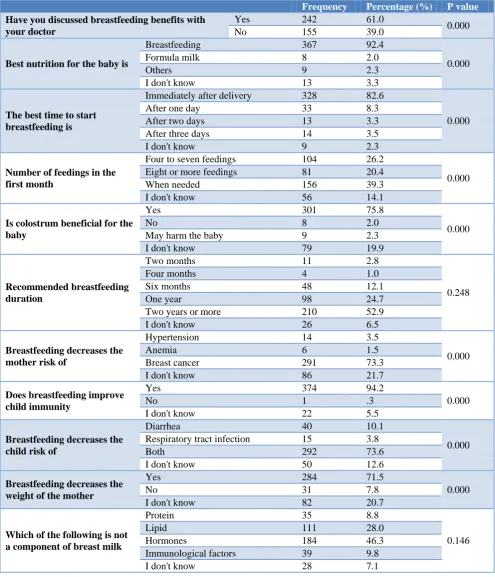
The following table shows the participants' distribution according to Information about breastfeeding.
20.4% of the mothers believe that the number of times a child breastfeeds during the first month is 8 or more. 75.8% of mothers believe that colostrum is beneficial for the child. 52.9% of mothers believe breastfeeding should last for at least two years. 73.3% of mothers believe that breastfeeding reduces breast cancer. 94.2% of mothers believe that breastfeeding strengthens the child's immunity. 73.4% of mothers believe that breastfeeding
reduces the child's diarrhea and respiratory tract infection. 71.5% of mothers believe that breastfeeding helps to reduce the weight of the mother. 46.3% of mothers believe that hormones are not the components of breast milk. 80.4% of mothers believe that the benefits of breast milk: facilitate digestion; reduce infection, rich in food sources.
Table 3: Shows the participants' distribution according to information about breastfeeding.
Frequency Percentage (%) P value
Have you discussed breastfeeding benefits with your doctor
Yes 242 61.0
0.000
No 155 39.0
Best nutrition for the baby is
Breastfeeding 367 92.4
0.000
Formula milk 8 2.0
Others 9 2.3
I don't know 13 3.3
The best time to start breastfeeding is
Immediately after delivery 328 82.6
0.000
After one day 33 8.3
After two days 13 3.3
After three days 14 3.5
I don't know 9 2.3
Number of feedings in the first month
Four to seven feedings 104 26.2
0.000 Eight or more feedings 81 20.4
When needed 156 39.3
I don't know 56 14.1
Is colostrum beneficial for the baby
Yes 301 75.8
0.000
No 8 2.0
May harm the baby 9 2.3
I don't know 79 19.9
Recommended breastfeeding duration
Two months 11 2.8
0.248
Four months 4 1.0
Six months 48 12.1
One year 98 24.7
Two years or more 210 52.9
I don't know 26 6.5
Breastfeeding decreases the mother risk of
Hypertension 14 3.5
0.000
Anemia 6 1.5
Breast cancer 291 73.3
I don't know 86 21.7
Does breastfeeding improve child immunity
Yes 374 94.2
0.000
No 1 .3
I don't know 22 5.5
Breastfeeding decreases the child risk of
Diarrhea 40 10.1
0.000 Respiratory tract infection 15 3.8
Both 292 73.6
I don't know 50 12.6
Breastfeeding decreases the weight of the mother
Yes 284 71.5
0.000
No 31 7.8
I don't know 82 20.7
Which of the following is not a component of breast milk
Protein 35 8.8
0.146
Lipid 111 28.0
Hormones 184 46.3
Immunological factors 39 9.8
Frequency Percentage (%) P value
Benefits of breastfeeding
Easily digested 27 6.8
0.000 Decreases the risk of infection 10 2.5
Rich in nutritional elements 11 2.8
All 319 80.4
I don't know 30 7.6
Total 397 100.0
Table 4: Result of the first hypothesis test.
N Mean Std. deviation F-test Sig
Illiterate 24 0.66 0.156
3.147 0.014
Elementary 20 0.64 0.229
Middle school 43 0.69 0.153
High school 127 0.66 0.189
University or more 183 0.73 0.176
Table 5: Result of the second hypothesis test.
N Mean Std. deviation F-test Sig
1-2 153 0.70 0.165
1.841 0.139
3-4 125 0.66 0.198
5-7 97 0.72 0.190
More than 7 22 0.71 0.145
Table 6: Result of the first hypothesis test.
N Mean Std. deviation T-test Sig
Yes 242 0.72 0.166
3.493 0.001
No 155 0.65 0.197
Test hypotheses
Hypotheses 1
"There is a significant difference at 0.05 level in the extent of mothers' awareness of breastfeeding due to educational level".
Through the Table 4 it is clear that the analysis of variance test result (ANOVA) indicate that there is a statistically significant difference in the extent of mothers' awareness of breastfeeding due to educational level.
Hypotheses 2
"There is a significant difference at 0.05 level in the extent of mothers' awareness of breastfeeding due to the number of children".
Through the Table 5 it is clear that the analysis of variance test result (ANOVA) indicate that there is no statistically significant difference in the extent of mothers' awareness of breastfeeding due to the number of children.
Hypotheses 3
"There is a significant difference at 0.05 level in the extent of mothers' awareness of breastfeeding due to discussing the competent doctor".
Through the Table 6 it is clear that the analysis of variance test result (ANOVA) indicate that there is a statistically significant difference in the extent of mothers' awareness of breastfeeding due to discussing the competent doctor.
DISCUSSION
of them continued breastfeeding until 9–12 months, and (23%) continued until 18–24 months.9 While in our study exclusive breastfeeding were (12.3%), (19.9%) uses breastfeeding as a source of nutrition for 6 months, (3.5%) until 10-12 month and (23.9%) were more than 12 months Table 2. Regarding to the breastfeeding knowledge assessment, "Does breastfeeding protects the mother from ovarian and breast cancer?" a survey question to evaluate Malaysian women awareness about breastfeeding, (31.8%) of the answers were I don't know.10 In our study a similar question "Breastfeeding decrease the mother risk of?" one of the answers is breast cancer, mothers who answered I don’t know were (21.7%), while the wrong answers to this question were (5%) Table 3, another question "Does breastfeeding protects the infant from diarrhea?" (16.4%) chose I don’t know.10 While in this study a similar question was mentioned and (12.6%) answered don't know Table 3, on the other hand, the most prevalent barrier in initiating of breastfeeding or quitting reason is working (66.7%).10 While in our survey the most prevalent barrier is inadequate breast milk (37.5%) Table 2. Furthermore, we found that education level Table 4 and discussing with a doctor Table 6 has a relation with increase awareness, while number of children has no relation Table 5. A social media campaign study in Saudi Arabia was done to measure and improve the awareness of breastfeeding, the results show that a combination of professional breastfeeding support, public health education programs through social media could be an effective tool in improving breastfeeding in Saudi Arabia.11
CONCLUSION
From this study, analysis of the collected material on the surveyed women showed that Saudi women have insufficient knowledge about breastfeeding benefits. Knowledge is improving after discussing with a doctor about breastfeeding benefits Table 6. Based on these results we highly recommend increasing the efforts to promote and endorse the benefits of breastfeeding by pediatricians and other health professionals.
ACKNOWLEDGEMENTS
The authors are grateful to the data collectors: Reem Abdulaziz Alharbi, Fatmah Ali Almohaimeed, Maram Abdullah Alharbi, Nawal Hamad Alawaji, Malak Salim Alrasheedi.
Funding: No funding sources Conflict of interest: None declared
Ethical approval: The study was approved by the Institutional Ethics Committee
REFERENCES
1. Mohapatra I, Roy A. Breastfeeding awareness and perception among antenatal mothers: A cross-sectional study in urban slum population of Bhubaneswar, Odisha. J Edu Health Promot. 2018;7:60
2. Oddy W, Kendall G, Li J, Jacoby P, Robinson M, de Klerk N, et al. The long-term effects of breastfeeding on child and adolescent mental health: a pregnancy cohort study followed for 14 years. J Pediatr. 2010;156(4):568–74.
3. Brion M, Lawlor D, Matijasevich A, Horta B, Anselmi L, Arau´jo C, et al. What are the causal effects of breastfeeding on IQ, obesity and blood pressure? Evidence from comparing high-income with middle-income cohorts. Int J Epidemiol. 2011;40(3):670–80.
4. Ip S, Chung M, Raman G, Chew P, Magula N, DeVine D, et al. Breastfeeding and maternal and infant health outcomes in developed countries. Evid Rep Technol Assess (Full Rep). 2007;153:1–186. 5. Horta B, Bahl R, Martinés J, Victora C. World
Health Organization. Evidence on the long-term effects of breastfeeding Systematic reviews and meta-analysis. Geneva: World Health Organization; 2007.
6. Khan J, Vesel L, Bahl R, Martines J. Timing of breastfeeding initiation and exclusivity of breastfeeding during the first month of life: effects on neonatal mortality and morbidity--a systematic review and meta-analysis. Matern Child Health J. 2015;19(3):468–79.
7. Brahm P, Valdés V. The benefits of breastfeeding and associated risks of replacement with baby formulas. Rev Chil Pediatr. 2017;88(1):7–14. 8. Li R., Zhao Z, Mokdad A, Barker L,
Grummer-Strawn L. Prevalence of breastfeeding in the United States: the 2001 National Immunization Survey. Pediatrics. 2003;111(5):1198–201.
9. Sobaih AMB. Attitudes of Saudi mothers towards breastfeeding. Sudan J Paediatr. 2016;16(1):31–6. 10. Juin J, Ghazali A, The Awareness About the
Benefits and Practice of Breastfeeding Among Mothers in Pioneer Technology Malaysia Sdn. Bhd., Ledang, Johor, Malaysia. Nursing & Allied Health Sciences, Open University Malaysia; 2013
11. Bahkali S, Alkharjy N, Alowairdy M, Househ M, Da'ar O, Alsurimi K, et al. A Social Media Campaign to Promote Breastfeeding among Saudi Women: A Web-based Survey Study. Stud Health Technol Inform. 2015;213:247–50.
Cite this article as: Alsoqeer AA, Alahmad AM.