BREASTFEEDING, FEMINISM, AND POLITICAL THEORY
Amanda Barnes Cook
A dissertation submitted to the faculty at the University of North Carolina at Chapel Hill in partial fulfillment of the requirements for the degree of Doctor of Philosophy in the Department
of Political Science in the College of Arts and Sciences.
Chapel Hill 2015
ii © 2015
iii ABSTRACT
Amanda Barnes Cook: Breastfeeding, Feminism, and Political Theory (Under the direction of Susan Bickford)
This project situates breastfeeding mothers within feminist liberal political theory, framing breastfeeding as a central human capability in a capabilities approach. It explores the ways in which social and political institutions and norms affect the ability of women to breastfeed; that is, an official legal right to breastfeed is inadequate because breastfeeding mothers demand positive conditions under which breastfeeding is possible given the constraints of their lives. The dissertation systematically considers both women’s capability of breastfeeding and women’s autonomy.
The first chapter explores welfare state theory as it affects breastfeeding workers; an analysis of the literature suggests that overlooking the needs of breastfeeding workers is common and harmful. This chapter concludes that an equality-promoting welfare model is appropriate for breastfeeding workers. Breastfeeding workers need specific protections, protections which may be sex-specific; this chapter shows that sex-specific policies have an important place in equality-promoting welfare models.
iv
more than an individual’s own needs in public; finally, all people must be able to opt for privacy in a way that does not entail invisibility or coerced exclusion.
The final chapter analyzes the concept of maternal access to children, arguing that breastfeeding mothers require access to their children and that the ability to express breast milk cannot function as a substitute for access. The chapter explores the concept of access through in-depth study of two cases of separations of mothers and their breastfed children: maternal
v
vi
ACKNOWLEDGEMENTS
If all projects are indebted to the work and support of a community, this project—which was conceived and written through the pregnancies and breastfeeding of two children—is especially so. I am grateful for the Graduate School’s graduate student parental leave policy, particularly because it is unusual for graduate schools to offer students parental leave. I am likewise thankful for advisors and a department who enabled me to take a year “off” after the birth of my second son. I owe thanks to the Political Science Department for transitioning an office into an impromptu pumping room and for making accommodations for pumping during exams. The Graduate School’s Dissertation Completion Fellowship was also integral to my ability to finish this project. These policies made it possible to finish my work without
conforming to ideal student norms; as my arguments below indicate, I know how rare this is and am correspondingly grateful.
vii
Breastfeeding and Feminism International Conference 2012–2015 for providing a forum in which to refine ideas, discuss concepts, and develop intellectual relationships.
I also owe a debt of gratitude to my graduate student peers who became mothers while I was at UNC. Having babies and writing our dissertations together has given me the solace and support of community while simultaneously offering me an informal focus group off of whom to bounce ideas and to brainstorm solutions to problems. Their humor, rage, and vision for a new future of work and family have salvaged my sanity.
viii
TABLE OF CONTENTS
LIST OF TABLES ... x
LIST OF FIGURES ... xi
LIST OF ABBREVIATIONS ... xii
INTRODUCTION ... 1
Theoretical Orientation ... 5
Historical Overview ... 8
Respecting Formula-Feeding Mothers ... 13
Outline of Chapter... 17
CHAPTER 1. WELFARE STATES AND BREASTFEEDING WORKERS: SEX-SPECIFIC POLICIES IN GENDER EGALITARIAN MODELS ... 19
Part 1: Background and Current Realities ... 23
Part 2: The Gendered Welfare State and the Politics of Sex-Specific Policies ... 29
Part 3: Difference at Work: Breastfeeding Workers ... 41
Part 4: Policies to Support Breastfeeding Workers ... 43
Part 5: Embracing Single-Parent and Same-Sex Breastfeeding Families ... 51
Part 6: Policy Implications ... 54
CHAPTER 2. BREASTFEEDING IN PUBLIC: DISGUST AND DISCOMFORT IN THE BODILESS PUBLIC SPHERE ... 58
Part 1: Disgust and Discomfort in the Public Sphere ... 61
Part 2: Moral Equality and Disgust ... 71
ix
Part 4: Equal and Autonomous Public and Private Spheres ... 83
Conclusion ... 87
CHAPTER 3. THE POLITICS OF MATERNAL ACCESS TO BABIES AND MOTHER-BABY SEPARATION... 91
Part 1: Breastfeeding as a central capability ... 93
Part 2: Maternal Access to Breastfed Children ... 98
Part 3: Separation and Trusting Mothers ... 102
Part 4: Parental Custody of Breastfed Children ... 106
Part 5: Incarcerated Mothers and Access to Children ... 118
Conclusion ... 136
CONCLUSION ... 138
APPENDIX A: BREASTFEEDING POLICIES AND RATES ... 141
x
LIST OF TABLES
xi
LIST OF FIGURES
xii
LIST OF ABBREVIATIONS AAP American Academy of Pediatrics
ACA Patient Protection and Affordable Care Act of 2010 ACOG American College of Obstetricians and Gynecologists ALI American Law Institute
CDC Centers for Disease Control and Prevention FMLA Family and Medical Leave Act of 1993
OECD Organisation for Economic Co-operation and Development
1
INTRODUCTION
The central claim of this dissertation is that a just and egalitarian society must have institutions and policies in place that guarantee women the preconditions under which they can freely decide to breastfeed. A political and social order that constrains this decision for women is unjust and exacerbates gender inequalities, alchemizing biological difference into social and political disadvantage. Ultimately, this project situates breastfeeding mothers within feminist political theory. As breastfeeding initiation and duration rates continue to increase, the political importance of breastfeeding to women’s lives will only become more salient. Feminist theories need to become attuned to the special needs of women’s lives in order to support the creation of social and political institutions that establish the preconditions for lives of human dignity and well-being—lives that allow women to exercise their fundamental human capabilities.
In certain contexts, women are disadvantaged relative to men because of biological differences; breastfeeding is an important case. Pregnant and breastfeeding mothers cannot ignore their bodies. Their bodies—the capabilities of the flesh—are visible and demanding. Pregnant and lactating bodies have an enormous effect on women’s lives, and a mother can easily spend more than ten years pregnant or lactating, so these effects are not passing, but rather integral to the lives of many mothers. The needs of women are, therefore, different than the needs of men. The needs of breastfeeding mothers are distinct from the needs of other groups, and these needs are urgent.
2
has a unique set of needs; some are sex specific and others not. That a need is sex specific does not constitute evidence of inferiority. Political society has traditionally been designed to meet the needs of men. A fair and just society features political and social institutions designed to avoid systematic advantage or disadvantage to a group on the basis of a distinct set of needs.
In the United States today, four in five women become mothers (Livingston and Cohn 2010). The needs and struggles of motherhood, therefore, are of primary importance to the feminist project, as they define the lives of the vast majority of women. Rather than framing the struggles of motherhood as logical consequences of a “choice,” which are therefore politically unimportant because women volunteered for these struggles when they became pregnant and birthed children, we must minimize the struggles of motherhood that stem from social and political structures while viewing the biological struggles of motherhood (including the logistics of pregnancy and breastfeeding) as a simple fact of reality. Politically, it makes more sense to think of motherhood as a fact of the human condition than as a “choice.”
3
accommodate breastfeeding mothers is a society that systematically disadvantages women on the basis of their maternity.
In the United States today, mothers of young children face many difficulties. In the United States, there is no guarantee of maternity leave. Most mothers have no guarantee of paid sick time. Postpartum Support International reports that 15-20% of new mothers experience either clinical depression or anxiety. Low-income women are even more likely to experience depression; one in four mothers in poverty suffers from mental illness (Center on the Developing Child 2009). Single mothers (approximately one in four mothers) are especially vulnerable to economic insecurity and childcare troubles (Wang, Parker, and Taylor 2013). In addition to these challenges, mothers who decide to breastfeed face public scrutiny, hostile workplaces, and difficulty accessing their children. It thus makes sense that some mothers, given a social and political context that does not support motherhood, might decide not to breastfeed. Breastfeeding is something that they can choose to skip—a task they can take off their already full plates. When Pam Carter interviewed women about breastfeeding, many of them reported feeling relieved that they did not have to breastfeed; “breastfeeding [was] depicted as a burden additional to many others” (1995, 50).
4
supportive state (2010), in which she argues that the institutions of the state affect families’ ability to provide care.
The political goal is for the rate of mothers who want to breastfeed to be as close as possible to the rate of women who do breastfeed, and likewise for the desired and the actual duration of breastfeeding to be as close as possible. The goal is not that all women will breastfeed, but rather that those who want to breastfeed are enabled to do so. Of course, some women will want to breastfeed and do everything they can to meet that goal, and still fail for reasons not solely due to lack of institutional supports. With institutional supports in place
(including access to good breastfeeding information, lactation professionals, donor milk, etc.) the number of women who fall into this category will be lower, but never nonexistent. Currently, in the United States, only 32.4% of mothers met their intended exclusive breastfeeding duration (Perrine et al. 2012). That is, only one third of mothers breastfeed for the amount of time that they desire.1 Even if some mothers end up weaning because the experience of breastfeeding is not what they expected (a change in desired duration), and if some mothers experience lactation failure, that still leaves a large proportion of mothers who are unable to breastfeed for as long as they want to. This is a political problem, and there are institutional solutions.
It is also important to remember that social support for breastfeeding mothers helps all women, even those who use infant formula and those who will never have children. As Bernice Hausman observes:
If the particularity of mammalian sexual difference confers on women a greater
biological burden in reproduction, we can choose to ensure that maternity does not hurt women’s participation in civil society and the waged labor market; in other words, we
1
5
can work to ensure that support for breastfeeding does not suggest the need to cloister women among themselves in the home….Whether they do or do not work in the waged labor market, all mothers share some interest in increasing the social value of their work as family caretakers. All mothers would benefit from social recognition of the physical costs (and benefits) of biosocial maternal practices. (Hausman 2003, 5-6)
Even mothers who are not breastfeeding benefit from a society that values care work, and that does not condone discrimination against women based on their unique bodily capabilities. In this way, a society that supports breastfeeding workers improves women’s position in society more generally, expanding the scope of women’s autonomy and gender equality.
Theoretical Orientation
My theoretical orientation here is a liberal one, but it is a feminist liberal one that is critical of many liberal treatments of women’s and mothers’ political problems. Despite my criticisms of certain liberal arguments, my orientation is a liberal one because of the emphasis I place on women’s autonomy: women should never be cajoled or coerced to breastfeed. I am most critical of those liberal arguments that frame women’s issues within a negative liberty scheme; I argue that the mere absence of interference with regard to parenting and breastfeeding decisions is not enough. A society that tells women “you are free to choose to breastfeed,” but whose institutions make it impossible for her to exercise this right, is not a just society—nor is it a society that lives up to liberalism’s own ideals.
6
free choice, is a claim supported by the logic of central human capabilities. Breastfeeding falls
under Nussbaum’s central capabilities of bodily health (“being able to have good health,
including reproductive health”), bodily integrity (“having opportunities…for choice in matters of
reproduction”), emotions (“being able to have attachments to things and people outside ourselves; to love those who love and care for us”), practical reason (“being able to form a
conception of the good and to engage in critical reflection about the planning of one’s life”), and
affiliation (“being able to live with and toward others, to recognize and show concern for other
humans, to engage in various forms of social interaction”) (Nussbaum 2000: 78-9). Moreover,
thinking of breastfeeding as a capability comports with intuitions about breastfeeding—most
women have a physiology that supports lactation after the birth of a baby.2 Lactation is a
potential use and capability of breasts that women are empowered to use to nourish their babies,
should they decide to.
The benefit of thinking about breastfeeding within a liberal capabilities approach is that
its rhetorical emphasis is appropriate both in its focus on securing the social conditions of
realizing capabilities and in its insistence on achieving capability rather than functioning. A
capabilities approach insists that “for political purposes it is appropriate that we shoot for
capabilities, and those alone. Citizens must be left free to determine their own course after that”
(Nussbaum 2000: 87).
For it is all about respect for the dignity of persons as choosers. This respect requires us to defend universally a wide range of liberties, plus their material conditions; and it requires us to respect persons as separate ends, in a way that reflects our acknowledgment
2
7
of the empirical fact of bodily separateness, asking how each and every life can have the preconditions of liberty and self-determination. (Nussbaum 2000: 59-60)
Once the material, social, and cultural conditions for breastfeeding are in place, it is the
fundamental liberty of each woman to decide whether to exercise this capability. The capabilities
approach does not aim for functioning—women actually breastfeeding—but rather their access
to the capability. It may be appropriate in certain contexts (such as carefully considered public
health promotions) to try to persuade women to decide to breastfeed, but the political goal is
capability only. Theoretically, this approach is driven by a profound respect of each individual
actor, and it requires that we trust women and women’s decisions. It may seem trite to impress
that women should be trusted, but given the history and context of breastfeeding decisions
(which I discuss below), trusting women is somewhat radical. At the same time, “this very
respect means taking a stand on the conditions that permit them to follow their own lights free
from tyrannies imposed by politics and tradition” (Nussbaum 2000: 69). The capabilities
approach’s focus on what “individuals are actually able to do and to be” is the appropriate
political goal for breastfeeding. The goal is that women can actually, in the context of their lives,
breastfeed their babies. Thus, it is the responsibility of the state to guarantee the means and
resources necessary for women to exercise their capability to breastfeed. It is a facet of the
human capability of control over one’s reproduction and the use of one’s body.
I want to be clear that I am not justifying support of women’s ability to breastfeed on the
basis of the health of breastfed children. The reasons for this are threefold: as stated above, I
agree with Hausman (2012) that a focus on scientific evidence for breastfeeding distracts debate
away from the more important issue of the realities of breastfeeding mothers’ lives. Secondly, I
do not believe that the child’s health justifies interfering with women’s autonomy. Certainly
8
infant); our obligation to that child can be fulfilled through ensuring access to donor breast milk
(I expand on this theory and on respect for the child’s health in chapter 3). Finally, I believe it is
dangerous to justify a woman’s actions on the basis of her child’s health. Justifying a practice on
the basis of its being important to women is enough. We need not deepen our justification by
saying it is also good for children; to do so endangers the position of women who do not want to
breastfeed and, in the extreme, risks reducing mothers to caregiving objects. I trust women; I
trust mothers. Mothers should have access to the best information about children’s health and
breastfeeding, and most mothers will take this information into account when they make infant
feeding decisions. Politically, though, the goal is that mothers have access to a context in which
they can decide to exercise their capability of breastfeeding.
Historical Overview
Mothers have been subject to demands to breastfeed for centuries. Cotton Mather, in 1741, wrote that “She is not a Dame that shall scorn to nourish in the World, the Children whom she has already nourish’d in her Womb,” exhorting women to “give suck to their young ones” (1741, 105–6). In 1762 Jean-Jacques Rousseau lamented those mothers who did not “deign to nurse their children” (1762, 46). Breastfeeding, in this paternalistic scheme, is part of the “duty” of motherhood.
9 of women as mother-objects.
Moreover, before the advent of safe infant formula, breastfeeding was part of a complex history of class and race through the practice of wet nursing. “Wet nurses had such dismal reputations that when a doctor suggested a family hire one, the recommendation almost always was met with dismay. The consternation was due largely to class differences—physicians and the families who hired wet nurses were well-off, while wet nurses tended to be poor women in unusually desperate circumstances” (Wolf 1999, 97). A desperate mother who became a wet nurse was often required to live with her employer and to send her own baby elsewhere—and likely, without mother’s milk—to die (Wolf 1999, 102). The history of wet nursing is a history of exploitation, class callousness, and disregard for the life of disadvantaged infants.
In the late 19th century, during the throes of urbanization, women of all classes began to claim that they were not making enough milk.
This oft-heard, late 19th century complaint among women of all classes and ethnic groups coincided with the invention of infant feeding schedules…. As one typical doctor urged, ‘First, we must teach regularity, the cultivation of accurate habits in the baby; make a machine of the little one. Teach it to employ its various functions at fixed and convenient times.’ Thus, prescheduled, widely spaced feedings were the likely cause of women’s complaints of inadequate milk, for human lactation is governed by the adage ‘supply equals demand’—the less opportunity a baby is given to suck on her mother, the less milk her mother’s breasts will produce. (Wolf 2006, 175)
10
through pasteurization, refrigeration, and pure food laws, but also through medicalization of infant “formulas” of proteins, fats, and other nutrients) (Wolf 2006, 176). In the first half of the twentieth century, breastfeeding became a partial casualty of a medical institution that claimed scientific knowledge that the expense of women’s capabilities.
11
In the 1980s, proponents of difference feminism—a variant of feminism which stresses the unavoidable biological difference between men and women—attempted to overcome the view that mothering, including breastfeeding, is oppressive, arguing instead for a society and for social policies that accommodate (and even celebrate) women’s biological difference.3 Other feminists are concerned that this deification of difference smacks of biological determinism, that celebrating difference means that woman are told their proper role is as a mother. Worse, special treatment for women (in the form of, say, special legal protections for pregnancy or
breastfeeding) could lead to discrimination. Moreover, any theory that promotes biological essentialism—seeing women as “different” and emphasizing maternalism—concerns feminists who fear that women who stay at home breastfeeding (a “choice” that they see as constrained and socially constructed) are perpetuating gender inequality, serving patriarchy, and diminishing their own future life prospects. “The question of who earns the family's income,” Okin writes, “has a great deal to do with the distribution of power and influence within the family, [and on] the distribution of other benefits, including basic security” (1989: 135). Thus the decision to breastfeed—insofar as that decision means a woman will stay home, and perhaps insofar as that decision puts her in a disadvantaged position in the workplace—is sometimes seen as detrimental to women’s larger security.
In recent years, as gender equality in the home has become a more widespread goal, breastfeeding also raises concerns because it is a task that cannot be shared.4 If the feminist ideal is gender-neutral, halved caregiving, breastfeeding challenges that ideal. Men and women have, indeed, been moving towards a more equal division of paid work and care work in the past
3
See, on motherhood, Ruddick 1989.
4
12
decades. A Pew study reports that “On the home front, men are spending more time doing
housework than they did in the 1960s, while women have cut back their hours in this area. Men’s housework time has doubled from four hours per week in 1965 to about nine hours per week in 2011. Women, meanwhile, have cut their housework time almost in half…. Fathers have nearly tripled the time they spend with their children (from 2.5 hours in 1965 to 7.3 hours today)” (Parker and Wang 2013, 32, 33). But the task of breastfeeding cannot be halved—even if the task of feeding the baby is shared through bottle feeding breast milk, the mother must still bear the burden of pumping that milk.
The problem arises because breastfeeding is sex-specific, and therefore challenges the feminist principle of gender-neutral childrearing. It is an even more difficult problem than pregnancy because whereas pregnancy is necessary for childbearing, many do not consider breastfeeding to be critical to an infant’s survival, at least in industrialized countries. (McCarter-Spaulding 2008, 207)
In a culture that increasingly idealizes shared “co-parenting,” breastfeeding can be problematic because of the demands it makes on the mother’s—but not the father’s—time. For an equal split of caregiving in a breastfeeding family, fathers would have to complete more than half of the non-breastfeeding tasks. (I explore this issue at length in chapter 1.)
In addition to some feminists’ criticism of gender egalitarianism in breastfeeding families, some are likewise critical of pro-breastfeeding activism. As scientific evidence about the superiority of breastfeeding has amassed, public health campaigns urging women to
breastfeed have become common. Some feminists charge that breastfeeding advocacy can cause guilt or shame among mothers who do not breastfeed, leading some feminists to criticize the entire practice of breastfeeding advocacy, while others interrogate how to encourage
13
seeking to increase rates of breastfeeding to be patriarchal, ignoring the experience and problems of infant feeding from the woman’s perspective (1995).
It is clear that breastfeeding raises complex issues for feminists and gender equality, issues that cannot be fully addressed in the scope of this dissertation. It is important to note that the focus of this dissertation is on the policies that are in place to support mothers who decide to breastfeed, not on a patriarchal or pronatalist goal of “increasing rates of breastfeeding” without considering how to make this decision a more feasible one for women to make. That is, the goal of this dissertation is to theorize how to ensure that woman are able to exercise the capability of breastfeeding.
Respecting Formula-Feeding Mothers
14
Just as I argue that women’s official “right” to breastfeed may not actually be practicable if the conditions aren’t in place for them to feasibly do so, it is also important that mothers don’t retain an official “choice” to formula feed while being actively pressured to breastfeed and shamed for not doing so. It is central that women are not shamed for not breastfeeding. Taylor and Wallace address this issue in detail:
If breastfeeding promotion is to take seriously the challenge of shame—as we argue that it must if it is to be truly feminist—promoters need to commit to three significant
conceptual shifts. First, breastfeeding promoters must place mothers at the center of our efforts rather than infants. The interests, needs, and well-being of mothers must be the objects of our promotion. Second, we must take the lived experiences of mothers as seriously as we take evidence-based biomedical data. Third, we need to approach our understanding of women’s infant feeding choices aware of both the constraints that women face in developing their own infant feeding plans and the ways in which these constraints may recommend something other than exclusive breastfeeding. (2012b, 201) What’s so tricky here is that formula-feeding mothers are likely to feel shame because infant feeding decisions are “irreducibly moral and the ways in which women can be judged, or indeed judge themselves, to be deviant are legion” (Murphy 1999, 188). So when policies are introduced that provide the conditions under which mothers who want to breastfeed can be successful at it, formula-feeding mothers are at risk for feeling an increase in pressure on them to breastfeed or judgment of them for having not done so.
15
biological benefits of breastfeeding without real social change will only create the ‘exhortation to breastfeed’…that many women chafe against, and rightly so” (Hausman 2003, 227-8).
It is difficult for a liberal feminist to know how to handle this conundrum: the very policies that breastfeeding mothers need have the potential to make formula-feeding mothers feel pressured, guilty, or ashamed; we want to respect the dignity and well-being of both
breastfeeding and formula-feeding mothers. Taylor and Wallace suggest that some level of guilt may be appropriate (or at least unavoidable)—it is shame that feminists need to guard against (2012a). Whereas guilt causes mothers to feel that they have broken a rule or caused harm, shame causes mothers to judge themselves as deficient, as failures (Taylor and Wallace 2012a, 85). Evidence-based medical information might cause formula-feeding mothers to feel guilt, but shame is caused by something bigger than mere information.
While the policies I am arguing for in this dissertation, such as pumping breaks for breastfeeding workers, may increase the perceived pressure to breastfeed felt by formula-feeding mothers, it is important to note that the these policies do not inflict shame. I would like to
suggest that what causes formula-feeding mothers to feel shame is not medical evidence of breastfeeding’s superiority or the existence of accommodations for breastfeeding mothers, but rather a culture that is preoccupied with judging mothers, with criticizing mothers’ choices, with claiming that “good” mothers are self-sacrificing mothers. In the context of this highly
judgmental culture in which all mothers feel like deficient mothers, any discussion of
breastfeeding might bring up feelings of guilt or shame. But this is a symptom of a much larger problem, and it is the larger problem that feminists should be fighting against.
16
support for mothers of all kinds and respecting mothers’ decisions. It means giving women reproductive agency, whether through access to contraception and abortion, excellent medical care and information, and knowledge on best practice for breastfeeding success. It means
recognizing the constraints on mothers’ decisions, including infant-feeding choices, and the ways in which the realities of their lives might lead them to prioritize other factors over breastfeeding. It means that feminists should be fighting battles about improving the material conditions of women’s lives, rather than on depriving women of supportive policies on the amorphous basis of avoiding guilt or shame.
One concrete recommendation this discussion suggests is that, when breastfeeding mothers could be accommodated through policies that help all women (or parents) or through breastfeeding-specific policies, breastfeeding-neutral policies should be preferred. For example, breastfeeding workers can be accommodated primarily through maternity leave or through policies allowing milk expression at work; maternity leave is preferable because it can provide benefits to all mothers and children, not just to those who decide to breastfeed. In thinking about how to accommodate breastfeeding mothers who are called for jury duty, courts could either allow breastfeeding mothers to pump on duty, allow breastfeeding mothers to delay their summons, or allow all caregivers of young children to delay their summons. The preferable policy here is the latter, since it would benefit all parents and children, rather than just
17 Outline of Chapters
The chapters in this dissertation focus on central issues concerning women and the politics of breastfeeding. The focus remains squarely on the breastfeeding mother, rather than treating the mother as an invisible subject in service to the well-being of babies, as much
literature on breastfeeding does. Much literature views breastfeeding as a subject primarily about babies—babies as beneficiaries of the nutrition and nurture of breastfeeding mothers. I urge a shift to breastfeeding as a women’s issue, as an issue that should demand attention from politics and from the state insofar as that attention is necessary for women’s well-being.5 I urge away from a focus on a contented baby at a faceless and disembodied breast, toward a focus on the woman herself.
In the first chapter, I analyze the needs of breastfeeding workers and articulate an
argument for robust state support for accommodating breastfeeding in the context of paid work. I analyze theories of gender and the welfare state and discuss how equality-promoting welfare models should accommodate breastfeeding, both through parental leave and at-work policies. I offer a typology of programs supporting breastfeeding workers and consider which policies are most appropriate within an equality-promoting welfare model.
In chapter 2, I turn to the issue of breastfeeding in public, articulating a conception of an equal and autonomous public sphere in a liberal society. I describe three main ways in which breastfeeding mothers respond to the antipathy of the public sphere: exclusion, accommodation, and affirmation. In the final section, I outline an ideal of public and private spheres defined by
5
18
equality and autonomy, a public sphere in which breastfeeding mothers’ experience of public space and public life is not distorted by the discomfort of others.
19
CHAPTER 1. WELFARE STATES AND BREASTFEEDING WORKERS: SEX-SPECIFIC POLICIES IN GENDER EGALITARIAN MODELS
Dating back at least to Orloff (1993), feminist literature on the welfare state has
considered women’s access to paid work a key measure of women’s social rights. In the case of mothers, access to paid work requires the ability to combine work and family. Combining work and family involves a special set of challenges in the case of breastfeeding—mothers and children must be physically together, or mothers must have time and space to express milk—yet breastfeeding has mostly been ignored, even among welfare state authors who focus explicitly on women and the family.
The purpose of this chapter is to interrogate the role of the state in providing institutional support for breastfeeding workers. By “breastfeeding worker,” I mean a breastfeeding mother who is not leaving the labor force, whether she is on maternity leave, reduced hours, or flex-time, working from home with a baby on her lap, pumping at the office, or has made other
arrangements. The issue of institutional support for breastfeeding workers is an important one, since female labor force participation is a key metric of women’s position in society and access to paid work is a key dimension of welfare state policy (Okin 1989; Orloff 1993). Thus, the focus of this paper is on helping those women who decide to breastfeed to be able to meet their own goals.
20
ways in which sex-specific policies, such as those supporting breastfeeding workers, present an ideological problem for the equality-promoting welfare model. Then, I tackle what has been called the “sameness/difference debate” as it applies to breastfeeding workers and the equality-promoting welfare model. From there, I offer a typology of programs supporting breastfeeding workers including equality- and breastfeeding-promoting parental leave. I consider the unique needs of non-normative breastfeeding mothers, including single breastfeeding mothers and co-breastfeeding queer parents. I close with a tentative formulation of an equality-promoting welfare model that also protects the sex-specific needs of breastfeeding workers.
The lack of attention to breastfeeding in both feminist and traditional political economy literature on the welfare state is not surprising. Formulating a theory of state involvement in reconciling breastfeeding with labor force participation is difficult terrain for feminists; a tension is often perceived between the goal of gender equality and the practice of breastfeeding.
Breastfeeding a child places high demands on the time and availability of the mother; newborns nurse as often as once every hour or two, keeping their mothers on call.6 As babies get older, their demands wane, but it remains an intense relationship. Women who work away from their babies while maintaining a commitment to breastfeeding spend a good deal of time expressing milk for the time they will be gone. They must find time and space to express milk at work and navigate the social dynamics of pumping in the workplace. For feminists and others who value gender equality, this is a difficult situation: how can feminists embrace a practice that places so many demands on the woman’s body and time, especially when it is possible to simply opt out through the use of infant formula?
6
21
In political economy literature, there is a concern that women who are out of the labor market to accommodate maternity are less likely to reenter the paid labor force; this is
problematic from the perspective of sustaining a generous package of public services and entitlements, because women workers are needed to pay into the system. It is also problematic from the perspective of gender equality, since a weakened labor force attachment puts women in a vulnerable financial position, and since time out of the formal labor market affects their
lifetime earning capacity relative to men (OECD 1995; Fodor and Kispeter 2014). There is therefore a legitimate concern that breastfeeding workers’ needs must be met in a way that does not harm their long-term careers. But recent research on the length of parental leave is calling into question the established wisdom that “too long” parental leaves are bad for gender equality (e.g. Keck and Saraceno 2013). Feminists must continue to evaluate the effect of leave
provisions on mothers’ economic security.
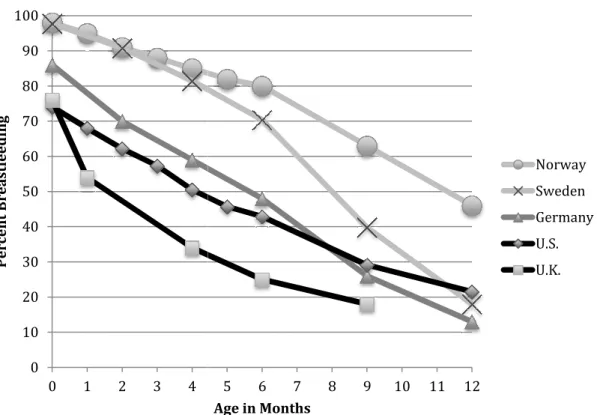
While breastfeeding rates declined rapidly in advanced industrial countries in the first half of the 20th century, the social and public health costs of this shift have brought a shift back towards public medical encouragement of exclusive breastfeeding for the first six months (see figure 1 on page 141). Within this medical culture of encouraging breastfeeding, mothers
22
the healthiest choice for both mother and child (Ip et al. 2007).7
As I argue in the introduction, I do not want to justify social support of breastfeeding mothers on the basis of the health of their children. But this scientific evidence remains relevant insofar as it affects individual women’s decisions. The World Health Organization, the American Academy of Pediatrics, the United States Surgeon General, and health authorities around the world agree that the optimum feeding schedule for infants is exclusive breastfeeding for the first six months of life, followed by breastfeeding with complementary foods until at least twelve months, with continued breastfeeding for as long as mutually desired by mother and child (at least two years for most agencies).8
Many mothers want to meet these guidelines, so it is reasonable to inquire whether a particular social welfare regime enables mothers to meet them. Beyond health, there are
additional reasons to choose breastfeeding; it is far cheaper for both the family and the state. In countries like the United States where unfriendly policies make mothers “choose” between basic commitments to young children and employment, there are also clear costs in terms of female labor force participation, with the United States having one of the lowest rates among advanced industrial countries.9
Whatever reasons mothers have for breastfeeding, women’s intentions to breastfeed make
7
Researchers have shown, for example, that breastfed infants experience reduced incidence and severity of diarrhea, lower respiratory infection, lymphoma, otitis media, and chronic digestive diseases, as well as reductions in mortality. They have also shown improved health outcomes for mothers who breastfeed, including improved post-partum health, weight loss, and blood
pressure, and lower incidence of breast, uterine, and cervical cancer, as well as of osteoporosis. For a comprehensive review of the health benefits of breastfeeding, see Ip et al.. 2007.
8
WHO 2007; AAP 2005; U.S. Department of Health and Human Services 2011.
9
23
it clear that it is imperative for feminists to make the reconciliation of breastfeeding and gender equality a priority in our theory and in our practice. To achieve a social context in which women have the ability to decide to breastfeed, the state must take positive steps to support
breastfeeding. This is especially true because the inequities that arise from breastfeeding are not easily addressed by individual action. When mothers fail at combining work with breastfeeding despite their preferences and intentions, it is not a personal failure on the women’s part; it is a social failure to support breastfeeding workers and their babies. The only way to create a social context that supports women’s capability of breastfeeding is for the state to establish robust institutional supports for breastfeeding workers, such as guaranteed breaks to express milk, assistance with retraining and reintegration for mothers reentering the paid work force, entitlement for parents to work flex-time or part-time, and longer maternity leaves.
I argue that a welfare model that encourages a gender-egalitarian split of work and care is necessary, but that the ideal must be clarified and expanded with regard to its position on sex-specific policies benefiting mothers. That is, welfare state ideals that privilege gender equality are appropriate, but the focus on gender equality cannot come at the expense of policies
supporting sex-specific tasks like breastfeeding. Even in an equality-promoting welfare model, mothers will continue to demand “special treatment”— welfare state theorists ignore this continued need for special treatment at the risk of sabotaging their own goals, and at the risk of failing to provide mothers with a social context that respects their fundamental human
capabilities.
Part 1: Background and Current Realities
24
commonly observed that this increase in female labor force participation has created new needs such as the needs for childcare and maternity leave (Esping-Andersen 1996). Along with female labor force participation, breastfeeding rates have been increasing steadily since the 1960s, generating a new set of challenges for mothers in the formal labor market (Figure 1, appendix A). The United States has lagged on accommodations of any kind for working mothers; breastfeeding workers, therefore, are not well protected by welfare state policies.
The body’s supply of breast milk is determined by the demand of the infant. The more a baby suckles at the breast, the more milk a mother produces, and vice versa (Kent 2007). What this means in practice is that a new mother must feed her infant every two to three hours during the day in order to keep her milk supply at a level that will meet the baby’s nutritional needs. In the absence of her baby, a mother can express milk by hand or with an electric pump, the cost of which is about $300 for a personal pump or about $50 per month to rent a more efficient
hospital-grade pump.10 A breastfeeding mother who works away from her baby will need to take two, perhaps three, 20-30 minute breaks during the day to pump. She will need a clean, private place in which to do this with a chair and electrical outlet. She will need a place to wash the pump when she is through and a refrigerator in which to store the expressed milk.
Since workplaces and work schedules have traditionally been designed for male workers, it is unsurprising that many women find that their employers do not meet their needs as a
breastfeeding worker. Beyond the considerable logistical difficulty of pumping at work, women also must deal with the social and professional cost of the decision; it may be awkward for a woman in a male-dominated workplace to even broach the topic of breastfeeding or pumping
10
It is important to note that pumping is a less efficient method of milk expression than directly nursing a baby. Indeed, “making enough milk is a common challenge for moms who are
25
with a male manager, or she may face harassment about pumping from coworkers. Pumping does not provide the same positive emotional feedback that nursing a baby does, is less comfortable, and takes longer.11 For all of these reasons, mothers who work outside the home are less likely to breastfeed; Laura Duberstein Lindberg found that women were more likely to stop breastfeeding if they were at work than if they were not and that there is an increased likelihood of stopping breastfeeding in the 3-month interval marking a woman’s entrance to employment (Duberstein Lindberg 1996, 248). Moreover, she found evidence that women who enter employment when their babies are older—when breastfeeding is well-established and less frequent—or who enter part-time employment are more likely to continue breastfeeding while working (248). This mismatch between breastfeeding and the formal labor market is echoed by Biagioli, who found that though working and stay-at-home mothers initiate breastfeeding at the same rate, the rate of breastfeeding declines sharply in mothers who return to work (Biagioli 2003).
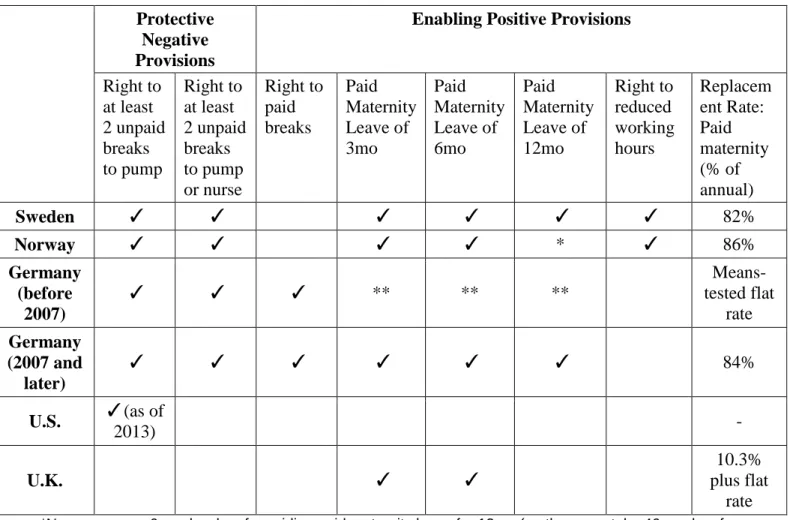
An overview of work policy as it pertains to motherhood is instructive. In the United States, women are not entitled to any paid maternity leave, though employers of full-time salaried women often offer a period of paid leave. The Family and Medical Leave Act of 1993 (FMLA) guarantees many parents in the United States an unpaid job-protected leave of 12 weeks; however, only those who are employed full-time by public agencies or private companies with at least 50 employees, and who have worked for the employer for twelve months are
eligible for the leave.12 Murtaugh et al. calculate that, as of 2000, only 56.3% of privately employed women with children aged 18 months or younger were entitled to FMLA leave time (2011, 219).
11
For an in-depth discussion of pumping versus breastfeeding, see chapter 3.
12
26
In 2010, the Patient Protection and Affordable Care Act (ACA) Section 4207 “Reasonable Break Time for Nursing Mothers” established a statutory right for some
breastfeeding mothers to unpaid breaks “each time such employee has need to express the milk” until the child is one year old.13 It does not quantify the amount of time that must be allowed for this purpose. Similar to the eligibility requirement for the FMLA, this statutory right to breaks is granted to non-exempt workers of companies with more than 50 employees. Interestingly, this law as written does not provide protection for women who want to nurse their babies directly rather than to pump, since the requirement refers only to the “express[ion of] breast milk for her nursing child.” Also as of 2010, the tax code was amended to allow women who submit itemized tax deductions to deduct the cost of breast pumping equipment, or to use their tax-advantaged medical savings accounts to pay for breast pumping equipment. Still, these benefits do nothing for the many poor working mothers who cannot come up with the upfront cash to purchase pumping equipment.
What are the different challenges faced by breastfeeding workers depending on the type of work they do? Gendered occupational segregation in the United States remains stark: 87% of primary school teachers in 201214 and 91% of nurses in 201115 were women (see also Charles and Grusky 2004). While these traditionally female jobs ultimately restrict women’s financial security (through limited earning capacity and restricted career advancement),16 schedules are
13
Patient Protection and Affordable Care Act, Pub.L. 111–148, 124 Stat. 119-1025 (2010) at 459.
14
World Bank 2014.
15
U.S. Census Bureau 2013.
16
27
often more compatible with children’s school hours, established part-time tracks are more available, and family leave is often more easily accommodated. These jobs have historically secured for women “dependable amounts of time for family life” (Williams 2000, 82).
But the expectations for these jobs were solidified in the post-war years during
historically low levels of breastfeeding and are particularly difficult for breastfeeding workers. The work realities of both teachers and nurses, for example, are unaccommodating of the needs of breastfeeding workers: a teacher cannot leave her class unattended to go pump milk, and there are no places for her to do so; a nurse cannot leave her patients unattended. The break time requirements of the ACA do not apply to teachers or nurses if they are salaried (exempt). The ability to pump at work is currently contingent upon workers not being solely responsible for the care of others—on the worker’s ability to be an unencumbered individual. Many traditionally female jobs, which have an element of care, do not allow workers this flexibility. The increase in the number of women who breastfeed is changing the established wisdom about which jobs are “family-friendly”—today, breastfeeding workers may be better accommodated in a traditionally male office job (with their norms of workers as unencumbered individuals) than they are in traditionally female jobs.
Making workplaces friendly to breastfeeding mothers is difficult in part because managers and bosses, more likely to be older and male,17 may be less likely to understand and empathize with their needs.18 Chow and Olson (2008) find that most managers do not know if a company policy on breastfeeding exists and that they have mixed feelings on the need for such a
17
95% of Fortune 500 CEOs, 83% of Fortune 500 board members, and 78% of all senior managers are men (Parker, Horowitz, and Rohal 2015).
18
28
policy. Leaving the negotiation of breastfeeding to individual women and their bosses therefore invites conflict and ensures some women will be unsuccessful, requiring that they choose between breastfeeding and work.
Quitting breastfeeding upon returning to work brings women the relief of not fighting against the status quo of the ideal-worker norm; a mother who decides to give up rather than fight a male manager who does not understand her needs and a workplace environment that is not designed around her needs is choosing not to oppose the “built-in headwinds” that
discriminate against women at work .19
A final note about the realities of breastfeeding in the United States today: single
mothers, low-income mothers, and mothers of color are much less likely to breastfeed than their more privileged counterparts (Best Start 2014, CDC 2004). The culture of breastfeeding is, indeed, a powerful story of intersectionality. The position of marginalized mothers today is one in which they often must choose between financial security and the ability to breastfeed. This is a tremendously vulnerable position.20 They are, therefore, in dire need of welfare state protection.
Consider a low-income mother in hourly work. She may be unable to take regular breaks to pump milk, and it is also likely that there is not a clean and private place for her to pump or to store her milk. She might try to run to her car (if she has one) or to a restroom to express milk when she has a chance, but a busy, physically demanding, or mobile work environment might make it impossible to get away. She might try to continue breastfeeding even though the
19
See Williams 2000, 38; Griggs v. Duke Power Co., 401 U.S. 424 (1971).
20
29
conditions are less than ideal, but failure to find time to pump milk might cause her to develop clogged milk ducts or mastitis, a serious infection which would cause her to miss work. If she does not get sick, failure to pump will cause her to lose her milk supply. Unless she has a rare employer who is sympathetic and understands the needs of breastfeeding mothers, she is unlikely to continue breastfeeding after returning to work.
Moreover, low-income mothers are informed about the benefits of breastfeeding; a 2000 study by Guttman and Zimmerman found that 72.4% of low-income mothers who formula fed believed that breastfeeding provides “a lot” of benefits for infants and 56.4% believed that breastfeeding prevents the infant from illness (2000, 1462). One mother explained, “If I could, I would, but it seems impossible” (1466). So it is not true that low-income mothers do not
understand the benefits of breastfeeding; rather, the constraints in their lives prevent them from acting on that knowledge.
The current system, which leaves the reconciliation of work and breastfeeding to individual mothers, does not respect the dignity of mothers. Their fundamental human capabilities, including the capability of breastfeeding, are not being met.
Part 2: The Gendered Welfare State and the Politics of Sex-Specific Policies
The welfare state regimes that developed after World War II were designed to allow a male breadwinner with a stay-at-home wife to achieve a family wage with benefits that would support his family (Esping-Andersen 1990, Orloff 1993, Huber and Stephens 2001). The
traditional family of the post-war welfare state ideal has largely disappeared; in the United States in 2013, 61% of mothers with children under the age of three were in paid work.21 The post-war welfare state is no longer viable because of four major changes: slowdown in economic growth
21
30
due to the shift from manufacturing to service economy, expansion of government commitments and welfare state maturation, demographic change, and the transformation of household
structures (Pierson 2001, 83).
Each of these changes has gendered elements. The shift from manufacturing (a
traditionally male industry) to service (a traditionally female industry) coincided with an increase of female labor force participation, and even today most service jobs are occupied by women (Charles and Grusky 2004). The expansion of government welfare commitments is partly caused by demographic changes; as the populations age (creating higher healthcare and pension
expenditures) and fertility rates fall (decreasing the amount that is paid into the system), the fiscal pressure on the welfare state has increased. It is clear that these factors are closely linked to increased female labor force participation and the subsequent decrease in fertility. In most
countries, the decrease in fertility rates has followed on the heels of increased labor force participation for women. As Pierson observes, “these changes have generated an intense
perception of mismatch between the needs of new households and the capabilities of old welfare state structures” (2001, 98). As such, the “old” welfare state model (the male-breadwinner model) is unable to respond to new social needs. Esping-Andersen thus argues that “a rewritten gender contract is an indispensable ingredient in any credible post-industrial welfare formula” (2002: 66). A welfare state that is viable in the long term requires a new understanding of gender and gender roles.
31
countries the United States is at the low end of female labor force participation. Moreover, as women’s educational achievement is consistently outperforming that of men,22 there is also productivity to be gained from women’s participation in a labor force that allows them to contribute on equal terms with men. Currently, women (especially mothers) are often forced to work in jobs that are below their ability or skill level because they cannot put in the hours required by these male-patterned jobs. For these reasons, Esping-Andersen notes that “women-friendly policy is, simultaneously, family- and society-“women-friendly” (2002: 94).
There is a broad consensus in the welfare state literature on what women-friendly policy is. It includes affordable day care and early childhood education (including good treatment of care workers), paid maternity and parental leave (including male take-up incentives), and provision for work absence when children are ill (Esping-Andersen 2002: 94; see also Morgan 2006: 13, Sainsbury 1999: 246, Orloff 1993: 322, Nelson and Stephens 2008: 8). It also requires provisions guaranteeing the right to and availability of part-time work (Gornick and Meyers 2003: 62-3), and an abandonment or rethinking of employment protection and social security payroll taxes, which are negatively correlated with female labor market participation (Nelson and Stephens 2008: 8). The new gender contract should also include general protections for (male and female) workers (some argue for overtime protection and workweek limits) (Gornick and Meyers 2003: 13), and unemployment compensation (Nelson and Stephens 2008: 8). Welfare states must abandon the goal of securing a “family wage,” instead accepting and embracing a
22
32
new gender contract in which women (and therefore mothers) work. Facilitating this new arrangement, they argue, is of fundamental importance to the credibility of the welfare state formula.
Williams (2000) argues convincingly that one reason many attempts to achieve equality in labor force participation and economic parity between women and men have failed is that these policies systematically underestimate care—that is, they underestimate the extent to which parents value the quality of their children’s upbringing.23 Generally, parents will not opt for work schedules in which childcare arrangements mean that the parents will never see their children awake; instead, mothers (much more rarely, fathers) choose to leave their jobs or to transition into more precarious part-time or mommy-track work. 24 Williams calls this the “norm of parental care,” or sometimes a “nondelegation doctrine.”
We are willing to give up a lot to achieve healthy, well-adjusted, secure, successful children; often we do. In the face of our dreams for our children, marginalization at work often seems a price worth paying, even if it may lead to disappointments or to economic vulnerability later in life. All this suggests that it is time to acknowledge the norm of parental care. Let me say loud and clear that this is not the same as saying that children need full-time mothercare….Note that the norm of parental care is not a simple carryover but a transmutation of domesticity’s norm of mothercare into a norm applicable to all parents regardless of the shape of their genitals. (Williams 2000, 52, 199)
23
To feminists who balk at this statement, Williams points out that many feminist mothers act on the norm of parental care in their own families. “I know radical lesbians who are dead set against the existence of marriage but who embrace as uncontroversial the view that children often need their parents in ways that can interfere with full-time market work. Feminists need to stop attacking ideals they act upon in their own lives” (2000, 200).
24
33
Breastfeeding fits well into this concept of the norm of parental care. Many women, for a wide variety of reasons, value giving their young children nutrition through breast milk and comfort through nursing. This is not a task they are willing to delegate to formula-feeding. As with childcare, our policies must acknowledge this non-delegation doctrine that exists for many women. If social policies fail to take into account the norm of parental care, we can expect that one parent (usually the mother) will act against her economic interests to stay home with her children, perpetuating the gender inequality of the current system.
The universal-breadwinner strategy, then, in which women and men alike attempt to fulfill the ideal-worker role, does not work for mothers. Welfare states should abandon policies that are based on universal-breadwinner presumptions (Esping-Anderson 2002, Sainsbury 1999, Williams 2000, Gornick and Meyers 2003 and 2008; Fraser 1994).
If the first liability of the [universal-breadwinner] model is its devaluation of family work, the second is its denial that structural changes are necessary in order for women to reach equality. Women’s entrance into the workforce without changes to either the structure of market work or the gendered allocation of family work means that women with full-time jobs work much longer hours than women at home,…[because] men would not give up their traditional entitlement to women’s household work (Williams 2000, 47, 46)
And because it does not consider the norm of parental care, the universal-breadwinner strategy has also, simply, failed at its own goal of drawing female workers into the formal labor market to the same extent as male workers. While female labor force participation of mothers rose steadily from the mid-1970s to the mid-1990s, it has been stagnant in recent years (U.S. Bureau of Labor Statistics 2009). The universal-breadwinner strategy is bad for women, families, and children.
34
to enable employment” (263). The caregiver-parity model is an improvement for women because it recognizes the value of the care work that they (mostly) provide. On the other hand, the
caregiver-parity policies of care allowances or care credits in social-insurance schemes do not take sufficient care for women’s long-term prospects: mothers are still in a disadvantaged position because of lower lifetime earning potential and difficulty reentering the labor force (Sainsbury 1999, 264, see also Fraser 1994). Because of this, caregiver-parity models fail at their goal of gender equality; indeed, “Neither universal breadwinner nor caregiver parity can actually make good on its promise of gender equity—even under very favorable conditions. Although both are good at preventing women's poverty and exploitation, both are only fair at redressing inequality of respect” (Fraser 1994, 610).
Equality-promoting welfare models25 hold much more promise for achieving gender equality and provide better economic protection to mothers (Okin 1989; Fraser 1994; Sainsbury 1999; Williams 2000; Esping-Anderson 2002; Gornick and Meyers 2003 and 2008).26 Instead of glossing over the needs of dependent family members like the universal-breadwinner model, the equality-promoting model acknowledges the norm of parental care and demands the dismantling of the ideal-worker norm. Instead of continuing the life-long marginalization and economic vulnerability of women like the caregiver-parity model, the equality-promoting model allows both men and women to maintain a (reasonable) attachment to paid work throughout the course of their lives, including through various stages of caregiving that are demanding of time.
25
Some scholars (Sainsbury 1999, Gornick and Meyers 2003, 2008) refer to this model as “dual-earner—dual-carer,” but I elect to use the “equality-promoting” language (Brighouse and Wright 2008, Ghaeus and Robeyns 2011) as it is more inclusive of non-traditional families.
26
35
The equality-promoting model entails a radical change: the feminization of male behavior. As Nancy Fraser argues, “The key to achieving gender equity in a postindustral welfare state, then, is to make women's current life patterns the norm” (1994: 611). There is an upper limit, Esping-Andersen rightly observes, to “female life course ‘masculinization’”—to how much women can become like men (2002: 93). “The pursuit of gender equality,” he therefore concludes, “will necessitate a substantial alteration of the male incentive structure” (2002: 93). So long as women’s potential income lags behind men’s, it is rational for each household to “adopt unequal specialization strategies” in which men do the paid work and women do the unpaid domestic work. The only way to get out of this situation is to change the institutions such that each household can act in an economically rational way while also allowing women to work outside of the home.
The goal here, say Gornick and Meyers, is that men and women “halve it all”—splitting paid work and unpaid work equally (2003: 85). This means men will take on more unpaid work and less paid work, and women will take on more paid work and less unpaid work. It is perhaps indicative of how gender inegalitarian our current society is that this ideal is almost
36
guaranteeing full wage compensation with no upper ceiling during parental leaves,
nontransferable father-only leave, provision for high-quality child care and early education, ensuring access to part-time work, regulation of working time, and changes in early childhood education and school scheduling (to match parents’ working hours).
What these changes amount to is a large-scale dismantling of the ideal-worker norm. Under the male- or universal-breadwinner norm, mothers are unable to act as ideal workers; they cannot put in overtime, they cannot handle unpredictable schedules, they cannot go to the bar after work for informal meetings where decisions are often made. What is important to point out, though, is that ideal-worker norms disadvantage involved fathers as much as they disadvantage mothers. Dismantling the ideal-worker norm helps fathers and mothers alike.
An equality-promoting model is explicitly associated with a degendering of roles. When Gornick and Meyers argue for the dual-earner—dual-carer ideal, they are pointing out that there is a more equitable distribution of tasks and that fathers and mothers each need to change their behavior to reach this ideal.
Parenting would be degendered; fathers and mothers would share responsibility for earning and caregiving symmetrically, with support from both employers and society more broadly. (Gornick and Meyers 2003, 12)
But, unless they are arguing for artificial reproduction (which they are not), sex-based
differences will continue to affect parenting. Breastfeeding and other biologically determined activities like pregnancy and childbirth simply are sex-based, even in a degendered family. While Esping-Anderson points out that there is an upper limit to female life course
37
to share the work of pregnancy or breastfeeding.27 To want to pursue both a society in which women can breastfeed their babies and work and care are split equally between the sexes requires a more nuanced and complex approach in which men would actually have to take on more of the non-breastfeeding responsibilities in order to balance women’s breastfeeding. The relevant question is, then, how can feminists argue for an equality-promoting model while simultaneously supporting special treatment of mothers?
The demand for an equal parental split of work and care and the demand for the
feminization of male lives (really, for a convergence of male and female behavior) make sense in the context of concern for the viability of the welfare state model and concern for gender
equality. It is true that men must take on more traditionally female tasks, like child care, and refuse traditionally male expectations, like working long overtime hours, if the goal of gender equality is to be met. But these demands have an unintended effect: while gender-neutral “family-friendly” policies are emphasized (such as parental leave), maternal-specific “woman-friendly” policies are not. “Special” treatment for women is seen as unwise for two reasons: it has the potential to disadvantage all women workers (because hiring a woman means taking on an increased level of liability, and because it can weaken women’s overall labor force
participation and economic stability) and it can operate as a deterrent from men taking on their full share of parental duties. So while it seems important to advocate for parental leave (and for father-only leave, insofar as fathers need take-up incentives to take their entitled leave), it seems dangerous to advocate for “maternity” leave—even though maternity leave is important both as a
27
38
time to recover from childbirth and also as a period in which to establish breastfeeding. Women-friendly policies that can be framed in gender-neutral language—access to part time work, equal pay, child care—are rhetorically easy to advocate for. But breastfeeding is a casualty of the gender-neutral paradigm because it cannot be framed in gender-neutral language.28 Not all policies should, or can, be framed in gender-neutral language; sex-specific policies have a place, even if the ultimate goal is degendered parenting. Policy makers need to tackle, rather than shy away from, issues like these that spark special treatment/equality debates.29
For this reason, the literature on gender and the welfare state addresses issues related to motherhood and to work-family balance, including such issues as parental leave, paid sick time, access to part-time work, and availability of child-care, but it almost never addresses the special difficulties faced by breastfeeding workers. Breastfeeding is never mentioned by
Esping-Andersen, Sainsbury, Williams, or Morgan in their discussions of the needs of working mothers. Because breastfeeding is a biologically linked caregiving activity that cannot be shared with men and because it can be a long-term relationship (childbirth lasts a day or two, pregnancy last nine months, breastfeeding is recommended for two years and can last even longer), it is imperative that discussions of women’s ability to navigate work and family include discussions of the needs of breastfeeding workers. Theories of how to dismantle the ideal-worker norm will not be
effective if they do not consider breastfeeding.
For example, as part of their dual-earner—dual-carer ideal, Gornick and Meyers discuss
28
Compare with the Indiana Guidelines for child custody presented on page 114; these guidelines support breastfeeding mothers and babies in a gender-neutral manner that never mentions breastfeeding explicitly.
29
39
ways to encourage a more egalitarian division of parental leave provision. They rightly point out that the fact that women take the vast majority of parental leave time may contribute to gender inequality. “If parental leave is taken up mostly or exclusively by women,” say Gornick and Meyers, leave will “weaken women’s labor force attachment and exacerbate gender inequalities at home and in the workplace” (Gornick and Meyers 2008, 133). Likewise, Sainsbury argues that the earner-carer strategy requires that “each parent would be entitled to equal periods of leave to care for a child” (1999, 265). Though it is imperative to consider the ways in which the structure of parental leave weakens women’s labor force participation, must the ideal situation be one in which men and women split parental leave time equally? After all, if women are taking more leave in order to facilitate their breastfeeding relationship, this should not be seen as evidence of inequality. Similarly, the special considerations of breastfeeding and the fact that many women hope to breastfeed for at least one year call into question Gornick and Meyers’s assertion that per-parent paid leave time must be capped at six months, especially absent other protections for breastfeeding mothers who are back to work outside of the home, in which case maternity leave acts as a practical safety net for breastfeeding (2008, 325). Though Gornick and Meyers note that employment arrangements should not limit a woman’s ability to breastfeed, 30 they do not fully consider all of the ways in which that ability might be limited.
In the very few cases in which welfare state theorists do mention breastfeeding, it is generally approached in the manner of Gornick and Meyers—that breastfeeding must be allowed, but shouldn’t work against goals of gender equality. Gheaus and Robeyns write in a footnote, “The choice to breastfeed introduces a bias in having the mother do the hands-on care
30