https://doi.org/10.5194/wes-3-545-2018
© Author(s) 2018. This work is distributed under the Creative Commons Attribution 4.0 License.
Dynamic inflow effects in measurements
and high-fidelity computations
Georg Raimund Pirrung and Helge Aagaard Madsen
Wind Energy Department, Technical University of Denmark, Frederiksborgvej 399, 4000 Roskilde, Denmark
Correspondence:Georg Raimund Pirrung ([email protected])
Received: 10 January 2018 – Discussion started: 18 January 2018 Revised: 26 July 2018 – Accepted: 6 August 2018 – Published: 22 August 2018
Abstract. A wind turbine experiences an overshoot in loading after, for example, a collective step change in pitch angle. This overshoot occurs because the wind turbine wake does not immediately reach its new equi-librium, an effect usually referred to as dynamic inflow. Vortex cylinder models and actuator disc simulations predict that the time constants of this dynamic inflow effect should decrease significantly towards the blade tip. As part of the NASA Ames Phase VI experiment, pitch steps have been performed on a turbine in controlled conditions in the wind tunnel. The measured aerodynamic forces from these experiments seemed to show much less radial dependency of the dynamic inflow time constants than expected when pitching towards low loading. Moreover the dynamic inflow effect seemed fundamentally different when pitching from low to high loading, and the reason for this behavior remained unclear in previous analyses of the experiment. High-fidelity compu-tational fluid dynamics and free-wake vortex code computations yielded the same behavior as the experiments. In the present work these observations from the experiments and high-fidelity computations are explained based on a simple vortex cylinder wake model.
1 Introduction
Models based on blade element momentum (BEM) theory are commonly used in aeroelastic wind turbine codes. Blade element momentum theory describes how the forces acting on the wind slow down its velocity at the rotor disc by super-imposing a so-called induced velocity on the free wind speed. The induced velocity depends on the loading of the wind tur-bine rotor. When the rotor loading changes, for example due to a change in pitch angle, the induced velocity does not im-mediately reach a new equilibrium value but instead slowly approaches it. Because BEM theory only predicts the steady-state induction, dynamic inflow submodels are added to ac-count for the delays in the induction response. The time con-stants of these models can be based on analytic derivations, results of higher-fidelity models or measurements. Schepers (2007) compared analytically derived time constants for dy-namic inflow with time constants derived from experimental data from the NASA Ames Phase VI measurements (Hand et al., 2001) and numerical results from the free-wake vortex code AWSM (van Garrel, 2003). This comparison showed
that the free-wake code could predict the dynamic variations in the turbine loading measured in the wind tunnel with high accuracy. The analytical vortex cylinder model, on the other hand, predicted a strong dependency of the time constants on the radial position on the blade. Neither the experiment nor the free-wake code results confirmed this predicted radial de-pendency. Investigating this disagreement was suggested as future research by Schepers (2012).
con-stants with the wake velocity. The time concon-stants have been obtained from actuator disc simulations.
More recently, Boorsma et al. (2016) compared results from the AWSM code with dynamic inflow measurements from the New Mexico experiment (Boorsma and Schepers, 2018). While the comparison is promising, the force over-shoots are not as pronounced as in the Phase VI experiments due to the lower pitching rate relative to the rotor speed. A recent PhD thesis by Yu (2018) contains both experimental and numerical investigations of dynamic inflow effects. The experimental investigations use discs with varying porosity (Yu et al., 2017), and the numerical model consists of un-steady vortex rings for the near wake and a vortex cylinder model for the far wake (Yu et al., 2016).
In the following section, the NASA Ames experiment and the previous analyses by Schepers and Sørensen and Madsen are presented in more detail. Then, a simple vortex cylinder model is introduced in Sect. 3. In Sect. 4 results from that model are used to explain the seemingly conflicting findings in previous work.
2 Previous analysis of NASA Ames experiments
In the NREL/NASA Ames Phase VI Experiments by Hand et al. (2001), a two-bladed wind turbine with 10 m diame-ter was placed in the NASA Ames open-loop wind tunnel. One of the turbine blades was instrumented at 30 %, 47 %, 63 %, 80 % and 95 % (corresponding to radii of 1.510, 2.343, 3.185, 4.023 and 4.780 m) with 22 pressure taps at each lo-cation. A large number of experiments in both parked and rotating conditions have been performed. The basis for the dynamic inflow investigations in Schepers (2007) are pitch step experiments at 5 m s−1wind tunnel speed and at a rotor speed of 72 rpm. In the relevant run, denoted asQ0500000in Hand et al. (2001), 20 pitch steps between−5.9◦pitch (heav-ily loaded rotor, induction factor a≈0.5) and 10.02◦pitch (unloaded rotor,a≈0) have been performed. The maximum pitch rate was roughly 66◦s−1. This pitch rate corresponds to 6.6◦s−1for a turbine with 100 m diameter because the dy-namic inflow time constants are inversely proportional to the rotor radius (Sørensen and Madsen, 2006). After each pitch step, a 15 s waiting time ensured that the flow conditions can reach an equilibrium. The previous analyses, as well as the present work, are based on the force response obtained by averaging the responses to the 20 pitch steps.
The measurement at 5 m s−1 exhibits prominent aerody-namic force overshoots that are characteristic for dyaerody-namic inflow. The dynamic response of the axial force after the up-ward and downup-ward pitch steps is shown in Fig. 1a and b, respectively. Note that upward pitching refers to the deload-ing of the rotor and downward pitchdeload-ing to the loaddeload-ing of the rotor. This is based on the convention that the pitch angle is positive towards lower angles of attack. The force is scaled such that the overshoot after the pitch step is 1 and that the
steady-state force some time after the pitch step is 0:
Fscaled=(F−F2)/(Fm−F2), (1)
whereF is the axial force,F2the equilibrium value of the force some time after the pitch step, andFmthe maximum or minimum force overshoot reached during the pitch step, depending on the pitching direction.
Some dynamics in the downward pitching step at the 80 % radial station and to a much smaller extent at the 63 % radial station appeared before the pitching was finished at roughly 0.35 s. The maximum value at the 80 % section has been in-creased to 1.2; see Fig. 1b. This was not necessary for the 63 % station because the maximum force overshoot at that station coincided with the remaining stations on the blade. The force response has been previously analyzed by Schep-ers (2007) and Sørensen and Madsen (2006). This previous work will be introduced in the following.
2.1 Single time constant analysis by Schepers
In the work by Schepers (2007) it was assumed that the be-havior of the induction factorain time can be modeled using one first-order low-pass filter. For a step change in pitch, the induction factor as a function of time is assumed to be:
a(t)=a2−(a2−a1)e−(t−t1)/τ, (2)
wherea1 is the induction factor att1, before the pitch step, anda2is the equilibrium value of the induction some time after the pitch step. The time constant is defined asτ. It is then assumed that the forces are driven only by the change in axial induction factor, neglecting the faster 2-D unsteady airfoil aerodynamics effects. This leads to an expression for the blade loadsF:
F(t)=F2−(F2−F1)e−(t−t1)/τ, (3)
whereF1andF2are the forces corresponding to the induc-tion factorsa1anda2defined above. The time constantτcan be determined as
τ(t)= t−t1
ln((F2−F(t))/(F2−F1))
. (4)
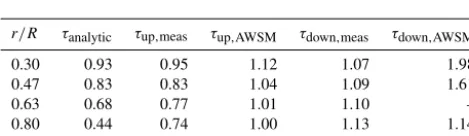
To avoid the initial overshoot and structural transients, this time constant was averaged between 0.7 and 3.7 s after the pitch step in Schepers (2007) for measurements (see Fig. 1) and free-wake code computations using the code AWSM (van Garrel, 2003). The computed time constants were then compared to the time constants obtained from a cylindrical wake model; see Sect. 3. This comparison is shown in Ta-ble 1. Comparing the time constants in the taTa-ble leads to sev-eral observations:
0 0.5 1 1.5 2 2.5 Time [s]
0 0.2 0.4 0.6 0.8 1 1.2
Scaled axial force [-]
30 % 47 % 63 % 80 % 95 %
0 0.5 1 1.5 2 2.5
Time [s] 0
0.2 0.4 0.6 0.8 1 1.2
Scaled axial force [-]
30 % 47 % 63 % 80 % 95 %
(a) (b)
Figure 1.Scaled axial force measurements from the Phase VI experiment at 5 m s−1. The pitch steps are deloading the rotor (induction factor froma=0.5 toa=0.0,a) and loading the rotor (a=0.0 toa=0.5,b).
Table 1.Time constants (in seconds) from measurements, AWSM calculations and a cylindrical wake model from Schepers (2007). The forces predicted by AWSM at the 63 % radial station for the downward pitching step did not exhibit clear exponential behavior, and therefore no time constant could be estimated.
r/R τanalytic τup,meas τup,AWSM τdown,meas τdown,AWSM
0.30 0.93 0.95 1.12 1.07 1.98
0.47 0.83 0.83 1.04 1.09 1.61
0.63 0.68 0.77 1.01 1.10 –
0.80 0.44 0.74 1.00 1.13 1.14
0.95 0.14 0.78 1.03 1.53 2.36
2. While the analytically derived time constants predict that the induction develops the fastest at the 95 % sec-tion, this cannot be seen in the measurements or AWSM computations. In the downward pitching case, the tip time constants are even found to be largest at the blade tip.
3. The analytic time constants, which are based on the undisturbed inflow speed, are independent of the pitch-ing direction, but there is considerable influence of the pitching direction on the dynamics seen in the measure-ments (Fig. 1) and free-wake computations.
2.2 Analysis of two time constants by Sørensen and Madsen
The NASA Ames Phase VI dynamic inflow measurements were also analyzed by Sørensen and Madsen (2006). In their work the results were compared to full rotor CFD computa-tions obtained from the EllipSys code (Sørensen, 1995) and BEM computations with a dynamic inflow model. The dy-namic inflow model consists of two time constants, where the fast time constant is radially varying and the slow time con-stant has much slower radial variation. These time concon-stants
were obtained from actuator disc simulations, and they are scaled with the wake velocityvw:
eτ=τ
vw
R, where vw=v∞(1−1.5a). (5)
In the above equation,v∞ is the undisturbed inflow speed andRis the wind turbine radius. The same scaling is applied to both the fast and the slow time constant.
The CFD computations agree well with the measurements showing a small radial variation in the time constants in gen-eral. In the CFD computations of the downward pitch step, loading the rotor, it was found that the tip forces seem to de-velop the slowest.
In a range of additional pitch step cases with a much smaller pitch angle variation computed by the CFD code, the radial variation in the dynamic inflow time constants also ap-peared to be much less pronounced than in the actuator disc simulations.
3 Induction due to cylindrical wake
The engineering model that predicts the strong radial depen-dency of the time constants in Schepers (2007) is based on an analytical cylindrical vortex wake model. In this model, which has been presented by Snel and Schepers (1995), a semi-infinite cylindrical vortex is trailed from the tip radius at the rotor disc. Thus it is assumed that the rotor has an in-finite number of blades with a radially constant bound circu-lation, and the root vortex is neglected. The induction from the trailed vortex cylinder is azimuth independent in the rotor plane but can vary radially. A sketch of the cylindrical wake is shown in Fig. 2.
Figure 2. Sketch of cylindrical wake with radius R and a step change in vortex strength at a distancexfrom the rotor.
ui= R
4π xend
Z
x=0
2π
Z
φ=0
γt(x) [R−rcosφ]
x2+R2+r2−2rRcosφ3/2dφdx, (6)
where x is the stream-wise coordinate, withxend denoting the length of the wake behind the rotor plane, andφ is the azimuthal coordinate. The rotor radius is denoted asR and
γt is the tangential component of the wake vorticity, which induces an axial velocity in the rotor plane.
Previously this model was used to analytically derive the time constant for a step change in circulation at the rotor disc, which is transported downstream with the free-stream veloc-ity. In the present work, the position of the step change is varied and the wake velocityvw(see Eq. 5), is chosen as the downstream convection velocity. Equation (6) is integrated numerically.
3.1 Assumptions
The aim of the vortex cylinder computations presented here is to demonstrate that some of the fundamental questions from the NASA Ames Phase VI experiment and regard-ing dynamic inflow in general can be answered based on a very simple model. Therefore the following assumptions are made, neglecting some aerodynamic effects:
– The vortex strength of the cylindrical vortex wake changes from zero to a constant value att=0.
– Two-dimensional unsteady airfoil aerodynamics and dynamic stall are neglected. To justify this, the force response to a step change in angle of attack has been computed using Jones’ equations for a flat plate and the relative speeds at the disc. Af-ter 0.35 s (corresponding roughly to the pitch step duration), the force response reaches between 90 % (most-inboard section) and 99 % (tip section) of its
0 0.5 1 1.5 2 2.5
x/R [-]
0 0.1 0.2 0.3 0.4 0.5 0.6 0.7 0.8 0.9 1
ui/ui
∞
[-]
0.3 R 0.47 R 0.63 R 0.8 R 0.95 R
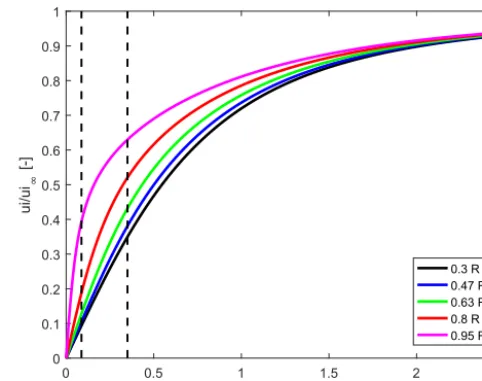
Figure 3.Normalized induced velocity at different radial stations depending on the length of the vortex wake behind the rotor plane. The dashed lines correspond to a time instantt=0.35 s when the wake velocity is 1.25 m s−1(left vertical line, corresponding toa= 0.5) and 5 m s−1(right vertical line, corresponding toa=0.0).
quasi-steady value, showing that this effect is much faster than the dynamic inflow effect.
– Pitching speed is neglected.
– The downwind convection velocity of the trailed vor-tices is constant and equal to the wake velocity before the pitch step as given in Eq. (5). Therefore, the results at a time soon after the pitch step will be accurate, but the error grows over time.
– Wake expansion is neglected, which introduces an error in the heavily loaded case.
Further, in all plots the induced velocitiesui at each radial station are scaled by the valueui,∞they reach if the wake is 10 diameters long.
4 Results from cylindrical wake model
Figure 3 shows the induction as function of the dimension-less length of the cylindrical vortex wake behind the rotor. As written above, a constant downwind convection velocity is assumed in the computations. In the unloaded case (a=0), this velocity isvw=5 m s−1=1R/s. Therefore the dimen-sionless length of the wake in the unloaded case corresponds directly to the time, since the wake length after 1 s is 1 radius (x/R=1). In the loaded case (a=0.5) the wake velocity is 4 times smaller (see Eq. 5); thus, the nondimensional wake length has to be multiplied by a factor of 4 to obtain the time. The induced velocity buildup clearly shows a large radial dependency at the beginning, but for a larger distancex/R >
0 0.5 1 1.5 2 2.5
Time [s]
0 0.2 0.4 0.6 0.8 1
τ
[s]
0.3 R 0.47 R 0.63 R 0.8 R 0.95 R
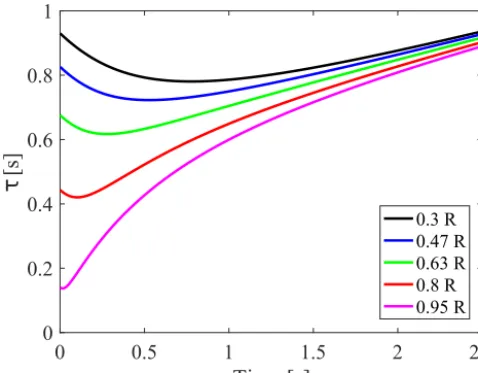
Figure 4.Estimated dynamic inflow time constants at different ra-dial stations depending on the length of the vortex wake behind the rotor plane.
dependency disappears. Then the dynamic induction buildup is similar on the whole disc.
4.1 Single time constant estimation
Based on Eqs. (2)–(4), the estimated time constant of a one-term exponential function can be found as
τ(t)= t−t1
ln((a2−a(t))/(a2−a1))
. (7)
Because the predicted time histories are not equal to one-term exponential functions, the predicted time constants vary with time.
Applying Eq. (7) to the induced velocities shown in Fig. 3 leads to the estimated time constants as a function of the di-mensionless length of the vortex wakes, which are shown in Fig. 4. Atx0/R→0, the time constants predicted by the cylindrical wake model are equal to the analytically derived time constants provided by Schepers (2007); cf. Table 1. As the values ofx0/Rincrease, the estimated time constants be-come less radially dependent because the parts of the wake that are further away from the rotor have a more even in-fluence on the whole rotor plane than the parts close to the rotor. In agreement with the actuator disc computations pre-sented by Sørensen and Madsen (2006), these findings in-dicate that a dynamic inflow model should employ two ex-ponential terms. Then a small time constant can capture the radial dependency, and a larger time constant captures the radially independent behavior on a longer timescale.
In Schepers (2007), the time constants obtained from the aerodynamic forces from measurements and free-wake code results had to be averaged betweent=0.7 andt=3.7 s af-ter the pitching step to avoid the initial force overshoot. The
time constant estimation in Fig. 4 shows how this method leads to moderate radial dependency, which explains some of the disagreements between analytical time constants and time constants estimated from measurements in Table 1.
4.2 Influence of pitching direction
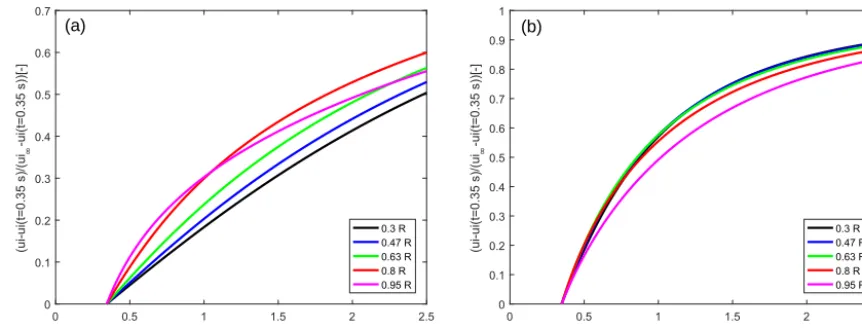
Due to the assumption of a constant wake velocity and trailed vortex strength, the different pitching directions only differ in how the wake length translates to the time after the pitch step, as explained at the beginning of Sect. 4. The force re-sponse decay in the Phase VI measurements can only be eval-uated after the maximum of the force overshoot is reached, which is at roughly 0.35 s; see Fig. 1. This 0.35 s corresponds to a nondimensional wake lengthx/Rof either 0.35 ing from unloaded to loaded conditions) or 0.0875 (pitch-ing from loaded to unloaded conditions), as indicated by the dashed lines in Fig. 3. To see what influence this de-layed evaluation has, the induced velocity has been rescaled such that the value at 0.35 s corresponds to 0 and the value at steady state to 1. These rescaled induced velocities are shown in Fig. 5. For the pitch step starting in loaded con-ditions (panel a) a clear radial dependency of the induced velocities is seen, which develops slowly inboard and faster outboard. In panel b, where the rotor is not loaded before the pitch step, the induced velocity seems to develop simi-larly fast for all sections except the tip sections, where the development is slowest. A comparison with the scaled mea-sured force response in Fig. 1 shows the same influence of the pitching direction. This indicates that the dynamic in-flow effect is mainly governed by the downstream convec-tion speed of the tip vortices. Further, the decreased or re-versed radial dependency in the force measurements from the NASA Ames Phase VI experiment does not contradict the ra-dial dependency in the induced velocity time constants that is expected from previous investigations using vortex cylinder models and actuator discs. Instead, the apparent reversal of the radial time constant dependency with pitching direction is observed because the decay of the dynamic forces can only be analyzed some time after the pitch step is completed. At this time, the induced velocity has already developed consid-erably, which has a large influence on the size of the over-shoot. This initial induced velocity development is missed when estimating time constants on the scaled time history of the forces.
0 0.5 1 1.5 2 2.5 Time [s]
0 0.1 0.2 0.3 0.4 0.5 0.6 0.7
(ui-ui(t=0.35
s)/(ui
-ui(t=0.35
s))
[-]
∞
0.3 R 0.47 R 0.63 R 0.8 R 0.95 R
0 0.5 1 1.5 2 2.5
Time [s] 0
0.1 0.2 0.3 0.4 0.5 0.6 0.7 0.8 0.9 1
(ui-ui(t=0.35
s)/(ui
-ui(t=0.35
s))
[-]
∞
0.3 R 0.47 R 0.63 R 0.8 R 0.95 R
(a) (b)
Figure 5.Scaled induced velocities predicted by the cylindrical wake model for the deloading(a)and loading(b)of the rotor. The scaling is such that the velocities range from 0 at the time instant just after the maximum force overshoot (indicated by dashed vertical lines in Fig. 3) to 1. The scaled induced velocities show the same qualitative trends as observed in the force measurements; see Fig. 1.
While the approach for loads with respect to the rotor-plane coordinate system such as distributed driving force or thrust is straightforward, a com-parison of aerodynamic characteristics is more challenging.
They present a promising methodology for extracting the unsteady induced velocities that can capture the increasing induction towards the blade tip.
The induced velocities at the blades or at an actuator disc are directly available in vortex codes. Yu (2018) has devel-oped an engineering dynamic inflow model based on results from a combined unsteady vortex ring and vortex cylinder model. The behavior of the unsteady cases investigated in Yu’s thesis was such that the increasing load case reacted slower than the decreasing load case. This appears to con-tradict the results from the Phase VI measurements at first glance, but the cases were fundamentally different: the in-creasing load case is defined as moving from middle to high loading and the decreasing load case from middle to low loading. Thus, the average wake velocity is lower in the in-creasing load case, leading to a slower dynamic inflow re-sponse. In the Phase VI experiments, the pitch steps change the load from low to high and high to low. Then the wake velocity before the pitching step governs the immediate dy-namic inflow response and the case with increasing load re-sponds faster. Also, Yu was able to study the effects of a rollup of the vortex rings, which would not be possible with the simple model used in the present work. This shows the importance of using higher-fidelity models for more detailed investigations.
5 Conclusions
A simple vortex wake model has been used to investigate the question why neither the unsteady NASA Ames Phase VI
experiments nor the corresponding high-fidelity simulations showed the expected radial dependency of the dynamic in-flow time constants. Results from the model show that the dynamic inflow response initially exhibits a strong radial de-pendency, but a short time after the step change in loading, the time constants for the different stations become similar, suggesting that two time constants are necessary for accurate modeling of dynamic inflow effects. When using the force response as a basis for time constant investigations, time con-stants can only be analyzed shortly after the pitch step when the forces start decaying from the maximum overshoot. This delayed analysis obscures some of the fast induction devel-opment and can lead to an apparent decreased or even re-versed radial dependency.
This indicates that it is difficult to obtain time constants for dynamic inflow models based only on the force time series from measurements, CFD or free-wake vortex code simula-tions of a wind turbine. These force measurements and com-putations, though, have a large value in validating the aero-dynamic force predictions from engineering models. Com-puting unsteady induced velocities from CFD simulations is an active field of research, and there is still some uncertainty, especially towards the blade root and tip. Free-wake vortex codes, on the other hand, could be used more easily to inves-tigate dynamic inflow effects and to tune engineering models because the induced velocity is directly available from the computations.
Author contributions. GP wrote the numerical code. GP and HM interpreted the results. GP wrote the manuscript with support from HM. GP and HM collaborated on the revisions.
Competing interests. The authors declare that they have no con-flict of interest.
Acknowledgements. The work has been carried out within the project “Dansk deltagelse i IEA Wind Task 29 Mexnext III” granted by the Danish funding agency EUDP, grant journal no. 64014-0543.
Edited by: Raúl Bayoán Cal
Reviewed by: two anonymous referees
References
Boorsma, K. and Schepers, J. G.: New Mexico Experiment, De-scription of experimental setup, Tech. Rep. ECN-X–15-093 (v3), ECN, 2018.
Boorsma, K., Hartvelt, M., and Orsi, L.: Application of the lift-ing line vortex wake method to dynamic load case simula-tions, J. Phys. Conf. Ser., 753, 2, https://doi.org/10.1088/1742-6596/753/2/022030, 2016.
Hand, M., Simms, D., Fingersh, L., Jager, D., Cotrell, J., Schreck, S., and Larwood, S.: Unsteady aerodynamics experiment phase VI: wind tunnel test configurations and available data campaigns, NREL/TP-500-29955, National Renewable Energy Laboratory Golden, Colorado, USA, 2001.
Jost, E., Klein, L., Leipprand, H., Lutz, T., and Krämer, E.: Ex-tracting the angle of attack on rotor blades from CFD sim-ulations, Wind Energy, https://doi.org/10.1002/we.2196, online first, 2018.
Pirrung, G. R.: Aerodynamics code used in Wind Energy Science paper “Dynamic inflow effects in measurements and high-fidelity computations”, https://doi.org/10.5281/zenodo.1346717, 2018.
Rahimi, H., Schepers, J. G., Shen, W. Z., Ramos García, N., Schneider, M., Micallef, D., Ferreira, C., Jost, E., Klein, L., and Herréz, I.: Evaluation of different methods for determin-ing the angle of attack on wind turbine blades with CFD re-sults under axial inflow conditions, Renew. Energ., 125, 866– 876, https://doi.org/10.1016/j.renene.2018.03.018, 2018. Schepers, J. G.: IEA Wind Task XX: Dynamic Inflow effects at fast
pitching steps on a wind turbine placed in the NASA-Ames wind tunnel, ECN-E-07-085, 2007.
Schepers, J. G.: Engineering models in wind energy aerodynam-ics: Development, implementation and analysis using dedicated aerodynamic measurements, TU Delft, Delft University of Tech-nology, PhD thesis ISBN 9789461915078, 2012.
Snel, H. and Schepers, J. G.: Joint investigation of dynamic inflow effects and implementation of an engineering method, Tech. Rep. ECN-C–94-107, ECN, 1995.
Sørensen, N.: General purpose flow solver applied to flow over hills, PhD thesis, published 2003, 1995.
Sørensen, N. N. and Madsen, H. A.: Modelling of transient wind turbine loads during pitch motion, European Wind Energy Asso-ciation (EWEA), 2006 European Wind Energy Conference and Exhibition, Athens, Greece, 2006.
van Garrel, A.: Development of a wind turbine aerodynamics sim-ulation module, Tech. Rep. ECN report ECN-C–03-079, ECN, 2003.
Yu, W.: The wake of an unsteady actuator disc, PhD thesis, Delft University of Technology, https://doi.org/10.4233/uuid:0e3a2402-585c-41b1-81cf-a35753076dfc, 2018.
Yu, W., Ferreira, C. S., Kuik, G., and Baldacchino, D.: Verifying the Blade Element Momentum Method in unsteady, radially varied, axisymmetric loading using a vortex ring model, Wind Energy, 20, 269–288, https://doi.org/10.1002/we.2005, 2016.