A
A
L
L
G
G
O
O
R
R
I
I
T
T
H
H
M
M
S
S
A
A
P
P
P
P
L
L
I
I
E
E
D
D
I
I
N
N
F
F
L
L
A
A
M
M
E
E
T
T
E
E
M
M
P
P
E
E
R
R
A
A
T
T
U
U
R
R
E
E
C
C
A
A
L
L
C
C
U
U
L
L
A
A
T
T
I
I
O
O
N
N
Ş
Ş
t
t
e
e
f
f
a
a
n
n
A
A
m
m
a
a
d
d
o
o
G
G
e
e
o
o
r
r
g
g
e
e
,
,
N
N
i
i
s
s
t
t
o
o
r
r
C
C
o
o
n
n
s
s
t
t
a
a
n
n
t
t
i
i
n
n
Military Technical Academy, Bucharest. Romania
ABSTRACT: This paper presents data on hydrocarbon
combustion stoichiometry and algorithms for determining flame temperature. If that does not take into account the dissociative reaction products (CO2, H2O and N2) algorithm allows the calculation of the flame temperature of the heat balance equation. It analyzes the general case of dissociative-products CO2 and H2O. In this case we apply a different algorithm that solve a system of
nonlinear equations with six unknowns , , , , , then apply the first algorithm to determine the flame temperature. When burning natural gas with the initial conditions t0 = 15 C and pressure of the atmosphere resulting tf = 2049.246 C under the same conditions, with consideration of dissociation, tf = 2049.822 C. Algorithms do not use iterative solution of the equation of thermal balance.
KEYWORDS: Stoichiometric combustion, Thermo-dynamics
1. INTRODUCTION
Efficient combustion of gaseous fuels is a major issue which requires attention on burning gaseous fuels in industrial installations in order to achieve a fue l savings as high. How to carry out the combustion process, leading to the achievement of quality products in the various processes.
In the majority of plants which use combustion of fuel gas is used diffusion (diffusion flame), which is characterized in that the mixing between fuel gas and combustion air is carried out just in the area of combustion, two jets (gaseous fuel and air ) are introduced separately into the combustion chamber. In order to obtain diffusion flames, with features allowing various processes to achieve optimal conditions, it is necessary to know the physical, chemical and geometrical characteristics influencing the flame. Knowledge of these factors and how they influence may lead to the development of fire with well-defined characteristics in the different stages of these processes.
Air needed for combustion, as the composition of the combustion products are determined by the equation expressing global fuel oxidation reactions , respecting the principle of conservation of mass for each of the elements of reactants.
If the fuel composition is a hydrocarbon
generated global full oxidation reaction has the form
, (1) where stoichiometric ratios (1, a, b, c) are expressed in moles.
Conservation of mass of carbon is expressed by the condition
b = m,
and hydrogen in the condition .
Conservation of mass requires oxygen provided a = m + n / 4.
Equation (1) takes the form
. (2) Dry atmospheric air contains 20.95% (volume) oxygen, 78.09% nitrogen, 0.93% argon, the other components being considered negligible proportions. The usual calculations that follow define the thermodynamic properties of the reactants and products are neglected and the presence of argon, considering that air consists of 21% (vol.) and oxygen and 79% nitrogen, expressed in moles. For each mole of oxygen is considered
(1 - 0.2095) / 0.2095 = 3.773 mole of nitrogen. The normal calculation is considered that the nitrogen does not participate in the combustion reaction. Therefore, the equation for the complete combustion in the ambient air, hydrocarbon has the form
. (3) 2. FLAME TEMPERATURE CALCULATION
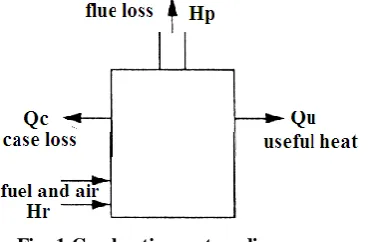
The figure 1 presents the energy balance of the combustion system.
Fig. 1 Combustion system diagram
3. ADIABATIC FLAME TEMPERATURE
The energy balance about the system can be written as:
(4) where
CVFuel – calorific value,
HR- the sensible heat in the air and fuel (is very small and often neglected),
HP - enthalpy of reaction products.
Table 1. Lower and Higher Heating Values of Gas Fuels
Fuels (Gaseous Fuels
and 1 atm)
Lower Heating Values LHV -
Higher Heating Values HHV -
Natural gas 47.141 52.225
Hydrogen 120.21 142l18
Still gas 46.898 50.951
The case loss from the outside of the plant, , is also generally small compared to the other energy fluxes and is similarly often considered negligible. It is assumed that combustion takes place under adiabatic conditions, i.e. no heat transfer is permitted across the boundary of the system.
The implication of this is that ,
and .
Hence equation (4) simplifies down to
. (5)
4. MOLAR ISOBARIC HEAT
It adopts the form isobaric molar heat:
. (6) For the reactants and products the isobaric molar heat depending on temperature, where the measure unit is , are:
- for CH4
, - for O2
,
- for CO2
, - fo r H2 O
, - for N2
, - for CO
, - for OH
, - for H2
. 5. CALCULATION ALGORITHM
A straight forward method for the calculation of adiabatic flame temperature is to execute the following steps:
(1) It evaluates both sides of the equation ;
where HR is the enthalpy sensitive, CV is calorific value and HP is the enthalpy of reaction products,
, ,
(2) solve the equation with unknown Tf
(7)
using Mathcad root function.
6. CASE STUDY. ANALYSIS WITHOUT CONSIDERATION DISSOCIATION REACTION PRODUCTS
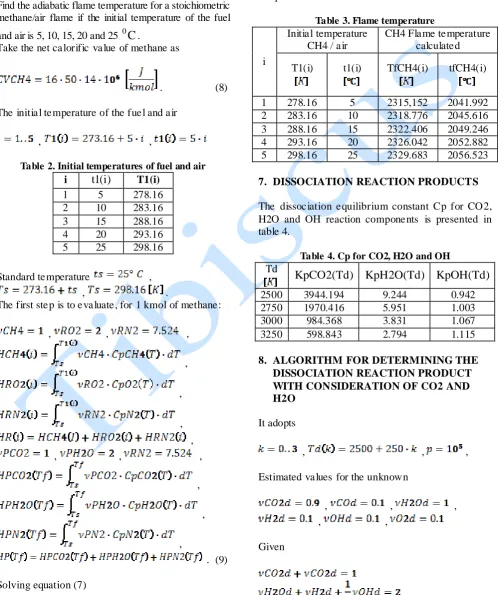
Find the adiabatic flame temperature for a stoichiometric methane/air flame if the initial temperature of the fuel and air is 5, 10, 15, 20 and 25 0
C
.Take the net calorific value of methane as
. (8) The initial temperature of the fuel and air
, ,
Table 2. Initial temperatures of fuel and air
i t1(i) T1(i)
1 5 278.16
2 10 283.16
3 15 288.16
4 20 293.16
5 25 298.16
Standard temperature ,
, .
The first step is to evaluate, for 1 kmol of methane:
, , ,
, , ,
,
, , ,
, , ,
. (9) Solving equation (7)
. (10) The calculated CH4 flame temperature is presented in table 3, depending on initial fuel and air temperature.
Table 3. Flame temperature
i
Initial temperature CH4 / air
CH4 Flame temperature calculated T1(i) t1(i) TfCH4(i) tfCH4(i)
1 278.16 5 2315,152 2041.992
2 283.16 10 2318.776 2045.616
3 288.16 15 2322.406 2049.246
4 293.16 20 2326.042 2052.882
5 298.16 25 2329.683 2056.523
7. DISSOCIATION REACTION PRODUCTS
The dissociation equilibrium constant Cp for CO2, H2O and OH reaction components is presented in table 4.
Table 4. Cp for CO2, H2O and OH
Td
KpCO2(Td) KpH2O(Td) KpOH(Td)
2500 3944.194 9.244 0.942
2750 1970.416 5.951 1.003
3000 984.368 3.831 1.067
3250 598.843 2.794 1.115
8. ALGORITHM FOR DETERMINING THE DISSOCIATION REACTION PRODUCT WITH CONSIDERATION OF CO2 AND H2O
It adopts
, , ,
Estimated values for the unknown
, , ,
, ,
Given
, ,
,
, ,
,
Table 5.
k Td(k)
1 2500 0.999989 0.000011 1.982456 2 2750 0.99998 0.00002 1.976076 3 3000 0.999965 0.000035 1.967379 4 3250 0.999948 0.000052 1.959285
Table 6.
k Td(k)
1 2500 0.013682 0.007724 0.004916 2 2750 0.018441 0.010966 0.006489 3 3000 0.024844 0.015554 0.008551 4 3250 0. 030741 0.019948 0.010409 9. FLAME TEMPERATURE CALCULATION
BASED ON PARAMETERS i AND k
Algorithm is applied to paragraph 7 of reaction products calculated by considering the dissociation
, , , , , , ,
, (11) (12)
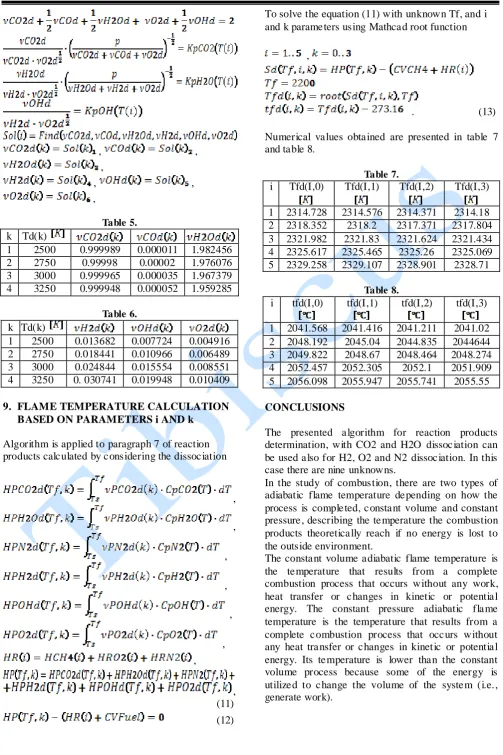
To solve the equation (11) with unknown Tf, and i and k parameters using Mathcad root function
,
. (13) Numerical values obtained are presented in table 7 and table 8.
Table 7.
i Tfd(I,0) Tfd(I,1) Tfd(I,2) Tfd(I,3) 1 2314.728 2314.576 2314.371 2314.18 2 2318.352 2318.2 2317.371 2317.804 3 2321.982 2321.83 2321.624 2321.434 4 2325.617 2325.465 2325.26 2325.069 5 2329.258 2329.107 2328.901 2328.71
Table 8.
i tfd(I,0) tfd(I,1) tfd(I,2) tfd(I,3) 1 2041.568 2041.416 2041.211 2041.02 2 2048.192 2045.04 2044.835 2044644 3 2049.822 2048.67 2048.464 2048.274 4 2052.457 2052.305 2052.1 2051.909 5 2056.098 2055.947 2055.741 2055.55 CONCLUSIONS
The presented algorithm for reaction products determination, with CO2 and H2O dissociation can be used also for H2, O2 and N2 dissociation. In this case there are nine unknowns.
In the study of combustion, there are two types of adiabatic flame temperature depending on how the process is completed, constant volume and constant pressure , describing the temperature the combustion products theoretically reach if no energy is lost to the outside environment.
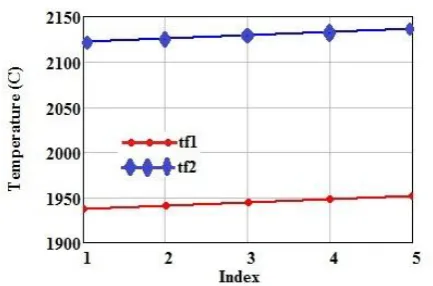
Fig. 2 Variation of flame temperature calculated according to the initial temperature CH4 / air
Table 9. Higher (HHV) and Lower (LHV) Heating values of some common fuels [Lew51]
Fuel
HHV HHV LHV
Hydrogen 141.80 286 119.96
Methane 55.50 889 50.00
Ethane 51.90 1,560 47.80
Propane 50.35 2,220 46.35 Butane 49.50 2,877 45.75
Pentane -- -- 45.35
Gasoline 47.30 -- --
The higher heating value takes into account the latent heat of vaporization of water in the combustion products, and is useful in calculating heating values for fuels where condensation of the reaction products is practical (e.g., in a gas-fired boiler used for space heat).
If the gross calorific value is used, then H R should contain a latent heat term equal to the mass of water produced per kilogram of fuel multiplied by the latent heat of evaporation of water at 25 (hfg). If the net calorific value is used, then the flue gas enthalpy will consist of sensible heat terms only. We are concerned with predicting the temperature reached within the flame, hence the net calorific value/sensible heat terms system is the more appropriate.
Table 10. Flame temperatures for some common fuels
Fuel Adiabatic flame temperature
Natural gas 2070
Kerosine 2093
Light fuel oil 2104
Medium fuel oil 2101
Heavy fuel oil 2102
Bituminous Coal 2172
Anthracite 2180
REFERENCES
[AC98] N. Apostolescu, R. Chiriac -
Combustion process in internal
combustion engine, Technical
Publishing House , Bucharest, 1998. [C+10] Gh. Caunei Florescu, A. G. Stefan et
all - Elements of the theory in fluid jets and applications in burning gaseous fuels, Scientific Universe Publishing, Bucharest, 2010.
[Lew51] B. Lewis - Combustion, Flames and explosions of gases, Academic Press, New York, 1951.
[MBR98] M. Marinescu, N. Baran, V. Radcenco - Technical Thermo-dynamics, Matrix Rom, Bucharest, 1998.
[S+12] A. G. Stefan, G. Marin, M. Cimpean, C. Nistor - Kinetics and diffuse burning
gaseous fuels, Theory, modeling,
Scientific Universe Publishing, Bucharest, 2012.
[S+94] St. Stefan, T. Paraschiv, I. Codreanu, P. Poradici - Fluid Mechanics. Special chapters, Vol I, II, III, Ed. A.T. Military, Bucharest, 1994.