Journal of Industrial Engineering and Management Studies
Vol. 6, No. 2, 2019, pp. 44-64
DOI: 10.22116/JIEMS.2019.92256
www.jiems.icms.ac.ir
A bi-objective model for the assembly flow shop scheduling
problem with sequence dependent setup times and considering
energy consumption
Seyed Mohammad Hassan Hosseini1,*
Abstract
The two-stage assembly flowshop scheduling problem has been studied in this research. Suppose that a number of products of different kinds are needed to be produced. Each product is consists of several parts. There are m uniform machines in the first stage to manufacture the components (parts) of products and there is one assembly station in the second stage to assembled parts into products. Setup operation should be done when a machine starts processing a new part and setup times are treated as separate from processing times. Two objective functions are considered: (1) minimizing the completion time of all products (makespan) as a classic objective, and (2) minimizing the cost of energy consumption as a new objective. Processing speed of each machine is adjustable and the rate of energy consumption of each machine is dependent of its processing speed. At first, this problem is described with an example, and then needed parameters and decision variables are defined. After that, this problem is modeled as a mixed integer linear programming (MILP) and GAMS software is applied to solve small problems. To solve this bi-objective model, Epsilon Constraint algorithm is used on some test problems obtained standard references. Data of test problems were obtained from previous references and new parameters have been adjusted for considered problem. Conflicting of two considered objective functions has been valid through the result. In additional, result of solving test problems and sensitivity analysis show that how we can reduce energy consumption by adjusting completion times.
Keywords: Assembly flowshop; Uniform parallel machines; Sequence dependent setup times; Energy consumption; Bi-objective.
Received: January 2019-15
Revised: May 2019-27
Accepted: June 2019-11
* Corresponding author; [email protected]
1. Introduction
The scheduling issue is one of the most critical issues in production planning and control systems. This is because of strong competition and limitation of resources in our environment (Cummings & Egbelu, 1998; Maleki-Darounkolaei, Modiri, Tavakkoli-Moghaddam, & Seyyedi, 2012). Hence, after publishing the first paper of Johnson in 1954, there has been an increasing interest in solving scheduling problems during recent years. In particular, manufacturing of almost all items may be modeled as a two-stage production system in which that there is a fabrication stage for processing the components, and an assembly stage to joint components to each other and form products (Allahverdi & Al-Anzi, 2009; Seyed Mohamad Hasan Hosseini, 2019). The fabrication stage may be formatted as parallel machines, flowshop, and jobshop and so on. When the first stage is a form of parallel machines and after that, there is an assembly stage, this production system is known as assembly flowshop that has a high application in two-stage manufacturing systems. This production system that is a generalization of flowshop, has many practical applications in industries especially in assembly-driven manufacturing and hence, has received an increasing attention of researchers recently (Arroyo & Armentano, 2005; Loukil, Teghem, & Tuyttens, 2005). Fire engine assembly plant was the first application of this problem that studied by Lee et al. (C.-Y. Lee, Cheng, & Lin, 1993). They studied this system as an assembly flow-shop scheduling problem with two stages. In their considered problem, each product is assembled from two types of parts and each type of part is processed by specific machine. There is a third machine in the second stage to assemble the two parts into a product. Makespan was considered as objective function and they proved that the problem with this condition is strongly NP-complete. Therefore, some several special cases of this problem were defined that can be solved in polynomial time.
After Lee et al., many researchers has been investigated assembly flowshop scheduling problem because of its applications in industries (Seyyed Mohammad Hassan Hosseini, 2016). Potts et al. presented another application of this problem in personal computer manufacturing (Potts, Sevast’janov, Strusevich, Van Wassenhove, & Zwaneveld, 1995). Their study aims to minimize the makespan as objective function and so, they developed some heuristic algorithm to solve it. Cheng and Wang also studied the two-machine flow-shop scheduling with a special structure and develop several properties of an optimal solution and obtain optimal schedules for some special cases (Cheng & Wang, 1999). They considered two kind of parts called “unique” and “common” components, which have been produced by the first machine in batches and so, a setup is needed to form each batch. However, the unique components are processed individually. The second machine assembles components into products.
Yokoyama and Santos introduced another study on flow-shop scheduling problem with assembly operations (Yokoyama & Santos, 2005). They supposed that, several products of different kinds are ordered to be produced and each product is formed by assembly its own components. They developed a solution procedure to obtain an 𝜀_optimal solution based on a branch-and-bound method.
The two-stage assembly scheduling problem was studied by Allahverdi and Al-Anzi (Allahverdi & Al-Anzi, 2009). They considered this system in condition that there are 𝑚 machines at the first stage and an assembly machine at the second stage with set up times separated from the processing times. They proved this problem is NP-hard, and therefore presented a dominance relation and proposed some heuristics based on a hybrid approach of tabu search, a self-adaptive differential evolution (SDE), and a new self-adaptive differential evolution (NSDE). They show that the NSDE is the best heuristic for the problem even if setup times are ignored.
and Johnson (JNS) heuristics to solve the problem. Computational experiment reveals that both PSO and SDE are much superior to tabu. Moreover, it is statistically shown that PSO performs better than SDE (Al-Anzi & Allahverdi, 2009).
Fattahi et al. have studied a two-stage production system that was consisted of a hybrid flowshop and an assembly stage. Different kinds of products were produced in their study and each of them has been assembled with a multipart set. They have used mathematical modeling for this problem to minimize the completion time of all products (makespan). In addition, a series of heuristic algorithms have been proposed by considering the Johnson algorithm in order to solve large-sized problems. Then, two lower bounds have been introduced and improved to evaluate the final solution obtained from heuristics algorithms (Fattahi, Hosseini, & Jolai, 2013). Also, a hybrid flow shop scheduling problem (HFSP) with assembly operations and considering setup times has been studied by fattahi et al. They have produced a number of identical products while each of these products were assembled by using a multipart set. Initially, the parts have been created in a hybrid flow shop and after that they were put together to form the products. In fact, minimizing the completion time of all products has been considered as the main objective (makespan). Because of this problem has been proved strongly NP-hard, so a hierarchical branch and bound algorithm has been presented to solve it. Also, some lower and upper bounds are developed to increase the efficiency of the proposed algorithm (Fattahi, Hosseini, Jolai, & Tavakkoli-Moghaddam, 2014). Lee et al. studied a two-stage assembly-type flowshop scheduling problem in which that the first two-stage consists of two independent machines, and the second stage consists of a single machine to assemble products. Each product is formed by assembly of two types of components that are fabricated in the first stage. Some dominance properties and lower bounds have been developed, and a branch and bound algorithm has been presented. They tried to minimize the total tardiness as a new objective function (J.-Y. Lee & Bang, 2016). Lee proposed a branch and bound for a two-stage assembly problem to minimize the total completion time (I. S. Lee, 2018). He also developed six lower bounds to increase performance efficiency of B&B algorithm. Also, four efficient heuristic algorithms have been developed to generate near-optimal schedules in his study. The results show that the derived B&B and heuristic algorithms perform very well. It is also important that some study have been done on
Most of research in scheduling problems is concerned with the minimization of a single criterion. So, up to the 1980s, scheduling researches were mainly concentrated on optimizing single performance measures such as makespan (Cmax), total flow time (F), maximum tardiness (Tmax), total tardiness (T) and number of tardy jobs (nT) (Arroyo & Armentano, 2005). While, most real world problems cope with several conflicting objectives. Therefore, considering some conflicting objectives is vital to make an optimization problem more realistic (Salmasnia, Mousavi-Saleh, & Mokhtari, 2018). For example in a company, the production manager tends to deliver products as soon as possible and minimize makespan. Also the commercial manager is interested in satisfying customers and then minimizing the tardiness. On the other hand, the financial manager and also department of energy focus on energy consumption and its costs. Each of these objectives are valid from a general point of view. Since, these are considered conflicting objectives, some of the solutions might be desirable for an objective and others might be undesirable. Therefore, a scheduling problem as a difficult decision making problem has often a multi-objective nature.
There have been many reasons to place reduction of energy consumption as a new objective in production industries and organizations such as:
To save their money and increase their profitability. To improve the national economy.
To keep environment against pollution.
To improve national security by providing demands of health centers, transportations, houses, schools, and so on.
To help preserve various habitat
Therefore, the energy consumption of the operations has to be considered in every organization such as production systems. Scheduling of production is one of the most activity with a lot of influence on energy consumption (Merkert et al., 2015). Although integration of the energy-awareness into production scheduling is getting more and more attention (Biel & Glock, 2016; Dooren, Sys, Toffolo, Wauters, & Berghe, 2017; Mansouri, Aktas, & Besikci, 2016), there is still a gap between industrial needs and academic research (Plitsos, Repoussis, Mourtos, & Tarantilis, 2017).
Some methods and solutions have been used to solve the problems of energy waste during production processes during recent years. Also, many operational methods have been utilized to reduce energy consumption and environmental effects. Yan et al. (2005) conducted one of the most relevant studies about reduction of energy consumption in production systems. These researchers presented a mathematical model for minimizing energy consumption and the makespan for job-shop scheduling problem. They also developed a heuristic algorithm to identify a good solutions for the model based on the “Tabu search mechanism” (He, Liu, Cao, & Li, 2005). After that, Mouzon et al. considered a single machine-scheduling problem to minimize total energy consumption. They proposed operation dispatching rules as steps to minimizing energy consumption: the machine could be shut down if the energy consumption for turning it off or on was less than the idle energy consumption (Mouzon, Yildirim, & Twomey, 2007). Liu et al. studied the hybrid flowshop scheduling problem to minimize energy consumption. They proposed a mixed-integer nonlinear programming model for this problem. They also applied an improved genetic algorithm to solve this problem while energy consumption was mainly considered and the makespan was a key constraint (Xiang Liu, Fengxing Zou, & Xiangping Zhang, 2008). Some others mathematical models have also been proposed for dynamic scheduling in flexible manufacturing systems (FMS) with energy consumption minimization by Zhanga et al. (Zhang, Li, Gao, Zhang, & Wen, 2012). Yi et al. proposed an emission-aware multi-machine job shop-scheduling model for minimizing both carbon emissions and makespan. They used a multi-objective genetic algorithm (MOGA) to solve this bi-objective optimization problem (Yi, Li, Tang, & Wang, 2012). Luo et al. studied a multi-objective scheduling problem in a hybrid flow shop. Two objectives considered in their proposed model were to minimize makespan and energy consumption. They developed a Preference Vector Ant Colony System (PVACS) to search for a set of Pareto-optimal solutions. They compared performance of PVACS to two well-known multi-objective genetic algorithms: SPEA2 and NSGA-II. The experimental results shown that PVACS outperforms the other two algorithms (Luo et al. 2013).
Mansouri et al. addressed energy consumption as an explicit criterion in flowshop scheduling. They considered variable speed of machining operations leading to different energy consumption levels and then traded-off between minimizing makespan, and total energy consumption, as an indicator for environmental sustainability. A mixed integer linear multi-objective optimization model has been developed to find the Pareto frontier comprised of makespan and total energy consumption. They also developed a new constructive heuristic for fast trade-off analysis between makespan and energy consumption (Mansouri et al., 2016). Modos et al. studied a scheduling problem in a production system with large electricity consumption considering the total energy consumption limits. The aim of their study is to design a robust production schedules pro-actively guaranteeing that the energy consumption limits are not violated. They scheduled jobs on one machine with release times of the operations and considered total tardiness as the objective function. In order to solve this problem, they proposed a pseudo-polynomial algorithm for finding the optimal robust schedule. They also developed two exact (Branch-and-Bound and logic-based Benders decomposition) and one heuristic algorithm (tabu search) for this problem (Módos, Šůcha, & Hanzálek, 2017).
To the best of authors’ knowledge, assembly flow shops considering cost of energy have not been explored yet. So, the energy consumption and its cost is considered as a new objective in this study for the assembly flowshop scheduling problem. We also consider sequence dependent setup times for all machines in stage 1 as a realistic assumption for this problem. Therefore, definition a new feature for the assembly flow shop scheduling problem considering more applicable conditions such as energy consumption is the main contribution of this study. The remaining sections of this paper are organized as follow: In section 2, the problem is described completely via a numeric example and the mathematical model is presented. Using epsilon constraint method to solve problem is illustrated in section 3. Adjusted test problems and experiments is described in section 4 while the evaluation and analysis of result is done in this section. Finally, a summary of the work and direction for the future research are given in section 5.
2. Problem description
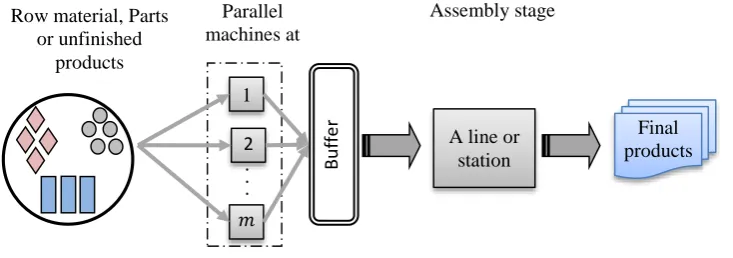
A two-stage assembly-type flowshop scheduling problem is studied in this paper. Figure (1) presents a schematic view of the considered problem. The first stage consists of 𝑚 independent machines that fabricate parts, and the second stage consists of a single machine to assemble products. Each product is formed by assembly special parts and components of products are different to each other’s. Setup operations and setup times are considered. Two objective functions are considered: (1) minimizing the completion time of all products (makespan) as a classic objective, and (2) minimizing the cost of energy consumption as a new objective. Machines in the first stage can process parts in three different speed and so, the rate of energy consumption of each machine is dependent of its processing speed.
The parallel machines considered uniform. As we know, the parallel machines in a scheduling problem can be classified in to the following types.
Identical parallel machines scheduling problem.
Uniform/proportional parallel machines scheduling problem. Unrelated parallel machines scheduling problem.
Let, 𝑡𝑖𝑗 be the processing times of the job 𝑗 on the machine 𝑖 with a specified and normal speed,
for 𝑖 = 1, 2, … , 𝑚 and 𝑗 = 1, 2, … , 𝑛. Then if the actual process time of part 𝑗 on machine 𝑚 is
𝑡𝑖𝑗
machines scheduling problem would be formed. This means that the parallel machines can have different speeds for processing parts.
Figure 1. A schematic view of the considered problem
The other basic assumptions of this problem are provided as below:
All parts are available at time zero.
The parallel machines in the first stage are unrelated.
Each machine can process only one job at a time.
Each job can be processed by only one machine at a time.
Time processing of jobs and assembly of products is deterministic.
Assembly operation for a product will not start until all parts of its product are completed.
When assembly operation of a product is started, it doesn't stopped until completed (no preemption in assembly stage)
There is no limited in buffer storages
In addition, the following notations are used to formulate the considered problem:
Indices
ℎ, ℎ′= 1, 2, … , 𝐻 Index for products 𝑖, 𝑗 = 1, 2, … , 𝑛 Index for parts
𝐽ℎ Set of parts for product ℎ
𝑙 = 1, 2 Index for stage
𝑚 = 1, 2, … , 𝑀 Index for parallel machines in stage 1
𝑠 = 1, 2, 3 Index for processing speed
Parameters
𝑃𝑖𝑚 Processing time of part 𝑖 on machine 𝑚 at normal speed (𝑠 = 2)
𝐴ℎ Assembly time of product ℎ
𝑆𝑖𝑗𝑚 Setup time for switching part 𝑖 to part 𝑗 on machine 𝑚 𝑆0𝑗𝑚 Setup time for the first part (𝑗) that is processed on machine 𝑚
𝐸𝑉𝑖𝑚 Binary variable taking value 1 if machine 𝑚 capable to process part 𝑖, and 0, otherwise 𝐸𝑁𝑝𝑚𝑠 Energy consumption per unit time of machine 𝑚 in processing mode with speed of 𝑠
Bu
ff
e
r
1
2
𝑚
. . .
Row material, Parts or unfinished
products
A line or station Parallel
machines at stage 1
Assembly stage
𝐸𝑁𝑠𝑚 Energy consumption per unit time of machine 𝑚 in set up mode
𝑣𝑠 Processing speed that is fast, normal, and slow for 𝑠 = 1, 2, 3 respectively
𝑢 Cost of energy per time
𝑀 A large number
Decision variables
𝑋𝑖𝑚𝑠 Binary variable taking value 1 if part 𝑖 is processed on machine 𝑚 at speed of 𝑠, and 0 otherwise
𝑌𝑖𝑗𝑚𝑠 Binary variable taking value 1 if part 𝑗 is assigned to machine 𝑚 at speed of 𝑠 immediately after part 𝑖 𝑌0𝑗𝑚𝑠 Binary variable taking value 1 if part 𝑗 is the first part on machine 𝑚, and 0 otherwise
𝑌𝑖0𝑚𝑠 Binary variable taking value 1, if job 𝑖 is the last job on machine 𝑚, and 0 otherwise
𝐴𝑆ℎ′ℎ
Binary variable taking value 1, if assembly operation of product ℎ start immediately after that product
ℎ′, and 0 otherwise
𝐴𝑆0ℎ Binary variable taking value 1 if product ℎ is the first product that is assembled, and 0 otherwise
𝐴𝑆ℎ′0 Binary variable taking value 1 if product ℎ′ is the last product that is assembled, and 0 otherwise 𝐹𝑗 Finish time of part 𝑗 on stage 1
𝑇𝐹ℎ Finish time of the set part of product ℎ at the first stage 𝐶ℎ Completion time of assemble the product ℎ
𝐶𝑚𝑎𝑥 Completion time of all products
𝐶𝑒 Total cost of energy consumption
3. Mathematical modeling
Fattahi et al. presented the scheduling problem of a hybrid flowshop followed by an assembly stage and developed a mixed integer linear programming (MILP) model for this problem. Their mathematical is adopted for our considered problem in this study with modification the hybridflow shop to one stage consists of 𝑚 uniform parallel machines. Also new parameters, new decision variables, and new operational constraints are added. According to this, and based on the present problem and notations, a new mathematical formulation for the problem is presented as follow:
Min 𝑍1= (𝐶𝑚𝑎𝑥) (1)
Min 𝑍2= (𝐶𝑒) (2)
Subject to:
∑ ∑ 𝑋𝑖𝑚𝑠 3
𝑠=1 𝑀
𝑚=1
= 1 i=1, 2,…,n (3)
∑ ∑ 𝑌𝑖𝑗𝑚𝑠
3
𝑠=1 𝑛
𝑖=0 ,𝑖≠𝑗
= ∑ 𝑋𝑗𝑚𝑠 3
𝑠=1
j=1, 2,…,n , m=1, 2, …, M (4)
∑ ∑ 𝑌𝑖𝑗𝑚𝑠
3
𝑠=1 𝑛
𝑗=0 ,𝑗≠𝑖
= ∑ 𝑋𝑖𝑚𝑠 3
𝑠=1
i=1, 2,…,n , m=1, 2, …, M (5)
∑ ∑ 𝑌𝑖𝑗𝑚𝑠 3
𝑠=1 𝑛
𝑖=0
≤ 1 j=1, 2,…,n , m=1, 2, …, M (6)
∑ ∑ 𝑌𝑖𝑗𝑚𝑠 3
𝑠=1 𝑛
𝑗=0
According relation (1) of the mathematical model, completion time of all products is minimized (the first objective). Also relation (2) minimizes total cost of energy consumption. Constraint (3) indicates that each part is processed precisely once by one machine with a certain speed. Constraints (4) to (7) state that each machine can process just one part at each time. In particular, constraints (4) and (5) indicate that each part on each machine with a specified speed, inevitably is processed before or after a job which including dummy part 0. Also, Constraints (6) and (7) ensure that each part is assigned exactly to one machine with a specified speed. Constraints (8) and (9) show that the first and last part that are process by each machine are unique. Constraint (10) indicates the eligibility restrictions. Constraint (11) take care of the completion times for each part. Completion time of each part should be equal or greater than sum of its processing time and its previous part completion. Constraint (12) indicates that the assembly operation of each product can be starts after completion all needed parts. Constraints
∑ ∑ 𝑌0𝑗𝑚𝑠 3
𝑠=1 𝑛
𝑗=1
= 1 m=1, 2, …, M (8)
∑ ∑ 𝑌𝑖0𝑚𝑠 3
𝑠=1 𝑛
𝑖=1
= 1 m=1, 2, …, M (9)
∑ 𝑋𝑖𝑚𝑠 3
𝑠=1
≤ 𝐸𝑉𝑖𝑚 i=1, 2,…,n , m=1, 2, …, M (10)
𝐹𝑗 ≥ ∑ ∑ ( 𝑃𝑗𝑚 𝑣𝑠 × 𝑋𝑖𝑚𝑠) 3 𝑠=1 𝑀 𝑚=1 + ∑ ∑ ∑[(𝐹𝑖+ 𝑆𝑖𝑗𝑚) × 𝑌𝑖𝑗𝑚𝑠] 3 𝑠=1 𝑛 𝑖=0 𝑀 𝑚=1
j=1, 2, …, n (11)
𝑇𝐹ℎ ≥ 𝐹𝑗 ∀ 𝑗 ∈ {𝐽ℎ} , h=1, 2,3,4,…,H (12)
∑ 𝐴𝑆ℎ′ℎ 𝐻
ℎ′=0,ℎ′≠ℎ
= 1 ∀ ℎ = 1, 2,3,4, … , H (13)
∑ 𝐴𝑆ℎ′ℎ 𝐻
ℎ=0,ℎ ≠ℎ′
= 1 ∀ ℎ′= 1, 2,3,4, … , H (14)
𝐶ℎ ≥ 𝑇𝐹ℎ+ 𝐴ℎ h=1, 2,3,4,…,H (15)
𝐶ℎ ≥ (𝐴𝑆ℎ′ℎ− 1) × 𝑀 + 𝐶ℎ′+ 𝐴ℎ ℎ, ℎ′= 1, 2,3,4, … , H (16)
𝐶𝑚𝑎𝑥 ≥ 𝐶ℎ ∀ h=1,2,3,…,H (17)
𝐶𝑒= 𝑢 × [∑ ∑ ∑ ( 𝑃𝑖𝑚 𝑣𝑠 × 𝐸𝑁𝑝𝑚𝑠× 𝑋𝑖𝑚𝑠) 3 𝑠=1 𝑀 𝑚=1 𝑛 𝑖=1 + ∑ ∑ ∑ ∑(𝑆𝑖𝑗𝑚× 𝐸𝑁𝑠𝑚× 𝑌𝑖𝑗𝑚𝑠) 3 𝑠=1 𝑀 𝑚=1 𝑛 𝑗 𝑛 𝑖=0,𝑖≠𝑗 ] (18)
𝑋ims∈ {0,1} 𝑖, 𝑗 = 0, 1, 2, … , 𝑛 ; 𝑚
= 1, 2, … , 𝑀 (19)
𝑌𝑖𝑗𝑚𝑠∈ {0,1}
𝑖, 𝑗 = 0, 1, … , 𝑛 ; 𝑚
= 1, 2, … , 𝑀 𝑠 = 1, 2, 3
(20)
(13) and (14) are used to determine assembly sequence of products. Constraints (15) ensure that the completion time of each product is at least equal to the sum of completion time of its parts and its assembly time. Constraint (16) ensure that the completion time of each product is at least equal to the sum of its assembly time and completion time of it’s before product. Constraint (17) is used to compute the first objective function (makespan). Equation of (18) is used to compute total cost of Energy consumption as the second objective function. Finally, constraints (19) to (21) are used to indicate the type of decision variables.
4. Numerical example
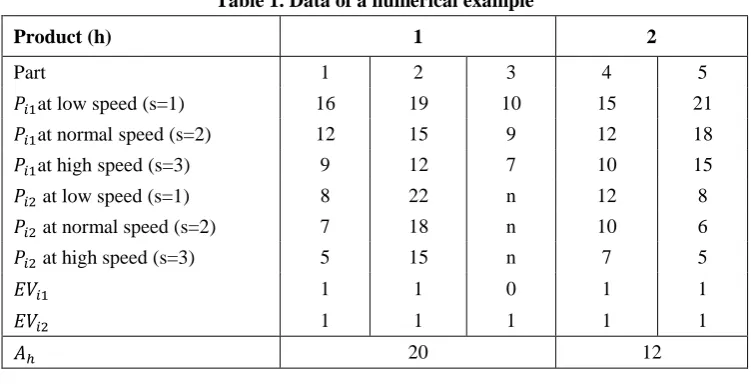
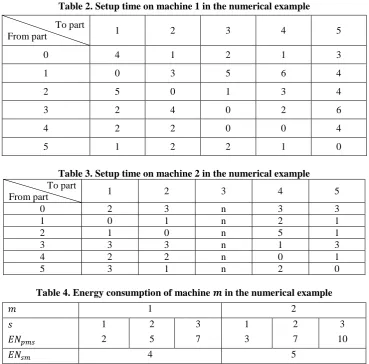
In order to clarify and better understanding the problem, a numerical example is provided. Assume two products are needed to be produced. Product 1 is formed by assembling of three parts and product 2 is formed by assembling of two parts. There are two parallel machines in stage 1 to process and ready the parts, and after that, there are a single station to assemble the parts to form products. The input data for parts and their processing time of machining operation and assembly are given in table 1. In additional, the amount of the cost of energy per time is considered equal to 1 $.
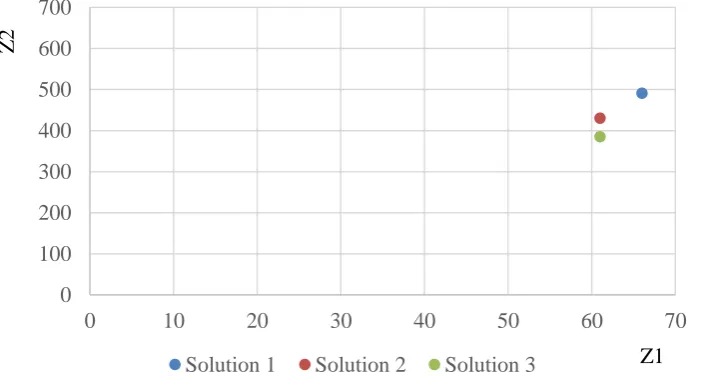
At first, we scheduled the products and assigned their parts to machines according their number (as a random scheduling). For simplicity, assume that machines process all parts in normal speed. The result is shown in figure (2) with value of 𝑍1 = 66 and 𝑍2 = 491 . Figure (3) shows another scheduling of this sample with value of 𝑍1 = 61 and 𝑍2 = 430. So, the second solution has dominated the first. In addition, we have obtained another scheduling from solving model with value of 𝑍1 = 61 and 𝑍2 = 385 as the third solution that has been presented in figure (4). Although this solution is equal to the second in first objective function (𝑍1 = 61 for both of these two solutions) but it has been dominated because it is worse in the second objective function (𝑍2). In these three figures, the yellow color denote setup operations, the gray cells denote machining operations (process operations of the parts), and the blue shows assembly operations. Parts and products are shown with their numbers in these figures.
Table 1. Data of a numerical example
Product (h) 1 2
Part 1 2 3 4 5
𝑃𝑖1at low speed (s=1) 16 19 10 15 21 𝑃𝑖1at normal speed (s=2) 12 15 9 12 18 𝑃𝑖1at high speed (s=3) 9 12 7 10 15 𝑃𝑖2 at low speed (s=1) 8 22 n 12 8
𝑃𝑖2 at normal speed (s=2) 7 18 n 10 6
𝑃𝑖2 at high speed (s=3) 5 15 n 7 5
𝐸𝑉𝑖1 1 1 0 1 1
𝐸𝑉𝑖2 1 1 1 1 1
Table 2. Setup time on machine 1 in the numerical example
To part
From part 1 2 3 4 5
0 4 1 2 1 3
1 0 3 5 6 4
2 5 0 1 3 4
3 2 4 0 2 6
4 2 2 0 0 4
5 1 2 2 1 0
Table 3. Setup time on machine 2 in the numerical example
To part
From part 1 2 3 4 5
0 2 3 n 3 3
1 0 1 n 2 1
2 1 0 n 5 1
3 3 3 n 1 3
4 2 2 n 0 1
5 3 1 n 2 0
Table 4. Energy consumption of machine 𝒎 in the numerical example
𝑚 1 2
𝑠 1 2 3 1 2 3
𝐸𝑁𝑝𝑚𝑠 2 5 7 3 7 10
𝐸𝑁𝑠𝑚 4 5
These results also are presented in figure (5). It is considerable that solution 1 is different in sequencing of product with solutions 2 and 3. And also, difference between solutions 2 and 3 is related to parts allocation to machines.
Figure 2. A schedule for numerical example according products and parts number with 𝒁𝟏= 𝟔𝟔 and 𝒁𝟐= 𝟒𝟗𝟏
Figure 4. The best schedule for numerical example with 𝒁𝟏 = 𝟔𝟏 and 𝒁𝟐= 𝟑𝟖𝟓
Figure 5. Comparison of three solutions the for numerical example
4.1. Using epsilon constraint method to solve problem
Generally, the minimization of an objective function with respect to the constraints is considered to be the main constraint in an optimization problem. Some of which are an inherent part of the original problem, while others may be introduced by way of the multi-objective problem formulation. It should also be noted that the multi-objective optimization problem doesn’t necessarily result in a single solution. Due to the existence of multiple objectives with their specific competitive nature, the possibility of obtaining an unlimited number of solutions, each of which prioritizes the objectives of the problem, is not entirely far from the mind. These kinds of solutions called Pareto points, which a collection of them comprises, the Pareto optimal set. The definition for the Pareto optimality is defined as the following:
Pareto Optimality: A point 𝑥∗∈ 𝑋 is Pareto optimal if and only if there does not an exist another point 𝑥 ∈ 𝑋, such that 𝐹(𝑥) ≤ 𝐹(𝑥∗), and t 𝐹𝑖(𝑥) ≤ 𝐹𝑖(𝑥∗) for at least one function.
The Ɛ-constraint method is a very intuitive and simple method to apply to bi-criterion problems to achieve Pareto optimal set. This method was first proposed by Haimes et al. in 1971 which emphasizes on selecting one of the objective functions and optimizing it while the other functions are transformed to additional constraints, leading to a solution that can be proven to always be weakly Pareto optimal (Chircop & Zammit-Mangion, 2013; Fattahi, Hosseini, Jolai, & safi Samghabadi, 2014). Indeed, generating an evenly distributed Pareto frontier has been originated from modifying the values of the objective functions, which form the additional constraints. In fact, it can be stated that an equidistant is a method for modifying the additional
0 100 200 300 400 500 600 700
0 10 20 30 40 50 60 70
Z
2
Z1
constraints in a systematic way. Also, the general form of the Ɛ-constraint method has been demonstrated as the following (Yahia, Felfel, Ayadi, & Masmoudi, 2015):
min 𝑓𝑗(𝑥)
𝑓𝑖(𝑥) ≤ 𝜀𝑖 𝑓𝑜𝑟 𝑖 = 1,2, … , 𝑛; 𝑖 ≠ 𝑗; 𝜀𝑖 = 𝑅𝐿𝑘
𝑥 ∈ 𝑋
It is important to note that this model has multiple run times. Each time an objective function has been considered as the main objective to be optimized while the other (s) are converted into additional constraints. There are two objective functions in considered problem of this study, included minimizing the completion time of all products as 𝑓1, and minimizing total cost of energy consumption as 𝑓2. In order to use the Ɛ-constraint method for solving the bi-objective considered problem, 25 cut points have been considered for each bi-objective. So, we will have 50 Pareto points totally. Since in some cut points just one objective has been worse and other point has not been better, so such these points are known as dominated points and are eliminated from continuing. Finally, the set points of non-dominated solutions are presented as an index of Overall Non-dominated Vector Generation (ONVG).
5. Result analysis on test problems
This section presents the results of solving test problems using proposed mathematical model. The mathematical model was run in GAMS and experiments are executed on a Pc with a 2.0GHz Intel Core 2 Duo processor and 4GB of RAM memory. Data of test problems were obtained from Fattahi et al. (2013) as table (5) and new parameters have been adjusted for considered problem as table (6). Also in study of Fattahi et al. the machining section is a hybrid flow shop and so, their processing data of the first stage have been considered for parallel machines of this study. These data about processing (machining) times are considered for normal speed of machines and for fast and slow status its calculated based on 𝑣𝑠.
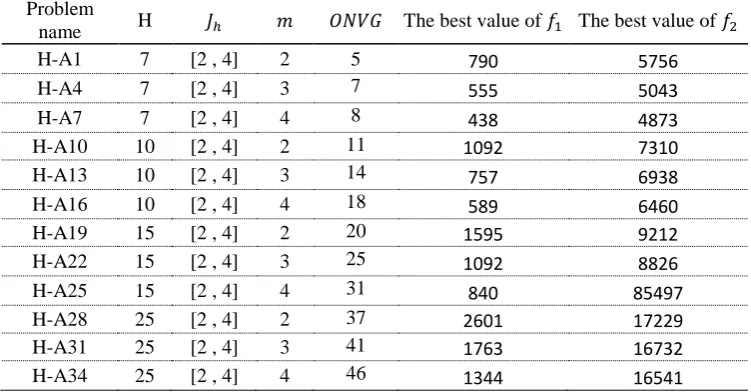
After solving test problems, the results include ONVG index and the best value of two objective functions have been presented in table (7). The best value of each objective function has been obtained by solving mathematical model without considering another objective and vice versa.
Table 5. Problem generation
Problem
name H 𝐽ℎ 𝑚 𝑆𝑙𝑗𝑚 𝑃𝑖𝑚 𝐴ℎ H-A1 7 [2 , 4] 2 [10, 50] [30, 40] [50, 100] H-A4 7 [2 , 4] 3 [10, 50] [30, 40] [50, 100] H-A7 7 [2 , 4] 4 [10, 50] [30, 40] [50, 100] H-A10 10 [2 , 4] 2 [10, 50] [30, 40] [50, 100] H-A13 10 [2 , 4] 3 [10, 50] [30, 40] [50, 100] H-A16 10 [2 , 4] 4 [10, 50] [30, 40] [50, 100] H-A19 15 [2 , 4] 2 [10, 50] [30, 40] [50, 100] H-A22 15 [2 , 4] 3 [10, 50] [30, 40] [50, 100] H-A25 15 [2 , 4] 4 [10, 50] [30, 40] [50, 100] H-A28 25 [2 , 4] 2 [10, 50] [30, 40] [50, 100] H-A31 25 [2 , 4] 3 [10, 50] [30, 40] [50, 100] H-A34 25 [2 , 4] 4 [10, 50] [30, 40] [50, 100]
Table 6. Specification of machines for test problems
𝑣𝑠 Chance of capability to process a part 𝐸𝑁𝑝𝑚𝑠 𝐸𝑁𝑠𝑚 𝑢
S=1 1.2 0.9 [5 ,7] [1 , 3] 1
S=2 1 0.9 [3 ,
5] [1 , 3] 1 S=3 0.8 0.9 [1 ,3] [1 , 3] 1
Table 7. The ONVG index and the best value of two objective functions
Problem
name H 𝐽ℎ 𝑚 𝑂𝑁𝑉𝐺 The best value of 𝑓1 The best value of 𝑓2 H-A1 7 [2 , 4] 2 5 790 5756 H-A4 7 [2 , 4] 3 7 555 5043 H-A7 7 [2 , 4] 4 8 438 4873 H-A10 10 [2 , 4] 2 11 1092 7310 H-A13 10 [2 , 4] 3 14 757 6938 H-A16 10 [2 , 4] 4 18 589 6460 H-A19 15 [2 , 4] 2 20 1595 9212 H-A22 15 [2 , 4] 3 25 1092 8826 H-A25 15 [2 , 4] 4 31 840 85497 H-A28 25 [2 , 4] 2 37 2601 17229 H-A31 25 [2 , 4] 3 41 1763 16732 H-A34 25 [2 , 4] 4 46 1344 16541
Figure 6. Pareto optimal solutions of the problem H-A19
Figure 7 (a). Impact of the 𝑬𝑵𝒑𝒎𝒔 rate variation on the total energy consumption
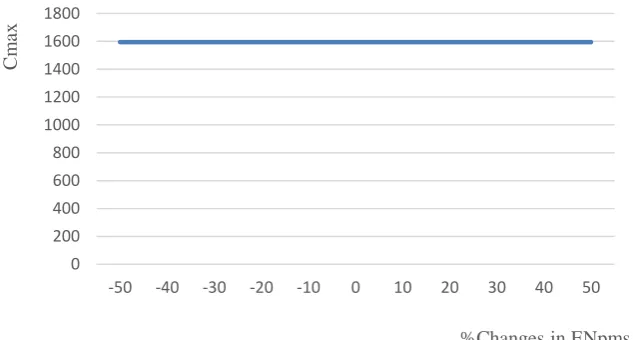
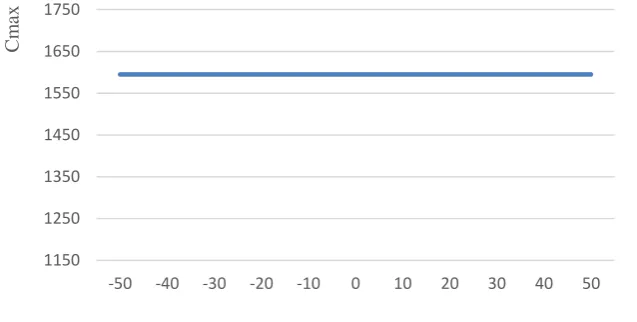
Figure 7 (b). Impact of the 𝑬𝑵𝒑𝒎𝒔 rate variation on the makespan
5000 7000 9000 11000 13000 15000 17000 19000
1500 1600 1700 1800 1900 2000 2100 2200
E
n
er
y
co
n
su
m
p
tio
n
Cmax
0 2000 4000 6000 8000 10000 12000 14000 16000
-50 -40 -30 -20 -10 0 10 20 30 40 50
E
n
er
y
co
n
su
m
p
tio
n
%Changes in ENpms
0 200 400 600 800 1000 1200 1400 1600 1800
-50 -40 -30 -20 -10 0 10 20 30 40 50
C
m
ax
Figure 7 (c). Impact of the 𝑬𝑵𝒑𝒎𝒔 rate variation on the makespan when total energy consumption is considered fixed
Figure 8 (a). Impact of the 𝑬𝑵𝒔𝒎 rate variation on the total energy consumption
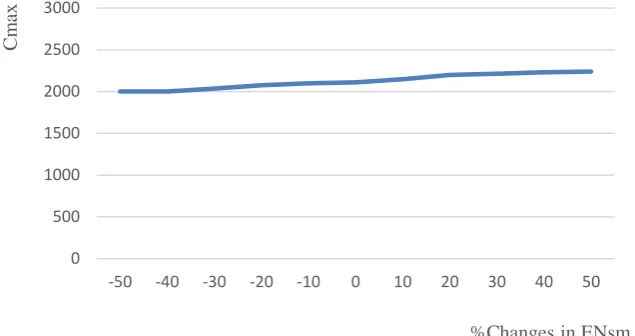
Figure 8 (b). Impact of the 𝑬𝑵𝒔𝒎 rate variation on the makespan
0 500 1000 1500 2000 2500 3000
-50 -40 -30 -20 -10 0 10 20 30 40 50
C
m
ax
%Changes in ENpms
5000 6000 7000 8000 9000 10000 11000 12000
-50 -40 -30 -20 -10 0 10 20 30 40 50
E
n
er
y
co
n
su
m
p
tio
n
%Changes in ENsm
1150 1250 1350 1450 1550 1650 1750
-50 -40 -30 -20 -10 0 10 20 30 40 50
C
m
ax
Figure 8 (c). Impact of the 𝑬𝑵𝒔𝒎 rate variation on the makespan when total energy consumption is considered fixed
6. Conclusion
This paper focused on the problem of scheduling a given set of jobs in a two-stage assembly-type flowshop in which the first stage consists of 𝑚 independent parallel machines and the second stage consists of a single machine as the assembly stage. In the first stage, the needed components are fabricated on different machines; then, they are assembled into the final product in the second (or assembly) stage. In this system, the components can be processed by one of the 𝑚 independent parallel machines. Setup operation should also be done when a machine starts processing a new part and setup times are treated as separate from the processing times. Each machine can processes parts with three different speeds. Energy consumption of machines can be reduced or increased by changing in processing speed. This problem was described via a numeric example. Also a mixed integer linear programming (MILP) as the mathematical model was developed for this problem with two objective functions: (1) minimizing the completion time of all products (makespan), and (2) minimizing the cost of energy consumption.
The methodology of 𝜖 − 𝑐𝑜𝑛𝑠𝑡𝑟𝑎𝑖𝑛𝑡 was used to solve this bi-objective problem. Some standards test problems that were introduced in previous studies were used to run the mathematical model. The solutions have been obtained from 25 cut points of each objective function and so 50 possible Pareto points were obtained totally. Because of some solutions were dominated by the others, so the final Overall Non-dominated Vector Generation (ONVG) was presented as possible Pareto points.
Some sensitivity analysis were conducted of main parameters. Due to these result, energy consumption per unit time of machines in processing mode with different speed, has the most impact on the makespan when total energy consumption is considered fixed. According the result, energy consumption can be managed and reduced by adjusting the speed of machines. So, production managers should take attention to energy consumption as one of the important environmental aspect and green production. They can reduce the energy consumption and energy costs by trade offing between two criteria of completion time and energy consumption. This goal can be earned by adjusting the speed if the speed of machines is adjustable and the rate of energy consumption of each machine is dependent of its processing speed. The result shown also that for an example problem, the energy cost can be reduced till 47% by adjusting the speed of processing machines.
0 500 1000 1500 2000 2500 3000
-50 -40 -30 -20 -10 0 10 20 30 40 50
C
m
ax
Definition a new problem considering more applicable conditions was the main contribution of this study. According to this problem is NP-Hard, using a good heuristic or metaheuristic such as MOGA, NSGA-II and NSGA-III to solve this problem by large-scale dimensions can be a new subject for study. In additional, design and implementation a hybrid approach of metaheuristics (for example NSGAII+VNS algorithm) can improve quality solutions. Modelling and solving this problem under uncertainty can be a new interesting subject to study. For this, some parameters such as process times or assembly operation can be considered as stochastic to more close the problem to practical and real world. Considering different cost for energy consumption such as pick period may be another applicable feature for this problem.
References
Al-Anzi, F. S., and Allahverdi, A., (2009). "Heuristics for a two-stage assembly flowshop with bicriteria of maximum lateness and makespan", Computers & Operations Research, Vol. 36, No. 9, pp. 2682– 2689. https://doi.org/10.1016/J.COR.2008.11.018
Allahverdi, A., and Al-Anzi, F. S., (2009). "The two-stage assembly scheduling problem to minimize total completion time with setup times", Computers & Operations Research, Vol. 36, No. 10, pp. 2740– 2747. https://doi.org/10.1016/J.COR.2008.12.001
Arroyo, J. E. C., and Armentano, V. A., (2005). "Genetic local search for multi-objective flowshop scheduling problems", European Journal of Operational Research, Vol. 167, No. 3, pp. 717–738. https://doi.org/10.1016/J.EJOR.2004.07.017
Biel, K., and Glock, C. H., (2016). "Systematic literature review of decision support models for energy-efficient production planning", Computers & Industrial Engineering, Vol. 101, pp. 243–259. https://doi.org/10.1016/J.CIE.2016.08.021
Cheng, T. C. E., and Wang, G., (1999). Scheduling the fabrication and assembly of components in a two-machine flowshop.
Chircop, K., and Zammit-Mangion, D., (2013). "On-constraint based methods for the generation of Pareto frontiers", Journal of Mechanics Engineering and Automation, Vol. 3, pp. 279–289.
Cummings, D. H., and Egbelu, M. P. J., (1998). "Minimizing production flow time in a process and assembly job shop", International Journal of Production Research, Vol. 36, No. 8, pp. 2315–2332. https://doi.org/10.1080/002075498192922
Dooren, D. Van Den, Sys, T., Toffolo, T. A. M., Wauters, T., and Berghe, G. Vanden., (2017). "Multi-machine energy-aware scheduling", EURO Journal on Computational Optimization, Vol. 5,pp. 285– 307. https://doi.org/10.1007/s13675-016-0072-0
Du, B., Chen, H., Huang, G. Q., and Yang, H. D. (2011). "Preference Vector Ant Colony System for Minimising Make-span and Energy Consumption in a Hybrid Flow Shop", In Multi-objective Evolutionary Optimisation for Product Design and Manufacturing (pp. 279–304). London: Springer London. https://doi.org/10.1007/978-0-85729-652-8_9
Fattahi, P., Hosseini, S., Jolai, F., and safi Samghabadi, A. (2014). "Multi-objective scheduling problem in a three-stage production system", IInternational Journal of Industrial Engineering & Production Research, Vol. 25, No. 1, pp. 1–12.
Fattahi, P., Hosseini, S. M. H., and Jolai, F. (2013). "A mathematical model and extension algorithm for assembly flexible flow shop scheduling problem", International Journal of Advanced Manufacturing Technology, Vol. 65. https://doi.org/10.1007/s00170-012-4217-x
He, Y., Liu, F., Cao, H., and Li, C. (2005). "A bi-objective model for job-shop scheduling problem to minimize both energy consumption and makespan", Journal of Central South University of Technology, Vol. 12, No. 2, pp. 167–171. https://doi.org/10.1007/s11771-005-0033-x
Hosseini, S. M. H. (2016). "Modeling the Hybrid Flow Shop Scheduling Problem Followed by an Assembly Stage Considering Aging Effects and Preventive Maintenance Activities", International Journal of Supply and Operations Management, Vol. 3, No. 1, pp. 1215–1233. https://doi.org/10.22034/2016.1.07
Hosseini, S. M. H. (2019). "Modelling and solving the job shop scheduling Problem followed by an assembly stage considering maintenance operations and access restrictions to machines", Journal of Optimization in Industrial Engineering, Vol. 12, No. 1, 71–80. https://doi.org/10.22094/JOIE.2018.760.1484
Lee, C.-Y., Cheng, T. C. E., and Lin, B. M. T., (1993). "Minimizing the Makespan in the 3-Machine Assembly-Type Flowshop Scheduling Problem", Management Science. INFORMS. https://doi.org/10.2307/2632599
Lee, I. S., (2018). "Minimizing total completion time in the assembly scheduling problem", Computers & Industrial Engineering, Vol. 122, pp. 211–218. https://doi.org/10.1016/J.CIE.2018.06.001
Lee, J.-Y., and Bang, J.-Y., (2016). "A Two-Stage Assembly-Type Flowshop Scheduling Problem for Minimizing Total Tardiness", Mathematical Problems in Engineering, Vol. 2016, pp. 1–10. https://doi.org/10.1155/2016/6409321
Loukil, T., Teghem, J., and Tuyttens, D., (2005). "Solving multi-objective production scheduling problems using metaheuristics", European Journal of Operational Research, Vol. 161, No. 1, pp. 42– 61. https://doi.org/10.1016/J.EJOR.2003.08.029
Maleki-Darounkolaei, A., Modiri, M., Tavakkoli-Moghaddam, R., and Seyyedi, I., (2012). "A three-stage assembly flow shop scheduling problem with blocking and sequence-dependent set up times", Journal of Industrial Engineering International, Vol. 8, No. 1, pp. 8-26. https://doi.org/10.1186/2251-712X-8-26
Mansouri, S. A., Aktas, E., and Besikci, U., (2016). "Green scheduling of a two-machine flowshop: Trade-off between makespan and energy consumption", European Journal of Operational Research, Vol. 248, No. 3, pp. 772–788. https://doi.org/10.1016/J.EJOR.2015.08.064
Merkert, L., Harjunkoski, I., Isaksson, A., Säynevirta, S., Saarela, A., and Sand, G., (2015). "Scheduling and energy – Industrial challenges and opportunities", Computers & Chemical Engineering, Vol. 72, pp. 183–198. https://doi.org/10.1016/J.COMPCHEMENG.2014.05.024
Módos, I., Šůcha, P., and Hanzálek, Z. (2017). "Algorithms for robust production scheduling with energy consumption limits", Computers & Industrial Engineering, Vol. 112, pp. 391–408. https://doi.org/10.1016/J.CIE.2017.08.011
Mouzon, G., Yildirim, M. B., and Twomey, J., (2007). "Operational methods for minimization of energy consumption of manufacturing equipment", International Journal of Production Research, Vol. 45, pp. 4247–4271. https://doi.org/10.1080/00207540701450013
Plitsos, S., Repoussis, P. P., Mourtos, I., and Tarantilis, C. D. (2017). "Energy-aware decision support for production scheduling", Decision Support Systems, Vol. 93, pp. 88–97. https://doi.org/10.1016/J.DSS.2016.09.017
Potts, C. N., Sevast’janov, S. V., Strusevich, V. A., Van Wassenhove, L. N., and Zwaneveld, C. M., (1995). "The Two-Stage Assembly Scheduling Problem: Complexity and Approximation", Operations Research, Vol. 43, No. 2, pp. 346–355. https://doi.org/10.1287/opre.43.2.346
Shrouf, F., Ordieres-Meré, J., García-Sánchez, A., and Ortega-Mier, M., (2014). "Optimizing the production scheduling of a single machine to minimize total energy consumption costs ", Journal of Cleaner Production, Vol. 67, pp. 197–207. https://doi.org/10.1016/J.JCLEPRO.2013.12.024
Xiang Liu, Fengxing Zou, and Xiangping Zhang., (2008). Mathematical model and genetic optimization for hybrid flow shop scheduling problem based on energy consumption, In 2008 Chinese Control and Decision Conference (pp. 1002–1007). IEEE. https://doi.org/10.1109/CCDC.2008.4597463
Yahia, W. Ben, Felfel, H., Ayadi, O., and Masmoudi, F., (2015). Comparative Study for a Multi-objective MLCSP Problem Solved Using NSGA-II & E-Constraint (pp. 139–149). Springer, Cham. https://doi.org/10.1007/978-3-319-17527-0_14
Yi, Q., Li, C., Tang, Y., and Wang, Q., (2012). A new operational framework to job shop scheduling for reducing carbon emissions. In IEEE International Conference on Automation Science and Engineering (CASE) (pp. 58–63). IEEE. https://doi.org/10.1109/CoASE.2012.6386372
Yokoyama, M., and Santos, D. L., (2005). "Three-stage flow-shop scheduling with assembly operations to minimize the weighted sum of product completion times ", European Journal of Operational Research, 161(3), 754–770. https://doi.org/10.1016/j.ejor.2003.09.016
Zhang, L., Li, X., Gao, L., Zhang, G., and Wen, X. (2012). Dynamic scheduling model in FMS by considering energy consumption and schedule efficiency. In Proceedings of the 2012 IEEE 16th International Conference on Computer Supported Cooperative Work in Design (CSCWD) (pp. 719– 724). IEEE. https://doi.org/10.1109/CSCWD.2012.6221898
This article can be cited: Hosseini, S. M. H., (2019). " A bi-objective model for the assembly flow shop scheduling problem with sequence dependent setup times and considering energy consumption", Journal of Industrial Engineering and Management Studies, Vol. 6, No. 2, pp. 44-64.