Spring 2019
Evaluation of the Effects of Repeated Applications of Athletic
Evaluation of the Effects of Repeated Applications of Athletic
Field Paint to a Sand-Based Rootzone
Field Paint to a Sand-Based Rootzone
Ryan Charles May
Iowa State University, [email protected]
Follow this and additional works at: https://lib.dr.iastate.edu/creativecomponents
Part of the Horticulture Commons
Recommended Citation Recommended Citation
May, Ryan Charles, "Evaluation of the Effects of Repeated Applications of Athletic Field Paint to a Sand-Based Rootzone" (2019). Creative Components. 218.
https://lib.dr.iastate.edu/creativecomponents/218
By
Ryan Charles May
A creative component submitted to the graduate faculty
in partial fulfillment of the requirements for the degree of
Masters of Science
Major: Horticulture
Program of Study Committee: Dr. Adam Thoms, Major Professor
Dr. Nick Christians Dr. Donald Lewis
Iowa State University
Ames, Iowa
2019
TABLE OF CONTENTS
LIST OF TABLES……….…iii
ABSTRACT………...iv
CHAPTER1……….1
Introduction..………...………1
Sand-based rootzones….………...………..1
Turf colorants………….………...…………..3
Athletic field paint…….……….4
Athletic field paint research…….………...6
Materials and Methods………..………...8
Results and Discussion…………..………....12
Conclusions………...15
References……….16
LIST OF TABLES
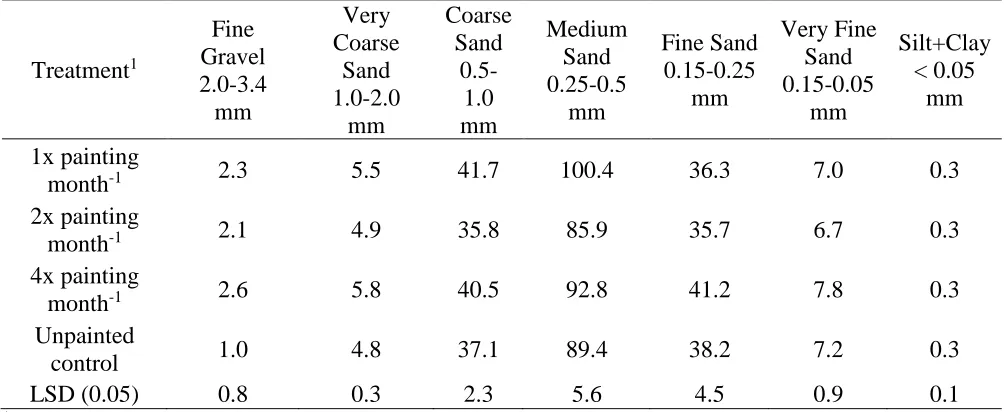
Table. 1.1 The effect of athletic field paint regimes on particle size analysis in Ames, IA in
2018………18
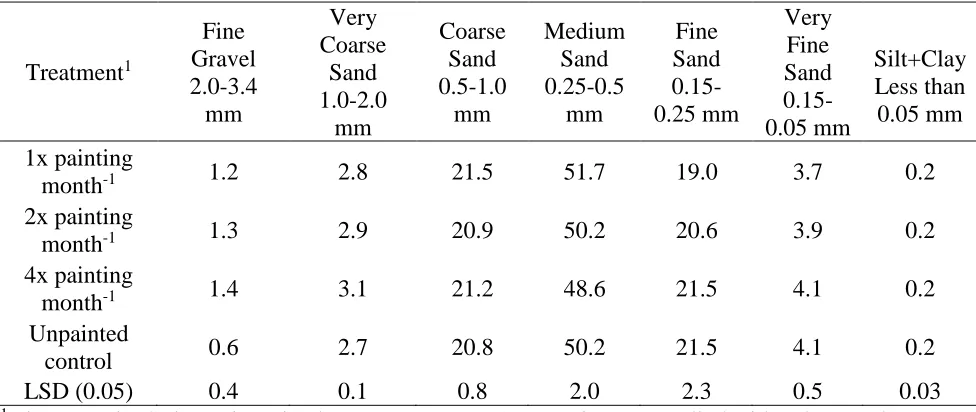
Table 1.2 Percent particle size of a sand-based rootzone subjected to various athletic field marking treatments in Ames, IA, in 2018.……..………..19
Table 1.3 Falling head water infiltration rates for various athletic field painting frequency
ABSTRACT
Athletic field paint is a major part of an athletic field maintenance budget, and can
require many hours of work to apply. Sports turf managers often complain about a lack of
turfgrass growth and slower drainage in heavily painted portions of their field. Little is known
about how repeated athletic field paint applications will change sand-based rootzone
characteristics. A study using Kentucky bluegrass and perennial ryegrass grown in flats on a
sand-based rootzone was conducted at Iowa State University to determine if repeated athletic
field paint applications would change a sand-based rootzone particle size and water infiltration
rate. Four different painting regimes were used: unpainted control, 1x painting month-1, 2x
paintings month-1, and 4x paintings month-1 for six months. All paint was applied at an
application rate of 1,138 ml of paint m-2. Athletic field paint was applied as an athletic field
manager would apply it. At the end of the study, flats were tested for infiltration rates as well as
particle size analysis. Repeated applications of athletic field paint caused an increase of 2 to 2.5
times the weight of fine gravel sized particles. No changes were noticed for the smaller sized
particles. Infiltration rates were 0.9% less on two of the three painting frequency treatments as
compared to the unpainted control. These results suggest that athletic field paint will join the
sand particles together causing it to be greater in size than the unpainted sand particles, and can
CHAPTER 1.
Introduction
In the cool-season climate, Kentucky bluegrass (Poa pratensis L.) and perennial ryegrass
(Lolium perenne L.) are the most commonly used turfgrass species for athletic fields (Christians
et al., 2017). These species produce an aesthetically pleasing, dense, traffic tolerant, high quality
turfgrass cover (Christians et al., 2017). Kentucky bluegrass has a rhizomatous growth habit that
enables the turf to spread laterally, allow players to make athletic moves, and recover from wear
and heavy foot traffic (Beard, 1973). The underground buds are protected from foot traffic,
which allows the plant to quickly recover when damaged above ground (Christians et al., 2017).
However, Kentucky bluegrass is slow to establish from seed, as it may take up to 28 days for
germination alone (Christians et al., 2017). Due to this, additions of a faster germinating turf like
perennial ryegrass are often added to Kentucky bluegrass stands; perennial ryegrass can
germinate in five days (Christians et al., 2017). Perennial ryegrass has a fine to medium leaf
texture and is also very wear tolerant, which allows it to blend in well with Kentucky bluegrass
on athletic fields. The two species, when managed correctly, complement each other well and
make for a high-quality athletic field cover. In the transition zone, bermudagrass (Cynodon Spp.)
athletic fields are often overseeded with perennial ryegrass because of its ability to germinate
quickly, add color, as well as protection to dormant bermudagrass athletic fields.
Sand-based rootzones
The success of many athletic fields starts with a good rootzone. Puhalla et al. (1999)
states that most athletic field managers would agree that the greatest improvement to an athletic
drainage. Surface drainage is achieved with either a flat field sloped to one side or a crowned
field sloped from the center of the playing surface; most fields are sloped at 1 to 1.75% slope
(Puhalla et al., 1999). Some sports that require a lot of ball-to-surface contact, like soccer, have a
lower percent slope (Puhalla et al., 1999). Multi-use fields will tend to use less slope to prevent
the field from influencing the play.
When surface slope is not achievable, or additional drainage is needed, improvements
should be made to the internal drainage of an athletic field. A sand-based rootzone meeting
certain specifications is often selected for athletic fields that require a large amount of internal
drainage. Sand is often used for athletic fields because it does not compact, and generally
provides good drainage due to larger porosity (Christians et al., 2017). Sand can be added in
small increments to existing athletic fields by topdressing, or in large amounts during new
construction. Typical sand-based athletic field rootzone construction consists of perforated
drainage tiles with four inches of pea gravel placed over the subgrade, and then a final 12 inches
of sand-based rootzone placed over the top (Christians et al., 2017). Often the sand-based
rootzone has some organic matter (10-20% based off of physical properties of the rootzone mix)
like peat moss added to the mixture (Christians et al., 2017). The performance of a sand-based
rootzone will be determined by the particle size distribution used in the rootzone mixture. Thoms
et al. (2016) has reported that sand-based rootzones have increased turfgrass cover during
periods of traffic with increased soil moisture, as compared to native soil athletic fields.
However, Dickson et al. (2018) reported that athletic field traffic on sand-based rootzones with
increasing soil moisture levels experienced a greater turfgrass cover decline as opposed to
Many turfgrass cultural practices are needed to maintain a high quality sand-based
athletic field. Perhaps the most important cultural practice is aerification and sand topdressing to
reduce compaction and lower thatch levels (Christians et al., 2017). Soil compaction and thatch
buildup can reduce water infiltration and slow turfgrass growth (Christians et al., 2017). The
United States Golf Association recommends that 15 to 20% of the surface area of a sand-based
rootzone is affected by aeration during a calendar year to limit thatch buildup. Soil organic
matter can also increase in the rootzone from the continual death and growth of turfgrass roots
(Christians et al., 2017). Roots will grow and spread in pore space of the rootzone around the
particles, and as these roots die, the pore space becomes clogged. This clogging of the pore space
can limit water infiltration and turfgrass performance.
Turf colorants
Pigments are often used on golf courses and athletic fields to create a more aesthetically
pleasing appearance and to hide turfgrass problems (Gann, 2013). Golf course superintendents
use different products to combat summer creeping bentgrass (Agrostis stolonifera L.) decline,
some of which have pigments in them such as copper, zinc oxide, and titanium dioxide (Gann,
2013). Gann (2013) reported that many of the pigment containing products used on golf greens
actually lowered the plants ability to cool itself and ultimately slowed recovery.
Recently, turfgrass managers are using green colorant as an “instant overseeding”
management practice on dormant warm-season turfgrasses (Miller, 2011). Turfgrass colorants
are put into one of two groups: paints or dyes (Pinnix et al., 2018). Overseeding with a
cool-season species has been traditionally used on dormant bermudagrass in transition zone
(Christians et al., 2017). Turf colorants are used to provide a green colored field during the
during the spring when transitioning back to bermudagrass, due to competition with
bermudagrass from the cool-season turfgrass (Miller, 2011). Clumps of perennial ryegrass
become problematic and often difficult to eradicate especially if spring conditions are favorable
with cool and wet weather (Miller, 2011). Applying turf colorants to dormant bermudagrass
provides turf managers an alternative to overseeding. Many different turf colorants exist in the
turfgrass industry, and can vary in cost from $30 to $75 per gallon (Miller, 2011). The average
cost of a turfgrass colorant needed for a 2-acre field would range between $400 to $1,000 per
application depending on brand and rate of colorant used. Overseeding can cost up to $1,000
without the cost of mowing included (Miller, 2011). Many of these turf colorant products will
wear off by 56 days after application, but increasing the rate of application from 80 gallons per
acre (gpa) to 160 gpa helped to increase the duration of the color (Miller, 2011). Turf colorants
do have their drawbacks; they will stain any protective padding or concrete they touch, and you
need a good sprayer to put them out (Miller and Pinnix, 2014). Many of the turf colorants will
fade from a green to a blue hue over the season (Miller and Pinnix, 2014). Color transfer from
the turf to the athlete’s uniform is another negative aspect to using turf colorants. Pinnix et al.
(2018), reported that color transfer was greatest when turf colorants were applied at 25°C as
opposed to 45°C or 60°C. Transfer of the turf colorant also varied by product, and that Spaint,
Green Dye Turf, and Green Turf Paint all demonstrated less color transfer than other products
(Pinnix et al., 2018).
Athletic Field Paint
Field painting has come a long way since its days of lime, chalk, and oil-based paints
(Whitlam, 2001). The primary goal when painting athletic fields is to maintain the quality of turf,
preferred paint because they are less harmful to the plant. Athletic field paint consists of four
main components: pigments (calcium carbonate [CaCO3], silicates, talc, and clay), binder (latex
resin), solvents (water), and additives (Reynolds et al., 2012). Each ingredient could be a
contributing factor of the degradation of turf quality. Latex has become the binder most often
used in field painting due to its unique structure and ability to be reduced with water (Whitlam,
2001). Once latex is applied and dried, it forms a unique polymer network of lattices (Whitlam,
2001). These structures build on one another to create a film of paint, and this paint structure still
allows the plant to breathe and transpire (Whitlam, 2001).
Common pigments in white, black, and red paint are titanium dioxide (TiO2), Carbon (C),
and iron oxide (Fe2O3) (Reynolds et al., 2012). When it comes to turf paints, there are two
ingredients to which groundskeepers should be concerned with: TiO2 and CaCO3 (Steinbach,
2000). TiO2 contributes to the brightness of white paint, therefore the more TiO2 the brighter the
paint. Paint concentrate can be used at different ratios mixed with water for desired shades of
paint, or varying the ratios of TiO2 can vary the brightness of white paint. CaCO3 is often
substituted into paint for TiO2. Repeated applications of CaCO3 from marking a field will lead to
build up in the soil (Steinbach, 2000). CaCO3 plays an important role in the soil as it is usually
used as a source of lime (Buckman and Brady, 1969). Turf managers will use CaCO3 containing
products to increase soil pH and balance the Cation Exchange Capacity (CEC) in their soils
(Christians et al., 2017). Too much of CaCO3 can change the pH and be harmful on trace
elements and ultimately tie up other elements like potassium and magnesium, which can create
deficiencies within the plant (Christians et al., 2017). Colored paints typically have even higher
levels of CaCO3 than white paints, so turf managers should limit the use of these paints
Athletic field painting can become very expensive, often making up the largest part of an
athletic field managers budget. During Iowa State University’s football season over 150 gallons
of paint are applied to MidAmerican Energy Field inside of Jack Trice Stadium before each
home game, taking 55 hours of labor to paint the field (Tim Van Loo personal communication,
2019). Van Loo estimates he spends $12,250.00 per year on athletic field paint. Athletic field
paint is available in a variety of forms. Aerosol paint is typically used for small athletic field
logos and lines, but often has a higher product cost. Additionally, aerosol paint color choices are
more limited than bulk paint, and can harm the turfgrass more than bulk paint.
Athletic field managers that use large amounts of paint will often use bulk paint, typically
shipped in 5 or 55 gallon containers. These paints can be used as a concentrate, or water can be
added to the paint to increase the coverage area. Often paint mixing ratios are one part water to
one part paint concentrate, however some athletic field mangers will add two or three parts water
to one part paint concentrate. The additional water is added to help lower the cost of painting, but
the painted area is often less durable due to a lower amount of paint pigment. Instead of adding
additional water to the mixture, some turf managers will try to stunt the painted turfgrass growth.
This can be achieved by adding plant growth regulators (PGR’s) to athletic field paint. Many
athletic field managers use a PGR like trinexapac-ethyl (Primo) in their paint. The label suggests
an addition of 1 oz. of Primo to every gallon of mixed paint for athletic field lines which should
cover 1,000 ft2 (Primo label, Syngenta). No labeled rates are suggested for athletic field logos.
Athletic field paint research
Previous research has been conducted on athletic field paints and its impact on light
spectral quality, photosynthesis, transpiration, and canopy temperature in bermudagrass
of carbon dioxide and oxygen through leaf stomata (Reynolds et al., 2016). Athletic field paints
are applied to completely coat the leaf, and as a result gas exchange is limited (Reynolds et al.,
2016). These changes to the respiration rate could potentially lead to a lack of carbon in the leaf,
and lower levels of evaporated cooling (Reynolds et al., 2016).
Reynolds et al. (2012) noted that weekly applications of athletic field paint to turfgrass
reduced photosynthesis, and that some colors had more of an effect. It was also reported that
changes were made in the photosynthetically active radiation (PAR) depending on paint color,
and that paint color could contribute to the decline in turfgrass quality (Reynolds et al., 2012).
Segars and Moss (2014) reported that darker paint colors reduced net photosynthesis and raised
canopy temperatures. Reynolds et al. (2012) noted that white paint reduced net photosynthesis,
probably due to a reduction of PAR.
Reynolds et al. (2016) investigated different colored paints and their effects on canopy
temperature, transpirational water loss and vapor pressure deficit (VPD) on bermudagrass. Black,
blue, yellow, orange, red, and white paints were tested in this study. Reynolds et al. (2016)
reported that black and blue paints showed the highest increase in VPD while having the lowest
transpirational water loss, compared to the non-painted control. White, yellow, orange and red
paints had canopy temperature ranges in the ideal ranges of 27 to 35oC for bermudagrass
(Reynolds et al., 2016). Blue and black paints impacted transpiration the most and raised the
canopy temperatures between 39.6 and 40.5oC which is well above the ideal range (Reynolds et
al., 2016). Heat stress is common when temperatures increase above the upper level of the ideal
temperature range. The relationship between reduced transpiration and increased canopy
temperatures in painted turfgrass plots can be linked to the ability of paint pigments to obstruct
Paint pigments are believed to impede the ability of CO2 from entering, and O2 from
exiting the plant via stomatal clogging (Reynolds at el., 2016). Additionally, Reynolds at el.
(2012) reported that as a result of paint color, photosynthetically active radiation, broadband, and
narrowband spectrometry support the theory that TCP can be changed by these alterations and
reductions in light spectral quality.
Lenz (2016) investigated how adding paint to soil would change the chemical properties
of the soil, and if the paint would breakdown at different rates. There were no differences in CEC
between paint products tested, however all CEC dropped for months two-three and then went up
by month six (Lenz, 2016).
According to athletic field paint manufacturers, athletic field paint can contain clay as a
carrier for the paint. Repeated applications of a small sized particle such as clay could slow water
infiltration and change the soil physical properties. Data are lacking on how repeated
applications of athletic field paint can change the particle size analysis of a sand-based rootzone.
The objective of this research is to investigate the effect of various athletic field painting regimes
on the soil particle size of a sand-based athletic field rootzone.
MATERIALS AND METHODS
Flat Preparation
Sixteen 50.8 cm by 35.6 cm by 8.9 cm flats were filled with a sand-based rootzone. Initial
sand particle size specifications are as follows: 3.4-2.0 mm (0.6%), 2.0-1.0 mm (2.7%), 1.0-0.5
mm (20.8%), 0.5-0.25 mm (50.2%), 0.25-0.15 mm (21.5%), 0.15-0.05 mm (4.1%), <0.05 mm
fields. A mesh screen was cut and placed at the bottom of each greenhouse flat before the
addition of the sand-based rootzone to prevent the loss of sand through the drainage holes. Once
the sand was placed into the flats, the measured rootzone depth in each greenhouse flat was
determined to be 7.62cm. Each test flat was then seeded on 12 Dec. 2017 with a 70% ‘Rush’
Kentucky bluegrass (Poa pratensis L.) and 30% 5 iron (‘Apple’ SGL, ‘Fastball’ RGL,
‘Grandslam’ GLD, ‘Infusion’ and ‘Wicked’) perennial ryegrass (Lolium perenne L.) at 195.3kg
ha-1. Scotts Turf Builder Starter Brand Fertilizer (24-25-4) was applied at a rate of 73 kg nitrogen
ha-1 to every flat. Once the seed and fertilizer was evenly distributed, light topdressing of sand
was then added to ensure an optimum seed-to-soil contact.
Flat Establishment
Flats were placed randomly under an automatic above-ground irrigation system. This
system was constructed using schedule 40 polyvinyl chloride (PVC) pipe, a Hunter electric
controller (Node, San Marcos, CA), a Hunter (Pro-spray PRS40, San Marcos, CA) valve and two
Hunter (MP 800SR 90-210o Rotators, San Marcos, CA) misting nozzles. Flats were placed under
the system, and irrigation was added as necessary to prevent drying of the surface, as observed
by the primary investigators. The establishment program was determined to be two minutes
every two hours allowing the seed to stay wet, making it an optimum environment for
germination. After six days, germination was documented. Establishment irrigation continued for
four weeks until it was determined that germination was completed by the investigator. The
water was reduced to five minutes, twice a day. Regular mowing practices were preformed once
the plots hit four inches in height with a hand shears and clippings were returned back into the
Additional fertility was added after eight weeks. A 30-0-5 fertilizer was applied at 68 kg
nitrogen ha-1. All flats were spiked with 52 solid tine aerification holes once during the growing
season to allow air into the rootzone and improve the turfgrass growing conditions.
Painting Applications
Paint treatments were applied starting 1 April 2018. Four different paint regimes were
applied to best mimic paint regimes of athletic field managers. Each paint regime was replicated
four times. The paint regimes were as follows:
• Once week-1
• Once month-1
• Once 2 weeks-1
• Unpainted control
These regimes were based on feedback from a survey of Iowa Sports Turf Manager
Association members. Athletic field paint is typically applied before events, and some sports
field managers will apply paint during times when the field is not in use to avoid having to
re-measure the playing surfaces. Paint treatments were applied as a randomized complete block
design with four replications.
Each paint application was performed with a Graco Ultra Corded Airless Handheld Painter
(17M356 Ultra 120V, Minneapolis, MN), and was calibrated to 2500 psi. This is a standard
pressure for an average airless athletic field painter. The paint used was Pioneer Brite Stripe
White Paint (Cleveland, OH), and was mixed at 1:1 paint:water ratio. Before each application,
System, Baltimore, MD) until the paint concentrate was thoroughly in suspension. Then the
water was added and mixed into suspension. Each application was applied at the same pressure
and from the same distance from the ground (15 cm). The painter was calibrated for 1138 ml of
paint mixture m-2. This program lasted six months, typical of the athletic field painting season in
Iowa.
Data Collection
At the conclusion of the painting regime, all flats were taken into the laboratory for soil
physical property testing. In-situ water infiltration rates were tested on every greenhouse flat, this
was completed with a double ring infiltrometer with three samples per plot. This followed
methods described by (Klingenberg et al., 2013).
Nine rootzone samples were taken from each flat for particle size analysis. Thatch and
vegetation were removed from every sample before particle size analysis was conducted.
Samples were then placed in an oven and dried at 105° C for 48 hours. After this, samples were
then placed into brass sieves (Turf-Tec International, Tallahassee, FL) for particle size analysis.
The following brass sieves were placed in sequential order from largest to smallest to complete
the particle size analysis:
• Fine Gravel- 3.4 mm
• Very course – 2.00 mm
• Coarse - 1.00 mm
• Medium - 0.5 mm
• Fine - 0.25 mm
• Silt and Clay - 0.05mm
Samples were each tested separately according to methods described by the USGA Green
Section Record. After particle separation sand remaining on that sieve was weighed on a digital
scale.
Data were analyzed using SAS (Version 9.1, Cary, N.C.) with ProcMixed ANOVA.
Treatment means were separated with Fishers Least Significant Difference at the P>0.05 level of
significance. No differences were determined between samples, as a result samples were pooled.
Results
Significant differences were determined for particle size analysis for actual particle size
analysis and percent of the sample size tested. Differences existed in saturated falling head water
infiltration rates between treatments.
Particle Size Analysis by Weight
While all treatments started with the same rootzone mix, at the conclusion of the study
differences existed between painting treatments for fine gravel (3.4-2.0 mm) sized particles
(Table 1). All treatments that received athletic field paint had at 2.1% more fine gravel sized
particles (2.6 g for 4 paintings month-1, 2.3 g for 1 painting month-1, and 2.1 g for 2 paintings
month-1) by weight, which was more than the unpainted control (1.0 g). There were no
differences between painting frequency for fine gravel sized particles. Painting 4 month-1 (5.8 g)
and painting 1 month-1 (5.5 g) resulted in an increase of 1.1% very coarse sand (2.0-1.0 mm
sand (1.0-0.5 mm sized particle), where the 1 painting month-1 (41.7 g) and the 4 paintings
month-1 (40.5 g) were 1 to 1.1% greater than the unpainted control (37.1 g).
One painting month-1 resulted in greater (100.4 g) medium sand (0.5-0.25 mm) sized
particles than all other treatments. Four paintings month-1 and unpainted control (92.8g and 89.4
g) had 1.1% less medium sized particles than the one painting month-1. Two paintings month-1
(85.9 g) had 1.2% fewer medium sized particles than one painting month-1 and four paintings
month-1. For fine sized particles (0.25-0.15 mm), the 4 paintings month-1 (41.2 g) was greater
than other paint treatments tested (36.3 g for 1 painting month-1, and 35.7 g for 2 paintings
month-1) but not the unpainted control (38.2 g).
Four paintings month-1 (7.8 g) resulted in 1.2% more very fine sand sized particles than 2
paintings month-1 (6.7 g) for very fine sand (0.15-0.05 mm). No differences were detected
between other treatments (7.0 g for 1 painting month-1 and 7.2 g for the unpainted control). No
differences were detected in silt and clay (less than 0.05 mm sized particles) sized particles
between treatments.
These results suggest that painting an athletic field four times month-1 could result in
binding the sand-based rootzone together as compared to the unpainted rootzone. In every
particle size breakdown, the 4 paints month-1 was greater than the unpainted control where
differences were observed. This binding of sand particles will create larger sand particles, thus
making these particles seem larger than when they were installed as the original mixture.
Reynolds et al. (2016) reported similar results in which turfgrass leaf tissue was thicker when
painted compared to unpainted leaves.
When determining sand-based rootzone analysis, sometimes it is useful to look at the
amount of particles by weight as a percent of the entire rootzone mixture. With this analysis, the
unpainted control (0.6%) had fewer fine gravel (3.4 mm to 2.0 mm) sized particles than all paint
treatments (Table 2). Painting 4 month-1 (3.1%) resulted in greater very coarse sand (2.0-1.0 mm
sized particles) than 2 paintings month-1 (2.9%) and 1 painting month-1 (2.8%), which were
greater than the unpainted control (2.7%). One painting month-1 (51.7%) resulted in greater
medium sand (0.5-0.25 mm) sized particles than 4 paintings month-1 (48.6%). Painting 4 month-1
(21.5%) and the unpainted control (21.5%) resulted in greater fine sand (0.25-0.15 mm particle
size) than the 1 painting month-1 (19.0%). There were no differences between the unpainted
control and two paintings month-1 (50.2%, and 50.2% respectively) for medium sand (0.25-0.5
mm particle size). No differences existed between treatments for coarse sand (1.0-0.5 mm) sized
particles, very fine sand (0.05-0.15 mm), and silt + clay (less than 0.05 mm) as demonstrated in
Table 1.2.
Repeated athletic field painting changed the percentage of the sand-based rootzone
mixture to contain 2-2.3% more large sized particles, when compared to the unpainted control.
These results suggest that repeated athletic field paint will change the percentages of the
sand-based rootzone from the original construction mix.
Water Infiltration
Water infiltration rates can change with a loss or clogging of rootzone pore space. One
painting month-1 (2.6 cm 15 min-1) resulted in a lower infiltration rate than all other treatments.
Four paintings month-1 (2.7 cm 15 min-1) resulted in a 0.9% less infiltration rate than both the
unpainted control (2.9 cm 15 min-1), and 2 paintings month-1 (3.1 cm 15 min-1). These results
rootzone, but that the change is not always incremental with the increased frequency of painting.
Lenz (2016) reported that with the addition of paint to the rootzone the saturated hydraulic
conductivity did not decrease immediately after the application of paint. It was hypothesized that
the paint coated the sand particles and caused the water to be repelled, thus increasing the water
infiltration (Lenz, 2016).
Conclusion
Results from this study indicate that athletic field paint will bind the sand particles, even
if it is applied to turfgrass cover. The athletic field paint will cause the rootzone mixture to shift
to contain a larger percentage of coarse material from the original mixture specifications. After
six months of painting even weekly, there was no increase in silt and clay sized particles
compared to the unpainted control. This was a bit surprising, as clay is often used in athletic field
paint as a part of the concentrated paint. The rootzone shift to contain more large sized particles
did not improve water infiltration characteristics, and in two out of three paint treatments it
actually lowered the infiltration rate.
Future research is needed on additional paint products and mixing ratios, as well as how
they affect the rootzone characteristics like particle size, porosity, bulk density, and infiltration
rate. It would also be useful to know if various colors would change the rootzone characteristics,
as it has been mentioned in the literature how colors contain different ingredients than white
athletic field paint.
What is not known is if these changes in particle sizes will be present over a longer study,
or if they will go away with time. Previous studies have demonstrated changes in rootzone
this would happen over a low temperature period like winter, as the previous research was done
in a greenhouse.
References:
Beard, J.B. 1973. Turfgrass: Science and culture. Prentice-Hall, Englewood Cliffs, NJ.
Buckman, H.O., and N.C. Brady. 1969. The nature and properties of soils, 7th ed. Macmillan,
New York, p. 418.
Christians, N.E., A.J. Patton, and Q.D. Law. 2017. Fundamentals of turfgrass management. 5th
Ed. Wiley and Sons. Hoboken, NJ.
Dickson, K.H., J.C. Sorochan, J.T. Brosnan, J.C. Stier, J. Lee, and W.D. Strunk. 2018. Impact of
soil water content on hybrid bermudagrass athletic fields. Crop Sci. May/June.
58(3):1416-1425.
Gann, J. 2013. Evaluaiton of pigment-containing products on creeping bentgrass [Agrostis
stolonifera L. var palustris (Huds.)] performance. M.S. Thesis. Clemson, SC.
Klingenberg, M.T., D. Li, N.E. Christians, and C.J. Blume. 2013. Core aeration programs and
sand topdressing improve creeping bentgrass fairways. Intl. Turfgrass Soc. Res. J.
12:151-156.
Lenz, J. 2016. Degradation of paint in a sand-based sports turf media. M.S. Creative Component.
Ames, IA.
to pigment-containing products. Agron. J. 106:1533-1539.
Miller, G., and D. Pinnix. 2014. Green sports fields using turf colorants. SportsTurf. Aug. p. 20-
22.
Miller, G. 2011. Turning fields green using turf colorants. SportsTurf. Dec. p. 16-19.
Pinnix, G.D., R.K. McCauley, and G.L. Miller. 2018. Air temperature effects on turfgrass
colorant transfer. Crop Forage Turfgrass Manage. 4:170091. 1-6.
doi:10.2134/ctfm2017.12.0091.
Puhalla, J., J. Krans, and M. Goatley. 1999. Sports fields: A manual for design construction and
maintenance. Wiley and Sons. Hoboken, NJ.
Reynolds, W.C., G.L. Miller, D.P. Livingston III, and T.W. Rufty. 2016. Athletic field paint
color impacts transpiration and canopy temperature in bermudagrass. Crop Sci.
56:2016-2025.
Reynolds, W.C., G.L. Miller, and T.W. Rufty. 2013. Athletic field paint color differentially alters
light spectral quality and bermudagrass photosynthesis. Crop Sci. 53:2209-2217.
Reynolds, W.C., G.L. Miller, and T.W. Rufty. 2012 Athletic field paint impacts light spectral
quality and turfgrass photosynthesis. Crop Sci. 52:2375-2384.
Segars, C.A., and J.Q. Moss. 2014. The effects of athletic-field paint color on net photosynthesis
and canopy temperature of overseeded perennial ryegrass. Applied Turfgrass Sci. 1-3.
Steinbach, P. 2000. The art of lining fields, rinks, tracks, and courts requires science
know-how. Athletic Business. April.Retrieved March 15, 2019.
Thoms, A.W., J.T. Brosnan, and J.C. Sorochan. 2016. Rootzone construction affects hybrid
bermudagrass responses to simulated traffic. Procedia Eng. 147:824-829.
Table. 1.1 The effect of athletic field paint regimes on particle size analysis in Ames, IA in 2018. Treatment1 Fine Gravel 2.0-3.4 mm Very Coarse Sand 1.0-2.0 mm Coarse Sand 0.5-1.0 mm Medium Sand 0.25-0.5 mm Fine Sand 0.15-0.25 mm Very Fine Sand 0.15-0.05 mm Silt+Clay < 0.05 mm 1x painting
month-1 2.3 5.5 41.7 100.4 36.3 7.0 0.3
2x painting
month-1 2.1 4.9 35.8 85.9 35.7 6.7 0.3
4x painting
month-1 2.6 5.8 40.5 92.8 41.2 7.8 0.3
Unpainted
control 1.0 4.8 37.1 89.4 38.2 7.2 0.3
LSD (0.05) 0.8 0.3 2.3 5.6 4.5 0.9 0.1
1 Pioneer Brite Stripe paint mixed at 1 part water to 1 part paint was applied with a Graco Ultra
Table 1.2 Percentage particle size of a sand-based rootzone subjected to various athletic field
marking treatments in Ames, IA, in 2018.
Treatment1 Fine Gravel 2.0-3.4 mm Very Coarse Sand 1.0-2.0 mm Coarse Sand 0.5-1.0 mm Medium Sand 0.25-0.5 mm Fine Sand 0.15-0.25 mm Very Fine Sand 0.15-0.05 mm Silt+Clay Less than 0.05 mm 1x painting
month-1 1.2 2.8 21.5 51.7 19.0 3.7 0.2
2x painting
month-1 1.3 2.9 20.9 50.2 20.6 3.9 0.2
4x painting
month-1 1.4 3.1 21.2 48.6 21.5 4.1 0.2
Unpainted
control 0.6 2.7 20.8 50.2 21.5 4.1 0.2
LSD (0.05) 0.4 0.1 0.8 2.0 2.3 0.5 0.03
1 Pioneer Brite Stripe paint mixed at 1 part water to 1 part paint was applied with a Graco Ultra
Table.1.3. Falling head water infiltration rates for various athletic field painting frequency treatments in Ames, IA in 2018.
Treatment Water infiltration rate (cm 15 min-1)
1 painting month-1 2.6
2 paintings month-1 3.1
4 paintings month-1 2.7
Unpainted control 2.9
LSD (0.05) 0.03
1 Pioneer Brite Stripe paint mixed at 1 part water to 1 part paint was applied with a Graco Ultra