Copyright © 2016 (Christian von Sikorski). Licensed under the Creative Commons Attribution Non-commercial No Derivatives (by-nc-nd). Available at http://ijoc.org.
The Effects of Reader Comments on the
Perception of Personalized Scandals: Exploring the
Roles of Comment Valence and Commenters’ Social Status
CHRISTIAN VON SIKORSKI1
University of Vienna, Austria
Reader comments posted below online news articles may affect a reader’s issue perception. However, it remains unknown how people are influenced by commenters’ social status information (high versus low). Potential effects were examined in a 2 (opposing/supporting/no comments) × 2 (high-status/low-status/no comments) between-subjects online experiment in connection with a mediated scandal. A multivariate analysis of covariance revealed that most of the effects—for example, on individuals’ scandal perception and their demanded punishments—were triggered by opposing comments and when high-status commenters had posted the comments. The effects of supporting comments were rather limited.
Keywords: media effects, reader comments, social status, scandal
Today, various online news media allow users to comment on news stories in comment boxes below professionally edited news articles (Singer, 2010). The posting of reader comments gives users the opportunity to emphasize and evaluate certain aspects of the stories and enables them to add their own opinions as well as particular aspects that, from an individual’s perspective, have not been addressed sufficiently in a news story (Toepfl & Piwoni, 2015). Scholars currently consider the commenting of online news stories the most popular and widely used form of online participation (e.g., Ziegele, Breiner, & Quiring, 2014). So-called lurkers, who read comments without commenting themselves, frequently read the contributions of others to better understand topics (Metzger, Flanagin, & Medders, 2010). According to a current study (representative for the U.S. population), 55% of Americans have left an online comment, and 77.9% have read comments online. Furthermore, 69.9% of lurkers report reading comments on social media sites, and 41.8% read comments (below news articles) on news sites or news apps (Stroud, Van Duyn, & Peacock, 2016). From a democratic theory perspective, posting comments as well as reading the contributions of other users can be regarded a positive development, because people can easily exchange different viewpoints, thus increasing freedom of speech and (at least in theory) enriching public discourse in a democratic way (Dahlgren, 2005).
Christian von Sikorski: [email protected] Date submitted: 2016–04–20
1 The research discussed in this article was financially supported by a grant of the Faculty of Social
Yet previous research has shown that reader comments are frequently unrepresentative (Freeman, 2011) and/or factually incorrect (Singer, 2010) and that users tend to comment on issues in a one-sided and judgmental manner (Chmiel et al., 2010). Researchers have begun to explore the effects of reader comments in connection with discussions of controversial topics. These first studies revealed that uncivil comments (Anderson, Brossard, Scheufele, Xenos, & Ladwig, 2014) and comments discrepant from the news slant (Lee, 2012; Lee & Jang, 2010) may systematically affect other readers’ perceptions of issues such as nanotechnology and animal testing.
However, in addition to writing comments that oppose the framing of an online news story, users may post comments that support the general framing of a news article (von Sikorski & Hänelt, 2016). Especially news stories that are negatively framed—such as crisis news and scandals—frequently trigger one-sided and judgmental comments (Chmiel et al., 2010; Pörksen & Detel, 2014). Reader comments that emphasize the negative framing of a news story may result in even stronger effects (a combination of a negatively framed article and negative comments), because research has shown that negative information has a stronger impact than positive information on an individual’s information processing (Baumeister, Bratslavsky, Finkenauer, & Vohs, 2001). Therefore, the present study advances research on the effects of one-sided comments by analyzing comments that are in line with as well as comments that oppose the framing of a professionally written online news article.
Previous research has not analyzed whether and how available information about users posting comments (e.g., their names/pseudonyms) influences the effectiveness of the comments. In addition to using a user’s name or pseudonym to identify with a commenter (Walther, DeAndrea, Kim, & Anthony, 2010), readers may use a name or pseudonym to infer the (alleged) social status of a contributor (Ball, Eckel, Grossman, & Zame, 2001). The perceived status of other people can significantly influence an individual’s perceptions and decision making (de Kwaadsteniet & van Dijk, 2010; Weisband, Schneider, & Connolly, 1995), and the contributions of users who are perceived as high-status individuals (e.g., highly educated) can potentially generate stronger effects because people may tend to perceive their comments as more convincing than comments posted by lower-status individuals (Eastin, 2006).
whether it was really reprehensible, would prevail. In scandal, consensus about the reprehensibility would dominate” (Esser & Hartung, 2004, p. 1047).
In summary, scandals can be defined as incidents in which specific social norms and values are (allegedly) infringed (transgression). And these (alleged) transgressions have to be publicly communicated and negotiated via the mass media and must be framed as a scandalous incident (Entman, 2012).2 Finally,
an incident that is framed as scandalous has to evoke a reaction—disapprobation—by the public (Thompson, 2000).
The media—in addition to reporting about political and financial scandals—regularly focuses on food scandals (Bánáti, 2011; Esser & Hartung, 2004). Food scandals have been extensively covered by the media—for example, the BSE scandal (mad cow disease) as well as several dioxin scandals (Bánáti, 2011)—and have repeatedly triggered public discussions (Esser & Hartung, 2004). Food scandals may be considered highly relevant to readers, because people may be directly affected by a particular norm transgression in their daily lives (e.g., consumption of contaminated food). In this context, readers can particularly take advantage of available comments to receive additional information, experiences, and evaluations from other users (of high and low social status) to better understand a personalized scandal case (Metzger et al., 2010). The present study examines a typical food scandal in which a foodstuff company and its managing director are scandalized for (allegedly) circulating dioxin-contaminated animal feed used for food production (Bánáti, 2011). The study has three main aims: First, it examines whether and how reader comments that additionally highlight scandalous information, supporting the framing of a news story, and comments that oppose the framing of a news story by highlighting exonerating information affect a reader’s perception of the severity of a depicted dioxin scandal. Second, it examines whether one-sided comments influenced a reader’s demanded punishment for a scandalized actor and his company. Finally, I examined the impact of comments posted by high- versus low-status contributors on people’s perceptions and evaluations in connection with an online news story.
Literature Review
Previous research has examined the different effects of particular reader comments on other readers’ perceptions of online news. Lee and Jang (2010) found that one-sided and disapproving comments published below controversial news articles (e.g., on animal testing) led to more divisive perceptions of the issue. Furthermore, readers—after being exposed to comments—tended to follow the opinions of the commentators more closely. A study by Lee (2012) corroborated these findings, and her results revealed that readers of online news used the comments of other unknown readers as a relevant informational cue to infer the public opinion regarding a particular issue. In addition to one-sided and disapproving comments, uncivil comments in the comment box below an online article can influence an individual’s perception of a topic. Anderson et al. (2014) examined how uncivil comments affected perceptions of a neutral blog post from a newspaper. The article dealt with the controversial topic of
2 “To frame is to select some aspects of a perceived reality and make them more salient in a
nanotechnology, and balanced information was presented on the risks and benefits of this technology. The results of the study revealed that uncivil comments—for example, “If you don’t see the benefits of using nanotechnology in these products, you’re an idiot” (Anderson et al., 2014, p. 378)—led to a polarization of opinions. Houston, Hansen, and Nisbett (2011) analyzed the effects of comments in connection with an online news article that depicted two individuals (political candidates). In the study, all participants read the identical news article, but the comments were altered. Among other findings, they found that, in line with the third-person effect (Davison, 1983), participants who were exposed to comments attacking a political candidate perceived negative attitudinal effects on other participants.
However, to date, it remains unknown whether one-sided reader comments can influence a person’s perception of a personalized scandal (e.g., perceived severity) and his or her respective demanded punishment as a consequence of scandalous behavior. Furthermore, it remains unknown whether the particular status of commenters (high versus low) affects readers of online news in different ways. Journalists (Singer, 2010) and others have expressed concerns that (judgmental) postings of online users could contribute to misinformation (Freeman, 2011) and change the dynamics of mediated scandals (Pörksen & Detel, 2014). In particular, comments that are in line with the negative framing of a news article and are posted by high-status commenters (Eastin, 2006) may generate effects that differ from previous findings (e.g., Lee & Jang, 2010) leading—as feared by some writers—to disproportionally strong influences (Pörksen & Detel, 2014). Comments that oppose the negative framing of a news story could dampen the potential negative effects of a news story (von Sikorski & Hänelt, 2016), thus influencing how a particular scandal is understood and how scandalized individuals are evaluated (Kepplinger et al., 2012). The present study aims to test these assumptions.
Explaining the Influence of Reader Comments
(information on the source allegedly having chosen a news article) proved to be important information for users when evaluating a news article. The source cues available (either the editor, a computer, other users, or the participants themselves had chosen the respective news articles) had a systematic influence on the participants’ evaluations of online articles. When other users had (allegedly) chosen the news stories, participants perceived them to be more likable and of higher quality compared to when the participants selected the news stories themselves (Sundar & Nass, 2001).
Perception of a Mediated Scandal
Similar to the effects of available source cues (Sundar & Nass, 2001), it was expected that one-sided comments could be regarded as a bandwagon cue that may trigger cognitive shortcuts among readers. As demonstrated in previous research, available comments that contrast the framing of the news may change a person’s opinion regarding a certain issue and may result in the circumstance that an individual follows the assessments of other users (commenters) more closely (Lee & Jang, 2010). Extending this line of research, it was assumed that one-sided opposing and supporting comments will affect how a person perceives a particular mediated scandal. It was expected that comments that focus on a scandalized managing director and his company in a positive way (opposing/discrepant to the framing of a news story) by relativizing the respective scandal allegations will result in a decrease in the perceived severity of the scandal. Conversely, previous psychological research has revealed that “negative information contributes more strongly to the final impression than does positive information” (Baumeister et al., 2001, p. 323). Thus, it was expected that comments that focus on a scandalized managing director and his company in a negative way (with additional supporting scandalous information) will result in an increase in the perceived severity of the scandal. Therefore, when exposed to other users’ comments, a reader could perceive them as a heuristic cue, thus concluding that, “if everyone thinks this is a serious scandal, it must be” or “if everyone thinks this is not a serious scandal, it is not” (Sundar & Nass, 2001). Thus, the first set of hypotheses are as follows:
H1a: Participants who are exposed to reader comments supporting the framing of a news story will perceive the depicted scandal to be more serious than will participants who are exposed to no comments (the control condition).
H1b: Participants who are exposed to reader comments opposing the framing of a news story will perceive the depicted scandal to be less serious than will participants who are exposed to no comments.
Demanded Punishment
criminal offenses (e.g., robbery). Furthermore, she demonstrated that individuals used “an availability heuristic in forming punishment preferences” (p. 468). Thus, as Stalans argues, when negative information was available to an individual, he or she tended to use this information in a heuristic way, increasing the demand for a more severe punishment. Transferred to the context of the present study, people may—in line with our earlier reasoning—be affected by available (supporting or opposing) comments of other users that trigger the bandwagon heuristic (Sundar, 2008; Sundar & Nass, 2001). Reader comments that additionally highlight (potential) wrongdoings may therefore increase other readers’ demands for a severe punishment for a scandalized individual’s company as well as for the scandalized actor himself. In contrast, comments that relativize scandal allegations may result in a decreased demand for a severe punishment. Accordingly, the following hypotheses are proposed:
H2: Participants who are exposed to reader comments supporting the framing of a news story (compared to no comments) will be (a) more likely to demand a severe punishment for a scandalized company and (b) more likely to demand a severe punishment for a scandalized individual.
H3: Participants who are exposed to reader comments opposing the framing of a news story (compared to no comments) will be (a) less likely to demand a severe punishment for a scandalized company and (b) less likely to demand a severe punishment for a scandalized individual.
Particular comments, as predicted by the third-person effect (Davison, 1983; Perloff, 1993), may change a person’s perception of how others perceive an individual actor (e.g., a politician) depicted in an online news article (Houston et al., 2011). Houston et al. found that negative anticandidate comments led readers to form a more negative perception of how other users exposed to the article would perceive the candidate. Therefore, the availability of certain comments below a news story may trigger the assumption that “communications exert a stronger influence on others than on the self” (Perloff, 1993, p. 167). In line with the reasoning of H3a and H3b, and based on the initial results of Stalans (1993) and Houston et al. (2011), the following hypotheses are proposed:
H4a: Participants who are exposed to reader comments supporting the framing of a news story will be more likely to think that other people in Germany will demand a severe punishment for a scandalized individual than will participants who are exposed to no comments.
H4b: Participants who are exposed to reader comments opposing the framing of a news story will be less likely to think that other people in Germany will demand a severe punishment for a scandalized individual than will participants who are exposed to no comments.
Commenter’s Social Status
to Ball et al. (2001), social status can be defined as a person’s ranking in a hierarchy that is socially recognized. Status may be differentiated according to whether it is achieved or earned (e.g., one’s own achievement such as an academic degree) or whether it is ascribed or unearned (an inherited position or membership in a certain social group). Names or pseudonyms may signal both, belonging to a high- or low-status social group (e.g., certain names) and disclosing an earned status (e.g., academic degree, MBA, PhD). Previous research has demonstrated that available status cues may significantly affect individuals’ evaluations and behaviors. Weisband et al. (1995) analyzed the role of status cues in computer-mediated communication and found that high-status individuals tended to participate more than low-status individuals in a mediated discussion and exercised a stronger influence on the results of the communication. Eastin (2006) manipulated source cues in an online health communication context and found that information provided by a high-status source (e.g., Dr. William Blake) was perceived as significantly more credible than information provided by a low-status source (e.g., Tim Alster, a high school freshman). Based on these findings, it was expected that:
H5: Participants will (a) be affected by comments posted by high-status commenters and (b) not be affected by comments posted by low-status commenters.
Method
Participants and Procedure
A total of 275 participants (55.4% women) took part in a 2 (comments opposing the news framing, comments supporting the news framing, no comments) × 2 (high-status, low-status, no comments) online experiment (between-subjects design). The German participants3 (age M = 28.62
years; SD = 11.76) were recruited online and received no compensation for participating. The participants were randomly assigned to one of five groups (opposing/high-status, n = 54; opposing/low-status, n = 50; supporting/high-status, n = 53; supporting/low-status, n = 59; and no comments/control condition, n = 59). The participants were instructed to click on a link that led to the stimulus materials and the questionnaire. SoSci Survey software (www.soscisurvey.de) was used to conduct the experiment. The study started with a short written introduction, and the participants were guaranteed complete anonymity. Participants were informed that the study dealt with “processing of information related to the news.” However, the actual purpose of the study (the impact of comments) was not disclosed. At the end of the study, the participants were informed about the true nature of the experiment.
3 Originally, a total of 296 participants took part in the study. However, the data sets of 21 individuals
Stimulus Materials
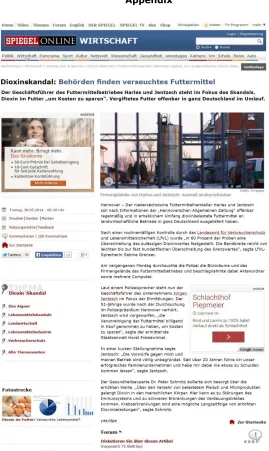
A fictitious online news article about a food scandal served as a text stimulus. In line with the more general trend of personalization in political communication (e.g., Van Aelst, Sheafer, & Stanyer, 2011) research shows that scandals are increasingly depicted in a personalized manner as well (Allern et al., 2012). In personalized scandals, individual actors (e.g., a politician, a manager) are accused of transgressing a particular norm. Therefore, the news article depicted a personalized and emerging scandal in which the managing director of a German company was accused of circulating contaminated animal feed used for food production. A fictitious and emerging scandal was used to ensure that the participants had no prior knowledge about the case. The rationale behind this was that scandals are usually extensively covered by the media, and scandalized individuals and facts and figures are thus often publicly known. Prior knowledge about a particular case would have caused several methodological problems, including the problem that a participant may have known the outcome of the scandal (e.g., whether the managing director was actually found guilty). This would have undermined the purpose of the study, so an authentic but fictitious scandal case was used. To ensure the authenticity and credibility of the scandal, the text stimulus was professionally embedded in the original layout of spiegel.de (see the Appendix). Spiegel.de is a liberal, high-quality, well-known German news site. It is among the top three news sites in Germany in terms of page views (Statista, 2015) and regularly reports about scandals. All participants read the identical news article. The participants in the four experimental conditions were exposed to five comments positioned below the article, and at the top of the forum, it was stated that the article had (allegedly) received a total of 72 comments.
Participants were exposed to comments either supporting the general framing of the news story or opposing the framing of the news article. Supporting comments were defined as negative if they additionally scandalized the manager and his company. The comments focused on the potential wrongdoing of the managing director and his company, and the fact that those responsible have to be held accountable (e.g., “Dioxin is dangerous! How can the manager live with that?” “He is endangering others, he and his company should be made responsible!”). Opposing comments were defined as positive if they exonerated the scandalized manager and his company. The comments qualified the scandal allegations against the company and the managing director and stated that it is too early to hold someone accountable regarding the depicted scandal (e.g., “This amount of dioxin is not that dangerous!”; “It’s still too early to decide if the manager or his company have endangered others. They are just trying to find someone to blame.”).
comments posted by either high-status commenters (e.g., Prof. Dr. Hans Eichert, Lydia_von_Stetten, Dr. Jochen Schmitt) or the identical comments posted by low-status commenters (Kevin_Schultheiss, Julia_mausi_90, pinacolada2.0). Group 1 participants were exposed to opposing/high-status comments, Group 2 participants to opposing/low-status comments, Group 3 participants to supporting/high-status comments, and Group 4 participants to supporting/low-status comments. The order of names/pseudonyms of the individual contributors was identical across the four experimental conditions. Participants in Group 5 were exposed to the article without any comments (control condition).
Measurement
Previous studies have successfully used single-item measures to analyze the impact of reader comments on other readers’ information processing (e.g., Anderson et al., 2014), and it has been demonstrated that single-item measures yield valid results (Rossiter, 2002). According to Rossiter (2002), it is beneficial to measure concrete attributes with the help of single-item scales instead of attempting to add synonyms (e.g., of a respective question), because this practice may decrease the validity of a measure. However, more abstract and complex constructs should be measured with the help of multiple items (Rossiter, 2002). Thus, both single-item and multiple-item measures (where appropriate) were used to examine the impact of reader comments.
Perception of the mediated scandal
The participants were asked to rate the following two items (1 = disagree, 5 = agree) that were based on previous research (Anduiza, Gallego, & Munoz, 2013): “In my opinion, the depicted case is scandalous” and “In my opinion, the depicted scandal can be regarded as a serious case.” The two items (Cronbach’s = 0.75) were combined to an index (M = 7.24, SD = 1.60).
Demanded punishment for the company
To analyze potential influences on a participant’s demanded punishment for the company, I adapted an item used by Stalans (1993). The participants were asked to rate the following statement (1 = disagree, 5 = agree): “Having looked into the case, I think that the company’s concession should be canceled” (M = 3.12, SD = 0.97).
Demanded punishment for the managing director: Effects on oneself
Demanded punishment for the managing director: Effects on others
To examine whether particular comments influenced a participant’s perception regarding other Germans’ demanded punishment of the scandalized actor, the following item, adapted from Stalans (1993), was used (1 = disagree, 5 = agree): “Having looked into the case, I think that other persons in Germany will demand a prison sentence for the managing director” (M = 3.95, SD = 1.46).
Control Variable: Involvement
Highly involved individuals who frequently expose themselves to news about scandals may process information in a systematic way. In contrast, low-involved individuals who rarely expose themselves to coverage about scandals may process information more heuristically (Petty & Cacioppo, 1986). The effects of comments may thus be stronger for individuals who tend to rely on cognitive shortcuts, whereas potential effects may be suppressed for individuals who tend to process information in a more systematic way (Lee & Jang, 2010). Based on an item used by Anderson et al. (2014), the following statement was constructed to assess an individual’s specific scandal involvement (1 = disagree, 5 = agree): “I frequently read news about current scandal cases” (M = 3.06, SD = 0.67).
Manipulation Check
All participants assigned to one of the four experimental groups reported that they had detected reader comments below the news article, and all the participants assigned to the control condition reported that they had not detected any comments. In the next step, those participants who had detected comments were asked to complete the following two items (1 = very negative, 5 = very positive): “How do you assess the reader comments posted below the news article?” (M = 2.16, SD = 1.01) and “How do you assess the overall educational level of forum contributors?” (M = 3.02, SD = 0.81). An independent-samples t test was conducted to compare the scores of the participants exposed to opposing comments that contrasted the negative framing of the news article in a positive way (M = 2.57, SD = 0.83) and comments that supported the negative framing of the article (M = 1.63, SD = 0.99). The analysis showed a significant result, t(214) = 7.43, p < .001, and, therefore, a successful manipulation was assumed. As mentioned, previous research (e.g., Eastin, 2006) has successfully operationalized an individual’s social status via his or her educational level (e.g., high educational level signals high status). In line with this operationalization, an independent-samples t test revealed that participants exposed to high-status commenters (M = 3.41 SD = 0.83) perceived the educational levels of commenters to be significantly higher than did participants exposed to low-status commenters (M = 2.91, SD = 0.80), t(214) = 2.12, p = 0.035. Although the mean group differences were rather small, the analysis revealed a significant difference, and thus a successful manipulation was assumed.
Results
model. The involvement item served as a covariate. The analysis revealed a significant effect for the condition, Pillai’s trace = 0.172, F(16, 1,076) = 3.03, p < .001, 2part = 0.043. The covariate did not show a
significant result, Pillai’s trace = 0.031, F(4, 266) = 2.09, p = 0.111, 2part = 0.031, and no interaction effect
between the condition and the participants’ involvement could be detected, Pillai’s trace = 0.095, F(20, 1,060)
= 1.27, p = 0.18, 2part = 0.024.
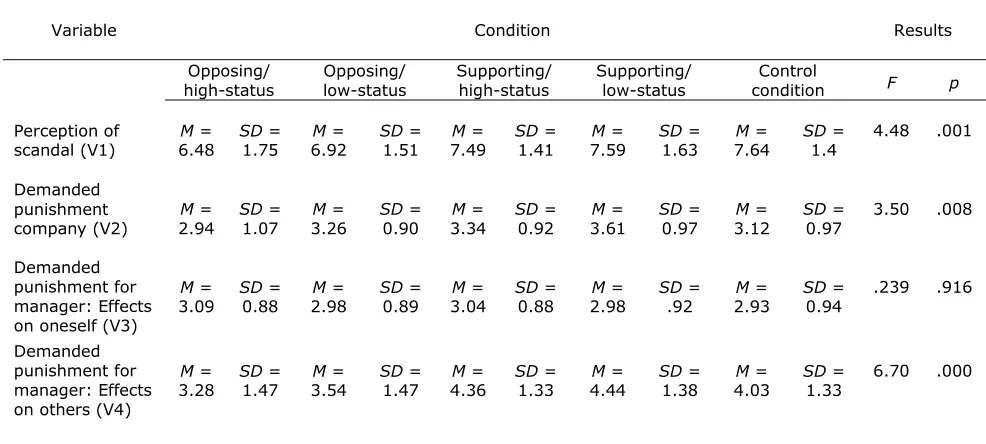
As depicted in Table 1, the condition had a significant impact on the participants’ perception of the scandal (p = 0.001, 2part = 0.067) and their demanded punishment for the company (p = 0.008, 2part
= 0.049). Furthermore, the analysis revealed an effect on the participants’ perceptions of others’ demanded punishment for the scandalized managing director (p < 0.001, 2part = 0.091). However, the
condition did not have a significant effect on the participants’ own demanded punishments for the scandalized actor (p = 0.916, 2part = 0.004). Therefore, hypotheses H2b and H3b (demanded punishment
for the scandalized manager) were not supported.
A further analysis using post hoc tests (Bonferroni)—Levene’s test indicated no significant differences for any of the dependent variables—found that participants who were exposed to opposing/high-status comments perceived the depicted case as less severe and less scandalous than did participants who were exposed to supporting/high-status (p = 0.019) and supporting/low-status comments (p = 0.006), as well as participants in the control condition (p = 0.006). No other significant effects could be detected. Therefore, H1a (effects of supporting comments) was not supported. Furthermore, no effects could be detected for the opposing/low-status condition. However, due to the effects of the opposing high/status-condition, H1b received some support.
Participants with the opposing/high-status condition were less likely to demand a severe punishment for the company (cancellation of the company’s concession) compared with participants with the supporting/low-status condition (p = 0.009). In contrast, participants who were exposed to supporting/low-status comments (compared to the control condition) were more likely to demand a severe punishment for the company (p = 0.041). No other significant effects could be detected. Thus, H2a and H3a (punishment for company)—due to the nonsignificant difference compared with the control condition—were not supported.
The analysis revealed that opposing comments posted by high-status commenters triggered several effects. However, no effects could be detected for supporting comments posted by high-status commenters. In addition, comments posted by low-status commenters led to significant effects (demanded punishment for the company, perceived effects on other people in Germany). Thus, H5a (effects of high-status comments) and H5b (effects of low-status comments) were not supported.
Table 1. Effects of Reader Comments on Dependent Variables.
Note. V = variable. V1–V4 were measured on 5-point scales (1 = disagree/negative and 5 = agree/positive). V1 consisted of two items that were combined to an index. V2–V4 were single-item measures.
Discussion
Overall, the results of this study reveal that reader comments may significantly influence how readers of online news perceive and evaluate a personalized scandal. Thus, the present examination supports and extends previous findings on the effects of reader comments (Anderson et al., 2014; Houston et al., 2011; Lee, 2012; Lee & Jang, 2010; von Sikorski & Hänelt, 2016). The results reveal that comments both opposing and supporting the framing of a news article as well as comments posted by high-status and low-status commenters influenced readers’ perceptions and evaluations regarding the depicted scandal and the scandalized manager.
Variable Condition Results
Opposing/
high-status Opposing/ low-status Supporting/ high-status Supporting/ low-status condition Control F p Perception of
scandal (V1) 6.48 M = SD = 1.75 6.92 M = SD = 1.51 7.49 M = SD = 1.41 7.59 M = SD = 1.63 7.64 M = SD = 1.4 4.48 .001 Demanded
punishment
company (V2) 2.94 M = SD = 1.07 3.26 M = SD = 0.90 3.34 M = SD = 0.92 3.61 M = SD = 0.97 3.12 M = SD = 0.97 3.50 .008 Demanded
punishment for manager: Effects on oneself (V3)
M =
3.09 SD = 0.88 2.98 M = SD = 0.89 3.04 M = SD = 0.88 2.98 M = SD = .92 2.93 M = SD = 0.94 .239 .916
Demanded punishment for manager: Effects on others (V4)
M =
However, most of the effects were triggered by opposing comments that were posted by high-status commenters. Participants who were exposed to this type of comment were more likely to assess the scandal as less severe, were less likely to demand a severe punishment for the scandalized manager’s company, and were more likely to think that other readers would demand a less severe punishment for the managing director. Interestingly, the effects of opposing comments were considerably reduced when the identical comments were posted by low-status commenters. In this condition—in line with the third-person effect (Davison, 1983)—only an effect on the participants’ perception of how other users exposed to the article would perceive the scandalized manager emerged.
In contrast, the effects of comments that additionally supported the negative framing of the news story were very limited. Supporting comments posted by low-status commenters made it more likely that participants demanded a severe punishment for the company owned by the manager (compared to the control condition). However, the detected group difference (p = 0.041) fell just below the defined level of significance (p < 0.05). Thus, future studies should try to replicate this effect by testing the robustness of respective influences of supporting comments. Surprisingly (and in contrast to my original assumption), the identical supporting comments posted by high-status commenters did not affect the participants in any way.
Therefore, participants tended to use the bandwagon heuristic (Sundar, 2008) when opposing comments countering the news framing were posted by high-status individuals, but the participants did not follow the rather negative and supporting assessments of high-status commenters. The participants may have perceived the supporting/high-status comments as biased and an unjustified evaluation of the company and the scandalized manager, because his actual responsibility remained unclear in the news article. Therefore, participants may have perceived this type of commenting as a persuasive attempt by other users, resulting in psychological reactance (Brehm, 1966). Psychological reactance theory presumes that people value the freedom of choosing among alternatives, and that state reactance occurs when an individual’s freedom to choose between alternatives has been constrained (Brehm, 1966; Dillard & Shen, 2005). The participants may have perceived the combination of the scandal news article and the one-sided and additionally scandalizing comments posted by high-status commenters as a reduction of their freedom to form an opinion based on the factual information provided by the news article (Kepplinger, 2009). Thus, state reactance that can be operationalized as an amalgamation of anger and negative cognitions (Dillard & Shen, 2005) followed, and the participants did not use the bandwagon heuristic (Sundar, 2008).
Moreover, it can be argued that the participants’ freedom in the opposing comments conditions was not reduced, but extended by contrasting and exonerating information. Individuals in these conditions were exposed to the scandalous information in the news article and the opposing opinions of other high- and low-status users. This combination of negative and exonerating information could have led to the scandal being perceived in a less one-sided manner overall. In this context, participants then used the bandwagon heuristic (Sundar, 2008) as a cognitive shortcut and followed the assessments of the high-status commenters (and, to a lesser degree, those of low-high-status commenters) more closely.
In summary, the results suggest that the high status of commenters is an influential cue when comments oppose the news framing. In contrast, the identical comments posted by low-status commenters were considerably less effective in affecting people’s perceptions and assessments. Based on previous research (e.g., Heesacker, Petty, & Cacioppo, 1983), one may argue that only commenters with a position of esteem (high status) obviously had the persuasive power and expertise to effectively oppose the framing of a credible (and high-quality) news source (spiegel.de). On the contrary, high status proved to be completely ineffective when commenters “added fuel to the fire” and commented on a scandal story in an additionally negative way. Nevertheless, when “ordinary people” (low status) agreed with the negative framing of the article (one does not need high status to agree with the framing of a credible news source), this seemed to be a relevant cue for participants’ own assessments. Readers may have identified with these “ordinary commenters” (Walther et al., 2010) and thus followed the bandwagon.
The effects of commenters’ respective social status are in line with the literature on source credibility (Eastin, 2006; Heesacker et al., 1983; Hovland & Weiss, 1951). Hovland and Weiss (1951) conceptualized credibility as a multidimensional concept consisting of two primary dimensions: trustworthiness and expertise (see also Yale, Jensen, Carcioppolo, Sun, & Liu, 2015). Social status (Ball et al., 2001) directly relates to these dimensions. Earned status (e.g., an academic degree) may increase an individual’s perceived expertise, and certain names (unearned status) convey information that can be used to evaluate an individual’s trustworthiness (Mehrabian, 2001).
personalized scandals. Future research should thus analyze in more depth the role of the “comments sections of news websites as counterpublic spaces” (Toepfl & Piwoni, 2015, p. 465).4
The analysis revealed no significant impact of the opposing/high-status condition (and the opposing/low-status condition) on the participants’ demand for punishment for the scandalized actor. A possible explanation for this could be that it was the case of application (emerging scandal) that contributed to this nonsignificant result. The news article depicted the factual situation in the case as rather vague, and it remained unclear whether the scandalized manager was actually responsible for the case and, thus, whether he should be punished. One may argue that the exonerating comments posted by high-status (and low-status) commenters were not strong enough to dissolve this uncertainty, and thus participants did not jump on the bandwagon and change their demand for punishment as much as did participants who were exposed to the control condition.
Limitations
The present study has several limitations. First, a specific food scandal was used, and it remains unclear whether the detected effects can be generalized to other topics. This should be examined in future studies. Second, this approach used a sample that consisted of rather highly educated individuals. The effects of high- and low-status comments may differ for individuals with lower levels of education. Future studies should examine this, and nationally representative samples should be used to test whether the present results can be generalized. Third, the stimulus materials were assigned to a particular medium. Although, spiegel.de can be regarded as a mainstream-quality medium that regularly reports about scandals, future studies should examine the effects of one-sided comments in connection with alternative news sources (e.g., boulevard online newspapers) to test whether the results can be replicated. Fourth, no effect could be detected for the control variable (involvement). It remains unclear why this was the case. Future studies should analyze the role of an individual’s involvement using different items (e.g., differentiating between different types of scandals) to measure the influence of this control variable in depth. Fifth, the present study—by definition—analyzed short-term effects, and the potential long-term influences of specific comments should be explored in future studies. Examining the long-term effects of comments would be a valuable and new avenue of research, because one may argue—for example, in line with the sleeper effect (Hovland & Weiss, 1951)—that people may be more persuaded by certain reader comments over time.
Conclusion
In summary, the present study finds that reader comments may significantly influence how people perceive a personalized scandal. Furthermore, the results reveal that it depends on who is posting a comment, and that social-status cues (of high and low status) may significantly influence the effectiveness of certain kinds of reader comments. It has to be emphasized that the identical comments— depending on the perceived social status that readers inferred from commenters’ names/pseudonyms—
4 The anonymous reviewers of this article suggested the idea that comments opposing the framing of a
resulted in very different effects (rather strong effects to no influence). This finding has important implications for future research. Researchers analyzing the effects of comments should examine the role of commenters’ status, but (depending on the particular issue) also take cues into account that allow readers to infer, for example, commenters’ racial background (Bertrand & Mullainathan, 2004) or gender via names/pseudonyms.
Furthermore, the results indicate that people handle the opinions and evaluations of other users in a rather differentiated way. Despite previous research that found that negative information tends to have a stronger impact than positive information on an individual’s information processing (Baumeister et al., 2001), in the present study, additionally scandalizing comments—as feared by some authors (Pörksen & Detel, 2014)—did not automatically result in negative effects. Although participants who were exposed to supporting comments posted by low-status commenters were more likely to demand a severe punishment for the scandalized company, it was the opposing comments posted by high-status individuals that triggered most of the relevant effects.
Reader comments can have several positive and socially wanted outcomes (e.g., freedom of speech). However, journalists, other readers, and even people who occupy public office (e.g., judges, politicians) and follow the coverage of mediated scandals should deal with the contributions of other users in a careful manner. Comments may affect an individual’s demanded punishment and can systematically influence how a personalized scandal is perceived. This may result in unjustified negative effects (e.g., demand for severe punishment). In contrast, exonerating comments that oppose the framing of a scandal news story may undermine the important function of the mass media in reporting about serious norm transgressions (Esser & Hartung, 2004) and may mislead citizens when it comes to their own risk assessments and decision making (e.g., consumption of dioxin-contaminated food). Citizens could perceive a serious norm transgression as being unimportant, and they may come to an erroneous realization that “This case is not so bad. It could be worse!”
References
Allern, S., Kantola, A., Pollack, E., & Blach-Orsten, M. (2012). Increased scandalization: Nordic political scandals 1980–2010. In S. Allern & E. Pollack (Eds.), Scandalous! The mediated construction of political scandals in four Nordic countries (pp. 29–50). Gothenburg, Sweden: Nordicom.
Allern, S., & Pollack, E. (2016). Nordic political scandals – Frequency, types and consequences. In M. Ludwig, T. Schierl & C. von Sikorski (Eds.), Mediated scandals. Gründe, Genese und Folgeeffekte von medialer Skandalberichterstattung (pp. 146–163) Mediated scandals. Causes, developments and effects of scandal coverage. Cologne, Germany: Halem.
Anduiza, E., Gallego, A., & Munoz, J. (2013). Turning a blind eye: Experimental evidence of partisan bias in attitudes toward corruption. Comparative Political Studies, 46(12), 1664–1692.
doi:10.1177/0010414013489081
Ball, S. B., Eckel, C. C., Grossman, P. J., & Zame, W. (2001). Status in markets. Quarterly Journal of Economics, 116(1), 161–188. doi:10.1162/003355301556374
Bánáti, D. (2011). Consumer response to food scandals and scares. Trends in Food Science and Technology, 22(2–3), 56–60. doi:10.1016/j.tifs.2010.12.007
Baumeister, R. F., Bratslavsky, E., Finkenauer, C., & Vohs, K. D. (2001). Bad is stronger than good. Review of General Psychology, 5(4), 323–370. doi:10.1037//1089-2680.5.4.323
Beckett, K., & Sasson, T. (2004). The politics of injustice: Crime and punishment in America. Thousand Oaks, CA: SAGE Publications.
Bellur, S., & Sundar, S. S. (2014). How can we tell when a heuristic has been used? Design and analysis strategies for capturing the operation of heuristics. Communication Methods and Measures, 8(2), 116–137. doi:10.1080/19312458.2014.903390
Bertrand, M., & Mullainathan, S. (2004). Are Emily and Greg more employable than Lakisha and Jamal? A field experiment on labor market discrimination. American Economic Review, 94(4), 991–1013. doi:10.3386/w9873
Brehm, J. W. (1966). A theory of psychological reactance. New York, NY: Academic Press.
Castells, M. (2007). Communication, power and counter-power in the network society. International Journal of Communication, 1, 238–266.
Chmiel A., Sienkiewicz, J., Paltoglou G., Buckley, K., Thelwall, M., & Holyst, A. (2010). Negative emotions accelerating users’ activity in BBC Forum. Cornell University Library E-prints. Retrieved from http://arxiv.org/abs/1011.5459v1
Chong, D., & Druckman, J. N. (2013). Counterframing effects. Journal of Politics, 75(1), 1–16. doi:10.1017/S0022381612000837
Dahlberg, L. (2011). Re-constructing digital democracy: An outline of four “positions.” New Media & Society, 13(6), 855–872. doi:10.1177/1461444810389569
Davison, W. P. (1983). The third-person effect in communication. Public Opinion Quarterly, 47(1), 1–15. doi:10.1086/268763
de Kwaadsteniet, E. W., & van Dijk, E. (2010). Social status as a cue for tacit coordination. Journal of Experimental Psychology, 46(3), 515–524. doi:10.1016/j.jesp.2010.01.005
Dillard, J. P., & Shen, L. (2005). On the nature of reactance and its role in persuasive health
communication. Communication Monographs, 72, 144–168. doi:10.1080/03637750500111815
Eastin, M. S. (2006). Credibility assessments of online health information: The effects of source expertise and knowledge content. Journal of Computer-Mediated Communication, 6(4).
doi:10.1111/j.1083-6101.2001.tb00126.x
Entman, R. M. (1993). Framing: Toward clarification of a fractured paradigm. Journal of Communication, 43(4), 51–58. doi:10.1111/j.1460-2466.1993.tb01304.x
Entman, R. M. (2012). Scandal and silence: Media responses to presidential misconduct. Cambridge, UK: Polity.
Esser, F., & Hartung, U. (2004). Nazis, pollution, and no sex: Political scandals as a reflection of political culture in Germany. American Behavioral Scientist, 47(8), 1040–1071.
doi:10.1177/0002764203262277
Fitzsimons, G. J., & Lehmann, D. R. (2004). Reactance to recommendations: When unsolicited advice yields contrary responses. Marketing Science, 23(1), 82–94. Retrieved from
http://dx.doi.org/10.1287/mksc.1030.0033
Freeman, B. (2011). Tobacco plain packaging legislation: A content analysis of commentary posted on Australian online news. Tobacco Control, 20, 361–366. doi:10.1136/tc.2011.042986
Heesacker, M., Petty, R. E., & Cacioppo, J. T. (1983). Field dependence and attitude change: Source credibility can alter persuasion by affecting message-relevant thinking. Journal of Personality, 51(4), 653–666. doi:10.1111/j.1467-6494.1983.tb00872.x
Houston, J. B., Hansen, G. J., & Nisbett, G. S. (2011). Influence of user comments on perceptions of media bias and third-person effect in online news. Electronic News, 5(2), 79–92.
doi:10.1177/1931243111407618
Hovland, C. I., & Weiss, W. (1951). The influence of source credibility on communication effectiveness. Public Opinion Quarterly, 15(4), 635–650. doi:10.1086/266350
Kepplinger, H. M., Geiss, S., & Siebert, S. (2012). Framing scandals: Cognitive and emotional media effects. Journal of Communication, 62(4), 659–681. doi:10.1111/j.1460-2466.2012.01653.x
Lee, E. J. (2012). That’s not the way it is: How user-generated comments on the news affect perceived media bias. Journal of Computer-Mediated Communication, 18(1), 32–45. doi:10.1111/j.1083-6101. 2012.01597.x
Lee, E. J., & Jang, Y. J. (2010). What do others’ reactions to news on Internet portal sites tell us? Effects of presentation format and readers’ need for cognition on reality perception. Communication Research, 37(6), 825–846. doi:10.1177/0093650210376189
Mehrabian, A. (2001). Characteristics attributed to individuals on the basis of their first names. Genetic, Social, and General Psychology Monographs, 127(1), 59–88.
Metzger, M. J., & Flanagin, A. J. (2013). Credibility and trust of information in online environments: The use of cognitive heuristics. Journal of Pragmatics, 59, 210–220. Retrieved from
http://dx.doi.org/10.1016/j.pragma.2013.07.012
Metzger, M. J., Flanagin, A. J., & Medders, R. B. (2010). Social and heuristic approaches to credibility evaluation online. Journal of Communication, 60(3), 413–439.
doi:10.1111/j.1460-2466.2010.01488.x.
Perloff, R. M. (1993). Third-person effect research 1983–1992: A review and synthesis. International Journal of Public Opinion Research, 5(2), 167–184. doi:10.1093/ijpor/5.2.167
Petty, R. E., & Cacioppo, J. T. (1986). Communication and persuasion: Central and peripheral routes to attitude change. New York, NY: Springer.
Pörksen, B., & Detel, H. (2014). The unleashed scandal: The end of control in the digital age. Exeter, UK: Imprint Academic.
Rossiter, J. R. (2002). The C-OAR-SE procedure for scale development in marketing. International Journal of Research in Marketing, 19(4), 305–335.
doi:10.1016/S0167-8116(02)00097-6
Singer, J. B. (2010). Quality control: Perceived effects of user-generated content on newsroom norms, values and routines. Journalism Practice, 4(2), 127–142. doi:10.1080/17512780903391979
Statista. (2015). IVW: Anzahl der Visits (Online + Mobile) der Nachrichtenportale in Deutschland im März 2016 (in Millionen) [Number of page views (online + mobile) of online news sites in Germany in March 2016 (in millions)]. Retrieved from http://de.statista.com/statistik/daten/studie/
154154/umfrage/anzahl-der-visits-von-nachrichtenportalen/
Stroud, N. J., Van Duyn, E., & Peacock, C. (2016). News commenters and news comment readers. Retrieved from https://engagingnewsproject.org/enp_prod/wp-content/uploads/2016/03/ENP-News-Commenters-and-Comment-Readers1.pdf
Sundar, S. S. (2008). The MAIN model: A heuristic approach to understanding technology effects on credibility. In M. J. Metzger & A. J. Flanagin (Eds.), Digital media, youth, and credibility: The John D. and Catherine T. MacArthur Foundation Series on Digital Media and Learning (pp. 73–100). Cambridge, MA: MIT Press. doi:10.1162/dmal.9780262562324.073
Sundar, S. S., & Nass, C. (2001). Conceptualizing sources in online news. Journal of Communication, 51(1), 52–72. doi:10.1111/j.1460-2466.2001.tb02872.x.
Thompson, J. B. (2000). Political scandal: Power and visibility in the media age. Cambridge, UK: Polity.
Toepfl, F., & Piwoni, E. (2015). Public spheres in interaction: Comment sections of news websites as counterpublic spaces. Journal of Communication, 65(3), 465–488. doi:10.1111/jcom.12156
Van Aelst, P., Sheafer, T., & Stanyer, J. (2011). The personalization of mediated political communication: A review of concepts, operationalizations and key findings. Journalism, 13(2), 203–220.
doi:10.1177/1464884911427802
von Sikorski, C., & Hänelt, M. (2016). How valenced reader comments affect recipients’ perception of scandalized individuals and the journalistic quality of online news. Journalism and Mass Communication Quarterly, 93(3), 551–571. doi:10.1177/1077699016628822
von Sikorski, C., & Schierl, T. (2014). Attitudes in context. Media effects of salient contextual information on recipients’ attitudes toward persons with disabilities. Journal of Media Psychology, 26(2), 70– 80. doi:10.1027/1864-1105/a000113
von Sikorski, C., & Schierl, T. (2012). Effects of news frames on recipients’ information processing in disability sports communications. Journal of Media Psychology, 24(3), 113–123.
doi:10.1027/1864-1105/a000069
Walther, J. B., DeAndrea, D., Kim, J., & Anthony, J. (2010). The influence of online comments on
Weisband, S. P., Schneider, S. K., & Connolly, T. (1995). Computer-mediated communication and social information: Status salience and status differences. Academy of Management Journal, 38(4), 1124–1151. doi:10.2307/256623
Yale, R. N., Jensen, J. D., Carcioppolo, N., Sun, Y., & Liu, M. (2015). Examining first- and second-order factor structures for news credibility. Communication Methods and Measures, 9(3), 1–24. doi:10.1080/19312458.2015.1061652
Ziegele, M., Breiner, T., & Quiring, O. (2014). What creates interactivity in online news discussions? An exploratory analysis of discussion factors in user comments on news items. Journal of
Appendix