Document type: International Standard Document subtype:
Document stage: (30) Committee
ISO TC 253/SC N
Date: 2012-04-26ISO/CD 16075-3
ISO TC 253/SC /WG
Secretariat: SII
Guidelines for Treated Wastewater Use for Irrigation Projects — Part 3:
Development of the project
Élément introductif — Élément central — Partie 3: Titre de la partie
Warning
This document is not an ISO International Standard. It is distributed for review and comment. It is subject to change without notice and may not be referred to as an International Standard.
Copyright notice
This ISO document is a working draft or committee draft and is copyright-protected by ISO. While the reproduction of working drafts or committee drafts in any form for use by participants in the ISO standards development process is permitted without prior permission from ISO, neither this document nor any extract from it may be reproduced, stored or transmitted in any form for any other purpose without prior written permission from ISO.
Requests for permission to reproduce this document for the purpose of selling it should be addressed as shown below or to ISO's member body in the country of the requester:
[Indicate the full address, telephone number, fax number, telex number, and electronic mail address, as appropriate, of the Copyright Manger of the ISO member body responsible for the secretariat of the TC or SC within the framework of which the working document has been prepared.]
Reproduction for sales purposes may be subject to royalty payments or a licensing agreement.
Contents
Page
1 Scope ... 1
2 Normative references ... 1
3 Terms and definitions ... 1
3.1 General ... 1
3.2 Use of treated wastewater (TWW) ... 3
3.2.1 Agricultural use ... 3
3.2.2 Urban use ... 3
3.3 Wastewater ... 4
3.4 Irrigation systems ... 5
3.5 Wastewater system related components ... 6
4 Health and environmentally conscious design (HECD) Concept ... 7
5 HECD Process ... 10
6 Health and water quality parameters to take into consideration in treated wastewater irrigation ... 11
6.1 Treated wastewater quality levels ... 11
7 Barriers Concept ... 14
7.1 Design process principles of treated wastewater use ... 14
7.1.1 Agricultural use ... 14
7.1.2 Urban use ... 14
7.1.3 Barriers ... 15
7.1.4 Clarification ... 15
7.1.5 Crops that can be irrigated without barriers ... 15
7.1.6 Barriers in the irrigation of public gardens ... 16
7.1.7 Barriers in the irrigation of forage crops ... 16
7.1.8 Possible barriers ... 16
7.1.9 Barriers that are needed for irrigation with treated wastewater according to their quality ... 17
7.2 Health aspects of flood and furrow irrigation with Treated Wastewater ... 23
7.2.1 Health risks for workers and surrounding residents ... 23
Bibliography ... 25
Annex A (informative) Fundamentals of health and environmentally conscious design (HECD) ... 26
A.1 General ... 26
A.2 Thinking in terms of "life cycle" ... 26
A.3 Regulatory and stakeholders' requirements ... 26
A.4 Assimilation in the management process ... 27
Annex B (informative) Health and Environmentally Conscious Design (HECD) Process ... 28
B.1 General ... 28
B.2 Analysis of Regulatory and Stakeholders’ Health and Environmental Requirements... 28
B.3 Identification and assessment of effects of the health and environmental aspects ... 29
B.4 Design and implementation... 29
B.5 Constant control and improvement ... 30
Foreword
ISO (the International Organization for Standardization) is a worldwide federation of national standards bodies (ISO member bodies). The work of preparing International Standards is normally carried out through ISO technical committees. Each member body interested in a subject for which a technical committee has been established has the right to be represented on that committee. International organizations, governmental and non-governmental, in liaison with ISO, also take part in the work. ISO collaborates closely with the International Electrotechnical Commission (IEC) on all matters of electrotechnical standardization.
International Standards are drafted in accordance with the rules given in the ISO/IEC Directives, Part 2.
The main task of technical committees is to prepare International Standards. Draft International Standards adopted by the technical committees are circulated to the member bodies for voting. Publication as an International Standard requires approval by at least 75 % of the member bodies casting a vote.
Attention is drawn to the possibility that some of the elements of this document may be the subject of patent rights. ISO shall not be held responsible for identifying any or all such patent rights.
ISO 16075-3 was prepared by Technical Committee ISO/TC 253, Treated Wastewater Use for Irrigation Projects, Subcommittee SC , .
This second/third/... edition cancels and replaces the first/second/... edition (), [clause(s) / subclause(s) / table(s) / figure(s) / annex(es)] of which [has / have] been technically revised.
ISO 16075 consists of the following parts, under the general title Guidelines for Treated Wastewater Use for Irrigation Projects:
Part 1: General
Part 2: The Basis of a Reuse Project for Irrigation
Part 3: Development of the project
Part 4: Components of a reuse project for irrigation
Introduction
A treated wastewater project can pose a potential hazard for the health of the population through direct or indirect contact with the treated wastewater or with products affected by the treated wastewater. This part of the International Standard specifies health requirements for the design of the treated wastewater project and the irrigation of crops and gardens, in order to reduce, as much as possible, the risk to the population's health. Health and environmentally conscious design (HECD) forms an integral part of the overall design process. “Design” in this context includes the design processes of using Treated Wastewater, development processes and decision-making processes, as well as processes of policy making by the project management.
This classification relates to the possible impacts of each factor, but also to the possibility of preventing the contaminants’ input during wastewater production and the ability to remove them in the course of treatment. Each of the parameter groups includes suggested values for the various regions according to soil, crop type and climate characteristics.
This international Guide considers the parameters of treated wastewater quality, including maximum concentration values of substances, in order to prevent or minimize damage to soil, flora and water sources (surface or groundwater) or health hazards.
The parameters are classified as: Health issues
Nutrients Salinity factors
Guidelines for Treated Wastewater Use for Irrigation Projects —
Part 3: Development of the project
1 Scope
This part of the international standard covers the following issues:
The process and specifications for the health and environmentally conscious design (HECD) and development of treated wastewater use for irrigation projects
The criterions for the design of treated wastewater irrigation projects intended to prevent health risks within the population that has been in direct or indirect contact with the treated wastewater or with any product that come in contact with the treated wastewater.
Specifications of the following:
i) The quality of the treated wastewater that can be used for irrigation ii) The types of crops that can be irrigated with treated wastewater
iii) The combination of the qualities of the irrigated treated wastewater and the types of crops that can be irrigated
iv) The idea of using barriers that can reduce the risks that arise from treated wastewater irrigation v) The correlation between the quality of the treated wastewater, the irrigated crops and the types
of barriers that can be used
vi) The distance required between the treated wastewater irrigation areas and residential areas
2
1BNormative references
TBC – Yaron Ben Ari
3
2BTerms and definitions
3.1
7BGeneral
3.1.1 barrier
any means that reduces or prevents the danger and/or contacts between the treated wastewater and the ingested produce, thus reducing the risk of human infection
3.1.2
environment
3.1.3 food crops
crops which are intended for direct human consumption, often further classified as to whether the food crop is to be cooked, processed or consumed raw
3.1.4
health and environmental aspect
element of an organization's activities, projects or products that can interact with the health or the environment
3.1.5
health and environmental impact
any change to the environment, whether adverse or beneficial, wholly or partly resulting from the health and environmental aspects of an organization or a project
3.1.6
health and environmental parameter
quantifiable attribute of a health and environmental aspect
3.1.7
health and environmentally conscious design (HECD)
systematic approach which takes into account health and environmental aspects in the design and development processes with the intention to reduce adverse health and environmental impacts
3.1.8
irrigation project
development, construction, selection of equipment, operation and monitoring of works to provide suitably treated wastewater for appropriate reliable irrigation
3.1.9 life cycle
consecutive and interlinked stages of a product system, from raw material acquisition or generation from natural resources to the final disposal
3.1.10
life cycle assessment (LCA)
compilation and evaluation of the inputs, outputs and the potential health and environmental impacts of a product system throughout its life cycle
3.1.11
non-food crops
crops not for human consumption such as: fodder, fiber, and seed crops, pasture land, commercial nurseries, and turf farms
3.1.12 organization
group of people and facilities with an arrangement of responsibilities, authorities and relationships
3.1.13
phreatic aquifer
water bearing layer in the ground that overlays an impermeable layer but above the aquifer are layers of soil that are permeable enough to permit the vertical passage of water
3.1.14 process
a set of interrelated or interacting activities which transform inputs into outputs
NOTE 1 inputs to a process are generally outputs of other processes.
3.1.15 product
any goods or services
NOTE This includes interconnected and/or interrelated goods or services.
3.1.16 soil
layer of unconsolidated material consisting of weathered material particles, dead and living organic matter, air space and the soil solution
3.1.17 soil solution
liquid phase of the soil and its solutes
3.1.18 stakeholder
individual, group or organization that has an interest in an organization or activity
NOTE usually a stakeholder can affect or is affected by the organization or the activity
3.2 Use of treated wastewater (TWW)
3.2.1 Agricultural use
3.2.1.1
restricted agricultural irrigation
irrigation of certain agricultural crops that have been permitted for irrigation, depending on the treated wastewater quality and the barriers which have been defined by the rules
3.2.1.2
unrestricted agricultural irrigation
irrigation of any agricultural crops with no restrictions whatsoever.
3.2.2 Urban use
3.2.2.1 gardens
public and private gardens, parks, road vegetation including lawns and turfed recreational areas
3.2.2.3
restricted urban use for irrigation
irrigation of areas in which public access during irrigation can be controlled, such as golf courses, cemeteries, and highway medians
3.2.2.4
unrestricted urban use for irrigation
irrigation of areas in which public access during irrigation is not restricted, such as gardens and playgrounds
3.2.3
environmental use
3.3 Wastewater
3.3.1
excellent quality treated wastewater
treated wastewater which has undergone physical and biological treatment followed by filtration, through the soil or ultrafiltration or reverse osmosis membranes, and its microbiological quality is equivalent to the water quality required by the local Drinking Water Quality Regulations
3.3.2
extensive treated wastewater
wastewater which has been treated in plant that occupies a relatively large area of ground such as: earth embankment ponds, oxidation ponds, wetlands, etc.
3.3.3
extra high quality treated wastewater
treated wastewater which has undergone physical and biological treatment and disinfection, and its quality is: BOD ≤ 10 mg L-1, TSS ≤ 10 mg L-1, turbidity ≤ 2 NTU (at 80% of the monthly results for the three parameters) and fecal coliforms = 0/100 mL (as the monthly median) and not more than 14/100 ml in any test. The disinfection should be equivalent to a chlorine dose value (CT) ≥ 30 mg L-1
*min (corresponding to a residual chlorine ≥ 1 mg L-1
measured after 30 min contact time).
NOTE In cases where disinfection other than by chlorine is carried out, such as UV or ozone treatment, there is a need
for other reliable means of control on the effectiveness of the disinfection, instead of the level of residual chlorine
3.3.4
very high quality treated wastewater
treated wastewater which has undergone physical and biological treatment and disinfection, and its quality is: BOD ≤ 10 mg L-1
, TSS ≤ 10 mg L-1
, turbidity ≤ 5 NTU (at 80% of the monthly results for the three parameters) and fecal coliforms ≤ 10/100 mL (as the monthly average) and not more than 40/100 ml in any test. The disinfection should be equivalent to a chlorine dose value (CT) ≥ 30 mg L-1 *min (corresponding to a residual chlorine ≥ 1 mg L-1
measured after 30 min contact time).
NOTE In cases where disinfection other than by chlorine is carried out, such as UV or ozone treatment, there is a need
for other reliable means of control on the effectiveness of the disinfection, instead of the level of residual chlorine
3.3.5
high quality treated wastewater
wastewater which has undergone physical and biological treatment, resulting in a monthly average quality of: BOD < 20 mg L-1 and TSS < 30 mg L-1 (both as monthly averages)
3.3.6
medium treated wastewater
wastewater which has undergone physical and biological treatment, resulting in a monthly average quality of: BOD < 60 mg L-1 and TSS < 90 mg L-1 (both as monthly averages)
3.3.7
low-quality quality treated wastewater
wastewater which has undergone physical and biological treatment, resulting in a monthly average quality of: BOD > 60 mg L-1 and TSS > 90 mg L-1 (both as monthly averages)
3.3.8
primary effluent
effluent from a primary treatment stage of a wastewater treatment plant
3.3.9
raw wastewater
3.4 Irrigation systems
3.4.1
boom sprinkler
composed by two symmetrical pipes (boom), with sprinkler nozzles distributed in one of the pipes, being the sprinkler action complemented by a gun sprinkler placed at each end of both pipes; the nozzles work through a reaction effect (similar to a hydraulic tourniquet) which drives the boom rotation at a desired speed.
3.4.2
center-pivot
rotates continuously, each revolution lasts 12 to 96 h
3.4.3
continuous linear move laterals
moving in a straight path, applying small and frequent irrigation in very large areas
3.4.4
continuous move laterals
consists of a long lateral (several hundred meters) equipped with sprinklers or sprayers, which is moving continuously at a controlled low speed, and generally electrically driven. There are two main systems: center-pivot and continuous linear move laterals
3.4.5
drip (or trickle) irrigation systems
this system is characterized by water point sources (drippers or trickles), generally equally spaced along the laterals, operating at low inlet pressure heads and small discharges (2-10 L h-1). The laterals and drippers can be placed above the soil surface – surface drip irrigation – or under the soil surface – sub-surface drip irrigation
3.4.6
gravity flow irrigation systems
network under atmospheric pressure used to water plants TBC - Bruno Molle 3.4.7
gun sprinklers
very large rotating sprinklers with high discharges (40 – 120 m3 h-1) at high operating pressure (4–8 bar)
3.4.8
micro-irrigation systems
small amounts of water are applied near the roots of plants, as drops, tiny-streams or mini-spray. Surface and sub-surface drip irrigation and micro-spray irrigation are the main types of this system TBC - Bruno Molle 3.4.9
micro-spray irrigation systems
this system is characterized by water point sources similar to sprinkler´s miniatures (micro-sprinklers), which are placed along the laterals, with a flow rate between 30 and 150 L h-1 at pressure heads of 15-25 m, and the corresponding wetted area between 2 and 6 m
3.4.10
mobile sprinkling machine
sprinkling unit which is automatically moved on the soil surface during the water application
3.4.11
perforating pipe system
consists of perforated irrigation pipes, operating at low pressure
3.4.12
permanent system
3.4.13
portable system
a network and\or its elements that can be removed
3.4.14
pressurized irrigation systems
piped network under pressure, used to water plants TBC - Bruno Molle 3.4.15
rotating sprinklers
consist of a perforated hollow arm mounted on a pivot. Its rotation is driven by the dynamic reaction of the water discharging
3.4.16
self-moved system
unit where a lateral is mounted on wheels and is moved as a whole; rotating sprinklers/sprayers are placed on the lateral
3.4.17
self-propelled gun traveller
gun sprinkler that is moved continuously by hydraulic forces
3.4.18
semi-permanent system
similar to the semi-portable system, but with portable laterals and permanent pumping plant, main lines and sub-mains
3.4.19
semi-portable system
similar to the portable system, except that the water source and the pumping plant are fixed
3.4.20
solid-set system
temporary fixednetwork, where the laterals are positioned in the field during all the irrigation season
3.4.21
sprinkler irrigation systems
water is sprayed into the air, and falls on the soil surface, like rainfall TBC - Bruno Molle 3.4.22
stationary sprinkler systems
network of fixed sprinklers
3.4.23
open irrigation systems
open channelled network used to water plants, where water is applied directly to the soil surface from a channel TBC - Bruno Molle
3.5 Wastewater system related components
3.5.1
storage reservoirs
3.5.2
treated wastewater disinfection facilities
certain uses require adequate disinfection
3.5.3
treated wastewater filtration facilities
in some cases it is required to filter the treated wastewater for health, environmental or technical reasons of the irrigations systems. Therefore, the filtration systems often form a part of the treated wastewater use system
3.5.4
treated wastewater pumping stations and transport systems
system of pipelines and pumps transporting the treated wastewater from the WWTP to storage reservoirs and to the use site
3.5.5
wastewater collection system
main and secondary drains and sewers (most of which are gravity driven and some pressurized) and pumping stations, collecting wastewater from the local households and factories and transporting it to the wastewater treatment plant (WWTP)
3.5.6
wastewater treatment plant (WWTP)
system of facilities designed to treat wastewater by a combination of physical unit (mechanical) and chemical and biological processes, for the purpose of reducing the concentration of organic and inorganic contaminants in the wastewater. There are different levels of wastewater treatment, according to the desired quality of treated wastewater (TWW) and the level of contamination
4 Health and environmentally conscious design (HECD) Concept
In most cases, treated wastewater from any treated wastewater use facility or element is likely to be of a quality that could become a health, environmental, operational or maintenance hazard. Hence, preventive actions need to be taken through correct HECD and engineering design. These actions will take into consideration the operational and maintenance solutions needed in such projects, so that the health and environmental impacts are minimized at reasonable costs. Actions must be taken during the plant’s design, establishment, operation and maintenance stages to minimize the plant’s negative effects. Treated wastewater is a carrier of many biological and chemical pollutants. The quality of treated wastewater may vary according to the performance of treatment given to it. Therefore, the effect of treated wastewater use directly depends on the wastewater treatment quality and the environment to which it is delivered. The HECD process needs to take into account Water Quality, Soils, plants and climate characteristics.
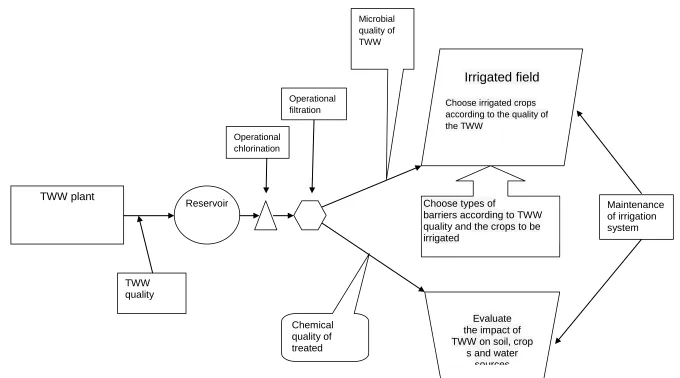
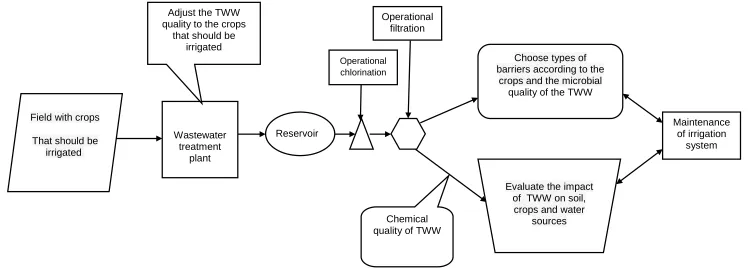
The HECD can be described by the following two figures:
1) Figure 1 is intended for unique situations, where there is a large area for a specific type of crop to be irrigated, and to determine the qulity of the treated wastewater that will be suitable for this purpose. 2) Figure 2 is intended for normal situations, where there is a wastewater treatment plant that yields a
Figure 1 — HECD according to the quality of the Treated wastewater
TWW plant
Reservoir
TWW quality
Operational chlorination
Operational filtration
Irrigated field
Choose irrigated crops according to the quality of the TWW
Choose types of
barriers according to TWW quality and the crops to be irrigated
Evaluate the impact of TWW on soil, crop
s and water sources Chemical
quality of treated
t t
Microbial quality of TWW
Figure 2 — HECD according to the irrigated crops
Wastewater treatment
plant
Reservoir
Operational chlorination
Operational filtration
Evaluate the impact of TWW on soil, crops and water
sources Chemical
quality of TWW
Maintenance of irrigation
system Field with crops
That should be irrigated
Choose types of barriers according to the
crops and the microbial quality of the TWW Adjust the TWW
quality to the crops that should be
5 HECD Process
The fundamentals of health and environmentally conscious design (HECD) are presented in Annex I. In the present chapter the application of HECD to the design of a Treated Wastewater Use System is presented.
5.1 A treated wastewater use project is made of a number of essential elements:
b) Treated wastewater pumping stations and transport systems - The system of pipelines and pumps transporting the treated wastewater from the WWTP to storage reservoirs and to the use site
c) Storage reservoirs - Wastewater is produced throughout the year. The use of treated wastewater in most cases takes place only during part of the year and at varying quantities according to crop demand. Therefore, it is generally required to build storage reservoirs for the temporarily-unused treated wastewater, to enable its exploitation during irrigation periods and in periods where consumption exceeds its production.
d) Treated wastewater filtration facilities - In some cases it is required to filter the treated wastewater for health, environmental or technical reasons of the irrigation systems. Therefore, the filtration systems often form a part of the treated wastewater use system.
e) Treated wastewater disinfection facilities - Certain uses require adequate disinfection. Furthermore, the proper maintenance of treated wastewater transport pipes requires frequent disinfection of the TWW. Treated wastewater disinfection facilities form a part of the treated wastewater use system.
f) distribution and irrigation systems:
link between achieved wastewater quality and distribution at plot level considering weather conditions , type of crops and soil characteristics maintenance
The use of treated wastewater for irrigation creates a potential risk for water sources (surface or underground) due to possible ruptures or leaks in the treated wastewater distribution system to the irrigated fields. Treated wastewater leaks could reach the aquifer water or the surface water and contaminate it.
The irrigation with treated wastewater involves a risk of contamination of drinking water sources in case of rupture of the treated wastewater transport pipelines. The main risk is penetration of pathogenic pollutants to drinking water sources). To prevent this risk it is required to distance the treated wastewater main supply lines from the drinking water sources (drillings) to a distance which will ensure that treated wastewater is not flown directly to the drilling, and that treated wastewater seeping to the soil will flow in the aquifer for at least 40 days until it reaches the drilling (the time during which annihilation of the pathogenic pollutants is guaranteed). In a sandy aquifer, water flows slowly through the sand layers (providing additional filtration), and therefore the protection zone radiuses around the drillings are relatively small. In fissured aquifers, water can flow through the cracks and reach the wells relatively quickly, therefore the protection zone radiuses are much larger than those in sandy soils.
6 Health and water quality parameters to take into consideration in treated
wastewater irrigation
In some countries, farmers need a permit from the authorities to use treated wastewater for agricultural irrigation.
6.1 Treated wastewater quality levels
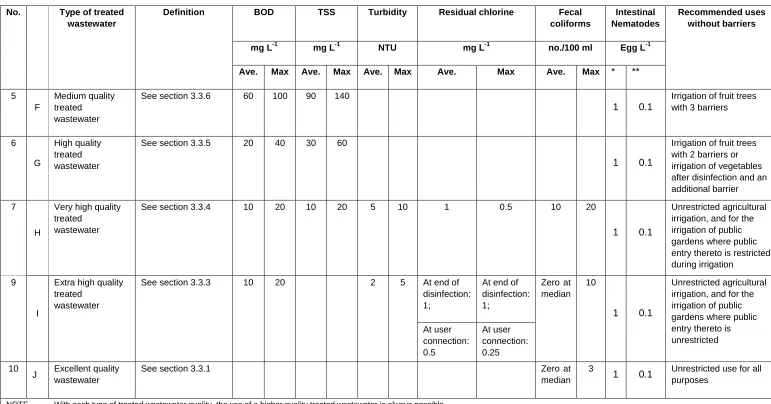
Table 1 — Wastewater and treated wastewater quality according to chemical, physical and biological parameters
No. Type of treated
wastewater
Definition BOD TSS Turbidity Residual chlorine Fecal
coliforms
Intestinal Nematodes
Recommended uses without barriers
mg L-1 mg L-1 NTU mg L-1 no./100 ml Egg L-1
Ave. Max Ave. Max Ave. Max Ave. Max Ave. Max * **
1 A Raw wastewater See section 3.3.9 Not for use
2 B Primary effluent See section 3.3.8
3
C
Low quality treated wastewater
See section 3.3.7 >60 >100 >90 >140
1
Irrigation of industrial crops (cotton) or
landscape impoundments
4
D
Extensive treated wastewater with at least 10-day retention in the ponds
See section 3.3.2
1 0.1
Irrigation of fruits with 3 barriers
E
Extensive treated wastewater with at least 15-day retention in the ponds
See section 3.3.2
1 0.1
Irrigation of fruit trees with 2 barriers
* - 1 egg L-1 if children under 15 years old are not exposed
Table 1 — Wastewater and treated wastewater quality according to chemical, physical and biological parameters (continue)
No. Type of treated
wastewater
Definition BOD TSS Turbidity Residual chlorine Fecal
coliforms
Intestinal Nematodes
Recommended uses without barriers
mg L-1 mg L-1 NTU mg L-1 no./100 ml Egg L-1
Ave. Max Ave. Max Ave. Max Ave. Max Ave. Max * **
5 F
Medium quality treated wastewater
See section 3.3.6 60 100 90 140
1 0.1
Irrigation of fruit trees with 3 barriers
6
G
High quality treated wastewater
See section 3.3.5 20 40 30 60
1 0.1
Irrigation of fruit trees with 2 barriers or irrigation of vegetables after disinfection and an additional barrier
7
H
Very high quality treated
wastewater
See section 3.3.4 10 20 10 20 5 10 1 0.5 10 20
1 0.1
Unrestricted agricultural irrigation, and for the irrigation of public gardens where public entry thereto is restricted during irrigation
9
I
Extra high quality treated
wastewater
See section 3.3.3 10 20 2 5 At end of
disinfection: 1;
At end of disinfection: 1;
Zero at median
10
1 0.1
Unrestricted agricultural irrigation, and for the irrigation of public gardens where public entry thereto is unrestricted At user connection: 0.5 At user connection: 0.25 10
J Excellent quality
wastewater
See section 3.3.1 Zero at
median 3
1 0.1 Unrestricted use for all
purposes
6.2 A region or a country following the guidance in this Standard may, as far as health parameters are concerned, choose the required or feasible level of treatment and restrict the irrigated crops in accordance with Table 1. Alternatively, a certain region or country may choose the level of treatment according to the health sensitivity of the dominant crops, as long as there are no other limitations arising from other considerations (e.g. hydrological).
7 Barriers Concept
In order to expand the group of crops that can be irrigated with the different qualities of treated wastewater, the method of barriers has been developed, to prevent contact between pathogens in treated wastewater and humans who ingest the fruit or vegetables irrigated with treated wastewater.
The quality of the treated wastewater is not the only parameter that can ensure the health of the consumers of the produce. There are other means of eliminating the pathogens that pass from the treated wastewater (that irrigates the crop) to the vegetables or the fruits. There are also some characteristics of the vegetables and the fruits that can prevent the ingestion of the pathogens by the consumer. By considering such characteristics, lower quality treated wastewater may be used for the irrigation of food crops.
Methods to minimize the possibilities of pathogens passing from the treated wastewater to the vegetables or the fruits include:
i) Appropriate distance between the treated wastewater and the vegetables or the fruits. ii) Disinfection of the treated wastewater.
iii) Subsurface drip irrigation where water does not penetrate the ground surface.
iv) A barrier (such as a sun-resistant cover sheet) between the treated wastewater and the fruit. The characteristics of crops that can prevent the pathogens from being ingested by the consumer include:
i) Fruit with an inedible skin (such as citrus fruits, banana, nuts).
ii) Crops that are always cooked before consumption (such as potatoes).
iii) Fruit and cereals undergoing a very high-heat treatment prior to ingestion (such as wheat).
7.1
13BDesign process principles of treated wastewater use
When adapting the water qualities to agricultural crops, which can be irrigated with treated wastewater, consideration should be made of the health and environmental impacts the crop irrigation has on: humans, flora, fauna, soil and water sources.
7.1.1 17BAgricultural use
7.1.1.1 For unrestricted irrigation it is required to use very high, extra high or excellent quality treated wastewater.
7.1.1.2 For restricted irrigation, low, medium, high, very high, extra high or excellent quality treated wastewater can be used, depending on the type of irrigated crop.
7.1.2 18BUrban use
7.1.2.2 For the irrigation of public gardens where public access is unrestricted during irrigation it is required to use extra high or excellent quality treated wastewater.
7.1.2.3 For the irrigation of private gardens it is required to use extra high or excellent quality treated wastewater.
7.1.3 Barriers
7.1.3.1 Destroying pathogens by suitable disinfection of the treated wastewater.
7.1.3.2 Creating disconnection between the treated wastewater and the fruit. Such “creation of disconnection” can be accomplished in one of the following ways:
I) A distance of at least 50 cm between the drip irrigation system (laying on the surface of the soil) and the fruit, will be considered as two barriers;
II) A distance of at least 25 cm between the drip irrigation system (laying on the surface of the soil) and the fruit, will be considered as one barrier;
III) A distance of at least 50 cm between the under-foliar sprinklers and the fruit will be considered as one barrier. The distance will be calculated from the height to which the sprinkled treated wastewater reaches, and will provide only one barrier (due to dispersal of aerosols in the air);
IV) A partition (sun-resistant cover sheet) between the treated wastewater and the fruit, that can prevent the passage of pathogens to the fruit, will be considered as one barrier;
V) Subsurface drip irrigation systems (considered as two barriers) should be designed and implemented in a way that water does not rise to the surface (the detection of water puddles on the surface should disqualify the barriers resulting from subsurface drip irrigation system in the following years).
7.1.4 Clarification
Each of the barriers in 7.1.3 should be approved only if the barrier is integral to the crop. No barrier should be considered based on a grower’s statement, or based on a requirement or special terms in the permit. Examples of special terms are:
A condition or statement that fallen fruit will not be gathered should not be accepted as foolproof;
The condition that fruit picking will be carried out only two weeks after the last irrigation may be suitable for orchards in areas where there is no irrigation in the fruit picking period, but not in dry or arid regions that require continuous irrigation throughout the year;
Cultivation intended for seeds only – should not be approved if the fruit could also be marketed for eating during the course of cultivation.
7.1.5 Crops that can be irrigated without barriers
Crops which do not come in contact with the public, or are protected, as a result of the method of their cultivation, from microorganisms, may be acceptable for irrigation by treated wastewater without barriers. Following is a list of example crops:
Industrial crops (such as cotton);
Irrigated watermelon for edible seeds or seeds for sowing, which has not been irrigated for 30 days prior to harvesting;
A grove or vegetation plot without public access;
Turf or grassland that is not intended to be subsequently used for domestic lawns and during its cultivation will have no public access.
7.1.6 Barriers in the irrigation of public gardens
i) Irrigation when the public does not enter the garden will be considered as one “barrier”; ii) Ultrafiltration or nanofiltration of the treated wastewater will be considered as one “barrier”.
7.1.7 Barriers in the irrigation of forage crops
i) Irrigation of forage crops when animals entering the field 5 days after the irrigation will be considered as two “barriers";
ii) Irrigation of forage crops when animals entering the field 24 hours or more after irrigation will be considered as one “barrier";
iii) Irrigation when animals entering the field less than 24 hours after irrigation will not be considered a "barrier";
iv) Drip irrigation or furrow irrigation will be considered as one “barrier”;
v) Processes of forage crops (drying, silage) will be considered as two “barriers”.
7.1.8 Possible barriers
[image:22.595.37.526.513.769.2]Table 2 describes the possible characteristics and activities that can be used as barriers in TWW irrigation and present the number of barriers that can be accredited for any of them.
Table 2 — Types and accredited number of barriers
Type of barrier Application Distance Number of
barriers
Irrigation of food crops
Disinfection of the treated wastewater 1
Microfiltration of the treated wastewater 1
Ultrafiltration or nanofiltration of the treated
wastewater 2
Distance between the lowest fruit/vegetable, to the upper point that the treated wastewater achieves
under 25 cm 0
Drip irrigation system
Sprinkler Micro sprinkler Surface irrigation
above 25 cm 1
above 50 cm 2
Sun-resistant cover sheet 1
Inedible skin 1
Requires cooking 1
Irrigation of public gardens
Irrigation when the public does not enter the
garden 1
Ultrafiltration or nanofiltration of the treated
wastewater 1
Irrigation of forage crops
Irrigation of forage crops (animals entering the field
5 days after irrigation) 2
Animals entering the field 24 hours or more after
irrigation 1
Animals entering the field less than 24 hours after
irrigation 0
Drip irrigation or furrow irrigation 1
Processes of forage crops (drying, silage) 2
Table 3 — Number of barriers that are needed for irrigation with treated wastewater according to their quality
Type of treated
wastewater Definition
Irrigation of vegetables ingested raw Irrigation of other vegetables Irrigation of food crops other than vegetables Irrigation of public gardens irrigation of forage crops Irrigation of industrial crops, energy crops, horticulture or landscape impoundments
Raw wastewater Municipal wastewater not treated in
any way forbidden forbidden forbidden forbidden forbidden forbidden
Primary effluent effluent from a primary treatment
properly operated Not for use Not for use Not for use Not for use 2 Not for use
Low quality of treated wastewater
treated wastewater which has undergone physical and biological treatment
forbidden forbidden forbidden forbidden 1 0
extensive treated wastewater *
extensive treated wastewater with at
least 10-day retention in the ponds forbidden forbidden 3 forbidden 0 0
extensive treated wastewater with at
least 15-day retention in the ponds forbidden forbidden 2 forbidden 0 0
Medium quality of treated wastewater
treated wastewater which has undergone physical and biological treatment
forbidden forbidden 3 forbidden 1 0
High quality of treated wastewater
treated wastewater which has undergone physical and biological treatment
Disinfection + 1 2 2 forbidden 0 0
Very high quality of treated wastewater
treated wastewater which has undergone physical and biological treatment followed by filtration and disinfection
Extra high quality of treated wastewater
treated wastewater which has undergone physical and biological treatment followed by filtration and disinfection
0 0 0 0 0 0
Excellent quality of wastewater
treated wastewater which has undergone physical and biological treatment followed by filtration through the soil or ultrafiltration or reverse osmosis membranes
[image:25.842.151.745.76.213.2]0 0 0 0 0 0
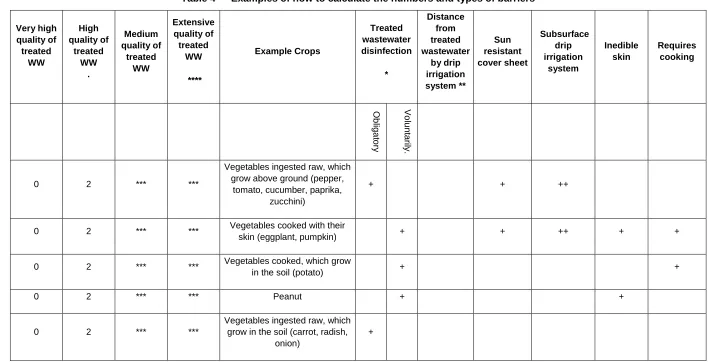
Table 4 will show examples for calculating the numbers and types of barriers.
Table 4 summarizes the barriers to be taken into consideration for each group of crops. The number of barriers that can be used for each crop is calculated by adding the number of + signs allocated to each form of barrier or method of irrigation. For example: to irrigate tropical fruits (mango, persimmon, avocado) there is 1+ for inedible skin, and can be 1+ for disinfection, 1+ for drip irrigation, 1+ for Sun-resistant cover sheet and 2+ for subsurface drip irrigation.
NOTE Treated wastewater disinfection is a mandatory barrier for irrigation of vegetables eaten raw.
The disinfection system of treated wastewater intended for the irrigation of vegetables must include constant control of residual chlorine, with data recording and storage, when the system is connected to the operation of treated wastewater supply.
The required number of barriers that are needed for irrigation depends upon the basic quality of the treated wastewater used for irrigation, as follows: a) Very high quality of treated wastewater (suitable for unrestricted irrigation) – no barriers are required;
b) High quality of treated wastewater requires 2 barriers;
c) Medium quality of treated wastewater requires 3 barriers, but is not suitable for the irrigation of vegetables;
Where crops, which are permitted to be irrigated by extensive treated wastewater, are concerned, the number of required barriers depends on the time of the treated wastewater retention in the pond. For treated wastewater of a regular oxidation pond with 10 days retention, 3 barriers are required. For treated wastewater of an oxidation pond with 15 days retention, 2 barriers are required.
Table 4 — Examples of how to calculate the numbers and types of barriers
Requires cooking Inedible skin Subsurface drip irrigation system Sun resistant cover sheet Distance from treated wastewater by drip irrigation system ** Treated wastewater disinfection * Example Crops Extensive quality of treated WW **** Medium quality of treated WW High quality of treated WW . Very high quality of treated WW V ol unt ar ily . O bl igat or y ++ + + Vegetables ingested raw, which
grow above ground (pepper, tomato, cucumber, paprika,
zucchini) *** *** 2 0 + + ++ + + Vegetables cooked with their
skin (eggplant, pumpkin) *** *** 2 0 + +
Vegetables cooked, which grow in the soil (potato) *** *** 2 0 + + Peanut *** *** 2 0 + Vegetables ingested raw, which
grow in the soil (carrot, radish, onion)
*** ***
+ ++ + + Bean *** *** 2 0 + ++ + +
Vegetables with skin (watermelon, melon, pea) *** *** 2 0 + ++ + ++ + Artichoke 3-2 3 2 0 + ++ + ++ + Corn for ingestion
3-2 3 2 0 + ++ ++ + Citrus fruits 3-2 3 2 0 + + + Citrus fruits – irrigation with
sprinklers or under foliage canopy 3-2 3 2 0 ++ ++ + Citrus fruits with edible skin
(Chinese orange) 3-2 3 2 0 + ++ ++ +
Nuts, almonds, pistachio, pomegranate 3-2 3 2 0 ++ ++ + Deciduous (apple, plum, pear,
peach, apricot) + cherry 3-2 3 2 0 + ++ + + + Tropical fruits (mango,
persimmon, avocado) 3-2 3 2 0 + ++ + ++ + Tropical fruits with trimming of
the lower branches 3-2 3 2 0 ++ ++ + Grapes – high trellising
3-2 3 2 0 ++ + + +
Grapes – regular trellising 3-2 3 2 0 ++ + + Grapes – no trellising
*** ***
+ ++
+ ++
+ Sabras (cactus fruits)
3-2 3
2 0
++ +
+++ +
Dates 3-2
3 2
0
+ ++
+ ++
+ Olives
3-2 3
2 0
+ ++
+ +
+ Flowers
3-2 3
2 0
Comments:
* Treated wastewater disinfection should be a required barrier when irrigating vegetables that are to be eaten raw. The disinfection system of treated wastewater intended for the irrigation of any vegetables must include constant control of residual chlorine, with data recording and storage.
** A distance of 50 cm of clean air between drip-irrigation and the fruit is considered as 2 barriers. A distance of 25 cm of clean air between drip-irrigation and the fruit is considered as 1 barrier. When irrigation is by spraying, (or sprinklers under the canopy) the distance should be calculated from the height to which the sprayed effluents arises and is considered as only 1 barrier, because of the aerosols in the air.
*** Effluents of medium quality and effluents of oxidation ponds should not be used for the irrigation of vegetables.
7.2 Health aspects of flood and furrow irrigation with Treated Wastewater
Flood and furrow irrigation with untreated or partially treated WW can increase helminth infection (mainly Ascaris infection), particularly in children under 15 years old (WHO 2006). This damage is caused as a result of direct contact with the TWW that is used for the irrigation. Special attention should, therefore, be given to the quality of the TWW that is used for flood and furrow irrigation, especially to the concentration of intestinal nematodes in the TWW.
WHO's standards, which are well-accepted by most countries, recommend that for children under 15 years old the worms' eggs which exist in TWW will be less than 0.1 eggs/liter of Intestinal Nematodes if they were exposed, and 1 egg/liter of Intestinal Nematodes, if they were not exposed.
Other health principles of irrigating with TWW, as described in this chapter, should be similar for Flood and furrow irrigation techniques as for closed (pressurized) irrigation systems.
The effluent quality required and barriers considerations which can be used are identical for flood and furrow irrigations, as for irrigation with TWW in closed (pressurized) systems.
As far as barriers related to the distance required between TWW and the fruit or vegetables, these can be compared with the ones prevailing for drip irrigation. However, cases where vegetables and/or fruits can physically touch the ground while applying the TWW in the field by flood or furrow irrigation systems, should be avoided, because the vegetables and the fruits can come in contact with the treated wastewater.
7.2.1 Health risks for workers and surrounding residents
Health risks for workers and their families depend mainly on the quality of the TWW (WHO 2006) and the irrigation methods and equipment used.
Flood or furrow irrigation with TWW can lead to an increase in helminth infection (mainly Ascaris) in children that come with direct contact with untreated or partially treated WW.
Sprinkler irrigation system that generates aerosols may pose potential risks for neighbours of irrigated plots. Aerosol-related risks depend on the TWW quality and wind velocity, which is responsible for the dissemination of aerosols in the surroundings of the irrigated area.
[image:29.595.76.551.556.734.2]Minimal distances between irrigated areas and residential areas, according to wastewater quality and to sprayer degree and maximal wind speed, are given in Table 5.
Table 5 — Minimal distance (expressed in meters) between irrigated borders and residential areas, according to TWW quality, type of sprinkler and wind speed1)
Sprinkle irrigation type
Sprayer degree of the sprinklers
TWW quality
Wind speed (m s-1)
2 3 4
Irrigation above the
foliage
High a
Primary and low quality 100 150 200
Medium quality 70 120 170
Extensive treated, medium and
high quality 50 100 150
Very high, extra high and
excellent quality 30 50 70
Low b
Primary and low quality 50 100 150
Medium quality 40 70 120
Extensive treated, medium and
high quality 30 50 100
Very high, extra high and
excellent quality 20 40 60
Irrigation under the foliage
High a
Primary and low quality 50 100 150
Medium quality 40 70 120
Extensive treated, medium and
high quality 30 50 100
Very high, extra high and
excellent quality 20 30 40
Low b
Primary and low quality 30 50 100
Medium quality 25 45 80
Extensive treated, medium and
high quality 20 40 60
Very high, extra high and
excellent quality 10 20 30
a
High sprayer degree produces large and moderately large drops
b
Bibliography
Annex A
(informative)
Fundamentals of health and environmentally conscious design (HECD)
A.1 General
Section 5 (HECD Process) describes the basic requirements for application by the project management. Section 6.1 (Treated wastewater quality levels) describes the HECD process for operative implementation.
A.2 Thinking in terms of "life cycle"
Health and Environmental Conscious design (HECD) should be based on thinking in terms of lifecycle (LC), which requires that in the course of planning, design and development, the health, environmental and agricultural aspects of the product will be taken into account throughout its life cycle stages. Key elements for "life cycle" thinking are:
a) setting a target to reduce the overall negative effects of the product on health, the environment and agriculture;
b) identifying, describing and quantifying, as much as possible, the significant effects of the product on health and the environment;
c) weighing the tradeoffs between the health and environmental effects of the product's life cycle against the economic benefit achieved by establishing the treated wastewater use plant.
Implementation of the above actions should start as early as possible in the planning and development process, while most opportunities to conduct changes and improvements in the products which will affect its health and environmental performance throughout its life cycle still exist.
NOTE 1 As an initial life cycle stage, it is required to determine the function of the product. During additional planning,
design and development stages, it is required to acknowledge the effects of the chosen business plan.
NOTE 2 The life cycle stages of each product generally include material processing, production, distribution, usage,
maintenance and life cycle management completion (including recycling and final disposal).
NOTE 3 When the product is part of a system, its health and environmental effects may affect or be affected by other
factors in the system during one or more of its life cycle stages.
NOTE 4 Health and environmental conscious design (HECD) requires cooperation among all interests and
stakeholders in the supply chain.
A.3 Regulatory and stakeholders' requirements
Health and environmental conscious design (HECD) is carried out in the framework of regulatory and stakeholder-related limitations. Such limitations should be examined from time to time, for changes to be considered by the project management performing the HECD. The recommended requirements include: a) limitations and undertakings arising from national and international regulation;
c) market or consumer needs, trends and expectations;
d) company and investors' expectations such as technological advance.
A.4 Assimilation in the management process
HECD objective to minimize the negative health and environmental effects of the project or the product, needs to be expressed in the project management’s policy and strategy. If the project management has a managing system in which product design and development are included, the HECD process must be an integral and recorded part of this project management system. The health and environmental effects may form one part of the project management’s RM (risk management) process.
NOTE "Risk Management Definitions” are mentioned in ISO/IEC GUIDE 73 and Risk Management Standard in
IS0 31000
As part of the project management’s managerial processes, it is required to both re-examine the HECD regarding the requirements and repeat this examination frequently to guarantee its continuity, sustainability, compatibility and efficiency. Such examination should include improvement possibilities, and the need to introduce changes in the HECD process as well as in the project management’s relevant policy and strategy.
NOTE 1 The iterative process of constant improvement in design and development can be described by the PDCA
(Plan, DO, Check, Act) cycle. This approach provides means for managing the required legal, technical, organizational, economic, health and environmental changes.
NOTE 2 The project management should see that information about the HECD process and its objectives is delivered,
so that relevant departments understand the initiative rationale and cooperate with the process.
Annex B
(informative)
Health and Environmentally Conscious Design (HECD) Process
B.1 General
Organizations carrying out HECD are required to determine record, implement and maintain the HECD process as a structured part of the facility design and implementation process. The HECD process includes the following stages:
a) Examine the health and environmental requirements of the regulatory responsible bodies and other stakeholders;
b) Identify and assess the health and environmental effects and their impact; c) Design and implementation;
d) Constant control and improvement.
The project management should record the relevant results, the draw conclusions and delegate responsibility while carrying out the above four stages.
B.2 Analysis of Regulatory and Stakeholders’ Health and Environmental
Requirements
As the first stage in the HECD implementation, combined with identification of the health and environmental aspects, the project management needs to understand the regulatory and other stakeholders’ requirements, both on a wide level and on a specific level. These requirements stipulate the basic framework for setting up treated wastewater use projects.
B.2.1 The project management should ensure that the regulatory and additional stakeholders' requirements have been identified, including the project's:
Objectives
Life cycle stages Health effects
Environmental effects Agricultural effects
Geographic scope of the target market Management’s relevant activities
a) Methodical, implemented and recorded analysis while identifying project objectives and life cycle stages which are likely to be affected, relevant activities and responsibilities of the project management, as well as the actions to be taken as a result of this analysis;
b) Examination of the effects on the project of new requirements or a change in current requirements, which emerge in the course of the planning and design stage, and implementation of the required changes.
B.3 Identification and assessment of effects of the health and environmental aspects
The project management should determine a structured process for identifying the health and environmental effects and their impacts, comprising of the following stages:
a) Identification of the health and environmental aspects including their effect. It is required to identify – for each stage of the project’s life cycle – inputs and products with health and environmental effects. Examples of products including the product itself, byproducts, wastes and emissions;
b) Assessment of the health and environmental effects; c) Determining significant health and environmental aspects:
1) Following the identification of all relevant health and environmental aspects, it is required to rate these aspects by assessment and prioritization, based on their overall effect on health and the environment
2) In the next HECD stages, the project management should refer to the health and environmental effects which are significant for the project and its elements. It is recommended to refrain from the arbitrary emphasis of a single aspect or a single life cycle stage
3) Quantitative and qualitative information concerning the assessment and prioritization of the health and environmental aspects may be used. Where possible, it is recommended to use quantitative information
B.4 Design and implementation
B.4.1 The chosen design solution needs to balance the various health and environmental aspects with other considerations such as: targets, technical requirements, quality, implementation, commercial risks and economic aspects. Where regulatory requirements obligate taking given factors (such as occupational health and safety) into account, these requirements should be met in a way that will minimize the damage to health and the environment. Such considerations also apply to the research and development of new technologies.
B.4.2 The design and implementation should be carried out according to the following stages: Setting the project (facility/facilities) targets
Defining the significant health and environmental parameters arising from the analysis of regulatory and other stakeholders’ requirements
Identifying strategies for improving the various parameters
Determining health and environmental objectives based on the improvement strategies
Featuring project specifications, taking the health and environmental objectives into consideration
NOTE The use of HECD tools and standards may be of assistance.
B.5 Constant control and improvement
B.5.1 It is recommended to determine, implement and reinforce a process of a continuous control and improvement process of the significant health and environmental aspects, throughout the project’s life cycle stages. The project management should conduct design controls to make sure the project design reaches its predefined objectives whenever a health and/or environmental aspect is identified and each time a design stage is completed.
B.5.2 In case the project’s health and environmental objectives are not reached, the current or future design process should be improved.
The project management may conduct additional controls after project operation, to examine feedbacks from users and other stakeholders, and as a result of new information in the field of health or the environment. The results of such controls should be used in the HECD process while reinforcing the project’s constant improvement and examining the project management’s policy and processes, thus determining the basis for the project’s future development specifications.
B.5.3 All records of the design controls, including the resulting actions, should be retained in order to be used as reference for the project’s future development and for constant improvement activities.
B.6 Information sharing for HECD
B.6.1 As part of the HECD process, all the organizations along the supply chain should reveal the information about their products to the project management involved in the design and development, to enable it to reach the HECD targets.
B.6.2 The information to be shared includes:
Relevant resources used in the project for construction and operation processes;
Emissions or discharges of products;
Training for the improvement of health or environmental performances; Handling a product after the completion of its life cycle;