http://www.sciencepublishinggroup.com/j/ajset doi: 10.11648/j.ajset.20170201.18
Galvanic Skin Response as a Estimation Method of the
Driver's Emotional State
Oleksii Prasolenko
*, Dmytro Burko, Andrii Halkin
Department of Transport systems and Logistics, O. M. Beketov National University of Urban Economy in Kharkiv, Kharkiv, Ukraine
Email address:
[email protected] (O. Prasolenko), [email protected] (D. Burko), [email protected] (A. Halkin) *
Corresponding author
To cite this article:
Oleksii Prasolenko, Dmytro Burko, Andrii Halkin. Galvanic Skin Response as a Estimation Method of the Driver's Emotional State. American Journal of Science, Engineering and Technology. Vol. 2, No. 1, 2017, pp. 50-56. doi: 10.11648/j.ajset.20170201.18
Received: October 31, 2016; Accepted: February 16, 2017; Published: March 1, 2017
Abstract:
The functioning of any transport system does not seem possible without a meaningful human interaction. Moreover, the human is the organizer of the transport processes and systems. At the same time, even the advanced transport technologies, designed and operated without due attention to the human factor, it is not enough based on the ergonomics of work and life. However, the transport system is a subsystem of a higher hierarchy system functioning of city, region or some areas. The last one, have their main purpose - to provide citizens of ability to live. Obviously, people are been organizers, performers and objects of transportation process. And, rising attention to the driver in the transport system is become more and more interesting and actual in nowadays. Therefore, the research of human functional state interacting with road traffic in the city’s transport system is considerable interest. The aim of the paper is to estimate the emotional condition of the driver in difficult traffic situations. Using the method of galvanic skin response the relationship between the road conditions, driver’s actions on the road and his emotional state had found. The vehicle’s deceleration process and driver's functional state changes due to these actions had considered. The indicators for assessing the driver’s emotional state based on the method of galvanic skin response had proposed. The method of galvanic skin reaction of the person allowed assessing the driver's reaction to the conditioned stimulus - braking at stop sign.Keywords:
Road Traffic, Road Traffic Accidents, Critical Traffic Situations, Driver, GSR, Emotional State, Vehicle, City1. Introduction
Increasing intensity and speed of traffic make higher and higher demands for drivers’ abilities to drive a car. The quality of operator activity of the driver depends on many factors: the level of professional training, emotional state and state of regulatory mechanisms that play a leading role in the energy and information support of the driver's ability to work well. Therefore, the logical consequence is the fact that one person gets 25-80% of the total number of failures in management systems [1].
Most of the traffic accidents (TA) occur because of the driver. It is known that the amount of traffic accidents highly depends on the duration of work of the driver. A large amount of time spent at the wheel is connected with fatigue and decrease of the driver's operability. The reason for decrease of the driver's operability in many cases is the emotional state and physical exhaustion. Different sources of
emotional stress continually arise at the driver’s work: a dangerous situation on the road, access to the congested intersection or to a complex road junction, and a lot of other sources, connected with the traffic. The change of the emotional state in the described situations may be very different. Experienced, confident drivers with a firm and resolute character act accurately and quickly in a dangerous situation. Others, usually inexperienced drivers demonstrate confusion, do not carry out the necessary actions or start performing redundant, unnecessary actions instead. Emotional resistance provides the driver with the ability to resist confusion and fear, accurately and quickly operate in difficult and dangerous situation.
predicting the driver's disability. Adaptation to environmental conditions, social, industrial, household, climatic and other factors is one of the fundamental properties of the human body. There are four levels of adaption of the functional abilities of the human:
satisfactory adaptation to environmental conditions; functional voltage;
unsatisfactory adaptation;
exhaustion of functional reserves, the state on the verge of failure of adaptation, adaptation failure [3].
To some extent, the driver's working intensity can be characterized by the number of emotionally significant stimuli that affect him during driving. The authors of [4] suspended as an irritant any impact on the driver, which make him take any decisions. For example, the gesture of the traffic controller, a pedestrian who crosses the street, road sign, sound or light signal made by the driver who overtakes a vehicle, etc [5]. It was found that an average car driver in modern large cities perceives more then 200 stimuli per 1 hour and 3-4 stimuli at each minute of driving. It is necessary to pay attention to the considerable unevenness of the load from the stimuli, which ranges from the complete absence of relevant stimuli to dozens per minute, and can negatively affect the quality of the professional activity of the driver.
Situations, that are similar to the emergency ones (sudden braking, sharp steering input, combination of a sharp deceleration with the turning of steering wheel, etc.) also have a big influence on the emotional state of the driver [2, 6].
In the study [7] of the following phenomena – monotony, sensory and motor failure, the questions about the meaning of the labour intensity of the driver in the system «driver - vehicle - road - motion environment» (DVRME) that does not exceed the boundaries at which the state stress occurs were raised.
Thus, the success of professional work of the driver is largely determined by the integral expression of his psycho-physiological and personal qualities.
2. Analysis of the System «Driver -
Vehicle - Road - Motion Environment»
Movement of traffic flows - is a complex dynamic system of interaction between traffic and pedestrian flows, a set of three components: vehicle operator (driver) - the vehicle - motion environment. The main elements of the system of movement of different modes of transport may vary. For example, traffic movement (TM) is a system that consists of driver, vehicle and road [1, 8, 9].
Specificity of functioning of the system of movement of traffic flows lies in the interaction of technical and human factors. For example, in traffic movement participate huge number of people, both professional and non-professional drivers, pedestrians. Each person has their physiological characteristics. Driver’s activity is characterized by a variety of negative factors.
Regarding the driver, the following factors are taken into account: his state of health, degree of fatigue, level of training, ability to make decisions under time pressure and to choose the right speed according to the driving conditions.
Regarding the vehicle, it can be noted that traffic safety is considerably affected by its dimensions, the quality of traction and braking, head lights, the driver's seat comfort, manoeuvrability, safety passive elements etc.
Regarding the road, the following characteristics are important: the width of the carriageway, the tire–road friction coefficient and flatness of the road, geometric parameters, the state of roadsides, availability and quality of fences as well as other elements of the engineering equipment of the road.
Regarding the motion environment, it should be noted that weather and climate conditions and the presence of pedestrians influence traffic safety.
Road safety depends on the reliability of the components in the DVRME system. It is obvious that the insurance of safe operation of the system requires relatively large expenses. But even under this condition, creating of an absolutely secure system is impossible, since it includes a human factor where different actions and errors significantly affect the functioning of the whole system.
The movement of vehicles must be effective (economic, productive), safe and comfortable. This is the basic requirements that apply to the traffic flow [1, 8].
Efficient movement involves creating of conditions that provide a high speed, the minimum time spent on transfer from one place to another, minimum of delays and stops of vehicles, as well as minimum of transport maintenance costs. Economic efficiency of traffic implies the existence of satisfactory road conditions that provide the minimum possible time for movement. The latter depends on the length of the route, speed and forced delays at intersections caused by the increase of traffic density. The high speed of movement reduces the time of movement, but leads to increased fuel consumption, and to a greater risk of accidents and great emotional stress of the driver. Thus, together with the creation of conditions for fast traffic it is necessary to take measures for their control.
Safe movement involves the creation of a set of conditions and requirements for vehicles, roads (movement environment), operators of vehicles that provide a minimum probability of traffic accidents and catastrophes. Traffic safety requires the implementation of complex of requirements for vehicles, drivers and road conditions.
One of the conditions for the safe movement is a good knowledge and adherence to traffic rules by pedestrians. These rules should be carefully studied in schools and pre-school institutions.
3. An Analysis of the Driver’s
Characteristics as a Subsystem of the
DVRME System
Specificity of functioning of traffic movement system is in the interaction of technical and human factors. A huge number of people, both professional and non-professional drivers, pedestrians are involved in the traffic movement. Each person has their physiological characteristics [6].
Driver’s activity is characterized by a number of negative factors [2, 4]:
1. A large amount of information that is processed, and the need for its continuous synthesis.
2. The chronic lack of time for decision-making. 3. High level of responsibility for the taken decisions. Factors that determine the reliability of driver [6]:
1. Working conditions (road, travel mode, driver's workplace).
2. Quality of the media (traffic signs, signalling, optical orientation means, the location of the media in the field of vision of the driver).
3. Qualification of the driver (work experience).
4. Individual driver’s qualities (attention, spontaneous distractions, changes, reaction to unexpected stimuli, noise immunity, endurance).
5. Ability to work (3 phases): entry into operation, optimal working capacity, decrease of activity.
6. Discipline – the factor that determines the reliability of the discipline can be increased artificially by channelization and organization of rumble strips.
7. Persistence of attention – the ability to hold the necessary intensity of attention on any object or process for a long time.
8. Change of attention is characterized by the time that operator spends entering a new activity or a new rhythm.
9. The long endurance – determines the ability to work. 10. Monotony – the main cause of decrease of activity. Long endurance characterizes the willingness to act.
11. Resistance – a person's ability to perform assigned task in conditions of active constraints.
12. Endurance to the voltage – the ability to perform the functions at the maximum voltage of all mental functions.
The driver must constantly take a large amount of information on the nature and mode of movement of all participants of the transport process. The process of driving can be represented by the following scheme: The sensation – perception –processing – analysis – decision taking – implementation of the action.
This whole process is time consuming. In the case of lack of time, the driver can make the wrong action because of the following factors [7]:
lack of time for the whole process of perception; errors in the interpretation of the information;
errors in the situation analysis with the correct interpretation;
wrong made decision;
misaction.
All of these reasons may be the result of the mental state of the driver. Mental properties of different people are not similar. Features of temperament affect driver’s activities. People of the choleric temperament are getting tired faster then people with phlegmatic temperament. People with sanguine temperament are good drivers, but sometimes overestimate their capabilities. People of the melancholic temperament are less prone to driver activities [2].
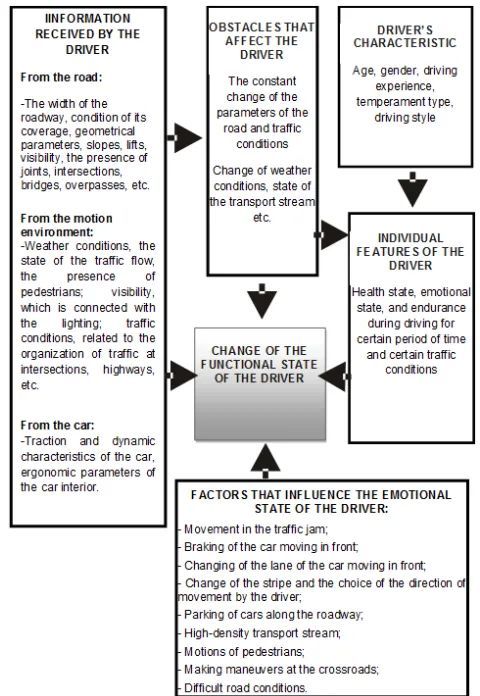
The complexity of the driver's activity lies in uncertain information that comes to him. In addition, various unfavourable factors influence the driver: the exhaust gases, temperature, noise, vibration, etc. All this leads to fatigue - a set of psycho-physiological changes in the human condition, which leads to a temporary reduction in the efficiency of his operations. Fig. 1 shows the factors that affect the state of the driver and their relationship.
Figure 1. Factors that influence the driver’s state.
4. Methods of the Assessment of the
Driver’s Emotional State
Table 1. Ananalysis of the driver's emotional stress assessment methods.
Method name Method content
Electro-cardiogram (ECG) ECG method allows to determine the dependence of the work of the human heart on the degree of addiction to stress. Electrodes mounted on the body trap difference between potentials, which appear as a result of the heart work.
Electro-encephalogram (EEG) EEG allows to determine the state and activity of the brain and is also indispensable for monitoring the condition of the central nervous system. For the EEG analysis, main characteristics of the brain are frequency, amplitude, waveform, etc.
Electromyogram (EMG) EMG method determines the dependence of the level of muscle tension from stress level, which is characterized by a change in electrical potential of muscle fibers.
Electro-oculography (EOG)
EOG reveals the presence of a stress state by analyzing the movements of the human eye. Anterior pole of the human eye is electrically positive and back pole is negative, so there is a potential difference between the bottom of the eye and the cornea that can be measured. When the eye turns, the position of the poles changes and the potential difference which occurs at this time, characterizes direction, amplitude and velocity of eye movement.
Galvanic skin response (G.S.R.).
G. S. R. method shows the impact of the stress situation on the human sympathetic nervous system, which in turn affects the activity of the sweat glands and thereby changes the electrical activity of the skin. G. S. R. is extremely sensitive in case of emotional response, anxiety, tension, and is often used for the characteristic of the functional state.
It should be noted that all the above discussed methods were used to study the state of the driver in practice; however, most of the authors of works [2, 6, 10] note the high availability of the G. S. R. method for studying the driver's emotional state. The incoming information about road conditions that comes to the driver passes a preliminary assessment of the importance and novelty, usually it is made unconsciously. When the driver receives information that may require a change in the driving mode (narrow bridge, tight curves, etc.), or cause any emotional shifts, its evaluation and development of further actions take place in the cerebral cortex. This process is known as the orienting reaction and is characterized by work of the specific areas of the cerebral cortex, the external manifestation of which is a galvanic skin response.
5. Research and Data Analysis
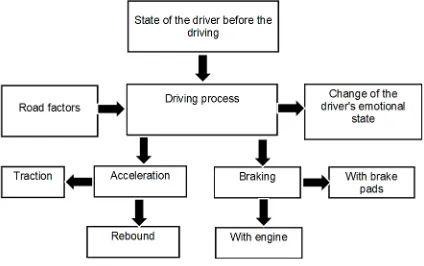
During driving, the driver takes into account various factors of road conditions: traffic signs, markings, traffic lights, intersections parameters, presence of pedestrians and other participants of the traffic movement. All this makes the driver to choose rational modes of motion. Since the movement modes show the driver’s behavior on the road and as a consequence characterize his emotional state, an important aspect is the identification of the emotional state of the driver, which depends on the driving modes. Modes of driver movement are manifested in his actions - acceleration, braking. Driving process is shown at Fig 2.
Figure 2. Driving process.
Motion modes are influenced by such factors as the brand and capacity of the car, the driver’s type of temperament (e.g. people of the choleric temperament always move faster than other road users), and the criteria for selecting the speed. Speed selection is caused by a variety of motives that guide the driver when choosing a mode of movement. Some drivers choose high speed of movement in order to save time; other drivers are guided by the fuel savings, thus choosing the minimum acceleration, deceleration and speed. The third type of drivers chooses driving modes that cause the minimum fatigue and ensure maximum safety of movement. Third type of drivers is also characterized by such features as braking in advance before obstacles, signs of traffic lights and the choice of the maximum distance. The process of movement is associated with a large number of actions that must be performed by the driver. In addition the driver constantly gets new information that he has to process and make decisions in a very short period of time.
Cardiogram of the driver’s movement in city traffic is presented at Fig. 3.
Figure 3. Cardiogram of the driver’s movement in city traffic.
(a)
(b)
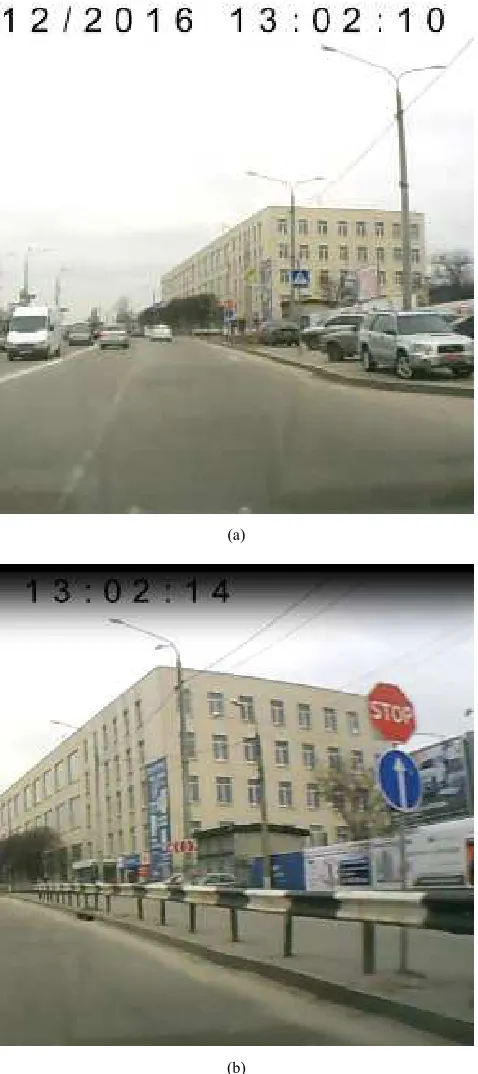
Figure 4. Entrance to the unregulated intersection equipped with a "STOP" sign.
As we see the driver was distracted and stopped at the speed 10 km / h in 4 seconds, using non-standard braking modes. According to the "racelogic" data speed at the start of braking was more than 55 km / h (Fig. 5).
Figure 5. Brake diagram, which shows the entrance to the unregulated intersection equipped with a "STOP" sign. Curves on the presented graphic mean: 1 – longitudinal deceleration, 2- speed, 3- distance.
Figure 6. Change of the G. S. R. during movement.
Fig. 6 shows a graphic of change of the G. S. R. of the driver during movement. Measurements of G. S. R. parameters were made by "NEULOG" device. Also the graphic presents a description of traffic conditions: 1 - stop at the "STOP" sign, 2 - an increase of emotional stress after the passage of "STOP" sign, 3 - stop at the controlled intersection (waiting in line without movement), 4 - movement on the highway with a high traffic density.
A more detailed description of the impact of the stop at the "STOP" sign on the driver is shown at Fig. 7.
As a result of the study of the driver's emotional state with the usage of the G. S. R., a number of indicators which help to assess the impact of various influences on the state of the driver were proposed (Table 2). These are such indicators as:
shift of the level of emotional intensity (takes into account the deviation of the background state, which is registered in 10 minutes before the trip of the driver in the quiescent state from the actual emotional state in
motion);
the actual indicator of tension for a certain period of time that allows to take into account the deviations of the actual amplitudes of G. S. R. from the background ones in a certain unit of time;
total indicator of tension, which takes into account area of oscillation of amplitudes of G. S. R. per unit of time.
Table 2. Parameters and indicators for the assessment of the emotional state.
Parameter Index Symbols Units of measurement
Shift of the level of emotional intensity
O 100 (W W) I ,
W
⋅ −
∆ = WO- meaning of microsiemens in the background state,
W- the actual value of microsiemens Microsiemens (µS)
Actual indicator of tension for a period of time
∆I P
t
= ∆I
t - tension indicator for the reviewed period of time Microsiemens/Seconds
Total indicator of tension
n
i i
i 1
K a s t
=
= ⋅ ⋅
∑
n - number of oscillations of amplitudes a , i
i
s - area of oscillation of amplitudes a i
Microsiemens* seconds
6. Conclusions
Sometimes the driver does not manage to track information about traffic conditions. The reasons of this may be different – fatigue or distraction of attention from the road. All this is connected with the time that is needed for the driver to perform the necessary actions at a particular point of time according to the road conditions. Precious seconds spent on distractions (e.g. talking on a cell phone), the driver has to compensate with the strong acceleration or deceleration, which in turn depends on the traction-dynamic features of the car used. Modern cars help the driver very much. The usage of various active and passive safety systems allow not only to improve the safety but also the comfort of movement. In the case when the driver responded to the changing road conditions with a delay he has to hope on the car as the seconds which are given to the driver's reaction time are lost. The average driver's reaction time in an urban setting changes from 0.6 to 1.1 seconds depending on the complexity of road traffic conditions. At the same time, the driver's response to the expected signal is much smaller than to the unexpected. Studies have shown that driver’s reaction to various stimuli in traffic directly depends on the expected and not expected type of road situation. As a rule, when the driver expects a change in the road conditions or the behavior of other participants of traffic, he is preparing for the necessary actions in advance and minimizes the impact of these factors on his emotional and physical state. It is the suddenness of the event that makes the driver nervous and causes mistakes in driving.
Changes of the value of the G. S. R. are caused by additional information, such as the emergence of an oncoming car, a man crossing the road (it is reflected as emergence of a new wave on the G. S. R. record). Each item related to the regime of movement corresponds to the appearance of the new wave, which means that the driver perceived and processed information contained in each object.
In the studies of traffic, when the driver is forced to constantly monitor the driving mode according to the road conditions change, G. S. R. can be used to estimate the impact of the geometric parameters of road and traffic control means on the driver.
Determination of the optimal emotional state of the driver allows to solve a number of engineering challenges, aimed at the choice of means and methods of traffic control. This circumstance is explained by the fact that emotions reflect external conditions, objects, and own experiences in human consciousness, which influence the person objectively. Studies have shown that a lack of information before the experimental driving as well as its excess leads to the emergence of emotional shifts. Available for the driver information about any traffic situations, despite the fact that he repeatedly got into it, is always less than the one that is necessary for safe driving. Studies have shown that fluctuations of the emotional state of drivers in the work process are the result of influence of road conditions.
References
[1] Rankin V., Claffe P. and Halbert S.: Automobile transportation and traffic arrangement, Transport, Moscow, 1981.
[2] Dolya V., Afanasieva I., Davidich U., Englezi I., Gyulyev N., Prasolenko O.: Influence of Information Flows on the Results of a Driver’s Activity in the System «Driver – Car – Road – Environment», AHFE 2014, Krakow, Poland, 4399-4406.
[3] Hemingway J., Ptoe P.: Risk Compensation: Are We Any Further Ahead in Understanding Driver’s Accident Risk?, The many faces of transportation, Сalgary 2013.
[4] Singh M., Queyam A.: Stress Detection in Automobile Drivers using Physiological Parameters, IJEE, Volume-5, Number-2 December 2013 pp. 1-5.
[6] Prasolenko О., Lobashov O., Galkin A. The Human Factor in Road Traffic City.: International Journal of Automation, Control and Intelligent Systems, Vol. 1, No. 3, 2015, pp. 77-84.
[7] Schnittker R.: Electrodermal activity of novice drivers during driving simulator training – an explorative study, department cognitive psychology and ergonomics, bachelorthesis, 2012.
[8] Ponkratov D., Іvanov І., Prasolenko O., Grigorova T., Lobashov O., Dolya V.: Traffic Streams and Anti-Congestions Activities in City Networks, International Journal of Automation, Control and Intelligent Systems, Vol. 1, No. 2, 2015, pp. 21-26.
[9] Benoit A., Bonnaud L., Caplier A., Ngo P., Lawson L., Treviesan D., Levacic V., Mancas C., Chanel G.: Multimodal Focus Attention Detection in an Augmented Driver Simulator, 2009, https://hal.archives-ouvertes.fr/hal-00256659.