117 *Corresponding author
Email address: [email protected]
Combined effect of Hall current and chemical reaction on MHD flow
through Porous medium with heat generation past an impulsively
started vertical plate with constant wall temperature and mass
diffusion
U S Rajput* and Neetu Kanaujia
Department of Mathematics and Astronomy, University of Lucknow, UP, PIN-226007, India
Article info: Abstract
Unsteady flow with magneto-hydrodynamics and heat generation through porous medium past an impulsively started vertical plate with constant wall temperature and mass diffusion is considered here. The effect studied is a combination of Hall current and chemical reaction. The motivation behind this study is the applications of such kind of problems in industry. In many industrial applications electrically conducting fluid is subjected to magnetic field. The fluid is passed through porous medium. The flow may be on a plate. There may be substance on the plate which may cause chemical reaction. The solution of flow model studied here is obtained by using Laplace transform method. The respective profiles have been drawn for velocity. The numerical data have been obtained using latest software techniques available. The profiles have been analyzed and discussed. The values of Nusselt number, Sherwood number, and drag on plate have been tabulated for analysis. The findings have been summarized in conclusion section.
Received: 18/09/2017 Accepted: 20/02/2019
Online: 20/02/2019
Keywords:
Hall current, Wall temperature, Mass diffusion, Porous medium, Heat generation.
Nomenclature
B0' The magnetic field
C C
Species conc. in the fluid The dimensionless conc. CP
Cw
C∞
Specific heat at constant pressure Species conc. at the plate
The conc. in the fluid away from the plate
D Mass diffusion
E The electric field
g Gravity acceleration
θ Gm Gr J
The dimensionless temp. Mass G. no.
Th. Grashaf no. The current density
k K Kc
K0
KT
The thermal conductivity Permeability of the medium Chemical reaction parameter The dimensionless chemical reaction parameter
Thermal diffusion ratio
L
M m
𝜔e
𝜏e
P
A characteristic length of the system
The magnetic parameter
Here (m = ωeτe) The Hall current
parameter
118
Pr Sc T T∞Tm
Tw
T V 𝛽
𝛽∗ υ 𝜌
e
𝜔
e
Pe
Prandtl number Schmidt number Temp. of the fluid
The temp. on the fluid away from the plate
The mean fluid temp. Temp. of the plate Time
The fluid velocity
Volum. Coeff. of thermal expansion
Volum. Coeff. of conc. Expansion The kinematic viscosity
The fluid density
The coeff. of viscosity of the fluid The effec. viscosity in the porous medium
Oscillating freq. of the plate The number of density of electrons The electron pressure
Heat generation parameter
1. Introduction
The study of magneto-hydrodynamics with heat generation effect on moving fluid is quite relevant due to its applications in the problems related to endothermic and exothermic chemical reactions in the fluid. Some related studies are mentioned here. Reddy and Sandeep [1] have studied transfer of heat and mass on magneto bio-convective flow. Seth et al [2] have discussed Hall effect on magneto-hydrodynamic free convection flow of a heat absorbing fluid on an accelerated moving vertical plate. Further, effects of heat and mass transfer on magneto-hydrodynamics free convection flow was studied by Siva and others [3]. Seddeek [4] has studied the effects of chemical reaction, thermophoresis and variable viscosity on steady flow over a flat plate.
Attia et al. [5] studied the heat transfer effect in Couette flow under pressure gradient along with Hall current. Hossain, et al. [6] have analyzed flow of viscous incompressible fluid over a permeable wedge with uniform heat flux. Chemical reaction on unsteady magneto-hydrodynamics was studied by Mythreye et al. [7]. They used perturbation technique to solve the governing equations. Cowling [8] studied Magnetohydrodynamics. Rajput and Kanaujia
[9] have studied magneto-hydrodynamics with chemical reaction over a vertical plate. Reddy et al. [10] have worked on chemical reaction and thermal radiation effects on magneto-hydrodynamics micro polar fluid. Further, Naramgari et al. [11] have analyzed magneto-hydrodynamics nano fluid with heat source/sink. Hayat et al. [12] have examined magneto-hydrodynamics with Dufour and Soret effects. Chemical reaction and thermal diffusion on magneto-hydrodynamics flow on a porous plate was presented by Ibrahim and Suneetha [13]. A numerical analysis of magneto-hydrodynamics radiative flow over a rotating cone was done by Sulochanna et al. [14]. Abdulaziz et al. [15] have studied magneto-hydrodynamics flow and heat diffusion in a liquid film. Further, Ishak et al. [16] focused their work on magneto-hydrodynamics flow and heat transfer.
Earlier we [9] studied magneto-hydrodynamics with chemical reaction over a vertical plate. In the present paper, we consider combined effect of chemical reaction and Hall current on magneto-hydrodynamics flow with heat generation past an impulsively started vertical plate. The effects have been observed with graphs and the drag has been tabulated.
2. Mathematical formulation
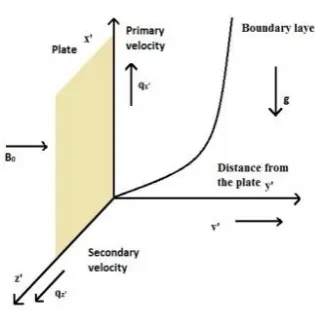
Let the flow be unsteady and electrically conducting. The medium considered is porous. The x' axis is along the motion with z' taken
normal to it. The boundary layer is formed in the direction of y'. A uniform field B'
0 is applied
transversely on the flow. At the start, it is assumed that the temperatures of the plate and the fluid are each T∞. Further, C∞ is the species concentration. After some time, the plate starts oscillating with frequency. Then the temp of the plate and the concentration of the fluid, respectively, are raised to Tw and Cw. Using the relation B0 for the magnetic field
z y
x,B ,B
B
B
we get B'y'(say B'0) = constant,
119 Fig. 1. Geometry of the problem.
Let q' be the velocity vector, and qx', qy', qz'are respectively the velocity components along x', y'
and z' - directions. The governing equation of continuity is 0 z q y q x
qx y z
Since there is no variation of flow in the y' - direction, therefore v' = 0
The generalized ohm’s law including the effect of Hall current according to cowling [9] is given as: ) B q E ( ) B J ( B
J e e
0
The external electric field E = 0, since polarization of charges is negligible.
Let J = (jx', jy', jz'). Here jx' jy' and jz' are the components of current density in the x', y', and
z' directions, respectively. Using the above assumption, we get
) q mq ( m B J and J ), mq q ( m B J z x z y z x x 2 2 0 2 2 0 1 0 1
The fluid model is as under:
, K q ) m ( ) mq q ( B ) C C ( g ) T -(T g y q t q x z x * x x 2 2 0 2 2 1 (1) , K q ) m ( ) q mq ( B y q t
qz z x z z
02 2
2 2 1 (2) ), C C ( K D y C t C
c
2 2 (3) , Q ) T T ( k y T t T
CP 2 0
2
(4)
The initial and b. c. are
. y as , C C , T T 0, q 0, q 0, y at T T , q , t cos q q : 0 t , y values all for C C , T T , q , q : t z x w z x x z x 0 0 0 0 0
(5)
Here qx'and qz' are the primary and the secondary velocities along x'and z'respectively.
The non-dimensional quantities introduced to transform equations (1), (2), (3) and (4) are as follows: . q , C C C C C , ) T T ( ) T T ( , q ) T T ( g Gr , q ) C C ( g Gm , q ' ' , t q t , q B M K q K , ρC q υ Q Q , k C , D Sc , q ' y ' y , q q q , q q q x w w ' x w ' x w * ' x ' x ' x ' x p ' x P ' x ' x ' z ' z ' x ' x ' x c υK K Pr 2 0 3 3 2 2 2 2 0 2 2 0 0 0 0 0 0 0 0 0 0 0 0 (6) The dimensionless flow model becomes
, q K ) m ( ) q m q ( M C Gm Gr y q t q x z x x ' x 1 1 2 2 2 (7) , q K ) m ( ) q q m ( M y q t q z z x z z 1 1 2 2 2 (8) , C K Sc y C t C 0 2 2 1 (9) . Q Pr y t 1 2 2 (10)
120
. y as , , C , q , q 0 y at C , , q , t cos q , t y of values all for , , C , q , q , t z x z x z x 0 0 0 0 1 1 0 0 0 0 0 0 0 (11)Removing the bars and combining eqs. (7 and 8), we get
, q K ) mi ( m M G GmC ' y q t q 1 1 1 2 2 2 (12) , C K Sc y C t C 0 2 2 1 (13) , Q Pr y t 1 2 2 (14)
where
q
q
x
iq
z,
with corresponding b. c.. y' as 0, 0, C 0, q' 0, y' at 1, C 1, 0, q' , t cos ' q : t , y of values all for , C , , q : t
0 0 0 0 (15) Solving analytically using Laplace transform method, equations (12, 13 and 14) are changed to
* * * * * q K ) mi ( m M GmC Gr ) s , y ( y ' q ) , ' y ( ' q ) s , ' y ( ' sq 1 1 1 0 2 2 2 (16) * *
* C(y,s) K C
y Sc ) , y ( C ) s , y (
sC 2 0
2
1
0
(17)
* * * Q ) s , y ( y Pr ) , y ( ) s , y (
s
2 2 1
0 (18)
where s is a parameter of Laplace transformation. On further solving, the solution obtained is as under:
)], A ) Sc K y exp( A )( Sc K y exp( ) Sc K a ( Gm )} A ) B exp( A ) B exp( ( ) B B exp( ) A ) B exp( A )( B B exp( ) A ) y a exp( A )( y a exp( { Gm ) Sc K a ( )}] A ) Pr Q y exp( A )( Pr Q y exp( ) A ) B exp( A ) B exp( )( B B {exp( )} A ) B exp( A ( ) B B exp( ) A ) y a exp( A )( y a exp( [{ Gr Pr) Q a ( ) P ) P y exp( P ) P y exp( ) y P exp( P ) i a y exp( P P )( it exp( [ q 14 0 13 0 0 12 3 11 3 3 2 6 5 3 2 2 1 0 10 9 8 2 7 1 1 0 4 1 3 1 0 2 1 6 0 5 0 4 3 2 1 2 1 2 1 2 2 1 2 2 1 2 1 2 1 2 2 1 2 2 2 1 4 1 ), A ) y Pr Q exp( A )( y Pr Q exp(
1 9 2 10
2
1
). A ) ScK y exp( B )( ScK y exp(
C 0 4 2 0 14
2
1
3. Drag at the surface
The drag at the plate y’= 0 is given by
i .
y q
z x
Here τ(x’) and τ(z’) are drags at the plate in
x'and z' directions. 4. Sherwood number
. y C Sh 7
6 0 14 0
0
0 0 14 0
exp( ) exp(2 ) } { 1
exp( ) .
2
( 1 exp(2 )) 2exp(2 ) B Sc B y ScK A ScK
y ScK t
y ScK y ScK A ScK
5. Nusselt number
. y Nu }) Pr Q A ) y Pr Q exp( )) y Pr Q exp( ( t Pr ) B exp( { } A ) y Pr Q exp( A { y Pr Q ( ) y Pr Q exp( 10 5 10 9 2 2 2 1 2 1 2 1
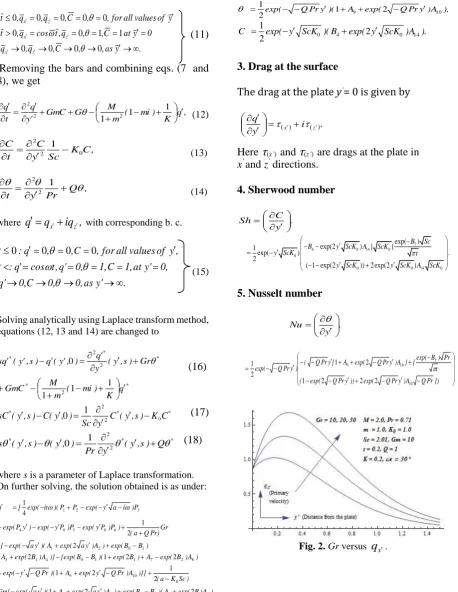
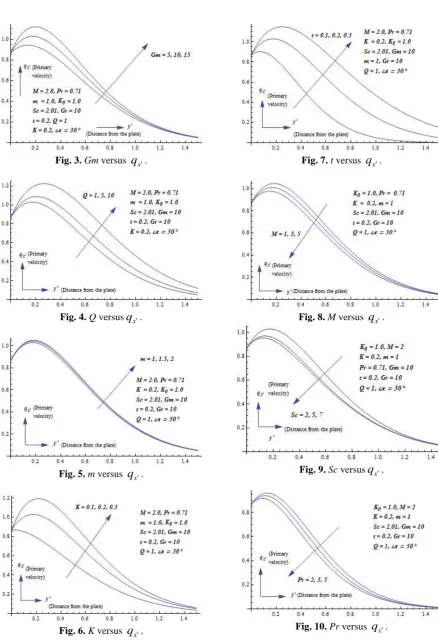
121 Fig. 3.Gm versus
q
x.Fig. 4.Q versus
q
x.Fig. 5.m versus
q
x.Fig. 6.K versus
q
x.Fig. 7.t versus
q
x.Fig. 8.M versus
q
x.Fig. 9.Sc versus
q
x.122
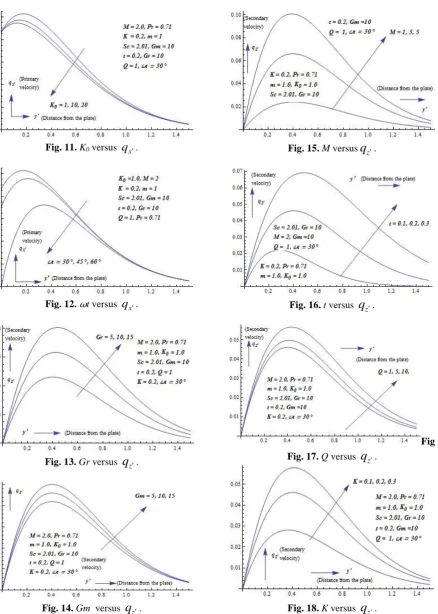
Fig. 11.K0 versus
q
x.Fig. 12.ωt versus
q
x.Fig. 13.Gr versus
q
z.Fig. 14.Gm versus
q
z.Fig. 15.M versus
q
z.Fig. 16.t versus
q
z.Fig
Fig. 17.Q versus
q
z.123 Fig. 19.m versus
q
z'.Fig. 20.Sc versus
q
z.Fig. 21.Pr versus
q
z.Fig. 22.K0 versus
q
z.Fig. 23. ωt versus
q
z.Fig. 24. Sc versus C.
Fig. 25.K0versus C.
Fig. 26.t versus C.
124
Fig. 27.Q versus θ. Fig. 28. t versus θ.
Fig. 29. Pr versus θ.
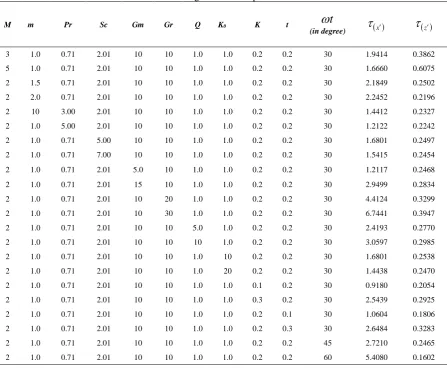
Table 1. Drag for different parameters.
M m Pr Sc Gm Gr Q K0 K t
t
(in degree)
x
z3 1.0 0.71 2.01 10 10 1.0 1.0 0.2 0.2 30 1.9414 0.3862
5 1.0 0.71 2.01 10 10 1.0 1.0 0.2 0.2 30 1.6660 0.6075
2 1.5 0.71 2.01 10 10 1.0 1.0 0.2 0.2 30 2.1849 0.2502
2 2.0 0.71 2.01 10 10 1.0 1.0 0.2 0.2 30 2.2452 0.2196
2 10 3.00 2.01 10 10 1.0 1.0 0.2 0.2 30 1.4412 0.2327
2 1.0 5.00 2.01 10 10 1.0 1.0 0.2 0.2 30 1.2122 0.2242
2 1.0 0.71 5.00 10 10 1.0 1.0 0.2 0.2 30 1.6801 0.2497
2 1.0 0.71 7.00 10 10 1.0 1.0 0.2 0.2 30 1.5415 0.2454
2 1.0 0.71 2.01 5.0 10 1.0 1.0 0.2 0.2 30 1.2117 0.2468
2 1.0 0.71 2.01 15 10 1.0 1.0 0.2 0.2 30 2.9499 0.2834
2 1.0 0.71 2.01 10 20 1.0 1.0 0.2 0.2 30 4.4124 0.3299
2 1.0 0.71 2.01 10 30 1.0 1.0 0.2 0.2 30 6.7441 0.3947
2 1.0 0.71 2.01 10 10 5.0 1.0 0.2 0.2 30 2.4193 0.2770
2 1.0 0.71 2.01 10 10 10 1.0 0.2 0.2 30 3.0597 0.2985
2 1.0 0.71 2.01 10 10 1.0 10 0.2 0.2 30 1.6801 0.2538
2 1.0 0.71 2.01 10 10 1.0 20 0.2 0.2 30 1.4438 0.2470
2 1.0 0.71 2.01 10 10 1.0 1.0 0.1 0.2 30 0.9180 0.2054
2 1.0 0.71 2.01 10 10 1.0 1.0 0.3 0.2 30 2.5439 0.2925
2 1.0 0.71 2.01 10 10 1.0 1.0 0.2 0.1 30 1.0604 0.1806
2 1.0 0.71 2.01 10 10 1.0 1.0 0.2 0.3 30 2.6484 0.3283
2 1.0 0.71 2.01 10 10 1.0 1.0 0.2 0.2 45 2.7210 0.2465
125 Table 2. Sherwood number. Table 3. Nusselt number.
Sc K0 t Sh
0.16 1.0 0.2 -0.21346 3.0 1.0 0.2 -0.26078
5.0 1.0 0.2 -3.3665 2.01 10 0.2 -2.1346
2.01 20 0.2 -4.5193
2.01 1.0 0.1 -2.7780
2.01 1.0 0.3 -1.8776
6. Results and discussion
The values computed for velocity, drag, Sherwood number and Nusselt number for different parameters have been ploted.
Table 4: Different value of parameters.
Symbols Values
m 1.0 1.5 2.0
M 1.0 3.0 5.0
Gm 5.0 10 15
Sc 2.0 5.0 7.0
Pr 2.0 3.0 5.0
t
30 45 60
K 0.1 0.2 0.3
K0 10 10 30
Q 1.0 5.0 10
t 0.1 0.2 0.3
It has been observed from Figs. 2-7 that
q
x'increases when Gr, Gm, Q, m, K, and t are increased respectively one at a time. In each case only one parameter changes with others keeping constant. We imply the same interpretation in our further discussion. Figs. 8, 9, 10, 11 and 12 show that
q
xdecreases, when M, Sc, Pr, K0 andt
are increased. Almost similar pattern is observed forq
z'. Figs. 13, 14, 15, 16, 17 and 18 show that theq
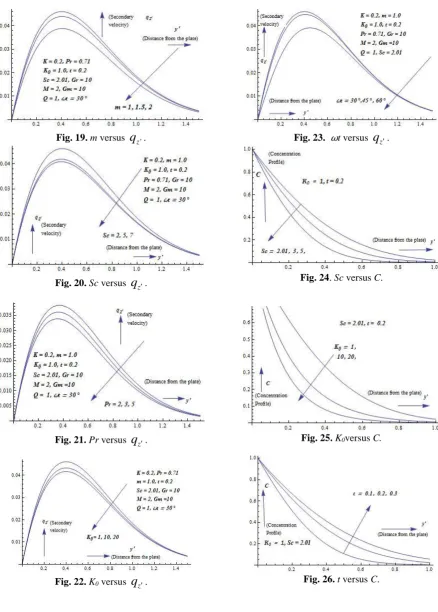
z increases when Gr, Gm, M, t, Q and K are increased. However, Figs. 19-23show that
q
z decreases when m, Sc, Pr, K0andt
are increased. This implies that the Hall parameter slows down the transverse velocity. Figs. 24, and 25 show that concentration decreases when Sc and K0 are increased. However, Figs. 26 shows that concentration increases when t is increased. Figs. 27 and 28 show that the temperature increases when Q andt are increased. Fig. 29 shows that it decreases when Pr is increased.
Table 1 shows that drag along x’ axis decreases with increase in Sc, Pr, K0 and M; and it increases with Gr, Gm, m, t, Q, K and
t. On the other hand, drag along z’ axis increases withincrease in Gr, Gm, t, Q, K and M; and it decreases with Pr, m, Sc, K0 and
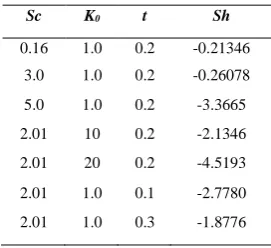
t. Table 2 shows that Sherwood number decreases with increase in Sc, and t. However, Sherwood number increases with increase in K0. Further, Table 3 shows that Nusselt number decreases with increase in Pr. However, it increases with increase in t and Q. The main parameters are in Table 4. The findings are concluded in the next section.7. Conclusions
It has been observed that
q
x' increases with heatgeneration, permeability of the medium and Hall parameter. However it decreases with chemical reaction parameter. Further,
q
z' increases when heat generation parameter, and permeability of the medium are increased. But it decreases with Hall parameter and chemical reaction parameter.Pr Q t Nu
0.71 1.0 0.2 -0.8430 7.0 1.0 0.2 -2.6470
13.0 1.0 0.2 -3.6073 0.71 5.0 0.2 0.2206
0.71 10 0.2 2.1991
126
As far as drag is concerned,
x' increases with heat generation parameter, permeability of the medium and Hall parameter; and it decreases with chemical reaction parameter. The Sherwood number decreases with increase in Schmidt number, and time. Further, the Nusselt number increases with increase in time and heat generation parameter. The results obtained are as per expectation for real flow.References
[1] M. G. Reddy, and N. Sandeep, “Free
convective heat and mass transfer of
magnetic bio-convective flow caused
by a rotating cone and plate in the
presence of nonlinearthermal radiation
and cross diffusion”,
Journal of
computational and applied research in
mechanical engineering
, Vol. 17, No.
1, pp. 1-21, (2017).
[2]
G. S. Seth, R.Sharma, and S. M.
Hussain, “Hall effects on unsteady
MHD natural convection flow of a
heat
absorbing
fluid
past
an
accelerated moving vertical plate with
ramped
temperature”,
Emirates
Journal for Engineering Research
,
Vol.19 No.2, pp.19-32,(2014).
[3]
S. R. Sheri, A. J. Chamkha and A. K.
Suram, “Heat and mass transfer effects
on MHD natural convection flow past
an impulsively moving vertical plate
with ramped temperature”,
Columbia
International Publishing American
Journal of Heat and Mass Transfer
,
Vol. 3 No. 3 pp.129-148,(2016).
[4]
M. A. Seddek, “Finite-element method
for the effects of chemical reaction,
variable viscosity, thermophoresis and
heat
generation/absorption
on
a
boundary-layer hydro magnetic flow
with heat and mass transfer over a heat
surface”,
Acta Mech
, Vol.177, No.
1-4, pp.1-18, (2005).
[5] A. H. Attia, Wabbas, A. M. Mostafa, and
A. M. S. Ahmed, “Heat transfer
between two parallel porous plates for
Couette flow under pressure gradient
and Hall current”,
Sadhana Indian
Academy of Sciences
, Vol. 40, No. 1,
pp.183–197,(2015).
[6] M. A.Hossain, M. S. Munir, and D. A.
S.
Rees,
“Flow
of
viscous
incompressible fluid with temperature
de-pendent viscosity and thermal
conductivity past a per-meable wedge
with
uniform
surface
heat
flux”,
International
Journal
of
Thermal Sciences,
Vol. 39, No. 6, pp.
635-644, ( 2000).
[7] A. Mythreye, J. P. Pramoda, K.S.
Balamurugan, “Chemical reaction on
unsteady MHD convective heat and
mass transfer past a semi-infinite
vertical permeable moving plate with
heat
absorption”,
Procedia,
Engineering,
Vol. 12, pp. 613-620,
(2015 ).
[8]
T.
G.
Cowling,
“Magnetohydro
dynamics”
Interscience Publishers
,
New York (1957).
[9]
U. S. Rajput and N. Kanaujia,
“Chemical reaction in MHD flow past
a vertical plate with mass diffusion and
constant wall temperature with Hall
current”,
International Journal of
Engineering, Science and Technology
.
Vol. 8, No. 4, pp. 28-38,(2016).
[10] L. R. Reddy, M. C. Raju G. S. S. Raju
and S. M. Ibrahim, “Chemical reaction
and thermal radiation effects on MHD
micro polar fluid past a stretching
sheet embedded in a non- Darcian
porous
medium”,
Journal
of
computational and applied research in
mechanical engineering
, Vol. 6, No.
2, pp. 27- 46, (2017).
127
presence
of
heat
source/sink”,
“
Journal
of
computational
and
applied
research
in
mechanical
engineering
”, Vol. 6, No. 2, pp. 233-
241, (2017).
[12] T. Hayat, S. Asghar, A. Tanveer, A.
Alsaedi,
“Chemical reaction in
peristaltic motion of MHD couple
stress fluid inchannel with Soret and
Dufour effects”, “
Results in physics
”,
Vol. 10 pp.69-80, (2018).
[13] S. M. Ibrahim and K. Suneetha, Effects
of thermal diffusion and chemical
reaction on MHD transient free
convection flow past a porous vertical
plate with radiation, temperature
gradient dependent heat source in slip
flow
regime,
“
Journal
of
computational and applied research in
mechanical engineering
”, Vol. 5, No.
2, pp. 83- 95, (2016).
[14] C. Sulochanna, S.P. Samrata and N.
Sandeep “Numrical investigation of
magnetohydrodynamic
(MHD)
radiative flow over a rotating cone in
the presence of soret and chemical
reaction”,
“
Propulsion
andPowerResearch”
; Vol.7, No.1, pp.
91–101,(2018).
[15] N. F. M. Noor, O. Abdulaziz and I.
Hashim, “MHD flow and heat transfer
in a thin liquid film on an unsteady
stretching sheet by the homotopy
analysis
method”,
“
International
Journal for Numerical Methods in
Fluids”
, Vol. 63, No. 3, pp. 357–373,
(2010).
[16] A. Ishak, R. Nazar and I. Pop,
“Magnetohydrodynamic flow and heat
transfer due to a stretching cylinder”,
“
Energy
Conversion
and
Management
”, Vol.49, No. 11, pp.
3265–3269, (2008).
Appendix
a i it ,
P0 1/22
a i
) exp(y
a i
), yexp(
P1 1/2 1/2
), P y exp( ) P y exp(
P2 0 0
], t i a t y [ erf P / / 2 1 2 1 3 2
2
], t i a t y [ erf P / / 2 1 2 1 4 2
2
], t i a t y [ erf P / / 2 1 2 1 5 2
2
], ) t ( y ) a ( t [ efr A / / 2 1 2 1 1 2
2
], ) t ( y ) a ( t [ efr A / / 2 1 2 1 2 2
2
], ) t ( Pr Pr ) Q a ( t ' y [ erfc A / / 2 1 2 1 3 2 1 2 ], ) t ( Pr Pr ) Q a ( t ' y [ erfc A / / 2 1 2 1 4 2 1 2 ], ) t ( Sc Pr ) K a ( t ' y [ erfc A / / 2 1 2 1 0 5 2 1 2 ], ) t ( Sc Pr ) K a ( t y [ erfc A / / 2 1 2 1 0 6 2 1 2 ], ) t ( (Pr) y Pr ) Q a ( t [ erf A / / / 2 1 2 1 2 1 7 2 1
2
], ) t ( (Pr) ' y Pr ) Q a ( t [ erf A / / / 2 1 2 1 2 1 8 2 1
2
], ) t ( (Pr) y t ) Q ( [ erf A / / / 2 1 2 1 2 1 9 2
2
], ) t ( (Pr) y t ) Q ( [ erf A / / / 2 1 2 1 2 1 10 2
2
], ) t ( ) Sc ( y Sc ) K a ( t [ erf A / / / 2 1 2 1 2 1 0 11 2 1
2
], ) t ( ) Sc ( y Sc ) K a ( t [ erf A / / / 2 1 2 1 2 1 0 12 2 1
2
], ) t ( ) Sc ( y ) K ( t [ erf A / / / 2 1 2 1 2 1 0 13 2
2
], ) t ( ) Sc ( y ) K ( t [ erf A / / / 2 1 2 1 2 1 0 13 2
2
, Pr tQ Pr Pr at B 1 1 0 , Pr Pr H a y B /2 1 1
1
, Sc Sc tK Sc at B 1 1 0 2 , Sc Sc ) K a ( y B /2 1 0 3
1
128
], )
t (
) K ( t ) Sc ( y [ erfc
B /
/
2 1
0 2
1 4
2 2
,t
) y (Pr t ) Q ( B
/
4
2 1 2 2
5
], )
t (
) K ( t ) Sc ( y [ erfc
B 1/2 0
6
2 2
], )
t (
) K ( t y ) Sc ( [
B /
/
2 1
2 0 2
1
7
4 2
. K ) im ( m M
a 1 1
1 2
How to cite this paper:
U S Rajput and Neetu Kanaujia,“ Combined effect of Hall current and chemical reaction on MHD flow through Porous medium with heat generation past an impulsively started vertical plate with constant wall temperature and mass diffusion