*
Corresponding author
Experimental study on thermal conductivity of polyurethane resin
filled with modified nanoparticles
A. A. Azematia, H. Khorasanizadeha, B. Shirkavand Hadavandb, * and G. A. Sheikhzadeha
aDepartment of Thermo Fluids, Faculty of Mechanical Engineering, University of Kashan, Kashan, Iran bDepartment of Resin and Additives, Institute for Color Science and Technology, Tehran, Iran
Article info: Abstract
Most of the energy loss in a building is through the walls. For this reason, insulating materials are used to reduce the loss of energy in buildings. Common insulations are high thickness thermally resistant material while thin coatings are usually used less. The purpose of this research was to introduce nanocomposite thin polymer coatings and their effects on thermal conductivity. In order to prepare the insulating layers with nanocomposite coatings, chemically modified nano zirconium and aluminum oxides in three different weight percentages (1, 3, and 5%) were used in polyurethane matrix. To study thermal conductivity, the metallic plates were coated with the prepared nanocomposites, and the thermal conductivity of the samples was measured. The results showed that adding zirconium oxide and aluminum oxide nanoparticles in the polyurethane matrix increases the thermal resistance of the plates in all three weight percentages, compared to the coating with no nanoparticles. The lowest thermal conductivity was found for 5% nano aluminum oxide composition, which compared to the conductivity of the pure polyurethane resin decreases about 40%.
Received: 06/11/2017
Accepted: 30/01/2018 Online: 10/04/2018
Keywords: Nanoparticles, Thermal conductivity, Thermal barrier coating, Polyurethane,
Insulation.
1. Introduction
Regarding the increasing demand of energy in the world, conservation of energy is the major topic of numerous studies in recent years [1-3]. Decreasing energy loss in the building envelope is one of the issues that has attracted the attention of materials and mechanical experts, leading to the development of various materials and systems to achieve this goal. Using thermally resistant materials such as fiberglass, stone wool, polymeric foams and other insulating materials [4] is a straightforward solution. In most cases, insulated walls are thick, and insulated walls
JCARME A. A. Azemati, et al. Vol. 8, No. 1
98
improvement in energy saving [7]; moreover, application of the hollow particles is not limited by weather conditions, and they can be used in different areas with different climates [8]. By choosing the right filler materials for reinforcing polymeric composites, low absorption or high reflection coatings can be achieved. In areas with high exposure to sunlight, these coatings can help to prevent buildings from warming, and hence, contribute to energy saving [9]. These types of coatings can be made using metal oxides [10]. Various studies have been carried out to identify and select materials with low thermal conductivity and highly stable thermodynamic properties [11-13]. In recent decades, the use of nanomaterials has made it possible to create special features, for which various applications have found in the industry. Nanofluids, for example, to which attention is drawn nowadays in heat transfer issue, have been the subject of a lot of research activities. The use of nanoparticles with ceramic and polymeric materials, have created ceramic and polymeric nanocomposite materials with special properties [14, 15]. The use of metallic nano oxides such as nano aluminum oxide and nano zirconium oxide as the thermal protection coating in a ceramic matrix has shown satisfactory results [16, 17]. Besides, polymeric nanocomposite made with nanoparticles create materials with different properties.
This research investigates the thermal conductivity of low-thickness polymeric nanocomposites. These nanocomposites may be used as the thermal barrier coating to coat the exterior metallic surfaces of buildings. For this purpose, polyurethane resin (with high resistance to weather conditions) was used as the polymeric matrix, and aluminum oxide and zirconium oxide nanoparticles were used to enhance thermal insulation properties. An experimental setup was also developed to investigate the heat transfer through the coatings as well as thermal properties.
2. Experimental setup
2.1. Materials
The polymer base coating was polyurethane 9016 WU18AX supplied by Peka Chimie Company (Iran). Synthesize grade of isopropyl
alcohol, acetoneو and vinyltrimethoxysilane (as coupling agent) were prepared from Merck Co. (Germany). Nano zirconium and aluminum oxides with an average of 40 nm diameters were supplied from US Research Nanomaterials Inc. (USA). All the materials were used without any purification.
2. 2. Method
Nanoparticles were modified by
vinyltrimethoxysilane [17-19] and dried in a vacuum oven for 12 h at 60ºC. Nanoparticles were dispersed in acetone by ultrasound and mixed with polyurethane resin by twin screw extruder. The blank composite with the same method was prepared without nanoparticles. Prepared materials were coated on a clean 10 cm × 15 cm galvanized plate and cured at 180ºC for 15 min.
2. 3. Instruments and test methods
Ultrasound (Hielscher UP400S, Germany) and twin screw extruder (Yantai Donghui Powder Processing Equipment Company, China) were
used for dispersing nanoparticles in
polyurethane resin. Vacuum oven (WiseVen, WOV-30 -60 cmHg, South Korea) was used for
drying materials. Morphology of
nanocomposites was studied by scanning electron microscopy (SEM, LEO 1455VP, Zeiss, Germany). The temperature of surface coatings was measured by thermography camera (Testo 875-2, United Kingdom).
a definite temperature (-125 to 500°C). At this temperature, the sample surface is then irradiated with the laser or xenon flash. This energy pulse results in a homogeneous temperature rise at the sample surface, which is measured by a high-speed infrared detector, and thermal diffusivity values are computed from the temperature rise versus time data. The resulting measuring signal computes the thermal diffusivity, and in most cases, the specific heat (Cp) data. If the density
(ρ) is identified, the thermal conductivity can be calculated [22]. For this purpose, copper surfaces with a diameter of 1.25 cm coated with thin polymeric nanocomposites was used. The specific heat capacity was measured using a Mettler Toledo calibrated at five points with Zn, Al, Au and Pd on samples according to ASTM 1269 standard. The density was measured (ASTM B 923) with a Helium Pycnometry calibrated with a stainless steel sphere. The thermal diffusivity was measured according to ASTM E1461 standard using the laser flash analyzer LFA 1000/1000 HT calibrated with graphite. This device measures thermal diffusivity and specific heat capacity within a temperature range of -125 to 500°C using an
absolute measurement technique and covers the widest measuring range from 0.1 to 2000 W/(m.K) for thermal conductivity and from 0.01 to 1000 mm2/s for thermal diffusivity. Eq. (1)
gives the value of thermal conductivity using the results obtained according to ASTM E1461. K(T) = a(T)·Cp(T)·ρ(T) (1)
where a(T) is the thermal diffusivity, Cp(T) is the
specific heat capacity, and ρ(T) is the density. 3. Results and discussion
3. 1. Morphology of nanocomposites
Fig. 1 shows SEM images of aluminum oxide and zirconium oxide urethane nanocomposites. As can be seen, nanoparticles are well distributed in the urethane matrix. For both 1 and 3% samples, a homogeneous distribution of nanoparticles is observed. In 5% sample, nanoparticles begin to agglomerate. Therefore, it can be predicted that above 5%, due to the adhesion and aggregation of nanoparticles and non-homogeneous distribution of them, the properties degrade.
3
O
2
5% Al -PU
3
O
2
3% Al -PU
3
O
2
1% Al -PU
2
ZrO 5% -PU
2
3% ZrO -PU
2
1% ZrO -PU
JCARME A. A. Azemati, et al. Vol. 8, No. 1
100
3. 2. Specific heat capacity of nanocomposites
To measure and calculate the thermal conductivity, it is needed to measure the specific heat capacity of the samples. The specific heat capacity depends on the intermolecular forces, kinetic motions in the polymer chain, and its physical state. The type of movements in a polymer chain affects both the heat transfer rate through the polymer chain and the heat capacity of the substance. The temperature of a substance increases with the movements of its components; the faster the components movements, the faster the temperature rise, and hence, the lower the heat capacity. Furthermore, if the intermolecular forces are weak, the temperature rises rapidly again since the particles escape from the forces of attraction. This leads to an increase in their movements and, thus, in the temperature of the substance. As a result, the weaker the intermolecular forces, the lower the specific heat capacity [23].
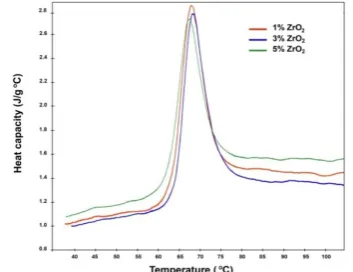
Besides, the specific heat capacity of nanocomposites depends on the type, size, weight content, distribution, and crystalline structure of nanoparticles. Since the particles for all coatings were the same size, the effect of size was not taken into account. For nano aluminum oxide, more adhesion of particles (compared to nano zirconium oxides) was observed. Figs. 2 and 3 show the specific heat capacity of the samples with nano aluminum and zirconium oxides.
Since the specific heat capacity of nano aluminum oxide (0.95 J/(g.K)) is higher than that of nano zirconium oxide (0.42 J/(g.K)), by adding nano aluminum oxide to the polymeric matrix higher heat capacity of the coating than that with zirconium oxide nanoparticles was expected. In addition, the increase in heat capacity of the coatings with higher content of the nanoparticle was expected.
As shown in Figs. 2 and 3, the specific heat capacity of the samples filled with nano aluminum oxide increases at 1, 3, and 5 wt% content, whereas that of the samples filled with nano zirconium oxide increases at 3, 5, and 1 wt% content, respectively. As can be seen, the specific heat capacity of the coatings increases with the rise of nano zirconium oxide content.
Regarding the results given in Fig. 1, this can be due to the good dispersion of the oxide. Moreover, the minimum value of specific heat capacity was for the sample filled with 3 wt% nano aluminum oxide which based on the results obtained from the SEM images (Fig. 1) it is attributable to the quality of the nanoparticles dispersion in the polymeric matrix.
Fig. 2. Specific heat capacity of urethane nanocomposites containing 1, 3, and 5 wt% nano aluminum oxide.
Fig. 3. Specific heat capacity of urethane nanocomposites containing 1, 3, and 5 wt% nano zirconium oxide.
3. 3. Thermal conductivity of nanocomposites
of mixtures (Eq. (2)), the thermal conductivity of nanocomposites is a function of the volume fraction of particles and their mesh, and increases with the addition of weight content of the nanoparticles [25-28].
m m p p
c k k
k
(2)where kc, kp, and km are the thermal
conductivities of the composite, particles, and matrix, respectively. Φp and Φm are the volume
fractions of the particles and mesh, respectively. The thermal conductivity of the nanocomposite coatings depends on the thermal properties of the nanoparticles. An increase in the weight content of the nanoparticles leads to an increase in the heat transfer area of the nanoparticles in the polymeric matrix and, thereby, an increase in the thermal conductivity coefficient [29].
Table 1 presents the results, obtained for the thermal conductivity, thermal diffusion, specific heat capacity, and density of the elaborated coatings. As given in Table 1, the thermal conductivity does not follow an orderly manner with the changes in the weight content of the nanoparticles. With reference to Fig. 1, these changes can be due to disperse situation of nanoparticles in the polymeric matrix. Taking into account the possibility of the accumulation of the nanoparticles at higher weight percentages and, thereby, the reduction of the heat transfer area of the nanoparticles in the polymeric matrix, the thermal conductivity of the samples reduces. As can be seen in Table 1, the measured density of the coatings is approximately the same; therefore it has no effect on their thermal conductivity. It is also observed that, compared to nano zirconium oxide, the lowest thermal conductivity coefficients are related to aluminum oxide nanocomposite coatings, which may be due to the properties of nano aluminum oxide and its chemical performance after the surface modification of the nanoparticles in the polymeric matrix. These changes can enhance interfacial forces and consequently reduce the thermal resistance in the polymeric matrix [30]. Also, the minimum thermal conductivity coefficient was related to the 5 wt% aluminum oxide nanocomposite coating, which may be
regarded to the increase in the nanoparticles amount.
The minimum conductivity coefficient was about 40% lower than the pure polyurethane sample leading to a decreased heat flux through the surface. According to Fourier’s law, the heat flux is directly related to thermal conductivity. Therefore, regarding the temperature difference and area being constant, the heat flux through the wall is directly proportional to the thermal conductivity.
In order to verify the results, the measurements were performed 10 times for each sample. Then, the effects of weight content and type of the nanoparticles on thermal conductivity were studied and also the standard deviation of the samples was analyzed by SPSS software, as presented in Table 2. It is seen that the material and weight content of the nanoparticles change the thermal conductivity of the coatings by 72.7%, whereas other factors such as dispersion of nanoparticles contribute to about 27% of the changes in thermal conductivity. Also, at 95% confidence level, it can be concluded that the thermal conductivity of nanocomposite coatings is best improved with nano aluminum oxide compared to the other nanoparticles. Fig. 4 shows the average and standard deviation values of thermal conductivity of the samples. The low value of standard deviation demonstrates a high accuracy in the measurements.
Fig. 5 shows the averages and standard deviations of the thermal conductivity of the nanocomposite coating coated on copper plates. Similar to Fig. 4, the results in Fig. 5 are highly accurate in the measurements. The left bar in Fig. 5 indicates the pure copper sample. As can be seen, the use of these coatings leads to a significant reduction in the thermal conductivity of all samples.
JCARME A. A. Azemati, et al. Vol. 8, No. 1
102
conductivity coefficient is related to the coating containing 3 wt% nano zirconium oxide. Therefore, when the surface temperature and thermal conductivity coefficient of the coating are low, the surface heat flux decreases
and, hence, the temperature of the other side of the sample decreases too [31, 32]. As a result, the prepared coating acted effectively as insulation, reducing significantly the energy consumption.
Table 1. Thermal conductivity, thermal diffusivity, specific heat capacity and density of samples.
Sample Density
(g/cm3)
Specific heat capacity Cp (J/(g.K))
Thermal diffusivity a (cm2/s)
Thermal conductivity K (W/(m.K))
Blank - 0% 1.470 1.02 0.00342 0.513
PU-1% nano ZrO2 1.420 0.98 0.00400 0.556
PU-3% nano ZrO2 1.455 1.00 0.00292 0.425
PU-5% nano ZrO2 1.520 1.04 0.00308 0.486
PU-1% nano Al2O3 1.460 1.10 0.00230 0.370
PU-3% nano Al2O3 1.42 0.80 0.00341 0.388
PU-5% nano Al2O3 1.468 0.90 0.00221 0.293
Table 2. The effect of various parameters on thermal conductivity.
Source Type of calculation
(Type III sum of squares)
Degree of freedom (df)
Error (Mean square)
Ratio (F)
Level of confidence (Sig)
Size effect (Partial Eta squared)
Intercept 8.780 1 8.780 320.168 0.000 0.988
VAR00001 0.292 2 0.146 5.318 0.045 0.727
Error 0.110 4 0.027 - - -
Fig. 4. Standard deviation of thermal conductivity of nanocomposite coatings with 0, 1, 3 and 5 wt% zirconium oxide and aluminum oxide nanoparticles.
Fig. 6. Thermography results of nanocomposite coating on copper plate; (a) samples with 0, 1, 3 and 5wt% aluminum oxide nanoparticles and (b) samples with 0, 1, 3 and 5 wt% zirconium oxide nanoparticles.
4. Conclusions
Nanoparticles can alter the thermal conductivity behavior of polymeric coatings. This may be due to the behavior and nature of the particles, their shape and amount. The present study investigated the effect of zirconium oxide and aluminum oxide nanoparticles addition to polymeric coatings on conductive heat transfer through these coatings. Based on the results, it was concluded that by adding modified
zirconium oxide and aluminum oxide
nanoparticles to polyurethane resin, the thermal conductivity of the samples is improved in all weight percentages of the nanoparticles compared to that of the pure polyurethane sample. The lowest thermal conductivity coefficients were related to the aluminum oxide samples, which can be due to its nature. Also, the sample with 5 wt% nano aluminum oxide
had the minimum thermal conductivity coefficient which was about 40% lower than pure polyurethane resin. On the other hand, the lowest surface temperature and thermal conductivity coefficient were observed in the sample with 3 wt% zirconium oxide. When the surface temperature and thermal conductivity of the coating were low, the surface heat flux and the temperature of the other side of the sample decreased.
References
[1] H. Zhou, M. Rao, and K. T. Chuang,
“Knowledge-based automation for
energy conservation and indoor air quality control in HVAC processes”,
Engineering Applications of Artificial Intelligence, Vol. 6, No. 2, pp. 131-144, (1993).
a) ))
JCARME A. A. Azemati, et al. Vol. 8, No. 1
104
[2] R. Parameshwaran, and S. Kalaiselvam, “Energy efficient hybrid nanocomposite-based cool thermal storage air conditioning system for sustainable buildings”, Energy, Vol. 59, pp. 194-214, (2013).
[3] R. Parameshwaran, S. Kalaiselvam, S. Harikrishnan, and A. Elayaperumal, “Sustainable thermal energy storage technologies for buildings: A review”, Renewable and Sustainable Energy Reviews, Vol. 16, No. 5, pp. 2394-2433, (2012).
[4] L. Aditya, T. M. I. Mahlia, B. Rismanchi, H. M. Ng, M. H. Hasan, H. S. C. Metselaar, O. Muraza, and H. B. Aditiya, “A review on insulation materials for energy conservation in buildings”, Renewable and Sustainable Energy Reviews, Vol. 73, pp. 1352-1365, (2017). [5] M. Zhao, W. Pan, Ch. Wan, Zh. Qu, Zh. Li, and J. Yang, “Defect engineering in development of low thermal conductivity materials: A review”, Journal of the European Ceramic Society, Vol. 37, No. 1, pp. 1-13, (2017).
[6] Y. Lin, Y.Jia, G. Alva, and G. Fang, “Review on thermal conductivity enhancement, thermal properties and applications of phase change materials in thermal energy storage”, Renewable and Sustainable Energy Reviews, ISSN 1364-0321,https://doi.org/10.1016/j.rser.2017. 10.002, (2017).
[7] A. A. Azemati, B. Shirkavand Hadavand, H. Hosseini, and A. Salemi Tajarrod, “Thermal modeling of mineral insulator in paints for energy saving”, Energy and Buildings, Vol. 56, pp. 109-114, 2013. [8] G. A. Sheikhzadeh, A. A. Azemati, H.
Khorasanizadeh, B. Shirkavand Hadavand, and A. Saraei, “The effect of mineral micro particle in coating on energy consumption reduction and thermal comfort in a room with a radiation coolingpanel in different climates”, Energy and Buildings, Vol. 82, pp. 644-650, (2014).
[9] S. W. Lee, Ch. H. Lim, and E. B.Salleh, “Reflective thermal insulation systems in
building: A review on radiant barrier and reflective insulation”, Renewable and Sustainable Energy Reviews, Vol. 65, pp. 643-661, (2016).
[10] A. A. Azemati, H. Khorasanizadeh, B. Shirkavand Hadavand, and G.A. Sheikhzadeh, “Study on radiation properties of polyurethane/nano zirconium oxide nanocomposite coatings”, Materials Science Forum, Vol. 894, pp. 109-112, (2017).
[11] D. R. Clarke, “Materials selection guidelines for low thermal conductivity thermal barrier coatings”,Surface and Coatings Technology, Vol. 163-164, pp. 67-74, (2003).
[12] W. W. Li, W. L. Cheng, B.Xie, N. Liu, and L. S. Zhang, “Thermal sensitive flexible phase change materials with high thermal conductivity for thermal energy storage”, Energy Conversion and Management, Vol. 149, pp. 1-12, (2017). [13] K. S. Reddy, and S. Jayachandran, “Investigations on design and construction of a square guarded hot plate (SGHP) apparatus for thermal conductivity measurement of insulation materials”, International Journal of Thermal Sciences, Vol. 120, pp. 136-147, (2017).
[14] H.Porwal, and R.Saggar, “Ceramic
Matrix Nanocomposites”,
Comprehensive Composite Materials II, Elsevier, Oxford, pp. 138-161, (2018). [15] J. Zhao, L. Wu, Ch. Zhan, Q. Shao,
Zh.Guo, and L. Zhang, “Overview of polymer nanocomposites: Computer simulation understanding of physical properties”, Polymer, available online 6 November 2017, ISSN 0032-3861, https://doi.org/10.1016/j.polymer.2017. 10.035.
[16] V. Kumar, and B. Kandasubramanian, “Processing and design methodologies for advanced and novel thermal barrier coatings for engineering applications”, Particuology, Vol. 27, pp. 1-28, (2016). [17] H. Farzad, F. Najafi, M. Bengisu, E.
aliphatic tri-functional oligomeric urethane methacrylate used for UV-curable aluminum pigmented coatings”, Journal of Macromolecular Science, Part A, Vol. 50,No. 5, pp. 504-512, (2013).
[18] B. Shirkavand Hadavand, M. Ataeefard, and H. Fakharizadeh Bafghi, “Preparation of modified nano ZnO/polyester/TGIC powder coating nanocomposite and evaluation of its antibacterial activity”, Composites Part B Engineering, Vol. 82, pp. 190-195, (2015).
[19] A. Madhi, B. Shirkavand Hadavand, and A. Amoozadeh, “Synthesis, characterization and study on thermal stability, mechanical properties and thermal conductivity of UV-curable urethane acrylate-Clay (MMT) nanocomposites”, Journal of Applied Chemistry, Vol. 12, No. 45, pp. 91-98, (2018).
[20] W. Nunes dos Santos, “Thermal properties of polymers by non-steady-state techniques”, Polymer Testing, Vol. 26, No. 4, pp. 556-566, (2007).
[21] W. Nunes dos Santos, P. Mummery, and A. Wallwork, “Thermal diffusivity of polymers by the laser flash technique”, Polymer Testing, Vol. 24, No. 5, pp. 628-634, (2005).
[22] P. S. Gaal, M. A. Thermitus, and D.E.Stroe, “Thermal conductivity measurements using the flash method”, Journal of Thermal Analysis and Calorimetry, Vol. 78, No. 1, pp. 185-189, (2004).
[23] I. Tavman, Y. Aydogdu, M. Kök, A. Turgut, and A. Ezan, “Measurement of heat capacity and thermal conductivity of
HDPE/expanded graphite
nanocomposites by differential scanning calorimetry”, Archives of Materials Science and Engineering, Vol. 50, pp. 56-60, (2011).
[24] I. H. Tavman, “Thermal and mechanical properties of aluminum powder-filled high-density polyethylene composites”,
Journal of Applied Polymer Science, Vol. 62, No. 12, pp. 2161-2167, (1996). [25] D. M. Bigg, “Thermal conductivity of
heterophase polymer compositions”, Advanced Polymer Science, Vol. 119, pp. 1-30, (1995).
[26] H. Zhou, S. Zhang, and M. Yang, “The effect of heat-transfer passages on the effective thermal conductivity of high filler loading composite materials”, Composites Science and Technology, Vol.67, No. 67, pp. 1035-1040, (2007). [27] S. Okamoto, and H. Ishida, “A new
theoretical equation for thermal conductivity of two-phase systems”, Journal of Applied Polymer Science, Vol.72, pp. 1689-1697, (1999).
[28] H. Ebadi-Dehaghani, M. Reiszadeh, A. Chavoshi, M. Nazempour, and M. H. Vakili, “The effect of zinc oxide and calcium carbonate nanoparticles on the thermal conductivity of polypropylene”, Journal of Macromolecular Science, Part B, Vol. 53, No. 1, pp. 93-107, (2014).
[29] L. Frormann, A. Iqbal, and S.A. Abdullah, “Thermo-viscoelastic behavior of PCNF-filled polypropylene nanocomposites”, Journal of Applied Polymer Science, Vol. 107, No. 4 pp. 2695-2703, (2008).
[30] A. Li, C. Zhang, and Y. F. Zhang, “Thermal conductivity of graphene-polymer composites: Mechanisms, properties, and applications”, Polymers, Vol. 9, pp. 420-437, (2017).
[31] W. Zhou, Sh. Qi, Ch. Tu, H. Zhao, C. Wang, and J. Kou, "Effect of the particle size of Al2O3on the properties of filled
heat-conductive silicone rubber", Journal of Applied Polymer Science, Vol. 104, No. 2, pp. 1312-1318, (2007). [32] A Ch. Liu, M. Chen, D. Zhou, D. Wu,
and W. Yu, "Effect of filler shape on the thermal conductivity of thermal functional composites", Journal of Nanomaterials, Vol. 2017, pp. 1-15,
Article ID 6375135, 15
JCARME A. A. Azemati, et al. Vol. 8, No. 1
106
How to cite this paper:
A. A. Azemati, H. Khorasanizadeh, B. Shirkavand Hadavand and G. A. Sheikhzadeh, “Experimental study on thermal conductivity of polyurethane resin filled with modified nanoparticles” Journal of Computational and Applied Research in Mechanical Engineering, Vol. 8, No. 1, pp. 97-106, (2018).
DOI: 10.22061/jcarme.2018.3063.1329