R E S E A R C H A R T I C L E
Open Access
Evaluation of the bacterial diversity of Pressure
ulcers using bTEFAP pyrosequencing
Drake M Smith
1, David E Snow
1, Eric Rees
1, Ann M Zischkau
1, J Delton Hanson
1, Randall D Wolcott
2, Yan Sun
1,
Jennifer White
1, Shashi Kumar
1, Scot E Dowd
1,3*Abstract
Background:Decubitus ulcers, also known as bedsores or pressure ulcers, affect millions of hospitalized patients each year. The microflora of chronic wounds such as ulcers most commonly exist in the biofilm phenotype and have been known to significantly impair normal healing trajectories.
Methods:Bacterial tag-encoded FLX amplicon pyrosequencing (bTEFAP), a universal bacterial identification method, was used to identify bacterial populations in 49 decubitus ulcers. Diversity estimators were utilized and wound community compositions analyzed in relation to metadata such as Age, race, gender, and comorbidities. Results:Decubitus ulcers are shown to be polymicrobial in nature with no single bacterium exclusively colonizing the wounds. The microbial community among such ulcers is highly variable. While there are between 3 and 10 primary populations in each wound there can be hundreds of different species present many of which are in trace amounts. There is no clearly significant differences in the microbial ecology of decubitus ulcer in relation to metadata except when considering diabetes. The microbial populations and composition in the decubitus ulcers of diabetics may be significantly different from the communities in non-diabetics.
Conclusions:Based upon the continued elucidation of chronic wound bioburdens as polymicrobial infections, it is recommended that, in addition to traditional biofilm-based wound care strategies, an antimicrobial/antibiofilm treatment program can be tailored to each patient’s respective wound microflora.
Background
An estimated 2.5 million hospitalized Americans cur-rently suffer from decubitus ulcers, also known as bed-sores or pressure ulcers,[1] and the annual cost for the prevention and treatment of decubitus ulcers is approxi-mately $10 billion [2]. Chronic wounds such as ulcers have troubled the medical community for centuries, as the first known decubitus ulcer was detected during the autopsy of an Egyptian mummy [3]. Today, approxi-mately 20% of long-term care patients are affected [2].
Decubitus ulcers often result from both external and internal patient factors [4]. Pressure, friction, shear force, and moisture are controllable external factors that affect a patient’s susceptibility to decubitus ulcers [5-7]. Internal patient factors such as fever, malnutrition, endothelial dysfunction, and anemia also contribute to a
patients susceptibility to ulceration [6,8]. Although exceptional care may alleviate external ulcer promoting factors, skin integrity is largely dependent on overall patient health. The dermis and epidermis rely on other organ systems for nutrition and immune function which when compromised by poor health considerably increase the risk of ulceration [9]. As reviewed elsewhere, those typically most at risk of developing decubitus ulcers are the aged, debilitated, paralyzed, unconscious, or patients with incontinentia pigmenti [4,6,10-12]. Less typical, though of equal concern, are children with similar com-promising health conditions [13-15].
Decubitus ulcers are most commonly found on the lower half of the body along bony prominences such as the sacrum and heels of bedridden patients [4,16]. Blood flow to compressed tissue becomes restricted and over time nutrient distribution comes to a relative halt while toxic metabolites begin to accumulate, causing cell death [4,17-19]. Additionally, because circulation is restricted, the patient’s immunological response in the * Correspondence: [email protected]
1Research and Testing Laboratory, Lubbock, TX 79407, USA
Full list of author information is available at the end of the article
vicinity of the wound becomes ineffective and the ability to heal is compromised [8].
The microbiota of chronic wounds is known to play a significant role in the hindrance of wound healing, even in the absence of inflammation. This microbial biobur-den exists in wounds predominantly as a biofilm [8,10,20-28]. The onset of decubitus ulcers occurs as described, and it is logical to suggest that this impaired host environment is extremely susceptible to biofilm incursion [29]. Functionally equivalent pathogroups (FEPs) are symbiotic colonies of otherwise nonpatho-genic species that act synergistically to promote their own survival at the expense of the host. These FEPs colonize and exist as a cohabitation of many bacterial species, known as a chronic wound pathogenic biofilm (CWPB). It is widely accepted that CWPBs are the pri-mary infectious agent in chronic wounds [20,22,25-32].
Current research efforts have exposed CWPBs as being extremely resistant to antimicrobial therapy and as highly adaptable systems with complex ecologies [21,33]. The use of universal 16 S rRNA amplification and sequencing molecular methods, specifically bacterial tag-encoded FLX amplicon pyrosequencing (bTEFAP), have uncovered many FEPs which comprise CWPBs [22,23,33-39]. As the diversity of these CWPB commu-nities increases, the effectiveness of the host’s immune system seems to decrease, leading to the effects on wound healing discussed previously [32].
Several helpful reviews have recently been published summarizing efforts within the scientific community to better understand the microbiology associated with chronic wounds, the resistance these wounds develop as a function of CWPBs, and improvements in the effective use of antibiotics and other treatments on wound heal-ing [21,40]. Also evident in the literature are recent efforts to survey the microbial diversity of venous leg ulcers [41]. However, other work indicates significant differences among pathogens in various wound types, and a survey of decubitus ulcers is a necessary contribu-tion to this body of work [37]. Therefore, the aim of this work is to shed new light on the polymicrobial diversity of chronic decubitus ulcer biofilm infections
using bacterial tag-encoded FLX amplicon
pyrosequencing.
Results
The diversity of 49 individual decubitus ulcers was eval-uated using the bTEFAP methodology. A total of 225,937 individual sequences longer than 350 bp were analyzed among the 49 samples with 210,836 sequences generating BLASTn hits against the bacterial database and an average sequence identity of 96.7%. A total of 83,705 sequences (39.7%) had identity below 96.5%. Only 2,000 of the total number of analyzed sequences
fell below 80% identity. A traceback analysis based upon the divergence of sequences from well described and type sequences was performed.
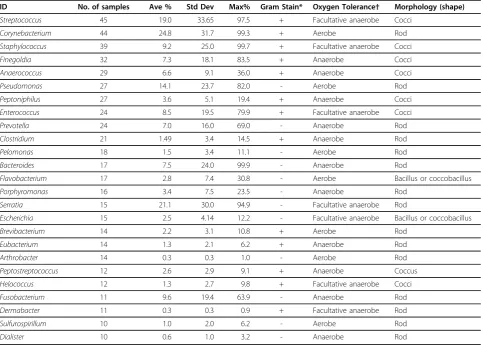
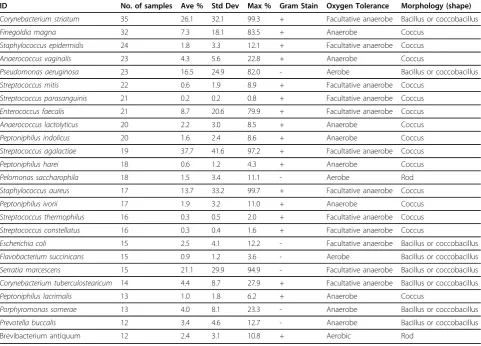
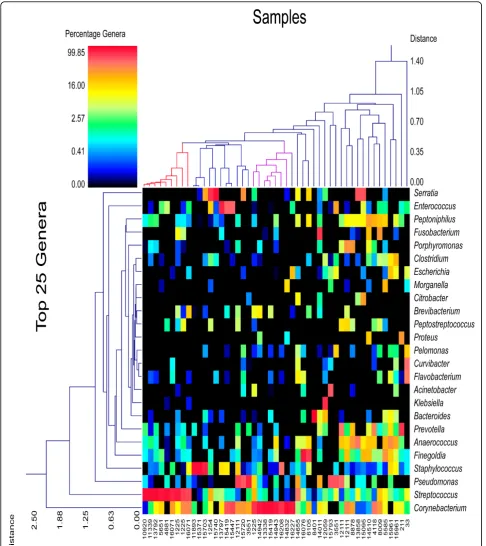
A total of 212 genera and 487 predicted species (occurring in at least 2 of the wounds) were identified among the 49 wounds. The top 25 unique and most ubiquitous genera (or closest taxonomic designation) are indicated in Table 1 and the top 25 species occurring in the wounds are shown in Table 2. Several genera and species were found in high percentage in individual
wounds (Figure 1 and Figure 2).Corynebacterium
stria-tum predominated in 12 of the wounds; Streptococcus
agalactiae predominated in 9 wounds; Pseudomonas aeruginosa predominated in 6 wounds;Anaerococcus vaginalisand Anaerococcus prevotiipredominated in 1 wound each, and a mixture of these two species with
Anaerococcus lactolyticusled to a predominance of this
genus in 3 additional wounds; Serratia marcescens
pre-dominated in 4 wounds;Staphylococcus aureus
predo-minated in 3 wounds and a mixture ofStaphylococcus
piscifermentansandStaphylococcus epidermidisled to a
predominance of this genus in a fourth wound;
Entero-coccus faecalis predominated in 3 wounds; Prevotella bividapredominated in 2 wounds and a mixture of Pre-votella bividawithPrevotella buccalisled to a predomi-nance of this genus in a third wound;Finegoldia magna,
Fusobacterium nucleatum, andPorphyromonas somerae
were predominant in 2 wounds each; and Bacteroides
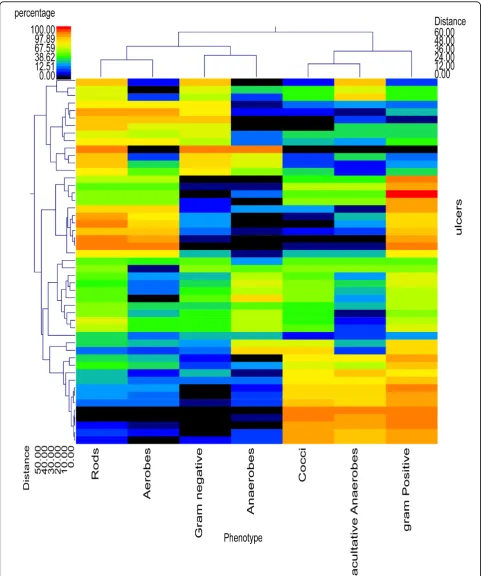
fragilis,Klebsiella pneumoniae,Acinetobacter bauman-nii,Curvibacter gracilis, andProteus mirabiliswere each predominant in 1 wound. The remaining wounds were highly diverse with no significantly predominant popula-tions. From the data we note that 69% were gram posi-tive, 31% were anaerobes, 43% were facultative anaerobes, and 69% were rod shaped bacteria (Figure 3). It should also be noted that genera appearing in less than 3 individual samples and also having only low rela-tive percentages < 1% were omitted from this figure to improve readability.
summary data on average diversity measurements evalu-ated statistically using Mann-Whitney and Kruskal-Wallis tests in relation to the metadata. No significant differences were observed for diversity measures in rela-tion to metadata parameters even antibiotic usage.
Discussion
The results indicate that there was a considerably large diversity in the samples, with 228 identified genera and 487 identified species among 49 decubitus ulcers. Addi-tionally, the 79,837 sequences with identity less than 96.5% can be considered as previously unknown or uncharacterized species of bacteria [42]. The majority of
these organisms were most closely related to
Staphylo-coccus,Enterococcus,Serratia, Pseudomonas,
Streptococ-cus, and Corynebacterium spp based upon 16 S
sequence. These bacteria were classified based upon
their closest identification and ranked at the most suita-ble genus, family or order level.
Our data indicates a number of important FEPs asso-ciated with decubitus ulcers (Figure 1 and Figure 2 den-dograms). At a relative distance of 0.30 based upon the weighted-pair linkage and Manhattan distance in Figure 2 we note there are 8 primary clusters, which included 8 predominant groups representing possible pathogroups. It is also evident that Staphylococcus aureus, Corynebac-terium striatum,Streptococcus agalactiae,Serratia mar-cescens,Finegoldia magna,Pseudomonas aeruginosa, and
Enterococcus faecalis are defining variables for these 8 clusters, withStreptococcus agalactiaebeing the defining variable for two separate clusters. It is interesting that so many of these wounds were predominated by what are either facultative or obligate anaerobic bacteria with only very minor populations of aerobes (36%). This Table 1 Evaluation of primary genera among the 49 decubitus ulcer samples
ID No. of samples Ave % Std Dev Max% Gram Stain* Oxygen Tolerance† Morphology (shape)
Streptococcus 45 19.0 33.65 97.5 + Facultative anaerobe Cocci
Corynebacterium 44 24.8 31.7 99.3 + Aerobe Rod
Staphylococcus 39 9.2 25.0 99.7 + Facultative anaerobe Cocci
Finegoldia 32 7.3 18.1 83.5 + Anaerobe Cocci
Anaerococcus 29 6.6 9.1 36.0 + Anaerobe Cocci
Pseudomonas 27 14.1 23.7 82.0 - Aerobe Rod
Peptoniphilus 27 3.6 5.1 19.4 + Anaerobe Cocci
Enterococcus 24 8.5 19.5 79.9 + Facultative anaerobe Cocci
Prevotella 24 7.0 16.0 69.0 - Anaerobe Rod
Clostridium 21 1.49 3.4 14.5 + Anaerobe Rod
Pelomonas 18 1.5 3.4 11.1 - Aerobe Rod
Bacteroides 17 7.5 24.0 99.9 - Anaerobe Rod
Flavobacterium 17 2.8 7.4 30.8 - Aerobe Bacillus or coccobacillus
Porphyromonas 16 3.4 7.5 23.5 - Anaerobe Rod
Serratia 15 21.1 30.0 94.9 - Facultative anaerobe Rod
Escherichia 15 2.5 4.14 12.2 - Facultative anaerobe Bacillus or coccobacillus
Brevibacterium 14 2.2 3.1 10.8 + Aerobe Rod
Eubacterium 14 1.3 2.1 6.2 + Anaerobe Rod
Arthrobacter 14 0.3 0.3 1.0 - Aerobe Rod
Peptostreptococcus 12 2.6 2.9 9.1 + Anaerobe Coccus
Helococcus 12 1.3 2.7 9.8 + Facultative anaerobe Cocci
Fusobacterium 11 9.6 19.4 63.9 - Anaerobe Rod
Dermabacter 11 0.3 0.3 0.9 + Facultative anaerobe Rod
Sulfurospirillum 10 1.0 2.0 6.2 - Aerobe Rod
Dialister 10 0.6 1.0 3.2 - Anaerobe Rod
The primary identification based upon percent sequence identity as described in the materials and methods is indicated. The number of samples in which each bacteria was identified is provided along with the average percent (avg %) among the positive samples, the standard deviation (st dev) and the range of percentages among the positive samples. No. of samples = the no. of samples in which the genus were identified Mean % = the average percentage of that genus in each of the samples SD = standard deviation of these percentages Maximum % = the maximum percentage of the genus in each sample * + Gram-positive; - Gram-negative
suggests that such anaerobes might be contributing sig-nificantly to the etiology of chronic wound biofilm infections.
Most of the wounds we have evaluated contain rela-tively high overall numbers of bacteria (> 105 per mg debridement), based upon quantitative molecular meth-ods so even ostensibly low percentages of individual spe-cies may potentially represent a large number of individual bacteria that have colonized or been recruited into and commenced propagating within decubitus ulcer biofilms even if we are considering populations that represent only 1% of the total. It is also important to note that, in addition to chronic wounds such as decubi-tus ulcers, healthy human skin is host to a diverse com-munity of microbes.
Several recent surveys have shown that intra- and inter-personal diversity of the human skin microbiome
is highly variable depending on gender, body regions, handedness, and time [43-46]. Skin microflora are found to fluctuate greatly in a short period of time, [43] women are shown to have a higher diversity than men, the dominant hand is shown to be more diverse than its counterpart, and skin regions are shown to be more similar in microbial composition with greater proximity [44]. In addition, the generaCorynebacterium, Propioni-bacteria, andStaphylococcushave been identified as pri-mary constituents of healthy skin microflora, with
CorynebacteriumandStaphylococcuspredominating the moist environments [45]. It is no surprise, then, to have
detectedCorynebacteriumandStaphylococcusin 44 and
39 respective wounds out of 49 surveyed. These ubiqui-tous skin bacteria may sometimes be the primary, opportunistic pathogenic constituents of CWPBs, as seen in Figures 1 and 2.
Table 2 Evaluation of primary species among the 49 decubitus ulcer samples
ID No. of samples Ave % Std Dev Max % Gram Stain Oxygen Tolerance Morphology (shape)
Corynebacterium striatum 35 26.1 32.1 99.3 + Facultative anaerobe Bacillus or coccobacillus
Finegoldia magna 32 7.3 18.1 83.5 + Anaerobe Coccus
Staphylococcus epidermidis 24 1.8 3.3 12.1 + Facultative anaerobe Coccus
Anaerococcus vaginalis 23 4.3 5.6 22.8 + Anaerobe Coccus
Pseudomonas aeruginosa 23 16.5 24.9 82.0 - Aerobe Bacillus or coccobacillus
Streptococcus mitis 22 0.6 1.9 8.9 + Facultative anaerobe Coccus
Streptococcus parasanguinis 21 0.2 0.2 0.8 + Facultative anaerobe Coccus
Enterococcus faecalis 21 8.7 20.6 79.9 + Facultative anaerobe Coccus
Anaerococcus lactolyticus 20 2.2 3.0 8.5 + Anaerobe Coccus
Peptoniphilus indolicus 20 1.6 2.4 8.6 + Anaerobe Coccus
Streptococcus agalactiae 19 37.7 41.6 97.2 + Facultative anaerobe Coccus
Peptoniphilus harei 18 0.6 1.2 4.3 + Anaerobe Coccus
Pelomonas saccharophila 18 1.5 3.4 11.1 - Aerobe Rod
Staphylococcus aureus 17 13.7 33.2 99.7 + Facultative anaerobe Coccus
Peptoniphilus ivorii 17 1.9 3.2 11.0 + Anaerobe Coccus
Streptococcus thermophilus 16 0.3 0.5 2.0 + Facultative anaerobe Coccus
Streptococcus constellatus 16 0.3 0.4 1.6 + Facultative anaerobe Coccus
Escherichia coli 15 2.5 4.1 12.2 - Facultative anaerobe Bacillus or coccobacillus
Flavobacterium succinicans 15 0.9 1.2 3.6 - Aerobe Bacillus or coccobacillus
Serratia marcescens 15 21.1 29.9 94.9 - Facultative anaerobe Bacillus or coccobacillus
Corynebacterium tuberculostearicum 14 4.4 8.7 27.9 + Facultative anaerobe Bacillus or coccobacillus
Peptoniphilus lacrimalis 13 1.0 1.8 6.2 + Anaerobe Coccus
Porphyromonas somerae 13 4.0 8.1 23.3 - Anaerobe Bacillus or coccobacillus
Prevotella buccalis 12 3.4 4.6 12.7 - Anaerobe Bacillus or coccobacillus
Brevibacterium antiquum 12 2.4 3.1 10.8 + Aerobic Rod
The primary identification based upon percent sequence identity as described in the materials and methods is indicated. The number of samples in which each bacteria was identified is provided along with the average percent (avg %) among the positive samples, the standard deviation (std dev) and the range of percentages among the positive samples. No. of samples = the no. of samples in which the species were identified Mean % = the average percentage of that species in each of the samples SD = standard deviation of these percentages Maximum % = the maximum percentage of the species in each sample * + Gram-positive; - Gram-negative
Figure 3Double dendogram of phenotypes in decubitus ulcers. The heat map shows relative percentages of the given phenotypes in each of the 49 samples with a color legend and scale provided. The distance of the samples based upon weighted pair linkage and Manhattan distance methods with no scaling is displayed at the top of the figure along with a distance score. The bacterial phenotypes and the associated clustering are provided along the Y-axis and their associated distance scores are indicated. The bacteria predominantly expressed the
Resident skin microflora may be considered largely commensal in nature, but it is known that nongenic microbes often become opportunistically patho-genic when the skin barrier becomes impaired [47]. The difference between a pathogenic dermatophyte and a resident skin bacterium is commonly defined not only by the inherent properties of the organism, but also by the host’s ability to resist infection. Resident skin bac-teria are capable of expressing virulence factors which under certain circumstances may allow for the evasion of host defensive onslaught, but the primary determi-nant of pathogenicity lies in the effectiveness of host response to microbial invasion [48]. It may be that con-ditions within the open wound environment allow for much greater propagation of resident cutaneous micro-flora, which colonize the wound without substantial opposition. In some cases, these nonpathogenic skin residents may harbor pathogenic recruits by concealing antigenic factors, thus preventing recognition by the host’s primary immune cells.
The 49 sampled wounds were found to be sufficiently diverse in composition as to negate any generalized recommendations for the targeting of microbial
bioburdens within chronic wounds. Instead, each wound is shown to be exceptionally unique, with some wounds predominated by opportunistically pathogenic commen-sal skin residents and others predominated by known pathogens. Other wounds showed no clear predomina-tion of a single species but rather a heterogeneous and complex assemblage. In addition, the present study is incapable of determining the role of certain bacteria that have been detected in lower, albeit potentially significant percentages. Even bacteria which comprise approxi-mately 15% of a wound, as indicated in Figures 1 and 2, may contribute to the etiology of chronic wounds as this percentage represents a substantial number of bac-teria even in a wound with only moderate bioburden at critical colonization levels. It is therefore recommended that future treatment courses be customized for each individual wound due to the highly variable etiology of chronic wounds such as decubitus ulcers.
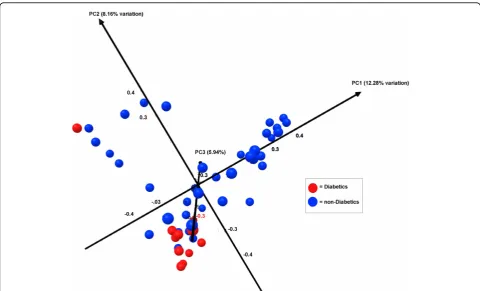
Taking into consideration the metadata we did not find any significant differences in ecological measure-ments of microbial diversity or population richness (rar-efaction, ace, Chao1) we did notice a significant difference in ulcers associated with their community
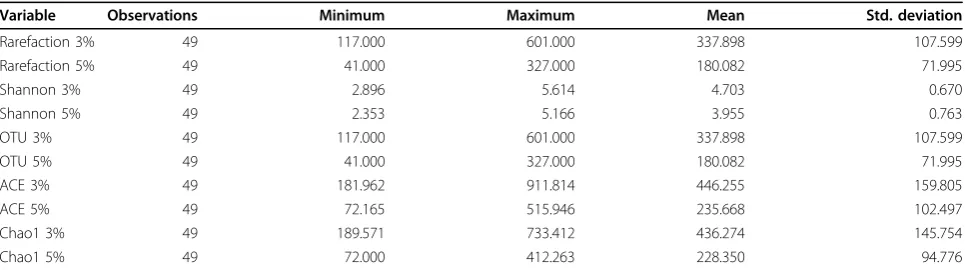
composition in relation to whether the patient had dia-betes or not. This suggests that the types of pathogens and opportunistic pathogens that populate pressure ulcers may be significantly different if the subject also has diabetes. Diversity measurements suggest that up to an average of 337 species and 180 genera of bacteria may be present in a pressure wound. These numbers can be misleading on two levels. First further optimiza-tion of next generaoptimiza-tion data processing will enhance the reliability of such measurements from a technical stand-point. Second, it is well understood that many of the bacteria that may be present in chronic wounds may not be active participants of the community of such bio-burdens but may transient populations or environmental contaminants. These large numbers are also strongly influenced by the very low relative abundance popula-tions, which for the sake of discussion might be consid-ered populations occurring at < 0.1% in wounds, yet their numbers still contribute to such diversity esti-mates. We also observed a relatively high standard deviation in relation to these diversity estimators sug-gesting that there is a broad range of diversity among pressure ulcers. In addition although we took every pre-processing precaution to enable the most accurate diver-sity estimation and modeling, newer methods must certainly be tested and validated to provide more accu-rate descriptions of the microbial diversity in environ-ments such as wounds.
Diversity measurements (Table 3) coordinated with the community structures represented in Figures 1 and Figure 2 illustrate that in most ulcers there are a hand-ful primary pathogens and opportunistic pathogens that make up the largest components of these communities. Thus, chronic wounds are highly polymicrobial and pre-dominant populations (e.g. > 0.1% of total proportion) must be considered clinically as potential opportunistic players in such infections. To ignore even a potential role of such microorganisms is also to limit the potential
efficacy of any type of therapy that is targeting the microbial bioburden/biofilm. If we target only the pri-mary population then ecological principles of selection will dictate that minor populations will succeed into this, now available, niche. If we can find a combination of treatments (e.g. antibiotic, antibiofilm, or antimicro-bial) that can target all of the primary or predominant populations in a wound then we have introduced a potentially larger barrier that the very minor populations must overcome to establish their own niche. Even as new populations potentially integrate into the bioburden a new round of diagnostics and a new targeted therapy can be implemented. This becomes a very easy cycle of diagnose and treat that is the cornerstone of medicine. To further the case and point recent diagnostic develop-ments in relation to chronic wounds and their polymi-crobial bioburdens, have already been shown to provide definitive and significant improvement in both healing rate and outcome [20]. Now taking this comprehensive diagnostics to the next level, targeted and personalized therapies directed by these diagnostics are currently available. Clinical effectiveness studies are currently in final stages and already clearly show how personalized treatments directed by comprehensive molecular diag-nostics may change the way wounds are treated thereby improving the lives of those afflicted and saving millions if not billions in health care dollars.
Conclusion
The present study is a continuation of the research stu-dies conducted by Dowd et al. and Wolcott et al. [29,30,35,37] using bTEFAP to survey the microbial ecology of diabetic foot ulcers, venous leg ulcers, surgi-cal site infections, and decubitus ulcers. The overwhelm-ing outcome of these collective studies is that traditional culture techniques are still largely inadequate in deter-mining the microbial composition of many chronic wounds. Chronic infections such as Venous, Diabetic
Table 3 Summary of diversity estimators Rarefaction, Shannon index, Ace, and Chao1
Variable Observations Minimum Maximum Mean Std. deviation
Rarefaction 3% 49 117.000 601.000 337.898 107.599
Rarefaction 5% 49 41.000 327.000 180.082 71.995
Shannon 3% 49 2.896 5.614 4.703 0.670
Shannon 5% 49 2.353 5.166 3.955 0.763
OTU 3% 49 117.000 601.000 337.898 107.599
OTU 5% 49 41.000 327.000 180.082 71.995
ACE 3% 49 181.962 911.814 446.255 159.805
ACE 5% 49 72.165 515.946 235.668 102.497
Chao1 3% 49 189.571 733.412 436.274 145.754
Chao1 5% 49 72.000 412.263 228.350 94.776
extremity, and Pressure ulcers, have proven to be much more of a diverse and complicated microbial ecology than previously recognized. Most interestingly, obligate anaerobes were found to be a significant proportion, if not a clear majority in chronic wounds, in all surveyed wound types. Requiring specialized collection, transport, and analysis methods for culture based diagnostics of anaerobes will remain difficult especially as part of poly-microbial infections. We demonstrate that chronic wounds such as decubitus ulcers are not merely infected by a single pathogenic species of bacteria, but rather by a blending of symbiotic microbes which form a CWPB. Whether termed bioburden or biofilm, the microbial participation in chronic wounds have been shown to represent a major contributing factor to the resistance of natural healing in chronic wounds, [37,49,50] and the great diversity of these microbial communities adds to their resilience against traditional host and medicinal onslaughts [32]. Previous efforts along with the present study indicate that the highly unique profile of each individual wound would require a therapeutic approach specifically tailored to the patient’s respective wound microflora in addition to the multitude of procedures already implemented in the assuage of chronic wounds and support of the host and comorbidities [51,52].
Methods
General sample collection methods
Patients were identified with decubitus ulcers and then enrolled in the study protocol after being educated and signing the informed consent protocol in compliance with Western Institutional Review Board approved pro-tocols 56-RW-004 WIRB® Protocol #20062347. All necessary details were thoroughly explained to the patients and written consent was obtained in the pre-sence of a third party witness. A copy of the consent form has been provided to the journal editors. Patients were knowledgeable of their right to discontinue partici-pation at any time despite the established written con-sent. Samples from decubitus ulcer wound-beds were collected using sharp debridement as a regimen of stan-dard care with aseptic precautions. Samples were placed into sterile 2 ml eppendorf tubes and frozen at -80°C. For metadata analysis we utilized age groups 20 (20-40), 50 (41-60), 80 (61 and older), presence of vascular or heart problems, diabetes, systemic antibiotic use, num-ber of days with wounds at time of evaluation (arbitra-rily grouped into <100 days, 100-900, and 901+ days), presence or absence of any type of immobility (e.g. para-plegia or quadripara-plegia), race, and gender.
DNA Extraction
After thawing, the debridement samples were centri-fuged at 14,000 rpm for 30 seconds and resuspended in
500 μl RLT buffer (Qiagen, Valencia, CA) (withb -mer-captoethanol). A sterile 5 mm steel bead (Qiagen, Valen-cia, CA) and 500μl sterile 0.1 mm glass beads (Scientific Industries, Inc., NY, USA) were added for complete bac-terial lyses in a Qiagen TissueLyser (Qiagen, Valencia, CA), run at 30 Hz for 5 min. Samples were centrifuged briefly and 100μl of 100% ethanol added to a 100μl ali-quot of the sample supernatant. This mixture was added to a DNA spin column, and DNA recovery protocols were followed as instructed in the QIAamp DNA Mini Kit (Qiagen, Valencia, CA) starting at step 5 of the Tis-sue Protocol. DNA was eluted from the column with 30
μl water and samples were diluted accordingly to a final concentration of 20 ng/μl. DNA samples were quantified using a Nanodrop spectrophotometer (Nyxor Biotech, Paris, France).
Massively parallel bTEFAP and bTEFAP titanium
Bacterial tag-encoded FLX amplicon pyrosequencing (bTEFAP) was performed as described previously [37]. The new bacterial tag-encoded FLX-Titanium amplicon pyrosequencing (bTEFAP) approach is based upon simi-lar principles to the previous generation of bTEFAP but utilizes Titanium reagents and titanium procedures and a one-step PCR, mixture of Hot Start and HotStar high fidelity taq polymerases, and amplicons originating from
the 27F region numbered in relation to E. coli rRNA.
The bTEFAP procedures were performed at the Research and Testing Laboratory (RTL; Lubbock, TX) based upon RTL protocols http://www.researchandtest-ing.com.
Bacterial diversity data analysis
quality reads was performed as described previously [53,56,29,30] using Mothur [57-59].
Bacterial identification
The bacteria were classified at the appropriate taxo-nomic levels based upon the above BLASTn derived sequence identity (percent of total length query sequence which aligns with a given database sequence) and validated using taxonomic distance methods. Sequences with identity scores, to known or well charac-terized 16 S sequences, greater than 97% identity (< 3% divergence) were resolved to the species, between 95% and 97% to the genus, between 90% and 95% to the family and between 80% and 90% to the order level etc. After resolving based upon these parameters, the per-centage of each bacterial ID was individually analyzed for each wound providing relative abundance informa-tion within and among the decubitus ulcers based upon relative numbers of reads within a given sample. Evalua-tions presented at a given taxonomic level, except speci-fic level, represent all sequences resolved to their primary generic identification or their closest relative (where indicated).
Basic Statistics
Statistics were performed using comparative functions and multivariate hierarchical clustering methods of NCSS 2007 (NCSS, Kaysville, Utah). Using methods described previously, a Unifrac-based principle compo-nent analysis (PCA) was utilized to determine significant relationships in the microbial population of ulcers based upon metadata. In short sequences were trimmed to include a uniform length of 350 assembled at 99% simi-larity using NGEN (DNAstar, Madison WI), alignment of unique sequences performed with Muscle [58], dis-tance matrix created using DNAdist algorithm of the Phylip package [59], and PCA analysis performed in R (R Development Core Team). Other basic statistics were performed in excel and with XLStat (Addinsoft, NY)
Author details
1Research and Testing Laboratory, Lubbock, TX 79407, USA.2Southwest
Regional Wound Care Center, Lubbock, TX 79410, USA.3Medical Biofilm
Research Institute, Lubbock, TX 79407, USA.
Authors’contributions
DMS, DS, JDH prepared and edited manuscript, AMZ, YS, JW performed laboratory methods, RDW obtained clinical samples, SK assisted with data analysis, SED conceived of project, developed molecular and analysis tools, analyzed data, reviewed final versions of manuscripts. All authors have read and approved the final manuscript.
Competing interests
SED and RDW are owners of Research and Testing Laboratory which provides commercial and research services related to bTEFAP. SED and RDW are owners of Pathogenius Diagnostics which is a clinical diagnostic company with a specific focus on diagnosis of chronic wound infections.
SED and RDW have patents submitted on molecular pathogen diagnostic methods. All other authors are employees of either Pathogenius Laboratory or Research and Testing Laboratory. SK was a student worker with no formal ties any no competing interests.
Received: 11 April 2010 Accepted: 21 September 2010 Published: 21 September 2010
References
1. Beckrich K, Aronovitch S:Hospital-acquired pressure ulcers: a comparison of costs in medical vs surgical patients.Nurs Econ1999,17:263-271. 2. Zulkowski K, Langemo D, Posthauer M:NPUAP. Coming to Consensus on
Deep Tissue Injury.Advances in Skin and Wound Care2005,18:28-29. 3. Thomson-Rawling J:Pathological Change in Mummies.Proc R Soc Med
1961,54:409-415.
4. Bansal C, Scott R, Stewart D, Cockerell CJ:Decubitus ulcers: A review of the literature.International journal of dermatology2005,44:805. 5. Gefen A:Risk factors for a pressure related deep tissue injury: a
theoretical model.Medical and Biological Engineering and Computing2007,
45:563-573.
6. Gelis A, Dupeyron A, Legros P, Benaim C, Pelissier J, Fattal C:Pressure ulcer risk factors in persons with SCI: part I: acute and rehabilitation stages.
Spinal Cord2009,47:99-107.
7. Sakai K, Sanada H, Matsui N, Nakagami G, Sugama J, Komiyama C,et al:
Continuous monitoring of interface pressure distribution in intensive care patients for pressure ulcer prevention.3rd Congress of the World-Union-of-Wound-Healing-Societies, Montreal, CANADA2008, 809-817. 8. Ebright JR:Microbiology of chronic leg and pressure ulcers: Clinical
significance and implications for treatment.Nursing Clinics of North America2005,40:207-216.
9. Vermillion C:Operating room acquired pressure ulcers.Plastic Surgical Nursing1990,10:181.
10. Reddy M, Gill SS, Kalkar SR, Wu W, Anderson PJ, Rochon PA:Treatment of Pressure Ulcers A Systematic Review.Jama-Journal of the American Medical Association2008,300:2647-2662.
11. Fowler EC, May WC, Wysocki AB:Decubitus Ulcers in the Do-Not-Resuscitate Population: Risk Factors and Comorbidities.Wound Repair and Regeneration2009,17:A56.
12. Guihan M, Garber SL, Bombardier CH, Goldstein B, Holmes SA, Cao L:
Predictors of Pressure Ulcer Recurrence in Veterans With Spinal Cord Injury.Journal of Spinal Cord Medicine2008,31:551-559.
13. Brook I:Anaerobic and aerobic bacteriology of decubitus ulcers in children.The American Surgeon1980,46:624.
14. Zollo MB, Gostisha ML, Berens RJ, Schmidt JE, Weigle CGM:Altered skin integrity in children admitted to a pediatric intensive care unit.Journal of Nursing Care Quality1996,11:62-67.
15. Curley MAQ, Quigley SM, Lin M:Pressure ulcers in pediatric intensive care: Incidence and associated factors.Pediatric Critical Care Medicine
2003,4:284.
16. Vohra RK, McCollum CN:Pressure Sores.BMJ1994,309:853-857. 17. Macklebust J:Pressure ulcers: etiology and prevention.Nursing Clinics of
North America1987,22:359-377.
18. Russell L:Physiology of the skin and prevention of pressure ulcers.British Journal of Sports Medicine1998,7:1084-1100.
19. Haleem S, Heinert G, Parker MJ:Pressure sores and hip fractures.
International Journal of the Care of the Injured2008,39:219-223.
20. Wolcott R, Ehrlich GD:Biofilms and chronic infections.Jama-Journal of the American Medical Association2008,299:2682-2684.
21. Howell-Jones RS, Wilson MJ, Hill KE, Howard AJ, Price PE, Thomas DW:A review of the microbiology, antibiotic usage and resistance in chronic skin wounds.Journal of Antimicrobial Chemotherapy2005,55:143-149. 22. James GA, Swogger E, Wolcott R, Pulcini ED, Secor P, Sestrich J,
Costerton JW, Stewart PS:Biofilms in chronic wounds.Wound Repair and Regeneration2008,16:37-44.
23. Frank DN, Wysocki A, Specht-Glick DD, Rooney A, Feldman RA, St Amand AL, Pace NR, Trent JD:Microbial diversity in chronic open wounds.Wound Repair and Regeneration2009,17:163-172.
24. Edwards R, Harding KG:Bacteria and wound healing.Current Opinion in Infectious Diseases2004,17:91-96.
26. Costerton JW, Greenberg EP:Bacterial biofilms: A common cause of persistant infections.Science1999,284:1318-1322.
27. Ehrlich GD, Hu FZ, Shen K, Stoodley P, Post JC:Bacterial Plurality as a General Mechanism Driving Persistence in Chronic Infections.Clin Orthop Relat Res2005,437:20-24.
28. Hill KE, Davies CE, Wilson MJ, Stephens P, Harding KG, Thomas DW:
Molecular analysis of the microflora in chronic venous leg ulceration.J Med Microbiol2003,52:365-369.
29. Wolcott RD, Gontcharova V, Sun Y, Dowd SE:Evaluation of the bacterial diversity among and within individual venous leg ulcers using bacterial tag-encoded FLX and Titanium amplicon pyrosequencing and metagenomic approaches.BMC Microbiology2009,9:226-237. 30. Wolcott RD, Gontcharova V, Sun Y, Zischkau AM, Dowd SE:Bacterial
diversity in surgical site infections: not just aerobic cocci any more.
Journal of Wound Care2009,18:103-104.
31. Ebright JR:Microbiology of chronic leg and pressure ulcers: Clinical significance and implications for treatment.Nursing Clinics of North America2005,40:207-216.
32. Boles BR, Thoendel M, Singh PK:Self-generated diversity produces
“insurance effects”in biofilm communities.Proceedings of the National Academy of Sciences USA2004,101:16630-16635.
33. Sun Y, Dowd SE, Smith E, Rhoads DD, Wolcott RD:In vitro multi species Lubbock chronic wound biofilm model.Journal of Wound Care2008,
16:805-813.
34. Leake JL, Dowd SE, Wolcott RD, Zischkau AM:Identification of yeast in wounds using new pathogen-detection techniques.Journal of Wound Care2009,18:103-104.
35. Dowd SE, Sun Y, Secor PR, Rhoads DD, Wolcott BM, James GA, Wolcott RD:
Survey of bacterial diversity in chronic wounds using Pyrosequencing, DGGE, and full ribosome shotgun sequencing.BMC Microbiology2008,
8:43.
36. Dowd SE, Wolcott RD:Molecular Diagnostics to Improve Therapy Choice and Enhance Wound Care.Wound Repair and Regeneration2009,17:A32. 37. Dowd SE, Wolcott RD, Sun Y, McKeehan T, Smith E, Rhoads D:
Polymicrobial nature of chronic diabetic foot ulcer biofilm infections determined using bacterial tag encoded FLX amplicon pyrosequencing (bTEFAP).PLoS ONE2008,3:e3326.
38. Dufort S, Richard M-J, de Fraipont F:Pyrosequencing method to detect KRAS mutation in formalin-fixed and paraffin-embedded tumor tissue.
Analytical Biochemistry2009,391:166-168.
39. Kennedy JP, Jones CE, Dowd SE:Biofilm Formation Inhibition by Sanguitec (R) Engineered Dressing Systems in a Chronic Wound Biofilm Model.Wound Repair and Regeneration2009,17:A33.
40. Reddy M, Gill SS, Kalkar SR, Wu W, Anderson PJ, Rochon PA:Treatment of Pressure Ulcers A Systematic Review.Jama-Journal of the American Medical Association2008,300:2647-2662.
41. Davies CE, Hill KE, Newcombe RG, Stephens P, Wilson MJ, Harding KG, Thomas DW:A prospective study of the microbiology of chronic venous leg ulcers to reevaluate the clinical predictive value of tissue biopsies and swabs.Wound Repair and Regeneration2007,15:17-22.
42. Stackebrandt E, Goebel BM:A place for DNA-DNA reassociation and 16 S ribosomal-RNA sequence-analysis in the present species definition in bacteriology.Int J Syst Bacteriol1994,44:846-849.
43. Gao Z, Tseng C, Pei Z, Blaser MJ:Molecular analysis of human forearm superficial skin bacterial biota.Proc Natl Acad Sci USA2007,
104:2927-2932.
44. Fierer N, Hamady M, Lauber CL, Knight R:The influence of sex,
handedness, and washing on the diversity of hand surface bacteria.Proc Natl Acad Sci USA2008,105:17994-17999.
45. Grice EA, Kong HH, Conlan S, Deming CB, Davis J, Young AC, Bouffard GG, Blakesley RW, Murray PR, Green ED, Turner ML, Segre JA:Topographical and temporal diversity of the human skin microbiome.Science2009,
324:1190-1192.
46. Grice EA, Kong HH, Renaud G, Young AC, Bouffard GG, Blakesley RW, Wolfsberg TG, Turner ML, Segre JA:A diversity profile of the human skin microbiota.Genome Res2008,18:1043-1050.
47. Roth RR, James WD:Microbial ecology of the skin.Annu Rev Microbiol
1988,42:441-464.
48. Cogen AL, Nizet V, Gallo RL:Skin microbiota: a source of disease or defense?Br J Dermatol2008,158(3):442-455.
49. Wolcott RD, Rhoads DD, Dowd SE:Biofilms and chronic wound inflammation.Journal of Wound Care2008,17:333-341.
50. Bjarnsholt T, Kirketerp-Moller K, Jensen PO, Madsen KG, Phipps R, Krogfelt K, Hoiby N, Givskov M:Why chronic wounds will not heal: a novel hypothesis.Wound Repair and Regeneration2008,16:2-10.
51. Wolcott RD, Rhoads DD:A study of biofilm-based wound management in subjects with critical limb ischaemia.Journal of Wound Care2008,
17:145-155.
52. Wolcott RD, Cox SB, Dowd SE:Healing and healing rates of chronic wounds in the age of molecular pathogen diagnostics.J Wound Care
2010,19:272-1.
53. Dowd SE, Callaway TR, Wolcott RD, Sun Y, McKeehan T, Hagevoort RG, Edrington TS:Evaluation of the bacterial diversity in the feces of cattle using 16 S rDNA bacterial tag-encoded FLX amplicon pyrosequencing (bTEFAP).BMC Microbiology2008,8:125.
54. Dowd SE, Zaragoza J, Rodriquez JR, Oliver MJ, Payton PR:Windows .NET Network Distributed Basic Local Alignment Search Toolkit (W.ND-BLAST).
BMC Bioinformatics2005,6:93.
55. Cole JR, Wang Q, Cardenas E, Fish J, Chai B, Farris RJ, Kulam-Syed-Mohideen AS, McGarrell DM, Marsh T, Garrity GM, Tiedje JM:The Ribosomal Database Project: improved alignments and new tools for rRNA analysis.Nucleic Asids Res2009,37:D141-D145.
56. Acosta-Martinez V, Dowd SE, Sun Y, Allen V:Tag-encoded pyrosequencing analysis of bacterial diversity in a single soil type as affected by management and land use.Soil Biology and Biochemistry2009,4:2770. 57. Schloss PD, Westcott SL, Ryabin T, Hall JR, Hartmann M, Hollister EB,et al:
Introducing mothur: open-source, platform-independent, community-supported software for describing and comparing microbial communities.Appl Environ Microbiol2009,75:7537-7541.
58. Edgar RC:MUSCLE: multiple sequence alignment with high accuracy and high throughput.Nucleic Acids Res2004,32:1792-1797.
59. Retief JD:Phylogenetic analysis using PHYLIP.Methods Mol Biol2000,
132:243-258.
Pre-publication history
The pre-publication history for this paper can be accessed here: http://www.biomedcentral.com/1755-8794/3/41/prepub
doi:10.1186/1755-8794-3-41
Cite this article as:Smithet al.:Evaluation of the bacterial diversity of Pressure ulcers using bTEFAP pyrosequencing.BMC Medical Genomics 20103:41.
Submit your next manuscript to BioMed Central and take full advantage of:
• Convenient online submission
• Thorough peer review
• No space constraints or color figure charges
• Immediate publication on acceptance
• Inclusion in PubMed, CAS, Scopus and Google Scholar
• Research which is freely available for redistribution