E D I T O R I A L
Open Access
Open, single-blind, double-blind: which peer
review process do you prefer?
Elizabeth C Moylan
1*, Simon Harold
2, Ciaran O
’
Neill
1and Maria K Kowalczuk
1Abstract
BMC Pharmacology and Toxicologywas created from the merger of two journals within theBMCseries published by BioMed Central:BMC PharmacologyandBMC Clinical Pharmacology. BMC Pharmacologyoperated anonymous peer review whereasBMC Clinical Pharmacologyoperated a fully open peer review policy where the identity of the reviewers was known to the editors, authors and readers. The merged journal also adopted a fully open peer review policy. Two years on we discuss the views and experiences of our Editorial Board Members towards open peer review on this biomedical journal.
The story so far
The BMC series of journals was established in 2000 by BioMed Central to provide open access to research pub-lished across a range of disciplines in biology and medi-cine [1]. Over the years, new journals have been launched to fulfil a particular research need (BMC Veterinary Re-search2005,BMC Systems Biology2007 andBMC Psych-ology 2013 are among such examples). All the biology journals within the BMC series operate traditional an-onymous peer review, where the authors do not know who the reviewers are. However, the medical journals were established with open peer review, where the identity of the reviewers is known to all parties – editors, authors and readers [2].
Two years ago the pharmacology titles in the BMC series, BMC Pharmacology(a biology journal) and BMC Clinical Pharmacology(a medical journal),joined forces under the new title BMC Pharmacology and Toxicology [3]. The combined journal retained the full scopes of the original titles while also expanding to explicitly include the field of toxicology. Many of the original Editorial Board Members remained associated with the journal, and new academics and clinicians also joined.
In merging a biology journal operating anonymous peer review with a medical journal operating open peer review, we debated what the peer review process should be on BMC Pharmacology and Toxicology. In the end,
the journal naturally retained the open peer review pol-icy previously adopted byBMC Clinical Pharmacology– in keeping with all the other medical titles in the BMC series. BMC Cancer, another journal in the BMC series with biology and medicine disciplines, also operates open peer review.
Under open peer review, authors know who reviewed their manuscript (reviewer reports are signed) and, if the manuscript is published, the reader will also see the re-viewers’ comments and the authors’ response. These comments are published as part of the ‘pre-publication history’ accompanying the published article, which also contains all versions of the manuscript and (where rele-vant) editors’ comments. By making the peer review process completely transparent we aim to reduce the competing interests that can occur especially for a jour-nal which frequently publishes research sponsored by pharmaceutical companies [4]. See this recent article [5] for an example of a pre-publication history [6].
While many have recently discussed the benefits of open peer review including transparency, accountability and giving credit to reviewers [7-11], there are challenges too. Potential reviewers may be more likely to decline to re-view [12] and some (junior) rere-viewers may be reluctant to sign a critical report [13,14]. There are field-specific differ-ences too. Medical disciplines with the particular need to be transparent about treatments for patients and compet-ing interests appear to be more willcompet-ing to embrace open peer review than the biological sciences. However, within biology there are differences between research fields, too: * Correspondence:[email protected]
1BioMed Central Ltd, 236 Gray’s Inn Road, London WC1X 8HL, UK Full list of author information is available at the end of the article
for example, the bioinformatics and genomics commu-nities seem to accept open peer review more readily than traditional subjects such as immunology and physi-ology [15]. Perhaps this reflects their familiarity with features of open-source software and social-networking technologies [16].
At the time of the merger of BMC Pharmacology and BMC Clinical Pharmacology,we said that we would report on our findings of open peer review with the resulting bio-medical journal. So, two years down the line, how have things fared withBMC Pharmacology and Toxicology?
Our survey says…
The Editorial Board Members onBMC Pharmacology& Toxicology represent a broad demographic from which to solicit views on open peer review given their variety of expertise in biology and clinical disciplines. Therefore, we surveyed the current members of the Editorial Board with eight questions (see Table 1). These covered their particular expertise and whether they preferred one sys-tem of peer review over another as an author, reviewer, or handling editor. Table 2 gives a summary of the main systems of peer review that were included for the pur-pose of this survey. We also asked whether our Editors read the pre-publication histories which accompany published articles. Finally, any other comments on open peer review were welcomed.
Of the 83 Editorial Board Members approached we ceived 37 replies (a response rate of 45%). Half the re-plies were from medics (of whom a third were practicing clinicians) and half were from non-medical fields includ-ing biology, chemistry and pharmaceutical sciences. The anonymised answers are provided in Additional file 1.
It is clear that the Editorial Board Members who did respond were consistent in that, regardless of their po-tential role as ‘author’,‘reviewer’ or ‘editor’, they prefer the same system of peer review. It was not the case that Editorial Board Members preferred one type of peer re-view system in their role as editor, and another in their role as reviewer (for example). Somewhat surprisingly, the majority of Editorial Board Members preferred double-blind peer review over open peer review (see Figure 1). Among the reasons put forward in support of double-blind peer review was the fact that this was perceived to be the most objective system and thus minimized bias. However, Editorial Board Members appreciated that it may not be very effective in practice as it may be possible to infer from the methods used, or reference list, who the authors are.
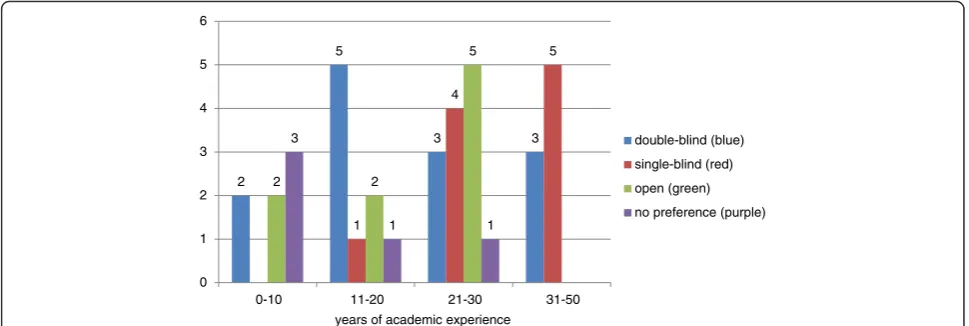
Although some Editorial Board Members recognised the value of open peer review, commenting that it is more egalitarian, increasing accountability and transpar-ency, it was felt that open peer reviews may be more diffi-cult for early career researchers to provide - as has been noted again recently [17]. Our survey suggested that the
more early career researchers preferred double-blind peer review while the more senior Editorial Board Members preferred single-blind or double-blind models (Figure 2).
In their role as authors, approximately half of the Edi-torial Board had published in an open peer review journal
Table 1 Survey questions to theBMC Pharmacology & ToxicologyEditorial Board
Number Questions
1. Is your area of expertise in medicine or biology?
If medicine, are you a clinical academic or full time academic? 2. How many years have you been working as an academic? 3. Choose one that best describes you:
I was on the original board ofBMC Clinical Pharmacology I was on the original board ofBMC Pharmacology I joined the editorial board ofBMC Pharmacology and Toxicologywithin the last 2 years.
4. As anauthor, have you published in an open peer review journal? (meaning that the reviewers’identity was revealed to you as an author)
4a (if yes) Do you think reports were less/equally/more useful to you than those from a closed peer review journal? If you have never published in a closed peer review journal please go to the next question.
4b (if no) Would you consider publishing in an open peer review journal? (if no, why?)
5. As areviewerwhich peer review system do you prefer, and why?
5a Open (authors and reading public know reviewers’identity) 5b single-blind (i.e. reviewers know authors’identity but not vice versa)
5c double-blind (i.e. authors and reviewers do not know each other’s identity)
6. As a handlingeditordo you prefer a different (from your answer to question 5) model of peer review? 6a (If yes), which model do you prefer and why do you have a different preference as an editor compared to as a reviewer? 7. As areaderdo you look at the pre-publication histories on
BMC Pharmacology and Toxicology(or any of the open peer review journals in theBMCseries)?
7a If no, why not?
7b If yes, what is your main reason for looking at the pre-publication history?
8. Do you have any further comments on open peer review?
Table 2 Definitions of open, single-blind and
double-blind peer review as operated by BioMed Central
Open peer review Editors, authors and reviewers know each other’s identity. If the manuscript is published, the reviewer reports, any editors’comments, authors’response and all versions of the manuscript are available via an accompanying
‘pre-publication history’.
Single-blind peer review Reviewers know authors’identity but not vice versa.
(see Figure 3). The majority found that the reports they re-ceived during an open peer review process wereequally useful to those received under anonymous peer review. However, in previous research [18] we have found that the quality of reports received was slightly higher under open peer review than anonymous peer review. Reviewers under an open peer review system provided more feed-back on the methods, more constructive comments on the content and substantiated their feedback better with explicit evidence [18].
Finally, approximately half of the respondents of this survey read the pre-publication history which accompan-ies open peer reviewed articles in theBMCseries, includ-ing BMC Pharmacology and Toxicology (see Figure 4). The pre-publication history contains all versions of the manuscript, named reviewer reports, author responses and (where relevant) editors’comments. Of those Editorial Board Members who reported that they did not look at the pre-publication history, many simply had no time or inclination to do so or wanted to judge an article on its own merits. Some simply did not appreciate this informa-tion was provided. However, of those that did look, many
did so in order to determine the scientific and ethical cre-dentials of the reviewers and for further insights into peer review.
The survey has provided a sample of the views and ex-periences of academics and clinicians with respect to peer review on a biomedical journal, and as a result we appreciate there are improvements which can be made. However, this small survey has some limitations too. The low response rate limits the generalizability of the findings; we were not able to draw any specific conclu-sions reflecting (for example) the attitudes of particular groups based on gender/subject background/seniority towards different systems of peer review.
What next?
So two years into the open peer review experiment on BMC Pharmacology and Toxicology,will we continue to operate an open peer review system? Put simply: yes.
Among the Editorial Board Members who responded to our survey, there appears to be an overall preference for a peer review system that is double-blind (where au-thors and reviewers are not revealed to each other). Other much larger surveys have also come to similar 13
10 9
5
double-blind (blue)
single-blind (red)
open (green)
no preference (purple)
Figure 1Piechart of the responses received from the Editorial Board to the question:‘As a reviewer which peer review system do you prefer?’
2
5
3 3
1
4
5
2 2
5
3
1 1
0 1 2 3 4 5 6
0-10 11-20 21-30 31-50
years of academic experience
double-blind (blue)
single-blind (red)
open (green)
no preference (purple)
Figure 2Diagram of the preferences for a given peer review model classified by years of academic experience.
20 16
1
no (blue)
yes (red)
no answer provided (green)
conclusions [17,19,20]. However, it is unclear if this is a genuine feeling among researchers or rather ‘wishful thinking’that double-blind peer review intuitively seems the fairest approach [21]. Certainly not many biology and medical journals operate double-blind peer review and from a pragmatic view point it is difficult to prevent reviewers from guessing who the authors are.
We will continue with open peer review at BMC
Pharmacology and Toxicology because of the ethical grounds for doing so [2] and because the potential bene-fits outweigh the negatives [22,23]. Open peer review provides a fully transparent pre-publication history, and the reading public can seewhoreviewed the manuscript and what was said. Having access to peer reviews also provides valuable information for training purposes [24,25] and allows further research into the benefits of peer review [26]. And by making peer review completely open and re-viewers (and editors) accountable, we aim to reduce the competing interests that can occur. But perhaps more rele-vant, in this era of‘predatory publishers’[27] and‘sting’ op-erations [28] open peer review ensures that the decision-making process is fully transparent for all to see.
From the feedback we receive more generally from au-thors on our open peer review journals in the BMC series, many value the helpfulness, quality and detail of the reports. But given the responses received from our Editorial Board Members we need to make more of the fact that the pre-publication history is provided for readers and what it contains.
If you have any further feedback on the open peer review policy operated by BMC Pharmacology and Toxicology we’d certainly welcome your comments.
Additional file
Additional file 1:Anonymised survey responses from the Editorial Board.
Competing interests
ECM, CON and MK are employed by BioMed Central. SH is employed by Nature Publishing Group.
Authors’contributions
SH and CON designed the survey. EM and MK collated the data. MK analysed the data. EM wrote the first draft and revised the text. All authors contributed to the writing of the manuscript and approved the final version.
Authors’information
ECM is the Biology Editor at BioMed Central. SH is an Associate Editor at
Nature Communications. CON is Associate Publisher at BioMed Central and Editor ofBiome. MK is the Deputy Biology Editor at BioMed Central.
Acknowledgements
Our thanks to Paul Lambert for contacting the Editorial Board; Caroline Black, Scott Edmunds, Christopher Morrey and Jigisha Patel for their comments on the text; and the Editorial Board Members ofBMC Pharmacology and Toxicologyfor their participation in this survey.
Author details
1BioMed Central Ltd, 236 Gray’s Inn Road, London WC1X 8HL, UK.2Present Address: Nature Communications, The Macmillan Campus, 4 Crinan Street, London N1 9XW, UK.
Received: 4 September 2014 Accepted: 10 September 2014 Published: 30 September 2014
References
1. BioMed Central:BMC series journals.In http://www.biomedcentral.com/ authors/bmcseries.
2. Godlee F:Making reviewers visible: openness, accountability, and credit.
JAMA2002,287(21):2762–2765.
3. Moylan EC, Morrey C, Appleford-Cook JM:Only connect: the merger of BMC PharmacologyandBMC Clinical Pharmacology.BMC Pharmacol Toxicol2012,13:1.
4. DeAngelis CD:Conflict of interest and the public trust.JAMA2000, 284:2237–2238.
5. Heard K, Green JL, Anderson V, Bucher-Bartelson B, Dart RC:A randomized, placebo-controlled trial to determine the course of aminotransferase elevation during prolonged acetaminophen administration.BMC Pharmacol Toxicol2014,15:39.
6. Pre-publication history; http://www.biomedcentral.com/2050-6511/15/39/ prepub.
7. Edmunds EC:Peering into peer-review at GigaScience.Giga Sci2013,2:1. 8. Kriegeskorte N:Open evaluation: a vision for entirely transparent
post-publication peer review and rating for science.Front Comput Neurosci2012,6:79.
9. Lee CJ, Sugimoto CR, Zhang G, Cronin B:Bias in peer review.J Assoc Inf Sci Technol2013,64:2.
10. Amsen E:What is open peer review?In http://blog.f1000research.com/ 2014/05/21/what-is-open-peer-review/.
11. Harriman S:A case for open peer review for clinical trials.In http://blogs. biomedcentral.com/bmcblog/2014/06/04/a-case-for-open-peer-review-for-clinical-trials/.
12. van Rooyen S, Godlee F, Evans S, Black N, Smith R:Effect of open peer review on quality of reviews and on reviewers' recommendations: A randomised trial.BMJ1999,318:23–27.
13. Khan K:Is open peer review the fairest system?No BMJ2010,341:c6425. 14. McGlynn T:Why I prefer anonymous reviews.http://smallpondscience.
com/2014/03/26/why-i-prefer-anonymous-peer-reviews/.
15. Koonin EV, Landweber LF, Lipman DJ:Biology Direct: celebrating 7 years of open, published peer review.Biol Direct2013,8:11.
16. Ghosh SS, Kliein A, Avants B, Millman KJ:Learning from open source software projects to improve scientific review.Front Comput Neurosci
2012,6:18.
17. Mulligan A, Hall L, Raphael E:Peer review in a changing world: An international study measuring the attitudes of researchers.J Assoc Info Sci Technol2012,64:132–161.
18. Kowalczuk MK, Dudbridge F, Nanda S, Harriman SL, Moylan EC:A comparison of the quality of reviewer reports from author-suggested 19
16
2
no (blue)
yes (red)
no answer provided (green)
reviewers and editor-suggested reviewers in journals operating on open or closed peer review models.F1000Posters2013,4:1252. poster. 19. Ho RC, Mak KK, Tao R, Lu Y, Day JR, Pan F:Views on the peer review
system of biomedical journals: an online survey of academics from high-ranking universities.BMC Med Res Methodol2013,13:74. 20. Ware M, Monkman M:Peer review in scholarly journals: Perspective of
the scholarly community—an international study.In Publishing Research Consortium; 2008.
21. Nature Editorial:Working double-blind.Nature2008,451:605–606. 22. Smith R:Opening upBMJpeer review.BMJ1999,318(7175):4–5. 23. van Rooyen S, Delamothe T, Evans SJ:Effect on peer review of telling
reviewers that their signed reviews might be posted on the web: randomised controlled trial.BMJ2010,341:c5729.
24. Russell F:Should there be training for peer reviewers?In http://blogs. biomedcentral.com/bmcblog/2014/05/16/should-there-be-training-for-peer-reviewers/.
25. Patel J:Why training and specialization is needed for peer review: a case study of peer review for randomized controlled trials.BMC Med2014, 12:128.
26. Hopewell S, Collins GS, Boutron I, Yu LM, Cook J, Shanyinde M, Wharton R, Shamseer L, Altman DG:Impact of peer review on reports of randomised trials published in open peer review journals: retrospective before and after study.BMJ2014,349:g4145.
27. Beall J:Predatory publishers are corrupting open access.Nature2012, 489:179.
28. Bohannon J:Who's Afraid of Peer Review?Science2013,342:60–65.
doi:10.1186/2050-6511-15-55
Cite this article as:Moylanet al.:Open, single-blind, double-blind: which
peer review process do you prefer?BMC Pharmacology and Toxicology
201415:55.
Submit your next manuscript to BioMed Central and take full advantage of:
• Convenient online submission
• Thorough peer review
• No space constraints or color figure charges
• Immediate publication on acceptance
• Inclusion in PubMed, CAS, Scopus and Google Scholar
• Research which is freely available for redistribution